2017 2nd International Conference on Computer, Mechatronics and Electronic Engineering (CMEE 2017) ISBN: 978-1-60595-532-2
Simplified Analysis Method for Parallel Composite Isolation System
Wei-chao SUN and Xiu-ling CAO
*Exploration Technology and Engineering College, Hebei GEO University, Shijiazhuang, Hebei, 050031, P.R. China
*Corresponding author
Keywords: Parallel composite isolation, Restoring force model, Equivalent linearization, Simplified analysis.
Abstract. The simplified analysis of the parallel composite isolation system (PCI) was carried out
based on equivalent linearization method. Through the derivation, the restoring force model expressed in the form of basal shear force and displacement was converted to the basal shear force coefficient and displacement model. According to the new code for seismic design of buildings, the application of the simplified analysis method was illustrated by an example. The results showed that the simplified analysis method could be conveniently and effectively used for preliminary design of the PCI system, which laid a foundation for the popularization and application of the PCI system.
Introduction
There are relatively few studies on the PCI system composed of laminated rubber isolation bearing and friction sliding isolation bearing at home and abroad [1]. With the development of computer technology and numerical integration methods, it is becoming more and more common to use the dynamic time history analysis method to carry out seismic response analysis of structures. However, in the preliminary design stage, the characteristics of the structure have not been determined [2]. Accurate time-history analysis method cannot show its convenience and simple design method is more conducive to the designer from the overall quick grasp of the performance of PCI system so as to make a reasonable choice of design options. Therefore, this paper discusses a simplified method for calculating the base shear force coefficient and displacement of the isolation performance of PCI system in the preliminary design stage while not use dynamic time history analysis method. Thus, in the preliminary design stage, designers can grasp the seismic performance of PCI system, pre-estimated how to choose the form of PCI support in a certain seismic intensity to achieve the desired isolation effect, facilitate the design process, reduce design time, and lay the foundation for the popularization and application of PCI system [3, 4].
Equivalent Linearized Restoring Force Model
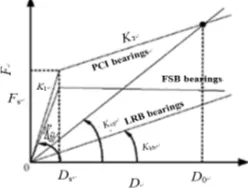
The restoring force model of the isolation bearing is usually expressed by a bilinear model based on the elastic stiffness K1, the plastic stiffness K2 and the yield strength Fs [5], as shown in Fig.1. The
three parameters K1, K2 and Fs determine the nature of the isolation bearing, and in the most general
case, they can be taken as the optimal design variables of the isolation bearings [6]. For the PCI bearing, generally it has the relationship K2 = βK1, where the stiffness coefficient β can be
determined according to the test.
In the design of PCI bearing, the equivalent linearization method can be used to express K1 and
K2 with the equivalent horizontal stiffness Keq as [7]:
1
2
0 lr b f s b
e q s
l r b
K K K
K G
K K
D α
= +
=
= +
s
s D D
D D
≤
> (1)
where, Klrb and Kfsb represent the horizontal shear stiffness of the laminated rubber isolation bearing
and yield displacement of the PCI bearing, respectively; αs= F/G =
λµ
represents the yield shear coefficient, which is an important parameter to reflect the shock absorption effect of the isolation bearing; G,λandµ
denote the total gravity load representative values, the friction pressure ratio and the friction coefficient of the isolation layer in the superstructure of the PCI system, respectively.Figure 1. The equivalent linearized restoring force model.
Derivation of Simplified Analytical Formula
From Fig.1, it can be seen that
1
s s
s s
F G
K
D D
α
= = (2)
Let
1 1
s
s
K K
G D
α = =α (3)
where, K1 is the stiffness of the isolated composite isolation system when the isolation layer is not
slippery, and the stiffness is the sum of the horizontal stiffness of the laminated rubber isolation bearing and the horizontal stiffness of the friction-sliding isolation bearing at this time;K1αis the horizontal stiffness when the post-isolation layer is not slipped.
Similarly, we can get
2 2
K K
G
α = (4)
Let
2
1 = K
K
β (5)
then,
2 1
Kα =
β
Kα (6) where, K2 is stiffness of the PCI system isolation layer after the sliding stiffness, i.e. the stiffness ofthe laminated rubber isolation bearing horizontal;K2αis the simplified horizontal stiffness of the isolated layer after slip.
As can be seen from Fig.1
0 1 2( 0 )
eq s s
K D =K D +K D −D (7)
Both sides are divided by G and D0 at the same time,
1 2
0
0
( )
s
s e q
K D K
D D
K G G
G D
+ −
= (8)
- (4), we can obtain,
2 0
0
( )
s s
eq
K D D K
D
α
α =α + − (9)
where,Keqα is the simplified equivalent horizontal stiffness. By the above derivation, Fig 1 can be
transformed into the base shear coefficient-displacement model shown in Fig.2. (The α-D model)
Figure 2.The α-D model
Obviously, it can be seen from Fig.2
0 =Ke qα D
α (10)
The equivalent period Teq and the equivalent damping ratio
ξ
eqof the PCI system can be expressed as [8]1 2 e q
e q
T
Kα
≈ (11)
0 2 0 2 s( s) e q
e q D D K α D
α ξ
π −
= (12)
Numerical Examples
Take an office building with PCI bearings for an example, the total mass G=24500t, λ=0.2, µ=0.1,
Ds =10mm, K1 = 490000N/mm, β=0.2; the design earthquake group is the second group and the
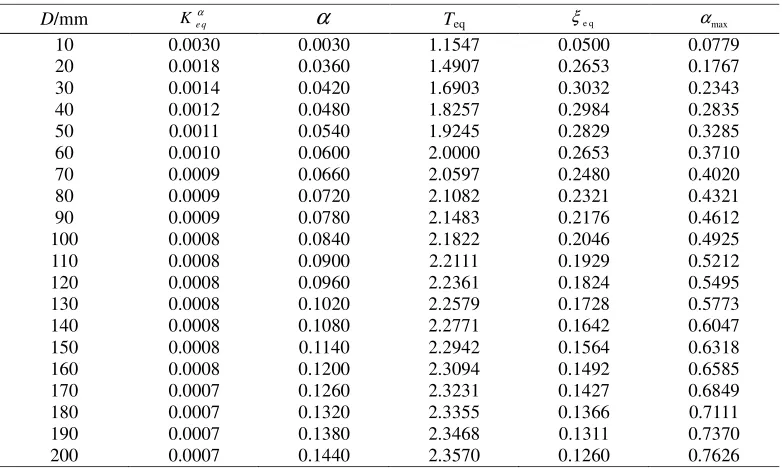
[image:3.612.111.502.516.751.2]ground site is class II with Tg = 0.4s. The results of the simplified analytical method are shown in
Table 1.
Table 1. Calculation results of simplified analysis method.
D/mm Ke q
α α
It can be seen from Table 1,
When the basic parametersλ,
µ
, Tg,β
and Ds of the PCI are given, the maximum horizontalseismic coefficientαmaxcorresponding to different displacements D of isolated layer can be determined, and furthermore, the seismic intensity that the PCI system to be designed can resist can be determined. In the PCI system given in Table 1, when the allowed maximum horizontal shear displacement of the designed composite isolation bearings is up to 110 mm, the corresponding αmax
is 0.5212, which indicates that the PCI system can resist at least 7 degrees of rare earthquakes, with its αmax= 0.50 in Chinese Building Seismic Design Code (GB50011-2010).
When the parameters Tg, seismic intensity,
β
and Ds of isolated layer are given, a series ofdifferent tables likeTable 1 can be made for PCI systems with differentλand
µ
. According to the value ofαmaxdetermined by the site class and the seismic fortification intensity, we can select the initial parallel isolation system, estimate the base shear coefficientα and the displacement D of the isolated layer for a PCI system, investigate the isolation performance, and verify whether the displacement of the isolated layer meets the specification requirements or not. It should be noted that the PCI system determined by this method is not unique, and the arrangement of the PCI bearings are also not unique, but it can give the designer a quick preliminary design.Conclusion
The simplified calculation method based on the equivalent linearization method can be used to make the corresponding relation table of isolation layer displacement, base shear coefficient and horizontal seismic influence coefficient maximum conveniently. The use of these tables as a PCI system design basis can simplify the design process.
Under the given site class, seismic fortification intensity and yield displacement, the PCI system can be determined according to the maximum value of the corresponding horizontal seismic influence coefficient. However, the arrangement of the isolated bearings of PCI system, i.e. the distribution of laminated rubber isolated bearings and friction sliding isolated bearings, needs further research work.
Acknowledgement
This research was financially supported by China and Australia cooperation research projects (16394507D); Hebei Funded Projects of Introducing Overseas Scholars (CL201703).
Reference
[1] Yuan Y, Zhou A, Sun W. Theory and Application of Parallel Compound Isolation [M]. Beijing: China Building Materials Industry Press, 2014.
[2] Yang Y F, Zhou F L. A Practical Method for Analysis of Seismic Response of Base-isolated Structures [J]. World Information on Earthquake Engineering, 2000.
[3] Yang S B. Test Study on Property of the Parallel Composite Isolation System [J]. Coal Engineering, 2003.
[4] Yuan Y, Zhou A, Yang S, et al. Seismic Response and Hysteretic Performance Analysis of Parallel Composite Isolated Structure [J]. Industrial Construction, 2014.
[5] Naeim F, Kelly J M. Design of Seismic Isolated Structures: From Theory to Practice [M]. New York: John Willy&Sons, Inc., 1999.
[7] Li G, Cheng G. Performance-Based Seismic Design of Structures: Theory, Methods and Applications [M]. Beijing: Science Press, 2004.