Available online at www.ijrp.org
International Journal of Research Publications
Integration the Process Oriented Guided Inquiry Learning (POGIL) into Sterile Pharmaceutical Preparation Course
Nik Hasnida Nik Leh1, Alias Mahmud2, Siti Mariam Dasman3
1
Management Training Division, Ministry of Health Malaysia
2
Faculty of Medicine, UKMMC
3
SMAP Bentong Pahang Abstract Teaching Process Oriented Guided Inquiry Learning (POGIL) is student-centered teaching and incorporates active, team-based learning. POGIL will also be involved in guided research using carefully crafted materials that instruct and guide students to build and rebuild their knowledge. This paper describes the basic concepts of POGIL, its features, and how it can improve the quality of student learning in the new millennium. Besides, it is proposed that POGIL be integrated into the teaching of Sterile Pharmaceutical Preparation Course organized by the Training Management Division, the Ministry of Health, Malaysia. Examples of how POGIL will be implemented is shown in this paper. The aims of this paper are to generate interest among educators, with the hope of eventually developing a kind of resource sharing community through POGIL. Hence, POGIL seems to make learning more interesting and can be as the introduction to a new concept for education in Malaysia.
© 2018 Published by IJRP.ORG. Selection and/or peer-review under responsibility of International Journal of Research Publications (IJRP.ORG)
Keywords: POGIL; Inquiry learning; Collaborative learning
1.Introduction
Malaysia Education system has to make the transformation due to the need of clients and also the globalization of the world. It is shown in Malaysia Education Blueprint 2013-2025 which the Ministry of
Available online at www.ijrp.org
International Journal of Research Publications
Volume-35, Issue-2,August 2019
Accepted and Published Manuscript
Integration the Process Oriented Guided Inquiry Learning (POGIL) into Sterile Pharmaceutical
Preparation Course
Nik Hasnida Nik Leh, Alias Mahmud, Siti Mariam Dasman
PII : Nik Hasnida Nik Leh.10035282019692
DOI: 10035282019692
Web: http://ijrp.org/paper-detail/693
To appear in: International Journal of Research Publication (IJRP.ORG)
Received date: 28 Aug 2019
Accepted date: 30 Aug 2019
Published date: 04 Sep 2019
Please cite this article as: Nik Hasnida Nik Leh, Alias Mahmud, Siti Mariam Dasman , Integration the
Process Oriented Guided Inquiry Learning (POGIL) into Sterile Pharmaceutical Preparation Course ,
International Journal of Research Publication (Volume: 35, Issue: 2), http://ijrp.org/paper-detail/693
International Journal of Research Publications
Integration the Process Oriented Guided Inquiry Learning (POGIL)
into Sterile Pharmaceutical Preparation Course
Nik Hasnida Nik Leh
1, Alias Mahmud
2, Siti Mariam Dasman
31Management Training Division, Ministry of Health Malaysia
2Faculty of Medicine, UKMMC
3SMAP Bentong Pahang
Abstract
Teaching Process Oriented Guided Inquiry Learning (POGIL) is student-centered teaching and incorporates active, team-based learning. POGIL will also be involved in guided research using carefully crafted materials that instruct and guide students to build and rebuild their knowledge. This paper describes the basic concepts of POGIL, its features, and how it can improve the quality of student learning in the new millennium. Besides, it is proposed that POGIL be integrated into the teaching of Sterile Pharmaceutical Preparation Course organized by the Training Management Division, the Ministry of Health, Malaysia. Examples of how POGIL will be implemented is shown in this paper. The aims of this paper are to generate interest among educators, with the hope of eventually developing a kind of resource sharing community through POGIL. Hence, POGIL seems to make learning more interesting and can be as the introduction to a new concept for education in Malaysia.
© 2018 Published by IJRP.ORG. Selection and/or peer-review under responsibility of International Journal of Research Publications (IJRP.ORG)
Keywords: POGIL; Inquiry learning; Collaborative learning
1.Introduction
2 First Author name / International Journal of Research Publications (IJRP.ORG)
Education starts to realize the changes of the real world to educate an individual with skills and knowledge not just become an expert in subject matter but in the whole real situation of life. Thus, the government aspire
to create a higher education system that ranks among the world’s leading higher education systems and
enables Malaysia to compete globally (Idris, 2015).
In recent years, technology has exponentially grown, and information is available at our fingertips. Educational goals have evolved from transferring only knowledge to students to developing student’s critical thinking capabilities (Chang, 2011; Fesler-Birch, 2005; Levett-Jones et al., 2010; Soltis et al., 2015). Understand knowledge in any given field is no longer a possibility and now our responsibility as educators is to help our students understand the fundamental concepts of the particular realize and develop the
“intellectual tools and learning strategies” that will help their learning in the future. This will able to help
those students develop the skills they need to compete in the global scientific community. However, studies have shown that traditional learning methods that being implemented now may not be meeting current student needs (Bransford, Brown & Cocking, 2000; Henson, 2015). Therefore, educators need to develop a wide variety of approaches to enhance learning and emphasize attitudes and skills in addition to knowledge.
One of the learning methods that require the active involvement of students in learning is the Process Oriented Guided Inquiry Learning (POGIL). POGIL is a team-based, student-centered learning method that originated in college chemistry classrooms in the early 1990s where students work in teams to solve problems or work through guided, structured exercises (Moore et.al., 2015). According to Moog & Spencer (2008), POGIL activities have three main characteristics: i) self-managed teams that employ the instructor as a facilitator of learning rather than as a source of information; ii) activities that are designed around a learning cycle, consisting of an exploration phase, a concept invention/term introduction phase, and an application phase; and iii) subject-specific content along with process skills such as communication and critical thinking.
POGIL has been developed and validated extensively over the last 15 years in the United States (Minderhout & Loertscher, 2007; Brown, 2010; Soltis et al., 2015). However, it is entirely new in the Malaysia education scenario. Therefore, there is a need for us to shift from the traditional teacher-centric approach, mainly a broadcast model of learning, to a learner-centric approach to enable students to acquire the new 21st-century knowledge and skills and in line with Malaysia Education Blueprint spirit. This is to allow students to move towards competence. Once such a productive and exciting environment is provided, and add to this a supportive teacher, students will be more responsible for their learning. They will search for, find, assimilate and share the knowledge with others.
Some students are frustrated because, in spite of earning high grades, they cannot explain basic concepts behind their achievement because much of their learning is through algorithmic and memorization. Do students fail to learn meaningfully because of the way the instructor teaches or because of the way the
student’s approach learning? Hence, this paper will suggest a suitable approach that can be guided to the
instructor for making the teaching and learning worth and sophisticated. Therefore, the POGIL learning approach is proposed to be implemented in the Pharmacy Assistant program, a program run by the Ministry of Health, Malaysia.
1.1 The Concept of POGIL
Process-Oriented Guided Inquiry Learning is a student-centred instructional strategy. POGIL also is to engage in guided inquiry using carefully designed materials that direct and guide students to build and rebuild their knowledge. POGIL simultaneously teaches both content and critical process skills of subject matter (Roller, 2015; Mullin, 2017).
groups on specially designed activities that follow a learning cycle paradigm. There are three critical characteristics of the materials used in a POGIL learning environment:
• They are designed to be used with self-managed teams that use teachers as facilitators of learning and not as sources of information.
• They guide students through the exploration to build understanding.
• They use disciplinary content to facilitate the development of essential process skills including high-level thinking and ability to learn and apply knowledge in a new context.
The goal of the POGIL approach is not only to develop content mastery through student construction of their own understanding, but also to enhance essential learning skills such as information processing, oral and written communication, critical thinking, problem-solving, and metacognition and assessment. POGIL is based on five currently accepted beliefs about how people learn best, namely by
• connecting new material to prior knowledge and experience;
• following the learning cycle of exploration, concept formation, and application;
• use different representations of ideas and relate them in different ways;
• discuss and interact with others;
• reflecting on their progress and assessing their performance.
1.2 Past Research Related to POGIL
Recent research indicates that students learn best when they are actively engaged, and they construct their understanding. Same goes to research results from Michelle (2011) shows that POGIL pedagogy provides appropriate learning support to foster the development of scientifically accurate mental models of abstract chemistry concepts in secondary students. This study also suggests that POGIL pedagogy could be useful in reducing or eliminating achievement gaps frequently found between racial groups and the gender achievement gap.
In other research by Margaret (2010) shows that POGIL offers tremendous potential to transform chemistry education by promoting deeper student learning, encouraging increased student responsibility for learning, developing process skills needed for employment, and increasing student satisfaction. POGIL has been demonstrated to be effective in improving student retention and performance.
One study of a full POGIL implementation in a pharmaceutical Science Course for the first-year student compares the student performance and engages the higher-level thinking skill through POGIL approach over the traditional method of the same instructor (Soltis et al., 2015). The overall mean examination scores increased significantly when POGIL was implemented. Then, performance on questions requiring higher-level thinking skills was substantially higher whereas performance on questions requiring lower-level
thinking skills was unchanged when the POGIL strategy was used. Hence, the student’s feedback on use of
this strategy was positive.
Another research was done by using experimental design, which is to identify the long-term retention improvement of information before and after treatment by full POGIL implementation (Vanags, Pammer & Brinker, 2013). This research shows that the POGIL approach to teaching can produce improved long-term learning outcomes for students even when the teaching is done by a less experienced teaching assistant. Then, student-centered learning is key to engage students in their studies and allow them to take responsibility for their learning, constructing their knowledge and assurance from facilitators that these mental representations are accurate are fundamental to long-term recall and confidence in that knowledge.
4 First Author name / International Journal of Research Publications (IJRP.ORG)
POGIL had substantially higher results in the pertinent criteria than the semester that used traditional delivery methods, which implies this method is a causal factor in the improvement.
2. Integration POGIL into the Sterile Pharmaceutical Preparation Course Module
The Sterile Pharmaceutical Preparation Course is an advanced course for an assistant pharmacist who works at the Aseptic Dispensing Unit at the Ministry of Health Malaysia. This course is conducted for 6 months (Training Management Division, 2016).
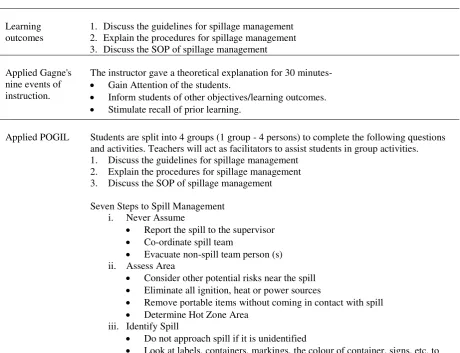
This course is conducted to provide exposure to the effects of cancer medication and the maintenance of cancer drugs, reconstitution techniques, labelling and basic knowledge to the Assistant Pharmacist in the Aseptic Dispensing Unit. This course is carried out using traditional teaching approaches as lectures, tutorials and presentations. In this regard, it is proposed that POGIL will be integrated into the teaching of this course to enhance the effectiveness of the course through student-centered teaching. Examples of a topic selected using Guided Inquiry-Based Learning Process (POGIL) in the teaching is Spillage Management. The writing format is as shown in Table I below:
Table 1: Spillage Management
Learning outcomes
1. Discuss the guidelines for spillage management 2. Explain the procedures for spillage management 3. Discuss the SOP of spillage management
Applied Gagne's nine events of instruction.
The instructor gave a theoretical explanation for 30 minutes- Gain Attention of the students.
Inform students of other objectives/learning outcomes. Stimulate recall of prior learning.
Applied POGIL Students are split into 4 groups (1 group - 4 persons) to complete the following questions and activities. Teachers will act as facilitators to assist students in group activities. 1. Discuss the guidelines for spillage management
2. Explain the procedures for spillage management 3. Discuss the SOP of spillage management
Seven Steps to Spill Management i. Never Assume
Report the spill to the supervisor Co-ordinate spill team
Evacuate non-spill team person (s) ii. Assess Area
Consider other potential risks near the spill Eliminate all ignition, heat or power sources
Remove portable items without coming in contact with spill Determine Hot Zone Area
iii. Identify Spill
Do not approach spill if it is unidentified
help determine what product
Use MSDS (Material Safety Data Sheet) to help identify spill iv. Respond
Wear appropriate PPE
If needed, cover all drains, doorways and areas where spill can escape Contain spill from spreading using granular or absorbent socks v. Clean-up/Disposal
Use spark-proof and chemically compatible equipment to clean up Pick up absorbed material and place in disposal bag or container All pads, granular, socks, non-reusable gloves, clothing, etc. should be
placed in a disposal container. vi. Decontamination
Removed the most spoiled or contaminated clothing first Rinse off heavily contaminated materials in a contained area Never touch clean clothing or materials with contaminated gloves Rinse or dispose of any non-usable equipment.
vii. Reporting
Report spills to a supervisor as per your spill procedures
All ‘Reportable Quantity’ spills must be reported to the proper authority.
Applied Gagne's nine events of instruction.
Present the content Provide learning guidance Elicit performance (practise)
Practical Demo (Activity in Labs)
Applied POGIL
Activity in Aseptic Lab (Student divide by 8 groups/ each group - 2 students) Practical for the following procedures are set:-
1. Guidelines and management of spillage 2. SOP on spillage
3. Spill kit content
4. Disposing of contaminant and used/unused content of spill kit Applied Gagne's
nine events of instruction.
Provide learning guidance Elicit performance (practise)
Assessment
Quizzes – 10 question.
Learning reflection / 1 page. Use Gagne nine event of instruction Provide feedback
Assess Performance
Enhance retention and transfer to the job.
3. Conclusion
6 First Author name / International Journal of Research Publications (IJRP.ORG)
progressed quite rapidly into a community as divergent to isolated individuals or groups because the group membership, and the roles within groups, changed regularly. This evolution induced open discussions, laughter and an amicable culture that became overt from an early stage of the semester. The inter-class group exercises cultivated interpersonal skills. Students who would regularly not interact at all in class felt comfortable from the beginning of the semester to engage in interactive activities with others.
Besides, a closer student-lecturer relationship, which can positively influence student retention in first-year students, is complicated with the traditional didactic lecturing form of delivery. Students who feel separated from class and lecturers do not achieve the same confidence levels as those who interact with fellow student and lecturers, which can negatively affect attrition. Therefore, POGIL work in the first year can positively influence retention rates because the lecturer can form a relationship with individual students early in the semester. Future work could incorporate POGIL to non-attendance modes of subject delivery, explore better methods to gauge POGIL success on pedagogy outcomes and include a trial on the scalability of POGIL to even larger class sizes (Soltis et al., 2015).
Acknowledgements
The authors would like to express grateful thanks to the Secretary of the Division, Training Management Division, Ministry of Health Malaysia, Faculty of Medicine and Faculty of Education, National University of Malaysia.
References
Bransford, J. D., Brown, A. L. & Cocking, R. R. (Eds.) (2000). How people learn: Brain, mind, experience and school. Washington, DC:
National Academy Press.
Brown, P. J. P. (2010). Process-oriented guided-inquiry learning in an introductory anatomy and physiology course with a diverse student
population. Advances in physiology education, 34(3), 150–155. DOI:10.1152/advan.00055.2010.
Brown, S. D. (2010). A process-oriented guided inquiry approach to teaching medicine chemistry. American journal of pharmaceutical
education, 74(7), 121. doi:10.5688/aj7407121
Chang, M.J., Chang, Y. J., Kuo, S. H., Yang, Y. H., Chou, F. H. (2011). Relationships between critical thinking ability and nursing
competence in clinical nurses. J. Clin. Nurs. 20 (21–22), 3224–3232. http://dx.doi.org/10.1111/j.1365-2702.2010.03593.x
Elliot, P. (2013). Implementation of Process Oriented Guided Inquiry Learning (POGIL) in Engineering, Department of Materials Science and Engineering, University of Florida.
Fesler-Birch, D. (2005). Critical thinking and patient outcomes: a review. Nurs. Outlook, 53 (2), 59–65
Hanson, J. M. (2015). The Admiralty Code: A Cognitive Tool for Self-Directed Learning. International Journal of Learning, Teaching
and Educational Research, 14(1), 97-115.
Helen, H. & Clifton, K. (2012). Promoting Student-Centered Learning with POGIL: Raleigh, North Carolina, USA.
Idris Jusoh. (2015). A student-centered education focus lies at the heart of the Malaysia. Malaysian Education Blueprint 2015-2025 (Higher Education). Kementerian Pendidikan Malaysia.
Abeysekera, L. & Dawson, P. (2015). Motivation and cognitive load in the flipped classroom: definition, rationale and a call for research,
Higher Education Research & Development, 34:1, 1-14, DOI: 10.1080/07294360.2014.934336.
Levett-Jones, T., Hoffman, K., Dempsey, J., Jeong, S., Noble, D., Norton, C., Hickey, N. (2010). The ‘five rights’ of clinical reasoning:
an educational model to enhance nursing students' ability to identify and manage clinically ‘at risk’ patients. Nurse Educ. Today, 30
(6),
Margaret .(2010.). Implementing POGIL in Allied Health Chemistry Courses: Insights from Process Education. International Journal of
Process Education, 2 (1), 515–520
Michelle J. (2011). The Effectiveness of Process Oriented Guided Inquiry Learning to Reduce Alternate Conceptions In Secondary Chemistry, Liberty University, Lynchburg, VA.
Minderhout V, Loertscher J. (2007). Lecture-free biochemistry: a process-oriented guided inquiry approach. Biochem. Mol. Biol. Educ.
35(3):172-180.
Myers. (2012). Overcoming The Glassy-Eyed Nod: An Application of Process-Oriented Guided Inquiry Learning Techniques.
Information Technology, Journal Of Learning Design, Vol. 5 No. 1, James Cook University, Australia.
Moore, C., Black, J., Glackin, B. C. Ruppel, M., & Watson, E. (2015). Integrating Information Literacy, the POGIL Method, and iPads
into a Foundational Studies Program. Library Faculty Publications and Presentations. Paper 170.
Mullins, M. H. (2017) Actively Teaching Research Methods with a Process Oriented Guided Inquiry Learning Approach. Journal of Teaching in Social Work, 37(4), 309-321, DOI: 10.1080/08841233.2017.1347122
Patrick J. (2010). Process-oriented guided-inquiry learning in an introductory anatomy and physiology course with a diverse student population, Department of Biology, King College, Bristol, Tennessee.
Roller, M. C. (2015). Fundamental Nursing: Process- Oriented Guided Learning (POGIL) Research. Journal for leadership and
instruction, 14(1), 20-23.
Simonson, S. R. (2013). Implementing Process Oriented Guided Inquiry Learning (POGIL) in Undergraduate Biomechanics: Lessons
Learned by a Novice. Kinesiology Faculty Publications and Presentations, Department of Kinesiology, Boise State University.
Soltis, R., Verlinden, N., Kruger, N., Carroll, A. & Trumbo, T. (2015). Process-oriented guided enquiry learning strategy enhances
students’ higher-level thinking skills in a pharmaceutical sciences course. American journal of pharmaceutical education, 79(1), 11.
DOI:10.5688/ajpe79111
Vanags, T., Pammer, K. & Brinker, J. (2013). Process-oriented guided-inquiry learning improves long-term retention of information.
Advances in physiology education, 37(3), 233–41. DOI:10.1152/advan.00104.2012.
Fachinger, J. (2006). Behavior of HTR Fuel Elements in Aquatic Phases of Repository Host Rock Formations. Nuclear Engineering &