Issues
ISSN: 2146-4138
available at http: www.econjournals.com
International Journal of Economics and Financial Issues, 2015, 5(Special Issue) 248-256.
Economics and Society in the Era of Technological Changes and Globalization
Provision of Global Economic and Energy Security in the Context
of the Development of the Arctic Resource Base by Industrialized
Countries
Mihail Nikolaevich Dudin
1*, Nikolaj Vasil’evich Lyasnikov
2, Vladimir Dmitriyevich Sekerin
3,
Anna Evgen’evna Gorohova
4, Sergey Valeryevich Bank
51Russian Academy of Entrepreneurship, 14 Radio Street, 105005 Moscow, Russian Federation, 2Russian Academy of
Entrepreneurship, 14 Radio Street, 105005 Moscow, Russian Federation, 3Moscow State University of Mechanical Engineering, 38 Bolshaya Semenovskaya Street, 107023 Moscow, Russian Federation, 4Moscow State University of Mechanical Engineering, 38 Bolshaya Semenovskaya Street, 107023 Moscow, Russian Federation, 5Moscow State University of Mechanical Engineering,
38 Bolshaya Semenovskaya Street, 107023 Moscow, Russian Federation. *Email: [email protected]
ABSTRACT
Some issues related to the problems of development of the Arctic and subarctic areas, which according to various expert estimates contain between 15% and 25% of the world reserves of primary energy resources, are presented and disclosed in this article. The purpose of this article is to develop a system of global economic and energy security provision in the context of advanced deposits developments in the Arctic. The goals set were consistently achieved, in particular: The general trends of the energy development of civilization were examined, the legal issues concerning the status of the subarctic and Arctic regions were considered, and the basic global trends of world energy development and the system of global energy security provision were defined. The following fundamental findings were obtained: Firstly, the subarctic and Arctic areas represent world heritage, so the development of deposits therein should be in the interests of the world community on a non-discriminatory basis. Secondly, civilization’s future energy supplies will be based on the harmony of traditional and renewable energy sources, which determines the need to rationalize the consumption of energy resources at present. Thirdly, the environmental issues of prospective development of the Arctic and subarctic areas are sufficiently acute
and debatable that non-aggressive technologies of primary energy resource extraction from the Arctic fields should be used. Significant reserves of hydrocarbon resources in the Arctic shelf allow estimation of a significant global rental potential, despite the territorial remoteness and difficult climatic conditions that greatly increase the cost of development in these areas. Therefore, the planning and management of the Arctic and subarctic areas should be considered as a strategic reserve of sustainable global socio-economic development.
Keywords: Energy Security, Arctic, Industrialized Countries, Economic Security, Resources
JEL Classifications: Q41, Q47, Q56
1. INTRODUCTION
Persistently high global demand for hydrocarbon resources shapes national priorities in the field of commissioning and development expansion and production from new deposits. However, at the same time, there are certain risks to the balanced development of the global energy system, namely: A reduction in the number of new studies and discoveries, the approaching of exhaustion periods of
active reserves exploited, and an increase in the ratio of challenged resources and fields (Bolsunovskaya and Bolsunovskaya 2012; Dudin et al., 2014; Weijermars, 2010). All of the above actualizes globally the trend towards large international projects for the development and exploitation of the Arctic offshore fields.
Rome” with a population of a quarter of a billion people (Smith, 2012). The Arctic “triangle” in the depths of the ocean shelf stores about 100 billion tons of hydrocarbons in oil equivalent. The Northern Sea Route (the shortest route from Europe to America and Asia, including for the transportation of hydrocarbons) also runs in these waters. At present, the Arctic waters formally belong to no country. Distribution of the Arctic areas takes place according to the so-called “sectoral principle,” by which a state can lay claim to the part of the sea area adjacent to its coast. The most serious claimants to the Arctic shelf still remain the five states of the “Arctic Club” - the United States, Canada, Denmark, Norway and Russia - which are developing projects to expand their economic zones in the Arctic with greater or lesser intensity in order to gain a foothold in the region. In addition to these five countries, Iceland, Finland and Sweden also have access to the Arctic.
In this regard, it should be noted that the Arctic territories have significant reserves of various natural resources, including some unique ones. The economic and geopolitical role of the Arctic is now more important than ever, and the importance of the various trends in its development is constantly increasing. The Polar and subpolar regions are in the plane of intersection of the long-term interests of many countries. The Arctic territories
are figuratively called the largest world “energy larder,” and are a key transportation hub of the Earth. The exploration of the virtually inexhaustible biological resources of the Arctic seas, most of which, according to experts, can simultaneously serve as a source of biological raw materials, is gaining a growing industrial importance for many countries of the world (Goldthau and Sovacool, 2012; Florini and Sovacool, 2009; Tatarkin, 2014; Aggarwal et al., 2009, Chai et al., 2015).
At the beginning of this century global warming triggered a sharp rise in interest in the Arctic among the leading states. On the one hand, climate mitigation in the region helped to promote research in this part of the globe, but on the other hand, it led to a certain
intersection of the interests of the subarctic states closely related
to competition for control over the natural riches of Arctic mineral resources.
Focusing on the scientific and economic value of research into and development of the Arctic shelf, in our view it is appropriate to consider that the Arctic region significantly influences both climatic and weather conditions in the northern hemisphere, playing a vital role in maintaining the ecological balance on the planet.
Thus, the development of the Arctic fields is certainly important in order to meet current and future demands for energy resources, but it should be borne in mind that serving the national interests and provision of global energy security should be based on the postulates of rationality, harmony and sustainability, which corresponds to an understanding of the concept of the sustainable development of the global socio-economic system.
2. METHODS
In methodological terms, this article is based on key provisions of the hypothesis of Etzkowitz and Leydesdorff (1998), Etzkowitz
and Leydesdorff (2000), Dudin et al., (2015) on the creation of a new institutional space, which is based on the triple helix model. Since the last quarter of the 20th century, the world has made its
way towards becoming an information society and has shaped a post-industrial economy at a growing rate. Changes in economic cooperation and technological, social and political progress determine the transformation of the interaction between three main actors or institutions of a new socio-economic reality: The state, business and science (Daheim and Uerz, 2008; Makarova and Sokolova, 2014; Weijermars, 2013).
This is not unexpected, because in the post-industrial economy, the development of which should be characterized by stability and innovation, knowledge is one of the main resources. It is quite natural that three of the most important institutions, generating the knowledge necessary for sustainable and innovative development, change the specificity of their interaction. If earlier in the industrial economy the state was a super-system institution defining the principles of economic, social, political or technological cooperation implementation, in the postindustrial economy the state is seen as an equal partner in constructing a new space.
Formation of a new institutional space is important not only in ensuring global innovative break through, but also in the provision of the global energy security that is most important at the final stage of globalization. Energy security should mean the state of protection of citizens, society, state and the economy against threats related to both deficits in meeting their energy demands and breaks in continuity of energy supply with the help of economically accessible energy resources of acceptable quality. Upon that, the state of protection is the state which corresponds to meeting the justified demands (needs) for energy in full in normal conditions, and the guaranteed provision of a minimum necessary volume to meet needs in extreme conditions (Toth and Rogner, 2005; Michael et al., 2006; LaBelle and Goldthau, 2014; Bürer and Wüstenhagen, 2009; Ross and Bustin, 2007).
The development of the Arctic and subarctic areas, including that of the formation of a new institutional space, requires new organizational and economic approaches that in modern conditions have to be reoriented from international energy confrontation to international energy cooperation. This approach is more appropriate to the understanding of the nature and objectives of global socio-economic development, in which the interests of future generations are no less important than the interests of the present generation.
3. RESULTS
18th century, when the Industrial Revolution first occurred, the
biggest breakthrough in the use of energy resources was made. The steam engine and the heat engine were invented in this period; coal was used as the first suitable fossil energy resource. But until almost the end of the 19th century, human civilization was
dependent on natural sources of energy.
Currently, world energy development is undergoing the next stage of its evolutionary change. The world volume of the global energy market has increased more than 35 times in less than two centuries (from the beginning of “the era of oil,” i.e., industrial extraction of subterranean energy resources). During this period, (from the second half of the 19th century to the present time) the
modern world of energy has successively passed three key stages in its development.
The first stage, the duration of which was about 70 years, was characterized by a considerable increase in energy consumption (the rate of energy consumption increased by almost 5 times over this period). A feature of this stage of world energy development is that the basic resources consumed were biomass (wood and waste) and coal. By the end of the first stage of development, the industrial extraction of fossil organic resources (oil and gas) as well as the production of energy from renewable sources (hydropower) had been launched.
The duration of the second stage of global energy development lasted only about 50 years (from the beginning of the 1940s to the beginning of the 1990s). During this stage the consumption of energy resources increased no more than 4.2 times. However, given the achievements of the first stage, the species diversity of the consumed energy resources qualitatively changed. Organic fossil energy resources (oil and gas) began to prevail in terms of consumption, while to a lesser extent the economy and society continued to consume biomass (wood and waste) resources, but at the same time the high coal consumption was maintained. Also, consumption of renewable energy sources (nuclear and hydro-energy) significantly increased in this period. It is worth noting that nuclear and hydro energies are considered as alternative sources of energy. However, it is necessary to specify that these resources can be also regarded as conditionally regenerated for their primary sources can be also exhausted (in particular, reserves of uranium, plutonium, and water are not boundless). However, at the same time the consumption of radioactive metals for generating energy is not too large. Besides, the science constantly carries out works on synthesizing new radioactive energetically valuable elements. It allows to consider nuclear energy as a regenerated alternative source of energy. But at the same time a radical substitution in the kinds of energy consumed did not happen. This is primarily due to the fact that energy production from renewable sources remained relatively expensive, while maintaining significantly high technological risks of emergencies.
The third stage of global energy development, with the shortest duration of about 25 years (from the beginning of the 1990s to the present time) has seen a 1.6 times growth in energy consumption, on average. The consumption of the three main types of energy resources during this third stage of global energy development
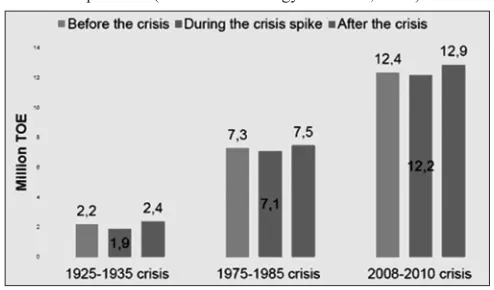
has not changed (oil, gas and coal have remained the main types of energy consumed), but it is worth noting the strengthening of the role of renewable energy resources in meeting the needs of the economy and society. The transition to each new stage of global energy development was accompanied by a crisis of energy resources (Figure 1).
In particular, during the first crisis (around 1925-1935) the consumption of energy resources dropped by almost 14% to the average pre-crisis level. During the second crisis (around 1975-1985) the consumption of these resources decreased by more than 3-5% as compared to the pre-crisis level. The third crisis (round 2007/2008-2010/2011) showed a decrease in the consumption of resources by not more than 1.5-3.5% of the pre-crisis level.
If we compare the crisis of global energy consumption with large economic cycles, we can note the direct superposition of a cycle bottom and the peak of the crisis of energy resources consumption. In particular, considering the period of the Industrial Revolution (from the beginning of the 1770s to the beginning of the 1930s), it should be noted that the first crisis in energy consumption coincided with the end of the third great economic cycle and change of the third technological structure (transition to the fourth technological structure and the creation of a combustion engine). This in turn led to the qualitative restructuring of energy consumption specifics.
The beginning of the information revolution (from the third quarter of the 20th century to the present) coincided with the second crisis
of energy resources consumption, as well as with the transition to the fifth technological structure and the fifth great economic cycle. After all, at the beginning of the information revolution the question of the reduction of world reserves of fossil energy resources and of the preservation of sustainable development of the World System and national socio-economic systems arose. This in turn led to increased interest in renewable energy resources, but given the preservation of long-term inertia in economic processes and the high cost of energy resources production from renewable sources, the replacement of traditional fossil organic energy sources with new renewable resources has not happened until the present time (Shah, 2014; Nonaka and Kilian, 2008; Medlock et al., 2014).
Figure 1: Dynamics of changes in global energy resources consumption in the periods of economic crisis million tonne oil
The recent decline in energy consumption due to the transition to the sixth large economic cycle and the new technological structure coincided with one of the most serious and deep financial and economic crises of the last 100-120 years. The negative trends of the 2008-2011 crisis are unlikely to be successfully overcome in the nearest 5 years term. The depth of the crisis in the economic, social and financial sectors suggests that the level of threat to energy security at the moment is the highest for the World System as a whole and for national socio-economic systems in particular.
Despite the fact that the absolute consumption of energy resources during the crisis declined, the specific energy consumption by the population had steadily increased before the 2000s, while on the contrary, the energy intensity of the global economy during the same period showed a decrease, and slightly increased after the peak of the 2010 crisis (Figure 2).
Interpretation of units in the figure:
• Average specific consumption (tonnes of oil equivalent [TOE]/ pers.) - annual average consumption of energy resources calculated as TOE per person per year.
• Average energy volume of the world economy TOE/ USD - annual average consumption of energy resources calculated as TOE per one US dollar of the Gross world product.
Thus, if we take the global consumption of energy resources over the last 10 years (from 2004 to 2014 inclusive) we will note significant structural and dynamic changes (Figure 3).
It is worth noting that over the last 10 years, the total volume of energy consumption by leading countries increased on average by 31% (in 2014 compared to 2004). More specifically, the growth in consumption of energy resources was supported by the “new industrialized countries,” including China, Russia and India. While the Russian Federation increased its energy consumption by an average of 1.13 times, China increased its consumption of these resources by 2.1 times, and India by 1.7 times (in 2014 compared to 2004). Thus, it is evident that the countries with transformational economies will be the leaders in the consumption of resources for the next two to three decades. At the same time, if we look at the statistics of primary energy resources production, we will note that out of the top 5 countries that account for about 70% of total production, only Saudi Arabia is not included in the list of the most developed countries/energy consumers. The volumes of primary energy resources production by Saudi Arabia are higher than those of India by 15-30% (Figure 4).
The USA also ranks in the top 5 leading producers of primary energy resources, but over the past decade the volume of primary energy resource production in the United States has increased by no more than 14% (in 2014 compared to 2004), while China has increased the volume of resources it produces by 85%, Russia by 20%, Saudi Arabia by 22%, and India by 39% (in 2014 compared to 2004).
If we consider the country structure of primary energy resources production in the top 5, we will note that almost all countries,
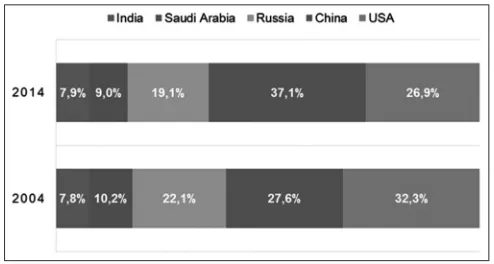
except for China, have shown a reduction in their specific contribution to the world production of primary energy resources (Figure 5).
China has increased its contribution to the world production of primary energy resources by 9.5% (in 2014 compared to 2004). Accordingly, the specific contribution of China to the world production of primary energy resources as of 2014 is about 37%; that is, almost two fifth of the world production of energy resources by the top 5 countries is accounted for by China.
Figure 2: Global energy consumption by population and the energy intensity of the world economy (Institute for Energy Research, 2013;
World Energy Outlook, 2015)
Figure 3: Dynamics of Energy resources consumption by leading countries of the world in 2004 and 2014, million tonnes of oil equivalent (Institute for Energy Research, 2013; World Energy
Outlook, 2015)
Figure 4: Top 5 producing primary energy resources in 2004 and 2014, million tonnes of oil equivalent (Institute for Energy Research, 2013;
This creates a certain pressure on social and economic relations in the world, and significantly transforms the trends of geopolitical development (Fan and Wang, 2014; Wu et al., 2014). Under these circumstances, the Arctic reserves of hydrocarbon raw materials represent a strategic reserve of development and potential for energy provision for countries that have access to subarctic territories, but at the same time, for objective or subjective reasons, production levels or self-sufficiency in energy resources cannot be increased.
4. DISCUSSION
The development of the Arctic and subarctic territories requires from any state member of the Arctic Council not only the large-scale investment of resources for exploration and the establishment of the necessary infrastructure appropriate to climatic and geophysical conditions, but also the creation of new organizational and economic mechanisms allowing coordination and integration of the activities of the set of economic subjects, executive power bodies, contractors and other stakeholders. In addition, it should be understood that at the global level the issues of legal regulation and the international status of the Arctic territories still remain unresolved. Issues regarding regulation of the status and legal condition of the Arctic territories have quite a long history, dating back to the beginning of the 20th century. Thus, in the first quarter of the last century the principle of the separation of sectoral areas became stable in international law. According to this principle the Arctic is divided into five sectors, the bases of which are the northern boundaries of the five major countries of the Arctic Council: Russia, USA, Denmark, Norway, and Canada (exclusive economic zones of these countries have a length of about 370 km from the coastline). But it is important to note that the area of the North Pole and the North Pole itself do not actually belong to any country.
In 1982, the UN Convention on the Law of the Sea (UN Convention on the Law of Sea, 2015) was signed. It has been ratified by almost all countries, including the Russian Federation in particular, but not the USA. The convention, which gave the former the right to expand the boundaries of its continental shelf, was ratified in 1992. In 2014, the UN Commission on the Limits of the Continental Shelf decided that 52,000 km2 of the Okhotsk Sea enclave would increase the continental shelf of the Russian
Federation. Somewhat earlier (in 2009) Norway expanded the territory of its continental shelf to 235000 km2 (Mazur, 2010).
From the standpoint of legal regulation, disputes between Canada and Denmark over Hans Island remained unresolved until 2005, when a certain amount of progress in the dispute was made, a political lull came, and further disputes were settled using the tools of international diplomacy.
The second problematic aspect of the international law of the Arctic and subarctic areas is the definition of the status of the Northwest Passage. In this case, the United States and Canada are the disputing parties. According to the Canadian party, the Northwest Passage, which runs across the Arctic ocean, as well as through the Canadian Arctic Archipelago, is within its internal waters (the legal basis for this assertion is the historical right of ownership). At the same time, according to the United States, the Northwest Passage is an international strait, so access to it can be implemented without notice to the Canadian party.
The third significant dispute is on the delimitation of waters in the Beaufort Sea (dispute between Canada and the United States). In this situation, the dispute is based on the legal casuistry included in the Anglo-Russian Convention of 1825, which states that the maritime boundary of the Beaufort Sea is “the continuation of the land boundary between Yukon and Alaska in a straight line that runs along the 141st meridian to the Arctic Ocean” (Mazur, 2010).
According to the United States, in this case the sea border, which runs along the 141st meridian, goes only to the Arctic Ocean coast,
and further the boundary is determined based on the equidistance principle (this principle implies that each point on the border is always equidistant from the two adjacent coasts). The United States are the interested party in this dispute, since the geographical
position of the meridian line allows the United States to receive the most part of the seabed.
It should be noted that another legal dispute over the Arctic and subarctic territories has ended recently very positively. In 2010, a treaty on maritime space delimitation was signed between Norway and Russia. The geographic location of the boundary line which forms the western border of the Russian continental shelf was determined within the treaty (Zhiznin, 2005).
This treaty can be regarded as an achievement of international diplomacy in the definition of powers and claims of countries having access to the Arctic and its territory. It should be noted
that the removal of mutual claims on delimitation of maritime
space between Norway and Russia has allowed both countries to proceed with the development of oil and gas deposits on the shelf. It is clear that the successful resolution of current disputes over the subarctic and Arctic territories will allow the “Arctic Club” countries to intensify their efforts in the field of Arctic exploration and production of primary hydrocarbon resources, whose reserves are estimated at a relatively high level. It should be noted, however, that the assessment of the reserves of primary hydrocarbon resources in the Arctic is very complex, and the error and variability of forecasts is more than 100-130 billion tons of oil equivalent (Figure 6).
Figure 5: Structure of the production of primary energy resources in the top 5 producing countries (Institute for Energy Research, 2013;
For example, according to reports from consulting companies Wood Mackenzie and Fugro Robertson, who formed their forecasts in 2006, the total projected amount of the reserves of primary hydrocarbon resources is about 30 billion tons of oil equivalents.
In contrast, the 2008 forecast of the reserves of primary hydrocarbon resources in the Arctic made by the United States Geological Survey is almost 2 times higher than the data presented by the above-mentioned companies. In turn, the forecast of relevant United Nations structures increases the presumable volume of hydrocarbon reserves that can be extracted from the depths of the Arctic by more than 3-5 times. This variation in the estimated reserves of primary hydrocarbon resources in the Arctic is related to the instructional methods used, and to the sufficient provision of information and analytical forecasts.
In spite of the fact that a lot of researchers and experts think that regenerated resources of energy will dominate in terms of meeting energy needs of the economy and society in the 21st century, there
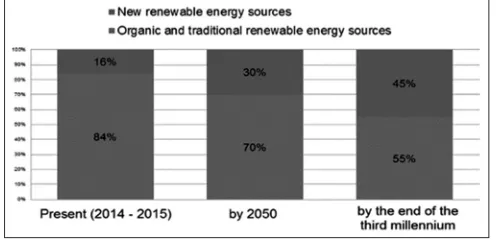
are those who suppose that the world energy balance will have been formed by traditional and regenerated (alternative) resources of energy in relatively equal proportions by the end of the third millennium (Figure 7).
In the short term, by 2050 (according to optimistic forecasts), the ratio of renewable to conventional (including fossil hydrocarbon) energy
sources will be 30-70% of the global production and consumption.
It should also be understood that mainland hydrocarbon reserves
are already significantly depleted, and that the exploration and extraction of resources from alternative sources (shale oil and gas deposits) are associated not only with high costs, in some cases comparable to the cost of development of Arctic territories, but also with high environmental risks. In particular, the method of hydraulic fracturing, which is very often used to stimulate the production of shale gas and shale oil, engenders the greatest debates in this regard. On the one hand, this method allows considerable increase in the production rate of the wells, but on the other hand, it leads to rapid depletion of resources. Some researchers call this method “predatory” both in relation to nature and in relation to society and the economy. This method is additionally characterized by high energy consumption of the production. It does not allow to recognize this method as not only ecologically safe but as also economically efficient (Kotomin, 2014; Plakitkin, 2013; Nyquist and Lund, 2014; Shah and Rivera, 2007; Weijermars, 2013; Baumeister and Peersman 2013).
Thus, the issues of meeting global energy needs and preservation of global energy security coupled with the need to reduce environmental risks demand a thorough exploration and development of projects of primary hydrocarbon resources development in the Arctic (Movagharnejad et al., 2011; Huppmann et al., 2011). It is necessary to note that the exploration and production of hydrocarbon raw materials in the Arctic shelf can be also related to specific ecological risks, in particular, for example, when the producer does not have experience of working under extreme arctic conditions. However, at the present time of the world globalization such risks are important and necessary. They can balance ecological risks that occur under the current methods of shale gas and oil development. In addition, it is necessary to specify that the world economic projects on developing the extraction of hydrocarbon resources of the Arctic shelf are based on extensive researches of transnational oil companies. They aim at creating the most efficient material and technical and technological basis that will allow to provide rational extraction of the existing resources with the minimum ecological risks.
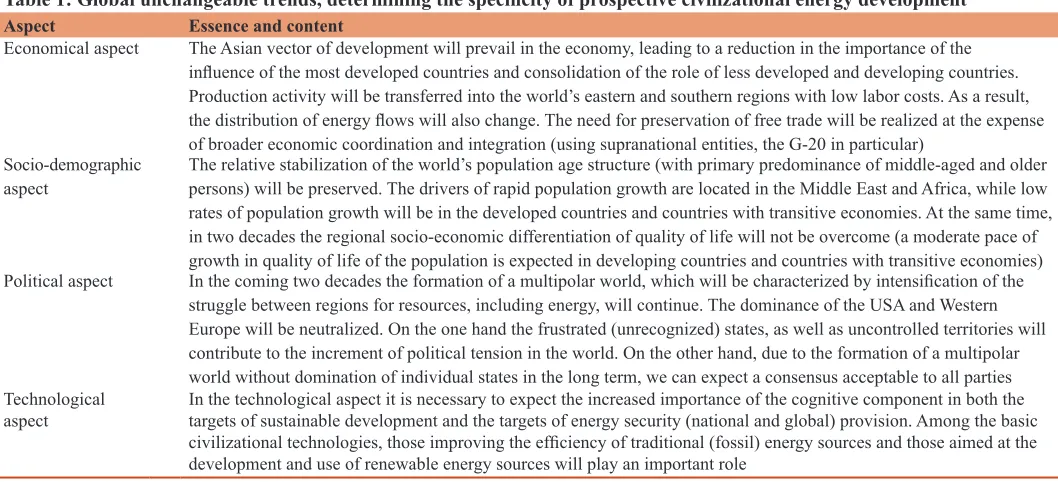
This need is also due to ongoing changes in the economy, society, politics and technology. Possible changes that are largely global and irreversible and directly affect the specificity of prospective civilizational energy development are presented in Table 1.
It should be borne in mind that in the context of globalization, along with rising demand for renewable energy resources, growth of the total consumption of energy resources will also take place, including that stipulated by (Allegret et al., 2015; Gabriel et al., 2005, Dombrowski, 2013, Richard et al., 2003, Wang et al., 2013, Viguier et al., 2006, Parfenova et al., 2014):
• Increase in the population and its concentration in developing countries and countries with transitive economies
• Transition (partial) of production activities to countries with low labour costs, including those with low provision of energy
resources and
• Humanist world-wide demand to increase the level and quality of life of local civilizations, which in turn overrides the considerable increase in energy consumption.
Figure 6: Assessments of the reserves of primary hydrocarbon resources in the Arctic, billion tonnes of oil equivalent (Future of the Arctic-A New Dawn for Exploration, 2015; Circum-Arctic Resource Appraisal: Estimates of Undiscovered Oil and Gas North of the Arctic Circle (CARA), 2015; Energy and Crisis: More or Less Secure? 2015)
Figure 7: Projected global structure of energy consumption in the context of the main types of primary energy resources (Guiding Principles for Reform of Environmental Enforcement Authorities in
It follows that the provision of global energy security, taking into account the development of Arctic fields, must be achieved by a specific system. This system can be as follows (Figure 8). First of all, the achievement of energy security on the world (global) level requires the development of a strategy that, on the one hand, will take into account regional energy needs and, on the other hand, will focus on the sustainable development of civilization in the context of energy by means of territorial and resource diversification of energy production and sufficient provision of sustainable consumer demand for energy resources.
And here arises the need to understand that the territorial
diversification of global energy strategy will be achieved through the development of primary deposits of hydrocarbon resources in the Arctic. At that, the absolute is the fact that the Arctic shelf is part of the international heritage, access to which cannot be discriminatory.
Consequently, the strategic reserves of hydrocarbon resources in the Arctic shelf belong not only to current, but also to future generations. This forms the postulate that global energy security is achieved and provided through rationalization of the consumption of energy resources by the economy and society. Rationalization means that social and economic entities have access to the necessary energy resources, with consumption of these resources being based on an objective (not underestimated and not overestimated) assessment of the demand for resources from these entities.
The development of Arctic territories should be incorporated into the strategy of global energy development, while work on the development of these areas and deposits of hydrocarbon resources located therein should be based on interstate cooperation through: • The creation of the necessary infrastructure (engineering,
social, scientific)
• Optimal and non-discriminatory trade and economic relations • Scientific and technical cooperation and technology transfer;
and
• Ecological and social cooperation.
The development of Arctic territories and deposits of primary energy resources located therein and incorporated into the global strategy of energy development must take into account that there will be production, distribution and consumption of
Table 1: Global unchangeable trends, determining the specificity of prospective civilizational energy development
Aspect Essence and content
Economical aspect The Asian vector of development will prevail in the economy, leading to a reduction in the importance of the influence of the most developed countries and consolidation of the role of less developed and developing countries. Production activity will be transferred into the world’s eastern and southern regions with low labor costs. As a result, the distribution of energy flows will also change. The need for preservation of free trade will be realized at the expense of broader economic coordination and integration (using supranational entities, the G-20 in particular)
Socio-demographic
aspect The relative stabilization of the world’s population age structure (with primary predominance of middle-aged and older persons) will be preserved. The drivers of rapid population growth are located in the Middle East and Africa, while low rates of population growth will be in the developed countries and countries with transitive economies. At the same time, in two decades the regional socio-economic differentiation of quality of life will not be overcome (a moderate pace of growth in quality of life of the population is expected in developing countries and countries with transitive economies) Political aspect In the coming two decades the formation of a multipolar world, which will be characterized by intensification of the
struggle between regions for resources, including energy, will continue. The dominance of the USA and Western Europe will be neutralized. On the one hand the frustrated (unrecognized) states, as well as uncontrolled territories will contribute to the increment of political tension in the world. On the other hand, due to the formation of a multipolar world without domination of individual states in the long term, we can expect a consensus acceptable to all parties Technological
aspect In the technological aspect it is necessary to expect the increased importance of the cognitive component in both the targets of sustainable development and the targets of energy security (national and global) provision. Among the basic civilizational technologies, those improving the efficiency of traditional (fossil) energy sources and those aimed at the development and use of renewable energy sources will play an important role
traditional and alternative energy resources. Each successive stage of civilizational development in terms of energy must be accompanied by appropriate substitution for relatively inefficient (both in economic and technological, and in ecological and social terms) traditional energy sources with new renewable sources. Hence, the development of Arctic deposits should not be aggressive and aimed at rapid recovery of all reserves of primary energy resources, because only a harmonious combination of traditional and renewable energy sources in meeting the needs of the economy and society corresponds to the concept of “sustainable development.” Thus, the system of global energy security provision in the context of prospective deposits development in the Arctic aims at preservation of our modern civilization by eliminating the risks (social, environmental, political and economic) that exist at the moment through adoption of a diversified approach to the provision of the rational energy needs of the economy and society.
5. CONCLUSION
The advanced intensive development and use of the resource base of the Arctic zone has become a key strategic priority contributing to the sustainable development of the global socio-economic system, thus providing the proper level of global energy security. In turn, in the context of the development of the Arctic shelf areas in the transformation of the global economy, the key vectors of provision of a global energy security strategy include trends to improve the conditions for the distribution and marketing of technological innovations while minimizing and neutralizing the geopolitical, military, economic, environmental and cultural risks in the Arctic region. In its turn, the global energy security strategy, taking into account the development of the Arctic region’s potential, should be aimed at achieving the following objectives:
• Search for new sources of energy (conventional and renewable).
• Development of cooperation between states in the field of energy supply by means of international diplomacy.
• Elimination of discrimination in world energy turnover. • Intensification of global mega-projects with the involvement
of all stakeholders.
• Definition of long-term trends of inter-country cooperation in the field of energy security provision.
The following quite important organizational and economic aspects have not been considered in this article:
• Possible approaches to the quality of implementation of projects (global and national) for the development of Arctic territories;
• Methodological concepts of the analysis and evaluation of probable reserves of resources that are available in the Arctic fields and the expediency of extraction thereof in various ways;
• Forecasting of possible environmental and other effects for modern civilization associated with long-term development of the Arctic territories.
These aspects of provision of global security, including its energy
component, in the context of the prospective deposits development in the Arctic will be discussed in subsequent papers and articles.
REFERENCES
Aggarwal, S.K., Saini, L.M., Kumar, A. (2009), Electricity price forecasting in deregulated markets: A review and evaluation. International Journal of Electrical Power and Energy Systems, 31(1), 13-22.
Allegret, J.P., Mignon, V., Sallenave, A. (2015), Oil price shocks and global imbalances: Lessons from a model with trade and financial interdependencies. Economic Modeling, 49, 232-247.
Balitsky, E.V. (2008), Comparative characteristics of the evolutionary technologies of the future. Almanac Science. Innovation Education. Moscow: Znak.
Baumeister, C., Peersman, G. (2013), Time-varying effects of oil supply shocks on the US economy. American Economic Journal: Macroeconomics, 5(4), 1-28.
Bolsunovskaya, L.M., Bolsunovskaya, Y.A. (2012), Impact of risks on the investment potential of the Arctic continental shelf of the Russian Federation. Bulletin of the Tomsk Polytechnic University, 321, 44-47. Bürer, M.J., Wüstenhagen, R. (2009), Which renewable energy policy is a
venture capitalist’s best friend? Empirical evidence from a survey of international clean tech investors. Energy Policy, 37(12), 4997-5006. Chai, J., Yang, Y., Xing, L. (2015), Oil price and economic growth: An
improved asymmetric co-integration approach. International Journal of Global Energy Issues, 38(4-6), 278-285.
Circum-Arctic Resource Appraisal: Estimates of Undiscovered Oil and Gas North of the Arctic Circle (CARA). (2015), U.S. Geological Survey. Available from: http://www.energy.usgs.gov/ RegionalStudies/Arctic.aspx. [Last retrieved on 2015 Sep]. Daheim, С., Uerz, G. (2008), Corporate foresight in Europe: From trend
based logics to open foresight. Technology Analysis and Strategic Management, 20(3), 321-336.
Dombrowski, M. (2013), Global Financial Crisis and its Impact on Emerging Markets. Warsaw: Center for Social and Economic Research (CASE).
Dudin, M.N., Frolova, E.E., Gryzunova, N.V., Shuvalova, E.B. (2015), The triple helix model as a mechanism for partnership between the state, business, and the scientific-educational community in the area of organizing national innovation development. Asian Social Science, 1, 230-238.
Dudin, M.N., Lyasnikov, N.V., Sekerin, D.V., Gorohova, A.E. (2014), Energy conservation and increase of energy efficiency as one of the priorities in the modernization of the Russian economy. Economy and Entrepreneurship, 12, 42-48.
Energy and Crisis: More or Less Secure? (2015), NATO Bulletin. Available from: http://www.nato.int/docu/review/2009/FinancialCrisis/Energy-Security-Cooperation/RU/index.htm. [Last retrieved on 2015 Sep]. Etzkowitz, H., Leydesdorff, L. (1998), The Endless Transition: A “Triple
Helix” of University – Industry – Government Relations. Introduction to a Theme Issue. Netherlands, Minerva: Kluwer Academic Publishers.
Etzkowitz, H., Leydesdorff, L. (2000), The Dynamics of innovation: From national systems and “mode 2” to a Triple Helix of University – Industry – Government Relations. Research Policy, 29(2), 109-123. Fan, Y., Wang, X. (2014), Which sectors should be included in the ETS
in the context of a unified carbon market in China? Energy and Environment, 25(3-4), 613-634.
Florini, A., Sovacool, B.K. (2009), Who governs energy? The challenges facing global energy governance. Energy Policy, 37 (12), 5239-5248. Future of the Arctic-A New Dawn for Exploration. (2015), Wood
[Last retrieved on 2015 Sep].
Gabriel, S.A., Kiet, S., Zhuang, J. (2005), A mixed complementarity-based equilibrium model of natural gas markets. Operations Research, 53(5), 799-818.
Goldthau, A., Sovacool, B.K. (2012), The uniqueness of the energy security, justice, and governance problem. Energy Policy, 41, 232-240.
Guiding Principles for Reform of Environmental Enforcement Authorities in Eastern Europe, Caucasus and Central Asia. CCNM/ENv/EAP 2003, 6, 45.
Huppmann, D., Egging, R., Holz, F., Von Hirschhausen, C., Rüster, S. (2011), The world gas market in 2030 - Development scenarios using the World gas model. International Journal of Global Energy, 35(1), 64-84.
Institute for Energy Research. (2013), Outlook for Energy: Russia and the World Through to 2040. Moscow: Institute for Energy Research, Analytical Centre under the Government of the Russian Federation. Kissinger, H. (2013), If You Can’t Hear the Drums of War You Must
Be Deaf. Global Research Centre for Research on Globalization. Available from: http://www.globalresearch.ca/accurate-satire-henry-kissinger. [Last retrieved on 2015 Sep].
Kotomin, A.B. (2014), Shale revolution and the prospects of development of the Russian gas industry. North and Market: Formation of Economic Procedure, 1(38), 88a-94.
LaBelle, M., Goldthau, A. (2014), Escaping the valley of death? Comparing shale gas technology policy prospects to nuclear and solar in Europe. Journal of World Energy Law and Business, 7(2), 93-111. Makarova, E.A., Sokolova, A. (2014), Foresight evaluation: Lessons from
project management. Foresight, 16(1), 75-91.
Mazur, I.I. (2010), Arctic the bifurcation point in the development of the global world. Age of Globalization, 2(6), 93-104.
Medlock, K.B., Jaffe, A.M., O’Sullivan, M. (2014), The global gas market, LNG exports and the shifting US geopolitical presence. Energy Strategy Reviews, 5, 14-25.
Michael, P., Georghiou, L., Keenan, M. (2006), Evaluation of national foresight activities: Assessing rationale, process and impact. Technology Analysis and Strategic Management, 73(7), 761-777. Movagharnejad, K., Mehdizadeh, B., Banihashemi, M., Kordkheili, M.S.
(2011), Forecasting the differences between various commercial oil prices in the Persian Gulf region by neural network. Energy, 36(7), 3979-3984.
Nonaka, I., Kilian, L. (2008), A comparison of the effects of exogenous oil supply shocks on output and inflation in the G7 countries. Journal of the European Economic Association, 6(1), 78-121.
Nyquist, S., Lund, S. (2014), Shale Revolution: Opportunity to Jump-Start Economic Growth. Available from: http:\\www.forbes.com/sites/ realspin/2014/11/19/the-shale-revolution-is-an-opportunity-to-jump-start-economic-growth-in-u-s. [Last retrieved on 2014 Nov 19]. Parfenova, M.J., Babishin, V.D., Yurkevich, E.V., Sekerin, V.D.,
Dudin, M.N. (2014), Methodology making management decisions based on a modified Ramsey model. Asian Social Science, 10(17), 292-301.
Plakitkin, Y.A. (2013), Shale revolution: Possible scope and impact on the coal market. Coal, 7(1048), 6-8.
Richard, S., Anders, H., Peter, S. (2003), Analysis of US energy scenarios: Meta-scenarios, pathways, and policy implications. Technological Forecasting and Social Change, 70(4), 297-315.
Ross, D.J.K., Bustin, R.M. (2007), Shale gas potential of the Lower Jurassic Gordondale member, northeastern British Columbia, Canada. Bulletin of Canadian Petroleum Geology, 55(1), 51-75. Shah, K.U., Rivera, J.E. (2007), Export processing zones and corporate
environmental performance in emerging economies: The case of the oil, gas, and chemical sectors of Trinidad and Tobago. Policy Sciences, 40(4), 265-285.
Shah, K.U., Philippidis, G., Dulal, H.B., Brodnig, G. (2014), Developing biofuels industry in small economies: Policy experiences and lessons from the Caribbean basin initiative. Mitigation and Adaptation Strategies for Global Change, 19(2), 229-253.
Smith, L.C. (2012), The New North – The World in 2050. UK, London: Profile Books.
Tatarkin, A.I. (2014), Methodological assessment of the status and prospects of institutional innovation in the Arctic subsoil use. The Region’s Economy, 3, 146-158.
Toth, F.L., Rogner, H.H. (2005), Oil and nuclear power: Past, present, and future. Energy Economics, 28(1), 1-25.
UN Convention on the Law of Sea. (2015), The Official Website of the United Nations. Available from: http://www.un.org/depts/los/ convention_agreements/texts/unclos/unclos_r.pdf. [Last retrieved on 2015 Sep].
Viguier, L., Vielle, M., Haurie, A., Bernard, A. (2006), A two-level computable equilibrium model to assess the strategic allocation of emission allowances within the European Union. Computers and Operations Research, 33(2), 369-385.
Wang, K., Yu, S., Zhang, W. (2013), China’s regional energy and environmental efficiency: A DEA window analysis based dynamic evaluation. Mathematical and Computer Modelling, 58(5-6), 1117-1127.
Weijermars, R. (2010), Value chain analysis of the natural gas industry. Lessons from the US regulatory success and opportunities for Europe. Journal of Natural Gas Science and Engineering, 2(2-3), 86-104. Weijermars, R. (2013), Economic appraisal of shale gas plays in
Continental Europe. Applied Energy, 106, 100-115.
World Energy Outlook. (2015), International Energy Agency. Available from: http://www.worldenergyoutlook.org. [Last retrieved on 2015 Sep].
Wu, Y., Fan, T., Zhang, J., Jiang, S., Li, Y., Zhang, J., Xie, C. (2014), Characterization of the upper ordovician and lower silurian marine shale in northwestern guizhou province of the upper yangtze block, South China: Implication for shale gas potential. Energy and Fuels, 28(6), 3679-3687.