A Task Based Two-Dimensional View of
Mathematical Competency Used to Analyse
a Modelling Task
Ragnhild J. Rensaa ([email protected])
Department of Technology, Narvik University College, Narvik N-8505, Norway
Keywords: task analysis model, mathematical competencies, knowledge and cognitive processes
International Journal of Innovation in Science and Mathematics Education, 19(2), 37-50, 2011.
Abstract
An analysis model is developed with a twofold aim: To analyse the formulations of a composed modelling task with respect to involved competencies and thereby obtain input to improve it, and to analyse and compare solutions to the task in order to extract information about which competencies that the task solver has. The model is presented as a two-dimensional task specific table, in which both a cognitive process dimension and a knowledge dimension are represented. It is used to analyse two different solutions to a given modelling task and through the obtained analysis tables, it is argued how both research aims may be met.
Introduction
The most traditional way of assessing university and college students in mathematics is by written end-of-course examination. Other assessment methods are making their entry, but summative judgement is still in substantial use. Thus, assessment methods are predominantly provided in written form, given by student solutions to test problems. Then it becomes important to ask what is actually measured by a written test solution. Such a question is too wide and too nonspecific, as there are various types of knowledge and various types of problems.
This article will restrict the focus by considering a particular type of mathematical problem; a modelling task. An analysis model based on the definition of competencies in mathematics (Niss, 2003) will be applied. Task formulation and selected responses will be analysed. Together, they serve to clarify what the modelling task actually measures in terms of competence and it provides an opportunity to compare solutions. Thus our research aim is two folded; to analyse the formulations of a composed modelling task with respect to involved competencies and thereby obtain input to improve it, and to analyse and compare selected solutions to the task in order to extract information about task solver competencies.
The tool of analysis
At the outset, Niss’ competence classifications are used to develop an analysis tool (2003). They are claimed to cover all aspects of a mathematics subject, and include competencies in thinking mathematically, posing and solving mathematical problems, modelling, reasoning, representing mathematical identities, handling symbols and formalisms, communication and use of aids and tools. The competency of particular interest in the present paper is modelling competency. Mathematical modelling is about analysing and decoding of existing models, together with the performance of modelling. In the present task, active modelling is asked for. The competencies are somewhat overlapping, which may create difficulties in an analysis process required by a task. To make the analysis more systematic, it is therefore useful to distinguish between modelling competence and cognitive processes that describe how knowledge is applied. Thus, a two-dimensional analysis table is developed. It is inspired by the work of Eichelmann, Narciss, Faulhaber and Melis (2008), who analysed computer-based fraction tasks by using a two-dimensional view of mathematical competencies.
In the two-dimensional analysis table, the knowledge dimension is divided into conceptual and procedural knowledge. The conceptual part is about ‘knowing what’ and is guided by what the task requires of argumentation. The procedural part is about ‘knowing how’ and includes rules and algorithms that are needed to solve the task. The knowledge dimension categories are specific to each mathematical task. The cognitive dimension is not task specific, and includes seven major categories as given by Eichelmann et al. (2008). Within each category, subcategories are selected with reference to which students the task is designated for. In the present case, the task is given to engineering students. Engineering students are not primarily interested in mathematics (Kümmerer, 2001), which sometimes is reflected in the teaching and thereby in the assigned task formulations. As Schoenfeld (1992) points out,
if we are to understand how people develop their mathematical perspectives, we must look at the issues in terms of the mathematical communities in which students live and the practices that underlie those communities (p.363).
The mathematical community includes a number of factors like social relations, teacher and student preferences and time constraints. In the present paper, however, these factors will not be discussed separately. The focus is on written task formulations and solutions, and factors of the mathematical community are reflected by the selection of cognitive subcategories within the analysis. In category remember, subcategories are recognize and recall, represent
with subcategory translate, compare which involves associate and classify, compute with subcategories execute and apply, model with reference to analyse and evaluate, communicate
as describe, explain and argue, and finally meta-cognition with subcategories controlling and regulating.
Method
A modelling task has been selected from a set of examination tasks given to engineering students at a Norwegian university college. Tasks with a real world connection are important in engineering educations and they often include a broad spectrum of cognitive processes. Names referred in the task have been changed in ensure anonymity. With this exception, the task is translated and given as follows:
cool down. After having cooled for t minutes, the temperature in the kettle isϕ degrees. Newton’s law of cooling says that the speed at which the water will be cooled is proportional to the difference between the temperature in the water and the room, thus the speed of cooling is proportional to (ϕ−15).
a) Set up a differential equation which describes the cooling and shows that the temperature in the kettle can be written asϕ(t)=85⋅e−kt +15.
b) After 10 min. the temperature is500C. Rod wants the temperature to be 450C when he mixes the water into the fodder for the dogs. How long must he wait? (It is not necessary to do exact calculations in this part of the task!)
Based on the formulations in the task and a suggested solution, categories in the knowledge dimension of the analysis table are developed. Conceptual knowledge entails interpretations and connections between vital concepts that are used in the solution. In the present task these are derived as interpretations of the text, differential equations, integrals, substitution of initial conditions and interpretation of obtained solutions. The second part refers to knowing how to solve the task; procedural knowledge. These are given as algorithms for calculations with the exponential and logarithmic functions, integration, use of absolute values and how to deal with equations. The cognitive dimension includes the same components as Eichelmann’s (2008) categories. In sum, a table with knowledge categories as rows and cognitive categories as columns is obtained, illustrated in Tables 1 and 2.
To illustrate how the table is used, two selected solutions will be analysed. The final examination, of which the above presented task was a part, was answered by altogether 81 students. The first selected solution is one that obtained full score. This solution is called Solution A, and the student who produced it is called Student A. It is analysed to provide a reference table, showing which arguments a clever student apprehends as necessary to solve the task. It can provide information about missing elements. To illustrate how other solutions may be analysed with reference to the derived table from Solution A, another answer is also considered. This solution is called Solution B. It is given by Student B, who obviously had some problems solving the modelling task.
The solutions will be briefly described since the excerpts are in the native language, and subsequently the corresponding analysis tables will be given. The system that is used when interpreting and substituting into the tables is to assign one cognitive process at a time. For instance, with respect to the process of ‘remember’, the entire list of knowledge categories is considered. The reason for coding the cells by columns is that the knowledge categories follow the same sequence as the progress in the task solution. Thus it is natural to go through the solution with focus on one cognitive process at a time.
Four categories of analysis values are used:
• ‘Yes’ means that the solution contains arguments that can be interpreted as assigning the particular cell’s competency. A short argument follows as to why.
• ‘No; not done’ means that the competency is not given by the solution, even if this should be expected in a complete solution.
• ‘No; not asked for’ means that this competency ought to have been specifically asked for in order to expect arguments about it in a solution.
Solutions with Analysis Tables
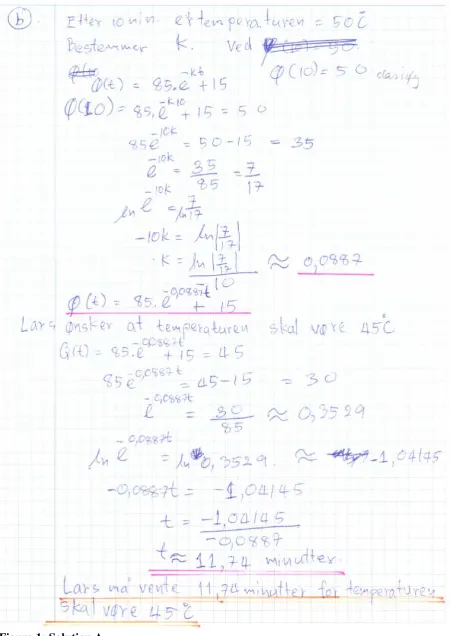
Figure 1: Solution A
the text into the formula. By this he obtains the relation to be used in calculations. Next, straight forward calculations follow; separation of variables, integration, insertion of the absolute value and dealing with equations. None of these calculations are followed by comments. As the general solution is obtained, the student states that this is the general one. He derives the integration constant C by substituting t=0 into the solution, knowing that
100 =
ϕ by then. This gives the correct value C=85 and the desired expression for the functionϕ(t).
In the second part of the solution, Student A explains in words and an equation how the initial
condition “After 10 minutes the temperature is 500C” can help when finding the
proportionality factor k. He carries out the calculations correctly, but prefers k =0,0887 to
17 7 ln 10 1 − =
k . Finally, he interprets the information about the temperature being 450C by
explaining that this means ϕ(t)=85e−0,0887t +15=45, and solves the equation. He gives a textual answer, telling correctly that Rod has to wait 11.74 minutes before the temperature is
C 0
45 . An excerpt of the solution is given in Figure 1, and the analysis table for Solution A is given in Table 1.
Table 1: Analysis of Solution A
Cognitive process dimension
Knowledge
dimension Rem
em be r (r ec ogn ise, rec al l) Rep res en t (t ra ns la te ) Co m pa re (as soc iat e, c las si fy ) Co m pu te (e xe cu te , a pp ly ) M od el (an al ys e, e val uat e) Co m mu nic at e (d es cr ib e, e xp la in , ar gu e) M et a-co gn it io n (c on tr ollin g, regu la ti ng) Conceptual Knowledge Interpret. of text Yes, shown change Yes, given relation between sizes Yes;
Newton’s Yes; done Analyse: Yes Evaluate: Not done Yes; explain text No; Not asked for Differential equation types Yes, shown separation Yes, show how to separate No; not done Yes;
separates No; not done No; Not done No; Not asked for
Integrals Yes, know integral types Yes; represent, implement No; not done Yes; integrates No; Not done No; Not done No; Not asked for Substitution, initial conditions Yes, stated how to interpret Yes, explains & implement Yes; explained Yes; done twice Yes; Given comment Yes; short arguments No; Not asked for Interpret. of solution Yes, intro & answer to b
Yes, stated by words Not Asked for Yes; extracted from calculation
No; not done, Yes; short statements No; Not asked for Procedural knowledge Fraction division rules Yes, divides Yes, used Not
relevant Yes, divided
Not relevant
Not
relevant No; Not asked for
Integration Yes, shown mathematically Yes, shown mathematically Not relevant Yes, integrated Not relevant Not relevant No; Not asked for
Exp & log
rules Yes, uses them Yes, introduced Not relevant Yes, used correctly Not relevant
Not
relevant No; Not asked for
Absolute
value rules Yes, uses them
Yes, used when needed
Not
relevant Yes, used when needed Not relevant
Not
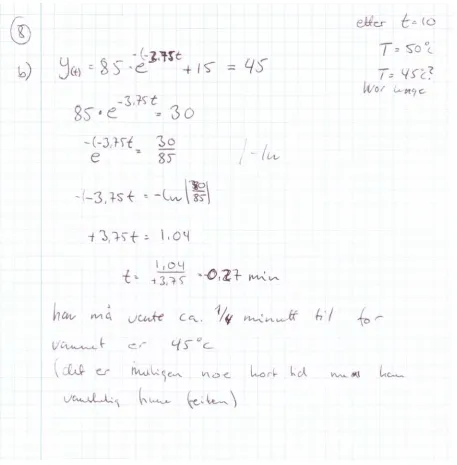
Figure 2: Solution B
Student B has not included much information from the task’s text initially, just stated in the upper right corner that t =time(min)and ∆T =100−15=85, see Figure 2. He puts up the differential equation directly, but without the minus sign in front on the right hand side. The minus is usually included to emphasize the decrease in temperature. This is not a problem, but implies that the student actually has a proportionality factor k* that corresponds to the
k
− in the solution given in the task. Correct calculations follow, but when the student obtainsϕ(t)=ekt+c +15 he proceeds to write ϕ(t)=Ce−kt +15in order to obtain a result similar to the one given. There are no comments as to the sudden change of sign in the exponent. The solution does not include any calculations showing how the value of the
constant C is obtained. Then he combines information by writing
15 50 15 85
) 10
( = e−k10+C + = −
ϕ , subtracting the temperature in the cottage from the
In the second part of the solution, the student sets out to calculate the value of t after having made some short statements about the given text in the upper right corner; “after t=10
C
T =500 T =450C? How long?”. At last he makes a proper substitution to obtain the time interval that Rod needs to wait before the temperature is450C. However, since the value of k
is wrong, he gets t = 0.27 min. The solution is followed by the following comment: “He must wait for about ¼ of a minute before the water is 450C (this is possibly somewhat short but finding the possible error is evasive)”. An excerpt of the solution is given in Figure 2, and the analysis of Solution B is given in Table 2.
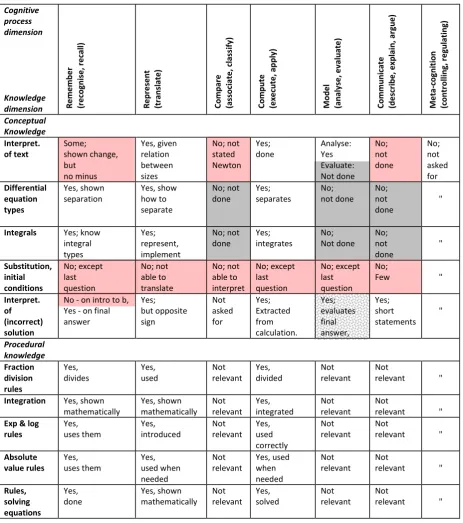
Table 2: Analysis of Solution B
Cognitive process dimension
Knowledge dimension Re
m em be r (r ecog ni se , r eca ll) Re pr es en t (tr an sl ate ) Co mp ar e (a ss oc ia te , c la ss ify ) Co m pu te (e xe cu te , a pp ly ) M ode l (a na ly se , e va lu ate ) Co mmu ni ca te (d es cr ib e, e xp la in , a rg ue ) M eta -c og nit io n (c on tr oll in g, r eg ula tin g) Conceptual Knowledge Interpret. of text Some; shown change, but no minus Yes, given relation between sizes No; not stated Newton Yes; done Analyse: Yes Evaluate: Not done No; not done No; not asked for Differential equation types Yes, shown separation Yes, show how to separate No; not done Yes; separates No; not done No; not done "
Integrals Yes; know integral types Yes; represent, implement No; not done Yes; integrates No; Not done No; not done " Substitution, initial conditions No; except last question No; not able to translate No; not able to interpret No; except last question No; except last question No;
Few "
Interpret. of (incorrect) solution
No - on intro to b, Yes - on final answer Yes; but opposite sign Not asked for Yes; Extracted from calculation. Yes; evaluates final answer, Yes; short statements " Procedural knowledge Fraction division rules Yes, divides Yes, used Not relevant Yes, divided Not relevant Not
relevant "
Integration Yes, shown mathematically Yes, shown mathematically Not relevant Yes, integrated Not relevant Not
relevant "
Exp & log rules Yes, uses them Yes, introduced Not relevant Yes, used correctly Not relevant Not
relevant "
Absolute value rules Yes, uses them Yes, used when needed Not relevant Yes, used when needed Not relevant Not
relevant "
Rules, solving equations Yes, done Yes, shown mathematically Not relevant Yes, solved Not relevant Not
Discussion
The analysis table and task formulations
The cognitive categories in the given two-dimensional analysis table are introduced by Eichelmann et al. (2008), while the knowledge categories are task specific and need to be tailor-made for each case. The latter are further differentiated into two types of conceptual knowledge; ‘the knowing what’ and procedural knowledge; ‘the knowing how’, making it possible to distinguish between concepts and algorithms. However realizing when it is needed to have knowledge about a concept beyond being able to deal with it computationally may prove to be challenging. In the present task, this is for instance seen in the concepts of integrals and integration. It can be difficult to interpret whether a student deals with an integral in a purely calculative manner or if he bases arguments on knowledge about the concept itself. Such related cognitive processes have to be separated and one may need to make comments about what is expected in each of them. The process of categorization may then enforce deeper reflection about what the task asks about and the classifications become easier when one gets used to thinking along these lines.
Once the table categories are developed, they may provide valuable information as to what a constructed task asks about, as well as what a solution requires in terms of displaying pertinent knowledge To gain information about which competencies the formulations emphasize, a solution should be interpreted and placed into the table. This may be a developed suggested solution to the task. In the present paper, however, this is a solution produced by a student that has obtained full score on the task. Such an analysis table is given in Table 1.In this table, the cells containing a ‘yes’ are not the ones contributing to improvements. They tell that the task includes instances of the demonstration of these competencies. Similarly, cells marked with ‘not relevant’ indicate that in the particular mathematical problem such arguments or computations are not expected to be given. Thus, the table shows the ‘yes’ and the ‘not relevant’ cells without further discussion.
The category ‘not asked for’ represents an important input for improvements. In the present problem, these marks are found in associating and classifying the interpretation of the solution and in all the meta-cognition categories. Both of these dimensions represent competencies where the students need to reflect upon their solution. Concerning the interpretation, the solution needs to be related to the information given in the text and compared to other possible solutions. This is an important part of a modelling competency. It is also a part of the meta-cognition process, where relating strategies to each other is emphasized. Monitoring and controlling is important for an engineer, since in her work she often will run projects or processes. It requires the ability to reflect upon chosen solution strategies. In the present task, an additional question like ‘Explain why your solution seems reasonable’ would address at least parts of these missing cognitive processes, without overly extending the task’s workload. Thus, the cells marked ‘not asked for’ may give valuable information for improving task formulation.
The analysis table and Solution A
With reference to the conceptual knowledge in Table 1, Student A shows competencies remembering, representing and computing the modelling task. This is essential for solving the task. However, competencies that demonstrate independent argumentation such as comparing knowledge to other ideas, analysing obtained solutions or communicating to the reader what is done, have shortcomings. These competencies are related. For instance, in order to classify the obtained differential equation as separable an analysis of the equation is required. This strategy should be explained to the reader. Hence, the cognitive processes compare, model and communicate about the classification of differential equations are connected. The same applies for dealing with integrals.
As for the procedural knowledge presented in Solution A, there are similar shortcomings in the cognitive processes. However, classification, analysis and description of each procedure used in the solution are not interpreted as relevant in a modelling task. This would entail a rather high level of detail in the solution.
If the analysis in Table 1 is to be used to draw some conclusions about competencies that Student A presents, some important cognitive processes are underrepresented. The solution was graded to A, but still some processes are missing and arguments following the solution are limited. For instance, when dealing with the differential equation, a comment like ‘this is a separable differential equation where variables can be separated in order to solve it’ would have provided concise but revealing information to the reader. It would classify the equation and explain the process to the reader. This is probably what Student A has been thinking, but it is not stated. It represents a lack of competency in elaborating around a solution rather than merely providing the exact computation. However, students’ solution methods are often related to how the course emphasis has been set. If the teacher has not stressed that the steps in a solution should be explained, then the students will omit this. There are also other sources of influence on the students’ solution strategies; the textbook, their own beliefs and fellow students’ comprehensions. In sum they lay the foundation for how a solution is to be given. However, an analysis result like the one in Table 1 may provide valuable input for the teacher to improve both the teaching and the formulation of tasks. It may increase consciousness about which cognitive processes that tasks represent. The major lack of meta-cognitive processes involved in the present task should be a thought-provoker.
Solution B compared to Solution A
analysing the information for further use. But few interpretations and no additional arguments such as classifying the relation or explaining what is done are included. This appears in the first row of Table 2. When Student B is to derive values of the constants in the obtained solution, more problems occur. He cannot extract relevant information from the text in order to make the correct substitutions. In the last part of the solution he finally manages to interpret the information given by the task, but then the relation that he substitutes into is incorrect due to earlier errors. Thus, most of the cognitive processes with reference to substitutions have shortcomings.
There is an interesting consequence of the incorrect solution that Student B has obtained at the end. Since the relation he substitutes into is wrong, he finds that the time spent to cool the
water to 450C is t =0,27minutes. This number is so small that the student in a way is ‘forced’ to realize that it must be incorrect. Thus, the final answer is followed by a comment about this probably being too short. The comment shows that the student has reflected on his answer and evaluated it in terms of what is realistic. He has come to see that the answer is not reasonable. By this, Solution B includes a cognitive process about evaluating the solution that Solution A does not have. It suggests that the students are willing to reflect and relate to reality – when encouraged to do so.
Conclusion
The categories in the cognitive dimension of the presented analysis table are developed with reference to mathematical challenges in a modelling process. The knowledge dimension of the table is task specific. Thus, the table is designed particularly to evaluate the given mathematical task. The design may, however, be adapted to other scientific subjects. Such adjustments need to take into account the specifics of each subject area.
As elaborated in the discussion, the process of determine categories in the table along with the interpretation of solutions requires knowledge of mathematical competencies. Thus, completing a table can be challenging. It may be hard to decide which knowledge dimensions that a given task requires. It may be difficult to conclude from a tasks’ formulation whether an assigned competency is not relevant or not asked for. Some cognitive processes may be difficult to categorize in a written solution since cognition is a matter of mind processes. However, the aim has been to investigate what can be derived from written material and this is what the analysis provides. Still it is legitimate to ask if it is worth the effort. The
arguments of the present paper endeavour to answer yes to this question. The
two-dimensional perspective encourages a systematically analysis with reference to one cognitive process at a time and has a two-folded aim. On the one hand the table clarifies demands put forth by the wording of a task and shows what is eventually missing. It provides information as how to improve the formulations. On the other hand it may be used to analyse students’ proposed solutions. Missing competencies and defectiveness are revealed, as shown in Table 2. Utilising the two-dimensional table can meet the challenge of analysing cognitive demands in written tasks. Even students struggling with mathematics may get support from such a systematic way of analysing a mathematical problem.
directs what students study (Kane, Crooks & Cohen, 1999), efforts in trying to improve test items become vital. The task formulations exercise an important influence on the students’ learning processes. The need for improving task formulations has been documented by other researchers as well. Bergqvist’s analysis of tasks from 16 exams in Swedish universities (Bergqvist, 2007) showed that about 70% of the tasks could be solved mainly by recalling answers or remembering algorithms. This is a narrow focus on mathematics in which limited creative reasoning or understanding of mathematical concepts is needed. Similar results were obtained by Senk, Beckman and Thompson (1997) who coded more than 100 teacher-made tests in high schools and concluded that in average only 5% of the test items required reasoning in terms of justification, explanation or proofs. Thus, putting focus on the analysis of assessment tasks is needed in order to obtain a broader spectrum of tasks. One way of doing this is to offer a variety of tasks in a test to solve, and let the students select among them. This may provide a wider range of themes and solution processes. The choice option alternative has been tried with some success earlier (Rensaa, 2007).
Some shortcomings to the analysis by a two-dimensional table like the one presented are apparent. One is that it is time-consuming, particularly in the opening stage of the process. Dealing which cognitive processes in written material is often challenging, and will therefore take time. Demands may lighten as the process proceeds, but rarely become easy. Thus, it will probably not be possible to analyse all solutions in a class and not feasible to analyse all
tasks in a set. But this may not be necessary either. Within the variety of tasks in an examination paper, some are designated to involve deeper reflection. These tasks should be chosen for analysis by the two-dimensional perspective. In the grading process, selected solutions may be analysed either due to their particular nature or due to certain levels of uncertainty with regard to assessment. Thus, selecting tasks and solutions for analysis may not be hard to do.
Another challenge for the process of developing an analysis table is that it probably not will present unique results. That is, different analysers may interpret tasks differently and thereby produce somewhat different tables. Still, the aim is not to produce a universal result, more to provide a tool that each researcher or teacher may use according to his or her discretion. When comparing solutions it will therefore be vital that the same person analyse all the solutions.
From the results of the present investigation, it appears that there is a predominance of procedural competencies. This is seen both in the analysis of the task formulation and in the two solutions to the task. Procedural knowledge has better scores than conceptual knowledge in terms of number of yes’s obtained in the tables. This is not unique to the present student task solvers. Researchers have stressed how students give low priority to understanding and regard mathematics as a collection of procedures to be used when solving tasks (Rasmussen, 2001; Vinner, 2007). Still, it seems to be more acceptable within the community of engineering education to have rule-based solutions (Bergqvist, 2006; Kümmerer, 2001; Mustoe, 2002). Such propensities may have their origin in what Bergqvist (2006) calls
Results given by analysis tables like the ones presented in this paper may make the teacher aware of an eventual emphasis on procedure in task formulations and solutions. This again may induce a consciousness about what a task actually emphasizes and thereby be a reference for formulation improvements which include a broader spectrum of competencies. An analysis tool like the one presented could also prove valuable in educating teachers. It heightens teacher awareness of the different kinds of demands that are placed on the assessed student. Thus, the analysis table is derived to be a helpful tool both for the development of task formulations and the grading process.
References
Adams, R. A. (2006). A complete course Toronto: Pearson Addison Wesley.
Bergqvist, E. (2006). University mathematics teachers views on the required reasoning in calculus exams. In E. Bergqvist (Doctorial Thesis) Mathematics and mathematics Education: Two sides of the same coin. Umeå University.
Bergqvist, E. (2007). Types of reasoning required in university exams in mathematics. The Journal of Mathematical Behavior, 26(4), 348-370.
Crouch, R., & Haines, C. (2004). Mathematical modelling: Transitions between the real world and the mathematical model. International Journal of Mathematical Education in Science and Technology, 35(2), 197-206.
Eichelmann, A., Narciss, S., Faulhaber, A., & Melis, E. (2008). Analyzing computer based fraction tasks on the basis of a two-dimensional view of mathematics competencies. In J. Zumbach, N. Schwartz, T. Seufert & L. Kester (Eds.), Beyond knowledge: The legacy of competence. Meaningful computer-based learning
environments (pp. 125-134 ). Dordrecht: Springer.
Kane, M., Crooks, T., & Cohen, A. (1999). Validating measures of performance. Educational Measurement: Issues and Practice, 18(2), 5-17.
Kümmerer, B. (2001). Trying the impossible: Teaching mathematics to physicists and engineers. In D. Holton (Ed.), The teaching and learning of mathematics at university level: An ICMI study (pp. 321-334).
Dordrecht, Boston & London: Kluwer Academic Publishers.
Lithner, J. (2003). Students' mathematical reasoning in university textbook exercises. Educational Studies in Mathematics, 52(1), 29-55.
Mustoe, L. (2002). Mathematics in engineering education. European Journal of Engineering Education, 27(3), 237-240.
Niss, M. (2003). Mathematical competencies and the learning of mathematics: The Danish KOM project. In A. Gagatsis & S. Papastavridis (Eds.), Proceedings of the 3rd Mediterranean Conference on Mathematical Education (pp. 115-124). Athens, Greece.
Randahl, M., & Grevholm, B. (2010). Learning opportunities offered by a classical calculus textbook. Nordic Studies in Mathematics Education, 15(2), 5-27.
Rasmussen, C. L. (2001). New directions in differential equations. A framework for interpreting student's understandings and difficulties. Journal of Mathematical Behaviour, 20, 55-87.
Rensaa, R. J. (2007). A choice between proofs in linear algebra. International Journal of Mathematical Education in Science and Technology, 38(6), 729-738.
Schoenfeld, A. (1992). Learning to think mathematically: Problem solving, metacognition, and sense making in mathematics. In D. A. Grouws (Ed.), Handbook of research on mathematics teaching and learning (pp. 334-370). New York: Macmillan.
Senk, S. L., Beckmann, C. E., & Thompson, D. R. (1997). Assessment in grading in high school mathematics classrooms. Journal for Research in Mathematics Education, 28, 187-215.