Issues
ISSN: 2146-4138
available at http: www.econjournals.com
International Journal of Economics and Financial Issues, 2019, 9(6), 177-183.
Micro, Small and Medium Enterprises’ Understanding in
Preparing Financial Statements Based on SAK ETAP
Wisnu Mawardi*, Nenik Woyanti, Lala Irviana, Darwanto
Faculty of Economics and Business, University of Diponegoro, Jl. H. Prof. Soedarto, SH., Tembalang, Semarang, Indonesia. *Email: [email protected]
Received: 19 August 2019 Accepted: 23 October 2019 DOI: https://doi.org/10.32479/ijefi.8748
ABSTRACT
Micro, small and medium enterprises (MSMEs) sector in Indonesia plays an important role in developing the economic growth, but it still has some
problems. One of the problems faced by MSMEs sector is the preparation of financial reports that are in accordance with the standards for preparing financial statements, namely SAK ETAP (Financial Accounting Standards for Entities without Public Accountability). MSMEs uses financial statement as a reference in efforts to develop MSMEs. The purpose of this study is to analyze and determine the influence of information and socialization, education levels, scale of business, and the company’s age on MSMEs’ understanding in preparing financial statements based on SAK ETAP. The
sample of this study is owners of MSMEs in Semarang. The method of determining the sample uses a random sampling method (the research sample
was 50 respondents). Data are analyzed using logistic regression analysis. The results show that the provision of information and socialization, business scale, and education level have a significant influence on the understanding of MSMEs in preparing financial statements based on SAK ETAP, while the company’s age does not affect the understanding of MSMEs in preparing financial statements based on SAK ETAP.
Keywords: Micro, Small and Medium Enterprises, Financial Reports, SAK ETAP, Logistic Regression JEL Classifications: A1, C01, M41
1. INTRODUCTION
Law of the Republic of Indonesia Number 20 of 2008 regarding micro, small and medium enterprises (MSMEs) describes MSMEs as productive economic businesses standing alone, conducted by individual persons or business entities not constituting subsidiaries or not constituting company branches. MSMEs are based on amicability, economic democracy, togetherness, equitable efficiency, sustainability, eco-friendliness, independence, balanced progress and unity of the national economy. The objective of establishing MSMEs is to engender and develop businesses in the context of building the national economy based on equitable economic democracy. The Ministry of Cooperatives and MSMEs recorded the development of MSME business units in 2012 up to 2017 has increased to 13.98 percent by absorbing employment of 116,673,416 people in 2017. Data on Gross Domestic Income
(GDP) of Constant Year Prices 2000 recorded the development of MSMEs until 2017 reached 57.08 percent of total GDP.
The empowerment of MSMEs by Bank Indonesia is based on the five-finger philosophy where empowerment efforts need the collaboration among related parties such as financial institutions, regulators (Government and Bank Indonesia), catalysts (such as promoting access to credit [PEAC] units, credit guarantee companies), facilitators, and MSME actors. Empowerment of MSMEs will be stronger if the related parties coordinate and cooperate with each other (Bank Indonesia, 2013). Efforts to empower MSMEs are conducted with the aim that MSMEs are able to develop and be competitive so they are able to face global challenges. Currently MSMEs still face several problems. Problems that are generally faced by small and medium enterprises (UKM) are categorized as financial problems and non-financial
problems (management problems), Urata (2000). Financial problems include: (1) Lack of accessibility of funds, lack of funding systematics; (2) high transaction costs caused by credit procedures; (3) sufficient credit interest for investment and/or working capital; and (4) less transparent financial management. Management problems in small and medium business organizations include: (1) Lack of knowledge of business people on knowledge of production technology, quality control, and marketing; (2) limited human resources (HR); and (3) lack of understanding of finance and accounting (Hapsari, 2014).
The application of accounting in the management of MSMEs is considered important in the effort to develop MSMEs. Harash (2017) explained that accounting performance plays an important role in the development and growth of SMEs in maintaining their business. Dorasamy et al. in Husin and Ibrahim (2013) also explained that accounting services and functions play a very important role for small and medium businesses because the application of accounting can improve and increase management control and provide direction for business actors in decision making, assist in access to marketing and profit maximization. Bramford and Bruton (2006) defined that accounting has functions include: (1) Account receivable showing the influenceiveness of a company’s credit and billing policies; (2) the account payable shows the obligations of the supplier company, cash discount facilities and allows payments to be made at maturity; (3) account inventory shows information related to purchasing, stock fulfillment, and calculation of turnover ratio; (4) payroll shows the total salary paid to employees and provides a basis for calculation and payment of salary/wage taxes; (5) cash record shows all receipts and expenses intended for cash protection (providing important information regarding cash flow and cash balance); (6) Fixed asset accounts show the original costs of each asset and depreciation conducted to date and other information such as the condition of business assets (Jayabalan et al., 2009).
Financial Accounting Standards for Entities without Public Accountability (SAK ETAP) were approved by the Accounting Standards Board (DSAK) in 2009. SAK ETAP is intended for entities that do not have significant public accountability and publish general purpose financial statements for external users (owners who are not directly involved in business management, creditors and credit rating agencies). Financial accounting standards aimed specifically at MSMEs are stipulated as SAK EMKM (Financial Accounting Standards for Micro, Small and Medium Enterprises). The establishment of financial accounting standards is intended to facilitate the filing of access to finance (IAI, 2016). SAK ETAP aims to create flexibility in its implementation so that it is expected to provide easy access for ETAP to funding and banking. The application of SAK ETAP to MSMEs is still considered low. Rahmawati and Puspasari’s research (2017) showed that MSME players, especially in Kuningan Regency are still not ready to implement SAK ETAP in preparing financial reports because most MSMEs do not understand SAK ETAP.
Based on the exposure of MSME problems related to the implementation of SAK ETAP in the preparation of MSME
financial reports, the purpose of this study is to analyze the influence of information and socialization, education levels, business scale, and company’s age on the understanding of MSMEs in preparing financial statements based on SAK ETAP.
2. THEORITICAL FRAMEWORK AND
HYPOTHESES
Financial statements describe the financial condition and results of operations of a company at a certain time or a period of time (Harahap and Sofyan Syafri, 2009. p. 105). The notes to the financial statements provide narrative explanations or details of the amounts presented in the financial statements and information on items that do not meet the recognition criteria in financial statements (SAK-ETAP chapter 8 paragraph 1, 2009). Regulations that require small businesses to keep good accounting records in Indonesia have been established. Government Regulation of the Republic of Indonesia Number 17 of 2013 regarding the implementation of Law Number 20 of 2008 regarding Micro, Small and Medium Enterprises, article 48 states that guidance and supervision of micro-businesses, small businesses and medium-sized businesses that have obtained business licenses is conducted regularly by officials in accordance with their authority. In article 49, it is affirmed that in the framework of fostering and supervising as referred to in article 48, the business license holder is obliged to prepare the accounting for business activities.
According to Institute of Indonesia Chartered Accountants (IAI) in SAK ETAP (2009) the types of financial statements consist of the balance sheet, profit and loss statements, changes in equity reports, and cash flow statements. The balance sheet is the financial statement of a company that is produced in an accounting period that shows the company’s financial position at the end of the period. The Profit and Loss Report is a report that presents the relationship between income and expenses of equity. A report on changes in equity is a report that shows all changes in equity for a certain period including in the income and expense items that are recognized directly in the equity. A cash flow report is a report that presents information on historical changes in cash and cash equivalents of entities that separately show changes occur during one period of operating, investing and financing activities. Notes to the Financial Statements are reports that contain information presented in the financial statements and provide details of the amounts presented in the financial statements and information on items that do not meet the recognition criteria of the financial statements.
of understanding held by MSME entrepreneurs. Entrepreneurs with higher levels of education are believed to have a better perception of bookkeeping and financial reporting than entrepreneurs with lower levels of education (Rudiantoro and Siregar, 2012).
Financial Accounting Standards for Entities without Public Accountability (SAK ETAP) are entities that do not have significant public accountability and publish financial statements for general purposes for external users. SAK ETAP aims to create flexibility in application and provide easy access for ETAP to funding and banking (Indonesian Accounting Association, 2009). The Accounting Standards for Entities without Public Accountability (SAK ETAP) which have been influenceive as of January 01, 2011 are expected to become a financial reporting guideline for MSMEs and can provide convenience for MSMEs in presenting financial statements. In addition, SAK ETAP is expected to be a solution to the company’s internal problems, especially for management who only sees the results of profits obtained without seeing the actual financial condition (Sofiah and Murniati, 2014).
2.1. Hypotheses
Variables in the formulation of research hypotheses include: (1) Variables of information and socialization; (2) education level variables; (3) business scale; and (4) company’s age. Information and socialization is explained as an effort/way to introduce and assist MSMEs in knowing and understanding about SAK ETAP (Tuti et al., 2014). The level of education is explained as the latest level of study pursued by MSME actors (Tuti et al., 2014). The scale of business is explained as the ability of a company to manage a business that is valued from total assets, the size of the number of employees and the amount of income the company receives in one accounting period. This study uses the number of employees as a variable proxy for MSME business scale. The company’s age is explained as the amount of time taken by the business in carrying out its business. Along with the longevity of a business stand, the business experience will increase. This will influence MSMEs in addressing the importance of financial reports that are in accordance with existing standards (Tuti et al., 2014).
The research hypotheses formulation includes several variables, among others: (1) The provision of information and socialization; (2) education level; (3) business scale; and (4) company’s age. Research hypotheses include: (1) H1: The provision of information and socialization has a positive influence on the understanding of MSMEs towards SAK ETAP; (2) H2: The level of education has a positive influence on the understanding of MSMEs towards SAK ETAP; (3) H3: The scale of business has a positive influence on the understanding of MSMEs towards SAK ETAP; and (4) H4: The company’s age has a positive influence on the understanding of MSMEs towards SAK ETAP.
3. RESEARCH METHOD
The study used primary data obtained from distributing questionnaires directly to research-related respondents (MSME entrepreneurs) in Semarang City, Central Java (Iskandar, 2008). The study population is MSMEs in Semarang City with 50
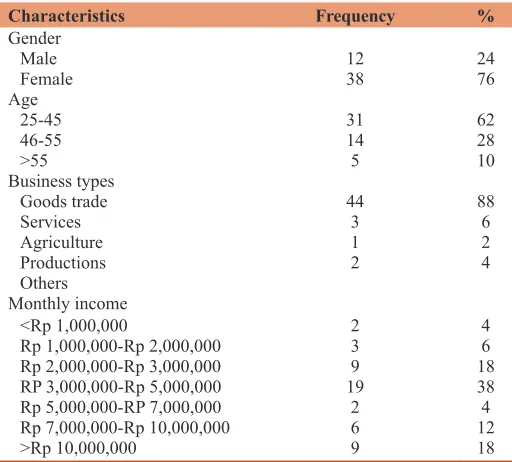
respondents taken as samples with random sampling techniques. Characteristics of respondents are shown in Table 1.
Analysis of research data using logistic regression or logit regression. Analysis of the data used in this study are as follows: (1) Test overall model fit; (2) test the coefficient of determination; (3) model feasibility test; (4) logistic regression analysis; and (5) hypothesis testing. Data analysis is part of the data testing process after the selection and collection of research data. Data quality testing in the study using the help of SPSS for Windows version 22 software.
3.1. Overall Fit Model Test
This statistical test is to determine whether all the independent variables in logistic regression simultaneously or simultaneously affect the dependent variable as F test in linear regression (Widarjono, 2010). The test is done by comparing the difference between the value of −2 log likelihood (called chi square count) where when the chi square value is calculated greater than the chi square table or the significance value is smaller than alpha, it can be said that there are simultaneous influences of independent variables on the dependent variable.
3.2. Determination Coefficient Test
Cox and Snell’s R Square are measures that try to replicate the size of R2 on multiple regression based on the likelihood estimation technique with a maximum value of <1 (one) so that it is difficult to interpret. Nagelkerke’s R square is a modification of the Cox and Snell coefficients to ensure that the values vary from 0 (zero) to 1 (one). This is done by dividing the Cox and Snell’s R2 values by their maximum values. The value of Nagelkerke’s R2 can be interpreted like the value of R2 at multiple regression. A small value means that the ability of independent variables to explain variations in the dependent variable is very limited. A value close to one means that the independent variables almost all the information needed to predict the dependent variables (Ghozali, 2006).
Table 1: Characteristics of respondents
Characteristics Frequency %
Gender
Male
Female 1238 2476
Age 25-45 46-55 >55
31 14 5
62 28
10
Business types
Goods trade
Services Agriculture Productions Others
44 3 1 2
88 6 2 4
Monthly income
<Rp 1,000,000
Rp 1,000,000-Rp 2,000,000 Rp 2,000,000-Rp 3,000,000 RP 3,000,000-Rp 5,000,000 Rp 5,000,000-RP 7,000,000 Rp 7,000,000-Rp 10,000,000 >Rp 10,000,000
2 3 9 19
2 6 9
4 6 18 38 4 12 18
3.3. Model Feasibility Test
The feasibility of the regression model was assessed using Hosmer and Lemeshow’s Goodness of Fit Test. Hosmer and Lemeshow’s Goodness of Fit Test tests empirical data suitable or in accordance with the model (there is no difference between the model and the data so that the model can be said to be fit). If the Hosmer and Lemeshow’s statistical value of Goodness of Fit Test is ≤0.05, then there is a significant difference between the model and the observational value so that the Goodness of fit model is not good because the model cannot predict the value of its observations. If the statistical value of Hosmer and Lemeshow’s Goodness of Fit Test is >0.05, then the model is able to predict the value of its observations or it can be said that the model can be accepted because it matches the observational data (Ghozali, 2009).
3.4. Logistic Regression Analysis
The analytical tool used in this study is logistic regression. Logistic regression is a regression that is used to test whether the probability of the occurrence of the dependent variable can be predicted by its independent variables (Ghozali, 2006). Regression models in this study are as follows:
0 1 1
2 2 3 3 4 4
1
i
i
P
Y Ln X
P
X X X e
(1)
Where:
Yi: The understanding of MSMEs in preparing finance is based on SAK ETAP (Understand = 1, Do not understand = 0)
P: The probability of MSMEs understands financial preparation based on SAK ETAP
P−1: The probability of MSMEs not understanding financial preparation based on SAK ETAP
X1: Information and socialization
X2: Level of education
X3: Usaha business scale
X4: Duration
ei: Error β0: Constants β1−β
8: Estimated parameters (coefficients).
3.5. Hypothesis Testing
This study uses a significance level of 5% to find out whether there is a real influence of the independent variable on the dependent variable. The criteria of this test include: (1) Significance level (sig.)>0.05 and >0.10, the hypothesis is rejected; and (2) significance level (Sig.) <0.05 and <0.05, the hypothesis is accepted.
4. RESULTS AND DISCUSSION
4.1. Overall Model Fit TestTable 2 shows the results of the overall fit model test show that the model formulated in the study is a good regression model or assessed model that is hypothesized to fit with the data. Assessment of the regression model has been fit with the data referring to the decrease in the value of −2 log initial likelihood (31,855) after the existence of independent variables included in the model until it reaches the final value of −2 log likelihood of 16,772.
4.2. Coefficient of Determination Test
The test results of the coefficient of determination based on Table 3. Coefficient determination test results show that the independent variables (variables of information and socialization, education level variables, business scale variables, and old business variables) provide almost all information needed in predicting dependent variable variation (understanding of MSMEs in compiling finances based on SAK ETAP). The statement is based on the results of the negative value for R Square of 0.870 (Negelkerke R Square value is close to 1).
Table 2: Overall fit model test results
Iteration historya,b,c
Iteration −2 Log likelihood Coefficients
Constant
Step 0
1 33.439 −1.574
2 31.897 −2.033
3 31.855 −2.125
4 31.855 −2.128
5 31.855 −2.128
a. Constant is included in the model b. Initial -2 Log Likelihood: 31.855 c. Estimation terminated at iteration number 5 because parameter estimates changed by < 0.001
Iteration historya,b,c,d
Iteration −2 Log likelihood Coefficients
Constant IS P JP SK
Step 1 16.722 −2.543 1.696 0.174 0.137 0.002
a. Method: Enter b. Constant is included in the model c. Initial−2 Log Likelihood: 31.855 d. Estimation terminated at iteration number 20 because maximum iterations has been reached. Final solution cannot be found. Source: Processed primary data, 2018
Table 3: Coefficient of determination test results Model summary
Step −2 Log likelihood Cox and Snell
R square Nagelkerke R square
1 0.000a 0.492 0.870
4.3. Goodness of Fit Test
The results of Hosmer-Lemeshow goodness of fit test in Table 4 show that the model is able to predict the value of its observations or it can be said that the model is acceptable because it matches the observational data. The statement is based on the significance value of the Hosmer-Lemeshow goodness of fit test greater than the significance level (1.00>0.05).
4.4. Logistic Regression Analysis
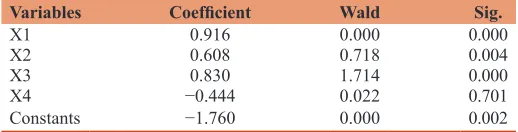
The logistic regression results in Table 5 resulted in regression model as follows:
1
2 3 4
1.760 0.916
1
.608
0 0.830 .444
i P
Y Ln X
P
X X X
(2)
Hypothesis testing shows that H1, H2, and H3 are accepted with a significance value of <0.05 while H4 is rejected because the significance value is 0.701 or more than 0.05. This shows that the hypothesis statement: (1) The provision of information and socialization has a positive influence on the understanding of MSMEs towards SAK ETAP received; (2) the level of education has a positive influence on the understanding of MSMEs towards SAK ETAP received; and (3) scale of business has a positive influence on the understanding of MSMEs towards SAK ETAP. While the hypothesis H4 statement regarding the company’s age does not affect the understanding of MSMEs towards SAK ETAP.
The influence of socialization and information on the understanding of MSMEs in preparing financial reports based on SAK ETAP is explained in the results of testing the first hypothesis. The results of testing the first hypothesis, namely socialization and information have a significant influence on the understanding of MSMEs in preparing financial statements based on SAK ETAP in the City of Semarang. This can be seen from the significance of the socialization and information variables (X1) on the understanding of MSMEs in preparing financial statements based on SAK ETAP (Y) which is smaller than the significant value of 5% (0.000<0.05) which shows that the socialization and information variables significantly influence understanding of MSMEs in preparing financial reports based on SAK ETAP. Research by Rahmawati and Puspasari (2017) and Tuti et al. (2014) research also show that the provision of socialization and information on SAK ETAP to MSME actors affected the level of understanding
of MSME actors related to the implementation of SAK ETAP. Information dissemination and important information are provided to MSME players in order to foster enthusiasm to learn and understand financial reporting based on SAK ETAP. In providing information and information, it is explained how the short and long-term influences of financial reporting are based on SAK ETAP on the continuity of its business. Rahmawati and Puspitasari (2017) explain other variables that influence the size of the business, the company’s age, the latest education of business actors and the professionalism of the management of MSME actors. These results are different from the study of Budiman et al. (2017) which showed that socialization and information did not affect the understanding of MSMEs on financial reporting based on SAK ETAP. MSME actors participate in socialization activities only to fulfill the invitation and do not apply the results of the socialization and information.
The influence of the level of education on the understanding of MSMEs in compiling financial statements based on SAK ETAP explained by the second hypothesis is that the level of education has a significant influence on the understanding of MSMEs in preparing financial statements based on SAK ETAP in the City of Semarang. This can be seen from the significance of the level of education (X2) on the understanding of MSMEs in preparing financial statements based on SAK ETAP (Y) smaller than the significant value of 5% (0.0004<0.05) which indicates that the education level variable has a significant influence on understanding MSMEs in preparing financial statements based on SAK ETAP. Diana’s research (2018) also shows that the level of education and educational background influence the level of understanding of MSMEs business actors towards SAK ETAP. Actors of MSMEs with higher levels of education will be easier to give direction so they can understand the importance of understanding SAK ETAP on business activities carried out (Rahmawati and Puspitasari, 2017).
The influence of the scale of business on the understanding of MSMEs in preparing financial statements based on SAK ETAP is explained by the results of the third hypothesis, namely the scale of business has a significant influence on the understanding of MSMEs in preparing financial statements based on SAK ETAP in Semarang City. This can be seen from the significance of the business scale (X3) on the understanding of MSMEs in preparing financial statements based on SAK ETAP (Y) smaller than the significant value of 5% (0.000<0.05) which indicates that business scale variables have a significant influence on the understanding of MSMEs in compile financial statements based on SAK ETAP. Research by Hutadjulu and Blesia (2016) shows that the scale of business also influences the perception of MSME actors on the importance of financial statements that aim to provide information and completeness of credit applications, performance evaluation, and decision making in developing businesses. The larger the scale of business, the greater awareness will be of learning financial reporting methods based on SAK ETAP. Understanding in preparing financial statements based on SAK ETAP is very important to have to retain and maintain the efforts that have been carried out (Hutadjulu and Blesia, 2016). These results are not in line with the study of Budiman et al. (2017) which stated Table 4: The Hosmer‑Lemeshow goodness of fit test result
Step Chi-square df Sig.
1 0.000 7 1.000
Source: Processed primary data, 2018
Table 5: Logistic regression results
Variables Coefficient Wald Sig.
X1 0.916 0.000 0.000
X2 0.608 0.718 0.004
X3 0.830 1.714 0.000
X4 −0.444 0.022 0.701
Constants −1.760 0.000 0.002
that business scale did not affect the understanding of MSMEs in preparing financial statements based on SAK ETAP.
The company’s age influence the understanding of MSMEs in compiling financial statements based on SAK ETAP is shown by the results of testing the fourth hypothesis which indicates that the company’s age does not significantly influence the understanding of MSMEs in preparing financial statements based on SAK ETAP in Semarang City. This can be seen from the company’s age significance (X4) on the understanding of MSMEs in preparing financial statements based on SAK ETAP (Y) is greater than the significant value of 5% (0.701>0.05) which shows that the socialization and information variables significantly influence MSME understanding in preparing financial statements based on SAK ETAP. The study of Budiman et al. (2017) also shows that the influence company’s age variable does not have a significant influence on the understanding of business people in the preparation of financial statements based on SAK ETAP. This is because new business activities will tend to be cooperative with all things that can support the development of their business, including understanding the preparation of financial statements. Preparation of financial statements refers to SAK ETAP intended for MSME actors. Understanding of SAK ETAP is more influenced by the willingness of entrepreneurs to learn and use it in the financial statements of the related companies. So, the company’s age does not determine the high level of understanding of MSMEs on SAK ETAP (Budiman et al., 2017).
5. CONCLUSION
The preparation of financial reports is one of the important parts in efforts to develop MSMEs. Consequently, MSME actors need to understand the preparation of financial reports based on SAK ETAP. Financial reports provide information regarding business performance, the condition of business assets and others. The understanding of MSMEs in preparing financial statements based on SAK ETAP especially MSMEs in Semarang based on the results of testing the coefficient of determination shows that the variables of information and socialization, education level variables, business scale variables and company’s age variables are able to explain the variable understanding of MSMEs in financial compilation based on SAK ETAP. While the results of hypothesis testing show that not all variables have a significant influence on the understanding of MSMEs in preparing financial statements based on SAK ETAP. The information and socialization variables have a significant influence on the inclusion of MSMEs in preparing financial statements based on SAK ETAP in Semarang City. Educational level variables significantly influence the understanding of MSMEs in preparing financial statements based on SAK ETAP in Semarang City. Business scale variables significantly influence the understanding of MSMEs in preparing financial statements based on SAK ETAP in Semarang City. The company’s age does not significantly influence the understanding of MSMEs in preparing financial statements based on SAK ETAP in Semarang City.
The results of the study are expected to have a positive impact and contribute to MSME business actors and MSME business actors
are expected to pay attention to and support the implementation of the Financial Accounting Standards for Entities without Public Accountability in managing MSME financial statement. This is intended to be able to help MSMEs internal recording purpose as well as facilitating loan application. The results of this study are also expected to be useful as consideration for MSMEs in improving Financial Accounting Standards. The application of Financial Accounting Standards in a business can influence business actors in carrying out records, so that employers can do bookkeeping for internal purpose and to ease loan application.
REFERENCES
Bank Indonesia. (2013), Five Finger Philosophy: Upaya Memberdayakan Usaha Mikro, Kecil, dan Menengah. Avilable from: https://www. bi.go.id. [Last accessed on 2019 Jan 18].
Bramford, C.E., Bruton, G.D. (2006), A Framework for Success:Small Business Management. United States of America: Thomson South-Western.
Budiman, A.I., Tjandrakirana, R., Daud, R., Ermadiani, E., Delamat, H.,
Burhanuddin, B., Ubaidillah, U. (2017), Factors affecting
understandibility of micro, small, and medium enterprises in
preparation of financial statement based on SAK ETAP in palembang.
Sriwijaya International Journal of Dynamic Economics and Business,
2017, 311-326.
Diana, N. (2018), Financial accounting standard for micro, small and medium entities (SAK EMKM) implementation and factors that
affect it. JEMA: Jurnal Ilmiah Bidang Akuntansi dan Manajemen,
15(2), 50-59.
Ghozali, I. (2006), Aplikasi Analisis Multivariate Dengan Program SPSS. Edisi Keempat. Semarang: Badan Penerbit Universitas Diponegoro. Ghozali, I. (2009), Aplikasi Analisis Multivariate Dengan Program SPSS. Edisi Keempat.Semarang: Badan Penerbit Universitas Diponegoro.
Hapsari, I.M. (2014), Identifikasi berbagai permasalahan yang dihadapi oleh UKM dan peninjauan kembali regulasi UKM sebagai langkah awal revitalisasi UKM. Permana, 5(2), 43-47.
Harahap, S.S. (2009), Analisis Kritis Atas Laporan Keuangan. Jakarta: Raja Grafindo. p105.
Harash, E. (2017), Accounting performance of SMEs and influence of accounting information system: A conceptual model. Global
Journal of Management and Business Research: (D) Accounting and Auditing, 17(3), 21-26.
Husin, M.A., Ibrahim, M.D. (2014), The role of acounting services
and impact on small medium enterprises (SMEs) performance in manufacturing sector from east coast region of malaysia: A conceptual paper. Procedia-Social and Behavioral Sciences, 115, 54-67.
Hutadjulu, L.Y., Blesia, J.U. (2016), Factors that affect the perception
of small and medium-sized businesses (SMEs)’ community on the
importance of financial statements, the amount of credit received
and implementation prospects. KnE Social Sciences, 2016, 125-135. Indonesian Accounting Association. (2009), Standar Akuntansi Keuangan
Entitas Tanpa Akuntanbilitas. Jakarta: Publik.
Ikatan Akuntan Indonesia (IAI). (2016), Standar Akuntansi Keuangan Entitas Tanpa Akuntabilitas Publik (ETAP). IAI Global. Availabe from: http://www.iaiglobal.or.id. [Last accessed on 2019 Jan 23]. Iskandar. (2008), Metodologi Penelitian Pendidikan dan Sosial (Kualitatif
dan Kuantitati). Jakarta: Gaung Persada Press.
Jayabalan, J., Raman, M., Dorasamy, M., Ching, N.K.C. (2009),
Public Interest, 8(2), 96-114.
Mulyani, S. (2014), Faktor-faktor yang mempengaruhi kualitas laporan keuangan pada UMKM di kabupaten kudus. Jumal Dinamika
Ekonomi and Bisnis, 11(2), 1-14.
Rahmawati, T., Puspasari, O.R. (2017), Implementasi SAK ETAP dan kualitas laporan keuangan UMKM terkait akses modal perbankan. Jurnal Kajian Akuntansi, 1(1), 45-58.
Rudiantoro, R., Siregar, SV. (2012), Persespi Pemilik dan Pengetahuan Akuntansi Pelaku Usaha Kecil dan Menengah atas Penggunaan Informasi Akuntansi. Universitas Gunadarma.
Sofiah, N., Murniati, A. (2014), Persepsi pengusaha UMKM keramik
dinoyo atas informasi akuntansi keuangan berbasis entitas tanpa
akuntabilitas publik (SAK ETAP). Jurnal JIBEKA, 8(1), 1-9. Tuti, R., Dwijayanti, S., Patricia, F. (2014), Faktor-faktor yang
mempengaruhi pemahaman UMKM dalam menyusun laporan keuangan berdasarkan SAK ETAP. Jurnal ISSN, 2014, 1978-6522. Urata, S., Kawai, H. (2000), The determinants of the location of foreign
direct investment by Japanese small and medium-sized enterprises.