E
E
F
F
F
F
I
I
C
C
I
I
E
E
N
N
T
T
R
R
S
S
A
A
C
C
R
R
Y
Y
P
P
T
T
O
O
S
S
Y
Y
S
S
T
T
E
E
M
M
D
D
E
E
C
C
R
R
Y
Y
P
P
T
T
I
I
O
O
N
N
B
B
A
A
S
S
E
E
D
D
O
O
N
N
C
C
H
H
I
I
N
N
E
E
S
S
E
E
R
R
E
E
M
M
A
A
I
I
N
N
D
D
E
E
R
R
T
T
H
H
E
E
O
O
R
R
E
E
M
M
A
A
N
N
D
D
S
S
T
T
R
R
O
O
N
N
G
G
P
P
R
R
I
I
M
M
E
E
1
1
S
Sa
ah
he
ee
ed
d
Y
Ya
ak
ku
ub
b
K
Ka
ay
yo
od
de
e
a
an
nd
d
22G
Gb
bo
ol
la
ag
ga
ad
de
e
K
Ka
az
ze
ee
em
m
A
Al
la
ag
gb
be
e
1
Department of Physical Sciences, Al-Hikmah University, Ilorin, Nigeria
2
Department of Computer Science, Kwara State University, Malete, Nigeria
Corresponding Author: Gbolagade Kazeem Alagbe, [email protected]
ABSTRACT: Number theory has turned out to be one of
the useful when it comes to computer security. For instance, number theory helps to protect sensitive data such as credit card numbers when you shop online, when online transactions is performed. The prime application of it’s is in the RSA cryptosystem. Rivest Shamir Adleman (RSA) algorithm is known to be a slower algorithm. The modular arithmetic in RSA is computationally expensive. In view of this, it has become a major challenge to implement RSA decryption in a faster manner. In this paper, we proposed an efficient method to implement RSA decryption based on Chinese Remainder Theorem and Strong prime. Three different operations, primitive traditional method, Chinese Remainder Theorem method and Chinese Remainder Theorem and strong prime criterion were used for comparisons. Our proposal achieves about 60% computational cost reduction of traditional method using Chinese Remainder method. More interesting, if the method based on Chinese Remainder Theorem and strong prime is implemented, about 84% computational cost can be reduced. Also, comparing to the Chinese Remainder method, the method based on Chinese Remainder Theorem and strong prime of RSA criterion takes about 37% of computational cost, almost 3.2 times faster than the Chinese Remainder Theorem based method. Theoretically, it was observed that our scheme is faster and it is also cheaper.
KEYWORDS: RSA, RSA-CRT, Number theory,
computational cost, CRT-strong prime criterion.
I. INTRODUCTION
Cryptography provides techniques for keeping information secret, for determining that information has not been tampered with, and for determining who authored pieces of information [SG17].
The need for a secured communication is more profound than ever, recognizing the fact that the conduct of almost all our business and personal matters are carried out today by computer networks [SG16]. RSA [RSA78] is the most famous and widely deployed public-key cryptosystem. It is used for securing web traffic, some wireless devices and email. RSA cryptosystem encryption and decryption are computationally heavy and expensive because of modular exponentiation with very large numbers are
needed. Since RSA is based on arithmetic modulo large numbers, it can be slow in constrained environments. For example, on a heavily loaded web server, RSA decryption significantly reduces the number of SSL requests per second that the server can handle.
The major bottleneck with the number theoretic RSA cryptosystem is that it require a lot of computational power for providing high and reasonable level of security with a low level efficiency most likely. Hence, how to make an efficient and faster implementation of RSA cryptosystem is great concerned.
In majority of RSA application, a small value of public key e is usually selected to speedup the encryption process. By this selection, the decryption takes more computational time because of the larger secret key d. The alternative approach to overcome this shortcoming is the introduction of Chinese Remainder Theorem to RSA protocol, referred to as RSA-CRT [Lab11, SS16] which is a step towards efficiency. In RSA-CRT, the digital signature operation process is given as S = Md mod Nis split in two operations Sp = Mdp mod p and Sq = Mdq mod q, where dp = d mod (p − 1) and dq = d mod (q − 1) [SS16]. Chinese Remainder Theorem ensures that the combination of Sp and Sq produces signature S as
S= Sq + [( Sp – Sq). (q-1 mod p) mod p].q (1) denoted
as S = CRT (Sp – Sq) with a speedup of operations of
approximately four times [SS16].
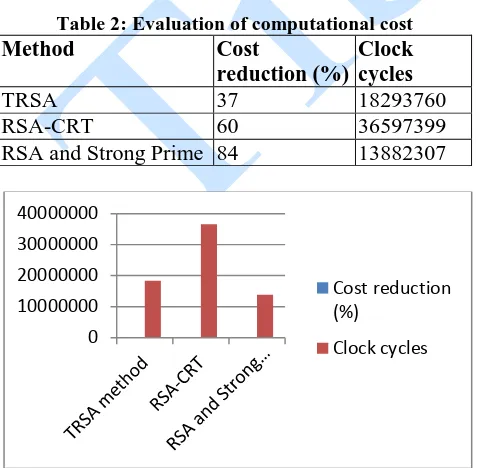
We propose a faster and efficient method to implement RSA decryption operation in this paper. This method is based on traditional RSA decryption method, RSA-CRT based method and CRT with strong prime criterion method. The proposed CRT with additional strong prime criterion takes 13882307 clock cycles. RSA-CRT decryption method takes 36597399 clock cycles and traditional RSA method takes 89290752 clock cycles.
II. CHINESE REMAINDER THEOREM
modulus, n regarding the decryption process. This exponent indicates the number of modular multiplication that is needed to perform the exponentiation. An approach that has become a cornerstone technique to reduce the size of both d and n is an ancient Chinese Remainder Theorem [AB97]. Theorem 1:
Let m1, m2,….. mn be a pairwise relatively prime.
That is gcd (mi, mj) = 1, for all i and j less than or
equal to n where i ≠ j . Then, the system of congruences
X ≡ a1 (mod m1)
X≡ a2 ( mod m2)
:
X≡ an ( mod mn)
has a unique solution modulo the integer m1,m2,...,mn. Further, if Mj = ∏
n i=1/mj
and Zj is a solution of Mj zj ≡ aj (mod mj ) for each j,
then the solution is stated by
X = ∑j=1 n
Mjzj.
Now the special case of Chinese Remainder Theorem with two factors is shown here.
This theorem is mostly used in implementation of the RSA cryptosystem decryption operation.
Theorem 2 [Dav03]:
Let p and q be two numbers (co-prime positive integer) where gcd(p,q) =1. If a ≡ b (mod p) and a ≡ b(mod q), then we have a ≡ b(mod pq).
III. EFFICIENT DECRYPTION METHOD
The prime factors p and q of modulus n in RSA cryptosystem has to be strong prime, in order to make the cryptosystem secure. It is reasonable that the private key party knows the prime factors of p-1, p+1, q-1 and q+1. The proposed decryption approach is specifically on the CRT with additional strong prime criterion. The private key (decryption key) holder performs the decryption procedure; Cd mod n by our proposed method.
Step one: Factor p-1, p+1,q-1 and q+1 to get their prime factors. Let’s assume that moduli p-1, p +1, q-1 and q +1 be expressed as follows;
, ,
, ,
Step two: compute the modular exponentiations
with prime factors of p – 1 as the modulus. Then, apply the CRT to generate y1 = c
d
mod (p – 1) based on these results. By the same technique, the private
key (decryption key) holder generates y2mod (p +
1), y3 = cd mod (q – 1) and y4 = cd mod (q + 1)
individually. The explanations are as follows: 2.1 compute c(p-1),i = c ( mod ri αi ), i = 1,…,h
2.2 compute d(p-1),i = d ( mod Φ(ri αi ), i = 1,…,h
2.3 compute the modular exponentiation M(p-1),i = c(p-1),I
d(p-1)
mod ri α i , i = 1,…,h
2.4 Apply the CRT to generate y1 = c d
mod (p – 1) based on M(p-1),i, i = 1,..,h
Step three: compute X1 = 2 -1
(y1 + y2 – z) mod p
where z = 0 if y1 ≥ y2 ; otherwise z = 1 and X2 = 2 -1
(y3 + y4 – z) mod q where z = 0 if y3 ≥ y4 ; otherwise
z = 1.
Step four: Apply the CRT to generate the plaintext
M = cd mod n based on X1 and X2.
The numbers p-1, p +1,q -1 and q +1 can be individually decomposed into three prime factors at least at step 1. The bit lengths of ri αi ( i = 1,…,h)
are smaller than p-1. The bit lengths of d(p-1),i ( i =
1,…,h) are smaller than d.
The complexity of modular exponentiation in RSA cryptosystem depends on the bit length of exponent and modulus. The totally computation time of step 2 to get y1 = c
d
mod(p -1) is smaller than to compute y1 by c
d
mod(p -1) directly. The efficient results are similar to y2 = c
d
mod(p +1), y3 = c d
mod(q -1), and y4 = c
d
mod(q +1).
The proposed decryption method using CRT with strong prime criterion is more efficient than the traditional method. The following theorem demonstrates that X1 and X2 generated in step 3 above are correct.
Theorem 3:
Given y1 = X mod (p-1), y2 =X mod (p +1) such that
0 ≤ X ≤ ( p2 – 1)/2 and p is a prime. Then X = X 1 =
2-1 (y1 + y2 – z) mod p, where z = 0 if y1≥y2 ;
otherwise z = 1 [Dav03].
IV. ANALYSIS OF COMPUTATIONAL
COST
In this section, we will show that the decryption method that has been proposed in section III is more efficient than the traditional decryption method and the decryption method that is based on the Chinese Remainder theorem only. Nowadays, the bit length of modulus should be at least 2048 bits in order to make the operations secure. We will use this value in our calculation below. Before that, let’s define some notations as follows:
MODE(y,z) denotes an operation of
modular exponentiation, xy mod z.
M(w), A(w) and Mod(w) denote operations of multiplication, addition and modulus with the bit length of operand is w.
As was shown earlier, we implement the decryption operation by computing Cd (mod n) , where d is the decryption exponent. The encrypted message can be recovered by repeated modular exponentiation. The modulo operation cd (mod n) can be replace with other equation. According to [Dav03] the modulo operation cd (mod n)can be expressed as follows; MODE (d, n) = 1.5 x l(d) [M (l(n) + 2Mod (l(n)) + 1]
Before we compute the total number of operations for the three methods that we want to compare, three equations concerning the multiplication operation, the addition operation and also the modulus operation will be introduce. These equations are very important in order to do the calculation. The multiplication operations can be expressed as follows
MODE (d, n) = 1.5 x l(d) [M (l(n) + 2Mod (l(n)) + 1] (1)
M (w) = 3 M (w/2) + 5A(w) + 2s (2) A (w) = w/32 (3) Mod (w) = Mod (w/2) + 4M (w/2) + 1.5A (w) + 3s (4)
In the first place, assume that all of Mod (32), M(32), A(32) and S take one clock cycle. For convenient, we find all the values of M(w) and Mod(w) first. Using equations (2) and (3), we get:
M(2048) = 3M (1024) + 5A (2048) + 2s = 3M (1024) + 322
= 3[3M (512) + 5A (1024) + 2s] + 322 = 9M (512) + 808
= 9 [3M (256) + 5A (512) + 2s] + 808 = 27M (256) + 1546
= 27 [3M(128) + 5A (256) + 2s] + 1546 = 81M (128) + 2680
= 81M[3M(64)+5A(128)+2s] +2680 =243M (64)+ 4462
= 243[3M (32) + 5A(64) + 2s] +4462 = 729M(32) + 7378
= 8107 clock cycles.
M(1024) = 3M(512) + 5A (1024) +2s = 3M(512) +162
= 3[3M(256) +5A (512)+2s]+162 = 9M (256) + 408
= 9[3M (128) +5A (256) +2s] +408 = 27M(128) + 786
= 27[3M (64) +5A (128) +2s] +786 =81M (64) + 1380
= 81M [3M(32)+5A(64) + 2s] + 1380 =243M(32) +2352
= 2595 clock cycles.
Using equation (2), (3) and (4)
Mod (64) = Mod (32) + 4M (32) + 1.5A (64) + 3s = 11 clock cycles
Mod (128) = Mod (64) + 4M (64) + 1.5A (128) + 3s = 80 clock cycles
Mod (256) = Mod (128) + 4M (128) + 1.5A (256) + 3s = 363 clock cycles
Mod (512) = Mod (256) + 4M (256) + 1.5A (512) + 3s = 1362 clock cycles
Mod (1024) = Mod (512) + 4M (512) + 1.5A (1024) +3s = 4657 clock cycles
Mod (2048) = Mod (1024) + 4M (1024) +1.5A (2048) +3s = 10479 clock cycles
The values for multiplication operation, addition operation and modulus operation are M(W), Mod (W) and A(W).
Table 1.
W(bits) 2048 1024 512 256 128 64 32 M(W) 8107 2595 811 243 67 15 1 Mod(W) 10479 4657 1362 363 80 11 1
A(W) 64 32 16 8 4 2 1
i. Primitive traditional method
MODE (d,n) = 1.5 X l(d) [ M(l(n)) + 2 mod (l(n)) + 1]
= 1.5 x 2048 [ M (2048) + 2 mod (2048) + 1] = 1.5 x 2048 [ 8107 + 2 (10479) + 1] = 1.5 x2048 [ 8107 + 20958 + 1] = 3072 [29066]
= 89290752 clock cycles
So, the traditional RSA cryptosystem decryption method should take 89290752 clock cycles.
ii. Method on CRT-RSA
The bit length of two distinct primes is equal in this method, so, the total number of decryption operation for this method can be shown as
Total number = 2MODE (d/2, n/2) + A (1024) + 2M
(1024) + mod (1024)
MODE = (d/n, n/2) = 1.5 X l(d/2) [M(1(n/2))+ 2mod (l(n/2)) + 1]
= 1.5 x 1024 [M(1024) + 2mod (1024) + 1 ] = 1.5 x 1024 [2595 + 2 (4657) + 1]
= 1536 [2595 + 9315 ] = 18293760 clock cycles
Total number = 2MODE (d/2, n/2) + A (1024) + 2M
(1024) + mod (1024)
= 2(18293760) + 32 + 2(2595) + 4657 = 36597399 clock cycles
The Method based on the Chinese Remainder Theorem should take 36597399 clock cycles.
iii. Method based on CRT with additional strong prime criterion
generality, assuming that the bit length of the largest prime factor is about l(n)/4 and others are about l(n)/8. The total decryption operation for this method is;
Total number = 4 MODE ( d/4,n/4) + 8 MODE (d/8,
n/8) + 4[A(512) + 2M(512) + mod(512)] +4 [a(256)+ 2M (256) + mod (256)] + 2[ A(1024) + M (1024) + mod (1024)] + A (1024) + 2 M(1024) + mod(1024).
MODE [d/4,n/4] = 1.5 x l (d/4) [ m (l(n/4)] + 2 mod
[l(n/4) +1].
= 1.5 x 512[m (512)[m(512) + 2 mod (512) + 1] = 768(3536)
= 2715648 clock cycles
Therefore,
Total number = 4(2715648) + 8(372480) +4 (3000) + 4(857) +2 (7284) + 9879
= 13882307 clock cycles.
From the above calculation, the CRT method should take about 40% computational cost of the primitive traditional method. It means that 60% computational cost can be reduced if the decryption method based on CRT is implemented. In addition, if the method based on CRT with additional strong prime criterion is implemented, about 84% computational cost can be reduced from the traditional method. Therefore, the method based on CRT with additional strong primes takes only 15% computational cost. More interesting, comparing to the CRT based method, the method on CRT and strong prime take about 37% computational cost, almost 3.2 times faster than the Chinese Remainder Theorem based method.
Table 2: Evaluation of computational cost
Method Cost
reduction (%) Clock cycles
TRSA 37 18293760
RSA-CRT 60 36597399
RSA and Strong Prime 84 13882307
Figure 1. Comparison of Proposed Approach
V. CONCLUSIONS
In this paper, we introduced traditional RSA decryption, RSA-CRT, Chinese Remainder Theorem and strong prime for RSA decryption operation. The CRT and strong prime methods is faster and efficient than RSA-CRT and traditional RSA decryption method. The private key decryption d is very significant in RSA algorithm. The cipher-text can only be change to plaintext if the key d is known. Time spent to decrypt the message depends on the efficiency of algorithms to be used. We have improved the efficiency in order to reduce the time spent for decryption. The performance of our proposed method is evaluated on cost reduction and number of operation cycles.
We based our proposed approach on three methods, Primitive traditional method, RSA-CRT method and method based on CRT and Strong prime and comparison between them was evaluated. The method based on CRT and strong prime criterion is the best whereas RSA-CRT performs better than the traditional method.
REFERENCES
[AB97] Anderson J. A., Bell J. M. - Number Theory with Applications. New Jersey: Prentice-Hall. 1997.
[Dav03] Davis T. - RSA Encryption [Online]. [Accessed 10th, January 2017]. Available from URL: http://www.geometer.org /mathcircles. 2003.
[H+05] Hwang R. J., Su F. F., Yeh Y. S.,
Chen C. Y. - An Efficient Decryption
Method for RSA Cryptosystem. AINA’05. 1, 585-590. 2005.
[Lab11] Lab R. - High-Speed RSA
Implementation (2011). URL ftp://ftp.rsasecurity.com/
pub/pdfs/tr201.pdf
[RSA78] Rivest R., Shamir A., Adleman L. - A Method for Obtaining Digital Signatures and Public Key Cryptosystems. Commun. ACM, 21(2):120–126. Feb. 1978.
[SG16] Saheed Y. K., Gbolagade K. A. - Efficient Image Encryption based on the moduli set {2n - 1, 2n, 2n +1}. Al-Hikmah Journal of Pure & Applied Sciences Vol.3. 2016: 15-21.
0 10000000 20000000 30000000 40000000
Cost reduction (%)
[SG17] Saheed Y. K., Gbolagade K. A. - An Improved RSA algorithm based on Residue Number System. In: Proceedings of 13th Nigeria Computer Society International Conference, 2017.Vol. 28. Pp 86-91.