https://doi.org/10.5194/gmd-12-3955-2019 © Author(s) 2019. This work is distributed under the Creative Commons Attribution 4.0 License.
Toward an open access to high-frequency lake modeling and
statistics data for scientists and practitioners – the case of
Swiss lakes using Simstrat v2.1
Adrien Gaudard,†, Love Råman Vinnå, Fabian Bärenbold, Martin Schmid, and Damien Bouffard
1Surface Waters Research and Management, Eawag, Swiss Federal Institute of Aquatic Sciences and Technology,
Kastanienbaum, Switzerland
†deceased, 2019
Correspondence:Damien Bouffard ([email protected]) Received: 23 December 2018 – Discussion started: 1 April 2019
Revised: 4 August 2019 – Accepted: 9 August 2019 – Published: 6 September 2019
Abstract.One-dimensional hydrodynamic models are nowa-days widely recognized as key tools for lake studies. They offer the possibility to analyze processes at high frequency, here referring to hourly timescales, to investigate scenarios and test hypotheses. Yet, simulation outputs are mainly used by the modellers themselves and often not easily reachable for the outside community. We have developed an open-access web-based platform for visualization and promotion of easy access to lake model output data updated in near-real time (http://simstrat.eawag.ch, last access: 29 August 2019). This platform was developed for 54 lakes in Switzerland with potential for adaptation to other regions or at global scale us-ing appropriate forcus-ing input data. The benefit of this data platform is practically illustrated with two examples. First, we show that the output data allows for assessing the long-term effects of past climate change on the thermal structure of a lake. The study confirms the need to not only evalu-ate changes in all atmospheric forcing but also changes in the watershed or throughflow heat energy and changes in light penetration to assess the lake thermal structure. Then, we show how the data platform can be used to study and compare the role of episodic strong wind events for different lakes on a regional scale and especially how their thermal structure is temporarily destabilized. With this open-access data platform, we demonstrate a new path forward for scien-tists and practitioners promoting a cross exchange of exper-tise through openly sharing in situ and model data.
1 Introduction
Aquatic research is particularly oriented towards providing relevant tools and expertise for practitioners. Understanding and monitoring inland waters is often based on in situ obser-vations. Today, the physical and biogeochemical properties of many lakes are monitored using monthly to bi-monthly vertical discrete profiles. Yet, part of the dynamics is not cap-tured at this temporal scale (Kiefer et al., 2015). An emerging alternative approach consists in deploying long-term moor-ings with sensors and loggers at different depths of the water column. However, this approach is seldom used for country-level monitoring, although it is promoted by research initia-tives such as GLEON (Hamilton et al., 2015) or NETLAKE (Jennings et al., 2017).
modellers themselves and often not easily accessible for the outside community.
The performance of lake models is determined by the physical representativeness of the algorithms and by the quality of the input data. The latter include (i) lake morphol-ogy, (ii) atmospheric forcing, (iii) hydrological cycle (e.g., inflow, outflow, and/or water level fluctuations), and (iv) light absorption. In situ observations, such as temperature pro-files, are required for calibration of model parameters. To support this approach, it is important to promote and facil-itate the sharing of existing datasets of observations among scientists and practitioners. Conversely, scientists and practi-tioners should benefit from the model output, which is often ready to use, high frequency, and up to date. Yet, model out-put data should not only be seen as a tool for temporal inter-polation of measurements. Models also provide data of hard-to-measure quantities which are helpful for specific analy-ses (e.g., the heat content change to asanaly-sess impact of climate change or the vertical diffusivity to estimate vertical turbu-lent transport). Models finally support the interpretation of biogeochemical processes which often depend on the thermal stratification, mixing, and temperature. In a global context of open science, collaboration between the different actors and reuse of field and model output data should be fostered. Such win–win collaboration serves the interests of lake modellers, researchers, field scientists, lake managers, lake users, and the public in general.
In this work, we present a new automated web-based plat-form to visualize and distribute the near-real-time (weakly) output of the one-dimensional hydrodynamic lake model Simstrat through an user-friendly web interface. The current version includes 54 Swiss lakes covering a wide range of characteristics from very small volume such as Inkwilersee (9×10⁻³km3) to very large systems such as Lake Geneva (89 km3), over an altitudinal gradient (Lake Maggiore at from 193 m a.s.l. to Daubensee at 2207 m a.s.l.) and over all trophic states (14 eutrophic lakes, 10 mesotrophic lakes, and 21 oligotrophic lakes; Appendix A). We focus here on de-scribing the fully automated workflow, which simulates the thermal structure of the lakes and updates the online plat-form weekly (https://simstrat.eawag.ch, last access: 29 Au-gust 2019) with metadata, plots, and downloadable results. This state-of-the-art framework is not restricted to the cur-rently selected lakes and can be applied to other systems or at global scale.
2 Methods
2.1 Model and workflow
We use the 1-D lake model Simstrat v2.1 to model 54 Swiss lakes or reservoirs (see Appendix A for details of modeled lakes) in an automated way. Simstrat was first introduced by Goudsmit et al. (2002) and has been successfully applied to
a number of lakes (Gaudard et al., 2017; Perroud et al., 2009; Råman Vinnå et al., 2018; Schwefel et al., 2016; Thiery et al., 2014). Recently, large parts of the code were refactored using the object-oriented Fortran 2003 standard. This version of Simstrat provides a clear, modular code structure. The source code of Simstrat v2.1 is available via GitHub at https://github.com/Eawag-AppliedSystemAnalysis/Simstrat/ releases/tag/v2.1 (last access: 29 August 2019). A simpler build procedure was implemented using a docker container. This portable build environment contains all necessary software dependencies for the build process of Simstrat. It can therefore be used on both Windows and Linux systems. A step-by-step guide is provided on GitHub.
In addition to the improvements already described by Schmid and Köster (2016), Simstrat v2.1 includes (i) the pos-sibility to use gravity-driven inflow and a wind drag coeffi-cient varying with wind speed – both described by Gaudard et al. (2017) – and (ii) an ice and snow module. The ice and snow module employed in the model is based on the work of Leppäranta (2014, 2010) and Saloranta and Andersen (2007), and is further described in Appendix B.
A Python script was developed to (i) retrieve the newest forcing data directly from data providers and integrate them into the existing datasets, (ii) process the input data and prepare the full model and calibration setups, (iii) run the calibration of the model for the chosen model parameters, (iv) provide output results, and (v) update the Simstrat online data platform to display these results. The script is controlled by an input file written in JavaScript Object Notation (JSON) format, which specifies the lakes to be modeled together with their physical properties (depth, volume, bathymetry, etc.) and identifies the meteorological and hydrological stations to be used for model forcing. The overall workflow is illustrated in Fig. 1.
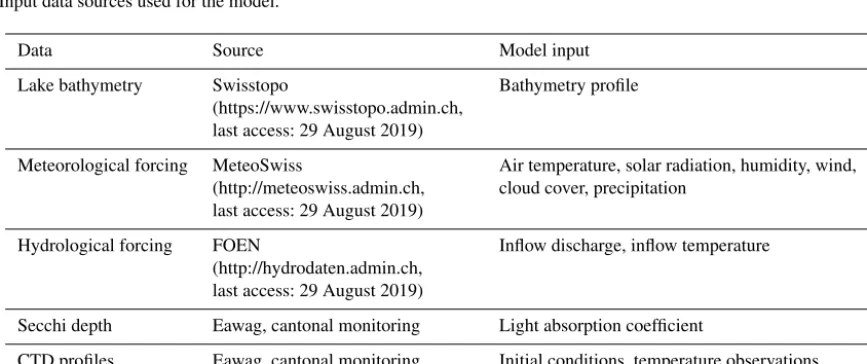
2.2 Input data
Table 1 summarizes the type and sources of the data fed to Simstrat. For meteorological forcing, homogenized hourly air temperature, wind speed and direction, solar radiation, and relative humidity from the Federal Office of Meteo-rology and Climatology (MeteoSwiss, Switzerland) weather stations are used. For each lake, the closest weather stations are used. Air temperature is corrected for the small alti-tude difference (see Appendix A) between the lake and the meteorological station, assuming an adiabatic lapse rate of −0.0065◦C m−1. This correction is a source of error in
Figure 1. General workflow diagram. Model input (a) is retrieved and processed by the Python script “Simstrat.py”, which runs the model (Simstrat v2.1) and/or model calibration (using PEST v15.0) (b) and produces output (c). This output is then uploaded to a web interface (https://simstrat.eawag.ch, last access: 29 August 2019) for general use. All scripts and programs are available on https://github.com/Eawag-AppliedSystemAnalysis/Simstrat/releases/tag/v2.1 (last access: 29 August 2019) and https://github.com/ Eawag-AppliedSystemAnalysis/Simstrat-WorkflowModellingSwissLakes (last access: 29 August 2019). Simstrat is the one-dimensional hydrodynamic model; CTD is a conductivity–temperature–depth profiler; PEST is the model-independent parameter estimation and uncer-tainty analysis software; FOEN is the Swiss Federal Office of Environment; MeteoSwiss is the Swiss Federal Office of Meteorology and Climatology; Swisstopo is the Swiss Federal Office of Topography.
Table 1.Input data sources used for the model.
Data Source Model input
Lake bathymetry Swisstopo
(https://www.swisstopo.admin.ch, last access: 29 August 2019)
Bathymetry profile
Meteorological forcing MeteoSwiss
(http://meteoswiss.admin.ch, last access: 29 August 2019)
Air temperature, solar radiation, humidity, wind, cloud cover, precipitation
Hydrological forcing FOEN
(http://hydrodaten.admin.ch, last access: 29 August 2019)
Inflow discharge, inflow temperature
Secchi depth Eawag, cantonal monitoring Light absorption coefficient
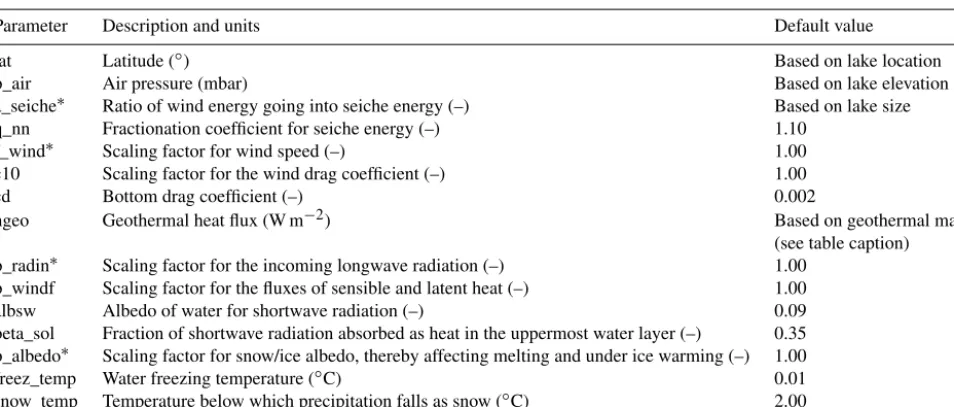
Table 2. Model parameters. The geothermal heat flux is based on existing geothermal data for Switzerland: https://www.geocat.ch/ geonetwork/srv/eng/md.viewer\#/full_view/2d8174b2-8c4a-44ea-b470-cb3f216b90d1 (last access: 29 August 2019).
Parameter Description and units Default value
lat Latitude (◦) Based on lake location
p_air Air pressure (mbar) Based on lake elevation
a_seiche∗ Ratio of wind energy going into seiche energy (–) Based on lake size q_nn Fractionation coefficient for seiche energy (–) 1.10
f_wind∗ Scaling factor for wind speed (–) 1.00
c10 Scaling factor for the wind drag coefficient (–) 1.00
cd Bottom drag coefficient (–) 0.002
hgeo Geothermal heat flux (W m−2) Based on geothermal map (see table caption) p_radin∗ Scaling factor for the incoming longwave radiation (–) 1.00
p_windf Scaling factor for the fluxes of sensible and latent heat (–) 1.00 albsw Albedo of water for shortwave radiation (–) 0.09 beta_sol Fraction of shortwave radiation absorbed as heat in the uppermost water layer (–) 0.35 p_albedo∗ Scaling factor for snow/ice albedo, thereby affecting melting and under ice warming (–) 1.00 freez_temp Water freezing temperature (◦C) 0.01 snow_temp Temperature below which precipitation falls as snow (◦C) 2.00
The asterisk (∗) indicates the parameters that were calibrated.
a single inflow. The aggregated discharge is the sum of the discharge of all inflows, and the aggregated temperature is the weighted average of the inflows for which temperature is measured. Inflow data are often missing for small or high-altitude lakes (Appendix A). Missing inflows and more gen-erally watershed data are a source of error in small alpine lakes, yet such error can be compensated during the calibra-tion process. The light absorpcalibra-tion coefficient εabs (m−1) is
either obtained from Secchi depthzSecchi(m) measurements
(for Inkwilersee, Lake Biel, Lake Brienz, Lake Geneva, Lake Neuchâtel, lower Lake Zurich, Oeschinen Lake, upper Lake Constance, and Sihlsee) or set to a constant value based on the lake trophic status. In the first case, the following equa-tion is applied: εabs=1.7/zSecchi (Poole and Atkins, 1929;
Schwefel et al., 2016). In the second case, εabs is set to
0.15 m−1 for oligotrophic lakes, 0.25 m−1 for mesotrophic lakes, and 0.50 m−1 for eutrophic lakes. The values cor-respond to observations of Secchi depths in Swiss lakes (Schwefel et al., 2016) and fall into the decreasing range of transparency from an oligotrophic to eutrophic system (Carl-son, 1977). For glacier-fed lakes (typical above 2000 m) rich in sedimentary material,εabsis set to 1.00 m−1.
The timeframe of the model is determined by the avail-ability of the meteorological data (air temperature, solar radiation, humidity, wind, precipitation). Initial conditions for temperature and salinity are set using conductivity– temperature–depth (CTD) profiles or using the temperature information from the closest lake. We apply different data patching methods to remove data gaps from the forcing de-pending on the length of the data gap. For small data gaps with duration not exceeding 1 d, the dataset is linearly in-terpolated. In total, <1 % of the dataset is corrected using
this approach. Longer data gaps of up to 20 d are replaced by the long-term average values for the corresponding day of the year. Only∼1.5 % of the dataset is corrected using this approach.
2.3 Calibration
Model parameters are set to default values, and four of them are calibrated (see Table 2). The parametersp_radin
andf_windscale the incoming longwave radiation and the wind speed, respectively, and can be used to compensate for systematic differences between the meteorological con-ditions on the lake and at the closest meteorological station. The parametera_seichedetermines the fraction of wind en-ergy that feeds the internal seiches. This parameter is lake-specific, as it depends on the lake’s morphology and its ex-posure to different wind directions. Finally, the parameter
without observational data, parameters are set to their default value (see Table 2) with no calibration performed, and the lack of calibration is indicated on the online platform. 2.4 Output/available data on the online platform
The online platform (accessible at https://simstrat.eawag.ch, last access: 29 August 2019) is automatically fed every week with model results, metadata, and plots for all the 54 mod-eled lakes (see Fig. 2). It allows for efficient display and open sharing of the model results for interested users. While the framework is here restricted to Swiss lakes, the code could be easily adapted to other lakes outside Switzerland and used at the global scale. From the model results, we directly obtain time series of several model output variables. Those datasets include temperature, salinity, Brunt–Väisälä frequency, ver-tical diffusivity, and ice thickness. In addition, we use the following known physical and lake-related properties: the ac-celeration of gravity (g=9.81 m2s−1), the heat capacity of water (cp=4.18×10³J K−1kg−1), the volume of the lake
V (m3), the area Az (m2), temperature Tz (◦C), and den-sity ρz (kg m−3) at depth z (m), and the mean lake depth z= 1
V
R
zAzdz(m) to calculate time series of derived values: – mean lake temperature:T = 1
V
R
TzAzdz(◦C); – heat content:H=cpRρzTzAzdz(J);
– Schmidt stability:ST =Ag0
R
(z−z) ρzAzdz(J m−2); – timing of summer stratification: we use a threshold
based on the Schmidt stability to determine the begin-ning and end of summer stratification. The lake is as-sumed to be stratified for ST/zlake≥10 J m−3. Using
a different criterion (e.g., temperature difference be-tween surface and bottom water) results in variations in the calculated stratification period; however, the general pattern among lakes remains similar;
– timing of ice cover: we use the existence of ice to deter-mine beginning and end of ice covered period.
From these results, we create static and interactive plots. The latter are created using the Plotly Python library (see https://plot.ly/python, last access: 29 August 2019). The plots can be categorized as follows:
– history (e.g., contour plot of the whole temperature time series, line plot of the whole time series of Schmidt sta-bility);
– current situation (e.g., latest temperature profile); – statistics (e.g., average monthly temperature profiles,
long-term trends).
All output and processed data are directly available from the online platform.
3 Results and discussion
Analysis of model output allows to compare the response of the different systems to specific events or to long-term changes. The Simstrat model web interface provides regional long-term high-frequency data updated in near-real time as output. This represents a novel way to monitor, analyze, and visualize processes in aquatic systems and, most importantly, grant the entire community direct access to the findings. The coupling between Simstrat and PEST provides an effective way to calibrate model parameters. The uncertainty quan-tification finally allows an appropriate informed use of the output data. Yet more advanced methods for both parameter estimation and uncertainty quantification such as Bayesian inference (Gelman et al., 2013) should be applied to Sim-strat.
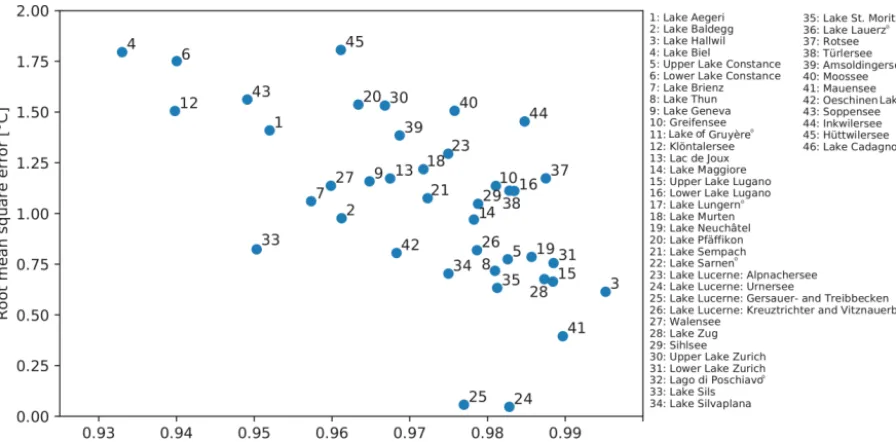
Out of the 46 calibrated lakes, the post-calibration root mean square error (RMSE) is<1◦C for 17 lakes, between 1 and 1.5◦C for 15 lakes, between 1.5 and 2◦C for eight lakes and between 2 and 3◦C for six lakes (Fig. 3). There were too few in situ observations on eight lakes to perform a proper calibration and all parameters were thereby set to default values. Overall, the performance is comparable to the RMSE range of∼0.7–2.1◦C reported in a recent global 32-lake modeling study using GLM (Bruce et al., 2018) also in-cluding Lake Geneva, Lake Constance, and Lake Zurich. The correlation coefficient remains always higher than 0.93, sug-gesting also that the model successfully reproduce the ther-mal structure of the investigated lakes. Overall, the quality of the results is better for lowland lakes than for high-altitude lakes where local meteorological and watershed information is often missing.
We illustrate the potential of high-frequency lake model data with two examples: first by briefly showing the long-term changes caused by climate change in Lake Brienz (Sect. 3.1), and secondly by investigating the differential re-sponse of lakes across Switzerland to episodic forcing (short-term extremes; Sect. 3.2).
3.1 Long-term evolution of the thermal structure of lakes in response to climate trends
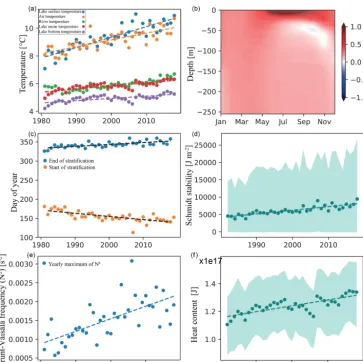
Over the period 1981–2015, yearly averaged simulated sur-face temperatures in Lake Brienz increased with a sig-nificant (p <0.001) trend of+0.69◦C decade−1 (Fig. 4a). For the same period, monthly in situ observations indi-cate a similar trend of 0.72◦C decade−1 (p∼0.07), while
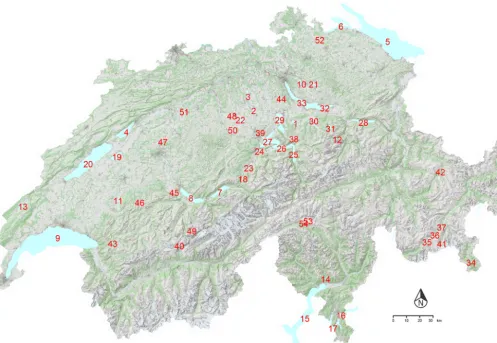
pe-Figure 2. Illustration of the interactive map displayed on the home page of the online platform: https://simstrat.eawag.ch (last access: 29 August 2019). The locations of the lakes discussed in this paper are also indicated with numbers (see Appendix A). Basemap source: Federal Office of Topography ©Swisstopo.
riod of 1981–2015, the ascending trend in solar radiation is 5 W m−2decade−1, which corresponds to an equilibrium temperature increase of about 0.2◦C decade−1. The warm-ing rate at the surface of Lake Brienz is larger than ob-served trends in neighboring lakes with reported increases of +0.46◦C decade−1 for upper Lake Constance (1984–2011;
Fink et al., 2014),+0.41◦C decade−1for lower Lake Zürich (1981–2013, Schmid and Köster, 2016; 1955–2013, Living-stone, 2003), and+0.55◦C decade−1for lower Lake Lugano (1972–2013; Lepori and Roberts, 2015). This can be ex-plained by the lower light penetration in Lake Brienz (rang-ing from∼1 to∼10 m) compared to other lakes, the increase in solar radiation being distributed into a shallower layer and thereby warming the lake surface slightly more. This low light penetration results from upstream hydropower opera-tion on the glacier-fed river (Finger et al. 2006).
The temperature increase was significantly smaller in the hypolimnion, with a minimum trend at the lake bot-tom of 0.16◦C decade−1 (p <0.001), leading to a depth-averaged rate of temperature increase of 0.22◦C decade−1
(p <0.001). The temperature difference between the inflow and the outflow also contributes to the heat budget. While no significant change in the yearly total discharge was observed at the gauging stations of FOEN for the inflows of the Aare and of the Lütschine rivers for the period 1981–2015, the weighted inflow temperature increased by 0.26◦C decade−1.
Figure 3.Performance of the model for the different lakes, as shown by the root mean square error (RMSE) and the correlation coefficient. Six lakes (with symbol•on the legend) with RMSE>2◦C are not shown.
discharge and its temperature resulting from climate change should therefore be taken into account in studies attempting to predict the change in lake thermal structure.
The vertically heterogeneous warming modeled in Lake Brienz is consistent with previous observations showing that the difference in warming between the surface and the bot-tom increases the strength and duration of the stratified period (Zhong et al., 2016; Wahl and Peeters, 2014). We simulate an earlier onset of the stratification in spring of −7.5 d decade−1 (p <0.001) and a later breakdown of the stratification by+3.7 d decade−1(p <0.001) (Fig. 4c). Both the warming trend and the increase in length of the strat-ified period increase the Schmidt stability (Fig. 4d) and heat content (Fig. 4f). Finally, the yearly maximum strat-ification strength (Brunt–Väisälä frequency; Fig. 4e) grad-ual increases over the investigated period with a rate of 3.3×10⁻⁴s−2decade−1. The simulated increase in overall stability (Fig. 4d–f) reduces vertical mixing and affects the vertical storage of heat with less heat transferred immedi-ately below the thermocline causing a slight decrease in tem-perature observed in autumn at∼30 m depth (Fig. 4b). This effect is even more clearly seen in other lakes like Lake Geneva (https://simstrat.eawag.ch/LakeGeneva, last access: 29 August 2019) with the surface waters warming strongly (+1◦C decade−1 in June), resulting in a cooling layer be-tween 20 and 60 m (−0.2◦C decade−1) in late summer. Such a reduction of vertical exchange is self-strengthening and en-hances the differential vertical warming.
Such analyses can be extended to all modeled lakes. An intercomparison of the temporal extent of summer stratifi-cation and winter ice cover period is illustrated in Fig. 5.
An altitude-dependent decrease of the duration of summer stratification is observed, along with a stronger correspond-ing increase in the duration of the inverse winter stratifica-tion from 1200 m a.s.l. This is possibly linked to an altitude dependency of climate-driven warming in Swiss lakes, first reported by Livingstone et al. (2005), which may be caused by a delay in meltwater runoff (Sadro et al., 2018). Here, this process is not directly resolved but incorporated through the calibration procedure spanning all seasons.
In conclusion, the online platform provides all the data to estimate the past warming rate of lakes and evaluate how the different external processes contribute to their heat budgets. The change in the thermal structure depends mostly on the change in atmospheric forcing, yet other factors such as the changes in discharge and temperature from the tributaries and the light absorption into the lake should also be taken into account. We specifically show that the warming rate of the lake surface temperature significantly differs from that of depth-averaged temperature, thereby highlighting the ben-efit of using either in situ observations resolving the ther-mal structure over the water column or hydrodynamic model output for assessing climate change impacts on lake thermal structure.
3.2 Event-based evolution of the lake thermal structure
pro-Figure 4.Evolution of several indicators for Lake Brienz over the period 1981–2018; all linear regression havepvalues0.001:(a)yearly mean lake surface temperature (0.69◦C decade−1), yearly mean air temperatures (0.49◦C decade−1), yearly mean tributary temperatures (0.26◦C decade−1), yearly mean lake temperatures (0.22◦C decade−1), and yearly mean bottom temperatures (0.16◦C decade−1), with linear regression, (b)contour plot of the linear temperature trend through depth and month,(c)yearly start (+3.7 d decade−1) and end (−7.5 d decade−1) days of summer stratification, with linear regression,(d)yearly mean (line), min, and max (shaded area) Schmidt stability, with linear regression,(e)yearly maximum Brunt–Väisälä frequency (3.3×10⁻⁴s−2decade−1), with linear regression,(f)yearly mean (line), min, and max (shaded area) heat content.
grams cannot resolve the impact of short-term events and their consequences for the ecosystem. This is a strength of high-frequency (hourly timescale) lake modeling, which al-lows for simulation and comparison of the effects associated with rapid and often severe events such as storms. Based on high-frequency observations, Woolway et al. (2018) showed the effects of a major storm on Lake Windermere. They ob-served a decrease in the strength of the stratification, a deep-ening of the thermocline and the onset of internal waves os-cillations ultimately upwelling oxygen-depleted cold water into the downstream river. Furthermore, Perga et al. (2018) illustrated how storms could be just as important as gradual long-term trends for changes in light penetration and thermal structure in an alpine lake.
Figure 5.Comparison of timing of stratification and ice cover for the considered lakes. The colored areas represent the mean periods of summer stratification (red) and ice cover (blue); the vertical lines represent the last year (here 2017). The transparency for the ice cover indicates the freezing frequency: full transparency means that ice was never modeled, while no transparency means that ice was modeled every winter. Lakes are ordered from left (low elevation) to right (high elevation). The time period of data used is indicated in Appendix A.
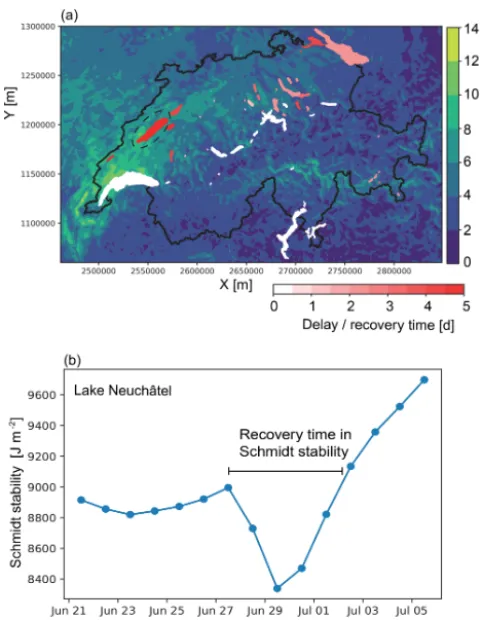
(Fig. 6b). This also resulted in a total increase of the lake heat content by∼1.4×10¹⁶J from the start of the storm to the time of recovery. We used the Schmidt stability recovery duration as a way to assess the short-term effect of the storm on the different modeled lakes. In Fig. 6a, lakes are colored based on the delay in Schmidt stability increase (in days) caused by the storm. The impact of the storm was not lim-ited to Lake Neuchâtel but rather showed a regionally vary-ing pattern. Particularly small- to medium-sized lakes in the northwestern parts of Switzerland were more affected than large lakes or lakes located in the southern part of Switzer-land. However, the thermal structure of these lakes quickly reverted to the seasonal early summer warming trend.
So far, climate-driven warming has been recognized to cause an overall increase in lake stratification strength and duration, and a gradual warming of the different layers (Schwefel et al., 2016; Zhong et al., 2016; Wahl and Peeters, 2014). Air temperature trend was the most studied forcing parameter. Yet, the dynamics of extreme events (such as heat waves, drought spells, storms), including their changes in strength and distribution, has been comparatively over-looked. Scenario exploration, climate change studies, or
his-torical forcing reanalysis should be integrated in such web-based hydrodynamic platforms to assess their roles in modi-fying the lake thermal structures and heat storage.
4 Conclusion
Figure 6. (a)Mean wind field on 28 June 2018 (data source: Me-teoSwiss, COSMO-1 model, coordinate system CH1903+) and de-lay in Schmidt stability increase for the modeled lakes: from no delay (white) to a delay of more than 5 d (red).(b)Schmidt stability (daily average) in Lake Neuchâtel during the period of the storm.
– For the public, the platform serves as an informative website enabling easy access to broad quantities of re-gional scientific results, with the intention of raising in-terest about lake ecosystem dynamics.
– For lake managers, the platform makes relevant infor-mation available, such as (i) near-real-time temperature and stratification conditions of the lakes and (ii) simple statistical analyses such as monthly temperature profiles and long-term temperature trends.
– For researchers, this work can facilitate (i) scenario modeling of any of the lakes, as the basic model setup is ready to use, (ii) improvement of the lake model with addition of previously unresolved processes (e.g., resuspension with changed light properties), (iii) ac-cess to variables that were previously not or irregularly available (e.g., vertical diffusivity, heat content, strati-fication, and heat fluxes), and (iv) specific comparative analyses, whereby a given question can be investigated simultaneously over many lakes (e.g., the impact of cli-mate change or a regional storm).
By promoting a cross exchange of expertise through openly sharing of in situ and model data at high frequency, this open-access data platform is a new path forward for sci-entists and practitioners.
Appendix A: Properties of the modeled lakes
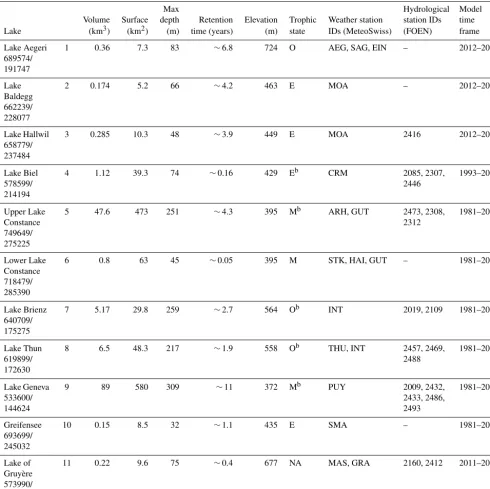
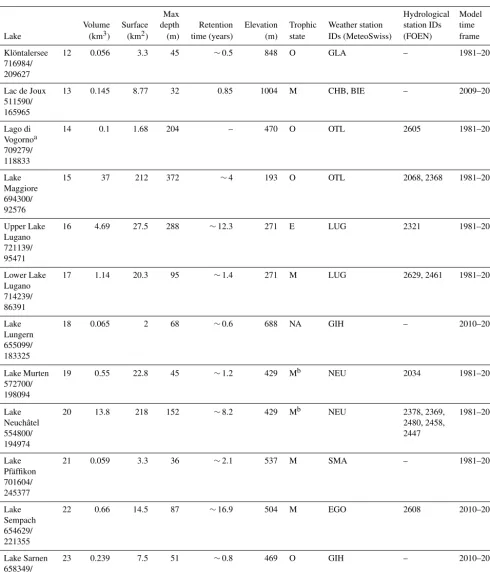
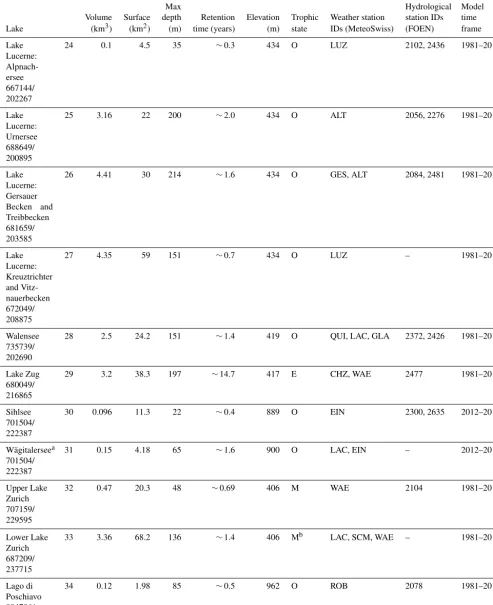
Table A1.This table summarizes the main properties of the 54 lakes we model in this work. The full dataset is available as a JSON file. The superscript “a” after the lake name indicates that this lake was not calibrated due to the lack of observational data. MeteoSwiss is the (Swiss) Federal Office of Meteorology and Climatology. FOEN is the (Swiss) Federal Office for the Environment. The superscript “b” indicates lakes where Secchi disk depths are available. For lakes with clearly defined multiple basins such as Lake Lucerne, Lake Zurich, Lake Constance and Lake Lugano, each basin is considered as a separated lake connected to the other basins by inflows/outflows.
Max Hydrological Model
Volume Surface depth Retention Elevation Trophic Weather station station IDs time Lake (km3) (km2) (m) time (years) (m) state IDs (MeteoSwiss) (FOEN) frame
Lake Aegeri 689574/ 191747
1 0.36 7.3 83 ∼6.8 724 O AEG, SAG, EIN – 2012–2018
Lake Baldegg 662239/ 228077
2 0.174 5.2 66 ∼4.2 463 E MOA – 2012–2018
Lake Hallwil 658779/ 237484
3 0.285 10.3 48 ∼3.9 449 E MOA 2416 2012–2018
Lake Biel 578599/ 214194
4 1.12 39.3 74 ∼0.16 429 Eb CRM 2085, 2307, 2446
1993–2018
Upper Lake Constance 749649/ 275225
5 47.6 473 251 ∼4.3 395 Mb ARH, GUT 2473, 2308, 2312
1981–2018
Lower Lake Constance 718479/ 285390
6 0.8 63 45 ∼0.05 395 M STK, HAI, GUT – 1981–2018
Lake Brienz 640709/ 175275
7 5.17 29.8 259 ∼2.7 564 Ob INT 2019, 2109 1981–2018
Lake Thun 619899/ 172630
8 6.5 48.3 217 ∼1.9 558 Ob THU, INT 2457, 2469, 2488
1981–2018
Lake Geneva 533600/ 144624
9 89 580 309 ∼11 372 Mb PUY 2009, 2432, 2433, 2486, 2493
1981–2018
Greifensee 693699/ 245032
10 0.15 8.5 32 ∼1.1 435 E SMA – 1981–2018
Lake of Gruyère 573990/ 168654
Table A1.Continued.
Max Hydrological Model
Volume Surface depth Retention Elevation Trophic Weather station station IDs time Lake (km3) (km2) (m) time (years) (m) state IDs (MeteoSwiss) (FOEN) frame
Klöntalersee 716984/ 209627
12 0.056 3.3 45 ∼0.5 848 O GLA – 1981–2018
Lac de Joux 511590/ 165965
13 0.145 8.77 32 0.85 1004 M CHB, BIE – 2009–2018
Lago di Vogornoa 709279/ 118833
14 0.1 1.68 204 – 470 O OTL 2605 1981–2018
Lake Maggiore 694300/ 92576
15 37 212 372 ∼4 193 O OTL 2068, 2368 1981–2018
Upper Lake Lugano 721139/ 95471
16 4.69 27.5 288 ∼12.3 271 E LUG 2321 1981–2018
Lower Lake Lugano 714239/ 86391
17 1.14 20.3 95 ∼1.4 271 M LUG 2629, 2461 1981–2018
Lake Lungern 655099/ 183325
18 0.065 2 68 ∼0.6 688 NA GIH – 2010–2018
Lake Murten 572700/ 198094
19 0.55 22.8 45 ∼1.2 429 Mb NEU 2034 1981–2018
Lake Neuchâtel 554800/ 194974
20 13.8 218 152 ∼8.2 429 Mb NEU 2378, 2369, 2480, 2458, 2447
1981–2018
Lake Pfäffikon 701604/ 245377
21 0.059 3.3 36 ∼2.1 537 M SMA – 1981–2018
Lake Sempach 654629/ 221355
22 0.66 14.5 87 ∼16.9 504 M EGO 2608 2010–2018
Lake Sarnen 658349/ 190767
Table A1.Continued.
Max Hydrological Model
Volume Surface depth Retention Elevation Trophic Weather station station IDs time Lake (km3) (km2) (m) time (years) (m) state IDs (MeteoSwiss) (FOEN) frame
Lake Lucerne: Alpnach-ersee 667144/ 202267
24 0.1 4.5 35 ∼0.3 434 O LUZ 2102, 2436 1981–2018
Lake Lucerne: Urnersee 688649/ 200895
25 3.16 22 200 ∼2.0 434 O ALT 2056, 2276 1981–2018
Lake Lucerne: Gersauer Becken and Treibbecken 681659/ 203585
26 4.41 30 214 ∼1.6 434 O GES, ALT 2084, 2481 1981–2018
Lake Lucerne: Kreuztrichter and Vitz-nauerbecken 672049/ 208875
27 4.35 59 151 ∼0.7 434 O LUZ – 1981–2018
Walensee 735739/ 202690
28 2.5 24.2 151 ∼1.4 419 O QUI, LAC, GLA 2372, 2426 1981–2018
Lake Zug 680049/ 216865
29 3.2 38.3 197 ∼14.7 417 E CHZ, WAE 2477 1981–2018
Sihlsee 701504/ 222387
30 0.096 11.3 22 ∼0.4 889 O EIN 2300, 2635 2012–2018
Wägitalerseea 701504/ 222387
31 0.15 4.18 65 ∼1.6 900 O LAC, EIN – 2012–2018
Upper Lake Zurich 707159/ 229595
32 0.47 20.3 48 ∼0.69 406 M WAE 2104 1981–2018
Lower Lake Zurich 687209/ 237715
33 3.36 68.2 136 ∼1.4 406 Mb LAC, SCM, WAE – 1981–2018
Lago di Poschiavo 804706/ 128871
Table A1.Continued.
Max Hydrological Model
Volume Surface depth Retention Elevation Trophic Weather station station IDs time Lake (km3) (km2) (m) time (years) (m) state IDs (MeteoSwiss) (FOEN) frame
Lake Sils 776533/ 143922
35 0.137 4.1 71 ∼2.2 1797 O SIA – 2014–2018
Lake Silva-plana 780801/ 146926
36 0.14 2.7 77 ∼0.7 1791 O SIA – 2014–2018
Lake St. Moritz 784870/ 152099
37 0.02 0.78 44 ∼0.1 1768 O SAM 2105 1981–2018
Lake Lauerz 688864/ 209546
38 0.0234 3.07 14 ∼0.3 447 M GES, LUZ – 1981–2018
Rotsee 666491/ 213558
39 0.00381 0.48 16 ∼0.4 419 E LUZ – 1981–2018
Daubenseea 613862/ 140026
40 0.64 50 NA 2207 O BLA – 2013–2018
Lej da Vadreta 785308/ 141515
41 0.43 50 NA 2160 O SIA – 2014–2018
Lake Davosa 784261/ 188317
42 0.0156 0.59 54 NA 1558 O DAV – 1981–2018
Lac de l’Hongrina 569975/ 141537
43 0.0532 1.6 105 NA 1250 O CHD – 2012–2018
Türlersee 680514/ 235858
44 0.00649 0.497 22 ∼2 643 E WAE – 1981–2018
Amsoldinger-see
610534/ 174906
45 0.00255 0.382 14 NA 641 Eb THU – 2012–2018
Lac Noira 587970/ 168280
46 0.00252 0.47 10 NA 1045 M PLF – 1989–2018
Moossee 603165/ 207928
47 0.00339 0.31 21 NA 521 E BER – 1981–2018
Mauensee 648258/ 224587
Table A1.Continued.
Max Hydrological Model
Volume Surface depth Retention Elevation Trophic Weather station station IDs time Lake (km3) (km2) (m) time (years) (m) state IDs (MeteoSwiss) (FOEN) frame
Oeschinen Lake 622116/ 149701
49 0.0402 1.11 56 ∼1.6 1578 O ABO – 1983–2018
Soppensee 648765/ 215720
50 0.00286 0.25 27 ∼3.1 596 E EGO – 2010–2018
Inkwilersee 617009/ 227527
51 0.00094 0.102 6 ∼0.1 461 Eb KOP – 2011–2018
Hüttwilersee 705538/ 274275
52 0.34 28 NA 434 E HAI – 2010–2018
Lake Cadagno 697683/ 156223
53 0.00242 0.26 21 ∼1.5 1921 E PIO – 1981–2018
Lago Ritoma 695933/ 155169
Table A2.Meteorological stations.
Meteorological Altitude Coordinates station Abbreviation (m a.s.l) (CH)
Oberägeri AEG 724 688728/220956 Sattel SAG 790 690999/215145 Einsiedeln EIN 911 699983/221068 Mosen MOA 453 660128/232851 Cressier CRM 430 571163/210797 Altenrhein ARH 398 760382/261387 Güttingen GUT 440 738422/273963 Steckborn STK 397 715871/280916 Salen-Reutenen HAI 719 719099/279047 Interlaken INT 577 633023/169092 Thun THU 570 611201/177640 Pully PUY 456 540819/151510 Zürich/
Fluntern
SMA 556 685117/248066
Marsens MAS 715 571758/167317 Fribourg/Posieux GRA 651 575184/180076 Les Charbonnières CHB 1045 513821/169387 Bière BIE 684 515888/153210 Locarno/Monti OTL 367 704172/114342 Lugano LUG 273 717874/95884 Giswil GIH 471 657322/188976 Neuchâtel NEU 485 563087/205560 Egolzwil EGO 522 642913/225541 Luzern LUZ 454 665544/209850 Altdorf ALT 438 690180/193564 Gersau GES 521 682510/205572 Quinten QUI 419 734848/221278 Laschen/
Galgenen
LAC 468 707637/226334
Glarus GLA 517 723756/210568 Cham CHZ 443 677758/226878 Wädenswil WAE 485 693847/230744 Schmerikon SCM 408 713725/231533 Plaffeien PLF 1042 586825/177407 Segl-Maria SIA 1804 778575/144977 Blatten,
Lötschental
BLA 1538 629564/141084
Adelboden ABO 1322 609350/149001 Piotta PIO 990 695880/152265
Appendix B: Ice module
The ice and snow module employed is based on the work of Leppäranta (2014, 2010) and Saloranta and Andersen (2007), and includes the following physical processes:
– air-temperature-dependent formation and growth of black ice, including the insulating effect of a snow cover;
– snow layer build-up, including the compression effect due to the weight of fresh snow;
– buoyancy-driven formation of white ice;
– shortwave irradiance reflection and penetration into the underlying water column; and
– melting of snow, white and black ice due to both the direct heat flux through the atmospheric interface and the absorption of shortwave irradiance.
Three layers are used to represent black ice, white ice, and snow. An instant supply of water through cracks in the black ice is assumed to occur in order to form white ice. The water stored in ice and snow is neither withdrawn during ice forma-tion nor added during melting to the water balance. Further-more, the effect of liquid water pools on top of or between the layers is neglected.
B1 Below the freezing point (ice formation)
The ice module is activated as the water temperature in the topmost grid cellTw (◦C) drops below the freezing
temper-atureTf (◦C).Tf can be set to zero for a vertical grid size
≤0.5 m; the user can adapt (raise) this value to fit coarser grids. If temperature is below the freezing point, the energy incorporated into the change of stateEfis calculated as
Ef=ρwcpwz1(Tf−Tw). (B1)
Here,ρw(1000 kg m−3) is the density of freshwater,cpwthe
heat capacity of water (4182 J kg−1◦C−1), andz1the height
of the topmost grid cell.Ef and the latent heat of freezing
lh(3.34×10⁵J kg−1) as well as the density of black iceρib
(916.2 kg m−3) are used for calculating the initial height of
black icehib(m) in Eq. (B2); thereafter,Twis set equal toTf:
hib=Ef/ (lhρib) . (B2)
If ice cover is present and if the atmospheric temperature Ta (◦C) is smaller than or equal toTf, the growth of black
ice dhib/dt continues as described in Saloranta and
Ander-sen (2007). dhib
dt =
p
2ki/ (ρib×lh)×(Tf−Ti) (B3)
Here,ki(2.22 W K−1m−1) is the thermal conductivity of ice
at 0◦C andTi(◦C) the ice temperature calculated as
Ti=
P Tf+Ta
1+P (B4)
P =max
kihs
kshib
, 1 10hib
. (B5)
There,ks(0.2 W K−1m−1) is the thermal conductivity of
snow and hs (m) the height of the snow layer. When Ta
is smaller than the snow temperature (default set to 2◦C), water-equivalent precipitationpr(m h−1) is turned into fresh
snowhs_new(m) as
hs_new=pr
ρw
ρs0
, (B6)
whereρs0(250 kg m−3) is the initial snow density. The
Eqs. B7 and B8) by the new layer as described in Yen (1981); thereafter, the new and existing layers are combined in both height and density (second terms of Eqs. B7 and B8).
dhs
dt = −hs
1− ρs [ρs+dρs]
+hs_new (B7)
dρs
dt =ρsC1wse −C2ρs−
ρs−
ρshs+ρs0hs_new
hs+hs_new
(B8) Here,ρs(kg m−3) is the snow layer density kept withinρs0<
ρs< ρsmwith the maximum snow density set to 450 kg m−3,
C1(5.8 m−1h−1) andC2(0.021 m3kg−1) are snow
compres-sion constants, andws(m) is the total weight above the layer
under compression expressed in water-equivalent height. If the snow massms (kg m−2) becomes heavier than the
upward acting buoyancy force Bi(kg m−2), white ice with
heighthiw(m) and densityρiw(875 kg m−3; Saloranta, 2000)
is formed between the snow and the black ice layers to achieve equilibrium betweenBiandms.
Bi=hib(ρw−ρib)+hiw(ρw−ρiw) (B9)
dhiw
dt =
ms−Bi
ρs
(B10) In this model, we assume continuous supply of water through cracks in the black ice to form white ice. The forma-tion of white ice takes place instantaneously each time step and we do not consider the influence of pools under the snow for melting or shortwave irradiance penetration.
B2 Above the freezing point (melting)
If ice cover is present and if Ta> Tf, melting starts. Each
layer melts from above through the atmospheric interface and by penetrating shortwave radiation:
dhx_upper
dt = −
Hx_y (lh+le) ρx
, (B11)
where Hx_y (W m−2) is the layer-dependent heat flux (in the following, subscriptxrepresents the subscript letters “s”, “iw”, or “ib”). The model supports melting through both sub-limation (solid to gas) and non-subsub-limation (solid to liquid) with the inclusion/exclusion of the latent heat of evapora-tion le (J kg−1). Non-sublimation melting is default with le
set to zero; for sublimation melting, the user can set le to
2265 kJ kg−1. For the uppermost layer (y=top; Eq. B12),
the heat flux includes layer-dependent uptake of shortwave radiationHs_x, longwave absorptionHa, or layer-dependent
emissionHw_x, as well as sensibleHkand latentHvheat. If
the layer is not in direct contact with the atmosphere, only Hsis used for melting from above (y=under; Eq. B13).
Hx_top=Hs_x+Ha+Hw_x+Hk+Hv (B12)
Hx_under=Hs_x (B13)
Here, we follow Leppäranta (2014, 2010) for determining the heat flux terms in Eq. (B12). The transmittance of shortwave
irradiance through each layer depends on each layer’s thick-nesshx as well as on the layer-specific bulk attenuation co-efficientλx(m−1; defaultλ
s=24,λiw=3, andλib=2;
Lep-päranta, 2014). Hs_s=IsAp(1−Ax)
1−e(−λshs) (B14) Hs_iw=IsAp(1−Ax)
e(−λshs)−e(−λshs−λiwhiw) (B15) Hs_ib=IsAp(1−Ax)
e(−λshs−λiwhiw)
−e(−λshs−λiwhiw−λibhib) (B16) Hs_w=IsAp(1−Ax)
1−e(−λshs−λiwhiw−λibhib). (B17) There,Hs_w is the radiation penetrating through the ice
cover to the water below andIs(W m−2) the incoming
short-wave irradiance. We introduce the albedo parameter Ap,
which tunes shortwave irradiance in order to match observed water temperatures, thus adjusting the melting and indirectly the duration of the ice cover. Furthermore, depending on which layer is in contact with the atmosphere, we use a layer-dependent constant albedoAx(defaultAs=0.7,Aiw=0.4,
andAib=0.3; Leppäranta, 2014).
Ax
As, hs>0
Aiw, hs=0 &hiw>0
Aib, hs+hiw=0
(B18)
Calculating Ha requires the longwave emission
param-eters ka=0.68, kb=0.036 (mbar−1), and kc=0.18
(Lep-päranta, 2010), atmospheric water vapor pressureea(mbar),
cloud coverC, and the Stefan–Boltzmann constantσ (5.67× 10⁻⁸W m−2K−4). For Eqs. (B19) and (B20), the temper-ature Tx is given in Kelvin. Hw_x is layer dependent for the emissivity Ex with Eiw=Eib=0.97 and Es(ρs) from
0.8 at ρs=250 kg m−3 to Es=0.9 for ρs=450 kg m−3.
Calculating Hk and Hv requires the atmospheric density
ρa=1.2 kg m−3, the heat capacity of aircpa=1005 J kg−1
K−1, the wind speed at 10 m height w10, the convective
(bc) and latent (bl) bulk exchange coefficients both set to
0.0015 (Leppäranta, 2010; Gill, 1982), as well as the spe-cific humidity of both measuredqa (mbar) and at saturation
q0. There,qa=0.622ea/pa, wherepais the air pressure and
q0=0.622×6.11/paatTa=0◦C (Leppäranta, 2014).
Ha=
ka+kb
√ ea
h
1+kcC2
i
σ Ta4 (B19)
Hw_x=Exσ Tf4 (B20)
Hk=ρacpabc(Ta−Tf) w10 (B21)
Hv=ρalhbl(qa−q0) w10 (B22)
As Hs_w warms the water under the ice, melting takes
place from underneath with the energyHbottom(W m−2):
After obtainingHbottom, the temperature of the first cell is
set toTfand the decrease of ice cover from below becomes
dhx_lower
dt = −
Hbottom
lmρx
. (B24)
Equation (B24) is only applied tohibandhiw. In principle,
hs melts completely from above using Eq. (B11) beforehib
andhiwreach zero; however, if no ice is present,hsis set to
zero. By combining Eqs. (B11) and (B24), the total melting of each ice layer is calculated as
dhx dt =
dhx_lower
dt +
dhx_upper
dt . (B25)
Whenhx<0 due to melting, the surplus energy is used for melting neighboring layers according to the following proce-dure: if the melting is initiated from above, the surplus energy is used to melt the layer directly underneath; if the melting is caused by the water below, the layer directly above receives the surplus melting energy; ifhib<=hiw<=0, the water in
the topmost grid cell is heated with the remaining energy. B3 Ice model performance
To test the ice module, Simstrat was calibrated in Sihlsee with PEST using monthly resolved vertical temperature pro-files (2006 to 2008, RMSE 1.2◦C) for four parameters in-cluding the new p_albedo parameter for scaling snow/ice albedo. Modeled and monthly measured total ice cover from 2012 to 2018 is shown in Fig. B1 (RMSE of 0.078 m). The modeled thickness agrees well with measurements during years with an extensive ice covered period (2013, 2014, and 2017, max height >5 cm). The model performance is not ideal for years with short temporal ice duration and thin ice thickness (2016 and 2018, max height<5 cm). During these years, the quality of the forcing dataset becomes crucial. In the case of Sihlsee, the timing and duration of snowfall pro-long the duration of the ice-covered period. We use the me-teorological station at Samedan (SAM) located 4 km from the lake in a region with rapid topographical change. This, in combination with monthly ice thickness measurements, re-sults in the divergence during 2016 and 2018.
Appendix C: Estimation of clear-sky solar radiation
The algorithm below is based on the equations from the lake HeatFluxAnalyzer (see http://heatfluxanalyzer.gleon. org/, last access: 29 August 2019), following the methods of Meyers and Dale (1983):
– declination of the Sun (rad): δ=sin−1
−0.39779 cos2πDOYs 365.24
, where DOYs is the day
of year after the winter solstice (21 December); – cosine of the solar zenith angle (–): cosZ=
maxsinϕsinδ+cosϕcosδcosπ (Hh12−12.5),0, where
Figure B1.Ice model performance in Sihlsee (2012 to 2018) show-ing modeled white ice (orange), black ice (green), and total ice cover (white and black ice combined, in blue) against measurements (black).
ϕis the latitude in radians andH is the hour of the day, assuming the solar noon is at 12:30 LT;
– air mass thickness coefficient (–): m=35 cosZ (1244cos2Z+1)−0.5;
– dew point temperature (◦C): Td=243.5 log6p.112w
17.67−log pw 6.112
+33.8, wherepw(mbar) is the water
vapor pressure;
– precipitable water vapor (cm): wp=
e0.1133−log(G+1)+0.0393(1.8Td+32), where G is an empirical constant dependent on latitude and day of year (see tables from Smith, 1966);
– attenuation coefficient for water vapor (–): λw=1−
0.077(wpm)0.3;
– attenuation coefficient for aerosols (–):λa=0.935m; – attenuation coefficient for Rayleigh scattering
and permanent gases (–): λRg=1.021−0.084
(m (0.000949pa+0.051))0.5, where pa (mbar) is the
air pressure;
– effective solar constant (W m−2): Ieff=1353(1+
0.034 cos2365πDOY.24, where DOY is the day of year; and – clear-sky solar radiation (W m−2):Hcs=Ieff×cosZ×
Author contributions. The new version of Simstrat was developed by FB, AG, and LRV. The workflow was developed by AG. The ice model was developed by LVR. The concept of the workflow was de-fined by DB. All authors contributed to the validation of the model and interpretation of the results. AG and DB wrote the manuscript with contributions from FB, LVR, and MS.
Competing interests. The authors declare that they have no conflict of interest.
Acknowledgements. We thank Davide Vanzo for helping with the docker and the scripts, and Michael Pantic for helping restructuring version 2.1 of Simstrat. We finally thank Marie-Elodie Perga for her comments on a preliminary version of the paper. The full list of ac-knowledgements regarding in situ observations can be found here: https://simstrat.eawag.ch/impressum (last access: 29 August 2019).
Review statement. This paper was edited by Min-Hui Lo and re-viewed by three anonymous referees.
References
Antenucci, J. and Imerito, A.: The CWR dynamic reservoir simula-tion model DYRESM, Science Manual, The University of West-ern Australia, Perth, Australia, 2000.
Bärenbold, F., Gaudard, A., and Raman Vinna, L.: Simstrat v2.1 (Version v2.1), Zenodo, https://doi.org/10.5281/zenodo.2600709, 2019.
Bruce, L. C., Frassl, M. A., Arhonditsis, G. B., Gal, G., Hamil-ton, D. P., Hanson, P. C., HetheringHamil-ton, A. L., Melack, J. M., Read, J. S., Rinke, K., Rigosi, A., Trolle, D., Winslow, L., Adrian, R., Ayala, A. I., Bocaniov, S. A., Boehrer, B., Boon, C., Brookes, J. D., Bueche, T., Busch, B. D., Copetti, D., Cortés, A., de Eyto, E., Elliott, J. A., Gallina, N., Gilboa, Y., Guyen-non, N., Huang, L., Kerimoglu, O., Lenters, J. D., MacIn-tyre, S., Makler-Pick, V., McBride, C. G., Moreira, S., Özkun-dakci, D., Pilotti, M., Rueda, F. J., Rusak, J. A., Samal, N. R., Schmid, M., Shatwell, T., Snorthheim, C., Soulignac, F., Valerio, G., van der Linden, L., Vetter, M., Vinçon-Leite, B., Wang, J., Weber, M., Wickramaratne, C., Woolway, R. I., Yao, H., and Hipsey, M. R.: A multi-lake comparative analysis of the General Lake Model (GLM): Stress-testing across a global observatory network, Environ. Model. Softw., 102, 274–291, https://doi.org/10.1016/j.envsoft.2017.11.016, 2018.
Burchard, H., Bolding, K., and Villarreal, M. R.: GOTM, a general ocean turbulence model: theory, implementation and test cases, Space Applications Institute, 1999.
Carlson, R. E.: A trophic state index for lakes, Limnol. Oceanogr., 22, 361–369, 1977.
Doherty, J.: PEST, Model-independent parameter estimation – User manual (5th edn., with slight additions): Brisbane, Aus-tralia, Watermark Numerical Computing, available at: http:// www.pesthomepage.org/ (last access: 29 August 2019), 2010. Doherty, J.: PEST: Model-Independent Parameter Estimation, 6th
edn., Watermark Numerical Computing, Australia, 2016.
Fink, G., Schmid, M., Wahl, B., Wolf, T., and Wüest, A.: Heat flux modifications related to climate-induced warming of large Euro-pean lakes, Water Resour. Res., 50, 2072–2085, 2014.
Gaudard, A.: Simstrat-WorkflowModellingSwissLakes (Version v1.0), Zenodo, https://doi.org/10.5281/zenodo.2607153, 2019. Gaudard, A., Schwefel, R., Vinnå, L. R., Schmid, M., Wüest, A.,
and Bouffard, D.: Optimizing the parameterization of deep mix-ing and internal seiches in one-dimensional hydrodynamic mod-els: a case study with Simstrat v1.3, Geosci. Model Dev., 10, 3411–3423, https://doi.org/10.5194/gmd-10-3411-2017, 2017. Gelman, A., Carlin, J., Stern, H., and Rubin, D.: Bayesian Data
Analysis, 3rd edn., Chapman and Hall/CRC, New York, 2013. Gill, A. E.: Atmosphere-Ocean Dynamics, Academic Press, San
Diego, California, USA, ISBN 0-12-283520-4, 1982.
Goudsmit, G.-H., Burchard, H., Peeters, F., and Wüest, A.: Ap-plication of k− turbulence models to enclosed basins: The role of internal seiches, J. Geophys. Res.-Oceans, 107, 3230, https://doi.org/10.1029/2001JC000954, 2002.
Gray, D. K., Hampton, S. E., O’Reilly, C. M., Sharma, S., and Cohen, R. S.: How do data collection and processing meth-ods impact the accuracy of long-term trend estimation in lake surface-water temperatures?, Limnol. Oceanogr.-Meth., 16, 504– 515, https://doi.org/10.1002/lom3.10262, 2018.
Hamilton, D. P., Carey, C. C., Arvola, L., Arzberger, P., Brewer, C., Cole, J. J., Gaiser, E., Hanson, P. C., Ibelings, B. W., Jen-nings, E., Kratz, T. K., Lin, F.-P., McBride, C. G., Marques, M. D. de, Muraoka, K., Nishri, A., Qin, B., Read, J. S., Rose, K. C., Ryder, E., Weathers, K. C., Zhu, G., Trolle, D., and Brookes, J. D.: A Global Lake Ecological Observatory Network (GLEON) for synthesising high-frequency sensor data for valida-tion of deterministic ecological models, Inland Waters, 5, 49–56, https://doi.org/10.5268/IW-5.1.566, 2015.
Hipsey, M. R., Bruce, L. C., and Hamilton, D. P.: GLM – General Lake Model. Model overview and user information, Technical Manual, The University of Western Australia, Perth, Australia, available at: http://swan.science.uwa.edu.au/downloads/AED_ GLM_v2_0b0_20141025.pdf (last access: 29 August 2019), 2014.
Jennings, E., Eyto, E., Laas, A., Pierson, D., Mircheva, G., Nau-moski, A., Clarke, A., Healy, M., Šumberová, K., and Langen-haun, D.: The NETLAKE Metadatabae – A Tool to Support Au-tomatic Monitoring on Lakes in Europe and Beyond, Limnol. Oceanogr., 26, 95–100, https://doi.org/10.1002/lob.10210, 2017. Kiefer, I., Odermatt, D., Anneville, O., Wüest, A., and Bouf-fard, D.: Application of remote sensing for the optimization of in-situ sampling for monitoring of phytoplankton abun-dance in a large lake, Sci. Total Environ., 527–528, 493–506, https://doi.org/10.1016/j.scitotenv.2015.05.011, 2015.
Lepori, F., and Roberts, J. J.: Past and future warming of a deep European lake (Lake Lugano): What are the climatic drivers?, J. Great Lakes Res., 41, 973–981, 2015.
Leppäranta, M.: Modelling the Formation and Decay of Lake Ice, in: The Impact of Climate Change on European Lakes, edited by: George, G., Springer Netherlands, Dordrecht, 63–83, 2010. Leppäranta, M.: Freezing of lakes and the evolution of their ice
cover, Springer, New York, 2014.
Livingstone, D. M., Lotter, A. F., and Kettle, H.: Altitude-dependent differences in the primary physical response of mountain lakes to climatic forcing, Limnol. Oceanogr., 50, 1313–1325, 2005. Meyers, T. P. and Dale, R. F.: Predicting Daily
Insola-tion with Hourly Cloud Height and Coverage, J. Cli-mate Appl. Meteor., 22, 537–545, https://doi.org/10.1175/1520-0450(1983)022< 0537:PDIWHC> 2.0.CO;2, 1983.
Mironov, D. V.: Parameterization of lakes in numerical weather pre-diction – Part 1: Description of a lake model, German Weather Service, Offenbach am Main, Germany, 2005.
Perga, M.-E., Bruel, R., Rodriguez, L., Guénand, Y., and Bouffard, D.: Storm impacts on alpine lakes: Antecedent weather condi-tions matter more than the event intensity, Glob. Chang. Biol., 24, 5004–5016, https://doi.org/10.1111/gcb.14384, 2018. Perroud, M., Goyette, S., Martynov, A., Beniston, M., and
An-neville, O.: Simulation of multiannual thermal profiles in deep Lake Geneva: A comparison of one-dimensional lake models, Limnol. Oceanogr., 54, 1574–1594, 2009.
Poole, H. H. and Atkins, W. R. G.: Photo-electric measurements of submarine illumination throughout the year, J. Mar. Biol. Assoc. UK, 16, 297–324, 1929.
Råman Vinnå, L., Wüest, A., Zappa, M., Fink, G., and Bouffard, D.: Tributaries affect the thermal response of lakes to climate change, Hydrol. Earth Syst. Sci., 22, 31–51, https://doi.org/10.5194/hess-22-31-2018, 2018.
Riley, M. J. and Stefan, H. G.: Minlake: A dynamic lake wa-ter quality simulation model, Ecol. Model., 43, 155–182, https://doi.org/10.1016/0304-3800(88)90002-6, 1988.
Sadro, S., Sickman, J. O., Melack, J. M., and Skeen, K.: Effects of Climate Variability on Snowmelt and Implications for Organic Matter in a High-Elevation Lake, Water Resour. Res., 54, 4563– 4578, https://doi.org/10.1029/2017WR022163, 2018.
Saloranta, T. M.: Modeling the evolution of snow, snow ice and ice in the Baltic Sea, Tellus A, 52, 93–108, https://doi.org/10.1034/j.1600-0870.2000.520107.x, 2000. Saloranta, T. M. and Andersen, T.: MyLake – A multi-year lake
sim-ulation model code suitable for uncertainty and sensitivity anal-ysis simulations, Ecol. Model., 207, 45–60, 2007.
Schmid, M., Hunziker, S., and Wüest, A.: Lake surface tempera-tures in a changing climate: a global perspective, Clim. Change, 124, 301–305, 2014.
Schmid, M. and Köster, O.: Excess warming of a Central European lake driven by solar brightening, Water Resour. Res., 52, 8103– 8116, https://doi.org/10.1002/2016WR018651, 2016.
Schwefel, R., Gaudard, A., Wüest, A., and Bouffard, D.: Ef-fects of climate change on deep-water oxygen and winter mix-ing in a deep lake (Lake Geneva)–Comparmix-ing observational findings and modeling, Water Resour. Res., 52, 8811–8826, https://doi.org/10.1002/2016WR019194, 2016.
Smith, W. L.: Note on the Relationship Between Total Precipitable Water and Surface Dew Point, J. Appl. Meteor., 5, 726–727, https://doi.org/10.1175/1520-0450(1966)005< 0726:NOTRBT> 2.0.CO;2, 1966.
Stepanenko, V., Mammarella, I., Ojala, A., Miettinen, H., Lykosov, V., and Vesala, T.: LAKE 2.0: a model for temperature, methane, carbon dioxide and oxygen dynamics in lakes, Geosci. Model Dev., 9, 1977–2006, https://doi.org/10.5194/gmd-9-1977-2016, 2016.
Thiery, W., Stepanenko, V. M., Fang, X., Jöhnk, K. D., Li, Z., Martynov, A., Perroud, M., Subin, Z. M., Darchambeau, F., Mironov, D. V., and Van Lipzig, N. P. M.: LakeMIP Kivu: evaluating the representation of a large, deep tropical lake by a set of one-dimensional lake models, Tellus A, 66, 21390, https://doi.org/10.3402/tellusa.v66.21390, 2014.
Wahl, B. and Peeters, F.: Effect of climatic changes on stratification and deep-water renewal in Lake Constance assessed by sensitiv-ity studies with a 3D hydrodynamic model, Limnol. Oceanogr., 59, 1035–1052, https://doi.org/10.4319/lo.2014.59.3.1035, 2014.
Woolway, R. I., Simpson, J. H., Spiby, D., Feuchtmayr, H., Pow-ell, B., and Maberly, S. C.: Physical and chemical impacts of a major storm on a temperate lake: a taste of things to come?, Clim. Change, 151, 333–347, https://doi.org/10.1007/s10584-018-2302-3, 2018.
Yen, Y. C.: Review of thermal properties of snow, ice and sea ice, Cold Regions Research and Engineering Laboratory, Hanover, New Hampshire, 1981.