journal homepage: http://civiljournal.semnan.ac.ir/
Performance Evaluation of a Trunk-A Road in North
Central Nigeria
M. Alhassan1and M. Mohammed Alhaji2 ⃰
1. Civil Engineering Department, Federal University of Technology, Minna, Niger State, Nigeria 2. Civil Engineering Department, Federal University of Technology, Minna, Niger State, Nigeria
Corresponding author:[email protected]
ARTICLE INFO ABSTRACT
Article history:
Received: 09 August 2018 Accepted: 20 December 2019
Pavement maintenance and rehabilitation have been neglected in Nigeria for a very long time and has resulted to maintenance backlog. Design agencies in Nigeria still use California Bearing Ratio (CBR), even though the method is outdated. An introduction of Dynamic Cone Penetration Test (DCPT) was pertinent, even though the method is relatively old in some developed countries, it has not gain much prominence in Nigeria. A flexible pavement, constructed from Bida to Mokwa,, Nigeria, was Rehabilitated after 22 years of construction. This was done by placement of stone base course in one section and lateritic base course in the other. The stretch of the road was then overlaid with asphalt surfacing. Before commencement of the rehabilitation, DCPT tests were conducted on the road to evaluate performance of the pavement base and subgrade. Two years after the rehabilitation, an evaluation was carried out at five selected positions (two at crushed stone base and three at lateritic base) to evaluate the performance of the two base courses. The evaluation was carried out by coring the asphalt concrete and DCPT test below the hole created by corer to indirectly estimate the in-situ CBR of the base and subgrade courses. The results from both the stone base and lateritic base sections satisfy the minimum specifications based on standard. The study also showed that pavement failure along the road is not as a result of the materials used in the base course, but as a result of the excessive axle loads experienced by the road.
Keywords:
California Bearing Ratio, Dynamic Cone Penetration Test, Marshall Stability,
North Central Nigeria, Trunk-A Road.
1. Introduction
Road is a facility used for the movement of man, goods and services, from one location
which require a lot of investment and it account for over 90% of human and fret movement in Nigeria [3].
According to Central Bank of Nigeria (CBN) [4], estimated 194,000Km of road network exist in Nigeria. These road network systems
are classified, according to Okigbo [5], into four categories which are:
Trunk A roads which are owned by the Federal Government and are constructed and maintained by the Ministry of Works and Housing.
Trunk F roads are originally owned by the states governments but are acquired by the Federal Government of Nigeria and upgraded them. Trunk A and F account for 17% of the total road network in Nigeria.
Trunk B roads are constructed, owned and maintained by the States Government. This accounts for 16% of the total road network in Nigeria.
Trunk C roads are constructed and owned by the Local Governments and accounts for 67% of the total road network in Nigeria
Construction of road is one of the most expensive civil engineering infrastructures which require comprehensive and careful design and execution. Durable pavement depends on its design as well as the quality of construction and may require immediate or long time maintenance, coupled with the normal regular maintenance.
Obeta and Njoku [6] evaluated the durability of flexible pavements in years and ranked the predominant factors that affect pavement durability. The authors concluded that average pavement durability in Nigeria valued at 1-5 years, which is regarded as poor to average. The authors identified
deliberate use of poor quality materials, inadequate thickness of pavement surface, improper mix design and lack of routine maintenance as the key factors responsible for low durability.
Cost, safety, environmental impact and complaint by road users were used to assess performance of road maintenance system [7]. The authors observed that low expenditure and poor management of roads usually resulted to serious consequences in vehicle operating cost, travel time cost, accident cost and impact on the environment. The common evidences of pavement failure presently in use are pavement cracks and ruts without consideration to other distresses [8]. The authors highlighted, generally, factors such as traffic, moisture, subgrade, construction quality and maintenance as factors influencing the performance of pavements.
Effect of climate of a particular region to performance of pavement structure cannot be overemphasized. Qiao et al. [9] attempted to input climatic factors into routine maintenance models without putting into consideration the cost implication. The authors used comprehensive life-cycle cost analysis to quantify the potential economic impact of climate adaptation.
modification of accident severity index, which is one of the Maintenance and Rehabilitation (MR) models, to consider the non-linearity during change in traffic volume was studied by Kermani and Jam [11]. The authors opined that the existing related model is not sensitive to change in traffic volume flow. They therefore concluded by evolving a linear model based on crash severity index, considering the non-linear effects of the traffic volume to identify roads main eventful locations. Another modification of importance is that carried out by Donev and Hoffmann [12]. The authors argued that long homogenous sections of 1–5km, considered as aggregate short survey sections in the existing Pavement Management System (PMS) are unacceptable. They therefore evolved a holistic models based on short survey sections (25–50m) and solved for optimal treatment type, timing, work-zone length and layout, minimizing agency road users and environmental life cycle cost. A multi-year pavement maintenance and rehabilitation was developed by Sahin et al. [13]. The steps according to the authors include condition assessment, network inventory and database development, identification of pavement sections requiring maintenance and rehabilitation, needs analysis and impact analysis.
An integrated platform for pavement monitoring and maintenance management was presented by Rusu et al. [14]. The authors attempted to design, integrate and implement an automated and portable visual road inspection system for traffic speed pavement distress monitoring analysis that can be installed on motor vehicles.
Karim et al. [15] used surface distresses to evaluate pavement condition index in Yemen. This was applied to suggested rehabilitation
procedures in a road in Yemen. The need to prioritize road maintenance implementation so as to optimize the allocated funds was studied by Ewadh et al. [16], through introduction of Maintenance Priority Index (MPI) and incremental BCR methods, and concluded that, though, the two methods introduced different layout display for priority, statistical test shows that no significant difference exists between the methods. Pantuso et al. [17] also attempted to develop a methodology for analysing data collected for implementation of management programs in Kazakhstan.
Asphalt stands as the most common pavement surface material used in pavement maintenance on road surfaces. An attempt to investigate the microstructural characteristics of asphalt to complement the macro structural characteristics was carried out by Keymanesh et al. [18]. Internal structure of laboratory and field samples was compared by the authors, and concluded that the number of contact points in the cored asphalt from the field is close to that of the laboratory samples that have been compacted at 45 to 65 blows on each side of the sample.
modified mix designs, prepared with two different types of modifier polymers and at different replacement levels. It was concluded that in both polymer modifiers, the highest bonding occurred in the presence of polymer with 20% of cement weight.
Kavussi et al. [21] used Falling Weight Deflectometer (FWD) and test on cored asphalt samples on some selected in-situ asphalt layers in some hot climatic sites in Iran. The results of the tests were introduced into the Mechanistic-Empirical Pavement Design Guide (MEPDG) to determine the undamaged dynamic modulus master curves. The authors concluded that in-service asphalt layers can be evaluated successfully with the resultant derived model. Soil-load condition such as modulus of elasticity, Poison’s ratio, drainage conditions and shear strength were conducted on a geogrid reinforced pavement layer by Khodakarami and Moghaddam [22] and the results feed into a finite element models. The authors showed that application of geogrid reinforced layer reduced the vertical settlement by restraining soils from lateral displacement. It was also concluded that increasing Poison’s ratio decreases vertical displacement.
The design and construction of flexible road pavements in many parts of the world in the past, uses conventional California Bearing Ratio (CBR) methods [23]. However, this method of flexible pavement design has been found to be expensive, time consuming and with low repeatability. Conventional CBR test is found to be completely unsuitable in the modelling of the sub-grade strength since the disturbed soil cannot be moulded to the form of the intact in-situ sub-grade soil.
Since Scala [24], developed the Dynamic Cone Penetrometer (DCP), attention have
been diverted from conventional CBR method to the use of the new technology for design and maintenance of road structures. According to ASTM 6951-03 [25], Standard DCP equipment consists of a 16mm diameter rod with 22mm cone base which has either a 30° or 60° cone head. The device is operated by driving the cone in to the ground with the help of an 8kg weight falling from the height of 575mm. The number of blows to advance the penetration of the rod by 10cm is recorded. This is continued until 1.0m of the rod is exhausted in to the ground. The operations of DCP have been found to be simple and the results more accurate and reproducible results [26]. In order to effectively use DCP for pavement design, a lot of correlations have been carried out [23, 26, 27, 28, 29, and 30] to show correlation between DCP results and results from conventional CBR method.
Out of the total road network in Nigeria, about 28,980 km are paved, while 164,220 km are not [1]. 27% of these roads are classified as good, 38% are fair and 35% are poor [31]. Annual loss from vehicle maintenance only, due to bad roads in Nigeria, is valued at over 420 million dollars [1]. Performance evaluation of rehabilitated roads in Nigeria has not been given due attention over the years thus resulting to large pavement maintenance backlog. The need to routinely evaluate the performance of these roads in Nigeria cannot be over emphasized.
existing sub-grade was evaluated using DCP. The rehabilitation essentially involved complete replacement of base course materials and asphalt surfacing material. One section of the rehabilitated road used stone base as base material while the second section used lateric soil as base material both of which were overlaid with asphalt surfacing of between 10cm to 15cm depending on weather the base material is stone base or lateritic base. A performance evaluation of the rehabilitated road was conducted to evaluate the performance of the two base materials.
2. Geology of the Study Area
The road studied is geologically located in one of the Sedimentary Basin terrains of Northern Nigeria, precisely in the Mid-Niger (Bida or Nupe) Basin. The Basin, which is NW–SE trending intracratonic sedimentary basin, extending from Kontagora in Niger State of Nigeria to areas, slightly beyond Lokoja to the south (Figure 1), is bounded to the North and South by crystalline rocks of
Basement Complexes, and delineated to the East by Benue Through. In terms of age, the Basin is of Upper Craterous and comprises mainly of four stratigraphic units or formations: the Bida Sandstone (divided into the Doko and the Jika Members), the Sakpe Ironstone, the Enagi Siltstone, and the Batati Formation [32]. According to Adeleye [33], the stratigraphic succession of the Mid-Niger Basin, which is collectively referred to as the Nupe Group, consists of a twofold Northern Bida Basin (Sub-Basin) and Southern Bida Sub-Basin. Akande et al. [34] stated that the Basin is assumed to be a northwesterly extension of the Anambra Basin. Sediment of the Basin comprises a North West trending belt of Upper Cretaceous sedimentary rocks that were deposited as a result of block faulting, basement fragmentation, subsidence, rifting and drifting consequent to the Cretaceous opening of the South Atlantic Ocean [32]. The Basin’s sediment is mostly capped by reddish lateritic soil/sand deposits, which in most cases form sub-grade material for roads in the area.
3. Methodology
Rehabilitation of the road under study essentially involved complete replacement of base course materials and resurfacing of the entire stretch with asphalt. At one section, base course was replaced with stone base instead of lateritic soil used in the initial construction while lateritic base was used in the second section as in the initial construction. Before commencement of rehabilitation, DCPT test was conducted on the pavement base made of lateritic material, and the in-situ CBR evaluated. The result satisfy the specification as highlighted in Nigerian Highway Manual [35]. In July 2017, a performance evaluation was carried using both field work and laboratory tests, involving five selected positions (two at portions with crushed stone base course and three at portions with lateritic base course) on the road to assess the strength and stability of the two sections of the road after two years of rehabilitation. This was done by coring the asphalt concrete for evaluation and conducting DCPT below the hole created by the corer, from the base course, through the sub-base course to the sub-grade course. It is worth noting that in Nigeria, DCPT have not gained much acceptance in road work, this study is therefore, also aimed at bringing awareness to its use in the evaluation of strength of sub-base, base and sub-grade courses in road construction works in Nigeria.
The field work, involved carrying out the following operations at the five different identified locations (CH 18+600, CH 25+800, CH 55+550, CH 68+00 and CH 84+400) along the road:
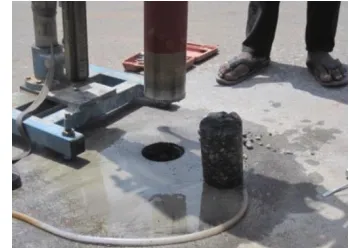
●Coring through the pavement structure (Fig. 2);
●Collection of core samples of asphalt (Fig. 3);
●Evaluation of thicknesses of asphalt, base and sub-base courses;
●Dynamic Cone Penetration (DCP) test (Fig. 4) to infer CBR values of Base, Sub-base and Sub-grade.
Fig. 2. Coring through the pavement structure.. In conducting the DCP test, a light weight 8kg rammer, 60-degree cone head Dynamic Penetrometer was used. The number of blows for each 10cm penetration was recorded, and averages of number of the blows were used to calculate the CBR of the pavement structures. In estimating CBR of the pavement structures, the correlation (equation 1) advanced by TRL [36] was used.
𝐿𝑜𝑔 (𝐶𝐵𝑅) = 2.48 − 1.057𝐿𝑜𝑔(𝑃𝐼) (1)
Where
PI = Penetration Index or Penetration Rate
Fig. 4. Dynamic Cone Penetration test. Laboratory tests, carried out on the cored asphaltic samples included Marshall Stability test, bulk density test, bitumen content test, flow test, void ratio test, determination of percentage voids filled with bitumen and aggregate grading test. Marshall Stability and flow of asphalt mixtures tests were conducted according to ASTM D6927-15 [37], while bitumen content extraction test was carried out using Centrifuge Extraction Procedure, as highlighted by ASTM D2172/D2172M-11 [37].
4. Results and Discussions
4.1 Field Observations
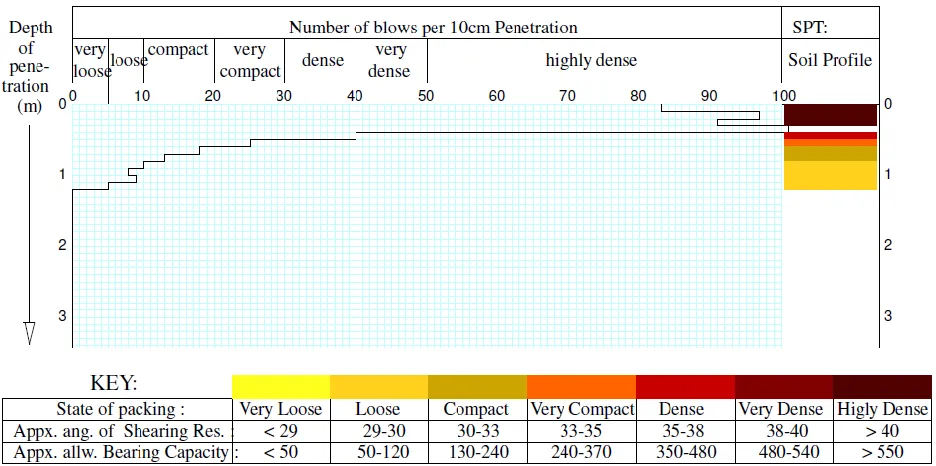
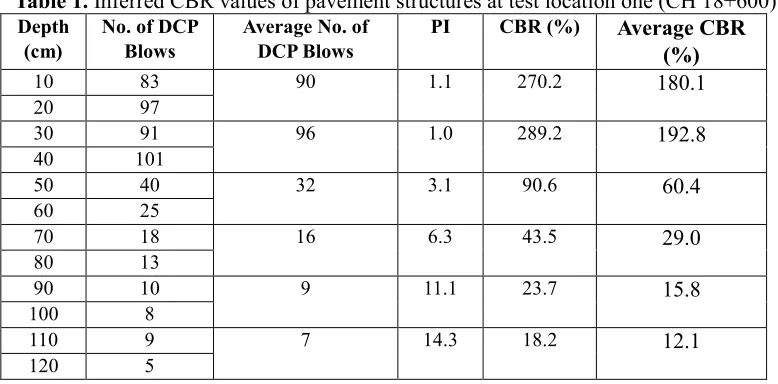
At the first test location (CH 18+600), repair work was observed to have been carried out at this location. Moderate fatting-up of bitumen and depression of the wearing course was noticed. Coring revealed thickness of the asphaltic concrete on this portion of the road to be 95mm. 200mm thick crushed stone base was observed to have been used at this location, while the sub-base course was of lateritic soil material, compacted to 200mm thick. The sub-grade material at this point was observed to be reddish sandy lateritic soil. The DCP result (Fig. 5) showed the base and sub-base courses at this location to be highly dense with average CBR values of 180 and 193% respectively, while the sub-grade, up to 600mm thick, ranges from dense to loose material with an average CBR value of 35% (Table 1).
Table 1. Inferred CBR values of pavement structures at test location one (CH 18+600). Depth
(cm)
No. of DCP Blows
Average No. of DCP Blows
PI CBR (%) Average CBR (%)
10 83 90 1.1 270.2 180.1
20 97
30 91 96 1.0 289.2 192.8
40 101
50 40 32 3.1 90.6 60.4
60 25
70 18 16 6.3 43.5 29.0
80 13
90 10 9 11.1 23.7 15.8
100 8
110 9 7 14.3 18.2 12.1
120 5
At the second test location (CH 25+800), Minor repair work was also observed to have taken place at this point, with minor wheel rut was still noticeable. Coring and DCP tests revealed that 152mm thick asphalt was used. Base and sub-base courses were of lateritic soil material, each compacted to thickness of 200mm. Sub-grade material was also observed to be lateritic soil. The DCP result showed the base and sub-base to be very dense and dense respectively, with average CBR values of 81 and 64% respectively, while the sub-grade, up to 600mm thick, ranges from very compact to compact material with average CBR value of 43% (Table 2).
At the thirdtest location(CH 55+550),speed bump was observed to have been removed and repair work carried out. Coring revealed thickness of the asphaltic concrete used at the location to be 135mm. Lateritic materials, each compacted to 200mm thickness were used as base and base courses. The sub-grade material also consisted of stable lateritic soil. DCP result showed the base and sub-base to be highly dense, with average CBR values of 167 and 187% respectively, while the sub-grade, up to 600mm thick,
ranges from highly dense to very compact material with an average CBR value of 77% (Table 2).
At the fourth test location (CH 68+000), speed bump was also observed to have been removed and repair work carried out. Coring revealed thickness of the asphaltic concrete used to be 130mm. Lateritic materials, each compacted to 200mm thickness were used as base and sub-base courses. The sub-grade material was also observed to be lateritic soil. DCP result at this location, showed the base and sub-base to be highly dense, with average CBR values of 159 and 180% respectively, while the sub-grade, up to 600mm thick, ranges from highly dense to very compact material with average CBR value of 91% (Table 2).
showed the base and sub-base to be highly dense, with average CBR values of 167 and 155% respectively. The sub-grade, up to 600mm thick, was also highly dense material
with average CBR value of 184% (Table 2). Summary of the coring and DCP results for all the test locations are presented on Table 2.
Table 2. Summary of Coring and DCP Results.
S/
N ASPHALT Base Course Sub-base Course Sub-grade LOCATION OF CORING Thickness
of Binder
(mm)
Thickness of Wearing
(mm)
Total Thickness
(mm)
Thickness (mm)
Average CBR
(%)
Thickness (mm)
Average CBR
(%)
Thickness (mm)
Average CBR
(%)
Chainage
GPS
N E
1 CH 18+600 9°16’49.68’’ N
5°17’8.70’’E 55 40 95 200 180 200 193 600 35
2 CH 25+800 9°16’3.45’’ N
5°20’47.52’’E 102 50 152 200 81 200 64 600 43
3 CH 55+550 9°8’2.19’’N 5°32’24.08’’E 95 40 135 200 167 200 187 600 77 4 CH 68+000 9°12’8.72’’
N
5°35’39.60’’E 90 40 130 200 159 200 180 600 91
5 CH 84+400 9°12’16.44’’ N
5°43’47.82’’E 72 40 112 200 167 200 155 600 184
4.2. Results of Laboratory Tests
Cored asphaltic samples from the five locations were subjected to laboratory tests and analysis. Summary of the test results on the four tested core asphalt samples are presented on Table 3.
Marshall Stability test results (Table 3) of the asphalt samples revealed that the core collected from test location one (CH 18+ 600), location two (CH 25 +800), location three (CH 55+550), location four (CH 68+000) and location five (CH 84+400) have stability of 3.47, 3.47, 3.19, 3.25 and 3.25kN respectively. These values are slightly less than the 3.5kN recommended by the Nigerian
Highway Manual [38]. The drop in Marshall Stability of the studied portions of the road (irrespective of the material used for the base course) over this relatively short period (two years), from completion of the reconstruction work of the road, could be attributed to the relatively heavy traffic (axle) load being experience by the road. As at the time of the study, the study road serves as the major artery for movement of goods (including imported cargo goods from Lagos sea port) and services to central and North-western parts of the country. Collapse of a bridge along an alternate route (road), that serves as a relief to the road was responsible for the large traffic volume.
Table 3. Summary of the Marshall Stability test and extraction test of the tested core asphalt samples. Location of
Core
Unit weight (gm/ml)
Specific gravity
Marshall Stability
(kN)
Flow (mm) Bitumen content (%) Void ratio Percentage void filled with
bitumen (%)
By total By
Aggregate
CH 18+600 2.56 2.71 3.47 3.8 8.0 8.7 5.45 75.34
CH 25+800 2.56 2.69 3.47 3.8 6.2 6.6 4.85 72.72
CH 55+550 2.56 2.69 3.19 3.8 5.9 6.2 4.85 71.72
CH 68+000 2.56 2.69 3.25 3.8 8.0 7.8 4.85 72.72
The tested cored asphaltic concrete samples generally have flow of 3.8 mm, which are within the 2 to 6mm recommended by the Nigerian Highway Manual [35].
The bitumen content of cored asphaltic concrete samples collected from test location one (CH 18+ 600), location two (CH 25 +800), location three (CH 55+550) and location four (CH 68+000) are within the 5 to 8% recommended by the Nigerian Highway Manual [35], while the sample collected from test location five (CH 84+400) have bitumen content slightly above the recommended range. This could be attributed to reduction in void spaces as a result of compaction from the relatively heavy traffic (axle) load being experience by the road.
The laboratory results (Table 3) revealed that voids in the cores collected from test locations one (CH 18+ 600), two (CH 25+800), three (CH 55+550), four (CH 68+000) and five (CH 84+400) are 5.45, 4.85, 4.85, 4.85 and 4.85% respectively. These values are within the 3 to 8% range recommended by the Nigerian Highway Manual [35].
The results showed that the percentage void filled with bitumen of asphaltic samples collected from test location one (CH 18+ 600), two (CH 25 +800), three (CH 55+550), four (CH 68+000) and five (CH 84+400) are 75.34, 72.72, 71.72, 72.72 and 72.72% respectively. Based on the 62 to 72% range recommended by the Nigerian Highway Manual [35], only sample from test location three perfectly satisfy the condition. The remaining samples are slightly above the recommended range. This again, could be attributed to reduction in void spaces as a result of compaction from the relatively
heavy traffic (axle) load being experience by the road.
Result of grading of the aggregate extracted from the cored samples revealed that the asphaltic mixtures from test location one (CH 18+600) is fairly within the upper and the lower limits as specified by Nigerian Highway Manual [35]. The grading of asphaltic mixtures from test location two (CH 25 +800), three (CH 55+550), four (CH 68+000) and test location five (CH 84+400) are not within the upper and the lower limit specification. This could be attributed to two reasons: 1- compaction of asphaltic surfacing, from the relatively heavy traffic (axle) load being experience by the road, could lead to crushing of the large sized aggregate in the mixture, resulting to finer fraction; 2- possible variation in the aggregated tested/recommended for the mixtures and those actually used, during the reconstruction work.
5. Conclusion
From the findings, the following were observed with the pavement structure of the road:
1. Sections of the road where crushed stone was used as base course material, were general overlaid with approximately 100mm thick asphalt, while sections of the road, where lateritic soil material was used as base course, were overlaid with asphalt ranging from 112 to 152mm thick.
course and sub-grade materials are relatively stable. The sub-grade material is also relatively stable.
3. Although, Marshall Stability results of the tested asphaltic samples were slightly less than the 3.5kN recommended by the Nigerian Highway Manual [35], the asphalt core samples generally have flow within the 2 to 6mm recommended.
4. The bitumen content of asphalt sample collected from test location one (CH 18+600), test location two (CH 25+800), test location three (CH 55+550) are within the 5 to 8% recommended by the Nigerian Highway Manual [38], while the sample collected from test location five (CH 84+400) have bitumen content slightly above the recommended range.
5. The laboratory results revealed that voids in the tested asphalted samples are within the 3 to 8% range recommended by the Nigerian Highway Manual [38]. Based on the 62 to 72% range recommended for percentage voids filled with bitumen, only sample from test location three (CH 55+550) perfectly satisfy the condition. The remaining samples were slightly above the recommended range.
6. Result of grading of the aggregate extracted from the cored samples revealed that the asphaltic mixtures from test location one (CH 18+600) is fairly within the upper and the lower limits specified by the Nigerian Highway Manual [35]. The grading of aggregate from test location two (CH 25+800), test location three (CH 55+550) and test location five (CH 84+400) are not within the upper and the lower limit specified.
7. The results of the study showed that pavement failure along the road is not as a
result of the material used for construction of the base course, but rather is as a result of the excessive axle load being experienced by the road.
REFERENCES
[1] Enwerem, G. C. and Ali, G. A. (2016). Economic Effects of Bad Roads on Vehicle Maintenance in Nigeria, International Journal of Scientific and Research Publications, 6(6): 761-766. [2] Singh, G. and Singh, J. (1991). Highway
Engineering. Standard Publishers Distributors, Nai, Sarak, India.
[3] Oguara, T. M. (2010). A management model for road infrastructure maintenance. Book of proceedings, 19th engineering assembly, Council for the regulation of engineering in Nigeria.
[4] Central Bank of Nigeria (CBN) (2003). Highway Maintenance in Nigeria; Lessons from Other Countries, Research Department Occasional Paper No. 27. [5] Okigbo, N. (2012). Causes of Highway
Failures in Nigeria, International Journal of Engineering Science and Technology (IJEST), 4 (11): 4695-4703.
[6] Obeta, I. N. and Njoku, J. E. (2016). Durability of Flexible Pavements: A Case Study of South-Eastern Nigeria, Nigerian Journal of Technology, 35 (2): 297-305. [7] Salih, J. Edum-Fotwe, F. and Price, A.
(2016). Investigating the Road Maintenance Performance in Developing Countries, International Journal of Civil, Environmental, Structural, Construction and Architectural Engineering,10 (4): 395-399.
[8] Adlinge, S. S. and Gupta, A.K. (2013). Pavement Deterioration and its Causes, International Journal of Innovative Research and Development, 2(4): 437-450 [9] Qiao, Y., Santos, J., Stoner, A. M. K. and
[10] Sarsam, S. I. (2016). Pavement Maintenance Management System: A Review, STM Journals, 3 (2): 19-30.
[11] Kermani, M. R. S. and Jam, A. N. (2016). Modifying PIARC’s Linear Model of Accident Severity Index to Identify Roads’ Accident Prone Spots to Rehabilitate Pavements Considering Nonlinear Effects of the Traffic Volume, Journal of Rehabilitation in Civil Engineering, 4 (2): 45-51.
[12] Donev, V. and Hoffmann, M. (2018). Optimization of Pavement Maintenance and Rehabilitation Activities, Timing and Work Zones for Short Survey Sections and Multiple Distress Types, International Journal of Pavement Engineering, (2018): 1-25.
[13] Sahin, H., Narciso, P. and Hariharan, N. (2013). Developing a Five-Year Maintenance and Rehabilitation (M&R) Plan for HMA and Concrete Pavement Networks, ICCEN 2013, Stockholm, Sweden, 9: 230-234.
[14] Rusu, L., Taut, D. A. S. and Jecan, S. (2015). An Integrated Solution for Pavement Management and Monitory Systems, 22nd International “Economic Conference-IECS 2015, Economic Prospects in the Context of Growing Global and Regional Interdependance”, 27: 14-21.
[15] Karim, F. M. A., Rubasi, K. A. H. and Saleh, A. B. (2016). The Road Pavement Condition Index (PCI), Evaluation and Maintenance: A Case Study of Yemen, Journal of Organization, Technology and Management in Construction, 8: 1446-1455.
[16] Ewadh, H. A., Almuhanna, R. and Alasadi, S. (2018). Developing Optimized Prioritizing Road Maintenance, MATEC Web of Conferences, 162: 1-7.
[17] Pantuso, A., Loprencipe, G., Bonin, G. and Teltayev, B. B. (2019). Analysis of Pavement Condition Survey Data for Effective Implementation of a Network Level Pavement Management Program for Kazakhstan, Sustainability, 11(901): 1-16.
[18] Keymanesh, M. R., Nasrollahtabar, A. and Shahriari, N. (2018). Internal Structure Features of Asphalt Mixture for Field Samples, Journal of Rehabilitation in Civil Engineering, (1): 10-22.
[19] Arabani, H. P. S., Sadrmomtazi, A., Langaroudi, M. A. M., Khoshkbijari, R. K. and Amooie, M. (2017). Durability of Self-compacting Lightweight Aggregate Concrete (LWSCC) as Repair Overlays, Journal of Rehabilitation in Civil Engineering, 5-2 (2007): 99-111.
[20] SadrMomtazi, A. and Khoshkbijari, R. K. (2017). An Investigation on In-Situ Strenght and Bonding Strenght of Polymer Modified Concretes (PMC) as Repair Overlays on Conventional Concrete Substrate, Journal of Rehabilitation in Civil Engineering, 5 (1): 67-78.
[21] Kavussi, A., Solatifar, N. and Abbasghorbani, M. (2016). Mechanistic-Emperical Analysis of Asphalt Dynamic Modulus for Rehabilitation Projects in Iran, Journal of Rehabilitation in Civil Engineering, 4 (1): 18-29.
[22] Khodakarami, M. I. and Moghaddam, H. K. (2017). Evaluation the Performance of Rehabilitated Roadway Base with Geogrid Reinforcement in the Presence of Soil-Geogrid-Interaction, Journal of Rehabilitation in Civil Engineering, Vol. 5 (1): 33-46.
[23] Gill, K. S., Jha, J. N. and Choudhary, A. K. (2010). CBR Value Estimate using Dynamic Cone Penetrometer, Indian Geotechnical Conference, Geotrends IGS, Mumbai Chapter and IIT Bombay.
[24] Scala, A. J. (1959). Simple Method of Flexible Pavement Design using Cone Penetrometers, Proceedings of 2nd Australian-New Zealand Conference on Soil Mechanics and Foundation Engineering, New Zealand.
[25] ASTM 6951-03 (2003). Standard Test Method for Use of the Dynamic Cone Penetrometer in Shallow Pavement Applications, West Conshohcken, PA. [26] Mohammadi S. D., Nikudel, M. R., Rahimi,
Skin Friction from Extended Dynamic Cone Penetrometer (EDCP) Test Supplemented by Measurement of Torgue within Testing Wells. IJST Transactions of Civil Engineering, 36(C1): 115-119. [27] Czado, B. and Pietras, J. S. (2012).
Comparison of the Cone Penetration Resistance Obtained in static and Dynamic Field Tests. AGH Journal of Mining and Geoengineering, 36(1): 97-105.
[28] Kumar, R. S., Ajmi, A. S. and Valkati, B. (2015). Comparative Study of Subgrade Soil Strength Estimation Models Developed Based on CBR, DCP and FWD Test Results, International Advance Research Journal in Science, Engineering and Technology, 2(8): 92-102.
[29] Jones, D. and Harvey, J. (2005). Relationship between DCP, Stifness, Shear Strength and R Value. California Dept. of Transportation, Office of the Road Research.
[30] Patel, M. A. and Patel, H. S. (2012). Experimental Study to Correlate the Test Results of PBT, UCS, and CBR with DCP on various Soils in soaked Condition, International Journal of Engineering, 6(5): 244-261.
[31] Ette, I. E. (2010). Challenges of sustainable infrastructural development, Proceedings of 19th Engineering Assembly, Council for the regulation of engineering in Nigeria, 18.
[32] Obaje, N. G. (2009). Geology and Mineral Resources of Nigeria. Springer-Verlag Berlin Heidelberg.
[33] Adeleye, D. R. (1973). Origin of Ironstones: An Example from the Mid-Niger Basin, Nigeria. Journal of Sedimentary Petrology, 43: 709–727.
[34] Akande, S. O., Ojo, O. J., Erdtmann, B. D., Hetenyi, M. (2005.) Paleoenvironments, Organic Petrology and Rock-Eval Studies on Source Rock Facies of the Lower Maastrichtian Patti Formation, Southern Bida Basin, Nigeria, Journal of African Earth Sciences, 41: 394–406.
[35] Highway Manual Code of Procedure (2013). Federal Ministry of Works and Housing, Federal Republic of Nigeria.
[36] TRL. (2008). TRL Dynamic Cone Penetrometer. Transport Research laboratory, UK.
[37] ASTM D6927-15. (2015). Standard Test Method for Marshall Stability and Flow of Asphalt Mixtures, ASTM International, West Conshohocken, PA.