© Strojniški vestnik (43) št. 5-6, str. 219-230, 1997 © Journal o f Mechanical Engineering (43) No. 5-6, pp. 219-230, 1997 Tiskano v Sloveniji. Vse pravice pridržane. Printed in Slovenia. All rights reserved. UDK 621.373:519.61/ 64:534.1/.2 SV:0039-2480(97)3-R4 UDC 621.373:519.61/.64:534.1/.2
Analiza nelinearnih oscilatorjev z več prostostnimi stopnjami
Analysis of Nonlinear Oscilators with Finite Degrees of Freedom
RUDI PUŠENJAK
V članku je prikazana analiza nelinearnih oscilatorjev z več prostostnimi stopnjami, ki lahko izvajajo lastna nihanja (avtonomni sistemi), ali jih vzbujamo z zunanjimi periodičnim i signali. Za izračun ustaljenega odziva v časovnem prostoru, za izračun limitnih ciklov, konstrukcijo stabilnih in nestabilnih vej resonančnih krivulj ter za določitev diagramov rešitev v odvisnosti od parametrov nelinearnega dinamičnega sistema je uporabljena metoda koračnega harmonskega ravnovesja. Z uporabo Floquetove teorije določimo stabilnost izračunanih rešitev. V zgledih je z uporabo metode KHR izračunana prim arna resonanca, superharmonična resonanca in subharm onična resonanca Duffingovega oscilatorja. M ed avtonomnimi sistemi j e obdelan Van der Polov oscilator z različnimi stopnjami nelinearnosti in sklopljeni nelinearni oscilator z dvema prostostnima stopnjama s prikazom diagrama rešitve. Izračunane so resonančne krivulje tega sistema ob spremenljivi frekvenci zunanjega vzbujevalnega signala.
Ključne besede: nelinearni oscilatorji, metoda koračnega harmonskega ravnovesja, resonanca primarna, resonanca superharmonična, resonanca subharmonična
This paper presents the analysis o f nonlinear oscillators with finite degrees o f freedom exhib iting self-sustained oscillations (autonomous systems) or performing oscillations under periodic exci tation. The incremental harmonic balance method is used fo r calculation o f the steady time response, limit cycles, stable and unstable branches o f the resonance curves and fo r construction o f solution diagrams in dependence o f system parameters. The stability o f the calculated solutions is proved by Floquet theory. In the paper construction o f primary, superharmonic and subharmonic resonances o f higher order o f the Duffing oscillator is made by the use o f IHB method. Autonomous systems are studied on the examples o f the Van der Pol oscillator and coupled nonlinear oscillator with two degrees o f freedom, where the solution diagram is shown. Additionally, the resonance curves fo r the same nonlinear oscillator under excitation with variable frequency are calculated and plotted. Keywords: nonlinear oscillators, incremental harmonic balance method, primary reonance, superharmonic reonance,
subharmonic resonance
0 UVOD
Raziskave nihanj nelinearnih oscilatorjev kažejo, da so analitične rešitve teh nihanj mogoče samo v redkih, izjemnih primerih. Če se omejimo na avtonom ne nelinearne oscilatorje in nelinearne oscilatorje, k ijih vzbujamo s periodičnimi signali, ugotovim o, da so o d ziv n a n ih an ja po preteku prehodnega pojava periodična samo v določenem območju parametrov in da obstajajo razvejitvene točke (bifurkacije) v param etričnem prostoru, ki delijo območja kakovostno povsem različnih rešitev. Tako ločimo obm očja stabilnih periodičnih nihanj od nestabilnih, ki s časom neom ejeno naraščajo in fizikalno niso mogoča. Poseben primer se pojavi, kadar so vsa možna periodična nihanja nestabilna, vendar ostajajo omejena: pravimo, da se sistem obnaša kaotično. V tem članku bomo periodične rešitve poiskali z uporabo metode koračnega harmonskega ravnovesja (KHR), čeprav je mogoče uporabiti tudi m eto d e n u m e rič n e in te g r a c ije in ra z lič n e perturbacijske metode. Metode numerične integracije računalniško niso učinkovite, ker nas zanima ustaljeni pojav, ki ga lahko izračunamo šele potem, ko prehodni pojav izzveni. Perturbacijske metode [1 ] so učinkovite in dodatno omogočajo globalno analizo stabilnosti, vendar so om ejene na dinamične sisteme z majhno stopnjo nelinearnosti.
0 IN T R O D U C T IO N
Z uporabo m etode KHR frekvenčni potek resonančne krivulje periodično vzbujanih nelinearnih dinamičnih sistemov zlahka izračunamo tako, da v korakih povečujemo (inkrem entiram o) frekvenco vzbujevalnega signala. Pri tem načeloma ni nobenih ovir, ne glede na to, ali gre za izračun stabilnih ali nestabilnih vej resonančne krivulje. S procesom priraščanja, v katerem smemo poljubno spreminjati nek nadaljnji sistemski parameter, lahko konstruiramo celotni diagram rešitev in v njem določimo točke razvejitev (bifurkacijske točke). Tako pri procesu večanja frekvence kakor pri procesu priraščanja izbranega siste m sk e g a p a ra m etra izhajam o iz poprejšnje oziroma predpostavljene rešitve, nakar uvedemo Newton-Raphsonov iterativni postopek, s katerim izračunamo konvergentno rešitev, ki zadošča vnaprej določenemu tolerančnemu kriteriju.
1 METODA KORAČNEGA HARMONSKEGA RAVNOVESJA (KHR)
Nihanja nelinearnih dinamičnih sistemov z N
prostostnimi stopnjami, ki so izpostavljeni periodičnemu vzbujanju, lahko opišemo s sistemom nelinearnih navadnih diferencialnih enačb:
By using the IHB method the frequency re sponse o f the resonance curve of periodically excited nonlinear oscillators can be easilly computed by incrementing the frequency o f the exciting signal. In principle stable as well as unstable branches o f the resonance curve can be com puted w ithout any trouble. If an additional parameter is varied inside the augmentation process, the complete solution dia gram with bifurcation points is constructed. In the process o f frequency incrementation as well as in the augmentation o f the selected system parameter we proceed from the previous or assumed solution and then introduce the Newton-Raphson iterative procedure until a convergent solution is obtained sub ject to a given tolerance criterion..
1 INCREMENTAL HARMONIC BALANCE (IHB) METHOD
Oscillations o f nonlinear dynamical systems with A degrees o f freedom, subjected to periodic ex citation can be described by a system o f nonlinear ordinary differential equations:
(1),
®2*; + f ( X \ , - . x N ;xv . X) = q,(x), (i = 1... A )
k je r u v e d e m o b r e z d i m e n z i j s k i č a s z = a n
k o t n e o d v i s n o s p r e m e n l j i v k o , s
f i(x l,...,xN; xx,...,xN ;a>,A) pa označimo nelinearne funkcije odvisnih spremenljivk x, in pripadajočih prvih odvodov X. = \/a>. dx./dt, pri čemer je cuvzbujevalna frekvenca, /t pa pom eni nek prosti param eter. Predpostavimo, da vzbujamo oscilator s harmoničnim signalom:
where dimensionless time x = o t is introduced as an in d e p e n d e n t v a ria b le and w h ere
f j(x x,...,xN;xx,...,xN;(ü,'k) denote nonlinear func tions of dependent variables x, and corresponding first derivatives x. = \/a>. dx./dt with exciting fre quency co and arbitrary changeable param eter A.
Suppose, that the nonlinear oscillator is harmonically excited:
(2),
<?/(z) = gj cos{(2m - /)r]/
pri čemer pom eni m neko prim erno celo število m = l,2 ,3 ...V z e m im o n e k o z a č e tn o re š ite v
x i0 ,xi0,a>0,X0,g io; ( i - l , . . . , N ) ter skušajmo z New- ton-Raphsonovim iterativnim procesom najti sosednjo rešitev:
t a k o , d a k z a č e t n i r e š i t v i d o d a j a m o : Ax,,Ax,, Aco,AA.,Ag, . Če izra za (3) v sta v im o v enačbo ( 1 ) in enačbo ( 1 ) razvijemo v Taylorjeve vrste v okolici začetne rešitve, dobimo linearizirane koračne diferencialne enačbe:
where m is an appropriate integer m = 1,2,3,... Fur th e rm o re , let us a ssu m e an in itia l s o lu tio n *,o » *;o > ® o > ^"0 > Si0 >'(*= • • •. N ) and attempting to get the neighbouring solution by using iterative Newton- Raphson procedure :
(3),
with adding increments Ax,,AA,, Aco, AA.,Ag, to the initial solution. Putting expressions (3) into equations (1) and developing equations (1) in Taylor’s series about initial solution, linearized incremental differen tial equations are obtained:
x, = x ia + Ax,-,x,. = xio + Ai,,co = co0 + AcoA = X0 + AA;
(O20Axi + Z
N
Ai,. + È 7=1\ dXJJ
7=i ydxj
= [g,0 cos[{2m - l)t] - co20x io - f o ] Ax,
%_
9co + 2coni: Aco-j^'^-'] AÀ + cc«[(2ff7-l)T]- Ag, (4),
pri čemer zanem arimo vse koračne izraze višjih where all incremental expressions o f higher order are redov. Če začetne vrednosti in pripadajoče prirastke neglected. If initial values and corresponding incre-
sestavimo v naslednje vektorje: ments are combined in the following vectors:
{X 0} = [x /o,...,xA,J -{AX} =[Ax/ ,...,AxiV] ,{G0} .{AG} =[A g/,...,A gA,] .{^o} = [//„.
(5)
in uvedemo matriki [C] in [ x l z ustreznimi členi ter and m atrices [C] and [X l as w ell as vecto rs v e k to rje [q] , {Pj in {7?} s p rip a d a jo č im i {Q},{P} and [k ] are defined with elements: komponentami:
' M i
\ d i j j K„ \ dxjJ
(6),
lahko linearizirane koračne diferencialne enačbe then the linearized incremental differential equations zapišemo v zgoščeni matrični obliki: can be written in compact m atrix form as:
®Ž{a x} + [C]-{a x} + [x]-{AX} = { ^ } -( 2coo{xo} + { 0 })aco- {p}.AX + cos[(2w-1 )t]-{AG} (7).
Dobljena m atrična diferencialna enačba je linearna, vendar ima spremenljive koeficiente. Rešitev takega sistem a enačb dobim o z G alerkinovim postopkom, ki pomeni drugi korak pri metodi KHR Ker je vzbujanje periodično, lahko pričakujemo, da bo ustaljena rešitev prav tako periodična, razen če rešitev ni stabilna (npr. se s časom zvečuje) ali če se sistem obnaša kaotično. V primeru, da periodična ustaljena rešitev obstaja, moremo rešitev enačbe (7) opisati z nastavkom:
The m atrix differential equation (7) is linear with periodic coefficients. The solution of this matrix equation can be obtained by the Galerkin procedure, which presents the second step in the IHB method. Because o f periodic excitation, we can expect that the steady-state solution is also periodic, except in the case o f unbounded solutions. I f a periodic steady state solution exists, then the solution o f equation (7) is expressed as follows:
sin[(2n -xi0 = ^ { alnCos[(2n-l)x\ + b[n
n=r
AXj = Z (Aö/ „c0j[(2« -7)t] + \ b itls in \{ 2 n -ì)-i^;(i = 1,...,N) (8),
oziroma v matrični obliki : or in matrix form :
[ r ] =
\cosx,cos 3x,...,cos^2K- l e s i n i , sin 3\,...,sin]^2K-i)i^
{aio} = \al1,a l,...,a lK;bfil,bl2,...,blK]T
{A a,} = [ Aflu , Aa,i2,..., AaiK ; Abt l ,A b,2,...,A b,K]T
(10a)
(10b)
(lOc).
Uvedemo še matriko [7] in vektorje {4,}, B y in tro d u c in g m a trix [F] and v e c to rs
{Azi}: { 4 > M M :
M =
\[T]
[
0]
[0] [r]
M"
[0]
■
U
l-k i
k ) •M =
1
__
_
_
_
1
io] [0]
[Tl
.M .
_{Aa*}_
( ii) ,
s katerimi lahko vektorje { } , { A l} izrazimo v the vectors |X 0},{AX}can be expressed as fol-
naslednj i obliki: l°ws ■
M = [ y]-{a a} (12).
Izvedimo Galerkinov postopek prek ene periode By performing the Galerkin procedure for one brezdimenzijskega časa t = cot, to je v mejah od 0 do period o f dimensionless time x = cot, that is on the
2rt: interval 0 to 27t :
1 2ti
- J 8{ ^ } r {[^]r [co§[Ü]+[C][7]+[^][F]J{A^}]c/x =
i 2f5{A ^}r {[Ff[{i?}-({ß}+2co0[Ü]{4) })Aco-{P}AU{AG}co4(2m-l)x]]}c/x
(13),
kjer je vektor variacij harmonskih prirastkov 8 {AA}T where 5{A ^| presents arbitrary variations o f har na obeh straneh enačbe (13) poljuben, s čimer dobimo monic increments vector, one obtains the linear ma- lin e a rn o m a trič n o e n a čb o za n e z n a n i v e k to r trix equation for unknown harmonic increments vec-
harmonskih prirastkov {A^} : tor IAA] :
[ä:]{A^} = {r} + |<7}Aco + {/?}AÀ + [s]{AG} [s] = — j [F]7co s[(2 m -l)x]flfx. ^4^
7t o
kjer sta [k] in [s] matriki,{r},{q},{p} pa naslednji where [k] and [s] are matrices, and {(/},{/?} are
vektorji: the following vectors:
W = ^ 2( M r h ^ ] + [ c p ] + M F ] ] c / T , (15),
= ®o[f] [fJ | 4 , } - [ F ] r • {F0} + [F]r {G0}cos,[(2 /n -l)x ] dx (16), 7 t 0
*-di, (17),
M atrično enačbo (14) moramo razrešiti na vsakem koraku Newton-Raphsonovega iterativnega postopka, dokler ne najdemo konvergentne rešitve. Ob predpostavki, da so Aco,AA,{AGJ enaki nič in daje [A J točna rešitev, je rezidualni vektor | r | enak nič in enačba (14) zagotavlja, d a je tedaj tudi {A/!j enak nič. Če je [ z ] aproksimacija, izračunamo boljši približek { Z } + {A4} z razrešitvijo enačbe (14). Postopek ponavljamo, dokler | r j ne postane dovolj m ajhen. Če vrednosti param etrov A(0,AA,{AGJ
variirajo, vzamemo prejšnjo rešitev za aproksimacijo in poiščemo novo rešitev z Newton-Raphsonovim iterativnim postopkom. Izmenjava procesa priraščanja param etrov z iterativnim postopkom om ogoča konstrukcijo resonančnih krivulj z naraščanjem frekvence a> v izbranem obm očju (frekvenčno večanje) ali s spreminjanjem izbrane komponente vektorja harmonskih koeficientov An (amplitudno večanje). Z izmenjavo procesa priraščanja parametra
A z iterativnim postopkom lahko zgradimo diagram rešitve.
K oje ustaljena rešitev z uporabo metode KHR izračunana, nas običajno zanim a stabilnost dobljene rešitve. Vzemimo, daje {XJ ustaljena rešitev enačbe (7), tako d a je {/?} = {o} . Če frekvence, amplitude vzbujevalnega signala in parametra A ne spreminjamo, z a d o šč a m a jh n a sp re m e m b a re š itv e
= {X0} + IA X} perturbirani enačbi:
The m atrix eq. (14) is solved at each step o f th e New ton-Raphson iterative procedure until con vergent solution is obtained. With the assumption that
Aco,AA,{AG} vanish and {/l} represents an exact solution, the residual vector {rj vanishes and equa tion ( 14) guarantes, that {A4} vanishes. If { z j is an approximation, then the better solution [A i + {A4} is computed by solving the equation (14).This proce dure is repeated until {r} becomes sufficiently small. I f th e v a lu e s o f p a ra m e te rs Aco,AA,{AG} are changed, the previous solution is taken as an approxi mation and a new solution is calculated by Newton- Raphson’s iterative procedure. The exchange o f aug mentation process and N ew ton-Raphson’s iterative procedure enables the construction o f resonance curves by incrementing the frequency co in the se lected range (frequency incrementation) or by vary ing certain component An o f the harmonic coeffi cients vector (amplitude incrementation). By exchang ing augmentation process for param eter A and N ew ton-Raphson procedure, the solution diagram can be constructed.
When the steady-state solution is computed by using IHB method, usually the stability o f the obtained solution is o f great interest. Supposing, that {X0} means a steady-state solution o f equation (7), whicn implies that {7?} = jo} . If the exciting frequency, as well as the amplitude o f the exciting signal and value o f parameter A are not changed, small changes o f solution {A} = {V Q j + {AY) will satisfy the perturbed equation:
(1 9 ),
®o{a v} + [C] ■ {AT} + [K] • {AT} = {0}
k ije matrična navadna linearna diferencialna enačba which is a matrix ordinary linear differential equation s periodičnimi koeficienti v [C] ali v [Ai] ali celo v with periodic coefficients in LC Ì ° r iK ] or both, obeh. Enačbo ( 19) lahko prevedemo na sistem prvega Equation ( 19) can be presented by first order system
reda z uvedbo kombiniranih vektorjev: introducing combined vectors:
*
1K}J
ri°] wiiMi
m
f i J l M l '
COn
[«1 M
LM
(20),
tako da ustreza stabilnost ustaljene rešitve stabilnosti re š ite v s is te m a }Žj = [Z ]{Z }. N aj bo [o(x)j pren o sn a m atrik a , s k atero prev ed em o v ek to r {z(t) | v času i = 0 v vektor {z(x + 2ti)} ob koncu ene periode. V skladu s Floquetovo teorijo [2] so rešitve sistema (2 0) stabilne, če so moduli lastnih vrednosti prenosne matrike na koncu ene periode Jo(27i)j manjši od enote, v nasprotnem primeru pa so rešitve nestabilne. V ta namen razdelimo vsako p e rio d o 2n na N k k o ra k o v (Tt _1,Ti ) , k je r je
A k = xA- xjt_1 dolžina posam eznega koraka in v v sak em od te h k o ra k o v p e rio d ič n o m a trik o koeficientov [z (x )| nadom estim o s konstantno matriko:
1 V
1
f K O K (21).
Prehodno m atriko na koncu ene periode The transition matrix at the end o f one period
dobimo z obrazcem: is given by:
[<D(27t)]= r i e ^ A * ^ ] ) (22)'
2 VAN DER POL-DUFFINGOV OSCILATOR
Opisano metodo bomo uporabili pri periodično vzbujanem sklopljenem nelinearnem oscilatorju z dvema prostostnima stopnjama, ki ga lahko opišemo z naslednjim a dvem a nelin earn im a navadnim a diferencialnima enačbama (N=2):
co2x, - - PjX2 jcoij 4- OjJCj + a ux,3 + a
(Ü2X 2— A,(e2- P-2X2 )® Ù + U2X2 + a 21xl3 +
2 VAN DER POL-DUFFING OSCILLATOR
Above method will now be used at a periodi cally excited coupled nonlinear oscillator with two de grees o f freedom, which can be described by using the following two nonlinear ordinary differential equa tions (N=2):
,x2x2 + a13x,x2 + a l4x2 = gj cos[(2m - l)xj (23a),
■22x\ x2 + a 23x ix 2 + a 24X2 = 0 (23b).
V posebnem primeru, ko so vrednosti para metrov a12, a13, a14 in a2], a22, a23, a24 vse enake nič, se zgornji nelinearni sistem razklopi in razpade na dva ločena nelinearna oscilatorja z eno prostostno stopnjo:
In special cases, when all parameter values a12, a13, a14 and a2], a22, a23, a24 all vanish, the above nonlinear system is decomposed into two dis tinct nonlinear oscillators with one degree o f free dom:
co2^! Mixi )° g, cos\if.m ~ 1)tJ, (24a),
co2x, ■ A.^82 - p 2x2 jcoxlcox2 + u2x2 = 0
ki sta lahko nelinearna oscilatorja Van der Polovega ali Van der Pol-D uffingovega tipa. Če ima tudi parameter v enačbi (24a) vrednost nič, dobimo oscilator Duffingovega tipa. Matriki [ä:Uj] in vektorji {r}, {/j} za sklopljeni nelinearni oscilator z dvema prostostnima stopnjama, opisan z enačbama (23 a,b), so izpeljani v [3],
(24b),
which can present nonlinear oscillators o f the Van der Pol or Van der Pol-Duffmg type. If the param eter value in the equation (24a) is also zero, one obtains the Duffing oscillator. M atrices [^],M and vectors {/?] for coupled nonlinear oscillator with two degrees o f freedom, described by equations (23 a,b), are derived in [3],
3 NUMERIČNI ZGLEDI 3 NUMERICAL EXAMPLES
Duffingov oscilator
Če v e n a č b i (2 4 a ) iz b e re m o v re d n o s t parametra p, = 0 , dobimo Duffmgov oscilator:
co2Xj - A-SjCo Xj + u ,x,
Pri določitvi resonančne krivulje Duffingovega oscilatorja se poleg stabilne veje pojavi tudi nestabilna veja, ki jo v tehničnem pomenu laže zgradimo, če zam enjam o proces frekvenčnega povečevanja s procesom fazne povečave. Fazne prirastke vpeljemo z uporabo nastavka:
Duffing oscillator
With the value p.] = 0 in the equation (24a) one obtains the Duffing oscillator:
+ “ i, xf = gi cos[(2m - l)t] (2 5).
xio = i k « C(4 ( 2" - 4 ] + Kn sin[{2n - /)x]) = £ An cos[{2n - / )t- 0 „] =
n ~ l n = l
K _
- Z \A„ cos <D„ co.v[(2/7 - / )t] + An sin sin[(2n - /)ij) (26), kjer so A velikosti, <P pa fazni koti. Transformacije where An denotes magnitudes and ®n denotes phase med harmonskimi ampìitudami ain , b°n in velikostmi angles. Transformations between harmonic
ampli-An ter faznimi koti so določene z razmerji: tudes a°in, b°in and magnitudes A n and phase angles
<Pn are determined by relations:
aln = An COS®t„
j
AdinKn = AnSÌn®n> [Ab
cos ®n - K „ [A4,,
sin ®n “In _
(27a),
(27b).
V n a s le d n je m z g le d u j e po tej m eto d i izračunana prim arna resonanca, superharmonična resonanca tretjega reda in subharmonična resonanca tretjega reda Duffmgovega oscilatorja, pri čemer so vrednosti posameznih parametrov:
A = - 2 ; s, = 0,01; u,
v vseh treh primerih, amplitude vzbujevalnega signala in harm onski indeksi m pri posam eznih vrstah resonanc pa so:
g , = 0,1; m = 1 pri primarni resonanci,
gi = 1,0; m = 1 pri su perharm onični resonanci tretjega reda in
g! =8,0; m = 2 p ri s u b h a rm o n ič n i resonanci tretjega reda.
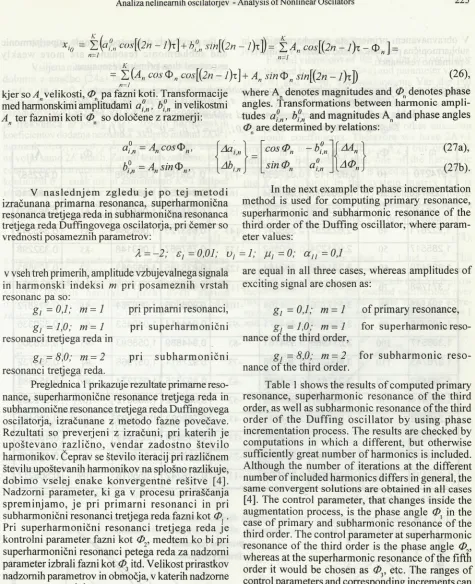
Preglednica 1 prikazuje rezultate primame reso nance, superharmonične resonance tretjega reda in subharmonične resonance tretjega reda Duffmgovega oscilatorja, izračunane z metodo fazne povečave. Rezultati so preverjeni z izračuni, pri katerih je upoštev an o ra z lič n o , v e n d a r z a d o stn o šte v ilo harmonikov. Čeprav se število iteracij pri različnem številu upoštevanih harmonikov na splošno razlikuje, dobim o vselej enake konvergentne rešitve [4]. Nadzorni param eter, ki ga v procesu priraščanja sprem injam o, je pri prim arni resonanci in pri subharmonični resonanci tretjega reda fazni kot <Z> . Pri superharm onični resonanci tre tje g a reda je kontrolni parameter fazni kot ®2, medtem ko bi pri superharmonični resonanci petega reda za nadzorni parameter izbrali fazni kot ®} itd. Velikost prirastkov nadzornih parametrov in območja, v katerih nadzorne parametre spreminjamo, so za posamezno vrsto reso nance razvidna iz preglednice 1. Frekvenca nihanja je pri postopku fazne povečave neznana in jo izračunamo obenem z velikostjo. Grafični potek izračunanih resonanc D uffingovega o scilatorja prikazuje slika 1.
Iz preglednice 1 in s slike 1 izhaja, da se pri marna resonanca in subharmonična resonanca tre tjega reda pojavljata v okolici frekvence co = Is '1, superharmonična resonanca tretjega reda pa v okolici frekvence co = / s'1, kar se ujema z rezultati, k ijih dobim o z uporabo pertu rb acijsk ih m etod [1].
In the next example the phase incrementation method is used for computing prim ary resonance, superharmonic and subharmonic resonance o f the third order o f the Duffing oscillator, where param eter values:
= 1; Hi = 0; a ,, = 0,1
are equal in all three cases, whereas amplitudes o f exciting signal are chosen as:
g, = 0,1; m = 1 o f prim ary resonance,
gi = 1,0; m = 1 for superharm onic reso nance o f the third order,
gy = 8,0; m = 2 fo r s u b h a rm o n ic re s o nance o f the third order.
Table 1 shows the results o f computed primary resonance, superharm onic resonance o f the third order, as well as subharm onic resonance o f the third order o f the D uffing o sc illa to r by using phase incrementation process. The results are checked by computations in which a different, but otherwise sufficiently great num ber o f harm onics is included. Although the num ber o f iterations at the different number o f included harm onics differs in general, the same convergent solutions are obtained in all cases [4]. The control parameter, that changes inside the augmentation process, is the phase angle ®] in the case o f prim ary and subharmonic resonance o f the third order. The control param eter at superharmonic resonance o f the third order is the phase angle <£>,, whereas at the superharmonic resonance o f the fifth order it would be chosen as etc. The ranges o f control parameters and corresponding increments can be seen from table 1. O scillatio n frequency is unknown in the phase incrementation process and is computed together with magnitude. Plots of computed resonances o f the Duffing oscillator are shown, in figure 1.
From table 1, as well as from figure 1, it follows that primary resonance and subharmonic resonance o f the third order appear in the vicinity o f frequency
V obravnavanem primeru sta superharmonična in In the previously discussed example, superharmonic subharmonična resonanca slabo izraženi v primerjavi and subharm onic reso n an ce are m ore w eakly
s primarno resonanco. expressed than primary resonance.
Preglednica 1: Primarna, superharmonična in subharmonična resonanca 3. reda Duffingovega oscilatorja (A = -2 ; e1 - 0,01; u, = 1; p t = 0; a u = 0,1) Table 1 : Primary , superharmonic and subharmonic resonance o f 3rd order o f
Duffing oscillator (A = -2 ; s 1 = 0,01; ul = 1; p, = 0; a u = 0.1)
co
o , Aico
(J>2 a2CO
® i A!0,974270
10
0,891113 0,327233 -173 0,139154 1,069688-77
0,4225871,065723
20
1,603873 0,348554 -163 0,346251 1,067520-79
0,3887161,148446 30 2,174205 0,354790 -153 0,518287 1,065792
-81
0,3636901,222671 40 2,623257 0,358247 -143 0,653723 1,064364
-83
0,3453431,285517 50 2,971224 0,360552 -133 0,757667 1,063148 -85 0,332298
1,335470 60 3,231459 0,362181 -123 0,835365 1,062083
-87
0,3236831,371798 70 3,412075 0,363330 -113 0,890787 1,061131
-89
0,3189671,394145 80 3,517736 0,364104 -103 0,926606 1,060261
-91
0,3178721,402379 90 3,550834 0,364571
-93
0,944414 1,059453-93
0,3203361,396517
100
3,511986 0,364781-83
0,944889 1,058693-95
0,3265001,376743
110
3,400237 0,364788 -73 0,927871 1,057968-97
0,3367321,343462
120
3,212813 0,364655 -63 0,892325 1,057274-99
0,3516811,297474 130 2,944497 0,364480 -53 0,836182 1,056612
-101
0,3723881,240408 140 2,586382 0,364431 -43 0,756063 1,055993
-103
0,4004841,175895 150 2,123941 0,364836
-33
0,646990 1,055449 -105 0,4385681,113172 160 1,535740 0,366474
-23
0,502633 1,055060 -107 0,4909451,082177
170
0,802288 0,371922-13
0,318242 1,055018-109
0,5652174 -,
<L> -o
3
3.5 -4-» ' 1
3
cd S
2.5 1
!
cd 2 j
B
2
5b
1.5 -cd
s
1 j
0.5
0 +- 0
frekvenca co / frequency co
Sl. 1. Primarna, superharmonična in subharmonična resonanca Duffingovega oscilatorja
Van der Polov oscilator
Vsiljena nihanja pri Van der Polovem oscilatorju dobimo z enačbo (24a) in vrednostmi parametrov
ju=u= 1 in a = 0. Avtonomni Van der Polov oscilator opisuje enačba (24b), če v njej postavimo vrednosti parametro v/r2=l in u =1. Pri avtonomnem oscilatorju, je frekvenca a> poleg vseh drugih harm onskih koeficientov dodatna neznanka. Skupno imamo 2K + 1 neznank co,a j X , . . . , aj K;bj X bj K, vendar imamo na voljo samo 2 K enačb. Zaradi tega vzamemo, daje eden izmed harm onskih koeficientov, na prim er koeficient bu , enak nič in zamenjamo AM-1 stolpec sistemske matrike [&] z vektorjem {c/ j , ki se pojavlja v izrazu {q}Aco na desni strani enačbe (14). S to metodo je izračunana Van der Polova enačba:
co2ič — A.^1 — jc
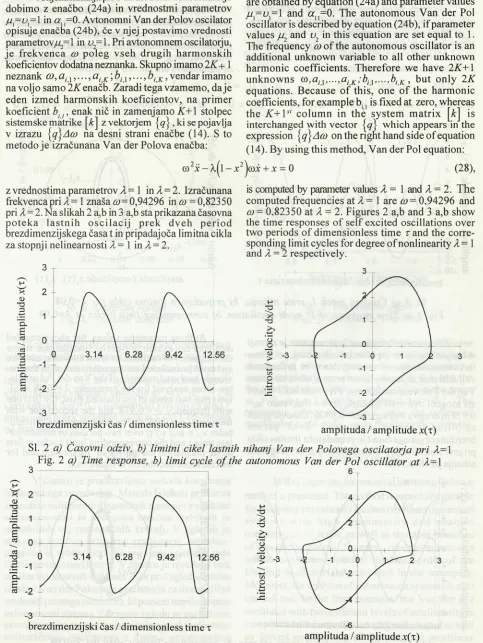
z vrednostima parametrov 2 = 1 in 2 = 2. Izračunana frekvenca pri 2 = 1 znaša tu =0,94296 in co =0,82350 pri 2 = 2. Na slikah 2 a,b in 3 a,b sta prikazana časovna p o te k a la s tn ih o s c ila c ij p re k dv eh p e rio d brezdimenzijskega časa t in pripadajoča limitna cikla za stopnji nelinearnosti 2 = 1 in 2 = 2.
Van der Pol oscillator
Forced vibrations o f the Van der Pol oscillator are obtained by equation (24a) and param eter values
H= i;,=1 and a u=0. The autonom ous Van der Pol oscillator is described by equation (24b), if parameter values n 2 and u2 in this equation are set equal to 1. The frequency co o f the autonom ous oscillator is an additional unknown variable to all other unknown harm onic coefficients. Therefore we have 2AM-1 unknow ns a>,aj -[,...,alK;bjX,...,b,K , but only 2K
equations. Because o f this, one o f the harm onic coefficients, for example b. , is fixed at zero, whereas the AM-Is' colum n in thè system m atrix [2] is interchanged with vector \q \ which appears in the expression [q^Aco on the right hand side o f equation (14). By using this method, Van der Pol equation:
jcoi + X = 0 (28),
is computed by parameter values 2 = 1 and 2 = 2. T he computed frequencies at 2 = 1 are co = 0,94296 and
co = 0,82350 at 2 = 2. Figures 2 a,b and 3 a,b show the time responses o f self excited oscillations over two periods o f dimensionless tim e r and the corre sponding limit cycles for degree o f nonlinearity 2 = 1 and 2 = 2 respectively.
brezdimenzijski čas / dimensionless time x
SI. 2 a) Časovni odziv, b) limitni cikel lastnih nihanj Van der Polovega oscilatorja pri 2=1
Sklopljeni nelinearni oscilator z dvema prostostnima stopnjama
N ajp rej v zem im o a v to n o m n i sk lo p ljen i nelinearni oscilator z dvema prostostnima stopnjama, ki ga lahko popolnoma opišemo z enačbama (23a,b). V tem primeru ni zunanjega vzbujanja, zaradi česar je g v enačbi (23a) enak nič, g,= 0. P reostale vrednosti parametrov izberimo takole:
/1 = 0,08 e x= 0,2 s 2 = - l
=
M2a n
= 0 a ,2 = -0 ,0 0 8a
13 = 0a u ■
brezdimenzijski čas / dimensionless time x
C oupled nonlinear o scilla to r with two degrees o f freedom
First we have chosen the autonomous coupled nonlinear oscillator with two degrees o f freedom, that can be completelly described by means o f equations (23a,b). In this case external excitation is not present, which implies g =0 in the equation (23a). Other values o f parameters are chosen as follows:
= 0 Dj = 1
U2 = 9
= 0
cc21 =
-0,0064a 22
= a 23 =a 24 =
0a m p litu d a /am plitudex, (t) , x2(t)
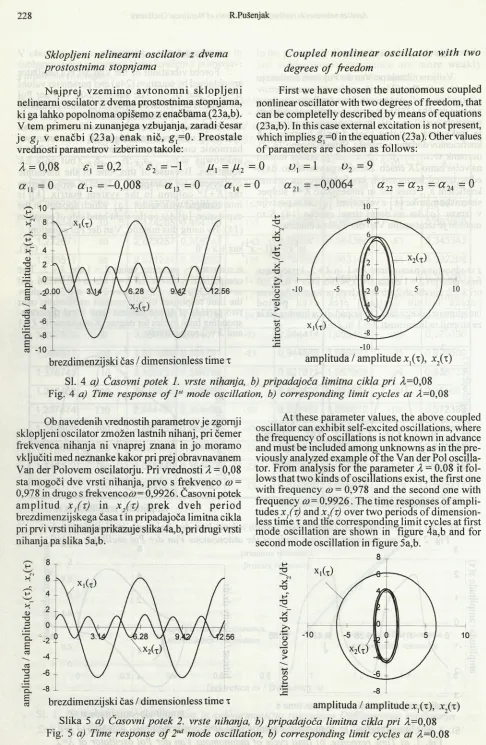
SI. 4 a) Časovni potek 1. vrste nihanja, b) pripadajoča limitna cikla p ri 2=0,08 Fig. 4 a) Time response o f T' mode oscillation, b) corresponding limit cycles at 2=0,08
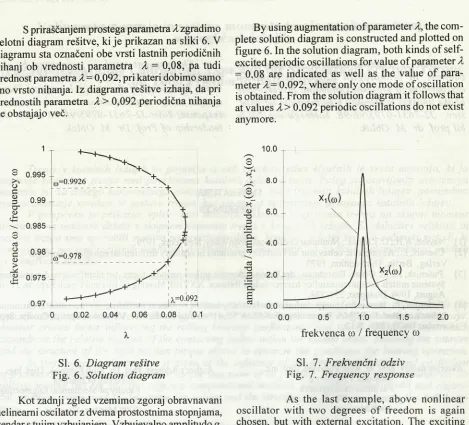
Ob navedenih vrednostih parametrov je zgornji sklopljeni oscilator zmožen lastnih nihanj, pri čemer frekvenca nihanja ni vnaprej znana in jo moramo vključiti med neznanke kakor pri prej obravnavanem Van der Polovem oscilatorju. Pri vrednosti 2 = 0,08 sta mogoči dve vrsti nihanja, prvo s frekvenco co = 0,978 in drugo s frekvencoču = 0,9926. Časovni potek a m p litu d x f x ) in x 2(z) p re k dveh p e rio d brezdimenzijskega časa t in pripadajoča limitna cikla pri prvi vrsti nihanja prikazuje slika 4a,b, pri drugi vrsti nihanja pa slika 5a,b.
At these parameter values, the above coupled oscillator can exhibit self-excited oscillations, where the frequency of oscillations is not known in advance and must be included among unknowns as in the pre viously analyzed example o f the Van der Pol oscilla tor. From analysis for the parameter 2 = 0,08 it fol lows that two kinds o f oscillations exist, the first one with frequency co = 0,978 and the second one with frequency co = 0.9926. The time responses o f ampli tudes x fr ) and x f r) over two periods o f dimension less time t and the corresponding limit cycles at first mode oscillation are shown in figure 4a,b and for second mode oscillation in figure 5a,b.
---1
10
a m p litu d a /am plitudexf x) , x f x )
S priraščanjem prostega parametra A zgradimo celotni diagram rešitve, ki je prikazan na sliki 6. V diagramu sta označeni obe vrsti lastnih periodičnih nihanj ob vrednosti param etra A = 0,08, pa tudi vrednost parametra A= 0,092, pri kateri dobimo samo eno vrsto nihanja. Iz diagrama rešitve izhaja, da pri vrednostih parametra A > 0,092 periodična nihanja ne obstajajo več.
1
-T-s 0.995
-O ,3=0.9926
S+
e 3 CT <D
0.99
i\
43
0.985 -
: t
S -
i
a o c
<D 0.98 ffl=0.978
\
i
i
i
i
i
i
i
i
>
<L> 0.975 !
. ' 1
-T ! 1
0.97 --- 1--- - , ______________ ^ =0'° H 0 0.02 0.04 0.06 0.08 0.1
X
Sl. 6. Diagram rešitve
Fig. 6. Solution diagram
Kot zadnji zgled vzemimo zgoraj obravnavani nelinearni oscilator z dvema prostostnima stopnjama, vendar s tujim vzbujanjem. Vzbujevalno amplitudo g, izb erem o g = 0,5 te r sp re m in ja m o fre k v e n c o vzbujevalnega signala v območju com.= 0, 0)mA = 2,0 s prirastkom Aco= 0,1. Resonančni krivulji na sliki 7 prikazujeta potek amplitud x {(a>) m x2(a>)v odvisnosti od frekvence.
4 SKLEP
V članku je predstavljena metoda koračnega harmonskega ravnovesja. M etoda je zlasti primerna za analizo nelinearnih dinamičnih sistemov z velikimi nelinearnostm i in om ogoča izračun stabilnih in nestabilnih vej resonančnih krivulj. V zgledih je prikazan izračun prim arne resonance, superhar- monične in subharmonične resonance tretjega reda Duffmgovega oscilatorja. V članku je izvedena tudi analiza avtonomnih sistemov. Kot prvi zgled je podan izračun Van der Polovega oscilatorja za dve različni vrednosti prostega parametra, ki pomeni merilo stopnje nelinearnosti sistema.V drugem zgledu so analizirana samostojna in tuje vzbujana nihanja sklopljenega nelinearnega o sc ila to rja z dvem a prostostnim a stopnjama.
By using augmentation o f param eter A, the com plete solution diagram is constructed and plotted on figure 6. In the solution diagram, both kinds o f self- excited periodic oscillations for value o f parameter A = 0,08 are indicated as well as the value o f para m eter A = 0.092, where only one mode o f oscillation is obtained. From the solution diagram it follows that at values A> 0.092 periodic oscillations do not exist anymore.
SI. 7. Frekvenčni odziv
Fig. 7. Frequency response
As the last exam ple, above nonlinear oscillator with two degrees o f freedom is again chosen, but with external excitation. The exciting signal am plitude is selected as g = 0.5 and the frequency o f the exciting signal is varied in the range
co . = 0 , co = 2 .0 with increm ent A co = 0.1 . The resonance curves in figure 7 show the course o f amplitudes x/cq) and x2(co) in the frequency domain.
4 CONCLUSION
Zahvala Aknow ledgem ent
Delo j e finančno podprlo M inistrstvo za zn a n o st in tehnologijo S lo ven ije v okviru raziskovalnega projekta: Optimalno projektiranje oblike linijskih konstrukcij z nelinearnim odzivom, štev.: J2-7631-0795/96-98, katerega nosilec je bil prof. dr. M. Oblak.
The p r e s e n t w ork is sp o n so red by the Ministry o f Science and Technology o f Slovenia in the framework o f the research project: Shape optimal design o f plane structures with nonlinear response, No.: J2-7631-0795/96-98 under the leadership o f Prof. Dr. M. Oblak.
5 LITERATURA
5 REFERENCES
[1] Nayfeh, A.H., D.T.Mook.: Nonlinear Oscillations, JohnWiley, New York, 1979.
[2] Caesari, L.: Asymptotic behaviour and stability problems in ordinary differential equations. Springer- Verlag, Berlin. Third edition, 1970.
[3] Pušenjak, R., M. Oblak: Berechnung der Resonanzkurven einiger periodisch erregten nichtlinearen dynamischen Systeme mittels der inkrementellen harmonischen Balance. XXVIIth Meeting of Bus and Coach Experts, 28-30 August, 1996, Budapest, 231-238.
[4] Pušenjak, R.: Numerical computation of periodically excited nonlinear oscillators by incremental harmonic balance method. KoREMA. Proceedings KoREMA’96,41st Annual Conference, Volume 4, Opatija, Croatia, Sep tember 18-20,1996, 9-12.
.Avtorjev naslov: prof. dr. Rudi Pušenjak, dipl. inž. Univerza v Mariboru
Fakulteta za strojništvo Smetanova 17
2000 Maribor
Author's Address: Prof. Dr. Rudi Pušenjak, Dipl. Ing. University of Maribor
Faculty o f Mechanical Engineering Smetanova 17
2000 Maribor, Slovenia
PreJet0: oo 1Qo7