ISSN: 2374-2208 (Print) 2374-2194 (Online) Copyright © The Author(s). 2014. All Rights Reserved. Published by American Research Institute for Policy Development
Utilisation Rate of Free Trade Agreements (FTAs) by Local Micro-, Small- and Medium-Sized Enterprises: A Story of ASEAN
Tulus Tambunan1 and Alexander C. Chandra2
Abstract
The Member States of the Association of Southeast Asian Nations (ASEAN) are not only progressing in the deepening of economic integration among themselves, but are also active in pursuing free trade agreements (FTAs) with their strategic economic partners (SEPs). It is generally expected that the implementation of all existing ASEAN-led FTAs will provides benefits to all enterprises in individual ASEAN member states (AMS) in the forms of greater export opportunities and greater availability of raw materials, intermediate inputs and capital goods with competitive prices and better quality. However, there are concerns over the extent to which MSMEs in individual AMS have benefited from these commercial pacts. Although literature on this issue is limited, available evidence suggests that MSMEs are by far the least active economic actors in the region to make use of such trade agreements. Aside from identifying key challenges and opportunities confronted by ASEAN-based MSMEs in taking advantage of ASEAN-led FTAs, this article also provides practical and policy recommendations that could allow the greater use of these FTAs by these enterprises.
Introduction
As of 2013, the Association of Southeast Asian Nations (ASEAN) and its member states (AMS) were involved in over 90 free trade agreements (FTAs) (refer to Table 1).
While many of these FTAs are already in full effect (e.g. those with China, Japan, South Korea, Australia and New Zealand, and India), others are either still under negotiations or in the early stages of discussion with trading partners.
1 Center for Industry, SME and Business Competition Studies, Trisakti University.
2 Trade Knowledge Network (TKN) Southeast Asia, the International Institute for Sustainable
In addition to an internal FTA among the member states (ASEAN Free Trade Area, or AFTA), which was upgraded to the ASEAN Trade in Goods Agreement (ATIGA) in 2010, ASEAN and its Member States are also party to numerous bilateral and regional FTAs, as well as participating in other regional trade arrangements beyond that of ASEAN, such as, inter alia, the Regional Comprehensive Economic Partnership (RCEP) and the Trans-Pacific Partnership (TPP).
Despite progress on economic integration processes within ASEAN, as well as between ASEAN and AMS with other non-ASEAN countries, there are concerns over the extent to which micro-, small-, and medium-sized enterprises (MSMEs) have benefited from these commercial pacts. Numerous studies, such as Kawai and Wignaraja (2008; 2009; 2010), Chia (2010), Dagooc (2013), and Chandra (2014) suggest that the utilisation rates of these commercial pacts are relatively low among MSMEs.
Table 1. Total Number of FTAs/EPAs involving ASEAN and the AMS Type of FTAs/EP As In effect Signed but not in effect Framework Agreement signed/FTA negotiated Under negotiation Under consultation /study Postponed /cancelled Total Internal FTA
1 0 0 0 0 1
State-to-State
26 4 2 16 10 0 58
State-to-Region
8 0 0 6 5 0 19
Region-to-Region
0 0 0 0 0 1 1
AMS Participat ing in Existing RTA initiatives
3 2 8 0 0 0 13
New RTAs
0 0 0 0 1 0 1
Total 38 6 10 22 15 1 92
Source: ASEAN Secretariat, Jakarta
Brief Overview of Asean-led FTAs and Asean Msmes
ASEAN-led FTAs: the Existing State of play
ASEAN has not only been playing an active role in promoting FTAs in Asia, but has also been turning itself into an FTA hub in the region. Its diplomatic and economic significance can be seen in the number of such commercial pacts (as well as other forms of economic cooperations, such as economic partnership agreements) that the grouping has either signed, or is still negotiating with major external economic partners (Chia, 2010). As mentioned, aside from an internal FTA, ASEAN has entered into numerous FTAs with its external economic partners. Internally, the ASEAN Free Trade Area (AFTA) was signed on 28 January 1992, and took effect in 2003. The agreement eliminates import duties on all products placed in the so-called ‘normal track’ in the ASEAN-6 countries (including Brunei Darussalam, Indonesia, Malaysia, the Philippines, Singapore, and Thailand). With the entrance of Vietnam in 1995, Lao People’s Democratic Republic and Myanmar in 1997, and Cambodia in 1999 into ASEAN, AFTA now comprises the full ten Member States of the grouping. Thus, the ten AMS have been able to make significant progress in lowering intra-regional tariffs through the AFTA’s Common Effective Preferential Tariff (CEPT) scheme. To date, up to 99 percent of the products included in the CEPT inclusion list of the ASEAN-6 have been brought down to the 0-5 percent tariff range, while a number of initiatives to eliminate non-tariff barriers (NTBs) have also been undertaken.3
In 2010, furthermore, the ASEAN Trade in Goods Agreement (ATIGA) entered into force, upon the ratification of all AMS. The ATIGA, in principle, is an enhancement of the CEPT-AFTA into a more comprehensive legal instrument. With the existence of the ATIGA, certain ASEAN agreements related to trade in goods, such as the CEPT-AFTA framework and other selected protocols, have been superseded by this new framework of agreement. As a result of the ATIGA, the older ASEAN-6 was required to issue legal enactments within 90 days, whereas the newer AMS were required to do so within 180 days after the signing of the ATIGA. Thereafter, tariff liberalisation commitments under the ATIGA should have been implemented retroactivelly since 1st January 2010 (Singapore’s FTA Network, n.d.).
3 A work programme on the elimination of NTBs, which include, inter alia, the process of verification
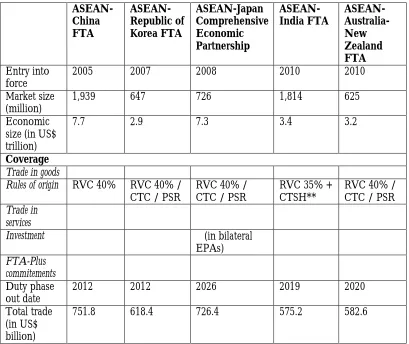
ASEAN has also signed various trade agreements with external partners, including those with China (in 2002), Japan (2003), the Republic of Korea (2005), Australia and New Zealand (2009), and India (2009). Table 2 provides a full list of ASEAN’s external FTAs.
Table 2. ASEAN-led External FTAs
ASEAN-China FTA ASEAN-Republic of Korea FTA ASEAN-Japan Comprehensive Economic Partnership ASEAN-India FTA ASEAN- Australia-New Zealand FTA Entry into force
2005 2007 2008 2010 2010
Market size (million)
1,939 647 726 1,814 625
Economic size (in US$ trillion)
7.7 2.9 7.3 3.4 3.2
Coverage
Trade in goods
Rules of origin RVC 40% RVC 40% /
CTC / PSR
RVC 40% / CTC / PSR
RVC 35% + CTSH**
RVC 40% / CTC / PSR
Trade in services
Investment (in bilateral
EPAs) FTA-Plus commitements Duty phase out date
2012 2012 2026 2019 2020
Total trade (in US$ billion)
751.8 618.4 726.4 575.2 582.6
Notes: *RVC: Regional Value Content; CTC: Change in Tariff Classification rule; PSR: Product-Specific Rules;
In addition to these external FTAs, ASEAN, together with the same external trade partners, is currently also pursuing negotiations to establish the Regional Comprehensive Economic Partnership (RCEP). The idea to set up the RCEP was first mooted at the 19th ASEAN Summit in November 2011, with the first round of the negotiations taking place in February 2013, in Bali, Indonesia. It is currently expected that the negotiation to establish the RCEP can be completed by the end of 2015, which is the same deadline for ASEAN to launch its own ASEAN Economic Community (AEC). At a public discussion organised in early 2013, in Jakarta, Indonesia, a senior official from the Indonesian Ministry of Trade explained that the establishment of RCEP is aimed at consolidating the existing ASEAN+1 FTA arrangements that the grouping currently engages itself in, but is also to serve as a platform to top the existing trade agreements that ASEAN has with the six existing strategic economic partners (SEPs). In other words, RCEP should be opened for issues that were previously put aside in ASEAN-led FTA talks, such as intellectual property rights, competition policy, procurement, etc).
ASEAN MSMEs: An Overview
Table 3: Msmes Contribtion to Total Enterprises, Employment, and GDP in AMS (In %)
Unit / AMS Bru Cam Indo Laos Mal Mya Phil Sing Thai Viet
No. of unit 98.5 99.0 99.9 99.8 99.2 99.4 99.6 99 99.6 99
Employment 98.0 85.0 99.0 83.0 65.0 70.0 63.0 70.0 78 85
GDP 68.4 76.7 58.2 69.0 32.0 n.a. 32.0 60.0 37.1 40
Share in
export n.a. n.a. 20 n.a. 19 n.a. n.a. 16 30.6 20.0
Source: Win Zaw Min (2012); Tambunan (2009a); ADB (2009); Goh (2007); OSMEP (2010).
While previously neglected, there is now increasing recognition given to MSMEs in the region. In her observation, Sinha (2003: 1-2) maintains that the growing commitments given to these economic actors have been based on three core arguments. Firstly, the existence of MSMEs encourage competition and entrepreneurship. Their presence, as such, not only creates economy-wide efficiency, but also innovation, and aggregate productivity growth. Accordingly, direct government support to these enterprises could assist countries to exploit the social benefits derive from greater competition and entrepreneurship. Secondly, MSMEs are generally more productive in comparison to their larger counterparts. However, financial market and other institutional failures often create obstacles for these economic actors to develop. Therefore, direct government support to MSMEs could help boost economic growth and development. Finally, the expansion of MSMEs could also boost employment far larger than large firms’ growth, particularly as the former are more labor intensive than the latter. To a large extent, direct assistance given to the MSMEs could represent a poverty alleviation tool.
Accordingly, as Troilo further observed, policy-makers might want to allocate scarce resources more efficiently than by offering special treatments to encourage MSMEs to export. If, for example, such enterprises desire additional knowledge of foreign markets, policy-makers could, inter alia, consider other avenues besides exporting to allow their MSMEs to export, such as specialized business education for MSME owners/managers, and so on (p. 74).
The Utilization of FTAs: Lessons from other Countries and Regions
As in the case with ASEAN, data on the utilization of FTAs by MSMEs from other regions is also difficult to come by. The majority of analyses covering the Asian region outside ASEAN generally give emphasis on large size exporting firms. Notwithstanding the lack of focus on MSMEs in these analyses, they should at least provide us with better a better understanding on the emerging issues confronting the utilization of FTAs in other parts of the world. In Japan, for example, despite the country’s active FTA policy, the preference utilization rates among Japanese-based firms was relatively modest (Takashi and Urata, 2008; 2009). Both scholars related this phenomenon to the low volume of trade between firms based in Japan and the country’s FTA partners. They also found that, in comparison with MSMEs, large enterprises were more likely to use FTA schemes, which suggests, at least at the firm-level, a positive relationship between the size of the firms, or a firm’s productivity, and its FTA use. 4
Meanwhile, based on a survey of 232 firms of different sizes in various regions of China, Zhang (2010) found that, while the utilization rates, as defined by incidence of use, are relatively high among the surveyed firms, the share of exports covered by FTAs was lower. He maintained that the variable coverage of export values by FTAs may reflect the present market orientation of Chinese-based firms towards traditional markets, such as the US. As a major actor in the global economy, the Chinese government considers FTAs an important element of the country’s trade strategies.
4 More recently, Hayakawa et al. (2013), using unique affiliate-level data to investigate the kind of
Accordingly, aside from attempting to improve coordination among relevant agencies dealing with FTAs (e.g. the Ministry of Commerce, the Ministry of Foreign Affairs, State General Administration for Quality Supervision, Inspection, and Quarantine, and others), the Chinese Ministry of Commerce also made available an official website that highlights relevant information (e.g. legal texts, step-by-step instructions, etc.) to provide further assistance to the private sectors to make use of the country’s FTAs.
A study conducted by Cheong and Cho (2009) on the use of FTAs in the Republic of Korea (RoK), however, highlights a more positive outcome on the use of FTAs among Asian-based businesses. Most of the ROK’s early FTAs were with relatively small- and medium-sized developing countries, where the range of preferential tariffs included in these commercial pacts were not very broad in scope, thus making them less attractive to potential exporters. However, the conclusion of FTAs with the US, and between RoK and the European Union (EU), has seen a growing interest among the country’s businesses in general to make use of these FTAs. Among the 120 firms surveyed in RoK, the study found that half of them intend to utilize the country’s existing FTAs, and most firms interviewed had the RoK-US FTA in mind. The study also found that the majority of South Korean-based MSMEs were not exporting under FTAs due to the fact that they were already part of the value-chains of larger enterprises.5
Elsewhere outside Asia, a study carried out by Ulloa and Wagner (2013) on the utilization of the United States-Chile FTA found that a far higher utilization rate of this FTA compared to FTAs pursued by AMS. In the following two or three years after the US-Chile FTA was implemented,6 the utilization rate of this trade agreement reached a plateau of around 80-85 percent. Despite such an achievement, both scholars also found that one in seven Chilean products entering the US still fail to enjoy the preferences from this FTA, which means that they are paying higher tariffs to the US as if the treaty does not exist.
5 While there are no available data concerning the utilization of the RoK-EU FTA by the private
sectors in the participating countries, the European Commission (2013) reported that exports from the most advanced regional grouping in the world to RoK increased by 37 percent since the implementation of the agreement in 2011. Accordingly, the Commission assumed that the figure suggests an increasing interests among European private sector to make use of this FTA.
6 The US-Chile FTA entered into force in 1st January 2004. Further details concerning this FTA is
They also concluded that small exporters that do not use this commercial pact could even suffer when the Chilean larger firms have the option of using the treaty. This is particularly so since the larger firms would have the chance to increase their exports, and push up factor prices for the industry as a whole.
Generally speaking, US-based MSMEs have been playing crucial role in boosting their country’s export performance. Soroka (2013: 7), for example, revealed that MSMEs, while accounting for a third of export on average, count for a larger share of exports compared to their larger counterparts to several countries among the top 25 US export markets. In 2011 alone, for instance, more than half of the known export value to Switzerland came from MSMEs. The same type of enterprises also accounted for more than 40 percent of known US exports to Hong Kong, the United Arab Emirates, Turkey, India, and Israel. China, on other hand, was the most popular import partner for US-based MSMEs, with a total of 91,184 registered purchases made by these enterprises from China, totaling US$ 150.4 billion, or 25 percent of total US merchandise imports to MSMEs that year. As Soroka further argues, campared with large firms, US-based MSMEs were particularly dependent on the US government initiatives to open new market opportunities. Unlike their larger counterparts, most US-based MSMEs do not possess offshore business affiliates that can be used to circumvent trade barriers and gain market access (p. 8).
Germany, furthermore, provides another good case example where the active roles of MSMEs in foreign trade can be observed. Although data on FTA utilization of such enterprises in Germany is not readily available, vast amount of literatures confirm this argument. To date, not only that Germany MSMEs, or mittelstand, enjoy relatively strong position in foreign markets, they are also considered as some of the best performing MSMEs in the European Union (EU), at least in terms of job created and value added generated (European Commission, 2012: 1). Export figures recorded by the country’s MSMEs, for example, rose by 29.5 percent to €186.1 billion betwen 2000 and 2010, with as many as 1,300 of the country’s leading MSMEs, particularly those in the fields of electrical engineering and industrial products, have successfully found niches for their products overseas.
Externally, in addition to supportive government policies, active overseas institutional support is also key to the promotion of German MSMEs’ active presence in the global marketplace. Instutions such as Germany Trade and Invest,7 overseas chambers of commerce,8 and German embassies/consulates often play active roles in facilitating the interests of German MSMEs in the countries they do business in (METI, 2012: 506-507).
ASEAN-led FTAs and MSMEs
FTAs are usually designed, among other things, to facilitate and improve trade and investment flows between the participating countries. However, the extent to which an FTA could increase trade and investment flows would depend largely on the utilization of this FTA by businesses in the participating countries. All exporters, large and small, are required to follow certain procedures to benefit preferential benefits of such a commercial pact. More specifically, MSMEs must be able to meet the so-called Rules of Origin (RoO) requirement, or the terms set out in trade agreements that define how a product’s country of origin should be defined, acquire the CoO from relevant agencies and/or business associations, and, subsequently, submit the CoO to the custom agencies in the importing countries.9 Economists usually assess the level of usefulness and attractiveness of an FTA by observing the so-called utilization rate of an FTA, which could be measured through the use of Certificate of Origin (COO) data collected by customs authorities or business association databases.10
7 Germany Trade and Invest is the economic development agency of the Federal Republic of Germany.
Its main mandate is to promote Germany as a business and technology locations, and provides supports to firms based in Germany with global market information. Further detail concerning the organization can be accessed from its official website at:
http://www.gtai.de/GTAI/Navigation/EN/invest.html
8 The German Chambers of Commerce, or Deutsche Auslandshandelskammern, provides assistance for the
country’s businesses to expand overseas. It has developed branch offices in 120 sites in 80 countries around the world, and is said to have covered over 98 percent of countries where German enterprises are actually involved in trade and investment with (METI, 2012: 506-507). Further details concerning the AHK is available from its official website at: http://ahk.de/en/
9 For a step-by-step guide to utilize ASEAN-led FTAs, see, inter alia, ASEAN Secretariat (2013) and
McClanahan et al. (2014).
10 As illustrated in the earlier section, however, more in-depth examinations of the utilisation of an
Although official data on the utilization of ASEAN-led FTAs by businesses, particularly the MSMEs, in the region, are hard to come by, studies and commentaries made in some AMS suggest that MSMEs have not generally taken the advantage from these trade pacts. A commentary made by Dagooc (2013) in The Philippine Star, a newspaper, stated that Philippines-based exporters face a number of barriers and perceived dis-incentives to trading under FTAs. Despite the active stance of the Philippines government to encourage firms to make use of the country’s existing FTAs, most exporters felt intimidated by the complicated rules and procedures associated with the use of FTAs. In addition, misconceptions about FTAs, complicated trade procedures in the partner countries, unharmonized codes within the ASEAN region, and the difficulty to access the most up-to-date information concerning the regulations dealing with FTAs have become the major disincentives for the Philippine-based MSMEs to fully participate in these FTAs.11
For Thailand, there are some important studies that assess the utilization rate of various Thai- and/or ASEAN-led FTAs by the Kingdom’s businesses. Kohpaiboon (2008), for example, analyzed the use of the AFTA by the country’s exporting firms for the period of 2003-2006. Using AFTA administrative records collected from the Bureau of Preferential Trade, the Department of Foreign Trade, and the Ministry of Commerce, he found that large exporting firms in industries were more inclined to make use of FTAs in cases of large differences between general and preferential tariff rates. Furthermore, a survey carried out among 221 exporting firms, both domestic and foreign, in three industries (textiles/garments, electronics, and auto/autoparts) by Wignaraja et al. (2010: 18-19) revealed the extent to which FTAs affect exporting firms in the Kingdom. Despite a reasonable use of FTA preferences by these economic actors, the study also found FTAs affect the business plans of these firms. The common complaint expressed by these firms, especially those large ones, about the Kingdom’s FTAs was the complex bureaucracy and additional costs associated with acquiring the Certificate of Origin (CoO) and the associated Rules of Origin (RoO). Accordingly, the sample firms, especially domestic ones, requested the Thai government to provide more institutional support so as to allow them to adjust themselves with their country’s FTA implementation.12
11 An earlier study conducted by Kawai and Wignaraja (2009) also found that firms in the Philippines
were generally unaware of the provisions attached to their country’s FTAs. Based on the survey that they carried out, both authors found only 7 percent firms surveyed indicated a good level of awareness, primarily due to the fact that these firms were already using the country’s FTAs.
12 Some of the commonly cited supports required by these businesses were information on the
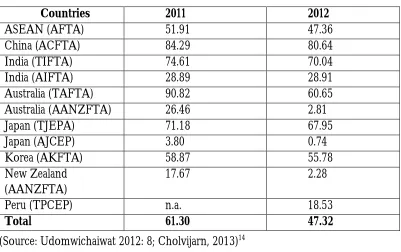
A more recent analysis conducted by Chandra (forthcoming) on the use of FTAs by Thai-based firms also reveals a general decline in the utilization of all Thailand’s FTAs. While the overall utilization among Thai-based firms reached 61.3 percent in 2011, the rate fell to 47.3 percent (refer to Table 4). Among its SEPs, Thai-based firms appeared to have made the most use of the Thailand-Australia FTA, or at 90.8 percent utilization rate in 2011, though Thai-based firms made more use of ASEAN-China FTA in the following year. An interesting aspect in the assessment of FTAs’ utilization rate in Thailand is the higher use of bilateral state-to-state, rather than state-to-region, FTAs. It turned out that more attractive preferences for key products and simplified rules of origin may explain the heavier use of bilateral state-to-state, instead of bilateral state-to-region, FTAs (Kawai and Wignaraja, 2013: 18).13
Table 4. The Utilisation of FTAs by Thai-Based Firms in 2011 and 2012 (in Percentage)
Countries 2011 2012
ASEAN (AFTA) 51.91 47.36
China (ACFTA) 84.29 80.64
India (TIFTA) 74.61 70.04
India (AIFTA) 28.89 28.91
Australia (TAFTA) 90.82 60.65
Australia (AANZFTA) 26.46 2.81
Japan (TJEPA) 71.18 67.95
Japan (AJCEP) 3.80 0.74
Korea (AKFTA) 58.87 55.78
New Zealand (AANZFTA)
17.67 2.28
Peru (TPCEP) n.a. 18.53
Total 61.30 47.32
(Source: Udomwichaiwat 2012: 8; Cholvijarn, 2013)14
support, the adoption of electronic custom (e-custom) initiative to speed up and simplify the exporting procedures, and so on.
13 This analysis was consistent with the outcome of the ‘Bangkok Dialogue Forum for SMEs: The
Utilization of ASEAN-Led Free Trade Agreements’, which was co-organised by the Federation of Thai Industries (FTI), ASEAN-BAC, and the IISD, in Bangkok, Thailand, on 26 November 2013.
14 As quoted from Chandra (forthcoming). The two following paragraphs are also adapted from the
Elsewhere in ASEAN, the utilisation of the grouping’s FTAs remain modest, if not low. In Indonesia, for instance, although the total number of CoO issued under the AFTA, Indonesia-Japan Economic Partnership Agreement (EPA), ASEAN-China FTA, ASEAN-Korea FTA, and the ASEAN-India FTA had been on the rise from 26,085 certificates in 2007 to 205,775 certificates in 2010 (Ing, 2013: 6), a study conducted by Friawan (2012) suggests that only 16-17 percent of Indonesian-based firms were using FTAs pursued by the country and/or ASEAN. The percentage rate for Indonesia was somewhat lower compared to those of Malaysia (24 percent in 2012), Vietnam (31 percent in 2011), and Thailand (the above-mentioned 47.3 percent for 2012).15
As for Malaysia, the ADB and the ADBI (2012) carried out a study that also showed that only 24 percent of the country’s firms exported under FTAs. Despite this, the Ministry of International Trade and Industry of Malaysia (2012) recently reported the increase use of CoO among Malaysian-based firms under different FTA schemes. While in 2009 the total number of CoO issued reached 232,860, equal to about US$ 19.0 billion of total value of trade, a total of 436,094 CoO were issued in 2011, amounting to roughly US$ 32.1 billion of the country’s total trade with the rest of the world. The largest number of CoO issued in 2011 was under the AFTA scheme, with 230,400 CoO, while the CoO under the ASEAN-Australia-New Zealand FTA came under the second place with 47,387 CoO.
Among the newer AMS, only Vietnam has relatively recent data concerning the utilization of ASEAN-led FTAs among the country stakeholders. Although showing a relatively low overall use of FTAs, as in the case with the majority of the country’s ASEAN neighbors, the utilization rates of FTAs among Vietnam-based firms nearly trebled from 11 percent in 2008 to 31 perent in 2011. Exporting firms who used these FTAs made particularly heavy utilization of the ASEAN-Korea FTA (at 90.8 percent utilization rate) and the ASEAN-Japan Comprehensive Economic Partnership (CEP) (at 31.23 percent utilization rate). Surprisingly, despite sharing land and maritime borders with China, the use of the ASEAN-China FTA among Vietnam-based businesses was relatively low (at 23.1 percent utilization rate), though this was higher than the use of AFTA (at 20.2 percent utilization rate) during the same period (Tran, 2012: 13).
Comprehensive assessments on the utilization of ASEAN-led FTAs among MSME’s in particular are largely absent. However, Lim and Kimura (2009) argued that with the increase internationalization of the region’s MSMEs in regional and global value chain, especially in electronics, machinery, information and communication technologies, automobile, and service industries, the use of FTAs by these enterprises can be expected to increase as well. Notwithstanding such an expectations, both authors also maintained that production networking and value chains have not really benefited from the internal and external economic integration of ASEAN. As observed by both authors, AFTA and other ASEAN-led FTAs consist of too many exceptions (often on key sectors), include inadequate harmonization of rules and regulations (including the existence of non-tariff barriers), and the unavailability of adequate infrastructre and institutions to implement these trade pacts.
Overall, as confirmed by numerous studies that have been carried out to assess the deliverability of ASEAN-led,16 there are at least three reasons why the utilization rates of these FTAs are generally low: (1) the lack of information on FTAs amongst ASEAN-based firms; (2) low margins of preference; and (3) delays and administrative costs associated with documenting and complying with the Rules of Origin (ROO). Other factors contributing to the low use of FTAs includes the existence of other trade-related initiatives, such as the export processing zones and Information Technology Agreements, which provide alternative incentives for exporters, and the non-tariff measures in partner countries that inhibit import, and, accordingly, inhibit the use of FTA preferences (Kawai and Wignaraja, 2013: 22). These reasonings also well confirmed in the series of MSMEs Dialogue Forums co-organised by the ASEAN-BAC, the IISD, and their local partners in several major cities of the AMS in the second-half of 2013 and early 2014.17
16 See, inter alia, Kawai and Wignaraja (2013: 22) and Chandra (2013).
17 The ASEAN-BAC and the IISD co-organized a total of five MSMEs Dialogue Forums throughout
ASEAN and AMS Initiatives to Promote the use of ASEAN-led FTAs among MSMEs
As far as ASEAN is concerned, the grouping has been in the process of implementing the ASEAN Policy Blueprint for MSME Development for the period of 2004 to 2014, which has the objectives of: (1) accelarating the pace of MSME development; (2) enhancing the competitiveness and dynamism of ASEAN MSMEs by facilitating their access to information, market, human resource development and skills, finance as well as technology; (3) strengthening the resilience of ASEAN MSMEs to better withstand adverse macroeconomic and financial difficulties, as well as the challenges of a more liberalized trading environment; and (4) increasing the contribution of ASEAN MSMEs to the overall economic growth and development of the region (ASEAN Secretariat, 2004: 3).
Some assessments on the progress of these two major ASEAN policies on MSME development are available. A year after the implementation of the Strategic Action Plan, Narjoko (2011: 17) of the Economic Research Institute for ASEAN and East Asia (ERIA) argued that the promotion of MSME development in ASEAN is extremely complex, much depends not only external conditions, such as the introduction of policies to facilitate MSME development, but also on the characteristics, performance, and/or behavior of the region’s MSMEs. Issues, such as the access to finance and MSMEs’ exposure to ASEAN-led trade and investment liberalization initiatives, remain common problems confronted by these economic actors. Aside from developing its own SME policy index, ASEAN was also asked to introduce a ‘scorecard’ to ensure the smooth implementation of its MSME development Blueprint and other relevant policy initiatives (pp. 18-19). Following the request of the 19th (2011) ASEAN Summit, in Jakarta, Indonesia, ERIA launched the ASEAN SME Policy Index18 and the SME Credibility Index in the following year.
Other studies have attempted to provide a national-level assessment on ASEAN’s achievement to promote MSME development in the region. The initial surveys and interviews conducted among Philippine-based MSMEs and the representative of the Philippines government to the ASEAN Working Group on ASEAN carried out by Aldaba (2013), for example, revealed relatively low average effectiveness scores for the ASEAN Policy Blueprint for MSME Development and the corresponding ASEAN Strategic Action Plan for MSME Development. The majority of respondents stated that both policy documents have either no or little concrete impacts on the implementation of various programs on access to financing, facilitation, technology development, and other regional MSME initiatives.
18 ASEAN SME Policy Index has similar methodology to the SME Policy Index developed by the
She concluded that the government of the Philippines could facilitate MSMEs’ participation in ASEAN by: (1) designing a coherent set of policies and programs; (2) awareness raising on global production network; (3) addressing financing issues; (4) improving technological capabilities of MSMEs; and (5) creating an enabling environment for MSMEs to realize their potentials to grow (p. 15).
Meanwhile, the extent to which individual AMS promotes the participation of MSMEs in regional and global trade varies among ASEAN member states. One outstanding outreach model has been pursued by the Philippines government. The country’s Department of Trade and Industry (DTI), in partnership with other relevant agencies (e.g. Bureau of Custom, Tariff Commission, and so on) and other non-state actors (e.g. the Philippine Chamber of Commerce and Industry (PCCI) and members of the academia), has, since 2010, launched a massive trade advocacy and information campaigns, known as the ‘Doing Business in Free Trade Areas (DBFTA)’, which has the objectives of: (1) institutionalizing an effective and efficient consultative mechanism; (2) gathering inputs from stakeholders; (3) promoting mutual trust, understanding, and cooperation among the sectors in society; (4) increasing public awareness on the country’s FTA policies and engagements; (5) responding to the interests of stakeholders, with specific emphasis on transparency and accountability; and (6) arriving at sound, rational, and balanced FTA policies. In addition to public engagement, the initiative also covers inter-government agencies coordination and trade policy research network (DTI and BoI, 2012: 6-8).
In their public seminars, the DTI and its partner organisations offer information concerning market opportunities for Philippines-based firms in the country’s FTA partner countries, step-by-step discussion on tariff reductions, rules, and custom procedures, among others. Seminars also include an ‘FTA Clinic’ which allows individual representative of firms to seek more in-depth guidance from relevant officials on how to make more effective use of the country’s FTA initiatives. The DBFTA’s public outreach program, which has been implemented nearly across the country, had reached 11,169 private sector stakeholders in 2012 alone, and another 1,746 stakeholders in the first quarter of 2013 (BETP-DTI 2013a; 2013b).19 The result of such an endeavor speaks for itself (Chandra, 2013). Although the Philippines was already rated the highest user of FTAs among AMS by the ASEAN Secretariat in 2010, many more Philippine-based firms are now using FTAs.
19 One of the DBFTA initiative carried out in the Philippines in 2013 was organised as part the
Among the AMS, for example, the Philippine businesses have been active in using the ASEAN-Australia-New Zealand FTA. In June 2012, the DTI reported a significant jump in the utilization of this trade pact from 64.1 percent in 2010 to 76.1 percent in 2011.
Thailand is another case example in ASEAN where extensive FTA campaign initiatives have encouraged businesses to make more effective use of the Kingdom’s FTAs. Under the purview of the Department of Foreign Trade within the Ministry of Commerce, the Thai government promotes the utilization of FTAs through, among others, public seminars in the capital and other provinces, electronic information being made available from the official website of the Department of Foreign Trade (www.dft.go.th), FTA consultation services for exporting firms, the implementation of electronic data interchange system to facilitate the application process of CoO for exporters,20 the establishment of an AEC Information Center, and the publication of quarterly journal on the utilization of FTA preferences. As of August 2012, the Department of Foreign Trade had established 17 Memorandum of Understandings with other government agencies and private organizations to ensure the smooth implementation of its public outreach program, while a total 21 seminars focused on AEC alone were organized, with a total of 6,193 participants taking part in these public consultation processes. Specific to MSMEs, the Department of Trade Negotiations of the Ministry of Commerce also organizes the so-called ‘AEC Business Trips for MSMEs’ (Udomwichaiwat, 2012: pp. 15-20), to enable greater networking opportunities for such enterprises in the region.
Moreover, as part of its efforts to improve the utilization of its FTAs, the Malaysian Ministry of International Trade and Industry (MITI) also holds regular outreach programs for the public and relevant stakeholders.
20 Electronic data interchange system is an electronic communication system that provides standards
These programs are either conducted directly by the Ministry and its regional offices, or through other agencies, such as the Malaysian External Trade Development Corporation (MATRADE)21 and SME Corp,22 and other non-state actors, particularly trade and industry associations. Prominent among MITI’s outreach programme is the ‘FTA Pocket Talks’, which is a series of dialogue forums that provides not only space for businesses to exchange ideas with trade policy-makers, but also to assist the former with the utilization of Malaysia’s FTAs. In 2014 alone, up to 25 of such a dialogue forum are expected to be carried out throughout the country (MITI, 2014).
Other AMS also pursue similar public outreach and MSMEs’ facilitation initiatives. However, many of these initiatives are often pursued in a rather ad-hoc manner, and generally involve only a very narrow industrial sectors. Comprehensive strategies and policies to facilitate such activities are also absent in these countries. In Indonesia, for example, although the Republic was among the first in ASEAN to engage civil society on trade policy decisions, the country’s public outreach and stakeholders consultations are very random at best. Though the government had, in 2003, established the so-called Indonesia WTO Forum to facilitate the exchange of ideas between policy-makers and stakeholders, this Forum went dormant from 2007 onward (Chandra, 2007: 70). While the country’s Ministry of Trade takes an active role in pursuing policy dialogues with business stakeholders, no institutional arrangement has been established thus far to ensure the sustainability of public outreach programs.
In the case where little or no domestic FTA outreach programs are being pursued by the AMS, non-state actors, such as trade and industry associations, research organizations, non-governmental organizations, or the combination of these, often with the support of the international donor communities, and/or in partnership with the AMS concerned, usually play the role of socializing ASEAN-led FTAs to the public and relevant stakeholders.
21 Established in 1993, MATRADE is an external trade promotion arm of the Malaysia’s Ministry of
International Trade and Industry. It provides assistance to Malaysian firms to establish presence overseas, and raise their profiles through different promotional means, including their participation in trade missions, specialized marketing missions, and/or international trade fairs. It also organizes business matching programs between Malaysian and foreign firms (ATPF, n.d.). Further information concerning the MATRADE is also available from its official website at: http://www.matrade.gov.my/
22 SME Corp is a dedicated agency in Malaysia that deals with the formulation of the overall policies
and strategies of the country’s MSMEs. It also coordinate MSMEs-related programs being pursued by other relevant ministries and agencies. Further information concerning the SME Corp is available from
The aforementioned project on MSMEs and ASEAN-led FTAs being pursued in financial year 2013/14 by the ASEAN-BAC and the IISD is a case in point. The project that is aimed at the enhancement of MSMEs’ participation in ASEAN-led FTAs does not only include the organization of dialogue forums in several AMS, but also produces an-easy-to-digest guidebook for the region’s MSMEs to make use of ASEAN-led FTAs.23 Elsewhere, the Mekong Institute, which is the research arm of the Greater Mekong Subregion had also implemented a so-called ‘Training of Trainer Program’ that focused on the enhancement of FTA utilization by MSMEs.24 Given the large potential that MSMEs could play to the economic development of ASEAN that many of such non-state organizations are increasingly embarking upon projects to assist SMEs to make use ASEAN-led FTAs more effectively.
To a large extent, however, it remains difficult to assess the actual contribution and the level of participation of MSMEs in ASEAN-led FTAs, particularly as no method has been applied to determine the size of the exporting firms across ASEAN. From general observation on the overall utilization rates of ASEAN-led FTAs, it can be argued that the MSMEs still play very small role in these trade pacts. There are several possible reasons for this. Firstly, in the AMS where comprehensive and integrated public outreach and MSMEs facilitation and development policies have been in place, it is likely that coverage of such initiatives has not been widespread enough. Much of such initiatives, for example, have been implemented either in capitals or in major cities of AMS. Secondly, in cases where MSMEs have been reached by such outreach programs, the lack of confidence in applying FTA preferences may hinder the participation of these economic actors in ASEAN-led FTAs. Thirdly, organizers of these public outreach programs, be it from state and/or non-state actors, can often be constrained by donor requirements, time and resources, and, as such, give little attention to the type of economic actors involved and the quality of information provided in these activities. Finally, the key orientation of ASEAN MSMEs remain that of domestic market (Tambunan, 2012). Rather than exporting directly their products and/or services, they become part of the larger value-chains at the national and/or regional levels.
23 See McClanahan et al. (2014).
24 For further information concerning this initiative, see the official website of the Mekong Institute at:
Public outreach initiatives at a single value-chain cluster are likely to provide more positive outcome in the participation of MSMEs in ASEAN-led FTAs.
ASEAN-led FTAs: Key Challenges and Opportunities for ASEAN MSMEs
ASEAN, as mentioned earlier, has been very active in pursuing strategic economic partnership agreements with its major economic partners. Although making a large contribution to the economic development of ASEAN, MSMEs have not been a key consideration in the free trade policy-making of the Association. Given the already full implementation of five FTAs, and numerous other to-state and state-to-region bilateral FTAs that each of the AMS pursuing with their SEPs, there is little that the region’s MSMEs can do aside from adjusting themselves to this strategic economic changes in ASEAN.
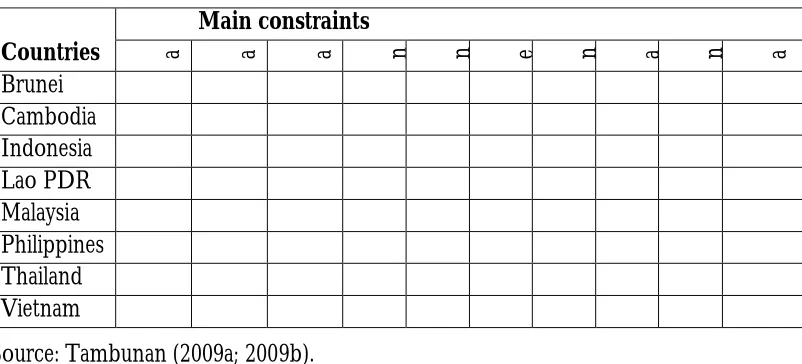
Table 5. Common Constraints Faced MSMEs in selected AMS
Countries
Main constraints
a w a r a p n n e n a n a r
Brunei
Cambodia
Indonesia
Lao PDR
Malaysia
Philippines
Thailand
Vietnam
Source: Tambunan (2009a; 2009b).
Thirdly, FTAs also help facilitate greater trade among the AMS and between ASEAN and its SEPs. Key components of ASEAN-led FTAs, such as trade facilitation, often encourage all the participating countries to establish more efficient custom procedures, greater transparency in trade policies, greater mutual recognition of technical standards adopted by all the involved parties, as well as the availability of a legal framework to ensure fair competition among all economic actors in the countries involved. Fourthly, ASEAN-led FTAs should also encourage greater foreign investment in AMS. While large investment projects, such as infrastructure development, can generate positive spill-over impacts to the long-term business operations of MSMEs, foreign investment could also, technically, spur the transfer of technologies and know-how, all of which allow MSMEs to enhance their business opportunities.
When it comes to the utilization of ASEAN-led FTAs, the series of MSMEs Dialogue Forums that were carried out by the ASEAN-BAC, the IISD, and their local partners in the second half of 2013 and early 2014 in several major cities of ASEAN (Manila, Jakarta, Bangkok, Hanoi, and Yangon) also found that the lack of information, especially with regard to information concerning foreign markets and the technical know-how to use these commercial agreements, was considered as the major stumbling block for the region MSMEs from using these FTAs. In addition, resource persons and participants of these forums also cited the lack of opportunities for MSMEs to network with their foreign counterparts as another common challenge for MSMEs to engage more effectively in ASEAN-led FTAs. The participants to these Forums, in fact, suggested the necessity of similar forums to be organized more consistently in other cities and/or regions outside the capitals.
At the policy level, the complex Rules of Origin (RoO), and the associated Certificate of Origin (CoO), in the implementation of ASEAN-led FTAs are also seen as burdensome by the region’s MSMEs. For example, the relatively high regional value content, which stands at about 40 percent in most ASEAN-led FTAs (refer to Table 2), is difficult for many MSMEs to comply with. This is not to mention high administrative costs attached to the compliance requirement to prove a product’s country of origin. In addition, multiple and often overlapping FTA commitments by the AMS often generates confusion among MSMEs. These also make many ASEAN-led FTAs redundant. It has been suggested that divergent RoOs across different FTAs is likely to fragment, rather than integrate regional markets (Tran Ba Cuong, 2012: 11). Traders are also likely to face higher administrative and production costs. All these constraints eventually lead to the low utilization rates of ASEAN-led FTAs.
Conclusion and Policy Recommendations
ASEAN is currently active in deepening not only its own internal economic integration processes, but is also in the process of enhancing its economic engagement with the global economy. As of today, the grouping has formed five FTAs with six of its SEPs. The number of FTAs forged by the AMS, however, is much higher than those pursued by ASEAN(over 80 FTAs as of 2013). Despite the proliferation of the bilateral and regional FTAs, the evidence suggests that the fruits of such initiatives have not been distributed evenly across the region, with the majority of firms capable of using these FTAs being large and multinational firms (including both ASEAN and non-ASEAN firms). In order to enhance the utilization of of ASEAN-led FTAs among MSMEs, and ensure more equal opportunities among economic actors across the region, the ASEAN-BAC and the IISD propose the following policy recommendations:
(1) An institutionalized, aggresive, well-coordinated, and interactive information campaign:
While information concerning ASEAN-led FTAs is increasingly available these days,25 many MSMEs still claim that a lack of information remains a major stumbling block. This suggests that the information campaign and socialization activities of ASEAN need to be organized more regularly, and be made available beyond capitals and/or major cities in the region;
In addition, given the vast number of similar information campaign and socialization activities carried out by numerous organizations and parties across the region, greater coordination on the implementation of thse ativities must be pursued, particularly between ASEAN, the AMS, donor communities, the private sector, and other stakeholders;
25 ASEAN and some of its SEPs, for example, have produced official websites that spell out not only
Information campaign and socialization of ASEAN-led FTAs should be a two-ways process. In this context, such activities should not only provide the opportunity for ASEAN, AMS, or major business associations to socialize these commercial pacts, they should also serve as venues for gathering practical and policy inputs from relevant stakeholders, including the MSMEs, in the region;
Given their relatively small size, MSME business owners and/or representatives may lack confidence in expressing their concerns and aspirations during public forums. Accordingly, a more interactive and practical methods in communicating components of ASEAN-led FTAs should be strongly considered;
The Philippine government, through its ‘Doing Business in FTAs’ initiative, has provided a very good example on how a well coordinated information campaign and socialization activities. Such an institutionalized information campaign and socialization mechanism can serve as a model for similar activities not only at the regional, but also at the national level in other AMS.
(2) Improving access to finance for MSMEs
Access to finance has been recognized as one of the classic issues that hinder MSMEs to explore and expand into new business opportunities. This problem is also a key determinant for these economic actors to engage more effectively in ASEAN-led FTAs. Although continuously recognized as a key issue in ASEAN’s SME development policies, there has been very little evidence to suggest the improvement of MSMEs’ access to financial facilities;
To date, while financial sector liberalization has the potential to address the access to finance problems to rural economic actors, the existence of entry and operation restrictions imposed on ASEAN- and non-ASEAN financial institutions hinder the potential gains that MSMEs could reap from such an reform initiative;
Financial sector reform through liberalization alone, however, is unlikely to be a sufficient means to improve access to finance to MSMEs.26 ASEAN and the AMS, for example, could establish a financial infrastructure that would stimulate income gains among the region’s MSMEs.
26 In their study, Chandra and Kinasih (2012: 3) also argue that financial liberalization might not
(3) The simplification of CoO/RoO requirement
The bureaucratic and technical knowledge needed to comply CoO/RoO requirements have been consistently mentioned by experts and business practitioners as one of the key impediments for businesses, including MSMEs, to engage more effectively in ASEAN-led FTAs. Accordingly, efforts to further simplyfing CoO requirements must be intensified;
Furthermore, while the creation of an ASEAN Single Window is progressing well,27 this initiative should be expanded to include countries with which the grouping has FTA arrangements with;
Finally, in order to improve the overall utilization of ASEAN-led FTAs, it is also imperative that ASEAN should accelerate the negotiation process of the Regional Comprehensive Economic Partnership (RCEP), which at the moment is being set for the end of 2015. If materialized, the initiative should help consolidate all existing ASEAN-1 FTAs.
References
ADB – Asian Development Bank. (2009). Key indicators for Asia and the Pacific, 2009. Manila: ADB.
ADB and ADBI. (2012). Malaysia FTA survey. Tokyo: ADB.
Aldaba, R. (2013). ASEAN economic community 2015 – SME development: Narrowing development gap measure. Discussion Paper Series No. 2013-05. Makati City: Philippine Institute for Development Studies (PIDS). Retrieved from:
http://dirp4.pids.gov.ph/ris/dps/pidsdps1305.pdf
Antara News. (2011, May 4). ‘ASEAN urged to develop SME policy index’. Retrieved from: http://www.antaranews.com/en/news/71001/asean-urged-to-develop-sme-policy-index
ASEAN Secretariat. (2013). SME guidebook: Towards the AEC 2015. Jakarta: the ASEAN Secretariat. Retrieved from:
http://www.asean.org/images/2013/resources/publication/ASEAN%20SME%202 015%20-%2018.11.13%20%28CD%29.pdf
ASEAN Secretariat. (2010). ASEAN strategic action plan for SME development (2010-2015). Jakarta: ASEAN Secretariat. Retrieved from:
http://www.asean.org/archive/SME/SPOA-SME.pdf
ASEAN Secretariat. (2004). ASEAN policy blueprint for SME development (APBSD), 2004-2014. Jakarta: ASEAN Secretariat. Retrieved from:
http://www.asean.org/archive/pdf/sme_blueprint.pdf
27 For further details concerning ASEAN Single Window initiative, see the official website of the
ASEAN Secretariat News. (2012, November 20). ASEAN and FTA partners launch the world’s biggest regional free trade deal. Retrieved from:
http://www.asean.org/news/asean-secretariat-news/item/asean-and-fta-partners-launch-the-world-s-biggest-regional-free-trade-deal
ATPF – Asian Trade Promotion Forum. (n.d.). Trade promotion organizations in Asia (member organizations): Malaysia External Trade Development Corporation (MATRADE). Retrieved from: http://www.atpf.org/en/org/malaysia.html
BETP-DTI – Bureau of Export Trade Promotion of the Department of Trade and Industry of the Republic of the Philippines. (2013a). ‘DTI reaches 11,169 participants through its 2012 DBFTA outreach program’. BETP Tradeline News and Events, 19 April. Retrieved from: http://www.betp.dti.gov.ph/dbfta/news/outreachprogram.htm BETP-DTI - Bureau of Export Trade Promotion of the Department of Trade and Industry
of the Republic of the Philippines. (2013b). ‘DTI meets 1,746 participants in first 4 DBFTA sessions in 2013’. BETP Tradeline News and Events, 1 April. Retrieved from: http://www.betp.dti.gov.ph/news/dbfta_sessions2013.htm
Chandra, A. C. (forthcoming). ASEAN’s rush towards free trade agreements: Do they deliver? In S. P. Wood and B. He. Eds., ASEAN-Australia relations. Palgrave Macmillan.
Chandra, A. C. (2013). ‘Indonesian SMEs and the use of ASEAN-led FTAs’, The Jakarta Post, 12 December. Retrieved from:
http://www.thejakartapost.com/news/2013/12/12/indonesian-smes-and-use-asean-led-ftas.html
Chandra, A. C. (2007). ‘Democratic governance and practices in the future US-Indonesia free trade agreement’. The Indonesian Quarterly 35(1), 53-77.
Chandra, A. C., and H. N. Kinasih. (2012). Services trade liberalization and food security: Exploring the links in the Association of Southeast Asian Nations (ASEAN). Winnipeg: International Institute for Sustainable Development (IISD). Retrieved from:
http://www.iisd.org/tkn/pdf/services_trade_liberalization_asean.pdf
Cheong, I., and J. Cho. (2009). The impact of free trade agreements (FTAs) on business in the Republic of Korea. Working Paper No. 156. Tokyo: Asian Development Bank Institute (ADBI). Retrieved from:
http://www.adbi.org/files/2009.10.15.wp156.impact.fta.business.korea.pdf
Chia Siow Yue. (2010). Trade and investment policies and regional economic integration in East Asia, ADBI Working Paper Series No. 10, April, Tokyo: Asian Development Bank Institute.
Cholvijarn, P. (2013). Benefits and potential business opportunities of Thai-EU and ASEAN-EU FTAs. Presentation deliverd at the ‘Bangkok Dialogue Forum for SMEs: The Utilization of ASEAN-led Free Trade Agreements’, organised by the Federation of Thai Industries, in Bangkok, Thailand, on 26 November.
Dagooc, E. M. (2013). ‘Philippine exporters still not keen on free trade deals’. The Philippine Star, 9 November. Retrieved from:
DTI and BoI – Department of Trade and Industry of the Republic of the Philippines and the Board of Investment of the Republic of the Philippines. (2012). Utilizing FTAs effective: The Philippine experience. Presentation delivered at a workshop on ‘Production Networks and Trade Policy in Turbulent Times’, organized by the Asian Development Bank (ADB), in Manila, the Philippines, on 16-18 May. Retrieved from:
http://www.adbi.org/files/2012.05.16.cpp.day1.5.magadia.fta.effectively.philippines. pdf
European Commission. (2013). Annual report on the implementation of the EU-Korea free trade agreement. Report of the European Commission to the European Parliament and the Council. Retrieved from:
http://trade.ec.europa.eu/doclib/docs/2013/february/tradoc_150647.pdf European Commission. (2012). Enterprise and industry – SBA fact sheet 2012, Germany.
Brussels: European Commission. Retrieved from:
http://ec.europa.eu/enterprise/policies/sme/facts-figures-analysis/performance-review/files/countries-sheets/2012/germany_en.pdf
Federal Ministry for Economic Affairs and Energy. (2013). German mittelstand: Engine of the German economy – Facts and figures about smal and medium-sized German firms. Retrieved from: https://www.bmwi.de/English/Redaktion/Pdf/factbook-german-mittelstand,property=pdf,bereich=bmwi2012,sprache=en,rwb=true.pdf Goh, M. (2007). High-growth, innovative Asian SMEs for international trade and
competitiveness: Challenges and solutions for APO member countries. Tokyo: Asian Productivity Organization.
Ing, L. Y. (2013). ‘Indonesia in economic cooperation fever’. The Jakarta Post, 4 February. Retrieved from: http://www.thejakartapost.com/news/2013/02/04/indonesia-economic-cooperation-fever.html
Kaplinsky, R., and M. Morris. (2000). A handbook for value chain research. Ottawa: International Development Research Centre (IDRC).
Kawai, M., and G. Wignaraja (2013), Patterns of Free Trade Areas in Asia, Policy Studies No. 65, Honolulu: East-West Center.
Kawai, M., and G. Wignaraja. (2009). The Asian ‘noodle bowl’: Is it serious for business? Economic Working Paper Series No. 136. Manila: Asian Development Bank (ADB). Retrieved from:
http://www.adbi.org/files/2009.04.14.wp136.asian.noodle.bowl.serious.business.pdf Lim, H., and F. Kimura. (2009). The internationalisation of SMEs in regional and global value
chains Paper delivered at the fifth Latin America/Caribbean and Asia/Pacific Economics and Business Association, organized by the Inter-American Development Bank (IDB) and the Asian Development Bank Institute (ADBI), on 15 July 2009. Retrieved from: http://www10.iadb.org/intal/intalcdi/PE/2012/11143a05.pdf Lu, J. W., and P. W. Beamish. (2001). ‘The internationalization and performance of SMEs’.
Strategic Management Journal 22(6/7), 565-586.
METI – Ministry of Economy, Trade, and Industry of Japan. (2012). White paper on international economy and trade. Tokyo: METI. Retrieved from:
http://www.meti.go.jp/english/report/data/gWT2012fe.html
MITI – Ministry of International Trade and Industry of Malaysia. (2014). FTA pocket talk. Retrieved from:
http://www.miti.gov.my/cms/content.jsp?id=com.tms.cms.section.Section_5a5560a 4-c0a81573-371b371b-8b8ba222
MITI - Ministry of International Trade and Industry of Malaysia. (2012). Malaysia’s involvement in free trade agreements (FTAs): What you should know about its benefits?. Presentation delivered at the ‘2012 Penang SMEs Forum’, in Penang, Malaysia, on 22 May. Retrieved from:
http://smartpenang.my/attachments/article/136/MITI_Presentation%20slides.pdf Nagalingam, H. (2012). Benefits and cost of region-wide FTAs: The ASEAN experience.
Presentation delivered at the ‘Production Networks and Trade Policy in Turbulent Times’ workshop organised by the Asian International Economist Network (AIEN) in the ADB headquarter, Manila, on 16-18 May. Retrieved from:
http://www.adbi.org/event/4993.production.networks.trade.policy/
Narjoko, D. (2011). Turning dream into reality? Achieving the goal of SME development in ASEAN economic community. Presentation delivered at an international conference on ‘ASEAN Vision 2015: Moving Towards One Community’, organized by Chung-Hua Institution for Economic Research (CIER), in Taipei, Taiwan, 24-25 May. Retrieved from: http://www.aseancenter.org.tw/upload/files/S2-1-Narjoko.pdf OSMEP – Office of Small- and Medium-Sized Enterprises Promotion of the Kingdom of
Thailand. (2010). The white paper on small and medium enterprises of Thailand in 2010 and trends 2011. Bangkok: OSMEP.
RSIS-NTS – Rajaratnam School for International Studies’ Center for Non-Traditional Security Studies (n.d.). SME development and management in Myanmar. Retrieved
from:http://ntsblog.wordpress.com/2013/06/14/sme-development-and-management-in-myanmar/
Singapore’s FTA Network. (2012). Overview of ASEAN (AFTA). Retrieved from: http://www.fta.gov.sg/fta_afta.asp?hl=1
Sinha, A. (2003). Experience of SMEs in South and Southeast Asia. Dhaka: South Asia Enterprise Development Facility. Retrieved from:
http://www.bei-bd.org/images/publication/whc4f4baa444ad1e.pdf
Soroka, N. (2013). US exporting companies, 2011. Washington, DC: International Trade Administration of the United States of America. Retrieved from:
http://www.trade.gov/mas/ian/smeoutlook/tg_ian_001925.asp
Takahashi, K., and S. Urata. (2009). On the use of FTAs by Japanese firms: Further evidence. Discussion Paper No. 09-E-028. Tokyo: Research Institute of Economy, Trade, and Industry.
Takahashi, K., and S. Urata. (2008). On the use of FTAs by Japanese firms. Discussion Paper No. 08-E-002. Tokyo: Research Institute of Economy, Trade, and Industry.
Tambunan, T. T. H. (2012). Export-oriented MSMEs – Access to trade facilitation: The story from Indonesia. Research report prepared for the United Nations Economic and Social Commission for Asia and the Pacific (UNESCAP). Jakarta: Center for Industry, SME, and Business Competition Studies.
Tambunan, T. T. H. (2009b). Development of SMEs in ASEAN countries. New Delhi: Readworthy Publications, Ltd.
Tran Ba Cuong. (2012). FTA utilization and how to support SMEs. Presentation delivered at the APEC workshop on ‘The Increasing of FTA Utilizaation by SMEs’, in Tokyo, Japan, on 7 August. Retrieved from:
http://www.meti.go.jp/policy/trade_policy/apec/about/pdf/08%5BSession2%5DT RAN_Ba_Cuong.pdf
Troilo, M. L. (2012). ‘Market orientation of SMEs in Southeast Asia: An empirical analysis’, The Copenhagen Journal of Asian Studies 30(1), 53-79. Retrieved from:
http://rauli.cbs.dk/index.php/cjas/article/view/4165/4584
Udomwichaiwat, P. (2012). Best practices on FTA promotion policies: The case of Thailand. Presentation delivered at the APEC workshop on ‘The Increasing of FTA Utilization by SMEs’, in Tokyo, Japan, on 7 August. Retrieved from:
http://www.meti.go.jp/policy/trade_policy/apec/about/pdf/11%5BSession2%5DP itak_UDOMWICHAIWAT.pdf
Ulloa, A., and R. Wagner. (2013). Why don’t all exporters benefit from free trade agreements? Estimating utilization costs, Working Paper Series No. WP-388. Washington, DC.: Integration and Trade Sector, Inter American Development Bank (IADB). Retrieved from: http://idbdocs.iadb.org/wsdocs/getdocument.aspx?docnum=38169586 Wignaraja, G., R. Olfindo, W. Pupphavesa, J. Panpiemras, and S. Ongkittikul. (2010). How do
FTAs affect exporting firms in Thailand? Working Paper Series No. 190. Tokyo: Asian Development Bank Institute. Retrieved from:
http://www.adbi.org/files/2010.01.29.wp190.fta.affect.exporting.firms.thailand.pdf Win Zaw Min. (2012). SMEs in Myanmar. Retrived from:
http://www.thaichamber.org/userfiles/file/Myanmar_U%20Zaw%20Min%20Win.p df
Yamada, Y. (2012). Connecting SMEs for CLMV development. Presentation delivered at the ‘Greater Mekong Subregion Investment Policy Forum’, in Phnom Penh, Cambodia, on 28-29 March. Retrieved from:
http://www.oecd.org/investment/investmentfordevelopment/49972531.pdf Zhang, Y. (2010). The impacts of free trade agreements on business activity: A survey of
firms in the People’s Republic of China. Working Paper Series No. 251. Tokyo: Asian Development Bank Institute (ADBI). Retrieved from: