Relationship of the Role of Counselor, Knowledge, Trust, Values, and
Social Relationship in Contraception Acceptors’ Decision of
Using Intrauterine Device (IUD)
Hubungan Faktor Peran Konselor, Pengetahuan, Kepercayaan, Nilai, dan Kekerabatan
terhadap Keputusan Akseptor KB untuk Menggunakan Kontrasepsi Intrauterine Device
(IUD)
Robby P Sulbahri1, Azhari2, Firmansyah Basir3, Theodorus4
1,2,3 Department Obstetric dan Gynecology 4 Research Unit of Health and Medicine
Faculty of Medicine Universitas Sriwijaya Dr. Mohammad Hoesin Hospital
Palembang
Correspondence : Robby P Sulbahri. [email protected]
Research Article
Objective: to assess the relationship of the role of counsellor, knowledge, trust, values, and social relationship regarding acceptors' decision in using intrauterine device at Dr. Mohammad Hoesin Hospital Palembang.
Tujuan : untuk mengetahui hubungan faktor peran konselor, pengetahuan, kepercayaan, nilai, dan kekerabatan terhadap keputusan akseptor KB untuk menggunakan alat kontrasepsi IUD di Rumah Sakit Mohammad Hoesin Palembang.
Methods : A cross-sectional study carried out on June 2017 until September 2017 in the Department of Obstetrics and Gynecology Dr. Mohammad Hoesin General Hospital. Forty subjects were included. The frequency and distribution data were described in table form, bivariate analysis was performed to assess the relationship between independent and dependent variables statistically using Chi-square/Fisher Exact test. Multivariate analysis using logistic regression test was performed to assess which independent variable affects acceptors’ decision the most. Data analysis was performed using SPSS 18.0 version.
Metode : Penelitian analitik observasional rancangan potong lintang ini dilakukan di Departemen Obstetri dan Ginekologi Rumah Sakit Dr. Mohammad Hoesin/Fakultas Kedokteran Universitas Sriwijaya Palembang sejak bulan Juni sampai September 2017. Didapatkan sampel sebanyak 40 perempuan melahirkan memenuhi kriteria inklusi. Frekuensi dan distribusi data dijelaskan dalam bentuk tabel, analisa bivariat untuk mengetahui ada tidaknya hubungan secara statistik antara variabel bebas dan dengan variabel terikat menggunakan uji Chi Square/Fisher Exact dan analisis multivariat untuk mengetahui variabel independen mana yang paling besar pengaruhnya terhadap keputusan akseptor KB untuk menggunakan alat kontrasepsi IUD menggunakan uji Regresi Logistik. Analisa data menggunakan SPSS versi 18.0.
Results : There were no statistical differences in age, duration of marriage, parity, number of children born alive, abortion, education, and jobs between the two groups (p<0.05). There was a statistically signifi cant relationship between knowledge, social relationship, and the role of counsellor with contraception acceptors' decision (p<0.005), but there was no signifi cant relationship between trust and values with contraception acceptors' decision (p>0.05). Meanwhile, the logistic regression analysis showed that the role of counsellor signifi cantly affects contraception acceptors' decision (PR=108.989, p value=0.002).
Hasil : Tidak terdapat perbedaan karakteristik pasien baik usia, lama pernikahan, paritas, jumlah anak hidup, abortus, pendidikan dan pekerjaan antara kedua kelompok (p<0,05). Terdapat hubungan yang signifi kan antara pengetahuan, kekerabatan, dan peran konselor dengan keputusan akspetor KB IUD (p<0,05), namun tidak terdapat hubungan yang signifi kan antara kepercayaan dan nilai dengan keputusan akspetor KB IUD (p > 0,05). Pada analisis regresi logistik didapatkan hasil peran konselor berpengaruh secara signifi kan terhadap keputusan akseptor KB IUD (PR = 108,989, p value = 0,002).
Kesimpulan : Peran konselor merupakan faktor yang mempengaruhi keputusan akseptor KB untuk menggunakan alat kontrasepsi IUD.
Conclusions : The role of the counsellor is a factor that affects contraception acceptors' decision in using IUD. Keywords : IUD, knowledge, role of counsellor, social
relationship, trust, values Kata kunci: IUD, kekerabatan, kepercayaan nilai, pengetahuan, peran konselor
INTRODUCTION
Health development is an effort implemented by all components of the Indonesian nation to realise the highest degree of public health. National Population and Family Planning Agency (BKKBN) realises its seriousness to improve Family Planning (KB) health services.1,2
One effort to form a quality small family with long-term contraception method (MKJP). The types of methods included in this group are the established methods of contraception, implants, and intrauterine contraception or Intrauterine Device (IUD).3,4
Based on data of Indonesia Demographic and Health Survey (SDKI) in South Sumatera Province 2012, the use of IUD contraception is smallest compared to other methods of contraception, that is 6.25%.4,5
In the selection of contraception, in addition to considering the effectiveness, side effects, advantages and limitations of method contraception, there are individual and external factors that infl uence the decision of the acceptor candidate.6
In the Department of Obstetrics and Gynecology Faculty of Medicine UNSRI RSMH Palembang in 2013 conducted research on the factors that affect the scope of use of IUD in Family Planning acceptor. Knowledge of effectiveness is a major factor in determining IUDs in addition to counselling, affordability and parity costs.
Researchers would like to see the factors of acceptance of Family Planning acceptor to use IUD contraception which can not be separated from behaviour factor infl uenced by culture factor, consist of knowledge, trust, values and social relationship owned by each individual and role of the counsellor in infl uencing decision of Family Planning acceptor to use IUD contraception.
METHOD
We conducted a cross-sectional study in June 2017 until September 2017 in the Department of Obstetrics and Gynecology Dr. Mohammad Hoesin Hospital/Faculty of Medicine Universitas Sriwijaya Palembang.
A sample of 40 delivered women who met the inclusion criteria. Data analysis was done by Chi-Square test and logistic regression analysis using SPSS version 18.
The inclusion criteria for this study were women who would give birth aged 15-49 years and were willing to take part in the study and had signed informed consent. The exclusion criteria for this study were women with contraindications for IUD insertion, women who would undoubtedly undergo tubectomy, postpartum haemorrhage (HPP), temperature
≥380C, premature rupture of the membranes> 24 hours, severe anaemia (Hb ≤8g / dL).
RESULT
The demographic characteristics of the study subjects are shown in Table 3. 33 people (82.5%) agreed to use IUD contraception and 7 (17.5%) refused to use IUD contraception with an average age of respondents agreeing to IUD at 26,152 ± 5,896 years (range 15-36 years) and those who reject IUD is 28,429 ± 6,241 years (range 19-38 years). There was no signifi cant difference of age of respondents between the two groups (p = 0.364). In addition, the average length of the marriage of respondents who agree IUD is 4,424 ± 3,937 years old (range 1-15 years) and those who reject IUD is 8,286 ± 8,077 years (range 1-20 year). There was no signifi cant difference between the length of marriage between the two groups (p = 0,290).
The highest number of parities was one parity in which the group agreed IUD 16 people (48.5%) while in the group rejected IUD 3 people (42.9%). There was no signifi cant difference in the number of respondents' parity between the two groups (p = 0.355). The largest number of children live is one child wherein the group agree IUD 16 people (48,5%) and group refused IUD 3 people (42,9%). There was no signifi cant difference in the number of children live between the two groups (p = 0.187).
The highest incidence of abortus was never have an abortus in which the group agreed IUD 28 people (84.8%) while in the group reject IUD 5 people (71.4%). There were no signifi cant differences in the incidence of abortion between the two groups (p = 0.158).
Characteristics Groups P value
Agree to use IUD Refuse to use IUD
Age (years), mean ± standard deviation
Length of marriage (year), mean ± standard deviation Parity, n(%)
1 2-3 > 3
16 (48.5) 14 (42.4) 3 (9.1)
3 (42.9) 2 (28.6) 2 (28.6)
0.355***
0.187***
0.158***
0.595*** 16 (48.5)
15 (45,4) 2 (6.1)
3 (42.9) 2 (28.6) 2 (28.6)
28 (84.8) 2 (6.1) 3 (9.1)
3 (9.1) 4 (12.1) 26 (78.8)
5 (71.4) 2 (28.6) 0 (0) Number of children live, n(%)
1 2-3 > 3
Abortus, n (%) 0
1 >1
Education, n(%) Primary School Junior High School High School Work, n(%) Working Not working
*Independent T Test, p = 0.05 **Mann Whitney Test, p = 0.05 ***Chi Square Test, p = 0.05
3 (9.1) 30 (90.9)
0(0) 7 (100)
1.000*** 1 (14.3)
0 (0) 6 (85.7)
26,152±5,896 28,429±6,241 0.364* 0.290** 4,424±3,937 8,286±8,077
Table 1. General Characteristics of Research Subjects (90.0%) and seven people in the group refused IUD (100%). There was no signifi cant difference of respondent work between the two groups (p = 1,000) (Table 1).
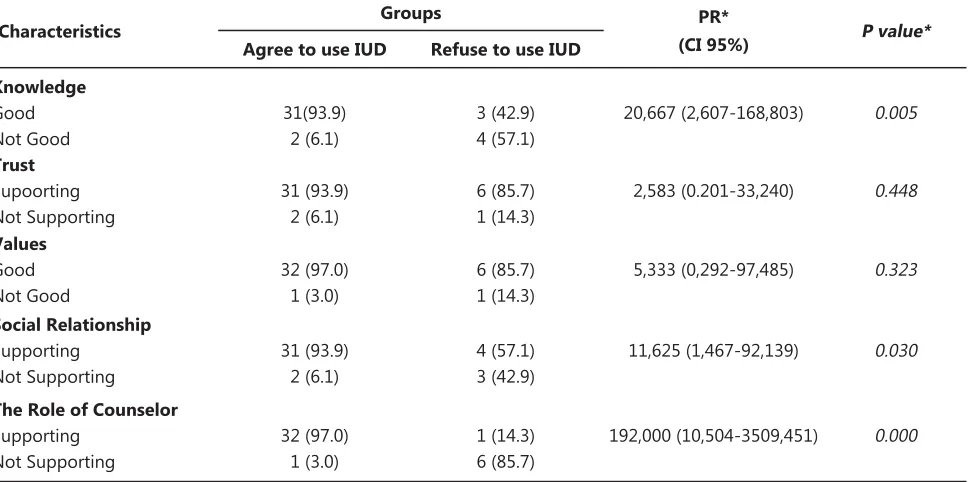
The majority of the group agreed IUD had good knowledge, 31 people (93.9%), supportive trust 31 people (93.9%), good values 32 people (97%), social relationship supporting 31 (93.9%) and the role of counsellors who supported 32 people (97%). In the group that rejected IUD, the majority of respondents had poor knowledge as many as 4 people (57.1%), supportive beliefs as many as 6 people (85.7%), good values of 6 people (85.7%), social relationship supporting 4 people (57.1%) and the role of counselor who does not support 6 people (85.7%) (Table 2).
With Fisher Exact test, there is a signifi cant correlation between knowledge with IUD acceptor decision, where good knowledge 20,667 times has more signifi cant effect on decision of Family Planning acceptor compared to unfavourable knowledge (PR = 20,667; p = 0.005) (Table 2).
With Fisher Exact test, there was a non-significant relationship between trust and acceptance of IUD acceptors, in which confi dence supporting 2.583 times had more effect on
decision of KB acceptor than unsupportive but insignifi cant trust (PR = 2,583; p = 0,448) (Table 2).
With Fisher Exact test, there was no signifi cant relationship between values and decision of IUD acceptor, where the good score 5,333 times had more infl uence on decision of IUD acceptor than bad value but not signifi cant (PR = 5,333; p = 0.323) (Table 2).
With Fisher Exact test, there is a relationship between social relationship with decision of IUD acceptor, where social relationship which support 11,625 times have more signifi cant effect to IUD acceptor decision than non-supporting social relationship (PR = 11,625; p = 0.030) (Table 2).
uterus. One example of contraception is the IUD.7 In this study obtained the average age of
respondents of 26.55 ± 5.939 years. The average
* Chi Square Test
**Binary Logistic Regression Test
Table 3. Analysis Results of Factors Affects Decision of IUD Acceptor
Variable Unadjusted* Adjusted**
PR p value PR p value
The Role of Counselor Knowledge
Social Relationship
192.00 20,667 11,625
108,989 4,224 2,325 0.000
0.005 0.030
0.002 0.465 0.729
Table 2. Analysis Result of Knowledge, Trust, Values, Social Relationship, The Role of Counselor, Relation with IUD Acceptor Decision
Characteristics PR* P value*
(CI 95%) Groups
Agree to use IUD Refuse to use IUD
Knowledge Good Not Good
31(93.9) 2 (6.1)
3 (42.9) 4 (57.1)
20,667 (2,607-168,803) 0.005
0.448
0.323
0.030
0.000 2,583 (0.201-33,240)
5,333 (0,292-97,485)
11,625 (1,467-92,139)
192,000 (10,504-3509,451) 31 (93.9)
2 (6.1)
6 (85.7) 1 (14.3)
32 (97.0) 1 (3.0)
6 (85.7) 1 (14.3)
31 (93.9) 2 (6.1)
4 (57.1) 3 (42.9)
32 (97.0) 1 (3.0)
1 (14.3) 6 (85.7) Trust
Supoorting Not Supporting Values
Good Not Good
Social Relationship Supporting
Not Supporting The Role of Counselor Supporting
Not Supporting
* Fisher Exact Test, p value = 0.05
signifi cant effect on the decision of IUD acceptor than the non-supportive the role of counsellor (PR = 192.00; p = 0.000) (Table 2).
Based on logistic regression test, the role of counsellor infl uenced signifi cantly on decision of IUD acceptor where supporter counsellor resulted in the respondent approved the use of IUD 108,989 times compared to counselor that did not support (PR = 108,989, p-value = 0,002), whereas good knowledge can cause the respondent approve the use of IUD KB 4.224 times compared to poor knowledge and supportive social relationship may result in the respondents approved the use of IUD 2,325 times compared to non-supportive but not signifi cant (p> 0,05) (Table 3).
DISCUSSION
Contraceptionisatool,amedicineoramethodused to eliminate the fl ow of conception or encounter between an egg and a sperm in the womb or
length of marriage is 5,100 ± 4,996 years with the highest number of parities of 1 parity, the number of children living the most 1 child and the most abortus incidence that never had an abortus. From the statistical analysis, there were no differences in age, length of marriage, parity, number of live children, abortus, education and occupation between the two groups (p> 0.05). In this study, the decision of the Family Planning acceptor choosing IUD is not infl uenced by age, marriage, parity, number of living children, abortion, education and occupation.
whereas in groups refuse to use IUD the majority of respondents have poor knowledge, supportive beliefs, good values, supportive social relationship and the role of counsellor which does not support.
Knowledge is everything known to the IUD Acceptors on IUD, including; understanding, a dvantages,sideeffects,propertimeforinstallatio n and myths about IUD.6,8 In this study found a
signifi cant relationship between knowledge with the acceptance of IUD acceptors, where good knowledge 20,667 times more signifi cant effect on decisions IUD acceptors compared poor knowledge (PR = 20,667; p = 0.005). These results are in line with Johana et al's research in 2013 which shows a signifi cant correlation between knowledge with the acceptance of IUD acceptors, in which a good knowledge of 2,971 times has a signifi cantly more signifi cant effect on the acceptors' decision than inadequate knowledge (PR = 2.971; p = 0.026 ).9
Respondents with good knowledge prove that knowledge of IUD has been obtained before through health, internet, television or magazine. According to Rogers (1974) quoted by Notoatmodjo (2007), a person behaves based on knowledge, awareness and positive attitude so that the behaviour will be lasting; otherwise if the behaviour is not based on knowledge and consciousness it will not last long.10 In this
study, trust is the opinion of the Family Planning Acceptor on Family Planning Program according to religion, norm and custom, include; restrictions on the number of children according to religion and custom, the meaning of children in family and methods of family planning in accordance with religion.8 In this study obtained results
there is a meaningless relationship between the belief with the acceptance of IUD acceptors in which the trust that supports 2,583 times more infl uence on the acceptors acceptance decisions compared to non-supportive but insignifi cant beliefs (PR = 2.583; p = 0.448). The result of this research is different with Ismi research in 2015 where the result showed that there was a signifi cant correlation between confi dence with the acceptors decision of Family Planning where trust that support 7,759 times more infl uence to decision of Family Planning acceptor compared to trust which not support but not signifi cant (PR = 7,759; p = 0.007).12
According to Pendit, a number of cultural factors may affect clients in choosing
contraception methods. These factors include misunderstanding in the community about various methods, religious and cultural beliefs, educational level, perceptions about pregnancy risk, and the status of women. The difference in outcomes in this study is likely due to the increase in community knowledge resulting in some beliefs and customs have begun to fade, for example, the trust of many children is much sustenance.13
Values are something that is considered good or bad by the family planning acceptors of the family planning program especially the IUD contraception which is the basis for decision making to use it, including; IUD membership can improve health status, family welfare, make family quality and improve family harmony.8 In
this research, there is no signifi cant relationship between value with acceptance decision of IUD where good value 5,333 times more infl uence to decision of Family Planning acceptor compared the value is not good but not signifi cant (PR = 5.333; p = 0.323). This shows that although respondents have good values or views about the IUD but have no signifi cant effect on the decision to reject or approve IUD.
The result of this research showed that there was a signifi cant correlation between social relationship with acceptance decision of IUD where social relationship that support 11.625 times had more signifi cant effect to decision of IUD acceptor than social relationship which did not support (PR = 11.625; p = 0,030). Social relationship is a social unit consisting of several families who have blood relations or marital relationships. The result of this research is consistent with Nana research in year 2103 that got result there is signifi cant relation between social relationship in this research support husband with decision of acceptors of IUD, where social relationship that support 9,250 times have more signifi cant effect to decision of IUD acceptors than social relationship which not support (PR = 9,250; p = 0,000).14
The role of counsellor is the contribution of counsellor in infl uencing Family Planning acceptor using IUD by conveying the advantages and disadvantages of IUD.15 In this study, there
Ministry of Health. Strategic Plan of the Ministry of Health of the Republic of Indonesia 2015-1.
counsellor non-supportive (PR = 192,00; p = 0,000).
Statistical analysis of logistic regression showed that the factor that most played a role in decision of Family Planning acceptor to approve IUD was the role of counsellor, supporter counsellor resulted in the respondent approving the use of IUD 108,989 times compared unsupportive counsellor (PR = 108,989, p = 0,002). The role of counsellor in the decision to approve or reject the use of IUD is very dominant, although knowledge and value of respondents is not good and social relationship and trust does not support but with the role of counsellor, respondents are more confi dent decide to approve IUD, even though knowledge and good values and social relationship and trust support but the role of counsellor does not support, respondents tend to decide to reject IUD.
Health workers and community leaders have a role as counsellor. With regard to community participation in IUD family planning programs, the role of community leaders and religious leaders is very important, especially in infl uencing, modelling and mobilising the involvement of all citizens in their communities. The role becomes a determinant factor because the position of the community leaders is still very strong infl uence.16
CONCLUSSION
Based on this research it can be concluded that; There is a signifi cant relationship between knowledge, social relationship, and the role of counsellor with decision of IUD acceptors; There is an insignifi cant relationship between the beliefs and values with decisions of IUD acceptors; The role of counsellor is a factor infl uencing decision of Family Planning acceptor to use IUD contraception.
SUGGESTION
Conducted counselling about the benefi ts and profi ts of IUD contraception followed by husbands. Conducted counselling that aims to motivate mothers to be able to increase the confi dence of mothers. Further research is undertaken to assess the effectiveness of family planning extension on the improvement of mother's knowledge and belief.
REFERENCES
2019. 2015: 1-248.
National Population and Family Planning Agency (BKKBN). BKKBN Profi le 2015. Accessed: http:// www.bkkbn.go.id/ (June 01, 2015).
Prihyugiarto, Mujianto. Further Analysis of IDHS 2007. Continuity of contraceptive use. Jakarta: Puslitbang Family Planning and Reproductive Health, National Family Planning Coordinating Board. 2009:1-29.
Witjaksono. Plan of action of family planning and reproductive health in 2012-2014. Jakarta: National Family Planning Board (BKKBN). 2012; 1-24.
Susanto. Explore the KKBPK program in South Sumatra. Accessed: http://sumsel.bkkbn.go.id/ (June 01, 2015).
Speroff L, Darney P. Guidelines for contraceptive clinics Edition 2, Jakarta: ECG; 2003: 87-91. M Kishen. Handbook of family planning and reproductive. 2008. Available at: www.elsevier health. co.uk
Kalangie NS. Culture and health (development of primary health care through sociocultural approach), Jakarta: Ksaint Blanc Indah Corp. 1994.
Johana D B, Agnes M, Gresty M. Factors related to the Selection of Intrauterine Device (IUD) for Family Planning Acceptor at Jailolo Public Health Center. J e-NERS (eNS),2013; 1(1): 1-10.
Notoatmodjo S. Health promotion and behavioral science. Jakarta: Rineka Cipta. 2007: 16–18. Soekanto S. Sociology (An Introduction). Jakarta: Rajagrafi ndo Persada. 2007: 115-9.
Ismi Dzalva Alfi ah. Factors Associated with the Use of Long Term Contraceptive Methods in Kalideres District Health Center Working Area 2015. Faculty of Medicine and Health Sciences Syarif Hidayatullah Islamic University. 2015: 1-158.
Pending. Various methods of contraception. Jakarta: EGC Medical Book. 2007: 151-7.
Nana A. Factors Associated with Uses of Intrauterine Device (IUD) in the Work Area of Kabun Health Center of Rokan Hulu Regency Year 2013. J Maternal Neonatal, 2013: 1-14. Imbarwati. Several factors are related to the use of IUD family planning in non-IUD family planning participants in Pedurungan sub-district of Semarang, Diponegoro University. 2009: 1-144. Syani A. Sociology and change of society. Jakarta: Pustaka Jaya. 1995: 88.
2.
3.
4.
5.
6.
7.
8.
9.
10.
11.
12.
13.
14.
15.