Volume 2, Issue 6, June 2013
Page 513
Abstract
Network-on-Chip (NoC) is a paradigm proposed to satisfy the communication demands of future Systems-on-Chip (SoC). Area and performance play a significant role since the size of technology to build modern digital systems are reduced. A router is the fundamental component of a NoC. In this paper, the Bidirectional Router using virtual channel regulator was designed and analyzed the various parameters such as area, speed and power. The Bidirectional router has consumed more area overhead, less speed and power. So the virtual channel regulator concept was implemented by logically combine virtual channel in BiNoC architecture, which dynamically allocates Virtual Channels (VC) and buffer resources according to network traffic conditions. The proposed architecture increases the speed of operation and reduces the critical path of the circuit. The aim of this work is to present a modified architecture of the BiNoC router to achieve higher area and speed efficiency using changes at the architecture level. The proposed architecture of BiNoC router is simulated in Xilinx ISE 9.1i software. The source code is written in VHDL. FPGA implementation of BiNoC Router has been performed on Xilinx Virtex2 FPGA. From the implementation results, the proposed router is operatedwith higher speed by 70%, area reduced by 8.47%.
Keywords—Interconnection networks, on-chip communication, Reconfigurable, NoC, FPGA.
1.
INTRODUCTION
Network-on-Chip (NoC) is an approach to design the communication subsystem between IP cores in a System On a Chip (SoC).Since the use of emerging NoC architecture in VLSI it reduces the size of the architecture due to the reduced amount of buses and transmission lines. The power requirement of the SoC is high where as it can be reduced by the NoC architecture. NoC provides separation between the computation and communication. The benefit of NoC is that multiple point to point link can be connected with the help of the routers. NoC has the better improvement over the System On chip busses and also over the cross bar switches. This also reduces the power consumption while compared to the SoC
ie; the requirement of source power in the SoC is high and it can be reduced by the NoC architecture. By the use of routers the messages or the data can be relayed from source node to the destination node over several links. In the NoC links the wires are designed to reduce the complexity for the predictable speed, reliability, noise, power etc.
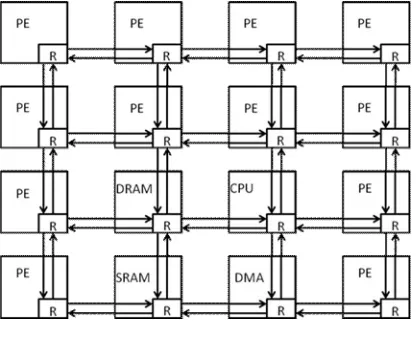
Fig 1.Typical NoC architecture in mesh topology
A typical NoC consists of computational processing elements (PEs), network interfaces (NIs), and routers. The NI is used to packetize data before using the router backbone to traverse the NoC. Each PE is attached to an NI which connects the PE to a local router. When a packet was sent from a source PE to a destination PE, the packet is forwarded hop by hop on the network via the decision made by each router. For each router, the packet is first received and stored at an input buffer. Then the control logics in the router are responsible to make routing decision and channel
Design and Implementation of FPGA Based
Bidirectional Network-on-Chip
Router through Virtual Channel Regulator
1
Volume 2, Issue 6, June 2013
Page 514
arbitration. Finally, the granted packet will traverse through a crossbar to the next router, and the process repeats until the packet arrives at its destination. The NoC architecture consists of data link, network and transport layer. The wiring is done using the physical layer shown in fig1.The power consumed by modern NoCs consists of a large portion of total chip power. Y. Hoskote et.al [1] for example, 28% of the total chip power of Intel Teraflops processors is spent for communication, while the expectation was only 10 %.
The main components of an NoC are the network adapters, routing nodes, and network interconnect links. The routing nodes further contains switch and buffers. Buffers consume the 64% of the total node leakage power for all process technologies, which makes it the largest power consumer in any NoC system N. Banerjee et. al [2].
Moreover, Xuning Chen et. al [3] buffers are dominant for dynamic energy consumption. Thus, reductions in number and size of buffers with increase in utilization affect the system performance and impact area and power efficiency. In the NoC architecture there are two routers the conventional router and the bidirectional router. In this conventional router the data can be send in only one direction whereas in bidirectional router the data can be send and receive simultaneously. In this BINoC router the ports are reconfigurable. The reconfiguration of ports is done by using the local information channel.
This paper introduces Bidirectional Network-on-Chip Router through a novel unified buffer structure called the dynamic Virtual Channel Regulator, which dynamically allocates Virtual Channels (VC) and buffer resources according to network traffic conditions.
The rest of this paper is organized as follows. In Section II, we will discuss some of the background materials prior related research. In section III, Motivation. Further section IV, proposed bidirectional network on-chip architecture through Virtual Channel Regulator. In section V, overview of router. Next Section VI, bidirectional CDC algorithm. Finally Section VII experiment results shows area consumed with FPGA comparison. In last section, brief statements conclude this paper.
2.
REWORK
The flow control policy employed by the network decided buffer size and directly linked to management; network performance and resource utilization, in turn, affected by flow control. Whereas an efficient flow control policy enables a network theoretical capacity to reach 80%, a poorly implemented flow control policy would result in a lacking 30% [4].
Lan et. al. [5] shows significant improvement in system performance which addresses the buffer utilization by making the channels bidirectional and. But in this case, each channel controller will have two additional tasks: dynamically configuring the channel direction and sharing the channel i.e. allocate the channel to one of the routers,. Also, the typical NoC router architecture contributed a 40% area overhead due to double crossbar design and control logic. Soteriou et. al [6] shows a significant improvement in throughput at the expense of area and power due to extra crossbar and complex arbitration scheme in distributed shared buffer NoC router.
Neishabouri et. al [7] propose Reliability Aware Virtual Channel in router architecture. In this approach, priority of more memory is allocated to the busy links and less to the idle links at the expense of complex memory control logic which provided 7.1% and 3.1% latency decrease under uniform and transposes traffic patterns respectively. However, this solution is latency efficient but not area and power efficient.
As design complexity of the NoC rises, communication mechanism issues are raised more as well. Wormhole flow control reduced the buffer requirement and enhances the system throughput. But one packet may occupy several intermediate buffers at the same time. Luca Benini et.al [8] In typical NoC architectures, when a packet occupies a buffer for a channel, the physical channel cannot be used by other channel which introduces the problem of deadlock and livelock in wormhole scheme. Virtual Channels (VCs) are used to avoid deadlock and livelock.
Robert Mullins et. al[9] given Typical virtual channel router architecture. Virtual channel flow control introduces an array of buffers at each input port. By allocating different flits from multiple packets to each of these buffers. This improves both latency and throughput by dividing packets into flits. The drawback of using VCs is that it require more complex control protocol [8].
By inserting the VC buffers, we increase the physical channel utilization but utilization of inserted VC buffers is not considered. It can be observed that if there is no communication on some channel at some time instant and at the same time, neighboring channel is overloaded, free buffers of one channel cannot contribute for congestion control by sharing the load of neighboring channel. We approach the problem with very simple control logic
Volume 2, Issue 6, June 2013
Page 515
resources allocation design named Virtual Channel Regulator focuses on efficiently allocating buffers to all virtual channels, by deploying a unified buffering unit instead of a series of separated buffers, and minimizing the required size shown in C. A. Nicopoulos et. al. [10].3.
M
OTIVATION A. Virtual ChannelA virtual channel splits a single channel into two channels, virtually providing two paths for the packets to be routed. The use of VCs reduces the network latency at the expense of area, power consumption, and production cost of the NOC implementation.
B. Network deadlock/livelock:
Since VCs provide more than one output path per channel there is a lesser probability that the network will suffer from a deadlock; the network livelock probability is eliminated.
C. Performance improvement:
A packet/flit waiting to be transmitted from an input/output port of a router/switch will have to wait if that port of the router/switch is busy. However, VCs can provide another virtual path for the packets to be transmitted through that route, thereby improving the performance of the network.
D. Supporting guaranteed traffic:
M. Galles et. al. [11], L. S. Peh et. al. [12] shown that VC may be reserved for the higher priority traffic, thereby guaranteeing the low latency for high priority data flits.
E. Reduced wire cost:
A virtual channel provides an alternative path for data traffic, thus it uses the wires more effectively for data transmission. Therefore, we can reduce the wire width on a system (number of parallel wires for data transmission). Bjerregaard and Sparso have proposed the design and implementation of a virtual channel router using asynchronous circuit techniques [11], [12].
The goal of this work is to describe the implementation and evaluation of BiNoC router through virtual channel regulator. Implementation of routers with virtual channel regulator is complex due to the degree of freedom to choose schemes for buffering, internal interconnections, arbitration and routing.
4.
BIDIRECTIONAL
CHANNEL
ROUTER
ARCHITECTURE
Fig.2 Proposed Bidirectional Network-on-Chip Router through Virtual Channel Regulator
Volume 2, Issue 6, June 2013
Page 516
flow is used where as in BiNoC the two way data flow can be performed [13]. Fig.2 shows Proposed Bidirectional Network-on-Chip Router through Virtual Channel Regulator. The BiNoC router architecture supports dynamically self-reconfiguration of flow direction at each channel. This architecture is designed to minimize area overhead. In this BiNoC router, neighboring routers will control the flow directions of connecting channels according to a channel direction control algorithm. It is shown that the CDC algorithm is deadlock-free and starvation free.5.
O
VERVIEW OFB
IDIRECTIONALN
ETWORK-
ON-C
HIPR
OUTERFig.2 illustrates the major components of a Bidirectional Network-on-Chip Router through Virtual Channel Regulator. The basic steps undertaken by a virtual-channel router are enumerated below:
a.Virtual channel Regulator
Fig.3 virtual channel regulator
The router implemented using virtual channel through Virtual Channel Regulator [10].This can efficiently allocating buffers to all virtual channels, instead of using separated buffers, a unified buffer structure (UBS) is used to share the internal flit buffers and Unified Control Logic (UCL,) to control UBS and assign buffers into VCs dynamically according to the network traffic [14]. It is shown in the Fig.3 that UBS is similar to generic buffer structure in which the v independently k- flit are logically grouped in a single vk-flit and with UCL as logically unified structure. To avoid large components UBS has the same number of MUX/DEMUX i.e. one MUX/DEMUX per k flits. In the shown Figure 3 the first stage reduces the number of requests from each input VC to one and the winning request from each input VC proceeds to the second arbitration stage. The XY routing algorithm is used to perform the architecture. The Bi-NoC architecture allows each channel to transmit in all direction and increases the bandwidth, reduces the access latency, and reduces power consumption.
b.Reconfigurable Input/Output Ports
The ports in the bidirectional are reconfigurable. This is done by using the local information.
Fig.4 Schematic of Reconfigurable Input/Output Ports implemented in BiNoC architecture.
Volume 2, Issue 6, June 2013
Page 517
c.Virtual-Channel Allocation
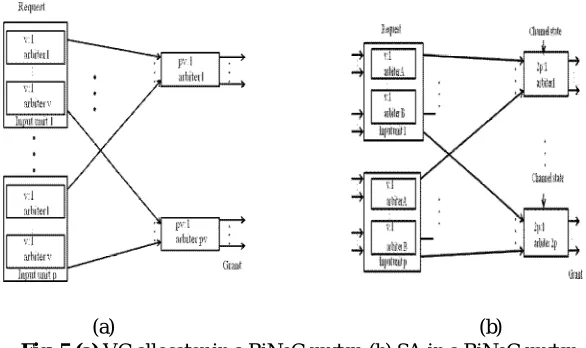
Peh and Dally detail the complexity of both virtual-channel (VC) allocation and switch-allocation logic in [15]. The routing function determines the output port and VCs that may be requested prior to VC allocation. A VC which is free to be allocated is then selected by the first stage of arbitration. The result of this first stage of arbitration is a request for a single VC at a particular output port. This request is subsequently sent to the appropriate second stage arbiter. In the most general case where the routing channel may return any of P x V VCs, the number of inputs to the first stage of arbiters must now be increased from V to P x V illustrated in fig 5 a).
(a) (b)
Fig. 5 (a) VC allocator in a BiNoC router. (b) SA in a BiNoC router
d. Switch Allocation
Individual flits arbitrate for access to physical channels via the crossbar on each cycle. Arbitration may be performed in two stages [15]. The first reflects the sharing of a single crossbar port by V input virtual-channels; this requires a V-input arbiter for each V-input port. The second stage must arbitrate between winning requests from each V-input port (P inputs) for each output channel. The scheme is illustrated in Fig 5 b).
e.Routing Protocol
The routing protocol selects the routes between two nodes in a network. Also it specifies how the routers communicate with each other. There are two basic routing protocols adaptive and oblivious routing protocol. In this adaptive routing protocol consists of many types and each type will have the special features. In this XY routing algorithm is used. It routes between given pair of nodes and follows the same path between the nodes. XY routing checks first in horizontal x direction and then checks the vertical y direction and forms the route to the receiver. By using this XY routing algorithm the traffic does not extends over the whole network. Hence the whole network is equalized from traffic load. The feature of the XY routing algorithm is simple and it never runs the deadlock and live locks.
6.
C
HANNELD
IRECTIONC
ONTROLA
LGORITHMThe flow direction at each channel is controlled by a channel direction control (CDC) algorithm. Two major functions performed by the channel control algorithm.
1. Dynamically configure the channel direction between neighboring routers.
The control algorithm is implemented with two finite state machines. The current status of channel direction decides whether the channel request for corresponding channel is blocked or not.
2. To process the channel allocation by sending arbiter request to the switch allocator.
The channel direction control algorithm replaces all the unidirectional channels in a typical NoC with bidirectional channels. The HP and LP ports of each router use two FSMs, a HP FSM and a LP FSM are connected to bidirectional channel. Pair of signals input_req and output_req is used to exchange information between two FSMs.
A.Bidirectional Channel Direction Control
The finite state machine diagrams for a High priority and a Low Priority Channel Direction Control algorithm are shown in Fig.6 (a) and (b), respectively. Each FSM has three states: free, wait, and idle.
a) Free State: the channel is ready for data to send (output) the adjacent router. b) Idle state: the channel is available to receive (input) data from the adjacent router.
c) Wait state: it is an intermediate state ready to transition from idle state with input channel to free state with output channel.
Volume 2, Issue 6, June 2013
Page 518
B.Handshaking Communication Mechanism
For making interaction between routers, handshaking communication protocol provided by channel control module is utilized in case the data is put on the line; the existence of data is informed to the next router. Next router takes the data from the line and transmits its confirmation to the sender router. So in addition to the flits sending and receiving channels, input_req and output_req signals are required. output_req base is the output and whenever the data is ready in the output port. Likewise input_req base is input and whenever another router ready to accept the data packet. The link between two ports from two neighbor routers is shown in Fig.6.
Fig. 6 (a) FSM for HP port and (b) FSM for LP port for bidirectional channels between two neighbouring routers.
7.
EXPERIMENTAL
RESULTS
A. Simulation Setup
In this section, the synthesis results will be presented
.
We evaluate the reconfigurable virtual channel regulator BiNoC in terms of power dissipation, area overhead and overall network performance. We consider 4-stage pipelined router design. Each router has P = 10 inout ports (8 for inout direction and 2 for the inout PE). The baseline design considered has 4 VCs (UBS) per input port, with each VC having 4 flit buffers in the router, for a total of 160 flit buffers (= 10× 4 × 4). Each packet consists of 16 flits and each flit is 128 bits long. In each case, the design is implemented in VHDL language on RTL level and synthesized using the Xilinx ISE 9.1i tool. The proposed router was prototyped in 3 different FPGA technologies. Table I presents the comparison between article's designed router and other router. Table II presents our router results with the same flit size and FPGAs used by authors of other works.B.Area breakdown and performance analysis
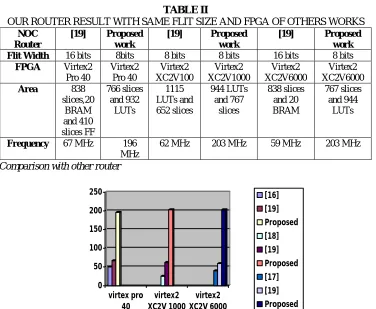
The router area, power and speed were estimated by varying two parameters: flit width and FPGA device for comparison with other works. Table I shows Comparison between article's designed router and other routers FPGA.TABLE II shows our router result with same flit size and FPGA of others works. This work describes Inter-router data communication and BiNoC Inter-router uses a deterministic XY algorithm with wormhole switching mode. The input queue is the used buffering techniques and channel directional is control by CDC protocol. The architecture was prototyped on a 3 different Virtex2 FPGA, the hardware occupancy of the system in terms of FPGA slices has been provided and the same flit size used by works of other rows and results are provided in table II. Table II shows that there is an efficient reduction in the number of slices, slice flip flops and input LUTs in the proposed system than those obtained in the existing router The area of our router is lower than the area of [16-19] because the presented area of the router [16-19] is without counting virtual channel regulator.
TABLE I
COMPARISON BETWEEN ARTICLE'S DESIGNED ROUTER AND OTHER ROUTERS FPGA
NOC Router
[16] [17] [18] Proposed
work
Flit Width 16 bits 16 bits 8 bits 8 bits
Buffering Output queue Input queue
Input queue Input queue
Protocol Custom Custom OCP CDC
FPGA Virtex2 Pro
40
Virtex2 XC2V600
0
Virtex2 XC2V1000
Virtex2 XC2V
1000 /6000
Area 552 slices
and 5 BRAM
611 slices 555 LUTs 278 slices
Depend on FPGA
Frequency 50 MHz 40 MHz 25 MHz Depend
Volume 2, Issue 6, June 2013
Page 519
TABLE II
OUR ROUTER RESULT WITH SAME FLIT SIZE AND FPGA OF OTHERS WORKS
NOC Router
[19] Proposed work
[19] Proposed
work
[19] Proposed
work
Flit Width 16 bits 8bits 8 bits 8 bits 16 bits 8 bits
FPGA Virtex2
Pro 40 Virtex2 Pro 40 Virtex2 XC2V100 Virtex2 XC2V1000 Virtex2 XC2V6000 Virtex2 XC2V6000
Area 838
slices,20 BRAM and 410 slices FF 766 slices and 932 LUTs 1115 LUTs and 652 slices 944 LUTs and 767 slices 838 slices and 20 BRAM 767 slices and 944 LUTs
Frequency 67 MHz 196
MHz
62 MHz 203 MHz 59 MHz 203 MHz
C.Frequency Comparison with other router
0 50 100 150 200 250 virtex pro 40 virtex2 XC2V 1000 virtex2 XC2V 6000 [16] [19] Proposed [18] [19] Proposed [17] [19] Proposed
Fig .7 Frequency comparison of various FPGA Router.
The fig.7 shows that the frequency in the proposed model is higher than that of the existing system. Hence the latency is less in the proposed system. Our router is 75%, 80%, 87% and 70% times faster than routers of [16], [17], [18] and [19].
D.Power breakdown
The total power consume for a 128-bit flit in the buffer is estimated to be 337 mW in Virtex2 XC2V1000 as well as for Virtex2 XC2V6000.
8.
CONCLUSIONS
This work presented the implementation of the virtual channel regulator concept for the BiNoC router. The synthesis and simulation of the proposed router is verified through VHDL codes using XILINX ISE 9.1i software. The simulation facilitates clear understanding of routing pattern and the functionality of a BiNoC router for a network on chip. In this paper we demonstrate that it is possible to create a high speed FPGA based BiNoC router using a modest amount of FPGA resources. When compared to previous publications about FPGA based NoCs router, our implementation has either smaller area, higher clock frequency. There is an efficient reduction in the number of slices and input LUTs in the proposed system than those obtained in the existing. These reduction rates are given as; the slices reduced by 8.47% [19].
ACKNOWLEDGMENTS
This journey of self actualization would not have been fulfilled without the guidance and support of several individuals. My deep appreciation is extended to my Project Guide Prof. C.N.Bhoyar, Department of Electronics and communication for his wisdom, guidance, encouraging, appreciation and design process. Authors wish to remark the great task carried out by the Xilinx user guide.
R
EFERENCES[1.] Y. Hoskote, S. Vangal, A. Singe, N. Borkar, and S. Borkar, “A 5-ghz mesh interconnect for a teraflops processor,” IEEE Micro, vol. 27, no. 5, 2007.
Volume 2, Issue 6, June 2013
Page 520
[3.] Xuning Chen and Li-Shiuan Peh. Leakage power modeling and optimization of interconnection networks. Proceedings of International Symposium on Low Power Electronics and Design, pp. 9095, 2003.
[4.] L. S. Peh and W. J. Dally, "A delay model for router micro architectures," IEEE Micro, vol. 21, pp. 26-34, 2001. [5.] Ying-Cherng Lan, Shih-Hsin Lo, Yueh-Chi Lin, Yu- Hen Hu, Sao-Jie Chen. BiNoC: bidirectional NoC
architecture with dynamic self-reconfigurable channel. Proceedings of 3rd ACM/IEEE International Symposium On Networks-on-Chip (NoCS), pp.266-275, May 2009.
[6.] V.Soteriou, R.S. Ramanujam, B. Lin, Li-Shiuan Peh. A High-Throughput Distributed Shared-Buffer NoC Router. IEEE Computer Architecture Letters, vol. 8, no. 1, pp. 21-24, Jan.-June 2009, doi:10.1109/LCA. 2009.5.
[7.] M. H. Neishabouri, Zeljko Zilic. Reliability aware NoC router architecture using input channel buffer sharing. Proceedings of the 19th ACM Great Lakes symposium on VLSI (GLSVLSI), pp.511-516, 2009.
[8.] Luca Benini and Giovanni De Micheli, Networks on Chips., Morgan Kaufmann Publishers, 2006.
[9.] Robert Mullins, Andrew West and Simon Moore. Low-Latency Virtual-Channel Routers for On-Chip Networks. Proceedings of the 31st Annual IEEE International Symposium on Computer Architecture (ISCA), pp.188-197, 2004.
[10.] C. A. Nicopoulos, D. Park, J. Kim, N. Vijaykrishnan, M. S. Yousif, and C. R. Das,“ViChaR: A dynamic virtual channel regulator for network-on-chip routers,” in MICRO’39: Proceedings of the 39th Annual IEEE/ACM International Sympo-sium on Micro architecture, Dec. 2006, pp. 333–346.
[11.] M. Galles, "Scalable Pipelined Interconnect for Distributed Endpoint Routing: The SGI SPIDER Chip," in Proc. of the Hot Interconnect Symposium IV, 1996.
[12.] L. S. Peh and W. J. Dally, "A delay model and speculative architecture for pipelined routers," in Proc. of the High Performance Computer Architecture (HPCA), pp. 255-266, 2001.
[13.] Wen-Chung Tsai,1 Ying-Cherng Lan,1 Yu-Hen Hu,2 and Sao-Jie Chen3,”Networks on Chips: Structure and Design Methodologies,” HindawiPublishing Corporation Journal of Electrical and Computer Engineering Volume 2012, Article ID 509465, 15 pages doi:10.1155/2.012/509465.
[14.] S. Ramany and D. Eager, “The interaction between virtual channel flow control and adaptive routing in wormhole networks,” in ICS ’94: Proceedings of the 8th International Conference on Supercomputing, Jul. 1994, pp. 136– 145.
[15.] L. S. Peh and W. J. Dally, "A delay model and speculative architecture for pipelined routers," in Proc. of the High Performance Computer Architecture (HPCA), pp. 255-266, 2001.
[16.] A. Bartic, J. Y. Mignolet, V. Nollet, T. Marescaux, D. Verkest, S. Vernalde, and R. Lauwereins Highly scalable network on chip for reconfigurable systems, in: International Symposium on System-on-Chip (SOC2003), November 2003.
[17.] T. Marescaux, J. -Y. Mignolet, A. Bartic, W. Moffat, D. Verkest, S. Vernalde, and R. Lauwereins, Networks on chip as hardware components of an OS for reconfigurable systems, ,in: Field-Programmable Logic and Applications (FPL03), September 2003.
[18.] F. Moraes, N. Calazans, A. Mello, L. M. oller, and L. Ost, HERMES: an infrastructure for low area overhead packet switching networks on chip, INTEGRATION, the VLSI journal 2004. VOL.38,Pages: 6993.