The Thirty-Third AAAI Conference on Artificial Intelligence (AAAI-19)
GRN: Gated Relation Network to Enhance
Convolutional Neural Network for Named Entity Recognition
∗Hui Chen,
†Zijia Lin,
‡Guiguang Ding,
†Jianguang Lou,
‡Yusen Zhang,
§Borje Karlsson
‡ †Beijing National Research Center for Information Science and Technology (BNRist)School of Software, Tsinghua University, Beijing, China
§School of Computer Science, Beijing Institute of Technology, Beijing, China ‡Microsoft Research, Beijing, China
{jichenhui2012, yusenzhang95}@gmail.com, [email protected],{zijlin, jlou, borje.karlsson}@microsoft.com
Abstract
The dominant approaches for named entity recognition (NER) mostly adopt complex recurrent neural networks (RNN), e.g., long-short-term-memory (LSTM). However, RNNs are limited by their recurrent nature in terms of compu-tational efficiency. In contrast, convolutional neural networks (CNN) can fully exploit the GPU parallelism with their feed-forward architectures. However, little attention has been paid to performing NER with CNNs, mainly owing to their dif-ficulties in capturing the long-term context information in a sequence. In this paper, we propose a simple but effective CNN-based network for NER, i.e., gated relation network (GRN), which is more capable than common CNNs in cap-turing long-term context. Specifically, in GRN we firstly em-ploy CNNs to explore the local context features of each word. Then we model the relations between words and use them as gates to fuse local context features into global ones for pre-dicting labels. Without using recurrent layers that process a sentence in a sequential manner, our GRN allows computa-tions to be performed in parallel across the entire sentence. Experiments on two benchmark NER datasets (i.e., CoNLL-2003 and Ontonotes 5.0) show that, our proposed GRN can achieve state-of-the-art performance with or without external knowledge. It also enjoys lower time costs to train and test.
Introduction
Named Entity Recognition (NER) is one of the fundamental tasks in natural language processing (NLP). It is designed to locate a word or a phrase that references a specific entity, like person, organization, location, etc., within a text sentence. It plays a critical role in NLP systems for question answering, information retrieval, relation extraction, etc. And thus many efforts have been dedicated to the field.
Traditional NER systems mostly adopt machine learning models, such as Hidden Markov Model (HMM) (Bikel et al. 1997) and Conditional Random Field (CRF) (McCallum and Li 2003). Although these systems can achieve high per-formance, they heavily rely on hand-crafted features or task-specific resources (Ma and Hovy 2016), which are expensive to obtain and hard to adapt to other domains or languages.
With the development of deep learning, recurrent neural network (RNN) along with its variants have brought great
∗
Work was done during an internship at Microsoft Research. Copyright c2019, Association for the Advancement of Artificial Intelligence (www.aaai.org). All rights reserved.
success to the NLP fields, including machine translation, syntactic parsing, relation extraction, etc. RNNs have been proved to be powerful in learning from basic components of text sentences, like words and characters (Tran, MacKinlay, and Yepes 2017). Therefore, currently the vast majority of state-of-the-art NER systems are based on RNNs, especially long-short-term-memory (LSTM) (Hochreiter and Schmid-huber 1997) and its variant Bi-directional LSTM (BiLSTM). For example, Huang et al. (2015) firstly used a BiLSTM to enhance words’ context information for NER and demon-strated its effectiveness.
However, RNNs process the sentence in a sequential man-ner, because they typically factor the computation along the positions of the input sequence. As a result, the computation at the current time step is highly dependent on those at pre-vious time steps. This inherently sequential nature of RNNs precludes them from fully exploiting the GPU parallelism on training examples, and thus can lead to higher time costs to train and test.
Unlike RNNs, convolutional neural network (CNN) can deal with all words in a feed-forward fashion, rather than composing representations incrementally over each word in a sentence. This property enables CNNs to well exploit the GPU parallelism. But in the NER community, little atten-tion has been paid to performing NER with CNNs. It is mainly due to the fact that CNNs have the capacity of cap-turing local context information but they are not as powerful as LSTMs in capturing the long-term context information. Although the receptive field of CNNs can be expanded by means of stacking multiple convolutional layers or using di-lated convolutional layers, the global context capturing is-sue still remains, especially for variant-sized text sentences, which hinders CNNs obtaining comparable performance as LSTMs for NER.
al-lows GRN to reach comparable performance in NER versus LSTM-based models. Moreover, without any recurrent lay-ers, GRN can be trained by feeding all words concurrently into the neural network at one time, which can generally im-prove efficiency in training and test.
Specifically, the proposed GRN is customized into 4 lay-ers, i.e., the representation layer, the context layer, the rela-tion layer and the CRF layer. In the representarela-tion layer, like previous works, a word embedding vector and a character-level embedding vector extracted by a CNN are used as word features. In the context layer, CNNs with various ker-nel sizes are employed to transform the word features from the embedding space to the latent space. The various CNNs can capture the local context information at different scales for each word. Then, the relation layer is built on top of the context layer, which aims to compose a global context fea-ture for a word via modelling its relations with all words in the sentence. Finally, we adopt a CRF layer as the loss func-tion to train GRN in an end-to-end manner.
To verify the effectiveness of the proposed GRN, we conduct extensive experiments on two benchmark NER datasets, i.e., CoNLL-2003 English NER and OntoNotes 5.0. Experimental results indicate that GRN can achieve state-of-the-art performance on both CoNLL-2003 (F1=91.44without external knowledge andF1=92.34
with ELMo (Peters et al. 2018) simply incorporated) and Ontonotes 5.0 (F1=87.67), meaning that using GRN,
CNN-based models can compete with LSTM-CNN-based ones for NER. Moreover, GRN can also enjoy lower time costs for training and test, compared to the most basic LSTM-based model.
Our contributions are summarized as follows.
• We propose a CNN-based network, i.e., gated relation network (GRN) for NER. GRN is a simple but effective CNN-based architecture with a more powerful capacity of capturing the global context information in a sequence than common CNNs.
• We propose an effective approach for GRN to model the relations between words, and then use them as gates to fuse local context features into global ones for incorpo-rating long-term context information.
• With extensive experiments, we demonstrate that the pro-posed CNN-based GRN can achieve state-of-the-art NER performance comparable to LSTM-based models, while enjoying lower training and test time costs.
Related Work
Traditional NER systems mostly rely on hand-crafted fea-tures and task-specific knowledge. In recent years, deep neu-ral networks have shown remarkable success in the NER task, as they are powerful in capturing the syntactic depen-dencies and semantic information for a sentence. They can also be trained in an end-to-end manner without involving subtle hand-crafted features, thus relieving the efforts of fea-ture engineering.
LSTM-based NER System.Currently, most state-of-the-art NER systems employ LSTM to extract the context infor-mation for each word. Huang et al. (2015) firstly proposed to apply a BiLSTM for NER and achieved a great success.
Later Ma and Hovy (2016) and Chiu and Nichols (2016) in-troduced character-level representation to enhance the fea-ture representation for each word and gained further perfor-mance improvement. MacKinlay et al. (2017) proposed to stack BiLSTMs with residual connections between different layers of BiLSTM to integrate low-level and high-level fea-tures. Liu et al. (2018) further proposed to enhance the NER model with a task-aware language model.
Though effective, the inherently recurrent nature of RNNs/LSTMs makes them hard to be trained with full par-allelization. And thus here we propose a CNN-based net-work, i.e., gated relation network (GRN), to dispense with the recurrence issue. And we show that the proposed GRN can obtain comparable performance as those state-of-the-art LSTM-based NER models while enjoying lower training and test time costs.
Leveraging External Knowledge.It has been shown that external knowledge can greatly benefit NER models. Exter-nal knowledge can be obtained by means of exterExter-nal vocab-ulary resources or pretrained knowledge representation, etc. Chiu and Nichols (2016) obtainedF1=91.62%on
CoNLL-2003 by integrating gazetteers. Peters et al. (2017) adopted a character-level language model pretrained on a large ex-ternal corpus and gained substantial performance improve-ment. More recently, Peters et al. (2018) proposed ELMo, a deep language model trained with billions of words, to gen-eratedynamic contextualword features, and gained the lat-est state-of-the-art performance on CoNLL-2003 by incor-porating it into a BiLSTM-based model. Our proposed GRN can also incorporate external knowledge. Specifically, exper-iments show that, with ELMo incorporated, GRN can obtain even slightly superior performance on the same dataset.
Non-Recurrent Networks in NLP. The efficiency is-sue of RNNs has started to attract attention from the NLP community. Several effective models have also been pro-posed to replace RNNs. Gehring et al. (2017) propro-posed a convolutional sequence-to-sequence model and achieved significant improvement in both performance and training speed. Vaswani et al. (2017) used a self-attention mecha-nism for machine translation and obtained remarkable trans-lation performance. Our proposed GRN is also a trial to in-vestigate whether CNNs can get comparable NER perfor-mances as LSTM-based models with lower time costs for training and test. And different from (Gehring et al. 2017; Vaswani et al. 2017), we do not adopt the attention mecha-nism here, though GRN is a general model and can be cus-tomized into the attention mechanism easily.
with-out regard to the limited receptive fields of CNNs. And thus GRN can achieve significantly superior performance than ID-CNN.
Proposed Model
In this section, we discuss the overall NER system utiliz-ing the proposed GRN in detail. To ease the explanation, we organize our system with 4 specific layers, i.e., the represen-tation layer, the context layer, the relation layer and the CRF layer. We will elaborate on these layers from bottom to top in the following subsections.
Representation Layer
Representation layer aims to provide informative features for the upper layers. The quality of features has great im-pacts on the system’s performance. Traditionally, features are hand-crafted obeying some elaborative rules that may not be applicable to other domains. Therefore, currently many state-of-the-art approaches tend to employ deep neural networks for automatic feature engineering.
As previous works like (Ye and Ling 2018), the represen-tation layer in GRN is comprised of only word-level fea-tures and character-level feafea-tures. In this paper, we use pre-trained static word embeddings, i.e., GloVe1 (Pennington, Socher, and Manning 2014), as the initialized word-level feature. And during training, they will be fine-tuned. Here we denote the input sentence s as s = {s1, s2, ..., sT},
wheresi withi = 1,2, . . . , T denotes theith word in the
sentence, andT is the length of the sentence. We also use y = {y1, y2, ..., yT}to denote the corresponding entity
la-bels for all words, i.e.,yi corresponding to si. With each
wordsirepresented as a one-hot vector, its word-level
fea-turewiis extracted as below:
wi=E(si) (1)
whereEis the word embedding dictionary, initialized by the GloVe embeddings and fine-tuned during training.
Furthermore, we augment the word representation with the character-level feature, which can contribute to ease the out-of-vocabulary problem (Rei, Crichton, and Pyysalo 2016). Same as (Ma and Hovy 2016), here we adopt a CNN to extract the character-level feature for each wordsi, as
il-lustrated in Figure 1.
Specifically, thej-th character in the wordsicontainingn
characters is firstly represented as an embedding vectorcijin a similar manner as Eq. 1, except that the character embed-ding dictionary is initialized randomly. Then we use a con-volutional layer to involve the information of neighboring characters for each character, which is critical to exploiting n-gram features. Finally, we perform a max-over-time pool-ing operation to reduce the convolution results into a spool-ingle embedding vectorci:
¯
cij =conv([cij−k/2, ..., cij, ..., cij+k/2])
ci=pooling([¯ci0, ...,¯c
i j, ...,¯c
i n])
(2)
wherekis the kernel size of the convolutional layer. Here we fixk= 3as (Ye and Ling 2018).
1
http://nlp.stanford.edu/projects/glove/
max pooling
𝑐0𝑖
𝑐𝑖
𝑐𝑛+1𝑖
𝑐1𝑖
𝑐2𝑖
𝑐3𝑖
𝑐𝑛−2𝑖
𝑐𝑛−1𝑖
𝑐𝑛𝑖
ҧ𝑐
1𝑖
ҧ𝑐
3𝑖
ҧ𝑐
𝑛−2𝑖
ҧ𝑐
𝑛𝑖
[ ҧ𝑐1𝑖 ҧ𝑐2𝑖 ҧ𝑐𝑛−1𝑖 ҧ𝑐𝑛𝑖] CNN filters
features
Character embedding layer Convolutional layer Max-over-time pooling
Figure 1: CNN to extract the character-level feature for a word. Best see in color.
Note that RNNs, especially LSTMs/BiLSTMs are also suitable to model the character-level feature. However, as revealed in (Yang, Liang, and Zhang 2018), CNNs are as powerful as RNNs in modelling the character-level feature. Besides, CNNs can probably enjoy higher training and test speed than RNNs. Therefore, in this paper we just adopt a CNN to model the character-level feature.
We regardcias the character-level feature for the wordsi.
then we concatenate it to the word-level featurewito derive
the final word featurezi= [ci, wi].
Context Layer
Context layer aims to model the local context information among neighboring words for each word. The local context is critical for predicting labels, regarding that there could ex-ist strong dependencies among neighboring words in a sen-tence. For example, a location word often co-occurs with prepositions likein,on,at. Therefore, it is of necessity to capture the local context information for each word.
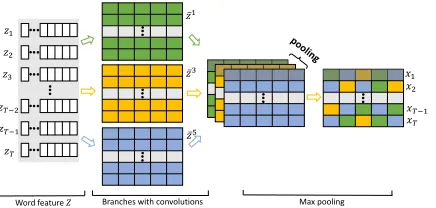
And it is obvious that the local dependencies are not lim-ited within a certain distance. Therefore, we should enable the context layer to be adaptive to different scales of local information. Here, like InceptionNet (Szegedy et al. 2015), we design the context layer with different branches, each being comprised of one certain convolutional layer. Figure 2 shows the computational process of the context layer.
Specifically, we use three convolutional layers with the kernel size being 1, 3, 5, respectively. After obtaining the word feature Z = {z1, z2, ..., zT} of a sentence s, each
branch firstly extracts the local information z¯k
i within a
window-sizekfor each wordsi. Then a max-pooling
opera-tion is employed to select the strongest channel-wise signals from all branches. To add the non-linear characteristic, we also applytanhafter each branch.
¯
zik=convk([zi−k/2, ..., zi, ..., ci+k/2])
xi=pooling([tanh(¯z1i), tanh(¯z
3
i), tanh(¯z
5
i)])
(3)
wherek ∈ {1,3,5}is the kernel size. For each k, we use
k/2zero-paddings to ensure that each word can get the cor-responding context feature. Here, we consider the outputxi
of the context layer as the context feature for wordsi.
𝑧1
𝑧2
𝑧3
𝑧𝑇−2
𝑧𝑇−1
𝑧𝑇
Branches with convolutions Max pooling Word feature𝑍
ҧ𝑧
1
ҧ𝑧
3
ҧ𝑧5
𝑥1 𝑥2
𝑥𝑇 𝑥𝑇−1
Figure 2: Branches with various convolutions for extracting the local context feature for words. Best see in colors.
struggles to capture the global one. However, we will show that with the gated relation layer described in the following subsection, the global context information can be realized by a fusion of the local one, thus tackling the shortcoming of the context layer.
Relation Layer
It has been shown that both short-term and long-term con-text information in a sequence is very critical in sequence learning tasks. LSTMs leverage the memory and the gating mechanism (Hochreiter and Schmidhuber 1997) to capture both context information and gain significant success. How-ever, conventional CNNs cannot well capture the long-term context information owing to the limited receptive fields, and thus existing CNN-based NER models cannot achieve comparable performance as LSTM-based ones.
In this subsection, we introduce the gated relation layer in our proposed GRN, which aims to enhance the conven-tional CNNs with global context information. Specifically, it models the relations between any two words in the sentence. Then, with the gating mechanism, it composes a global con-text feature vector by weighted-summing up the relation scores with their corresponding local context feature vec-tors, as shown in Figure 3. Similar to the attention mecha-nism, our proposed GRN is effective in modelling long-term dependencies without regard to the limited CNN receptive fields. And importantly, GRN can allow computations to be performed in parallel across the entire sentence, which can generally help to reduce the time costs for training and test.
Given the local context features x = {x1, x2, ..., xT}
from the context layer for a sentence s, the relation layer firstly computes the relation score vectorrij between any
two words si andsj, which is of the same dimension as
any xi. Specifically, it firstly concatenates the
correspond-ing context featuresxiandxj, and then uses a linear
func-tion with the weight matrixWrxand the bias vectorbrxto
obtainrij:
rij=Wrx[xi;xj] +brx (4)
Like (Santoro et al. 2017), we can directly average these relation score vectors as follows:
ri=
1
T
T
X
j=1
rij (5)
whereri is the fused global context feature vector for the
wordsiby the direct feature fusion operation, i.e., averaging
in Eq. 5. However, considering that non-entity words gener-ally take up the majority of a sentence, this operation may introduce much noise and mislead the label prediction. To tackle that, we further introduce the gating mechanism, and enable the relation layer to learn to select other dependent words adaptively. Specifically, for the word si, we firstly
normalize all its relation score vectors rij with a sigmoid
function to reduce their biases. Then we sum up the normal-ized relation score vectorsrij with the corresponding local
context feature vector xj ∈ x = {x1, x2, ..., xT} of any
other wordsj. And similar to Eq. 5, finally we normalize
the sum by the length of the sentence, i.e.,T.
ri=
1
T
T
X
j=1
σ(rij)xj (6)
where σ is a gate using sigmoid function, and means element-wise multiplication. Note that rij is asymmetrical
and different fromrji, and the relation vector w.r.tsiitself,
i.e.,rii, is also incorporated in the equation above.
There-fore, withriconsisting of all the information of other words
in the sentence, it can be seen as the global context feature vector forsi.
In a way, GRN can be seen as a channel-wise attention mechanism (Chen et al. 2017). However, instead of using a softmax function, we leverage the gating mechanism on the relation score vectors to decide how all the words play a part in predicting the label for the wordsi. We can also customize
Eq. 6 to the formula of attention with gating mechanism, where a gate is used to compute the attention weight for a word:
αij =σ(Wx[xi;xj] +bx)
ri=
1
T
T
X
j=1
αij∗xj
(7)
whereαij ∈R1is an attention weight rather than a vector.
To distinguish from the proposed GRN (i.e., Eq. 6), we name Eq. 5 as Direct Fusion Network (DFN) and Eq. 7 as Gated Attention Network (GAttN). We will consider DFN and GAttN as two of our baseline models to show the supe-riority of the proposed GRN.
Here we also add a non-linear function forrias follows.
pi=tanh(ri) (8)
And we definepias the final predicting feature for wordsi.
CRF Layer
Modelling label dependencies is crucial for NER task (Ma and Hovy 2016; Liu et al. 2018). Following (Ma and Hovy 2016; Huang, Xu, and Yu 2015), we employ a conditional random field (CRF) layer to model the label dependencies and calculate the loss for training GRN.
Formally, for a given sentences={s1, s2, ..., sT}and its
generic sequence of labelsy = {y1, y2, ..., yT}, we firstly
𝑥1
𝑥2
𝑥3
𝑥𝑇−2
𝑥𝑇−1
𝑥𝑇
𝑟2
𝑟3
𝑟𝑇−2
𝑟𝑇−1
𝑟𝑇 𝑟1
Relations Gating
Local context featurex
relation matrix: {𝑟𝑖𝑗} 𝐸𝑞. 4
Figure 3: Gated relation layer in GRN for composing the global context feature for each word.rijdenotes the relation
score vector between wordsiand wordsj. Best see in color.
s. The CRF model defines a family of conditional probabil-ityp(y|s)over all possible label sequencesygivens:
p(y|s) =
QT
i=1φi(yi−1, yi,s)
P
y0∈Y(s)
QT
i=1φi(yi0−1, yi0,s)
(9)
where φi(yi−1, yi, s) = exp(f(si, y0, y)) with f being a
function that maps words into labels:
f(si, y0, y) =Wypi+by0,y (10) wherepi is derived as Eq. 8,Wy is the predicting weights
w.r.ty andby0,yis the transition weight fromy0 toy. Both
Wyandby0,yare parameters to be learned. Loss of the CRF layer is formulated as follows.
L=−X s
logp(y|s) (11)
And for decoding, we aim to find the label sequencey∗
with the highest conditional probability:
y∗= arg maxy∈Y(s)p(y|s) (12) which can be efficiently derived via Viterbi decoding.
Experiments
To verify the effectiveness of the proposed GRN, we conduct extensive experiments on two benchmark NER datasets: CoNLL-2003 English NER (Tjong Kim Sang and De Meul-der 2003) and OntoNotes 5.0 (Hovy et al. 2006; Pradhan et al. 2013).
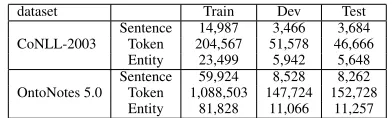
• CoNLL-2003 English NERconsists of 22,137 sentences totally and is split into 14,987, 3,466 and 3,684 sen-tences for the training set, the development set and the test set, respectively. It includes annotations for 4 types of named entities:PERSON,LOCATION,ORGANIZATION
andMISC.
• OntoNotes 5.0consists of much more (76,714) sentences from a wide variety of sources (telephone conversation, newswire, etc.). Following (Chiu and Nichols 2016), we use the portion of the dataset with gold-standard named entity annotations, and thus excluded the New Testaments portion. It also contains much more kinds of entities, in-cludingCARDINAL,MONEY,LOC,PRODUCT, etc.
dataset Train Dev Test
CoNLL-2003
Sentence 14,987 3,466 3,684 Token 204,567 51,578 46,666 Entity 23,499 5,942 5,648
OntoNotes 5.0
Sentence 59,924 8,528 8,262 Token 1,088,503 147,724 152,728 Entity 81,828 11,066 11,257
Table 1: Statistics of CoNLL-2003 and Ontonotes 5.0.
Table 1 shows some statistics of both datasets. Follow-ing (Ma and Hovy 2016), we use the BIOES sequence la-belling scheme instead of BIO for both datasets to train mod-els. As for test, we convert the prediction results back to the BIO scheme and use the standard CoNLL-2003 evaluation script to measure the NER performance, i.e.,F1scores, etc.
Network Training
We implement our proposed GRN with the Pytorch li-brary (Paszke et al. 2017). And we set the parameters below following (Ma and Hovy 2016).
Word Embeddings.The dimension of word embedding is set as100. And as mentioned, we initialize it with Stan-ford’s publicly available GloVe 100-dimensional embed-dings. We include all words of GloVe when building the vo-cabulary, besides those words appearing at least3times in the training set. For words out of the vocabulary (denoted as
UNK) or those not in GloVe, we initialize their embeddings with kaiming uniform initialization (He et al. 2015).
Character Embeddings.We set the dimension of charac-ter embeddings as30, and also initialize them with kaiming uniform initialization.
Weight Matrices and Bias Vectors.All weight matrices in linear functions and CNNs are initialized with kaiming uniform initialization, while bias vectors are initialized as0. Optimization.We employ mini-batch stochastic gradient descent with momentum to train the model. The batch size is set as10. The momentum is set as0.9and the initial learning rate is set as0.02. We use learning rate decay strategy to up-date the learning rate during training. Namely, we upup-date the learning rate as 1+0.02ρ∗t at thet-th epoch withρ = 0.02. We train each model on training sets with200epochs totally, us-ing dropout =0.5. For evaluation, we select its best version with the highest performance on the development set and report the corresponding performance on the test set. To re-duce the model bias, we carry out 5 runs for each model and report the average performance and the standard deviation.
Network Structure.The output channel number of the CNN in Eq. 2 and Eq. 3 is set as 30 and 400, respectively.
Performance Comparison
Here we first focus on the NER performance comparison between the proposed GRN and the existing state-of-the-art approaches.
Model Mean(±std)F1 MaxF1 Mean P/R
(Collobert et al. 2011) 88.67
(Luo et al. 2015) 89.9 90.0 / 89.9 (Chiu and Nichols 2016) 90.91±0.20 90.75 / 91.08 (Zhuo et al. 2016) 88.12
(Rei, Crichton, and Pyysalo 2016) 84.09 (Lample et al. 2016) 90.94
(Ma and Hovy 2016) 91.21 91.35/ 91.06 (Rei 2017) 86.26
(Zukov-Gregoric et al. 2017) 89.83 (Liu, Baldwin, and Cohn 2017) 89.5 (Peters et al. 2017) 90.87±0.13 (Liu et al. 2018) 91.24±0.12 91.35 (Ye and Ling 2018) 91.38±0.10 91.53 ID-CNN (Strubell et al. 2017) 90.54±0.18
CNN-BiLSTM-CRF 91.17±0.18 91.45 90.98 / 91.35
GRN 91.44±0.16 91.67 91.31 /91.57
(Collobert et al. 2011)* 89.59
(Luo et al. 2015)* 91.2 91.5 / 91.4 (Chiu and Nichols 2016)* 91.62±0.33 91.39 / 91.85 (Peters et al. 2017)* 91.93±0.19
(Tran, MacKinlay, and Yepes 2017)* 91.66 (Yang, Salakhutdinov, and Cohen 2017)* 91.26 (Peters et al. 2018)* 92.22±0.10
GRN* 92.34±0.10 92.45 92.04/92.65
Table 2: Performance comparison on CoNLL-2003. * in-dicates models utilizing external knowledge besides the CoNLL-2003 training set and pre-trained word embeddings. P/R denotes precision and recall.
knowledge to boost their performance, here we also report the performance of GRN with ELMo (Peters et al. 2018) in-corporated as the external knowledge. Note that ELMo is trained on a large corpus of text data and can generate dy-namic contextualfeatures for words in a sentence. Here we simply concatenate the output ELMo features to the word feature in GRN. The experimental results are reported in Ta-ble 2, which also includes the maxF1scores, mean precision
and recall values if available. Note that CNN-BiLSTM-CRF is our re-implementation of (Ma and Hovy 2016), and we obtain comparable performance as that reported in the pa-per. Therefore, by default we directly compare GRN with the reported performance of compared baselines. It should also be noticed that, since the relation layer in GRN can be re-lated to the attention mechanism, here we also include some attention-based baselines, i.e.,, (Rei, Crichton, and Pyysalo 2016) and (Zukov-Gregoric et al. 2017).
As shown in Table 2, compared with those LSTM-based NER models, the proposed GRN can obtain comparable or even slightly superior performance, with or without the ex-ternal knowledge, which well demonstrates the effectiveness of GRN. And compared with ID-CNN, our proposed GRN can defeat it at a great margin in terms ofF1score. We also
try to add ELMo to the latest state-of-the-art model of (Ye and Ling 2018) based on their published codes, and we find that the correspondingF1 score is91.79±0.08, which is
substantially lower than that of GRN.
OntoNotes 5.0.On OntoNotes 5.0, we compare the pro-posed GRN with NER models that also reported perfor-mance on it, including (Chiu and Nichols 2016; Shen et al. 2017; Durrett and Klein 2014), etc. As shown in Table 3, GRN can obtain the state-of-the-art NER performance on OntoNotes 5.0, which further demonstrates its effectiveness. Overall, the comparison results on both CoNLL-2003 and OntoNotes 5.0 well indicate that our proposed GRN can
Model Mean(±std)F1 Mean P/R
(Passos, Kumar, and McCallum 2014) 82.30
(Durrett and Klein 2014) 84.04 85.22 / 82.89
(Chiu and Nichols 2016) 86.28±0.26 86.04 / 86.53
(Shen et al. 2017) 86.63±0.49
ID-CNN (Strubell et al. 2017) 86.84±0.19
GRN 87.67±0.17 87.79/87.56
Table 3: Performance comparison on OntoNotes 5.0. P/R de-notes precision and recall.
Model Mean(±std)F1 F1Drop
context GRN w/o context 88.36±0.21 3.08
GRN w/branch3 90.88±0.22 0.56
relation
GRN w/o relation 90.13±0.28 1.31
DFN 90.72±0.06 0.72
GAttN 87.11±0.25 4.33
Full GRN 91.44±0.16 0
Table 4: Ablation study on CoNLL-2003.
Model Mean(±std)F1 F1Drop
context GRN w/o context 82.21±0.23 5.46
GRN w/branch3 86.66±0.21 1.01
relation
GRN w/o relation 85.87±0.16 1.80
DFN 85.81±0.14 1.86
GAttN 79.83±0.37 7.83
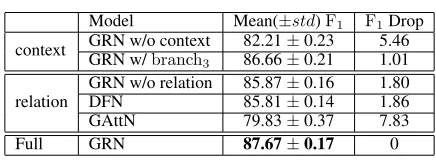
Full GRN 87.67±0.17 0
Table 5: Ablation study on OntoNotes 5.0.
achieve state-of-the-art NER performance with or without external knowledge. It demonstrates that, using GRN, CNN-based models can compete with LSTM-CNN-based ones for NER.
Ablation Study
Here we study the impact of each layer on GRN. Firstly, we analyze the context layer by introducing two baseline models: (1) GRN w/o context: wiping out the context layer and building the relation layer on top of the representation layer directly; (2) GRN w/branch3: removing branches in
the context layer, except the one with kernel size= 3. Then to analyze the relation layer and the importance of gating mechanism in it, we compare GRN with: (1) GRN w/o rela-tion: wiping out the relation layer and directly building the CRF layer on top of the context feature; (2) DFN (see Eq. 5); (3) GAttN (see Eq. 7). All compared baselines use the same experimental settings as GRN. Table 4 and Table 5 report the experimental results on both datasets, where the last column shows the absolute performance drops compared to GRN.
As shown in Table 4 and Table 5, when reducing the num-ber of branches in the context layer, GRN w/o context and GRN w/ branch3 drop significantly, which indicates that
modelling different scales of local context information plays a crucial role for NER.
Compared with GRN w/o relation, DFN and GAttN, the proposed GRN defeats them at a substantial margin in terms ofF1score, which demonstrates that the proposed gated
atten-CoNLL-2003 OntoNotes 5.0 Training 1.16x 1.15x
Test 1.19x 1.08x
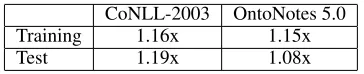
Table 6: Training/test speedup of GRN compared with CNN-BiLSTM-CRF.
tion approach (i.e., Eq. 7) and the direct fusion approach (i.e., Eq. 5) under the same experimental settings for NER.
Training/Test Time Comparison
In this section, we further compare the training and test time costs of the proposed GRN with those of CNN-BiLSTM-CRF, which is the most basic LSTM-based NER model achieving high performance. We conduct our experiments on a physical machine with Ubuntu 16.04, 2 Intel Xeon E5-2690 v4 CPUs, and a Tesla P100 GPU. For fair comparison, we keep the representation layer and the CRF layer the same for both models, so that the input and output dimensions for the “BiLSTM layer” in CNN-BiLSTM-CRF would be iden-tical to those of the “context layer + relation layer” in GRN. We train both models with random initialization for a total of 30 epochs, and after each epoch, we evaluate the learned model on the test set. For both training and test, batch size is set as10as before. And here we use the average train-ing time per epoch and the average test time to calculate speedups.
As shown in Table 6, GRN can obtain a speedup of more than 1.15 during training and around 1.10 during test on both datasets. The speedup may seem not so significant, be-cause the time costs reported here also include those con-sumed by common representation layer, CRF layer, etc. For reference, the fast ID-CNN with a CRF layer (i.e., ID-CNN-CRF) (Strubell et al. 2017) was reported to have a test-time speedup of 1.28 over the basic BiLSTM-CRF model on CoNLL-2003. Compared to ID-CNN-CRF, GRN sacrifices some speedup for better performance, and the speedup gap between both is still reasonable. We can also see that the speedup on CoNLL-2003 is larger than that on OntoNotes 5.0, which can be attributed to that the aver-age sentence length of CoNLL-2003 (∼14) is smaller than that of OntoNotes 5.0 (∼ 18) and thus the relation layer in GRN would cost less time for the former. The results above demonstrate that the proposed GRN can generally bring ef-ficiency improvement over LSTM-based methods for NER, via fully exploiting the GPU parallelism.
Word Relation Visualization
Since the proposed GRN aims to boost the NER perfor-mance by modelling the relations between words, especially long-term ones, we can visualize the gating output in the re-lation layer to illustrate the interpretability of GRN. Specif-ically, we utilize theL2norm ofrijto indicate the extent of
relations between the wordsiand the wordsj. Then we
fur-ther normalize the values into[0,1]to build a heat map. Fig-ure 4 shows a visualization sample. We can find out that the entity words (y-axis) are more related to other entity words as well, even though they may be “far away” from each other
Figure 4: Word relation visualization: the x-axis shows the sentence and the y-axis shows the entity words in it. Regions with deeper color means stronger relations between the cor-responding pair of words.
in the sentence, like the 1st word “Sun” and the 8th word “Sidek” in the sample. Note that “Sun” and “Sidek” are not in an identical receptive field of any CNN used in our ex-periments, but their strong correlation can still be exploited with the relation layer in GRN. That concretely illustrates that, by introducing the gated relation layer, GRN is able to capture the long-term dependency between words.
Conclusion
In this paper, we propose a CNN-based network, i.e., gated relation network (GRN), for named entity recogni-tion (NER). Unlike the dominant LSTM-based NER mod-els which process a sentence in a sequential manner, GRN can process all the words concurrently with one forward operation and thus can fully exploit the GPU parallelism for potential efficiency improvement. Besides, compared with common CNNs, GRN has a better capacity of captur-ing long-term context information. Specifically, GRN intro-duces a gated relation layer to model the relations between any two words, and utilizes gating mechanism to fuse local context features into global ones for all words. Experiments on CoNLL-2003 English NER and Ontonotes 5.0 datasets show that, GRN can achieve state-of-the-art NER perfor-mance with or without external knowledge, meaning that using GRN, CNN-based models can compete with LSTM-based models for NER. Experimental results also show that GRN can generally bring efficiency improvement for train-ing and test.
Acknowledgements
This work is jointly supported by the National Natural Sci-ence Foundation of China (No. 61571269) and the National Key R&D Program of China (No. 2018YFC0807500).
References
Bikel, D. M.; Miller, S.; Schwartz, R.; and Weischedel, R. 1997. Nymble: a high-performance learning name-finder. InANLP, 194–201.
Chen, L.; Zhang, H.; Xiao, J.; Nie, L.; Shao, J.; Liu, W.; and Chua, T.-S. 2017. Sca-cnn: Spatial and channel-wise attention in convolutional networks for image captioning. In
Chiu, J., and Nichols, E. 2016. Named entity recognition with bidirectional lstm-cnns. TACL4(1):357–370.
Collobert, R.; Weston, J.; Bottou, L.; Karlen, M.; Kavukcuoglu, K.; and Kuksa, P. 2011. Natural language processing (almost) from scratch.JMLR12:2493–2537. Durrett, G., and Klein, D. 2014. A joint model for entity analysis: Coreference, typing, and linking. TACL2(1):477– 490.
Gehring, J.; Auli, M.; Grangier, D.; Yarats, D.; and Dauphin, Y. N. 2017. Convolutional sequence to sequence learning. InICML, 1243–1252.
He, K.; Zhang, X.; Ren, S.; and Sun, J. 2015. Delving deep into rectifiers: Surpassing human-level performance on ima-genet classification. InICCV, 1026–1034.
Hochreiter, S., and Schmidhuber, J. 1997. Long short-term memory.Neural Computation9(8):1735–1780.
Hovy, E.; Marcus, M.; Palmer, M.; Ramshaw, L.; and Weischedel, R. 2006. Ontonotes: the 90% solution. In
NAACL-HLT, 57–60.
Huang, Z.; Xu, W.; and Yu, K. 2015. Bidirectional lstm-crf models for sequence tagging. arXiv:1508.01991.
Lample, G.; Ballesteros, M.; Subramanian, S.; Kawakami, K.; and Dyer, C. 2016. Neural architectures for named entity recognition. InNAACL-HLT, 260–270.
Liu, F.; Baldwin, T.; and Cohn, T. 2017. Capturing long-range contextual dependencies with memory-enhanced con-ditional random fields. InIJCNLP, 555–565.
Liu, L.; Shang, J.; Xu, F.; Ren, X.; Gui, H.; Peng, J.; and Han, J. 2018. Empower Sequence Labeling with Task-Aware Neural Language Model. InAAAI.
Luo, G.; Huang, X.; Lin, C.-Y.; and Nie, Z. 2015. Joint entity recognition and disambiguation. InEMNLP, 879–888. Ma, X., and Hovy, E. 2016. End-to-end sequence labeling via bi-directional lstm-cnns-crf. InACL, 1064–1074. McCallum, A., and Li, W. 2003. Early results for named entity recognition with conditional random fields, feature in-duction and web-enhanced lexicons. InCoNLL, 188–191. Passos, A.; Kumar, V.; and McCallum, A. 2014. Lexicon infused phrase embeddings for named entity resolution. In
CoNLL, 78–86.
Paszke, A.; Gross, S.; Chintala, S.; Chanan, G.; Yang, E.; DeVito, Z.; Lin, Z.; Desmaison, A.; Antiga, L.; and Lerer, A. 2017. Automatic differentiation in pytorch. InNIPS. Pennington, J.; Socher, R.; and Manning, C. 2014. Glove: Global vectors for word representation. InEMNLP, 1532– 1543.
Peters, M.; Ammar, W.; Bhagavatula, C.; and Power, R. 2017. Semi-supervised sequence tagging with bidirectional language models. InACL, 1756–1765.
Peters, M.; Neumann, M.; Iyyer, M.; Gardner, M.; Clark, C.; Lee, K.; and Zettlemoyer, L. 2018. Deep contextualized word representations. InNAACL-HLT, 2227–2237.
Pradhan, S.; Moschitti, A.; Xue, N.; Ng, H. T.; Bj¨orkelund, A.; Uryupina, O.; Zhang, Y.; and Zhong, Z. 2013. Towards
robust linguistic analysis using ontonotes. InCoNLL, 143– 152.
Rei, M.; Crichton, G.; and Pyysalo, S. 2016. Attending to characters in neural sequence labeling models. InCOLING, 309–318.
Rei, M. 2017. Semi-supervised multitask learning for se-quence labeling. InACL, 2121–2130.
Santoro, A.; Raposo, D.; Barrett, D. G.; Malinowski, M.; Pascanu, R.; Battaglia, P.; and Lillicrap, T. 2017. A simple neural network module for relational reasoning. In NIPS, 4967–4976.
Shen, Y.; Yun, H.; Lipton, Z.; Kronrod, Y.; and Anandkumar, A. 2017. Deep active learning for named entity recognition. InWorkshop on Representation Learning for NLP, 252–256. Strubell, E.; Verga, P.; Belanger, D.; and McCallum, A. 2017. Fast and accurate entity recognition with iterated di-lated convolutions. InEMNLP, 2670–2680.
Szegedy, C.; Liu, W.; Jia, Y.; Sermanet, P.; Reed, S.; Anguelov, D.; Erhan, D.; Vanhoucke, V.; and Rabinovich, A. 2015. Going deeper with convolutions. InCVPR, 1–9. Tjong Kim Sang, E. F., and De Meulder, F. 2003. Introduc-tion to the conll-2003 shared task: Language-independent named entity recognition. InCoNLL, 142–147.
Tran, Q.; MacKinlay, A.; and Yepes, A. J. 2017. Named entity recognition with stack residual lstm and trainable bias decoding. InIJCNLP, 566–575.
Vaswani, A.; Shazeer, N.; Parmar, N.; Uszkoreit, J.; Jones, L.; Gomez, A. N.; Kaiser, Ł.; and Polosukhin, I. 2017. At-tention is all you need. InNIPS, 5998–6008.
Yang, J.; Liang, S.; and Zhang, Y. 2018. Design challenges and misconceptions in neural sequence labeling. In COL-ING, 3879–3889.
Yang, Z.; Salakhutdinov, R.; and Cohen, W. W. 2017. Trans-fer learning for sequence tagging with hierarchical recurrent networks. arXiv:1703.06345.
Ye, Z., and Ling, Z.-H. 2018. Hybrid semi-markov crf for neural sequence labeling. InACL, 235–240.
Zhuo, J.; Cao, Y.; Zhu, J.; Zhang, B.; and Nie, Z. 2016. Segment-level sequence modeling using gated recursive semi-markov conditional random fields. In ACL, 1413– 1423.