Reprinted from the Soil Science Society of America Proceedings Volume 37, no. 3, May-June 1973
677 South Segoe Rd., Madison, Wis. 53711 USA
Purchased by the U. S. Dz,p.-3rtr7,c,nA Agr.cuitur.
Predicting Optimum Depth of Profile Modification by
Deep Plowing for Improving Saline-Sodic Soils
Predicting Optimum Depth of Profile Modification by
Deep Plowing for Improving Saline-Sodic Soils'
W. W. RASMUSSEN AND B. L. MCNEAL 2
ABSTRACT
A previously developed procedure for predicting the effect of mixed-salt solutions on soil hydraulic conductivity (HC) was used to predict the relative hydraulic conductivity (RHC) of separate soil horizons from saline-sodic soils, using a standard low-salt solution following a standard high-salt solution at a fixed exchangeable-sodium level. These values were then used to predict the RHC of mixtures of thr same horizons simulating profiles modified to various depths by deep plowing. Weighting RHC values for individual horizons by the depth fraction of each horizon in the soil mixture provided RHC values of proper magnitude, except when large proportions of calcareous sub-solum material were incorporated into the mixture. Results were improved by multiplying calculated RHC values for each
soil mixture by the initial HC of the mixture. This corrected for the filling of conducting pores in more permeable horizons by smaller particles from less permeable horizons during the mixing process (analogous to particle dispersion and pore seal-ing durseal-ing the leachseal-ing of saline-sodic soils). Soil constants deterMined for the mixed soils permit the prediction of the response of these soils to any other exchangeable sodium levels or soil solution concentrations of interest. Results were con-sistent with Iysimeter and field plot observations on the same soils, including deep plowing trials.
Additional Index Words: hydraulic conductivity, dispersion, mixed-salt solutions, reclamation, gypsum, lime, soil mixing.
OIL PROFILE modification has been proposed as a means
of improving saline-sodic soils and soils with hardpans, claypans, or dense clay subsoil layers (1, 2, 3, 7, 8, 9, 12). Various means have been suggested and devised for mechanical mixing to radically alter soil profile conditions. At the present time, deep plowing is the most practical means of significantly and economically modifying adverse soil profile conditions on a large scale.
On the lower Snake River Plain and in the adjacent river valleys of southwestern Idaho and southeastern Oregon, more than 100,000 ha (250,000 acres) of irrigated and potentially irrigable lands are affected by inclusions of saline-sodic (slick spot) soils. The occurrence of such soils in these lands seriously complicates soil and water manage-ment and greatly decreases land value and productivity. Several studies have shown that the soils can be improved by adequate deep plowing or mechanical mixing (8, 9). An estimated 6,000 to 8,000 ha (15,000 to 20,000 acres)
Joint contribution from the NW Branch, Soil and Water Conservation Res. Div., ARS, USDA, and the Dep. of Agron-omy and Soils, Washington State Univ., Pullman, Wash. College of Agr. Res. Center Sci. Paper No. 3933, Project 0032. Work initiated during temporary assignment of the senior author to the US Salinity Laboratory, Riverside, Calif. Received Oct. 16, 1972. Approved Dec. 6, 1972.
2 Soil Scientist, Snake River Conservation Research Center, Kimberly, Idaho 83341 and Associate Professor of Soils, Wash-ington State University, Pullman, WashWash-ington, respectively,
of such soils in the area have been deep plowed with (.0-or 1.3-m (3- (.0-or 4-foot) moldboard plows.
The success of deep plowing depends on the mixing of low-clay calcareous or gypsiferous subsoil material with high-clay, B-horizon material to provide a more favorable physical matrix for soil water movement (physical reclama-tion) and to provide a source of calcium for replacement of exchangeable sodium in the profile (chemical reclama-tion). If the soluble salt concentration of the leaching solu-tion is not maintained sufficiently high during the chemical reclamation process or the exchangeable sodium percent-age (ESP) of the soil is not reduced sufficiently by mix-ing, the soil will disperse due to the presence of excess exchangeable sodium. Also, the hydraulic conductivity (HC) of the soil will decrease substantially. Increasing the depth of deep plowing on those soils that are most respon-sive to this treatment generally results in a more coarse tex-tured and more calcareous mixed soil, that is more resistant to the effects of high soil ESP and low salt concentration of the leaching water, The initial mixing tends to lower the overall ESP of the mixed soil and to modify the average salt concentration of the soil solution as well. However, the depth of plowing is limited to about 107 cm (42 inches) by available equipment, and plowing to the maximum pos-sible depth costs considerably more than more shallow plowing because of the increased power requirements. Thus, it is economically advantageous to mix the soil to the minimum depth required for adequate reclamation.
The conditions that affect soil improvement by deep plowing are not fully understood. There are few precedent studies on methods for evaluating mixed soil systems or for predicting the possible beneficial effects of soil profile modification. The general method for evaluating soil con-ditions which may be improved by deep plowing has been to plow the affected soils and to evaluate soil improvement through detailed chemical and physical analyses over a 3-to-5 year period. Such large scale tests are costly, time consuming, and often yield little fundamental information of use in extending the results to other soils. Consequently, there is a need for adequate methods to predict the types of response to be expected from deep plowing operations. This study determines the applicability of a procedure (4) for using predicted changes in relative hydraulic con-ductivity (RHC) of separate soil horizons from saline-sodic soils (determined first by using a standard high-salt solu-tion followed by a standard low-salt solusolu-tion, at a fixed exchangeable-sodium level) for predicting the relative HC of mixtures of the same horizons simulating profiles modi-fied to various depths by deep plowing. The ultimate objec-tive was to develop a procedure for predicting the depth of deep plowing necessary to insure the maintenance of ade-quate permeability during the reclamation process. This aspect of the problem, coupled with the question of the average particle-size distribution to be sought in the mixed
RASMUSSEN& MC NEAL; DEEP PLOWING FOR IMPROVING SALINE-SODIC SOILS
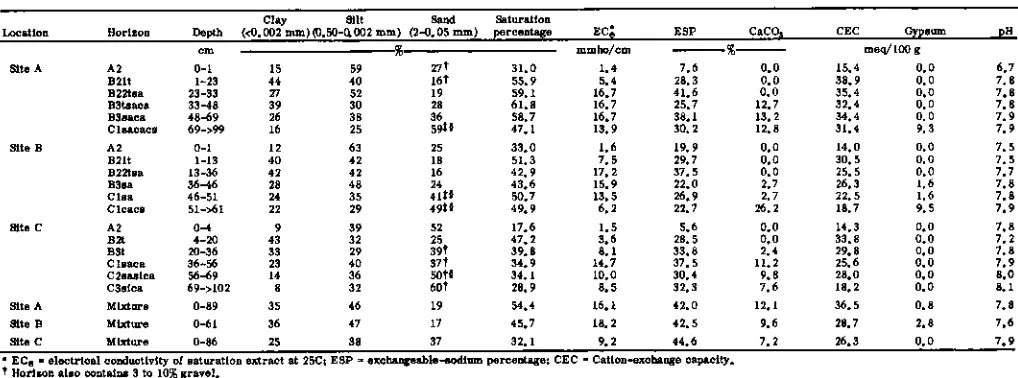
Table 1--Physical and chemical characteristics of soils used in the hydraulic conductivity and plowing depth studies
433
Location Dodson Depth (<0.002Clay Silt
Sand tuna) 0.50-0.092 Tom) (3-0.05 nun)
Saturation
percentage EC; ESP CaC% CEC Gypeurn pH
mzehoicre -5 meq/100 g
cm
0-1 15 59 276 31.0 7.6 0.0
Site A A2 1.4 15.4 0,0 6,7
8211 1-23 44 40 16t 55.9 5.4 28.3 0.0 38. 0.0 7.8
1322tea 23-33 52 19 59.1 16.7 41.6 0.0 15.4 0,0 7.8
B3tsana 3348 39 30 28 61.8 16.7 25.7 12.7 32.4 0.0 7.8
B3saca 48-69 26 36 36 58.7 16.7 38.1 13.2 34.4 0.0 7.9
Cleacaca 69->99 16 25 5938 47.1 13.9 30.2 12.8 31.4 9.3 7.9
Site B A2 0-1 12 63 25 33.0 1.6 19.9 0.0 14.0 0.0 7.5
B21t 1-13 40 42 16 51.3 7,5 29.7 0.0 30.5 0.0 7.5
B2Asa 13-36 42 42 16 42.9 17,2 37.5 0.0 25.5 0.0 7.7
B3sa 36-46 28 48 24 43,6 15.9 22.0 2,7 26.3 1,6 7.8
Claa 46-51 24 35 41t1 50.7 13.5 26.9 2.7 22.5 1.6 7.8
Cloaca 51-461 22 29 4961 49,9 6,2 22.7 26.2 18.7 9,5 7,9
Bite C A2 0-4 9 39 52 17.6 1.5 5.6 0.0 14,3 0,0 7,8
BA 4-20 43 32 25 47.2 3.6 28.5 0,0 33.8 0.0 7.2
133t 20-36 33 29 391 39.6 8.1 33.8 2.4 29.8 0,0 7.8
C /soca 36-56 23 40 376 34.9 14.7 37.5 11.2 25.6 0.0 7.9
C2aaelca 56-69 14 36 5016 34.1 10.0 30.4 9.8 280 0,0 3.0
C3eica 69->102 8 32 601 28,9 8.5 32.3 7.6 18,2 0.0 8.1
Site A Mixture 0-89 35 46 1.9 34.4 16. k 42.0 12,1 36.5 0.8 7.8
Site B Mixture 0-61 36 47 17 45,7 18.2 42.5 9.6 28.7 2.8 7,6
Site C II Mare 0-86 25 37 32.1 9.2 44.6 7.2 26.3 0,0 7.9
• EC ! • electrical conductivity of alteration extract at 25C 1 ESP = exchangeable-sodium percentage: CEC - Cation-exchange capacity.
► Horizon also contains 3 to 10% gravel.
I Horizon also contains 20 to 30% gravel. Sands conaiet mostly of caliche.
profile in order to provide adequate initial permeability (a question which is beyond the scope of the current paper), constitutes one of the major considerations in establishing the optimum depth of deep plowing on saline-sodic soils.
MATERIALS AND METHODS
The study samples were representative saline-sodic soils from three sites (designated A, B, and C), typical of the soil inclu-sions (slick spots) occurring in three major complex soil asso-ciations in the proposed Initial Butte Irrigation Unit near Boise, Idaho. The individual soils in the complexes are unnamed but the saline-sodic and normal associated soils within each complex usually have similar morphological characteristics. The strongly salt-affected soils of the "slick spot" areas merge gradually to the predominant nonsaline, nonsodic soils in the areas surround-ing the spots. Generally, the soils have developed over or in mixed silty alluvium or alluvium and loess with the surface hori-zons influenced by variable depositions of loess. The soils at Sites A and C are deep soils, underlain by coarse textured allu-vium to depths greater than 3 m (10 feet). The saline-sodic soil inclusions at these sites would be classified as natrargids, whereas the surrounding soils would be classed as calcic hap-largids. The soils at Site B have moderately shallow profiles formed in thin layers of loess over poorly consolidated allu-vium or basalt at depths of 60 to 75 cm (24 to 30 inches). The saline-sodic soils at Site B have an indurated or strongly ce-mented silica-calcium carbonate duripan at depths of 40 to 100
cm (16 to 40 inches) and would be classed as nadurargids. They are similar to the Sebree soils described previously (8), whereas the surrounding nonsaline, nonsodic soils would be classified as calcic durargids and are similar to the Chilcott
series. The associations containing the slick spots comprise ap-proximately 50% of the irrigable land area in the irrigation unit. Each soil association contains from 25 to 35% of slick spots on an areal basis. The soils occur on nearly level alluvial terraces and have favorable topographic characteristics. Except for the presence of the slick spots, they appear to be well suited for irrigation.
Soil characterization included particle-size distribution, pH, and electrical conductivity of the saturation extract, exchange-able sodium percentage, cation-exchange capacity, and gypsum and lime contents. Procedures used were those outlined by the US Salinity Laboratory Staff (14). Some initial analyses were performed by personnel at the Snake River Development Office of the US Bureau of Reclamation, Boise, Idaho (Vernon C. Bushnell and Everett V. Williams, unpublished data). Samples from individual horizons of each of the soils, as well as samples
mixed to simulate the same soils deep plowed to various depths, were analyzed. As the field bulk density on the major horizons were comparable, each horizon was included in the mixture as a weight fraction equal proportionally to the depth of the hori-zon relative to the overall depth of the mixture. This is equiva-lent to assuming a uniform bulk density for the profile.
Hydraulic conductivity was determined by the method out-lined by McNeal and Coleman (5), except for the substitution of 25-g samples and 3.2-cm I.D. permeameters. (6), Determin-ations were made at a high-salt concentration (500 meq/liter) and then at a low-salt concentration (50 meq/liter) as dis-cussed by McNeal (4). All solutions had an SAR of 100 [SAR = sodium-adsorption-ratio = Na/ ( (Ca + Mg)/2) 1/2 where all concentrations are in meq/liter]. These solutions would produce an equilibrium ESP of approximately 60 for many arid-land soils (14). These salt concentrations and this exchangeable so-dium level were selected to provide a significant reduction in HC from which to calculate reductions in HC at other salt concentration and exchangeable sodium levels. A total of 250 ml of each solution was passed through the soil to insure equili-bration of soil and solution and to produce nearly constant HC values.
RESULTS
Physical and chemical characteristics of the soils are summarized in Table 1. Each soil had both a high clay con-tent and a high ESP level in the B horizon which enhanced the probability of HC reductions as soluble salts were leached during reclamation. Initial soluble salt concentra-tions were high in all but the surface layers. Mineralogical data for the soils indicated that montmorillonite was the dominant clay-sized mineral throughout the soil profiles at Sites A and B and in the lower B horizon at Site C (un-published data, Vernon C. Bushnell).
434 SOIL SCI. SOC. AMER. PROC., VOL. 37, 1973
Table 2-Hydraulic conductivity data for soils used in the hydraulic conductivity and plowing depth studies
Location Roil moo
High-salt
Depth He • low-saltHC RelativeHC
Weighted" relative
BC Cruihoor
cm
0-1 0.27 0.15 0.57 0,01
Site A A2
521 1-23 1.05 0.04 0.04 0.01 822 23-33 0.99 0.03 0.03 0,00 53 33-48 1.69 0.06 0.04 0.01 53 48-69 1.41 0.14 0.10 0.03 CI 69-99 0.49 0.43 0.88 ...t._.-0`13_
0.191
Site 8 A2 0-1 0.19 0.08 0.45 0.01
821 1-13 0.18 0.05 0.30 0.04 822 13-36 0,14 0,11 0.90 0,23 83 36-46 0.28 0.25 0.91 0.11 Cl 46-51 0,28 0,26 0,44 0.06 C1 51-a61 0.25 0.22 0.99 ----0t 33
0.781'
Site C 82 0-4 0,39 0.34 0.97 0.04
52 4-20 0.43 0.07 0.16 0.03 83 20-36 0.32 0.08 0.24 0,05 Cl 36-56 0.29 0.23 0.81 0.20 C2 56-69 0.46 0,41 0.89 0,14 C3 69-,102 0.39 0.35 0.89 0l9 D. 591
• HC = Hydraulic 000duotivity.
• Assuming an 81-cal (32-Inch) depth of mixing,
sodium replaced for samples mixed to depths of 60 cm and 80 cm, respectively. However, many of the soils from the same geographical area have been reclaimed satisfactorily with deep plowing and irrigation alone when CaCO3 is the
only detectable source of calcium in the soil profile (9). Visual observation of field tests suggests that the native gypsum is imperfectly mixed under these conditions and hence would be less effective as a chemical amendment. The quantity of gypsum present would dissolve in the first 25 to 50 ml of high-salt solution that passed through the mixed soils during the laboratory HC determinations. Suffi-cient high-salt solution was passed through the soils sub-sequently to ensure equilibration of the soil and solution. Thus, the gypsum was not a factor in most conclusions from the laboratory portion of this study although it would be an important asset in the reclamation of the field soils. Properties of the soil mixtures such as ECe and clay
con-tent were in general agreement with those anticipated from determinations on individual soil horizons. The most dis-concerting deviation was the occurrence of the ESP levels
which were 10 to 13% higher for the soil mixtures than
predicted from the ESP and CEC values of the component horizons. No suitable explanation for this result has been developed to date. Minor variations in predicted properties probably reflect the variations in bulk density among the different layers so that weight proportions and depth
pro-portions are not strictly comparable. Determination of field bulk densities and mixing in proportion to weight fractions of the mixture instead of in proportion to depth fractions would constitute an improvement in future studies.
HC data for individual soil horizons at each site are given in Table 2. These values are the means of three to nine separate determinations on each sample. Average co-efficients of variation for the low-salt HC values were 5.0, 7.7, and 4.3% at Sites A, B, and C, respectively, expressed as a percentage of the respective high-salt values. Such a basis of expression is reasonable for it is the maintenance of the inherent (high-salt) HC that is of most concern to
the reclamation process. For the deep soils from Sites A
Table 3-Hydraulic conductivity data for soils mixed to simulate deep plowing
Laudon
Depth or
Mixing
Relative RC High-salt HC Low-salt HC (1) (2)
Measured Predicted
(3) (4) (5)
Honoured Predicted Measured Predicted ---./ b..-em
Site A 0-81 0.23 0.19 0.55 1.16 0.12 0.10 0-89 0,22 0.25 0.41 1.10 0.09 0.10 0-99 0.44 0.32 0.37 1,04 0.16 0.12 0-107 0.66 0.36 0,45 1.00 0.29 0.16 811e 8 0-61 0.92 0.74 0.16 0,20 0.15 0.12 0-69 0.80 0.76 0.19 0.21 0,15 0.14 0-76 0,77 0,77 0.25 0.21 0.19 0.19 Site C 0-81 0.79 0.60 0.13 0.37 0.11 0.08 0-99 0.74 0.65 0,12 0,97 0,08 0,09 0-107 0,87 0.67 0.22 0,38 0.19 0,15
and C, samples from the upper and lower parts of the pro-file were relatively stable under high-sodium, low-salt con-ditions, but samples from intermediate depths were un-stable under these same conditions. This unun-stable material was present from the 1- to-69-cm depths at Site A, so recla-mation by deep plowing would require mixing to depths as great as 90 cm or deeper. For soils from both Site A and Site C, a mixture containing less than 25% clay appeared to be required to insure a relatively stable HC during the reclamation process. However, samples from Site A were more unstable than those from Site C at comparable clay contents.
Although clay contents and ESP levels were as high as those observed at the other sites, samples from the shallow, gypsiferous site (Site B) maintained considerably higher RHC values under high-sodium, low-salt conditions. How-ever, such apparent "stability" may be partially due to the low values for high-salt HC observed for these samples, resulting in less opportunity for drastic changes in soil HC under low-salt conditions. The rapid reclamation of soils at this site following mixing in lysimeters and in the .field probably arises more from the presence of substantial quan-tities of gypsum in the profile than from an unusually high stability under high-sodium, low-salt conditions.
Sample calculations in the final column of Table 2 illus-trate the relative contributions of the individual horizons to the predicted RHC of typical soil mixtures. An 81-cm (32-inch) depth of mixing was assumed for the
calcula-tions. The weighted RHC of the mixed soil (RHCm) is
calculated from the relation
RHC„, (RHC, x Di)/ D„, 11]
i = I
where D refers to the appropriate horizon thickness (in cm), i is an interger serving as an index for the horizon under consideration, and D. is the total thickness of the mixed profile. For the deep soils (Sites A and C), the pre-dicted RHC of the mixture would depend largely upon the quantity of C horizon material incorporated, with 1/2 to
3/4 of the RHC attributable to C horizon material. For the
more shallow soil (Site B), however, nearly half of the
RHC of the mixture was associated with material from the B horizons. In all cases, the thin A2 layer at the soil surface had essentially no effect on the overall HC of the mixture.
610
50
lA
" .9
.8
3 .7
g
.6.4
.3
13
.2a
Ix I
0
Solution I Meg./ Liter
10 2q
•
Soil A
60
2:2L Solution 10 Meg./Uter
oil El
oil C
a t .2
re . 1
• •
la 20 30 40 ESP A
1.0
9
ESP
RASMUSSEN & MC NEAL: DEEP PLOWING FOR IMPROVING SALINE-SODIC SOILS
435
1
I
1q 20 30 40 50 60
ESP
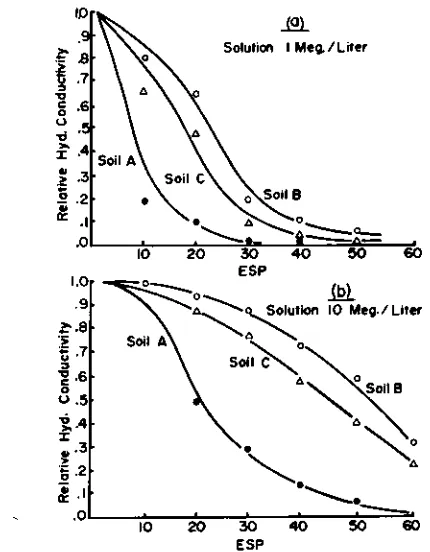
Fig. 1—Predicted relative hydraulic conductivity as a function of soil ESP and soil solution concentration. Hypothetical depth of mixing 86 cm for soils, Site A and C, 61 cm for soil, Site B.
predicted RHC values for soil mixtures. Predicted RHC values were of the same magnitude as measured values but generally somewhat smaller. For samples from Sites A and C, measured RHC values did not increase commensurably with the increasing amounts of C horizon material incor-porated into the mixture by mixing to greater soil depths. The values in columns 3 and 4 of Table 3 represent mea-sured and predicted HC (rather than RHC) values for the high-salt solution. Predicted values were two- to threefold greater in all cases than measured values for mixtures from the deep soils (Sites A and C). This probably arises from small particles from other horizons being packed into inter-aggregate pores of a given horizon in the mixed samples. As a result, the HC of the mixture was lower than would he predicted from the HC of the component horizons. However, high-sodium, low-salt conditions also tend to de-crease the HC by decreasing the size and number of con-ducting pores (5, I I, 13). If some of the conducting pores
were already partially clogged during the soil mixing pro-cess. opportunity for additional decreases in HC would he less because of swelling and dispersion, and the RHC of the mixture to the low-salt solution would be higher than anticipated. This effect should he lessened under field con-ditions where soil aggregates would he less completely dis-rupted and less intimately mixed than in the laboratory. The last two columns of Table 3 show the measured and predicted values of the low-salt NC for various soil mix-tures. Predicted values were weighted as indicated in equa-tion 111, except that the low-salt HC was obtained by mul-tiplying the measured high-salt HC by the predicted RHC of the mixture. In this manner, differences in HC arising
Fig. 2—Predicted relative hydraulic conductivity as a function of soil ESP and soil solution concentration. Hypothetical depth of mixing 107 cm for soils, Site A and C, 76 cm for soil, Site B.
from the mixing and packing operations were compensated. Although it had been hoped initially that even this degree of curve-fitting would not be necessary, fitting at this single point permits the generation of an entire family of curves describing response of the soil to any other salt concentra-tions and exchangeable sodium levels. This is also the sug-gested manner for using predicted HC values in the field (4). The procedure thus can be coupled with models of the salt concentrations and ESP during the reclamation process to predict in advance the success or failure of vari-ous deep plowing and leaching combinations.
The agreement between measured and predicted low-salt HC values was acceptable in all cases and was excellent in the case of all but the greatest depth of mixing at the deep, gypsiferous site (Site A). The situation at Site A rep-resents the maximum possible depth for current deep-plowing equipment and should not be considered a serious discrepancy in evaluating the recommended approach.
Once the RHC of a soil mixture has been predicted at a given salt concentration and exchangeable sodium level, the MC at any other salt concentration and exchangeable sodium level can be predicted subsequently. The predic-tions can he used in conjunction with models of the chemi-cal reclamation process to estimate changes in soil permea-hility at selected depths in the soil profile during various stages of the leaching process. Typical predictions are pre-sented in Fig. 1. where the predicted RHC of samples from Sites A, B, and C mixed to depths of 86, 61, and 86 cm, respectively, are given as a function of ESP at total salt concentrations of 1 and 10 meq/liter. Similar predictions arc given in Fig, 2 for mixing depths of 107, 76, and 107
436 SOIL SCI. SOC. AMER. PROC., VOL. 37, 1973
cm, respectively. Plotted points represent the results of cal-culations at predetermined ESP levels with smooth curves then fitted through these points. The procedure described by McNeal (4) involves fitting a function of specified form to the experimental values and then using the resultant empirical constants to predict RHC for any other salt con-centration or exchangeable sodium levels of interest. A nomograph simplifying the calculations is given in the cited article. Once generated, soil curves can be used to predict the response of a mixed soil to a wide variety of chemical conditions which may be anticipated during the reclamation process.
The total salt concentration of the river waters to be used for the proposed irrigation project is approximately 1 meq/liter. The average initial ESP level for all mixing depths represented by the figures was approximately 40%. The most dispersive chemical conditions which could be encountered during the leaching process would occur if soil solutions having the approximate salt concentration of the irrigation water were to coexist with soil particles having the approximate ESP of the mixed soil. This is not unreasonable because salt is removed more readily than exchangeable sodium during the leaching process. Soil from the deep, gypsiferous site (Site A) would be stable (i.e. RHC 0.50) only to an ESP of approximately 5 to 10 at a total salt concentration of 1 meq/liter if mixing were carried out to a depth of 86 cm. In comparison, soil from Site A mixed to a depth of 107 cm would be stable to an ESP of 15 to 20. Reclamation following deep plowing would be unlikely with the first depth of plowing but quite probable when the deeper plowing depth was employed. Soils from Sites B and C exhibited approximately the same stability at either mixing depth with respective stabilities to 20 and 25% ESP at a salt concentration of 1 meq/liter.
Due to mineral dissolution, a total salt concentration of 10 meq/liter is more reasonable for the lower limit of salt concentration in the soil solution during the initial stages of the reclamation process when the highest levels of ex-changeable sodium are present on the soil (10). At this salt concentration, soil from Site A is particularly respon-sive to depth of mixing with stability to ESP levels of 25 and 40, respectively, for the shallow and deep mixing depths. Therefore, deep plowing at Site A should be more successful by mixing to the greatest possible depth, so more effort should be made to increase the depth of deep plow-ing at this site. At a total salt concentration of 10 meq/liter, soils from Sites B and C would be stable at either depth of deep plowing so increasing the depth of deep plowing would be of little benefit at these locations. Data such as given in Fig. 1 and 2 would also indicate situations where deep plowing would be impractical for sodic soil reclamation because of insufficient soil depth of or insuffi-cient stability of the mixed soil under anticipated chemical conditions.
DISCUSSION
Verification of RHC predictions under field conditions is difficult because of variations in soil properties, difficul-ties in predicting soil chemical conditions during
reclama-tion, and limitations on the degree of mixing obtained dur-ing field operations. Infiltration rates determined durdur-ing application at 15 to 20 cm (6 to 8 inches) of water by basin irrigation for the deep plowed field plots were in
the ranges of 0.5 to 2, 5 to 10, and 2 to 4 cm/hour at Sites A, B, and C, respectively. This compares with infiltration rates of 0.05 to 0.10 cm/hour for untreated slick-spot soils at the same sites. Soils at the shallow, gypsiferous site (Site B) and the deep, nongypsiferous site (Site C) were reclaimed readily by deep plowing to the 61- and 86-cm depths, respectively. Such responses were predictable from RHC vs. ESP relationships shown in Fig. 1 and 2. How-ever, soils from the deep, gypsiferous site (Site A), which was deep plowed to a depth of approximately 81 cm in the field, were not reclaimed after 4 years of cropping. Furthermore, this site demonstrated only limited reduc-tions in ESP on two of four field plots after 4 years of cropping, despite the significant amounts of gypsum that were present in the lower portion of the profile at this site before plowing. This is probably a consequence of the relatively high clay content persisting in the upper soil layers following mixing and the dispersion and sealing of this soil during the initial increments of leaching which restricted water penetration, gypsum dissolution, and re-placement of exchangeable sodium. The rate of reduction of ESP in the field was greatest at the shallow, gypsiferous site (Site B) as predicted from Fig. 1 and 2 and from the presence of considerable natural gypsum within the pro-file at this site.
In lysimeter studies where the soils were thoroughly mixed to 86 cm reclamation had occurred in all cases within 3 to 4 years after mixing. Thus, the critical depth of mixing for the deep, gypsiferous site (Site A) was some-what greater than 81 cm for imperfectly mixed sites and somewhat less than 86 cm for well mixed sites. In the ly-simeter experiments, the rate of reduction in ESP was low-est for mixed soil from the deep, nongypsiferous site (Site C). This is undoubtedly so because gypsum was lacking in this profile with resultant dependence only on lime from the calcareous layer and of the irrigation water as sources of soluble calcium to replace exchangeable sodium. How-ever, the relative stability of this soil when plowed to the 86-cm depth sustains adequate water percolation and per-mits reclamation even in the absence of a more readily-soluble source of calcium. Since the soil would be quite unstable at the average ESP of the mixture (ESP = 44.6, Table 1) and the salt concentration of the irrigation water (1 meq/liter), the average salt concentration of the soil solution must have been closer to 10 meq/liter or higher during the initial stages of the field leaching process. Salt concentrations of saturation extracts from various depths of this soil during the field reclamation process ranged be-tween 10 and 100 meq/liter, bearing out this prediction (W. W. Rasmussen, unpublished data). At salt concentra-tions of this magnitude, the soil has a relatively high RHC even at ESP values of 40 or greater.
parame-RASMUSSEN & MC NEAL: DEEP PLOWING FOR IMPROVING SALINE-SODIC SOILS 437
ters on soil hydraulic conductivity is still in the embryonic stages. So, direct consideration of the degree to which the mixed soil can be expected to resist HC changes under the most adverse chemical conditions (lowest salt concentra-tions and highest exchangeable sodium levels) anticipated for the reclamation process is a substantial improvement in the selection criteria. The approach may eventually be
extended to the selection of actual infiltration rates or HC values below which the values for the mixed soils should not decrease for "safe" chemical and physical reclamation. Such values are difficult to predict in advance, whereas RHC can be predicted in advance following a few simple measurements using the approach outlined above.
LITERATURE CITED
1. Bowser, W. E., and R. R. Cairns. 1967. Some effects of deep plowing a Solonetz soil. Can. J. Soil Sci. 47:239-244. 2. Burnett, E., and V. L. Hauser. 1968. Deep tillage and soil-plant-water relationships, In Tillage for greater crop pro-duction. ASAE Publ. Proc. 168;47-52.
3. Eck, H. V., and H. M. Taylor. 1969. Profile modification of a slowly permeable soil. Soil Sci, Soc. Amer. Proc. 33: 779-783.
4. McNeal, B. L. 1968. Prediction of the effect of mixed-salt solutions on soil hydraulic conductivity. Soil Sci. Soc.
Amer. Proc. 32:190-193.
5. McNeal, B. L., and N. T. Coleman. 1966. Effect of
solu-(ion composition on soil hydraulic conductivity. Soil Sci.
Soc. Amer. Proc. 30:308-312.
6. McNeal, B. L., D. A. Layfield, W. A. Norvell, and J. D. Rhoades. 1968. Factors influencing hydraulic conductivity of soils in the presence of mixed-salt solutions. Soil Sci. Soc. Amer. Proc. 32:187-190.
7. Mech, S. J., G. M. Homer, L. M. Cox, and E. E. Cary. /967. Soil profile modification by backhoe mixing and deep plowing. Trans. of the ASAE 10:775-779.
8. Rasmussen, W. W., G. C. Lewis, and M. A. Fosberg. 1964. Improvement of the Chilcott-Sebree (solodized-solonetz) slick spot soils in southwestern Idaho. US Dep. Agr. (ARS 41-91) 39 p.
9. Rasmussen, W. W., D. P. Moore, and L. A. Alban. 1972.
Improvement of a solonetzic (slick spot) soil by deep plowing, subsoiling and amendments. Soil Sci. Soc. Amer. Proc. 36:137-142.
10. Rhoades, I. D., D. B. Krueger, and M. J. Reed. 1968. The effect of soil-mineral weathering on the sodium hazard of irrigation waters. Soil Sci. Soc. Amer. Proc. 32:643-647. 11. Rowell, D. L., D. Payne, and N. Ahmad. 1969. The effect of the concentration and movement of solutions on the swelling, dispersion, and movement of clay in saline and alkali soils. J. Soil Sci. 20:176-188.
12. Sandoval, F. M., and G. A. Reichman. 1971. Some prop-erties of solonetzic (sodic) soils in western North Dakota. Can. J. Soil Sci. 51:143-155.
13. Shainberg, I., and A. Caiserman. 1971. Studies of Na/Ca montmorillonite systems: 2. The hydraulic conductivity. Soil Sci. 11:276-281.