E ff e c t o n R e n a l F u n c t i o n o f R e s t o r a t i o n o f E u t h y r o i d i s m i n
H y p e r t h y r o i d C a t s w i t h Ia t r o g e n i c H y p o t h y r o i d i s m
T.L. Williams, J. Elliott, and H.M. Syme
Background: Iatrogenic hypothyroidism is associated with an increased incidence of azotemia after treatment of hyper-thyroidism, and decreased survival time in azotemic hyperthyroid cats.
Hypothesis: Restoration of euthyroidism will decrease plasma creatinine concentrations.
Animals: Nineteen client-owned, methimazole- or carbimazole-treated, hyperthyroid cats with documented iatrogenic hypothyroidism (based on subnormal plasma total thyroxine concentrations [TT4] and increased plasma thyroid-stimulat-ing hormone concentrations).
Methods: Prospective interventional study. Doses of antithyroid medication were reduced until euthyroidism was restored (TT4 10–40 nmol/L). Plasma creatinine concentration and selected other clinicopathologic variables were evalu-ated before and after restoration of euthyroidism and compared by nonparametric statistics. Data are presented as median [25th, 75th percentile].
Results: Restoration of euthyroidism was associated with a significant decrease in plasma creatinine concentrations (2.61 [1.90, 3.26] mg/dL versus 2.07 [1.42, 2.82] mg/dL;P<.001) and body weight (4.03 [3.59, 4.53] kg versus 3.89 [3.34, 4.18] kg;P=.019), and a significant increase in packed cell volume (30 [28, 39]% versus 34 [29, 39]%;P=.038), heart rate (174 [163, 201] bpm versus 190 [164, 202] bpm;P=.009), and plasma alkaline phosphatase activity (26.6 [17.0, 33.0] IU/L versus 38.0 [23.5, 46.5] IU/L;P<.001).
Conclusions and Clinical Importance: Restoration of euthyroidism in medically treated hyperthyroid cats with iatrogenic hypothyroidism causes a reduction in plasma creatinine concentrations, and thus might improve renal function; however, this could be influenced by concurrent changes in body weight.
Key words: Azotemia; Anemia; CKD; PCV; ALP.
I
atrogenic hypothyroidism is associated with an increased incidence of azotemia in hyperthyroid cats after treatment.1 Thyroid hormone replacement treat-ment is associated with an improvetreat-ment in renal func-tion in dogs with primary hypothyroidism2; however, the effect of restoration of euthyroidism on renal func-tion in cats with iatrogenic hypothyroidism has only been investigated in 1 small previous study of cats that had been treated with radioactive iodine, which demon-strated no improvement in glomerular filtration rate (GFR).3The aim of the present prospective study was to investigate the effect of restoration of euthyroidism on renal function, and selected other clinicopathologic variables, in a cohort of medically treated hyperthy-roid cats with iatrogenic hypothyhyperthy-roidism.
Materials and Methods
Hyperthyroid cats receiving antithyroid medication (methimaz-ole [n=18] or carbimazole [n=1]) with documented iatrogenic
hypothyroidism were prospectively recruited into the study at 2 London based 1st opinion practices (Peoples’ Dispensary for Sick Animals, Bow and Beaumont Sainsbury Animal Hospital, Cam-den) between July 2009 and October 2013. Blood samples were collected with the informed consent of the owner. Iatrogenic hypothyroidism was defined as a plasma total thyroxine (TT4)
<10 nmol/L in combination with plasma thyroid stimulating hor-mone (TSH)>0.15 ng/mL (the upper limit of the reference inter-val derived from 90 healthy geriatric cats in a previous study4). The Ethics and Welfare Committee of the Royal Veterinary Col-lege approved the diagnostic protocol. Jugular venous blood samples were collected and transferred to heparinized tubes. Sam-ples were kept at 4°C before processing which occurred within 6 hours of collection. Blood samples were placed in a centrifuge at 20169gfor 10 minutes to enable separation of plasma from cellular components. Heparinized plasma was submitted to an external laboratorya for routine biochemical analysis (including TT4 concentration). Plasma creatinine concentrations were mea-sured by using the Jaffe (picric acid) method and plasma total thyroxine concentrations were determined by using the Immulite chemiluminescent assay as validated for use in cats previously.5,6 Plasma TSH concentrations were measured at the Royal Veteri-nary College laboratoryb by using the Immulite canine TSH assay (Siemens, Camberley, UK) as previously validated.7 From the Department of Veterinary Clinical Sciences, Royal
Veterinary College, North Mymms, UK (Williams, Syme); the Department of Comparative Biomedical Sciences, Royal Veterinary College, London, UK (Elliott); Present address: Department of Veterinary Medicine, University of Cambridge, Cambridge, UK (Williams). This study was presented in abstract form at 2012 ACVIM Forum, New Orleans, LA
Corresponding author: T.L. Williams, Department of Veterinary Clinical Sciences, Royal Veterinary College, Hawkshead Lane, North Mymms, Hatfield AL9 7TA, UK; e-mail: timwilliams@ cantab.net.
Submitted January 10, 2014; Revised February 18, 2014; Accepted March 12, 2014.
Copyright©2014 by the American College of Veterinary Internal Medicine
DOI: 10.1111/jvim.12359
Abbreviations:
ALP alkaline phosphatase ALT alanine aminotransferase BCS body condition score CKD chronic kidney disease GFR glomerular filtration rate
HR heart rate
Systolic blood pressure (SBP) measurements were made with an 8.1 MHz Doppler ultrasound probe according to the protocol previously described.8
After confirmation of iatrogenic hypothyroidism, dose reduc-tions were made in 1.25 mg average daily methimazole dose increments (usually by reducing the dose in 2.5 mg methimazole every other day increments) every 4 weeks until euthyroidism was established (plasma TT4 between 10 and 40 nmol/L). During the study period, no new medications or diets were instituted and the doses of all existing medications (except antithyroid medica-tion) were not changed. Body weight, body condition score (BCS), SBP, packed cell volume (PCV), heart rate (HR), and plasma concentrations of urea, creatinine, cholesterol, total cal-cium and plasma activities of alanine aminotransferase (ALT) and alkaline phosphatase (ALP) were recorded at baseline and once euthyroidism was achieved.
Statistical Analysis
Continuous data are presented as median [25th, 75th percen-tile]. Clinicopathologic parameters were compared at baseline and after restoration of euthyroidism using the Wilcoxon signed rank test. Correlations were made using Spearman’s correlation coefficient. Statistical significance was defined asP<.05.
Results
Nineteen cats with iatrogenic hypothyroidism were recruited into the study. Baseline plasma TT4 and TSH concentrations were <4.0 [<4.0, 4.8] nmol/L and 4.3 [0.9, 7.2] ng/mL, respectively. At baseline, 14/19 cats (74%) were azotemic (defined as plasma creati-nine concentration >2 mg/dL [the upper reference limit for creatinine at the external laboratorya]). Three of these cats were azotemic before or at the time of diagnosis of hyperthyroidism. The reference limits for plasma creatinine concentration were determined by the external laboratorya in an internal unpublished study (Federico Sacchini, personal communication). Urine specific gravity (USG) was <1.035 in 8 of the azotemic cats (consistent with renal azotemia). In the other 6 azotemic cats, concurrent USG measurement was not performed (as the cats did not have a palpa-ble bladder). Five cats had a plasma creatinine
>250lmol/L (the lower limit of IRIS stage 3) and 14 cats had plasma creatinine concentrations between 177 and 249lmol/L. The average daily methimazole dose given to cats at the hypothyroid visit was 5 [5, 7.5] mg.
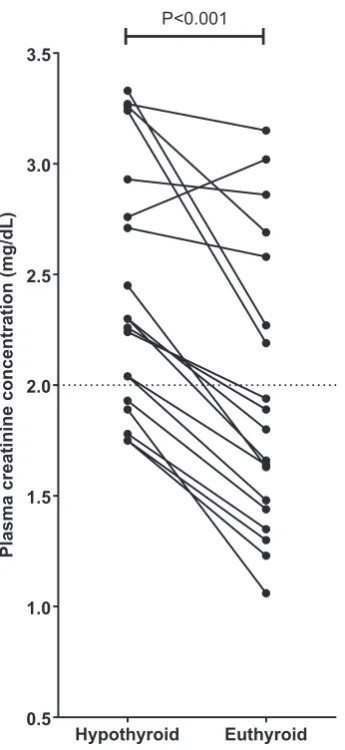
Euthyroidism was established 32 [28, 68] days (maximum 218 days) after diagnosis of iatrogenic hypothyroidism and required a dose adjustment of 2.5 [1.25, 2.5] mg methimazole (or methimazole equivalent) daily. Eight cats required every other day dosing. The average daily methimazole dose given to cats after restoration of euthyroidism was 3.75 [2.5, 5] mg. Plasma TT4 concentration after dose adjust-ment was 20.8 [14.7, 26.1] nmol/L. Plasma TSH con-centrations were not determined after restoration of euthyroidism. Restoration of euthyroidism resulted in a significant decrease (median 20.7%) in plasma cre-atinine concentration (Fig 1), and azotemia resolved in 7/14 cats (50%). After restoration of
euthyroid-ism, 3 cats had a plasma creatinine concentration
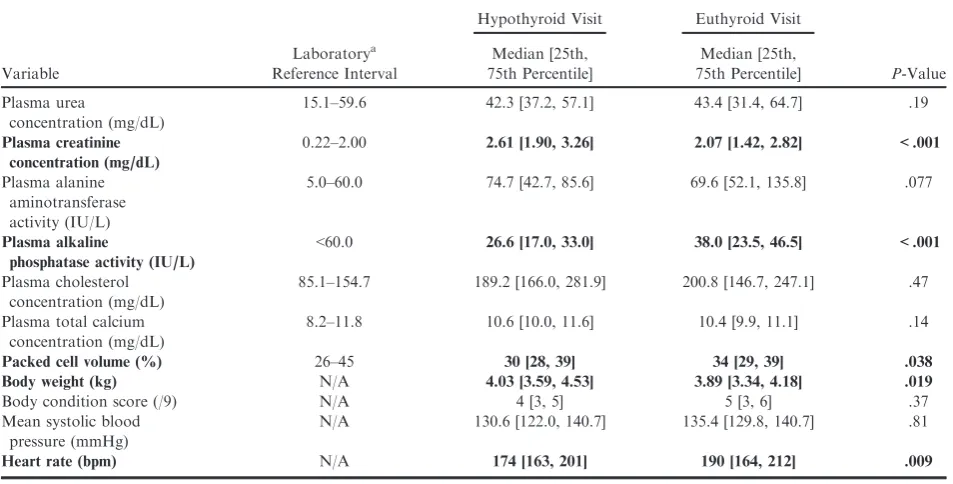
>250lmol/L (the lower limit of IRIS stage 3), 2 of which had concentrations >250 lmol/L at the hypo-thyroid visit, and all other cats had plasma creati-nine concentrations between 140 and 249lmol/L (corresponding to lower and upper limits of IRIS stage 2). Restoration of euthyroidism also resulted in a significant increase in plasma ALP activity, HR, and PCV, and a significant decrease in body weight (Table 1). No significant changes in BCS, SBP, plasma concentrations of urea, cholesterol, total cal-cium, or plasma ALT activity were observed after restoration of euthyroidism (Table 1). Plasma creati-nine concentrations were not correlated (P>.05) with body weight or TT4 at either the hypothyroid or euthyroid visits.
Plasma creatinine concentration (mg/dL)
Hypothyroid Euthyroid 0.5
1.0 1.5 2.0 2.5 3.0 3.5
P<0.001
Discussion
The aim of the present study was to assess the effect of restoring euthyroidism on renal function, using plasma creatinine concentration as a marker of GFR. Thyroid hormone replacement therapy is associated with an improvement in renal function in canine patients with primary hypothyroidism2; however, 1 small previous study reported that restoration of euthy-roidism in radioiodine-treated cats with iatrogenic hypothyroidism and azotemia did not improve GFR.3 In the present study, restoration of euthyroidism in cats with iatrogenic hypothyroidism resulted in a decrease in plasma creatinine concentrations in 18 of 19 cats, and resolution of azotemia in 50% of hypothyroid azo-temic cats. However, restoration of euthyroidism also resulted in a significant decrease in body weight; there-fore, if this was also associated with a reduction in body muscle mass, this could account for the reduction in plasma creatinine concentrations. Body condition score was recorded in the present study, and did not change significantly after restoration of euthyroidism; however, specific muscle condition scoring systems are currently being developed and validated, which might be a more sensitive indicator of changes in body muscle mass. These could be incorporated into future studies to assess the changes in muscle mass that occur after restoration of euthyroidism in cats with iatrogenic hypothyroidism. However, it is likely that these scoring methods will always be insensitive to small changes and hampered by interindividual variability in assessment, making it difficult to detect changes in body weight and body muscle mass accurately.
In addition, dogs with experimentally induced hypo-thyroidism have reduced GFR without significant increases in plasma creatinine concentration, perhaps because of a reduction in endogenous creatinine pro-duction.9 Therefore, it could be hypothesized that iat-rogenic hypothyroidism in cats might also result in decreased endogenous creatinine production, which in turn might cause an overestimation of GFR (based on plasma creatinine concentrations) in these cats. Hence, the severity of renal dysfunction in iatrogenic hypothy-roidism might have been underestimated in the present study. Direct measurement of GFR would be required to determine the true degree of renal dysfunction in cats with iatrogenic hypothyroidism, and to determine if renal function improved after restoration of euthy-roidism; however, this was not performed in the pres-ent study.
In the present study, renal azotemia (defined as doc-umentation of an increased plasma creatinine concen-tration and concurrent USG <1.035) was only confirmed in 8/14 azotemic cats; therefore, the pres-ence of prerenal azotemia, which could have been tran-sient, cannot be excluded in the remaining 6 azotemic cats. Nevertheless, plasma creatinine concentrations decreased after restoration of euthyroidism in all 8 cats with confirmed renal azotemia and 18/19 cats in the entire study cohort; therefore it is unlikely that the presence of transient prerenal azotemia could account for the observed changes in plasma creatinine concen-trations after restoration of euthyroidism.
Previous studies have reported that up to 49% of initially nonazotemic hyperthyroid cats will develop azotemic CKD after treatment,10 which has led to the Table 1. Selected clinicopathologic variables before and after establishment of euthyroidism in 19 cats with iatro-genic hypothyroidism. N/A, not applicable. Wilcoxon signed rank test was used to compare variables between the hypothyroid and euthyroid visits. Variables highlighted in bold were significantly different between the 2 visits (P< .05).
Variable
Laboratorya Reference Interval
Hypothyroid Visit Euthyroid Visit
P-Value Median [25th,
75th Percentile]
Median [25th, 75th Percentile]
Plasma urea
concentration (mg/dL)
15.1–59.6 42.3 [37.2, 57.1] 43.4 [31.4, 64.7] .19
Plasma creatinine concentration (mg/dL)
0.22–2.00 2.61 [1.90, 3.26] 2.07 [1.42, 2.82] <.001
Plasma alanine aminotransferase activity (IU/L)
5.0–60.0 74.7 [42.7, 85.6] 69.6 [52.1, 135.8] .077
Plasma alkaline
phosphatase activity (IU/L)
<60.0 26.6 [17.0, 33.0] 38.0 [23.5, 46.5] <.001
Plasma cholesterol concentration (mg/dL)
85.1–154.7 189.2 [166.0, 281.9] 200.8 [146.7, 247.1] .47
Plasma total calcium concentration (mg/dL)
8.2–11.8 10.6 [10.0, 11.6] 10.4 [9.9, 11.1] .14
Packed cell volume (%) 26–45 30 [28, 39] 34 [29, 39] .038
Body weight (kg) N/A 4.03 [3.59, 4.53] 3.89 [3.34, 4.18] .019
Body condition score (/9) N/A 4 [3, 5] 5 [3, 6] .37
Mean systolic blood pressure (mmHg)
N/A 130.6 [122.0, 140.7] 135.4 [129.8, 140.7] .81
suggestion that hyperthyroid cats could be at increased risk of developing CKD. However, the results of the present study confirm that iatrogenic hypothyroidism is likely to increase plasma creatinine concentration and thus may have overexaggerated the prevalence of azo-temic CKD in hyperthyroid cats in previous studies.
Restoration of euthyroidism resulted in a significant increase in PCV and HR of cats in the present study. These findings suggest that iatrogenic hypothyroidism has a negative effect on hematopoietic function, result-ing in a reduction in red cell mass, and a concurrent negative effect on cardiovascular function, that together might increase morbidity (and thus perhaps mortality) in cats with iatrogenic hypothyroidism. Human patients with hypothyroidism are reported to have a macrocytic hypochromic anemia, which is asso-ciated with a reduced proliferative potential of hema-topoietic stem cells.11 It is possible that a similar pathophysiologic mechanism could account for the reduced PCV that was observed in hypothyroid cats in the present study; however, further studies would be required to confirm this.
Hypothyroid azotemic cats have reduced survival times compared to hypothyroid nonazotemic cats,1 therefore it could be postulated that dose adjustments of antithyroid medication to restore euthyroidism will also improve the survival times of hypothyroid azo-temic cats. Thyroid hormone replacement treatment in human patients with subclinical hypothyroidism atten-uates the decline in renal function of patients with CKD,12 and could therefore also attenuate the decline in renal function in cats with iatrogenic hypothyroid-ism and CKD, thus perhaps increasing the survival time of these cats. However, it has also been suggested that mild hypothyroidism might be a beneficial adapta-tion in human patients with CKD, as hypothyroidism will lead to reduced protein nitrogen turnover and pro-tein catabolism and hence reduced nitrogenous waste load for the kidney to excrete.13 Interestingly, plasma urea concentration did not decrease after restoration of euthyroidism in the present study, despite a concur-rent significant reduction in plasma creatinine concen-trations. This could suggest that iatrogenic hypothyroidism results in a decreased protein nitrogen turnover in cats, which could be beneficial in cats with CKD, although this beneficial effect is likely to be minimal. Alternatively, the lack of reduction in plasma urea concentrations despite a reduction in plasma cre-atinine concentrations could suggest that the reduction in plasma creatinine concentrations was secondary to changes in body weight and body muscle mass rather than changes in GFR. To improve the survival times of cats with CKD, the effect of decreasing nitrogenous waste load in the hypothyroid state would have to be more beneficial than the increase in GFR that would be associated with restoration of the euthyroid state. Prospective randomized, controlled, interventional studies would be required to evaluate the long-term survival of azotemic cats with iatrogenic hypothyroid-ism after restoration of euthyroidhypothyroid-ism; however, they were not performed in the present study as it was not
felt to be ethically justifiable to not adjust the dose of antithyroid medication given to some client-owned azotemic cats with iatrogenic hypothyroidism in light of the current available data.1Nevertheless, these stud-ies would be required to definitively prove that restora-tion of euthyroidism results in improved survival times in azotemic cats with iatrogenic hypothyroidism.
Corrections made after online publication April 28, 2014: cita-tions in the final paragraph of the Discussion section have been updated.
Footnotes
a
IDEXX Laboratories, Wetherby, UK b
Royal Veterinary College Diagnostic Laboratories, North Mymms, Hatfield, UK
Acknowledgment
Conflict of Interest: Authors disclose no conflict of interest.
References
1. Williams TL, Elliott J, Syme HM. Association of iatrogenic hypothyroidism with azotemia and reduced survival time in cats treated for hyperthyroidism. J Vet Intern Med 2010;24:1086– 1092.
2. Gommeren K, van Hoek I, Lefebvre HP, et al. Effect of thyroxine supplementation on glomerular filtration rate in hypo-thyroid dogs. J Vet Intern Med 2009;23:844–849.
3. van Hoek IM, Vandermeulen E, Peremans K, Daminet S. Thyroid stimulation with recombinant human thyrotropin in healthy cats, cats with non-thyroidal illness and in cats with low serum thyroxin and azotaemia after treatment of hyperthyroid-ism. J Feline Med Surg 2010;12:117–121.
4. Wakeling J, Elliott J, Syme H. Evaluation of predictors for the diagnosis of hyperthyroidism in cats. J Vet Intern Med 2011;25:1057–1065.
5. Singh AK, Jiang Y, White T, Spassova D. Validation of nonradioactive chemiluminescent immunoassay methods for the analysis of thyroxine and cortisol in blood samples obtained from dogs, cats, and horses. J Vet Diagn Invest 1997;9:261– 268.
6. Jacobs RM, Lumsden JH, Taylor JA, Grift E. Effects of in-terferents on the kinetic Jaffe reaction and an enzymatic colori-metric test for serum creatinine concentration determination in cats, cows, dogs and horses. Can J Vet Res 1991;55:150–154.
7. Wakeling J, Moore K, Elliott J, Syme H. Diagnosis of hyperthyroidism in cats with mild chronic kidney disease. J Small Anim Pract 2008;49:287–294.
8. Syme HM, Barber PJ, Markwell PJ, Elliott J. Prevalence of systolic hypertension in cats with chronic renal failure at initial evaluation. J Am Vet Med Assoc 2002;220:1799–1804.
9. Panciera DL, Lefebvre HP. Effect of experimental hypothy-roidism on glomerular filtration rate and plasma creatinine con-centration in dogs. J Vet Intern Med 2009;23:1045–1050.
11. Kawa MP, Grymula K, Paczkowska E, et al. Clinical rele-vance of thyroid dysfunction in human haematopoiesis: Biochem-ical and molecular studies. Eur J Endocrinol 2010;162:295–305.
12. Shin DH, Lee MJ, Kim SJ, et al. Preservation of renal function by thyroid hormone replacement therapy in chronic
kid-ney disease patients with subclinical hypothyroidism. J Clin Endocrinol Metab 2012;97:2732–2740.