The Thirty-Third AAAI Conference on Artificial Intelligence (AAAI-19)
Revisiting LSTM Networks for Semi-Supervised
Text Classification via Mixed Objective Function
Devendra Singh Sachan
Petuum IncManzil Zaheer
Carnegie Mellon UniversityRuslan Salakhutdinov
Carnegie Mellon UniversityAbstract
In this paper, we study bidirectional LSTM network for the task of text classification using both supervised and semi-supervised approaches. Several prior works have suggested that either complex pretraining schemes using unsupervised methods such as language modeling (Dai and Le 2015; Miyato, Dai, and Goodfellow 2016) or complicated mod-els (Johnson and Zhang 2017) are necessary to achieve a high classification accuracy. However, we develop a training strat-egy that allows even a simple BiLSTM model, when trained with cross-entropy loss, to achieve competitive results com-pared with more complex approaches. Furthermore, in ad-dition to cross-entropy loss, by using a combination of en-tropy minimization, adversarial, and virtual adversarial losses for both labeled and unlabeled data, we report state-of-the-art results for text classification task on several benchmark datasets. In particular, on the ACL-IMDB sentiment analysis and AG-News topic classification datasets, our method out-performs current approaches by a substantial margin. We also show the generality of the mixed objective function by im-proving the performance on relation extraction task.1
1
Introduction
Text classification is an important problem in natural lan-guage processing (NLP). The task is to assign a document to one or more predefined categories. It has a wide range of applications such as sentiment analysis (Pang and Lee 2008), topic categorization (Lewis et al. 2004), and email filtering (Sahami et al. 1998). Early machine learning ap-proaches for text classification were based on the extraction of bag-of-words features followed by a supervised classifier such as na¨ıve Bayes (McCallum and Nigam 1998) or a linear SVM (Joachims 1998). Later, better word representations were introduced, such as latent semantic analysis (Deer-wester et al. 1990), skipgram (Mikolov et al. 2013), and fastText (Joulin et al. 2017), which improved classification accuracy. Recently, recurrent and convolutional neural net-work (Kim 2014) models were introduced to utilize the word order and grammatical structure. Many complex variations of these models have been proposed to improve the text clas-sification accuracy, e.g. training one-hot CNN (JZ15a;
John-Copyright © 2019, Association for the Advancement of Artificial Intelligence (www.aaai.org). All rights reserved.
1
https://github.com/DevSinghSachan/ssl text classification
son and Zhang 2015a) or one-hot bidirectional LSTM (BiL-STM) network with dynamic max-pooling (JZ16; Johnson and Zhang 2016).
Current state-of-the-art approaches for text classification involve using pretrained LSTMs (DL15; Dai and Le 2015) or complex computationally intensive models (JZ17; John-son and Zhang 2017). DL15 argued that randomly initial-ized LSTMs are difficult to optimize and can lead to worse performance than linear models. Therefore, to improve the performance, they proposedpretrainingthe LSTM with ei-ther a language model or a sequence auto-encoder. How-ever, pretraining or using complicated models can be very time consuming, which is a major disadvantage and may not be always feasible. In this paper, we consider a BiLSTM classifier model similar to the one proposed by DL15 for text classification. For this simple BiLSTM model with pre-trained embeddings, we propose a training strategy that can achieve accuracy competitive with the previous purely su-pervised models, but without the extra pretraining step. We also perform ablation studies to understand aspects of the proposed training strategy that result in an improvement.
Pretraining approaches often use extra unlabeled data in addition to the labeled data. We explore the applicability of such semi-supervised learning (SSL) in our training frame-work, where there is no prior pretraining step. In this re-gard, we propose a mixed objective function for SSL that can utilize both labeled and unlabeled data to obtain further improvement in classification. To summarize, our contribu-tions are as follows:
• We show that with proper model training, using a max-imum likelihood objective with a simple one-layer BiL-STM model (§2) can produce competitive accuracies,
• We propose a mixed objective function that can be applied to text classification tasks (§2),
• On seven benchmark text classification tasks, we achieve new state-of-the-art results despite having a much simpler model, minimal model tuning, and fewer parameters (§4),
LSTMF LSTMF LSTMF
LSTMB LSTMB LSTMB
Max Over Time Linear Softmax
Embedding Lookup Table
awesome movie :) word vectors
bidirectional LSTM concatenated hidden states
class probabilities
logits
pooling layer
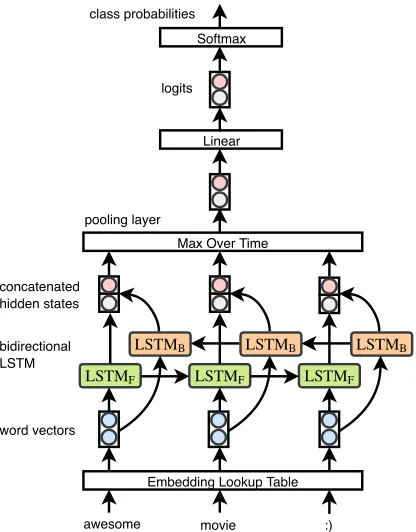
Figure 1: Text classification model architecture.
2
Methods
In this section, we will describe the model architecture, our training strategy, and our proposed mixed objective function. For mathematical notation, we will use bold lowercase to denote vectors, bold uppercase to denote matrices, and low-ercase to denote scalars and individual words in a document.
Model Architecture
The classification model consists of an embedding layer, a bidirectional long short-term memory (BiLSTM) en-coder (Hochreiter and Schmidhuber 1997; Schuster and Paliwal 1997), a max-pooling layer, a linear (fully-connected) layer, and finally a softmax layer (see Figure 1). First, the sequence of words (w1, . . . , wT) contained in a
document are passed through an embedding layer that con-tains a lookup table which maps them to dense vectors (v1, . . . ,vT, vt ∈ Rd). Next, the forward and backward
LSTM of the BiLSTM encoder processes these word vectors in the forward (left to right) and backward (right to left) di-rections respectively, updating corresponding hidden states at each time-step
− →
ht=−−−−−→LSTMF(−−→ht−1,vt), h←−t=←−−−−−LSTMB(←−−ht−1,vt). Next, these hidden state outputs from the forward LSTM (−→ht) and backward LSTM (←ht) are concatenated at every− time-step to enable encoding of information from past and future contexts respectively
ht= [−→ht||←ht−], t∈[1, T], ht∈Rn.
These concatenated hidden states are next fed to the pooling layer that computes the maximum value over time to obtain the feature representation of the input sequence (h∈Rn)
h`= max
t h `
t, t∈[1, T], ∀`∈ {1, . . . , n}. This max-pooling mechanism constrains the model to cap-ture the most useful feacap-tures produced by the BiLSTM en-coder. Next, the linear layer applies an affine transformation to the feature vector to producelogits(d)
d=Wh+b, d∈RK,
whereKis the number of classes,Wis the weight matrix, andbis the bias. Next, these logits are normalized using the
softmaxfunction to give our estimated class probabilities as
p(y=k|x;θ) = exp(dk) PK
j=1exp(dj)
, ∀k∈ {1, . . . ,K},
where(x, y)is a training example andθdenotes the model parameters. For model training, we use supervised and un-supervised loss functions, which are discussed next.
Supervised Training
Let there be m` labeled examples in the training set that are denoted as{(x(1), y(1)), . . . ,(x(m`), y(m`))}, wherex(i)
represents a document’s word sequence,y(i)represents class
label such thaty(i)
∈ {1,2, . . . , K}. For supervised training of the classification model, we make use of two methodolo-gies:maximum likelihoodestimation andadversarial train-ing, which are described next.
Maximum Likelihood (ML) This is the most widely used method to learn the parameters of neural network models from observed data for text classification task. Here, we min-imize the average cross-entropy loss between the estimated class probability and the ground truth class label for all train-ing examples
LML(θ) =− 1
m` m` X
i=1
K X
k=1
1(y(i)=k) logp(y(i)=k|x(i);θ),
where1(; )is an indicator function.
Adversarial Training (AT) Adversarial examples are cre-ated from inputs by small perturbations to mislead the ma-chine learning algorithm. The objective of adversarial train-ing is to construct and give as input adversarial examples during model training procedure to make the model more robust to adversarial noise and thereby improving its gener-alization ability (Goodfellow, Shlens, and Szegedy 2014).
In this work, we make adversarial perturbations to the in-put word embeddings (v= [v1, . . . ,vT]) (MDG16, Miyato, Dai, and Goodfellow 2016). These perturbations (rat) are
estimated by linearizing the supervised cross-entropy loss around the input word embeddings. Specifically, to get the adversarial embedding(v∗)corresponding tov, we use the
L2 norm of the training loss gradient (g) that is computed
by backpropagation using the current model parameters (θˆ)
rat=g/kgk2, whereg=−∇vlogp(y=k|v;θˆ)
where,kis the correct class label,is a hyperparameter that controls the magnitude of the perturbation. We apply adver-sarial loss to only the labeled data. It is defined as
LAT(θ) =− 1
m` m` X
i=1
K
X
k=1
1(y(i)=k) logp(y(i)=k|v∗(i);θˆ).
Unsupervised Training
In this paper, in addition to supervised training, we also experiment with two unsupervised methodologies:entropy minimization and virtual adversarial training. These loss functions when incorporated into the objective function act as effective regularizers during model training. To describe them, we assume that there exists an additionalmuunlabeled
examples in the dataset{x(1), . . . ,x(mu)}.
Entropy Minimization (EM) In addition to supervised cross-entropy loss, we also minimize the conditional entropy of the estimated class probabilities (Grandvalet and Bengio 2004; Miyato et al. 2018). This can also be interpreted as a special case of the missing label problem where the proba-bilityp(y(i) =k
|x(i);θ)signifies a soft assignment of the
ith example to labelk(i.e.soft clustering). Entropy mini-mization loss is applied in an unsupervised manner to both the labeled and unlabeled data.
LEM(θ) =
−1 m
m
X
i=1 K
X
k=1
p(y(i)=k|x(i)) logp(y(i)=k|x(i)),
wherem=m`+muand dependence onθis suppressed.
Virtual Adversarial Training (VAT) As opposed to min-imizing the cross-entropy loss of the adversarial examples in AT, in VAT, we minimize the KL divergence betweenp(v)
andp(v∗), wherev∗=v+rvat. The motivation of using KL
divergence as an additional loss term in the objective func-tion is that it tends to make the loss surface smooth at the cur-rent example (Miyato et al. 2018). Also, computing the VAT loss doesn’t require class labels, so it can be applied to unla-beled data as well. In this work, we follow the approach pro-posed by MDG16 that makes use of the second-order Taylor expansion of distance followed by power iteration method to approximate the virtual adversarial perturbation. First, an i.i.d. random unit vector is sampled for every example from the Normal distribution (d(i)
∼ N(0, I) ∈ Rd) and then
adversarial perturbation computed asξd(i) is added to the
word embeddings, whereξis a hyperparameter
v0(i)=v(i)+ξd(i).
Dataset Train Test K `
ACL-IMDB 25,000 25,000 2 268
Elec 25,000 25,000 2 125
AG-News 120,000 7,600 4 46 DBpedia 560,000 70,000 14 56 RCV1 15,564 49,821 51 120 IMDB 1,490,000 1,070,000 5 280 Arxiv 664,000 443,000 127 153
Table 1: Summary statistics for text classification datasets; K= number of classes;`= average length of a document.
Next, the gradient is estimated from the KL divergence as:
g=∇v0DKL(p(.|v(i);θˆ)kp(.|v0(i);θˆ)).
Virtual adversarial perturbation (rvadv) is generated using the
L2norm of the gradient and added to the word embeddings
r(vati)=g/kgk2
v∗(i)=v(i)+r(vati).
Lastly, virtual adversarial loss can be computed from both the labeled and unlabeled data as:
LVAT(θ) = 1
m
m
X
i=1
DKL(p(.|v(i);θ)kp(.|v∗(i);θ)),
wherem=m`+mu.
Mixed Objective Function
Our proposed mixed objective function combines the above described supervised and unsupervised loss functions using
λML,λAT,λEM, andλVATas hyperparameters
LMIXED=λMLLML+λATLAT+λEMLEM+λVATLVAT.
Training Strategy
We note that there are three main considerations to be taken into account when training the text classifier. First, the knowledge of the entire sequence is essential for good classification performance. Thus, commonly used practice of truncated backpropagation through time (Werbos 1988) is a key limiting factor. One should perform gradient update for the entire text sequence. To prevent out of memory issues that can result from longer sequences, we propose to use dy-namic batch sizethat consists of fixed number of total words per mini-batch. Second, not only we need to use pretrained word embeddings, but we need to finetune them for the spe-cific task. Lastly, we should use a larger vocabulary size and not limit to only high-frequency words. This is because rare or tail words are often strong indicators of the class.
3
Experiments
Dataset Description
In this work, we experiment with seven datasets that are summarized in Table 1.ACL-IMDB(Maas et al. 2011) and
Dataset BSize Vocab
ACL-IMDB 3,000 80,000 5 Elec 2,000 40,000 2 AG-News 2,000 75,000 1 DBpedia 7,500 50,000 1 RCV1 2,000 100,000 2 IMDB 15,000 150,000 5 Arxiv 8,000 100,000 1
Model ACL-IMDB Elec AG-News DBpedia RCV1 IMDB Arxiv
Linear Model (TFIDF + SVM) 9.51 9.16 7.64 1.31 10.68 40.00 34.81
Vanilla LSTM [Dai and Le (2015)] 10.00 – – 13.64 – – –
DocVec [Le and Mikolov (2014)] 11.40 8.95 8.00 2.34 – 44.10 37.40 FastText [Joulin et al. (2017)] 11.34 – 7.50 1.40 – 42.13 33.23
CNN [Kim (2014)] 9.17 8.03 5.92 0.98 10.44 49.53 34.21
oh-CNN [Johnson and Zhang (2015b; 2017)] 7.67 7.14 6.88 0.88 9.17 38.15 35.89 char-CNN [Zhang, Zhao, and LeCun (2015)] – – 9.51 1.55 – – –
LML[Our Method] 6.43 7.40 5.62 0.91 7.78 35.64 31.76
Table 3: Error rates (%) when the model is trained usingLMLand comparison with previous best supervised methods.
Model ACL-IMDB Elec AG-News DBpedia RCV1 IMDB Arxiv
SA-LSTM [Dai and Le (2015)] 7.24 – – 1.19 7.40 – –
LSTM [Miyato, Dai, and Goodfellow (2016)] 5.91 5.40 6.78 0.76 6.68 35.85 30.97 oh-LSTM [Johnson and Zhang (2016; 2017)] 5.94 5.55 6.57 0.84 7.15 37.56 31.17
ULMFit [Howard and Ruder (2018)] 4.60 – 5.01 0.80 – – –
LMIXED[Our Method] 4.32 5.24 4.95 0.70 6.23 34.04 29.95
Table 4: Error rates (%) when the model is trained usingLMIXEDand comparison with previous best semi-supervised methods.
Elec(JZ15a) datasets are widely used for binary sentiment classification of movie reviews and Amazon product reviews respectively while AG-News,DBpedia (Zhang, Zhao, and LeCun 2015), andRCV1(Lewis et al. 2004) are for topic classification of news articles, Wikipedia, and Reuters cor-pus respectively. For the RCV1 dataset, we perform mul-ticlass topic classification based on the second-level topics and construct its training, dev, and test splits in accordance with JZ15a. To show that our proposed method also scales to larger datasets and categories, we also experiment with large-scale datasets of IMDB reviews and Arxiv abstracts that are used for fine-grained sentiment- and topic classifica-tion respectively (Sachan, Zaheer, and Salakhutdinov 2018). We preprocess all the datasets by converting the text to low-ercase and treat all punctuations as separate tokens.
Implementation Details
All of our models were implemented in PyTorch frame-work (Paszke et al. 2017) and were trained on a single GPU. Our experimental setup is common for all the datasets un-less specified otherwise. We use 300D pretrained vectors to initialize the embedding layer. We learn embeddings for the ACL-IMDB, RCV1, IMDB, and Arxiv datasets using
word2vec(Mikolov et al. 2013) and usefastText pre-trained embeddings2 (Mikolov et al. 2018) for all the other
datasets. We use one-layer BiLSTM of size 512D. For regu-larization, we apply dropout (pdrop = 0.5) to word embed-dings and to LSTM’s hidden states. We also use the word dropout strategy in which we randomly set a word to be “UNK” with a probabilitypw = 0.1. For training, we em-ploy SGD using Adam optimizer (Kingma and Ba 2014) (learning rate = 10−3,β
1 = 0,β2 = 0.98,adam = 10−8)
with an exponential learning rate decay scheme. We
per-2
These embeddings were trained on data containing 600B to-kens from Common Crawl (crawl-300d-2M.vec).
form gradient clipping by having a maximum L2 norm of
1. For training, we backpropagate through time over en-tire sequence, i.e. we did not truncate sequence. This differs from DL15 where they perform truncated backpropagation through time for 400 time-steps from the end of a sequence. For semi-supervised training, we experiment with all the objective functions described in §2. ForLMIXED, we include
all the constituent terms withλML,λAT,λEM,λVATset to 1
andξ = 0.1. We want to emphasize that in contrast with MDG16, we do not performembedding layer normalization during AT or VAT objectives, as by including it, we noticed a drop in accuracy during our initial experiments. We select the hyperparameters such as dynamic batch size, vocabulary size, and adversarial perturbation () by cross-validation on the development set. We mention these dataset-specific hy-perparameters in Table 2. For supervised experiments (LML),
we perform training till 20 epochs and for semi-supervised experiments (LMIXED), training is done till 50 epochs. For
ACL-IMDB, Elec, RCV1, IMDB, and Arxiv datasets, we use training and test set as unlabeled data, while for AG-News and DBpedia datasets as their test sets are small, we use only the training set as unlabeled data. During training, we keep the batch size of the unlabeled data the same as that of the labeled data.
4
Results
In this section, we report the classification accuracy on the test set and perform ablation studies for both supervised and semi-supervised training.
Maximum Likelihood Training
In Table 3, we present the error rates of our method and the previous best-published models when training is done using only the maximum likelihood objective (LML). We observe
pre-N Embedding pw BSize H Vocab ACL-IMDB
1 Finetune 0.1 3,000 512 80,000 6.43
2 6.47
Random 7.64 Static 8.17
0.0 6.57
1,000 6.98
256 6.67
1,024 7.05
30,000 7.78
No text preprocessing 8.80
Table 5: Error rates (%) of variations on the BiLSTM model trained usingLMLon the ACL-IMDB dataset. Unlisted
val-ues are identical to those of the first row; N = number of BiLSTM layers;H = LSTM hidden size.
trained embedding weights achieves a very competitive per-formance on all the datasets compared with the more com-plex approaches such as one-hot LSTM (JZ16) or pyrami-dal CNN (JZ17). Specifically, for ACL-IMDB, AG-News, IMDB, and Arxiv datasets, we report much better results than earlier methods. Thus, our proposed model and training strategy enjoy the following advantages: (a) it is very easy to implement using current deep learning frameworks; (b) it re-quires much less training time and GPU memory compared with other complicated models; (c) it entirely avoids com-plex initialization strategies such as pretraining the LSTM weights using a language model; (d) Our results can serve as strong baselines when developing more advanced task-specific models.
To know the importance of various components in the model and training regimen, we perform ablation studies using the ACL-IMDB dataset (see Table 5). We verify that good performance of our model mostly results from fine-tuning the pretrained embeddings, using a larger vocabulary size, and using a carefully preprocessed dataset. We also see that excluding word dropout, smaller-sized LSTM, and lowering the batch size causes a slight drop in performance while using static pretrained or randomly initialized embed-dings or smaller vocabulary size can cause a large drop.
Semi-Supervised Training
For our next set of experiments, we perform training using
LMIXED objective whose results are shown in Table 4. We
observe that the mixed objective improves over maximum likelihood objective and achieves state-of-the-art results on all the seven datasets. Specifically, on the widely used ACL-IMDB dataset, there is a substantial reduction of 26.9% in relative error compared with the previous best-published model of JZ16, which was substantially more complex as they use one-hot encodings of words along with a lot of additional features such as multi-view region embeddings from CNNs and LSTMs. We also want to highlight that, although the model of MDG16 also experiments with ad-versarial and virtual adad-versarial training, our approach per-forms much better compared with them due to our improved
L U λML λAT λEM λVAT ACL-IMDB
1 0 1 0 0 0 6.43
1 0 1 1 0 0 5.96
1 0 1 0 1 0 6.46
1 0 1 0 0 1 5.98
1 0 1 1 1 1 5.68
1 1 1 0 1 0 5.78
1 1 1 0 0 1 5.52
1 1 1 0 1 1 4.47
1 1 1 1 1 1 4.32
Table 6: Error rates (%) for ablation study on the importance of hyperparameters when the BiLSTM model is trained us-ingLMIXEDobjective;L= was labeled data used?U = was
unlabeled data used?
training strategy and the use ofLEMobjective. Similarly, for
the benchmark AG-News dataset, we observe relative error reduction of 26.6% compared with previous state-of-the-art model of JZ17 who use a very deep pyramidal-CNN along with region embeddings. Even on the Elec, DBPedia, and RCV1 datasets, our results present significant improvements over the previous best semi-supervised results. LMIXED
ob-jective also scales well to the dataset sizes, as on the large datasets of IMDB and Arxiv, it outperforms the above men-tioned previous approaches by a substantial margin. We note here that the approach of Howard and Ruder (2018) is not di-rectly comparable with our results as they use a three-layer LSTM model. We discuss the effect of model size in §5.
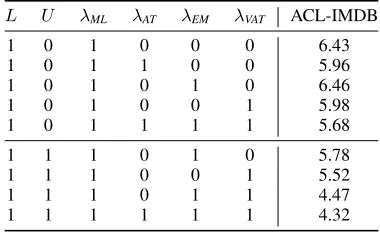
Next, we perform ablation studies when the model is trained usingLMIXEDon the ACL-IMDB dataset and analyze
the contributions of the different component terms present in the objective (see Table 6). First, we observe that when the model is trained usingLMIXEDobjective on both the
la-beled and unlala-beled data, the accuracy on ACL-IMDB dras-tically improves by 33% compared with using only theLML
objective. Second, we also observe that when trained only on labeled data the inclusion ofLATandLVATcan also
sig-nificantly improve the performance. However, LEM alone
doesn’t lead to any significant gains. Furthermore, when
LMIXED is trained with only labeled data, we see 12%
rel-ative increase in accuracy. Finally, when we add unlabeled data to bothLVATandLEM, we see consistent improvements,
thus suggesting that these objective functions complement each other and together improve the overall performance.
5
Analysis
Effect on Word Embeddings
To understand the effect on word embeddings due to train-ing ustrain-ingLML andLMIXED objectives, we show the top-10
query word: good
word2vec ML Objective Mixed Objective
great (0.64) great (0.66) funny (0.73) really (0.61) nice (0.62) well-acted (0.72) decent (0.60) decent (0.58) interesting (0.66) nice (0.59) entertaining (0.56) fine (0.65) ok (0.57) overall (0.55) nice (0.65)
but (0.56) really (0.55) thought-provoking (0.63) pretty (0.56) liked (0.54) decent (0.62)
overall (0.55) lot (0.52) worth (0.60) bad (0.54) enjoyable (0.52) recommend (0.60) movie (0.53) fun (0.51) recommendable (0.60)
Table 7: Top-10 nearest neighbors according to cosine simi-larity (shown in parentheses) for the word “good” computed in the embedding space. “word2vec” refers to the static em-beddings i.e. not finetuned during training.
finetuned using theLMLobjective, the network learns more
meaningful representations and accommodates more posi-tive sentiment words close to the query word ‘good’. More-over, when trained using theLMIXEDobjective, we see that
those words that have a very high correlation with the class label (positive sentimentclass in this case) are clustered to-gether in the embedding space. Our hypothesis is that this factor also contributes to an increase in the overall classifi-cation accuracy.
Model Regularization Effect
0 10 20 30 40 50
Number of Epochs 10−2
10−1 100 101 T raining Loss (log scale) ML AT VAT EM MIXED
0 10 20 30 40 50
Number of Epochs 5 7 10 12 T est Erro r ML AT VAT EM MIXED
Figure 2: (a) Training loss vs. epochs on ACL-IMDB; (b) Test error vs. epochs on ACL-IMDB.
Figure 2a and Figure 2b show the moving average training loss and test error respectively versus the number of epochs on the ACL-IMDB dataset with theLML,LAT,LVAT,LEM,
andLMIXEDobjectives. We can see thatLMLbegins to
over-fit after 5 epochs,LAToverfits after 10 epochs whileLMIXED,
LEM, andLVAT don’t overfit much and thus achieve better
generalization than theLMLandLATobjectives (see in
Fig-ure 2b). Moreover, as LMIXEDandLVAT objectives can use
unlabeled data, their training loss decays gradually. Thus,
LMIXEDobjective while being very effective in performance
is also a very robust model regularizer. On the other hand, from Figure 2b, we can see thatLVAT,LEM, andLMIXEDtake
a long time to converge compared with LML andLAT and
are thus quite slow to train. In our experiments, one epoch of LMIXEDtakes around 20m on GeForce GTX 1080 GPU
and it requires roughly 45 epochs to converge. This is con-siderably slower thanLMLobjective where each epoch takes
around 3m and the overall convergence time is thus 15m for 5 epochs.
Varying Data Size
1 4 7 10 13 16 19 22 25 Number of Training Examples (×103)
3 6 9 12 15 T est Erro r ML AT VAT EM MIXED
5 10 15 20 25 30 35 40 45 50 Number of Unlabeled Examples (×103)
4 5 6 7 8 T est Erro r ML AT VAT EM MIXED
Figure 3: Test Error on ACL-IMDB vs. (a) number of train-ing examples (b) increastrain-ing number of unlabeled examples.
In this setup, we first analyze the test error on ACL-IMDB dataset by feeding the model trained with different objective functions (§2) with an increasing number of training exam-ples (learning curve; see Figure 3a). We observe that all the objective functions converge to lower error rates when train-ing data is increased. We also see that mixed objective model is always optimal (achieves lower test error rate) for any set-ting of the number of training examples.
Next, we analyze the test error on ACL-IMDB dataset by varying the amount of unlabeled data. For this experi-ment, we use additional 50,000 reviews provided with the ACL-IMDB dataset and its 25,000 reviews from test set as unlabeled data. We evaluate the performance of each objec-tive function by linearly increasing the amounts of unlabeled data (see Figure 3b). Initially, increasing the amount of un-labeled data tends to improve the performance ofLVAT,LEM,
and LMIXED. However, we observe that their performance
saturates once 25,000 unlabeled examples are available. Fur-thermore, as the amount of unlabeled data increases, the per-formance tends to degrade sharply. As ACL-IMDB training set also consists of 25,000 examples, from this observation, it can be assumed that to obtain the best performance using
LMIXED, the size of unlabeled and labeled dataset should be
roughly the same. We also note that asLMLandLATare
su-pervised approaches, their performance remains unaffected.
Varying Model Size
128 256 512 768 1024
Hidden Layer Size 4 5 6 7 8 T est Erro r ML AT VAT EM MIXED
1 2 3 4
Number of Hidden Layers 4 5 6 7 8 T est Erro r ML AT VAT EM MIXED
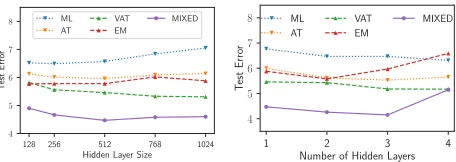
Figure 4: Test error on ACL-IMDB vs. (a) hidden layer size of LSTMs in the BiLSTM with one-hidden layer; (b) num-ber of BiLSTM layers where each LSTM has size of 512.
Sentiment Text
Mixed Objective Training(LMIXED)
Negative This movie is so over-the-top as to be a borderline comedy. Laws of physics are broken. Things explode for no good reason. Great movie to sit down with a six-pack and enjoy. Do not - I repeat DO NOT see this movie sober. You will die horrible death!
Entropy Minimization Training(LEM)
Positive Coming from Oz I probably shouldn’t say it but I find a lot of the local movies lacking that cohesive flow with a weak storyline. This comedy lacks in nothing. Great story, no overacting, no melodrama, just brilliant comedy as we know Oz can do it. Do yourself a favour and laugh till you drop.
Virtual Adversarial Training(LVAT)
Negative The plot seemed to be interesting, but this film is a great dissapointment. Bad actors, a camera moving like in the hands of an amateur. If there was C-movies, this would be a perfect example. A plus for a nice DVD cover though and a great looking female actor.
Table 8: Examples from ACL-IMDB dataset for sentiment classification task that are correctly classified by the method indicated directly above it and incorrectly classified by all the other methods.
hidden state sizes at most 512 units because larger models didn’t give accuracy gains (DL15, JZ16). This is also con-sistent with our observation, as we find that that supervised approaches (LML) do not benefit much from increasing the
model size. However, when using additional loss functions such as the mixed objective, accuracy scales much better with model size (see Figure 4a). Further, we also observe accuracy gains for all methods upon increasing the number of layers in the model (see Figure 4b). Specifically, the er-ror rate ofLMIXEDobjective improves to 4.15% when using a
three-layer deep model. This suggests that larger-sized semi-supervised methods can lead to the development of more ac-curate models for text classification task. However, a four-layer model hurts theLMIXED objective’s performance due
to the training instability ofLEMmethod.
Effect on Prediction Probabilities
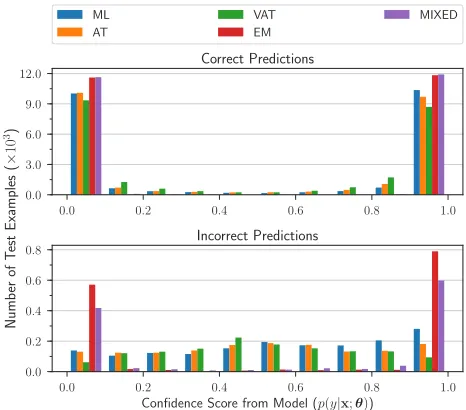
To study the behavior of different methods, we plot a his-togram of the prediction probabilities for both the correct (Figure 5a) and incorrect (Figure 5b) predictions. We ob-serve that for correct predictions all the methods especially
LEM and LMIXED have very sharp and confident
distribu-tion of class probabilities. However, for incorrect predicdistribu-tions onlyLEMhas sharp peaks whileLVAT,LAT, andLML
encour-age the model to learn a smoother distribution.
Ensemble Approach vs Mixed Objective
To understand if the above objectives have complementary strengths, we combine their predicted probabilities with a linear interpolation strategy. Given the output probability for a classkasp(y=k|x), the interpolated probabilitypI(y=
k|x)is calculated as:
pI=αMLpML+αATpAT+αVATpVAT+αEMpEM| X
αi= 1,
whereαi ∈ [0,1]and is chosen based on grid search. This
simple interpolation technique results in an improved error rate of 5.2%. However, the error rate of our proposed mixed objective function is substantially lower (4.3%) thus high-lighting the importance of performing joint training of the model based on different objective functions.
0.0 0.2 0.4 0.6 0.8 1.0 0.0
3.0 6.0 9.0 12.0
Correct Predictions
0.0 0.2 0.4 0.6 0.8 1.0
Confidence Score from Model (p(y|x;θ))
0.0 0.2 0.4 0.6 0.8
Incorrect Predictions
ML AT
VAT EM
MIXED
Numb
er
of
T
est
Examples
(
×
10
3)
Figure 5: Histogram of prediction probabilities on ACL-IMDB test set for the case of (a) correct predictions; (b) in-correct predictions.
Example Predictions
In Table 8, we show some example movie reviews from the test set of ACL-IMDB dataset that are correctly classified by the highlighted method and incorrectly by all the remaining methods. We observe that methods such as LMIXED,LEM,
andLVATthat are based on unsupervised training are able
to correctly classify difficult instances in which the over-all sentiment is determined by the entire sentence structure. This illustrates the ability of these methods to learn complex long-range dependencies.
6
Relation Extraction
predefined semantic “relation category” exists (or doesn’t exist) between a pair ofsubjectandobjectentities present in text. This task also presents specific challenges: the linguis-ticscoverage problemdue to the lack of all possible training examples of a relation class and longer text span between the entities in a sentence.
For the RE task, we use a position-aware attention model (Zhang et al. 2017) that consists of a word em-bedding, position emem-bedding, LSTM, attention layer, linear layer, and softmax layer. We augment the word embeddings by concatenating them with POS tag and NER category em-beddings which is then fed to the LSTM to get hidden states for each word. The position embeddings for a word is de-rived based on the relative distance of the current word from the subject and object entities. Next, the attention layer com-putes the final sentence representation by focusing on both the hidden states and position embeddings. Finally, sentence representation is fed to the linear layer followed by a soft-max layer for relation classification.
We perform experiments using our proposed mixed ob-jective function on two RE datasets:TACREDand SemEval-2010 Task 8 whose statistics are shown in Table 9. The POS and NER tags are computed using the Stanford CoreNLP toolkit.3 Following standard convention, we
re-port the micro-averaged F1 score on TACRED and
offi-cial macro-averaged F1score on SemEval datasets. We
per-formed only a small number of experiments to search for the hyper-parameter values of dropout, embedding size, hid-den layer size, and learning rate on the development set, all other parameters remained the same as the positional atten-tion model of Zhang et al. (2017).4 Our results in Table 10
show that when trained with mixed objective function, our model performs quite well, producing better results than all previously reported models despite the lack of complex task-specific hyper-parameter tuning.
7
Related Work
Neural Network Methods. Neural network models for NLP have yielded impressive results on several benchmark tasks (Collobert et al. 2011; Peters et al. 2018). To learn doc-ument features for text classification task, several methods have been proposed— Kim (2014) uses 1D CNNs, Lai et al. (2015) uses a simple bidirectional recurrent CNN with max-pooling, Zhou et al. (2016) applies 2D max-pooling on top of BiLSTMs, Zhou et al. (2015) investigates a joint CNN-LSTM model, and JZ15a, JZ16, JZ17 apply CNNs, LSTMs, and pyramidal CNNs respectively to one-hot en-coding of word sequences. An alternative approach is to first learn sentence representations followed by combining them to learn document features. To do this, Tang, Qin, and Liu (2015) first apply a CNN or LSTM followed by a gated RNN while Yang et al. (2016) learn the sentence and docu-ment features in a hierarchical manner using a self-attention mechanism.
3
https://stanfordnlp.github.io/CoreNLP/
4
https://github.com/yuhaozhang/tacred-relation
Dataset Train Dev Test % Neg K `
TACRED 68,124 22,631 15,509 79.5% 42 36 SemEval 8,000 – 2,717 17.4% 19 19
Table 9: Summary statistics for RE datasets; % Neg = per-centage of examples with class label of “no relation” be-tween entities;K= number of classes including theno rela-tionclass;`= average length of a sentence in the dataset.
TACRED SemEval-2010
Model P R F1 P R F1
CNN-PEa 70.3 54.2 61.2 82.1 83.1 82.5 SDP-LSTMb 66.3 52.7 58.7 – – 83.7
PA-LSTMc 65.7 64.5 65.1 – – 82.7
Our Method 66.4 67.3 66.8 83.5 84.8 84.1
Table 10: Model performance on TACRED and SemEval datasets; P = Precision; R = Recall; aSantos, Xiang, and Zhou (2015);bXu et al. (2015);cZhang et al. (2017). For fair
comparison, we only report results from models that don’t use ensembling or ranking-based approaches.
Semi-Supervised Learning. SSL approaches can be broadly categorized into three types: multi-view, data aug-mentation, and transfer learning. First, under multi-view learning, the objective is to use multiple views of both the labeled and unlabeled data to train the model. These multi-ple views can be obtained either from raw text (Blum and Mitchell 1998) or from the features (JZ15b). Second, under data augmentation, as the name implies, involves pseudo-augmenting either the features or the labels. For text classifi-cation, Nigam et al. (2000) performed semi-supervised train-ing ustrain-ing na¨ıve Bayes and expectation-maximization algo-rithms and demonstrated substantial improvements in per-formance. MDG16 compute embedding perturbations us-ing adversarial and virtual adversarial approaches to im-prove model training. Third, under transfer learning, the approach of initializing the task-specific model weights by pretrained weights from an auxiliary task is a widely used strategy that has shown to improve the performance in tasks such as text classification (Dai and Le 2015; Howard and Ruder 2018), question-answering (Devlin et al. 2018), and machine translation (Ramachandran, Liu, and Le 2017; Qi et al. 2018).
8
Conclusion
References
Blum, A., and Mitchell, T. 1998. Combining labeled and unlabeled data with co-training. InCOLT.
Collobert, R.; Weston, J.; Bottou, L.; Karlen, M.; Kavukcuoglu, K.; and Kuksa, P. 2011. Natural language processing (almost) from scratch.JMLR.
Dai, A. M., and Le, Q. V. 2015. Semi-supervised sequence learn-ing. InNIPS.
Deerwester, S.; Dumais, S. T.; Furnas, G. W.; Landauer, T. K.; and Harshman, R. 1990. Indexing by latent semantic analysis.JAIST. Devlin, J.; Chang, M.-W.; Lee, K.; and Toutanova, K. 2018. Bert: Pre-training of deep bidirectional transformers for language under-standing.Computing Research RepositoryarXiv:1810.04805. Goodfellow, I. J.; Shlens, J.; and Szegedy, C. 2014. Explaining and harnessing adversarial examples. Computing Research Repository arXiv:1412.6572.
Grandvalet, Y., and Bengio, Y. 2004. Semi-supervised learning by entropy minimization. InNIPS.
Hochreiter, S., and Schmidhuber, J. 1997. Long short-term mem-ory.Neural Computation.
Howard, J., and Ruder, S. 2018. Universal language model fine-tuning for text classification. InACL.
Joachims, T. 1998. Text categorization with support vector ma-chines: Learning with many relevant features. InECML.
Johnson, R., and Zhang, T. 2015a. Effective use of word order for text categorization with convolutional neural networks. InNAACL. Johnson, R., and Zhang, T. 2015b. Semi-supervised convolutional neural networks for text categorization via region embedding. In NIPS.
Johnson, R., and Zhang, T. 2016. Supervised and semi-supervised text categorization using lstm for region embeddings. InICML. Johnson, R., and Zhang, T. 2017. Deep pyramid convolutional neural networks for text categorization. InACL.
Joulin, A.; Grave, E.; Bojanowski, P.; and Mikolov, T. 2017. Bag of tricks for efficient text classification. InEACL.
Kim, Y. 2014. Convolutional neural networks for sentence classi-fication. InEMNLP.
Kingma, D. P., and Ba, J. 2014. Adam: A method for stochastic optimization.Computing Research RepositoryarXiv:1412.6980. Lai, S.; Xu, L.; Liu, K.; and Zhao, J. 2015. Recurrent convolutional neural networks for text classification. InAAAI.
Le, Q., and Mikolov, T. 2014. Distributed representations of sen-tences and documents. InICML.
Lewis, D. D.; Yang, Y.; Rose, T. G.; and Li, F. 2004. Rcv1: A new benchmark collection for text categorization research.JMLR. Maas, A. L.; Daly, R. E.; Pham, P. T.; Huang, D.; Ng, A. Y.; and Potts, C. 2011. Learning word vectors for sentiment analysis. In ACL.
McCallum, A., and Nigam, K. 1998. A comparison of event models for naive bayes text classification. InWorkshop on Learning for Text Categorization, AAAI.
Mikolov, T.; Sutskever, I.; Chen, K.; Corrado, G.; and Dean, J. 2013. Distributed representations of words and phrases and their compositionality. InNIPS.
Mikolov, T.; Grave, E.; Bojanowski, P.; Puhrsch, C.; and Joulin, A. 2018. Advances in pre-training distributed word representations. InLREC.
Miyato, T.; Maeda, S.-i.; Koyama, M.; and Ishii, S. 2018. Vir-tual adversarial training: a regularization method for supervised and semi-supervised learning.IEEE TPAMI.
Miyato, T.; Dai, A. M.; and Goodfellow, I. 2016. Adversarial training methods for semi-supervised text classification. Comput-ing Research RepositoryarXiv:1605.07725.
Nigam, K.; McCallum, A. K.; Thrun, S.; and Mitchell, T. 2000. Text classification from labeled and unlabeled documents using EM.Machine Learning.
Pang, B., and Lee, L. 2008. Opinion mining and sentiment analy-sis.Found. Trends Inf. Retr.
Paszke, A.; Gross, S.; Chintala, S.; Chanan, G.; Yang, E.; DeVito, Z.; Lin, Z.; Desmaison, A.; Antiga, L.; and Lerer, A. 2017. Auto-matic differentiation in pytorch. InNIPS-W.
Peters, M.; Neumann, M.; Iyyer, M.; Gardner, M.; Clark, C.; Lee, K.; and Zettlemoyer, L. 2018. Deep contextualized word represen-tations. InNAACL.
Qi, Y.; Sachan, D.; Felix, M.; Padmanabhan, S.; and Neubig, G. 2018. When and why are pre-trained word embeddings useful for neural machine translation? InNAACL.
Ramachandran, P.; Liu, P.; and Le, Q. 2017. Unsupervised pre-training for sequence to sequence learning. InEMNLP.
Sachan, D. S.; Zaheer, M.; and Salakhutdinov, R. 2018. Investigat-ing the workInvestigat-ing of text classifiers. InCOLING.
Sahami, M.; Dumais, S.; Heckerman, D.; and Horvitz, E. 1998. A bayesian approach to filtering junk E-mail. InWorkshop on Learn-ing for Text Categorization, AAAI.
Santos, C. d.; Xiang, B.; and Zhou, B. 2015. Classifying relations by ranking with convolutional neural networks. InACL.
Schuster, M., and Paliwal, K. 1997. Bidirectional recurrent neural networks.Trans. Sig. Proc.
Tang, D.; Qin, B.; and Liu, T. 2015. Document modeling with gated recurrent neural network for sentiment classification. InEMNLP. Werbos, P. J. 1988. Generalization of backpropagation with appli-cation to a recurrent gas market model.Neural networks.
Xu, Y.; Mou, L.; Li, G.; Chen, Y.; Peng, H.; and Jin, Z. 2015. Classifying relations via long short term memory networks along shortest dependency paths. InEMNLP.
Yang, Z.; Yang, D.; Dyer, C.; He, X.; Smola, A.; and Hovy, E. 2016. Hierarchical attention networks for document classification. InNAACL.
Zhang, Y.; Zhong, V.; Chen, D.; Angeli, G.; and Manning, C. D. 2017. Position-aware attention and supervised data improve slot filling. InEMNLP.
Zhang, X.; Zhao, J.; and LeCun, Y. 2015. Character-level convo-lutional networks for text classification. InNIPS.
Zhou, C.; Sun, C.; Liu, Z.; and Lau, F. C. M. 2015. A C-LSTM neural network for text classification.Computing Research Repos-itoryarXiv:1511.08630.