Implementation of IOT Architecture for SMART HOME using
GSM Technology
Dr.E.N.Ganesh*
*(ECE, Saveetha Engineering College, Chennai )
---
************************
---Abstract:
Today people want the world on their hands, It outlets the revolutions of computing and smart environment. Some technologies like ambient intelligence satisfy the maximum need of smart world but these technologies are not tightly coupled with internet, so the people need another technology extension. Internet of Things (IoT) is an ideal emerging technology to influence the internet and communication technologies. Simply “Internet of Things” connects „living and non living things‟ through „internet‟. Traditionally in the object oriented paradigm everything in the world is considered as an object, but in the IoT paradigm everything in the world is considered as a smart object, and allows them to communicate to each other through the internet technologies by physically or virtually. This paper proposes architecture to enable the users to control and monitor smart devices through internet. It creates an interface between users and smart home by using GSM and internet technologies, or it simply creates GSM based wireless communication from the web server into the smart home. In this architecture the users give commands through web then the users inputs are converted into GSM-SMS commands. These commands are sent to embedded system module (embedded system directly connect with devices) through GSM network, and finally the user commands are parsed and executed by microcontroller to control any electronic objects like home appliances, lights, etc and it sends the acknowledgement. The embedded system module can be placed anywhere in the world and it will be controlled by IoT Agent through GSM network.
Keywords —Internet of Things, Short Message Service, Web Interface, Global system for Mobile Communication, Embedded system and Web Server.
---
************************
---I ---Introduction
In today’s modern and smart trend people expect new devices and new technologies to simplify their day to day life. The innovators and researchers are always trying to find new things to satisfy the people but the process is still infinite. In the early 1990s, Internet connectivity began to proliferate in enterprise and consumer markets, but was still limited in its use because of the low performance of the network interconnects. In the 2000s Internet connectivity became the norm for many applications and today is expected as part of many enterprise, industrial and consumer products to provide access to information. However, these devices are still primarily things on the Internet that require more human interaction and monitoring through apps and interfaces. The objective of IoT is
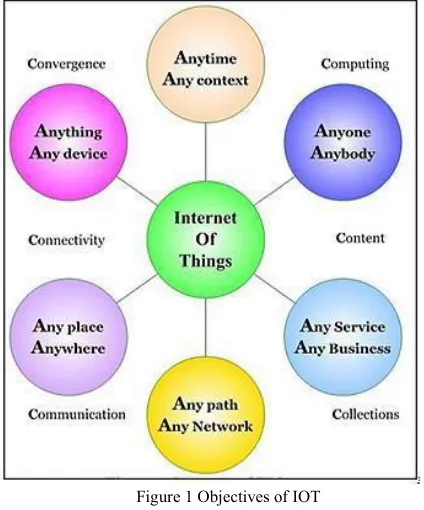
Anything, Anyone, Anytime, Anyplace, Any service and any network [2]. Fig. 1 describes the coupling of C‟s and A‟s. That reveals, people and things can be connected anytime, anyplace, with anyone, ideally by using in any path/network and any service. This implies addressing elements such as Convergence, Content, Collections (Repositories), Computing, Communication, and Connectivity in the context where there is seamless interconnection between people and things and/or between things and things so the A and C elements are present and tightly coupled. This paper proposes a novel architecture of IoT enabled Smart home which is control and monitor smart devices through GSM and Internet Technologies. Normally the smart homes will be conscious about what happens inside a building, mainly impacting three aspects:
Figure 1 Objectives of IOT
1.Resource usage (water conservation and Energy consumption etc), 2.Security
3.Comfort
The user can control or check the status of any resources or enable/disable security options of the smart home. This paper introduces an IoT agent which is brain of this architecture and it controls web server and remote embedded system module. At very short period of time the IoT agent reads the user data from the web server, created a SMS command and it will be sent to remote embedded system module through GSM-SMS. This command will be received by GSM receiving module which is connected with embedded system placed in a remote home. The home appliances and other devices are directly connected and controlled by this embedded system module. The GSM module is inbuilt with IoT agent and embedded system module. After executing the commands the acknowledgement will be sent to user.
If all objects and people in daily life were equipped with identifiers, they could be managed and inventoried by computers. Besides using RFID, the tagging of things may be achieved through such technologies as near field communication, barcodes, QR codes, Mobile Computing, Ambient
Intelligence. [12] Describes the origin and vision of IoT and the paper investigated and analyzed applications, challenges and future trends of IoT. Chonggang Wang et al, broadly discussed the state of the art of IoT. Yin Jie proposed a novel idea of applying IoT technologies to smart home [9]. Alberto M.C et al. proposed architecture for accessing smart home devices through web clients. The paper uses Link Smart Middleware layer to create interface between web server and embedded system unit. The embedded System physically connects with web server and act as a gateway to the devices [3]. Tengfei Zhang, Perumal, T et al. [4,11] introduced new solution to create a interface between user and smart home using GSM and IoT. Ming Wang et al. [5] developed smart central controller to set up a radio frequency 433 MHz wireless sensor and actuator network (WSAN). A series of control modules, such as switch modules, radio frequency control modules, have been developed in the WSAN to control all kinds of home appliances directly. Application servers, client computers, tablets or smart phones can communicate with the smart central controller through a wireless router via a Wi-Fi interface. Yepeng Ni and Sun Yi et al. [6,10] introduced lightweight Wi- Fi–ZigBee wireless home gateway to access smart home devices.
Things technologies. The system includes a ZigBee coordinator node, multiple ZigBee sensor nodes, multiple ZigBee routing nodes, a GSM SMS module, and the management software based on SQL running on the remote control centre PC.
III OVERVIEW OF THE INTERNET OF THINGS.
In the digital world, especially the computer communication starts with sharing data between machine to machine, and it moves to machine to infrastructure, then machine to environment, and machine to people but now internet is everything. The people also want to communicate with all non living things through internet such as home appliances, furniture’s, stationeries, cloths etc.
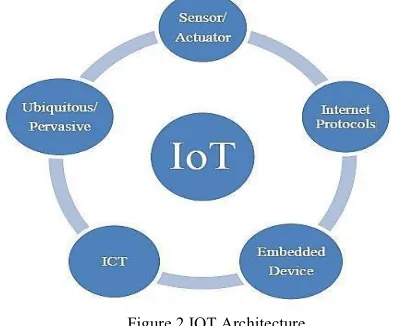
The people already have A lot of technologies to interact with living things but IoT enable to communicate with non living things with comfort Manner. IoT is a convergence of several technologies like ubiquitous, pervasive computing, Ambient Intelligence, Sensors, Actuators, Communications technologies, Internet Technologies, Embedded systems etc. As in Fig. 2.
Figure 2 IOT Architecture
In the architecture, embedded system, sensors and actuators are the physical components which are directly interacting with the users. The users manipulate the data through these components. ICT, ubiquitous/pervasive computing, Internet protocols used to create communication among the devices and manage high end user interactions. According to the IoT architecture the components are further classified into three functional units (Fig. 3). In the IoT architecture, “Internet Oriented” represents internet and its technologies and it act as a
middleware between user and intelligent things and so it’s called as intelligent middleware. Intelligent middleware will allow the creation of a dynamic map of the real/physical world within the digital/virtual space by using a high temporal and spatial resolution and combining the characteristics of ubiquitous sensor networks and other identifiable “things” [2].
Figure 3. Classification of IoT based on functionalities
Figure 4. Functional Integration of IoT
the interfaces for each message, enables things to interact with their surroundings. Hence to make the virtual world comprehensible, there needs to be consistency in messages and it responses. This is enabled through standard interfaces, which is in turn to facilitate interoperability. Simply this phase focuses the functionalities and communications among sensor/actuators, embedded devices and any other smart devices.“Semantic Oriented” is known as “Intelligent Process” which represents knowledge based and decision making processes.
IV IOT ARCHEITECTURE
Today, Global System for Mobile Communication is a vital communication technology and the proposed architecture uses GSM is a primary communication technology between the home and IoT agent. The IoT agent is the core part of this architecture because it manages web server data, SMS command, GSM module interactions and all knowledge based processes (parsing, analysis and creation of SMS commands).
A. Web Users
The web users are common people, this architecture provides them to know the status of the home devices and control (ON or OFF) the devices. The user can send the commands through any web enabled devices like PC, Tablet, iPOD, smart phones or any WAP enabled devices.
B. Web Server
Web server might be a Tomcat, Apache, IIS etc. and it must have internal database. The user data kept in the centralized database and it will read by IoT agent through COM or DCOM, API or any other ODBC. The web server is not involved to parsing and knowledge processes. It belong only request and response to the user and stores the data. The web server have internal timer to refresh the web page to update the status of the smart home devices. The IoT agent also have internal timer to refresh the status of the devices from the embedded module.
C. IoT Agent
The IoT is the software and hardware unit which continuously monitors Web server and GSM module for incoming SMS from smart home. The special SMS has unique structure which is constructed by microcontroller of embedded unit. Once the NEW_MESSAGE_RECEIVED event generated by GSM module the IoT Agent reads newly arrived SMS and check it whether special SMS or not. If it so, it parse and extract the data. The special SMSs are always start and end with special symbol like „#‟, ‟@‟, ‟&‟, etc. and this paper uses „#‟ symbol. After confirming special SMS, the IoT Agent parse the data based on <SPACE> or <ENTER> or whitespaces. For example the incoming SMS Like “#R1L001
1 <enter> R2L002 0 <enter> KL001 0
<enter>HF001 0<enter> HL001 1 #” In this
example agent checks starting character and then parse SMS into actual parameters like
R1L001 : 1 R2L001 : 0 KL001 : 0 HF001 : 0 HL001 : 1
Figure 5. Smart Home architecture for IoT
In the SMS commands R represents Rooms, L represents Lights, K represents Kitchen, H represents Hall. If the device is ON or OFF, represents 1 or 0. This parsed data will be executed by IoT Agent and Micro Controller.
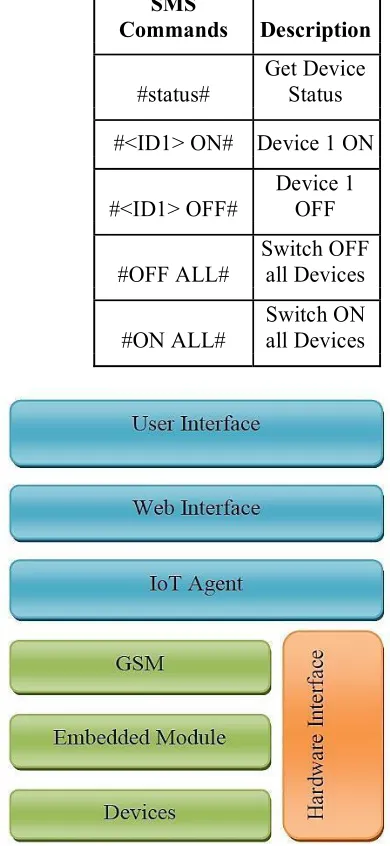
Some Sample SMS Commands are:
SMS
Commands Description
#status# Get Device Status
#<ID1> ON# Device 1 ON
#<ID1> OFF# Device 1 OFF
#OFF ALL# Switch OFF all Devices
#ON ALL#
Switch ON all Devices
Figure 6. Smart Home based functional interface using IoT
The agent also continuously monitors web server for user inputs. The user can see the status of the home devices through the web client. The IoT agent maintains the current status of the devices and keeps updating with short period of time. The web server keeps refreshing the data to the web client. Whenever the user changes the status or gives any data, this will be updated in the web server internal database then the IoT agent will handle the routine process based on the data.
V GSM INTERFACE
The GSM receiving module acts as a gateway in communication module. This receiving module can be a GSM/GPRS modem, mobile phone or any SMS send/receiving device. This device connects with computer and microcontroller through USB or serial cable. The AT (Attention) commands are used to manage connections and to send/receive the SMS. The IoT Agent will receive SMS by NEW_MESSAGE_RECEIVED event. When new SMS arrived the agent parsed and process what the SMS command tells. Sample AT Commands are “AT+CMGL” List messages, “AT+CMGR” Read message, “AT+CMGS” Send message.
The interface module communicates with GSM device and reads the SMS and checks whether It is a special SMS or ordinary SMS. If it is a command SMS, this commands are executed by IoT Agent.
A. Measurement of SMS Transfer Rate
In GSM architecture SMS messages are carried on either SD-CCH or SACCH depending on the use of the traffic channel. When the TCH (Traffic Channels) is not allocated, i.e., no voice call or data transfer are in progress, but the short message is carried on the SDCCH (stand alone dedicated control channel). In this architecture the GSM module does not commit TCH but it does dedicate to send SMS only. So it always uses SDCCH to send SMS. Basically the SMS delivery is based on network, location and time.
Let λsms, λι and λv be the arrival rates for SMS message, Location updation and voice call setup respectively. The arrival rate of this aggregate traffic that uses SDCCH channels is given by
λ
c
= λ
sms
+ λι + λν
(1)=/ ×
μ
+/×
μ
+/×
μ
(2)VI SMART DEVICE INTERFACE
The interface between devices and embedded system is established by physical connection using cables.
A. Microcontroller
An easy way to comply with the conference paper formatting requirements is to use this document as a template and simply type your text into it.
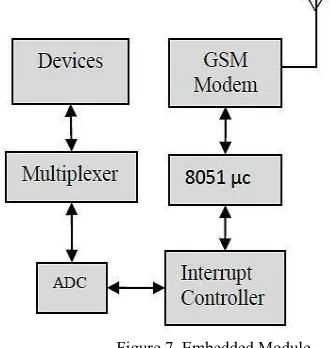
Figure 7. Embedded Module
Microcontroller (μс) is the brain of this module because it controls the entire devices in the smart home directly. Whenever the new SMS is received in GSM modem μс reads the message and execute. The μс reads the device status and values. Then it constructs the special structured SMS and sends it to IoT Agent through GSM network. The μс uses AT (Attention) commands
to access GSM modem. In this proposed architecture the μс can support Xn devices and
one GSM module. The μс creates interface with GPS and GSM components through RS232 protocol.
VII CONCLUSIONS
The paper presents a web based architecture for IoT using GSM for the implementation of smart home applications and GSM based design of smart home controlling system. Prototype operates for data gathering and transmission using GSM-SMS and preliminary test prove that the developed prototype is capable to monitor and control devices in the deployed environment and has several advantages in term of fast delivery, zero data lose, low cost, flexibility, user friendliness and energy efficiency. The established GSM network is a highly efficient and the average SMS deliver time is 3.5 sec. It is important to note the following attributes of the application: the user interfaces are simple and intuitive. In future this architecture will be extend to implement with video streaming of home activities using GSM-MMS and RTMP protocol and improve the security of the data transmission and authentication process.
REFERENCES
[1] P. Magrassi, T. Berg, “A World of Smart Objects”, Gartner research report R-17-2243, 12 August 2002.
[2] White Paper: “Internet of Things Strategic Research Roadmap”, Antoine de Saint-Exupery, 15 sep. 2009.
[3] Souza, Alberto M.C. Amazonas, Jose R.A. “A Novel Smart Home Application Using an Internet of Things Middleware”, Proceedings of 2013 European Conference on Smart Objects, Systems and Technologies (SmartSysTech), pp. 1-7, June 2013.
[4] Perumal, T, Ramli, A.R, Chui Yew Leong, “Design and implementation of SOAP-based residential management for smart home systems”, IEEE Transactions on Consumer Electronics, 54 (2008) 453-459.
[5] Ming Wang, Guiqing Zhang, Chenghui Zhang, Jianbin Zhang, Chengdong Li. “An IoT-based appliance control system for smart homes”, Fourth International Conference onIntelligent Control and Information Processing (ICICIP), pp. 744-747, June 2013.
[6] Yepeng Ni, Fang Miao, Jianbo Liu, Jianping Chai. “Implementation of Wireless Gateway for Smart Home”, Communications and Network, pp. 16-20, 2013.
[7] Kelly, S.D.T., Suryadevara, N.K. ; Mukhopadhyay, S.C. “Toward the Implementation of IoT for Environmental Condition Monitoring in Homes”, Sensors Journal, IEEE, 13 (2013) 3846-3853.
[8] Yuanxin Lin, Rui Kong, Rongbin She and Shugao DengResearch, “Design and Implementation of Remote/Short-range Smart Home Monitoring System Based on ZigBee and STM32”, Journal of Applied Sciences, Engineering and Technology, 5 (2013) 2792-2798
[10] Sun Yi, Xu Chengwen, “The research of Bridge state monitoring system based on IOT technology”, IEEE International Conference on Advanced Management Science (ICAMS), 3 (2010) 87-90.
[11] Tengfei Zhang, Qinxiao Li, Fumin Ma, “Remote control system of smart appliances based on wireless sensor network”, Control and Decision Conference (CCDC), Guiyang, pp. 3704-3709, May 2013.