EXPERIMENTAL SALICYLATE INTOXICATION
I. Comparison of Exchange Transfusion, Intermiftent
Peritoneal Lavage, and Hemodialysis as
Means for Removing Salicylate
J. A. James, M.B., M.R.C.P., Lewis Kimbell, B.S., and William T. Read, M.D. Department of Pediatrics, the University of Texas Southwestern Medical School, Dallas, Texas
S ALICYLATE INTOXICATION is the common
est form of medicinal poisoning in the United States and accounted for at least 389 deaths in children under 15 during the years
1952-1956.' In such severe cases prompt treatment aimed at removing absorbed sali cylate from the body may be lifesaving, and good clinical results have recently been reported following the use of exchange transfusion,2@ peritoneal lavage with albu
mm5 or nonprotein-containing 7
and hemodialysis.8b0 Equally satisfactory clinical results have been claimed with methods designed to promote renal excre tion of salicylate by infusion of sodium bi carbonate,h1,12 acetazoleamide,13 and alka line tris buffer (THAM).――5The problem of choosing optimal therapy from a multi plicity of recommended methods together with tile well-known difficulties involved in evaluating therapy in poisoned human subjects prompted the present studies, which were designed to test the relative efficiencies of these various modes of treat ment under experimental conditions. The present paper concerns exchange transfu sion, peritoneal lavage, and hemodialysis. The resultsof investigationsintothe effi ciency of renal excretion of salicylate will be reported in a subsequent paper.
METHODS
Fasting mongrel dogs weighing from 4 to 19 kg were given 125 mg/kg of salicylate intravenously in the form of sodium sali cylate. Following an equilibration period (usually 1-2 hours) the selected procedure was begun under pentobarbital anesthesia and was continued for 4 hours. The fol lowing techniques were used.
Exchange Transfusion
Experimental animals were cross
matched against donor dogs. Exchange transfusion was carried out through the fe moral vein with use of 10-cc increments, according to the usual procedure. Assuming blood volume in the dog to be 80 ml/kg, the exchanges represented 1.7 to 3.1 blood volumes. The effluent was collected in ACD solution to facilitate measurement of salicy late in the whole blood.
Peritoneal Lavage
Peritoneal lavage was carried out with standard commercial equipment. °The cath eter was inserted into the peritoneum un der direct vision. Ten milligrams of hep arm was added to tile infusate to promote free return flow through tue catheter. Two dialyses were carried out, each lasting 2 hours. Samples of blood and infusate were taken at hourly intervals. The solutions used were as follows:
a) 2 X 500 ml 5% human albumint (2 animals)
b) 2 X 500 ml 5% human albumint plus
150 ml 10% dextrose (2 animals)
c) 2 X 1,000 ml commercial dialysis solu
tion°(4animals)
d) 2 X 500 ml commercial dialysis solu
tion* (4 animals)
At the end of each procedure the pen toneum was opened widely and the ani mal was decanted to assure removal of any residual intraperitoneal fluid.
° Peridial and administration equipment supplied courtesy of Cutter Laboratories, Berkeley, Cali
fornia.
f Albumisol, supplied courtesy of Merck Sharp
and Dohme, West Point, Pennsylvania.
PEDIATRICS, March 1962
ADDRESS: (J.A.J.) 5323 Harry Hines Boulevard, Dallas 35.
Fxperiinent.
JI elg/lt
of Dog
(kg).
b@quzlzbratwn Time
(hr).
Duration of Exchange
(hr),
J ofiiinc Exchanged
(ml)Pla.@,na
Salicylate%
Do.@e
Ileinosed by Transfusion%
Dose Excreted in UrineBefore
(iitg/1()() ml)After(ing/lO() nil)1
2 3
49.50
10.4 9.5
6.41.25
2.1 3.0
1.53.0
3.75
2.5
3.01,390
1,390 1,415
1,58022.9
35.6 29.7
30.213.8
18.1 16.0
11.917.3
15.6 13.3
22.8.
14.7
11.2
ARTICLES 443
TABLE I
EXCIIANGE TRANSFUSION
Hemodialysis
The McNeill-Collins dialyzer° was used for hemodialysis.16 Blood flow through the dialyzer ranged from 150 to 180 ml per minute with a dialysate flow of 2,700 ml per minute. The dialysate bath (10 1) was changed hourly.
The animals were sacnified at the end of each study. Bladder urine was collected from some of the animals.
Salicylate in plasma, whole blood and dialysate was measured by the method of Brodie et al,Ir with use of chloroform to extract salicylate.―' Urine samples were first refluxed for 3 hours with 10 N HC1 fol lowed by 15 N NaOH to destroy all con
jugates of salicylate.19
RESULTS
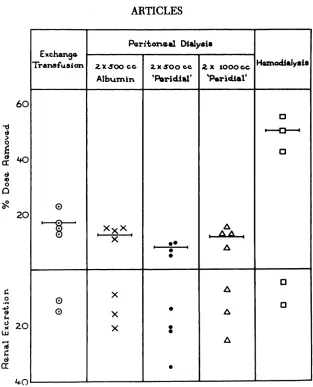
All animals developed some hyperpnea following salicylate administration, but other symptoms of intoxication did not ap pear. The experimental results are sum marized in Tables I through III and in Fig urel.
Exchange Transfusion (Experiments 1-4, Table I)
In these studies the time elapsing be tween salicylate injection and the start of exchange transfusion, the duration of the exchange transfusion, and the amount of blood exchanged varied as shown in Table I. The amount of salicylate removed by the transfusions ranged from 13.3 to 22.8% of the injected dose, the highest recovery being
° Warren E. Collins, Inc., 535 Huntington Ave nue, Boston 15, Massachusetts.
obtained in a small animal (Experiment 4) in which over three blood volumes were ex changed during a 3-hour procedure. Urine salicylate excretion during the study period was measured in two animals and repre sented 14.7 and 11.2% of the injected dose. The plasma salicylate concentration de creased on the average by 49% during the procedures.
Peritoneal Lavage (Experiments 5-16, Table II)
In the first two animals (Experiments 5 and 6) two 2-hour lavages with 500 ml albu mm were performed, with recoveries of 10.8 and 14.4% of the injected dose. Twenty one per cent of the dose was recovered in the urine of one of these animals. In these experiments drainage from the penitoneal catheter accounted for only 60 to 70% of the volume infused, and the excess was not found in the peritoneal cavity at autopsy. In order to test further the likelihood that albumin had been absorbed across the penitoneal membrane, a further experiment was carried out in which an anesthetized control animal was given 175 ml of 5% a!-bumin into the penitoneum. Six hours later the abdomen was opened and only 60 ml could be recovered. In this experiment and in the others, the total protein concentra tion (Biuret method) in the fluid removed was similar to that in the infusate, indicat ing that water and albumin had both been absorbed.
ExperimentWeight of Dog (kg)Equilibration Time (hr)Fluid UsedPlasma Salicylate% Dose Removed by Dialysis% @ in UrineBefore
(mg/lOU ml)After(mg/lOO ml)5 6 7 8 9 10 11 12 13 14 15 169.5 4.1 8.2 10.0 11.4 19.8 11.4 7.7 10.0 10.0 8.9 11.81.75 2.0 2.5 1.75 1.0 1.0 1.2 1.0 1.5 1.25 1.0 1.02X500ml albumin “¿ 2XSOOml +10% glucose “¿ 2X500ml Peridial “¿ “¿ “¿ 2X1,000ml Peridial “¿ “¿ “¿34.9 21.7 29.0 37.6 32.8 39.5 36.5 39.1 31.5 37.1 .. 38.023.6 15.4* 18.3 29.0 21.9 24.6 24.0 22.4 21.4 24.3 .. 26.810.8 14.4 14.1 14.8 7.6 5.4 8.9 9.4 14.6 12.9 13.0 8.421.3 .. 16.4 8.8 20.6 13.9 22.1 35.0 .. 23.9 6.5 14.4
was achieved. The amounts of salicylate re moved in these two experiments were 14.1 and 14.8% of the injected (lose in the dialy sate and 16.4 and 8.8% in the urine. Since the recoveries were similar in all the ani mals receiving albumin, they have been grouped together in Figure 1.
Four studies (Experiments 9-12) were carried out with 2 X 500 ml commercial dialysis solution. The recoveries in these experiments ranged from 5.4 to 9.4% of the injected dose with urinary excretion of 13.9 to 35%. The explanation for the very large urinary excretion of salicylate in Experi ment 12 is not apparent. Over half of the total was excreted during the hour of equili bration following salicylate injection when urinary pH was 7.1.
Four studies (Experiments 13-16) were performed with 2 X 1,000 ml of protein free commercial dialysis solution. Complete recovery of tile infused fluid was obtained. Tile salicylate removed in the dialysate ranged from 8.4 to 14.6% of the injected dose, and the urinary excretion was 6.5 to 23.0%.
The average decrease in plasma salicylate
concentration was 31% in Experiments 5-8,
38% in Experiments 9-12, and 32% in Ex
periments 13-16. Efficient renal excretion appears to account for most of the decrease in plasma level in Experiments 9-12.
Hemodialysis (Experiments 17-19,
Table Ill)
The amount of salicylate removed by 4 hours of dialysis in three animals ranged from 42 to 55% of the dose injected. Urine recoveries in these studies were 3.9 and 12.3% of the injected dose. Plasma salicylate concentration decreased by an average of 66% during these procedures.
COMMENT
If a lethal dose of salicylate has been in gested, it must be removed before irreversi ble celiular derangement occurs. Optimal treatment, therefore, involves removal of the maximum amount of salicylate with the minimum of delay. However, since fatal
cases are the exception, the ideal treatment
should also have a wide margin of safety;
it should be technically simple to carry out
and should be suitable for use in children
of all ages. None of the techniques used in
this study fulfill all of these criteria.
TABLE II
PERITONEAL LAVAGE
ExchangG
TransfusionPeri@onq@a1
DialysisHQmodMlyslsz
xsoo cc
A1bui@@1nax
@ @
‘¿PGrldial'X
1000 @
‘¿Psiridial'0
@r'X@X
I x ‘¿â€¢â€¢
I •¿ I
.£@
,AA,0
-D--@
00
0X @<
x•
:
•¿t@
t@
t@0
0
0
-@
C) ‘¿C
w
20
20
ExperimentWeight of Dog
(kg)Equilibration Time
(hr)Duration
of Dialysis
(hr)Plasma
Salicylate%
Dose Removed by
Dial@jns%
Dose
Excreted
in UrineBefore
(mg/100 ml)After(mg/1(K) ml)17
18 198.6
11.3 10.02.25
1.25 1.54
4 432.2
34.0 29.66.4
11.0 14.355.4
49.3 41.6..
3.9 12.3 ARTICLES
FIG. 1. Efficiency of various procedures in removing salicylate. 60
-d
@40
The technique of exchange transfusion is familiar to most pediatricians, and the present studies suggest that a significant amount of salicylate can be removed by this procedure. To obtain worthwhile re coveries, however, at least two blood vol umes need to be exchanged, which makes
the procedure lengthy and tedious. Sensi tization reactions, hypocalcemia, and circu latory disturbances may occur, which would be particularly serious in an oliguric pa tient. It is our impression that exchange transfusion is probably less desirable than the other two procedures for clinical use.
TABLE III
It has been known since 1914 that he modialysis was a highly efficient method for removing salicylate.20 The recoveries in the present experiments (42-55% of the injected dose) are similar to those achieved by En gel and Metcalfe,21 who reported 51% mean
recovery in five dogs with use of a different type of dialyzer. Apparently a considerable fraction of the plasma salicylate is freely dialyzable at high concentrations. The com pact McNeill-Collins dialyzer, requiring an extracorporeal circulation of only 200 ml,
has obvious applicability to the pediatric age
group, although hemodialysis in infants is still generally impracticable.
Intermittent peritoneal lavage is a much
simpler technique than hemodialysis and is applicable to children of any age.7 The rate of removal of salicylate is, however, considerably slower; in the present studies about one-fourth as much was removed in 4 hours, an “¿efficiencyratio―similar to that
observed by Maxwell et al.22 in uremic pa
tients treated by peritoneal lavage and by hemodialysis. Etteldorf et
@ have
claimed that the efficiency of peritoneal lavage can be significantly increased by using albumin as the lavage fluid; our ob servations tend to support this view, since the recovery of salicylate from the periton eum was consistently greater in the animals receiving albumin than in those receiving an equal amount of nonprotein solution. Doubling the volume of nonprotein solution made the recoveries about equal. The trans peritoneal absorption of albumin observed in these studies was not unexpected since albumin and other large molecules are readily absorbed from the peritoneum in rats.24
The value of these procedures in the treatment of clinical poisoning cannot be accurately gauged from these acute experi ments. It is interesting, however, that the excretion of salicylate in the urine some times exceeded that removed by peritoneal lavage or exchange transfusion. Subsequent experiments have confirmed the efficiency of renal removal of salicylate when appro priate fluid therapy is used. Correction of
dehydration and electrolyte deficits is re quired in all patients with salicylate poi soning, and the additional methods of treat ment described are no substitute for correc tive fluid therapy; their use actually tends to make the planning of replacement ther apy more difficult. These considerations suggest that additional procedures should be used when (and perhaps only when) oliguria or cardiac failure make vigorous fluid therapy undesirable. Hemodialysis ap pears to be the treatment of choice for such patients, while peritoneal lavage, because of its simplicity and feasibilty in the age group most frequently poisoned, seems to merit further trial.
SUMMARY
Exchange transfusion, hemodialysis and peritoneal dialysis with albumin and con ventional dialysis solutions was carried out in dogs following the administration of a standard dose of sodium salicylate intra venously. Hemodialysis was the most effi cient method of removing salicylate, about 50% of the dose injected being removed dur ing a 4-hour period. Exchange transfusion and peritoneal lavage were considerably less efficient. Peritoneal lavage with 5% albumin solution was more effective than lavage with an equal volume of conven tional dialysis solution, but absorption of albumin from the peritoneum took place unless additional dextrose was added to the solution. The amount of salicylate excreted in the urine during the period of study sometimes exceeded that removed by pen toneal dialysis or exchange transfusion. Some clinical implications of these studies are discussed.
REFERENCES
1. Cann, H. M., Heyman, D. S., and Verhulst, H. L.: Control of accidental poisoning: a progress report. J.A.M.A., 168:717, 1958. 2. Done, A. K., and Otterness, L. J.: Exchange
transfusion in treatment of oil of wintergreen (methyl salicylate) poisoning. PEDIATRICS, 18:80, 1956.
A case of methyl salicylate intoxication treated by exchange transfusion. J.A.M.A.,
165:1563, 1957.
4. Rentsch, J. B., Bradley, A., and Marsh, S. B.:
Two cases of salicylate intoxication success
fully treated by exchange transfusion. J. Dis. Child., 98:778, 1959.
5. Etteldorf, J. N., et al.: Intermittent peritoneal
dialysis using 5% albumin in the treatment of salicylate intoxication in children. J.
Pediat., 58:226, 1961.
6. Elliot, G. B., and Crichton, J. U.: Peritoneal dialysis in salicylate intoxication. Lancet, 2:840, 1960.
7. Segar, W. E., Gibson, R. K., and Rhamy, R.:
Peritoneal dialysis in infants and small chil dren. PEDIATRICS, 27:603, 1961.
8. Doolan, P. D., et al.: Acetylsalicylic acid in
toxication: proposed method of treatment. J.A.M.A., 146: 105, 1951.
9. Schreiner,G. E., et al.:Specifictherapy for
salicylism. New Engi. J. Med., 253:213,
1955.
10. Spritz, N., et al.: The use of extracorporeal hemodialysis in treatment of salicylate in toxication in a two-year old. PEDIATRICS, 24: 540, 1959.
11. Oliver,T. K., and Dyer, M. E.: The prompt
treatment of salicylism with sodium bi
cabonate. J. Dis. Child., 99:555, 1960.
12. Whitten, C. F., Kesaree,N. M., and Goodwin,
J. F.: Managing salicylate poisoning in chil dren. J. Dis. Child., 101:178, 1961. 13. Feuerstein, R. C., Finberg, L., and Fleishman,
E.: The use of acetazoleamide in the therapy of salicylate poisoning. PEDIATRICS,25:215, 1960.
14. Clark, L. C.: Transactions of the American
Society for Artificial Internal Organs, Vol.
VI, 1960. Quoted by Strauss and Nahas: Proc. Soc. Exp. Biol. Med., 105:348, 1960. 15. Israels, S., and Davies, H. : The effects of tris
hydroxymethyl amino methane (THAM) on
renal excretion of salicylate (Abstract). J. Dis. Child., 102:118, 1961.
16. MacNeil, A E.., et al.: Unusual hemolytic trans fusion reaction with renal failure treated by hemodialysis. J.A.M.A., 161:1630, 1956.
17. Brodie, B. B., Udenfriend, S., and Cobum,
A. F. : The determination of salicylic acid in plasma. J. Pharm. Exp. Ther., 80:114,
1944.
18. Smith, P. K., et al.: Studies on the pharma
cology of salicylates. J. Pharm. Exp. Ther.,
87:237, 1946.
19. Dalgaard-Mikkelsen,S.: On the renalexcretion
of salicylate. Acta Pharmacol. Toxicol., 7:
243, 1951.
20. Abel, J. J., Rowntree, L. G., and Turner, B. B.: On the removal of diffusible substances from the circulating blood of living animals by
dialysis. J. Pharm. Exp. Ther., 5:275,
1913-14.
21. Engel, H. P., and Metcalfe, J. 0.: Extracorpo real dialysis in treatment of salicylate intoxi cation in dogs. Arch. Internat. Pharmaeo
dynamie Therapie, 120:31, 1959.
22. Maxwell, M. H., et al: Peritoneal dialysis. J.A.M.A., 170:917, 1959.
23. Ettledorf, J. N., et al.: Intermittent peritoneal dialysis in treatment of experimental salicy
lateintoxication.J.Pediat.,56:1, 1960.
24. Baxter, J. H., and Cotzias,G. C.: Effectsof
proteinuria on the kidney: proteinuria, renal
enlargement and renal injury consequent on
protracted parenteral administration of pro tein solutions in rats. J. Exp. Med., 89:643,
1962;29;442
Pediatrics
J. A. James, Lewis Kimbell and William T. Read
Removing Salicylate
Transfusion, Intermittent Peritoneal Lavage, and Hemodialysis as Means for
EXPERIMENTAL SALICYLATE INTOXICATION: I. Comparison of Exchange
Services
Updated Information &
http://pediatrics.aappublications.org/content/29/3/442 including high resolution figures, can be found at:
Permissions & Licensing
http://www.aappublications.org/site/misc/Permissions.xhtml entirety can be found online at:
Information about reproducing this article in parts (figures, tables) or in its
Reprints
1962;29;442
Pediatrics
J. A. James, Lewis Kimbell and William T. Read
Removing Salicylate
Transfusion, Intermittent Peritoneal Lavage, and Hemodialysis as Means for
EXPERIMENTAL SALICYLATE INTOXICATION: I. Comparison of Exchange
http://pediatrics.aappublications.org/content/29/3/442
the World Wide Web at:
The online version of this article, along with updated information and services, is located on
American Academy of Pediatrics. All rights reserved. Print ISSN: 1073-0397.