SAMJ
F
ORUM
682
Background
The Burden of Disease (BoD) Reduction Project1 of the Western Cape Department of Health reviewed risks for violence-related injury and best practice interventions for potential application.2
Violence claims an estimated 1.6 million lives worldwide, with 90% of these in low- to- middle-income countries.3 This reflects a fraction of the impact of violence on global health and development.4 In South Africa, most violence is interpersonal rather than self-inflicted and homicide rates are 5 - 8 times higher than the global average for females and males respectively.5 In the Western Cape, interpersonal violence accounted for 12.9% of premature mortality and was the second leading cause of years of life lost (YLL) after HIV/ AIDS, which accounted for 14.1% of YLL in 2000. Western Cape mortality rates were higher than national rates for males per hundred thousand (129 v. 115), and females (25 v. 21).6
Data for the Western Cape province and the literature on risk factors for interpersonal violence were reviewed with a view to providing policy makers with an inventory of appropriate interventions.
Violence was defined as ‘The intentional use of physical force or power, threatened or actual, against oneself, another person, or against a group or community, that either results in or has a high likelihood of resulting in, injury, death, psychological
harm, mal-development or deprivation’,7 and the focus of the BoD was interpersonal violence, which is typologically categorised into family and intimate partner violence and community violence.
Risks were conceptualised as biological, behavioural, societal and structural following the ecological approach1 and the relevant literature was reviewed.
The National Injury Mortality Surveillance System (NIMMS) provided all homicides in the City of Cape Town and Stellenbosch8 and the published reports of the Crime, Information and Analysis Centre of the South African Police Services also informed the aggregate data pool for analysis.9 The BoD project prioritised upstream risk factors and interventions, which refer to more upstream societal and structural levels further up the causal chain that typically fall within sectors other than health.
Risks for violence
Age and sex are the principal biological risks. Young males are at greater risk for being both perpetrators and victims of violence. In the Western Cape there were 5.2 violent male deaths for every female death,6 compared with the world average of 3.4.3 Males are more frequently victims of physical abuse, and females of sexual abuse. Children constitute a large proportion of victims of violence generally and of sexual abuse in particular. Homicide rates increase sharply from 15 years of age, peaking in the 25 - 29 and 35 - 39 age groups for men and women.10
Behavioural risks include individual personality characteristics and quality of social interactions, which are aggravated by environmental factors. Problems experienced in early childhood development can predispose youth to violent behaviour. Diet and exposure to lead may affect aggressiveness and risk-taking behaviour.11-13
Alcohol and substance abuse impact primarily at the behavioural level. Their association with trauma is well documented. Alcohol accounts for 25 - 50% of intentional injuries,14-17 and is associated with child abuse18-19 and intimate partner violence.20-22 In South Africa, more than half of the patients presenting with injuries from violence tested positive for alcohol use.23 Although testing for other drugs is not routinely performed, urinalysis among arrestees in Cape Town, Durban and Johannesburg found that 46% of murder suspects tested positive for drugs.24
I
SSUES INP
UBLICH
EALTHInterpersonal violence prevention: Prioritising interventions
R Matzopoulos, J E Myers, B Bowman, S Mathews
Richard Matzopoulos is a specialist scientist at the Crime, Violence and Injury Lead Programme, and is affiliated to the Medical Research Council, the UNISA Institute for Social and Health Sciences, and the School of Public Health and Family Medicine of the University of Cape Town.
Jonny Myers is Director of the Occupational and
Environmental Health Research Unit, and Professor in the School of Public Health and Family Medicine of the University of Cape Town.
Brett Bowman is a Senior Researcher in the Department of Psychology at the University of the Witwatersrand.
Shanaaz Mathews is a Senior Scientist in the Gender and Health Research Unit of the Medical Research Council of South Africa.
SAMJ
F
ORUM
684
Societal risks begin with early childhood family relationships including large numbers of children, poor family cohesion, single-parent households, young mothers, partner and child abuse and harsh punishment.25-31 The quarter of men from three municipalities in the Western Cape who had witnessed abuse of their mothers were three times more likely than other men to abuse their partner.32 Half of all murdered women were killed by an intimate partner.33
Having violent friends is a risk factor for violent and sexually abusive behaviour and substance abuse among youth.34-35 The Western Cape has a history of social problems associated with street crime and gangs comprising an estimated 90 000 members.36 Gangs, drugs and guns with high violence rates engender violence in residents with negative mental health implications for children.30,37-38
Reduced social capital, manifesting as low social cohesion and interpersonal mistrust, has been linked with higher violence rates.39 A Cape Town study found that 32% of pregnant adolescents and 18% of matched controls had been forced into their first sexual experience.40 In the Lavender Hill and Steenberg area in Cape Town, over 70% of a sample of primary school children reported exposure to violence.41
Traditional gender and social norms are associated with female partner abuse.42 Such abuse is aggravated by the existence of armed conflict where violence is an everyday occurrence.43-44 In the Western Cape, 38% of male and 8% of female learners admitted carrying weapons in the past 6 months45 and a national study on female homicide showed that women were at 10 times greater risk of being killed if their intimate partners owned legal guns (Shanaaz Mathews – unpublished data).
The effectiveness of policing for social protection and crime and violence prevention is a key determinant of violence levels. Effective apprehension of murder suspects and state provision of social protection institutions and welfare have substantial violence-reducing impacts.46-48
Structural risks include major social and demographic changes, e.g. migration, urbanisation or modernisation, which are associated with increased youth violence.27, 49-51 Poverty, deprivation and inequality are strong determinants.34,49,51-53 The highest homicide rates in Cape Town are recorded in Nyanga (132/100 000) and Khayelitsha (120) compared with the Southern Suburbs (60).54 Homogeneous, poor populations have lower rates of violence than heterogeneous socio-economically unequal populations.55-56 Urban living with increased
population density, degraded environment, overloaded infrastructure, and stretched service delivery is associated with higher injury and homicide rates.57
Proven and promising interventions
The hierarchy of anti-violence interventions prioritises sustainable upstream primary preventive interventions
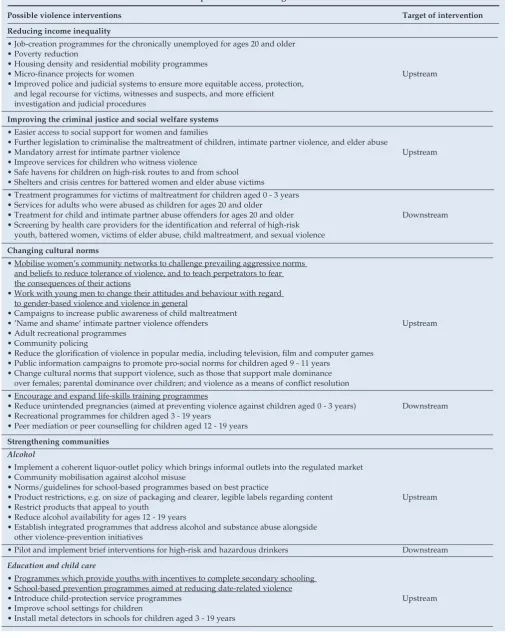
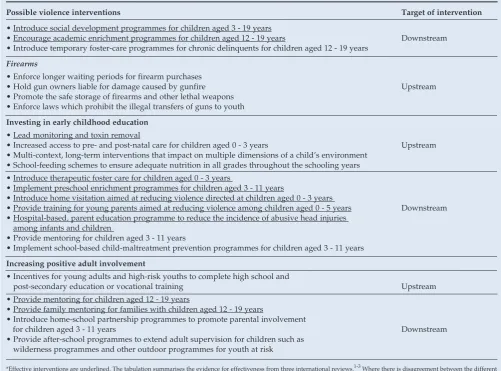
(reducing deprivation and inequality and early education), rather than purely downstream interventions (behaviour change via policing and law enforcement); however, the latter remain critically important. Strategies include reducing income inequality and social deprivation; improving criminal justice and social welfare systems resources; changing cultural norms to promote gender equality and respect for the elderly while challenging negative norms associating violence with masculinity, racism or sexism; strengthening communities through reducing alcohol availability and improving child care facilities; investing in early childhood education; and increasing positive adult involvement in the monitoring and supervision of children and adolescents.34 A summary of feasible
interventions for the Western Cape is presented in Table I. Interventions aimed at individuals and relationships are more prevalent, affordable, feasible and evaluable. The evidence is typically for knowledge and attitude changes rather than injury reduction.58 Community and societal violence prevention strategies are less common with relatively little evidence for their effectiveness, but nevertheless hold great promise. Effectiveness is difficult to measure owing to rarity of outcomes and complexity of causal pathways.
The need for an intersectoral approach
In Bogota, Colombia, a violence prevention programme partnering local government and academic institutions included social development, political empowerment, enhanced social cohesion and substantial investments in the enhancement of public spaces, transportation, policing and the criminal justice system, resulting in dramatic decreases in rates of interpersonal violence over a 10-year period. The homicide rate dropped to a quarter of 1994 levels by 2003. A key success factor was the programme’s institutionalisation within the municipality and hence its sustainability through changes in government, unlike a similar but failed intervention in another city, Cali.59
SAMJ
F
ORUM
[image:3.637.62.576.161.800.2]686
Table I. Potential interventions in the Western Cape Province for a range of risk factors*
Possible violence interventions Target of intervention
Reducing income inequality
• Job-creation programmes for the chronically unemployed for ages 20 and older • Poverty reduction
• Housing density and residential mobility programmes
• Micro-finance projects for women Upstream
• Improved police and judicial systems to ensure more equitable access, protection, and legal recourse for victims, witnesses and suspects, and more efficient investigation and judicial procedures
Improving the criminal justice and social welfare systems
• Easier access to social support for women and families
• Further legislation to criminalise the maltreatment of children, intimate partner violence, and elder abuse
• Mandatory arrest for intimate partner violence Upstream
• Improve services for children who witness violence
• Safe havens for children on high-risk routes to and from school • Shelters and crisis centres for battered women and elder abuse victims • Treatment programmes for victims of maltreatment for children aged 0 - 3 years • Services for adults who were abused as children for ages 20 and older
• Treatment for child and intimate partner abuse offenders for ages 20 and older Downstream
• Screening by health care providers for the identification and referral of high-risk youth, battered women, victims of elder abuse, child maltreatment, and sexual violence
Changing cultural norms
• Mobilise women’s community networks to challenge prevailing aggressive norms and beliefs to reduce tolerance of violence, and to teach perpetrators to fear the consequences of their actions
• Work with young men to change their attitudes and behaviour with regard to gender-based violence and violence in general
• Campaigns to increase public awareness of child maltreatment
• ’Name and shame‘ intimate partner violence offenders Upstream
• Adult recreational programmes • Community policing
• Reduce the glorification of violence in popular media, including television, film and computer games • Public information campaigns to promote pro-social norms for children aged 9 - 11 years
• Change cultural norms that support violence, such as those that support male dominance over females; parental dominance over children; and violence as a means of conflict resolution
• Encourage and expand life-skills training programmes
• Reduce unintended pregnancies (aimed at preventing violence against children aged 0 - 3 years) Downstream • Recreational programmes for children aged 3 - 19 years
• Peer mediation or peer counselling for children aged 12 - 19 years
Strengthening communities
Alcohol
• Implement a coherent liquor-outlet policy which brings informal outlets into the regulated market • Community mobilisation against alcohol misuse
• Norms/guidelines for school-based programmes based on best practice
• Product restrictions, e.g. on size of packaging and clearer, legible labels regarding content Upstream
• Restrict products that appeal to youth
• Reduce alcohol availability for ages 12 - 19 years
• Establish integrated programmes that address alcohol and substance abuse alongside other violence-prevention initiatives
• Pilot and implement brief interventions for high-risk and hazardous drinkers Downstream
Education and child care
• Programmes which provide youths with incentives to complete secondary schooling • School-based prevention programmes aimed at reducing date-related violence
• Introduce child-protection service programmes Upstream
• Improve school settings for children
SAMJ
F
ORUM
688
and evaluation are important factors in driving long-term investment, ensuring effectiveness and enabling replication of successful programmes. Evaluation should, wherever possible, include the measurement of behaviour change and actual changes in injury rates.
1. Myers JE, Naledi NT. Western Cape Burden of Disease Reduction Project: Overview of the Report. Cape Town: University of Cape Town on behalf of the Provincial Department of Health, 2007. http://www.capegateway.gov.za/Text/2007/10/cd_volume_1_overview_and_executive_ summaries180907.pdf (accessed 12 December 2007).
2. Matzopoulos RG, Mathews S, Bowman B, Myers JE. Violence Risk Factor Review and Intervention Analysis: Decreasing the Burden of Injury from Violence. Cape Town: University of Cape Town on behalf of the Provincial Department of Health, 2007. http://www. capegateway.gov.za/Text/2007/10/cd_volume_5_violent_and_traffic_injury_revised_190907. pdf (last accessed 12 December 2007).
3. Mathers CD, Inoue M, Guigoz Y, Lozano R, Tomaskovic L. Statistical annex. In: Krug EG, Dahlberg LL, Mercy JA, Zwi AB, Lozano R, eds. World Report on Violence and Health. Geneva:
4. Matzopoulos RG, Bowman B, Butchart A. Violence, health, and development. In: Violence Prevention in Low- and Middle-Income Countries: Finding a Place on the Gobal Agenda. Workshop Summary, by the Institute of Medicine. Washington, DC: National Academies Press, 2008: 201-246.
5. Norman R, Matzopoulos RG, Groenewald P, Bradshaw, D. The high burden of injuries in South Africa. Bull World Health Organ 2007; 85(9): 695-701.
6. Bradshaw D, Nannan N, Laubscher R, et al. South African National Burden of Disease Study 2000: Estimates of Provincial Mortality. Cape Town: Medical Research Council, 2004. http:// www.mrc.ac.za/bod/estimates.htm (accessed 15 September 2007).
7. WHO Global Consultation on Violence and Health 1996. Violence: A Public Health Priority. Document WHO/EHA/SPI.POA.2. Geneva: World Health Organization, 1996.
8. Matzopoulos RG, ed. A Profile of Fatal Injuries in South Africa: 6th Annual Report of the National Injury Mortality Surveillance System, 2004. Cape Town: Crime, Violence and Injury Lead Programme, Medical Research Council/University of South Africa, 2005.
9. South African Police Services. South African Crime Statistics. 2007. http://www.issafrica.org/ index.php?link_id=24&tmpl_id=3&slink_id=2489&link_type=12&slink_type=12 (accessed 5 February 2008).
10. Prinsloo M. Cape Town. In: Matzopoulos RG, ed. A Profile of Fatal Injuries in South Africa 2003: Fifth Annual Report of the National Injury Mortality Surveillance System (NIMSS). Cape Town: Crime, Violence and Injury Lead Programme, Medical Research Council/University of South Africa, 2004.
Table I (continued). Potential interventions in the Western Cape Province for a range of risk factors*
Possible violence interventions Target of intervention
• Introduce social development programmes for children aged 3 - 19 years
• Encourage academic enrichment programmes for children aged 12 - 19 years Downstream
• Introduce temporary foster-care programmes for chronic delinquents for children aged 12 - 19 years
Firearms
• Enforce longer waiting periods for firearm purchases
• Hold gun owners liable for damage caused by gunfire Upstream
• Promote the safe storage of firearms and other lethal weapons • Enforce laws which prohibit the illegal transfers of guns to youth
Investing in early childhood education
• Lead monitoring and toxin removal
• Increased access to pre- and post-natal care for children aged 0 - 3 years Upstream
• Multi-context, long-term interventions that impact on multiple dimensions of a child’s environment • School-feeding schemes to ensure adequate nutrition in all grades throughout the schooling years • Introduce therapeutic foster care for children aged 0 - 3 years
• Implement preschool enrichment programmes for children aged 3 - 11 years
• Introduce home visitation aimed at reducing violence directed at children aged 0 - 3 years
• Provide training for young parents aimed at reducing violence among children aged 0 - 5 years Downstream
• Hospital-based, parent education programme to reduce the incidence of abusive head injuries among infants and children
• Provide mentoring for children aged 3 - 11 years
• Implement school-based child-maltreatment prevention programmes for children aged 3 - 11 years
Increasing positive adult involvement
• Incentives for young adults and high-risk youths to complete high school and
post-secondary education or vocational training Upstream
• Provide mentoring for children aged 12 - 19 years
• Provide family mentoring for families with children aged 12 - 19 years
• Introduce home-school partnership programmes to promote parental involvement
for children aged 3 - 11 years Downstream
• Provide after-school programmes to extend adult supervision for children such as wilderness programmes and other outdoor programmes for youth at risk
*Effective interventions are underlined. The tabulation summarises the evidence for effectiveness from three international reviews.1-3 Where there is disagreement between the different sources as to the strength of evidence, the most recent source is favoured. The criteria for effectiveness included: evaluations using a strong research design; evidence of a significant prevention effect; evidence of a sustained effect (i.e. the effect extends beyond the duration of the programme); and replication of a programme with demonstrated preventive effects across different settings. The remaining interventions were described as ‘promising’ in that they had been evaluated with a strong design and had some evidence of effectiveness, but required further testing.
1. Butchart A, Phinney A, Check, P, Villaveces A. Preventing Violence: A Guide to Implementing the Recommendations of the World Report on Violence and Health. Geneva: World Health Organization, 2004.
2. Dahlberg LL, Butchart A. State of the science: violence prevention efforts in developing and developed countries. International Journal of Injury Control and Safety Promotion 2005; 12(2): 93-104.
[image:4.637.63.565.164.535.2]SAMJ
F
ORUM
690
11. Gesch CB, Hammond SM, Hampson SE, Eves A, Crowder MJ. Influence of supplementary vitamins, minerals and essential fatty acids on the antisocial behaviour of young adult prisoners. Br J Psychiatry 2002; 181: 22-28.
12. Schoenthaler SJ, Amos S, Doraz W, Kelly M, Muedeking G, Wakefield J. The effect of randomized vitamin-mineral supplementation on violent and non-violent antisocial behavior among incarcerated juveniles. Journal of Nutritional and Environmental Medicine 1997; 7: 343-352.
13. Nevin R. How lead exposure relates to temporal changes in IQ, violent crime, and unwed pregnancy. Environ Res 2000; 83(1): 1-22.
14. Parry CDH, Dewing S. A public health approach to addressing alcohol-related crime in South Africa. African Journal of Drug and Alcohol Studies 2006; 5(1): 41-56.
15. Shultz JM, Rice DP. Quantifying the disease impact of alcohol with ARDI software. Public Health Reports 1991; 106: 443-450.
16. Single E, Robson L, Xie X, Rehm J. The economic costs of alcohol, tobacco and illicit drugs in Canada in 1992. Addiction 1998; 93: 983-998.
17. English DR, Holman CDJ, Milne E, Hulse G, Winter MG. The Quantification of Drug Caused Morbidity and Mortality in Australia. 1995 ed. Canberra: Commonwealth Department of Human Services and Health, 1995.
18. Strauss M, Gelles RJ. Societal change and change in family violence from 1975 to 1985 as revealed by two national surveys. Journal of Marriage and the Family 1986; 48: 465-479. 19. Golding JM. Sexual assault history and limitations in physical functioning in two general
population samples. Research in Nursing and Health 1996; 19: 33-44.
20. Black DA, Schumacher JA, Smith Slep AM, Heyman RE. Partner, child abuse risk factors literature review. 1999 [monograph online]. National Network of Family Resiliency, National Network for Health. http://www.nnh.org/risk (accessed 29 June 2006).
21. Rodgers K. Wife assault: the findings of a national survey. Juristat Service Bulletin 1994; 14: 1-22.
22. Johnson H. Dangerous Domains: Violence Against Women in Canada. Ontario: International Thomson Publishing, 1966.
23. Plüddemann A, Parry C, Donson H, Sukhai A. Alcohol use and trauma in Cape Town, Durban and Port Elizabeth, South Africa: 1999- 2001. Injury Control and Safety Promotion 2004; 11: 265-267.
24. Parry CDH, Plüddemann A, Louw A, Legget T. The 3-metros study of drugs and crime in South Africa: findings and policy implications. Am J Drug Alcohol Abuse 2004; 30: 167-185. 25. National Research Council. Understanding Child Abuse and Neglect. Washington: National
Academy of Sciences Press, 1993.
26. Klevens J, Bayon MC, Sierra M. Risk factors and the context of men who physically abuse in Bogota, Colombia. Child Abuse and Neglect 2000; 24: 323-332.
27. Mercy, JA, Butchart, A, Farrington D, Cerda M. Youth violence. In: Krug EG, Dahlberg LL, Mercy JA, Zwi AB, Lozano R, eds. World Report on Violence and Health. Geneva: World Health Organization, 2002.
28. McCord J. Some child-rearing antecedents of criminal behavior in adult men. J Pers Soc Psychol 1979; 37: 477-1486.
29. Eron LD, Huesmann LR Zelli A. The role of parental variables in the learning of aggression. In: Pepler DJ, Rubin KJ, eds. The Development and Treatment of Childhood Aggression. Hilssdale: Lawrence Erlbaum, 1991.
30. Farrington DP. Predictors, causes, and correlates of male youth violence. In: Tonry M, Moore MH, eds. Youth Violence. Chicago: University of Chicago Press, 1998.
31. Madu SN, Peltzer K. Risk factors and child sexual abuse among secondary students in the Northern Province (South Africa). Child Abuse and Neglect 2000; 24: 259-268.
32. Abrahams N, Jewkes R, Laubscher R, Hoffman M. Intimate partner violence: prevalence and risk factors for men in Cape Town, South Africa. Violence and Victims 2005; 21(2): 247-264. 33. Matthews S, Abrahams N, Martin LJ, Van der Merwe L, Jewkes R. Every six hours a woman
is killed by her intimate partner: a national study on female homicide in South Africa. MRC Policy Brief 2004. Cape Town: Medical Research Council, 2004.
34. Butchart A, Phinney A, Check P, Villaveces A. Preventing Violence: A Guide to Implementing the Recommendations of the World Report on Violence and Health. Geneva: World Health Organization, 2004.
35. Dunkle K, Koss M, Levin J, Nduna M, Jama N, Sikweyiya Y. Rape perpetration by young, rural South African men: Prevalence, patterns and risk factors. Soc Sci Med 2006; 63(11): 2949-2961.
36. Cerda M. A profile of gangs. In: Krug EG, Dahlberg LL, Mercy JA, Zwi AB, Lozano R, eds.
World Report on Violence and Health. Geneva: World Health Organization, 2002.
37. Thornberry TP, Huizinga D, Loeber R. The prevention of serious delinquency and violence: implications from the program of research on the causes and correlates of delinquency. In: Howell JC, Hawkins JD, Wilson J, eds. Sourcebook on Serious, Violent, and Chronic Juvenile Offenders. Thousand Oaks, Calif.: Sage, 1995.
38. Ensink K, Robertson B, Zissis C, Leger P. Posttraumatic stress disorder in children exposed to violence. S Afr Med J 1997; 87(11): 1533-1537.
39. Wilkinson RG, Kawachi I, Kennedy BP. Mortality, the social environment, crime and violence.
Sociology of Health and Illness 1998; 20: 578-597.
40. Jewkes R, Vundule C, Maforah F, Jordaan E. Relationship dynamics and adolescent pregnancy in South Africa. Soc Sci Med 2001; 52(5): 733-744.
41. Van der Merwe AP, Dawes AD. Prosocial and antisocial tendencies in children exposed to community violence. Southern African Journal of Child and Adolescent Mental Health 2000; 12: 19-27.
42. Heise L, Garcia-Moreno C. Violence by intimate partners. In: Krug EG, Dahlberg LL, Mercy JA, Zwi AB, Lozano R, eds. World Report on Violence and Health. Geneva: World Health Organization, 2002.
43. Counts DA, Brown J, Campbell C. Sanctions and Sanctuary. Boulder: Westview Press, 1992. 44. Moore H. The problem of explaining violence in the social sciences. In: Harvey P, Gow P, eds.
Sex and Violence. London: Routledge, 1994.
45. Medical Research Council. Umthente Uhlaba Usamila: The First South African National Youth Risk Behaviour Survey. Cape Town: Medical Research Council, 2002.
46. Fajnzylber P, Lederman D, Loayza N. Inequality and Violent Crime. Washington: World Bank, 1999.
47. Pampel FC, Gartner R. Age structure, socio-political institutions, and national homicide rates.
European Sociological Review 1995; 11: 243-260.
48. Messner SF, Rosenfeld R. Political restraint of the market and levels of criminal homicide: a crossnational application of institutional anomie theory. Social Forces 1997; 75: 1393-1416. 49. United Nations Office on Drugs and Crime. Why Fighting Crime Can Assist the Development of
Africa: Rule of Law and the Protection of the Most Vulnerable. Vienna: UNODC, 2005. 50. Burton P, Du Plessis A, Leggett T, Louw A, Mistry D, Van Vuuren H. National Victims of
Crime Survey: South Africa 2003. Pretoria: Institute for Security Studies, 2004.
51. Messner SF. Research on cultural and socioeconomic factors in criminal violence. Psychiatr Clin North Am 1988; 11: 511-525.
52. Sampson RJ, Raudenbush SW, Earls F. Neighbourhoods and violent crime: a multilevel study of collective efficacy. Science 1997; 277: 918-924.
53. Krahn H, Hartnagel TF, Gartrell JW. Income inequality and homicide rates: cross-national data and criminological theories. Criminology 1986; 24: 269-295.
54. Groenewald P, Bradshaw D, Daniels J, et al. Cause of death and premature mortality in Cape Town, 2001-2004. 2007. Cape Town: University of Cape Town, on behalf of the Provincial Department of Health (in press). http://www.capegateway.gov.za/Text/2007/6/cd_ volume_2_mortality_surveillance.pdf (accessed 12 December 2007).
55. Kawachi I, Kennedy BB, Lochner K, Pothrow-Smith D. Social capital, income inequality and mortality. Am J Public Health 1997; 87(9): 1491-1498.
56. Szwarcwald CL, Leal MC. The threat in Brazilian youth lives: the dimension of the mortality by firearms. In: National Commission on Population and Development. Youths and Public Policies. Brasilia: National Commission on Population and Development, 1998.
57. Santosa SM, Barcellosa C, Sa´ Carvalhob M. Ecological analysis of the distribution and socio-spatial context of homicides in Porto Alegre, Brazil. Health and Place 2006; 12: 38-47. 58. Dahlberg LL, Butchart A. State of the science: violence prevention efforts in developing and
developed countries. International Journal of Injury Control and Safety Promotion 2005; 12(2): 93-104.