2016
Induced Subgraph Saturated Graphs
Craig M. Tennenhouse
University of New England, [email protected]
Follow this and additional works at:https://digitalcommons.georgiasouthern.edu/tag Part of theDiscrete Mathematics and Combinatorics Commons
This article is brought to you for free and open access by the Journals at Digital Commons@Georgia Southern. It has been accepted for inclusion in Theory and Applications of Graphs by an authorized administrator of Digital Commons@Georgia Southern. For more information, please contact [email protected].
Recommended Citation
Tennenhouse, Craig M. (2016) "Induced Subgraph Saturated Graphs,"Theory and Applications of Graphs: Vol. 3 : Iss. 2 , Article 1. DOI: 10.20429/tag.2017.030201
Abstract
A graph G is said to be H-saturated if G contains no subgraph isomorphic to H
but the addition of any edge between non-adjacent vertices in G creates one. While induced subgraphs are often studied in the extremal case with regard to the removal of edges, we extend saturation to induced subgraphs. We say that G is induced H -saturated ifGcontains no induced subgraph isomorphic to H and the addition of any edge toG results in an induced copy ofH. We demonstrate constructively that there are non-trivial examples of saturated graphs for all cycles and an infinite family of paths and find a lower bound on the size of some induced path-saturated graphs.
1
Introduction
In this paper we address the problem of graph saturation as it pertains to induced graphs, in particular paths and cycles. We begin with some background and definitions, and complete Section 1 with statements of the main theorems. In Section 2 we demonstrate that there are non-trivial induced saturated graphs for an infinite family of paths, and prove lower bounds on the number of edges in possible constructions. We continue on to demonstrate results regarding induced cycles in Section 3 and claws in Section 4.
A number of results were discovered using the SAGE mathematics software [11], an open source mathematics suite.
Throughout we use Kn to denote the complete graph on n vertices, Cn the cycle on n vertices, Kn,m the complete bipartite graph with parts of order n and m, and Pn the path on n vertices. All graphs in this paper are simple, and by G we mean the complement of the graph G. If u, v are nonadjacent vertices in G then G+uv is the graph Gwith edge uv
added. Given graphsG and H the graph join G∨H is composed of a copy of G, a copy of
H, and all possible edges between the vertices of G and the vertices ofH. The graph union
G∪H consists of disjoint copies ofGandH. The graphkH consists of the union ofk copies of H. In particular a matching is a collection of pairwise disjoint edges, denoted kK2. The
order n(G) and size e(G) of G are the numbers of its vertices and edges, respectively. A vertexv in a connected graphGis acut vertex if its removal results in a disconnected graph. If G has no cut vertex then it is 2-connected, and a maximal 2-connected subgraph of G is a block. Note that a cut edge is also a block.
For simple graphs G and H we say that G is H-saturated if it contains no subgraph isomorphic to H but the addition of any edge from G creates a copy of H. We refer to G
as the parent graph. The study of graph saturation began when Mantel and students [9] determined the greatest number of edges in aK3-free graph onn vertices in 1907, which was generalized by Tur´an in the middle of the last century [12] to graphs that avoid arbitrarily large cliques. Erd˝os, Hajnal, and Moon then addressed the problem of finding the fewest number of edges in a Km-saturated graph [3]. In particular, they proved the following theorem.
Theorem 1.1. For m ≥ 3 and n ≥ m, the unique smallest graph on n vertices that is
Km-saturated is Km−2∨Kn−m+2. This graph contains m−22
Since then, graph saturation has been studied extensively, having been generalized to many other families of graphs, oriented graphs [7], topological minors [5], and numerous other properties. A comprehensive collection of results in graph saturation is available in [4].
Given a graph G and a subset X of vertices of G, the subgraph induced by X is the graph composed of the vertices X and all edges in G among those vertices. We say that a subgraphH ofGis an induced subgraph if there is a set of vertices inGthat induces a graph isomorphic to H. We say thatGis H-free if Gcontains no induced subgraph isomorphic to
H.
Finding induced subgraphs of one graph isomorphic to another is a traditionally difficult problem. Chung, Jiang, and West addressed the problem of finding the greatest number of edges in degree-constrained Pn-free graphs [1]. Martin and Smith created the parameter of
induced saturation number [10]. We include their definition below for completeness.
Definition 1.2 (Martin, Smith 2012). Let T be a graph with edges colored black, white, and gray. The graph T realizes H if the black edges and some subset of the gray edges of
T together include H as an induced subgraph. The induced saturation number of H with respect to an integer n is the fewest number of gray edges in such a graph T on n vertices that does not realize H but if any black or white edge is changed to gray then the resulting graph realizes H.
In this paper we only consider adding edges to a simple non-colored graph.
Definition 1.3. Given graphs G and H we say that G is induced H-saturated if G does not contain an induced subgraph isomorphic to H but the addition of any edge from G to G
creates one.
Note that in Definition 1.3 we allow G to be a complete graph. This case provides for a trivial family of inducedH-saturated graphs for any non-complete graph H. Henceforth we will be concerned with determining non-trivial induced H-saturated graphs.
1.1
Main results
We will prove the following results to show the existence of non-complete induced Pm -saturated graphs for infinitely many values ofm.
Theorem. (2.6) For any k ≥ 0 and n ≥ 14 + 8k there is a non-complete induced P9+6k
-saturated graph on n vertices. Further, if n is a multiple of (14 + 8k) there is such a graph that is 3-regular.
As we will see in Section 2.1, these orders are the result of the search for a longest induced path in a class of vertex transitive hamiltonian graphs of small size, visualizable with high rotational symmetry.
Theorem. (2.11) IfGis an induced Pm-saturated graph onn vertices with no pendant edges
except a K2 component, m >4, then G has size at least 32(n−2) + 1. This bound is realized
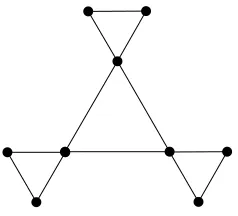
Figure 1: An induced P5-saturated graph
Theorem. (2.14) For every integer k > 0 there is a non-complete graph that is induced
P11+6k-saturated.
Regarding cycles, we will prove the following theorem.
Theorem. (3.3) For any k ≥ 3 and n ≥ 3(k −2) there is a non-complete induced Ck
-saturated graph of order n.
Finally, we will demonstrate the following regarding induced claw-saturated graphs.
Theorem. (4.2) For all n≥12, there is a graph on n vertices that is inducedK1,3-saturated
and is non-complete.
2
Paths
2.1
An infinite family of paths
The only induced P2-saturated graph on n ≥ 2 vertices is Kn. The induced P3-saturated graph of ordernwith the smallest size is either the matching n2K2 ifnis even, or n−21K2∪K1 if n is odd. The case for P4 is similar, consisting of the matching n2K2 if n is even and
n−3
2 K2∪K3 if n is odd. It is also easily seen that the graph of order 9 and size 12 consisting of a triangle with each vertex sharing a vertex with another triangle, as in Figure 1, is inducedP5-saturated, and that the Petersen graph is induced P6-saturated.
We begin our analysis of induced path-saturated graphs by examining an infinite family of cubic hamiltonian graphs developed by Lederberg [8] and modified by Coxeter and Frucht, and later by Coxeter, Frucht, and Powers [6, 2]. For our purposes we will only consider graphs from this family denoted in LCF (for Lederberg, Coxeter, Frucht) notation by [x,−x]a with
x odd. A graph of this form consists of a 3-regular cycle on 2a vertices{v0v1. . . v2a−1} and a matching that pairs each v2i with v2i+x, with arithmetic taken modulo 2a. See Figure 2 for an example.
Let Gk denote the graph with LCF notation [5,−5]7+4k. Note that the order of Gk is 14 + 8k. First we find a long induced cycle in Gk.
v28
v29
v0
v1
v2
v3
v4
v5
v6
v7
v8
v9
v10
v11
v12
v13
v14 v15 v16
v17
v18
v19
v20
v21
v22
v23
v24
v25
v26
v27
Figure 2: The graph G2, which has LCF notation [5,−5]15, with an inducedC20
Proof. Let n be the order of G, and let C = {v0, v1, v2, v3, vn−2, vn−3, vn−8, vn−9}. Then, proceed to add 6 vertices at a time to C in the following way until v5 is included. Let vp be the last vertex added to C. Add the vertices {vp−5, vp−4, vp−3, vp−2, vp−7, vp−8}. Once v5 is added, the graph induced by C is a chordless cycle of order 8 + 6k (Figure 2).
Note that the closed neighborhoods of vn−5 and vn−6 are disjoint from the cycle C con-structed in the proof of Fact 2.1. Therefore, the addition of any edge between any vertex on this cycle and vn−5 or vn−6 generates an induced path of order 9 + 6k. A simple reflection that reverses vn−5 and vn−6 shows that another induced cycle of the same length exists in
Gk.
We next must bound the length of induced paths in Gk. Note that a simple counting argument is not sufficient, since in general a 3-regular graph on 14 + 8k vertices may contain an induced path on as many as 10+6kvertices as seen in the following construction. Consider a pathP on 10 + 6k vertices and an independent setX of 4 + 2kvertices. From each internal vertex in P add a single edge to a vertex in X, and from the endpoints in P add two edges to vertices in X, in such a way as to create a 3-regular graph. The resulting graph has order 14 + 8k and an induced path on 10 + 6k vertices.
Lemma 2.2. The graph Gk contains no induced path on more than 8 + 6k vertices.
Proof. First, note that an exhaustive search of G0 yields a longest induced path of
or-der 7. Consior-der the case where k ≥ 1. Let P be a longest induced path in Gk. Let
V be the m = 8 + 6k vertices in the cycle C from the proof of Fact 2.1. Let the sets
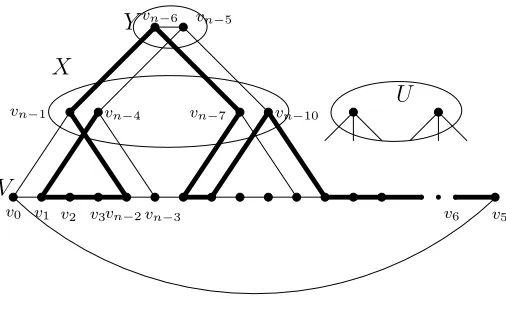
U, X, and Y contain the remaining vertices that have 3,2, and 0, neighbors, respectively, in V. Note that |X| = 4 and |Y| = 2, irrespective of k, and |U| = 2k. Consider the in-duced path P0 on m vertices in Figure 3. For example, in Figure 2 P0 would be the path
Y
X
U
V
v0 v1 v2 v3vn−2vn−3
vn−1 vn−4 vn−7 vn−10
v5
v6
vn−6 vn−5
Figure 3: The graph Gk with longest induced path P0
For every vertexu∈U in P there is one neighbor (if u is an internal vertex ofP) or two neighbors (ifuis a terminal vertex) fromV not inP. Let us assume thatUP ={u1, . . . , ul}=
U∩P, and denote byN(UP)⊂V the neighbors of all vertices inUP. SoP includeslvertices fromU and avoids at least l vertices fromN(UP).
Similarly, assume there is a vertex x in P ∩V that is not in P0. Then either a neighbor of x in P0∩V is not in P, or a route through X∪Y onP0 is diverted and hence a vertex fromP0∩(X∪Y) is not in P. In either case, the inclusion of any vertex from U in P leads to at least one fewer vertex from P0, and hence does not lead to a longer induced path.
Finally, we consider the possible inclusion of vertices from X∪Y. It is easily seen that no induced path can include all vertices fromX∪Y. If P has no vertices fromX∪Y then it is strictly shorter than P0. If P contains exactly one or two vertices from X then there are at least three vertices in V not in P, making P at least as short as P0. Any induced path containing 5 vertices from X∪Y must exclude one from Y as in P0, and so no other induced path also containing 5 of these vertices will be longer that P0. Therefore, P0 is a longest induced path in Gk, and hence Gk does not contain an induced path on more than 8 + 6k vertices.
Now we demonstrate that the graphGk is saturated with respect to the property of long induced paths.
Lemma 2.3. The graph Gk is induced P9+6k-saturated.
Proof. Once again we let n = 14 + 8k, the order of Gk. By Lemma 2.2 there is no induced path of order 9 + 6k in the graphGk. Define the bijectionsφ and ψ on the vertices of Gk by
φ(vi) = v1−i (reflection) and ψ(vi) = vi+1 (rotation), with arithmetic modulo n. Note that bothφ2 and ψ are automorphisms of G
k. Givenvi, vj ∈V(Gk) there is an automorphism of the form φ2k◦ψm that takes v
induced cycle Ck can be rotated and reflected via these functions to yield a functionf such that for any pair x, y of nonadjacent vertices in Gk there is an image f(Ck) so that x is on
f(Ck) and neitherynor its neighbors are onf(Ck). Therefore, between any two nonadjacent vertices the addition of any edge creates an induced P9+6k.
We now generalize to an arbitrary number of vertices.
Lemma 2.4. The disjoint union H of m copies of Gk, with at most one complete graph on
at least 2 vertices, is induced P9+6k-saturated.
Proof. Since each connected component of H is induced P9+6k-saturated by Lemma 2.3 we need only consider the addition of edges between components. SinceGk is vertex transitive and contains an induced cycle on (8+6k) vertices (Fact 2.1), each vertex inGkis the terminal vertex of an induced path on (7 + 6k) vertices. Therefore, any edge between disjoint copies ofGk creates an induced path on far more than the necessary (8 + 6k) vertices. The addition of an edge between a copy of Gk and a complete component will also result in an induced
P9+6k Therefore, H is induced P9+6k-saturated.
Lemma 2.5. The join of any complete graph to any induced Pn-saturated graph, for any
n≥4, generates a new induced Pn-saturated graph.
Proof. Note that joining a clique to a graph does not contribute to the length of the longest induced path except in the most trivial cases ofP1, P2, andP3, nor does it add any non-edges to the graph which require testing for saturation.
Note that joining a complete graph to any induced H-saturated graph, for any non-complete graph H, generates a new induced H-saturated graph. Therefore, we can prove the main result of this section.
Theorem 2.6. For any k ≥ 0 and n ≥ 14 + 8k there is a non-complete induced P9+6k
-saturated graph on n vertices. Further, if n is a multiple of (14 + 8k) there is such a graph that is 3-regular.
Proof. By Lemma 2.3 there is such a graph on n = 14 + 8k vertices, and Lemmas 2.4 and 2.5 demonstrate that n increases without bound.
2.2
Lower bounds
As an analogue to Theorem 1.1 by Erd˝os, Hajnal, and Moon [3], in which smallest Kn -saturated graphs are studied, we now turn our attention to finding the smallest induced
Pm-saturated graphs. Assume throughout that m >3.
First we look at some properties of inducedPm-saturated graphs with pendant edges, and then we will turn our attention to graphs with minimum degree two.
Fact 2.7. If u and v are distinct pendant vertices in an induced Pm-saturated graph G then
Proof. Ifu and v share a neighbor w then the addition of edgeuv cannot create an induced path that includes w, so their distance is at least three. If instead u has neighborwu and v has neighbor wv, with wu adjacent to wv, then the added edge uwv must begin an induced
Pm. However, this edge can be replaced in Gbyvwv, so Gmust already contain an induced
Pm. Therefore the neighbors of u and v cannot be adjacent.
Next we examine the neighbor of a pendant vertex in an induced Pm-saturated graph.
Fact 2.8. Letv be a pendant vertex in a non-complete component of an induced Pm-saturated
graph G, with neighbor u. Then u has degree at least four.
Proof. If deg(u) = 2 then the addition of the edge joining its neighbors cannot create a longer induced path than one that includes u. Assumeuonly has neighbors v, a, and b. If a
and b are adjacent then the added edge va must begin an induced Pm that avoids b, but we can then replaceva with ua and get an induced path of the same length. If instead a and b
are not adjacent then adding edge ab to G does not result in an induced path longer than one containing the path aub. Hence u has at least one other neighbor c.
For the remainder of the section we will consider non-complete graphs without pendant edges.
Fact 2.9. IfGis inducedPm-saturated and contains a vertexv of degree2then the neighbors
of v are adjacent.
Proof. Assume that deg(v) = 2 and v has neighborhood {u, w}. If u is not adjacent to w
then the addition of edge uw cannot generate a longer induced path than one originally present in Gthat includes edges uv, vw. Therefore, u and w must already be adjacent.
As noted in the beginning of Section 2.1, a matching with possibly an isolated vertex or a connected component isomorphic to K3 constitute an induced P3- and P4-saturated graph, respectively. Note that when m >4 an inducedPm-saturated graph cannot have more than one complete component, as any edge between two such components generates an induced path of order at most 4. We now demonstrate that any induced Pm-saturated graph on n vertices, for m >4, has average degree at least 3 among its non-complete components.
Lemma 2.10. Form >5all non-complete connected components of an inducedPm-saturated
graph with no pendant edges have average degree at least 3.
Proof. Let G be an induced Pm-saturated graph. If all vertices of G have degree 3 or more then the result is clear, so let us assume that v is a vertex of G with degree 2 and with neighbors u and w. By Lemma 2.9 u and w are adjacent. Without loss of generality we may assume that deg(w) ≤ deg(u). We will consider the cases in which deg(w) = 2 and
deg(w)>2.
neighbor of u and b a neighbor of w, with a, b /∈ {u, v, w}. If deg(w) = 3 and a and b are distinct then no induced path containing the new edge wa can be longer than an induced path containing the sub-path wua. If instead a=b then the addition of va does not create any induced path not already inGby means of edge wa. Thus, if deg(u)≥deg(w)≥3 then deg(u)≥deg(w)≥4.
Now we consider the case in which deg(w) = 2. Vertex u is therefore a cut vertex of G. Note that if there is another block containinguthat is isomorphic toK3 then the addition of an edge between two such blocks does not result in a longer induced path than one already present in the graph. If deg(u) = 3, with u adjacent to a vertex a distinct from w and v, then adding edgeva toG does not create any induced path longer than one already present inGthat uses the edgeua. So deg(u)≥4. Say that{v, w, u0, w0}are in the neighborhood of
u and note that, as above, if deg(u0) = deg(w0) = 3 then the the addition of edge w0a shows that G is not induced Pm-saturated. So the graph G with vertices v, w removed must also have average degree at least 3, and therefore G does as well.
Next consider the setT of vertices of degree 2 whose neighbors all have degree at least 3, and the set S composed of neighbors of vertices in T. Since vertices in S all have degree at least 4, if t=|T| ≤ |S|=sthen the graph has at least as many vertices with degree greater than three than those with degree 2 and we are done. Assume instead that t > s. Since the two neighbors of each vertex inT are adjacent, we know that for each vertex inT there are at least 3 edges in the induced graph < T ∪S >. Hence the average degree among vertices in< T∪S >is at least s6+tt > 62tt = 3. Since all other vertices in Geither have degree at least 3 or are part of a distinct triple with total degree at least 9 as shown above, the average degree of any non-complete component of an induced Pm-saturated graph is at least 3.
This leads us to the proof of the lower bound for the size of a class of inducedPm-saturated graphs.
Theorem 2.11. If G is an induced Pm-saturated graph on n vertices with no pendant edges
except for a K2 component, m > 5, then G has size at least 32(n −2) + 1. This bound is
realized when m= 9 + 6k and n ≡2 mod (14 + 8k).
Proof. In the graphGall but at most one connected component consists of vertices of average degree at least 3, with potentially one component isomorphic to K2 or K3 by Lemma 2.10. Therefore,e(G)≥ 3
2(n−2) + 1. By Lemma 2.4 the graph consisting of disjoint copies ofGk and a K2 has size 32(n−2) + 1 and is induced Pm-saturated.
2.3
Other path results
For certain induced Pm-saturated graphs we can create induced Pm+2-saturated graphs by using the following constructions.
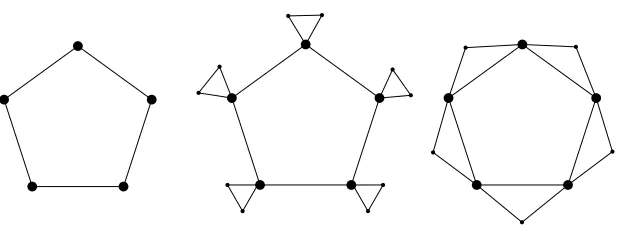
Construction 2.12. Generate the graph Tv(G) by identifying each vertex in G with one
vertex of a distinct triangle. The new graph Tv(G) has order 3n(G) and size e(G) + 3n(G)
Figure 4: The graphs C5, Tv(C5), andTe(C5)
Construction 2.13. The graph Te(G) is composed of the graph G along with a new vertex
for each edge of G, adjoined to both endpoints of that edge. The graph Te(G) has order
n(G) +e(G) and size 3e(G) (Figure 4).
Now we will show that both constructions yield the expected results. First, we restate and prove Theorem 2.14 in a different form than that given in Section 1.1.
Theorem 2.14. The graph Tv(Gk) is induced P11+6k-saturated.
Proof. First we establish that every vertexv in the graphGkis the terminal vertex for two in-duced paths of order 8+6k, each with a different terminal edge. LetP be the path that begins
{v0v5v6v7v2v3vn−2vn−3vn−4vn−5vn−6vn−7vn−12}. If i = (n−12) then proceed similar toC in
Fact 2.1 by adding
{vivi−1vi−6vi−5vi−4vi−3vi−8} to P, repeating until the addition of edge v10v9. By apply-ing the automorphism φ8 ◦ψ we get another induced path of order 8 + 6k starting at v
0,
P0. Notice that P contains the edge v0v5 and P0 the edge v0vn−1. Again, since Gk is vertex transitive, we see that each vertex in Gk is the terminal vertex for two induced paths with distinct terminal edges.
Next, we consider a pairx, y of distinct non-adjacent vertices inGk. We need only consider the cases in which a pair of nonadjacent vertices are both in the original graph Gk, neither in the original graph Gk, or exactly one is in Gk.
Say that x, y ∈ Gk. Since the addition of edge xy to Gk creates an induced P9+6k, one vertex from each added triangle to the endpoints of this path in Tv(Gk) yields an induced
P11+6k. If neitherx nor yare in Gk and their neighbors inGk, sayx0 andy0 respectively, are not adjacent then, since a new edge betweenx0 andy0 inGk generates an inducedP9+6k, this path is extended similarly by two edges to create an induced P11+6k in Tv(Gk). If instead
x0y0 is an edge of Gk, consider the induced P8+6k in Gk that begins at x0 and avoids the edge x0y0. This extends to an induced P9+6k in Tv(Gk). Since x0y0 is not in this path, then the vertexy0 is also avoided entirely. The addition of edge xy to Tv(Gk) creates an induced
P11+6k beginning withy.
P9+6kinTv(Gk) that begins atxand avoidsy0, the addition of the edgexycreates an induced
P11+6k beginning at y00.
Theorem 2.15. If G is K3-free, induced Pm-saturated, and every vertex is in a component
of order at least three, then Te(G) is induced Pm+2-saturated.
Proof. Just as in the proof of Theorem 2.12 we need to consider the same three cases. If x, y are nonadjacent vertices, both in G, then the addition of edge xy to G generates an induced Pm. Since none of the neighbors of the end vertices are in the path, it can be extended on both ends to the added vertices, yielding an induced Pm+2. If both x and y are new vertices added in the construction of Te(G), then let the neighbors of x be x0, x00 and the neighbors ofy y0, y00. If adding edge x0y0 orx00y00 creates an induced Pm that avoids the edges x0x00 and y0y00 then the addition of edge xy generates an induced Pm+2. If instead every induced Pm created by adding either edge x0y0 or x00y00 includes at least one of the edges {x0x00, y0y00} then there is an induced Pm that includes the added edge x0y00 that does not since G is K3-free . Therefore the addition of edge xy is equivalent to adding an edge between a neighbor of each in G, with the induced Pm extended by one edge toward x and one toward y. Lastly, if x is in the original graphG and y is not, then we proceed as above and extend the inducedPm that results from joiningxto a neighbor ofynot already adjacent tox(which exists sinceGisK3-free) by one edge towardyand by another edge at a terminal vertex of the path. Therefore, Te(G) is induced Pm+2-saturated.
We end this section by noting that a computer search using SAGE [11], in conjunction with Constructions 2.12 and 2.13, has found inducedPm-saturated graphs for all 7≤m ≤30. The results are listed in Table 5, most in LCF notation. In the interest of space we have omitted the proof that they are saturated, as each is simply a case analysis. Note that there are induced Pm-saturated graphs that cannot be written in the form [x,−x]n, and further some are the result of the operations Te and Tv. Therefore, not all induced Pm-saturated graph are regular nor the result of a regular graph joined to a complete graph.
3
Cycles
The starK1,(n−1) is induced C3-saturated, and is in fact the graph onn vertices of smallest size for n ≥ 3. This is a direct consequence of Theorem 1.1. The largest such graph is
Kdn
2e,b
n
2c due to Mantel [9].
Note thatC5 is trivially both inducedC3-saturated and induced C4-saturated.
We now show that for all integers k ≥ 3, n ≥ 3(k−2) there is an induced Ck-saturated graph on n vertices that is non-complete. We begin with another construction.
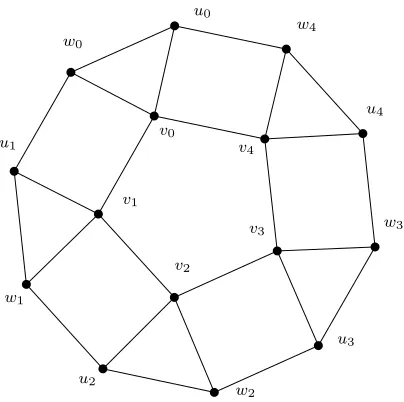
Construction 3.1. Define the graph G[k] on 3k vertices, k ≥3, in the following way. Let
v0v1. . . vk−1v0 be a k-cycle, the internal cycle of G[k]. Add the matching uiwi and the edges
m induced Pm-saturated graph 7 [4,−4,5,−5]3
8,9 [5,−5]7 10 [4,6]10 11 Te([5,−5]7]) 12,13 [5,−5,9,−9]5 14,15 [5,9]13
16 [9,15]12 17 Te([5,9]13) 18 [5,17]15 19,20 [7,23]15
21,22 [5,−5,13,−13]8 23 [−17,9]20
24 Te([5,−5,13,−13]8) 25,26 [−15,15]19
27 [−13,13]19 28 [−15,15]21 29,30 [−13,13]22
Figure 5: Induced path-saturated graphs
v1
v2
v3
v4
v0
u2
w2
u3
w3
u4
w4
u0
w0
u1
w1
Claim 3.2. The graph G[k] is induced Ck+2-saturated.
Proof. First we show that G[k] does not contain an induced cycle of length k + 2. Note that every copy ofCk+2 inG[k] contains vertices from both the internal and external cycles. Any induced cycleC inG[k] contains paths on the internal cycle of the formvivi+1vi+2. . . vj and/or paths on the outer cycle, and edges joining these paths into a cycle. The cycle C
therefore has length eitherk (if i=j) or at least (k+ 3).
Now we show that the addition of any edgeetoG[k] results in an inducedCk+2. Note that there are three potential forms that e can take: an edge among the vertices of the internal cycle, an external cycle edge, or an edge between these cycles. If e=vivj then we need only consider k > 3. There is a newly created induced cycle of length l ≥ (dk
2e+ 1) along the internal cycle. This can be extended by considering an edge from vi to one of its neighbors on the external cycle, and traversing an appropriate number of edges before rejoining the internal cycle. In this way we create an induced cycle of every length between (dk
2e+ 4) and (k+ 3), inclusive.
If instead e joins vertices between the internal and external cycles, then we create an induced Ck+2 in the following way. Without loss of generality we assume that e = viu0. We get an induced Ck−i+2 by proceeding around the internal cycle from vi to vk−1 then to
wk−1. Other induced cycles result from returning to the outer cycle sooner, creating cycles of length (k−i+ 3) through (2k−2i+ 1). We can also find induced cycles proceeding in the other direction along the internal cycle from vi down to v1 (or v0 if i 6= (k−1)), then back to u1, yielding induced cycles with lengths from (i+ 3) through (2i+ 2). Therefore, an induced cycle of length (k+ 2) can be found in G[k] with the added edge for 1≤i≤ k−1
2 in
the latter case and k2 ≤i≤(k−1) in the former.
Finally, if the new edge joins vertices on the external cycle ofG[k] then an induced cycle of length (k+ 2) can be formed by utilizing an edge from vi to the internal cycle, continuing along a sufficiently long path, then rejoining the described induced path along the external cycle.
Theorem 3.3. For anyk ≥3andn≥3(k−2)there is a non-complete induced Ck-saturated
graph of order n.
Proof. By Claim 3.2 there is an n and a graph G[k−2] on n vertices that is induced Ck -saturated. We can extend Construction 3.1 to a larger number of vertices by joining it to a clique, since any vertex in the joined clique is adjacent to all other vertices so cannot be in the induced cycle.
v0
v1
v2
v3
v4
v5
u0
u1
u2
u3
u4
u5
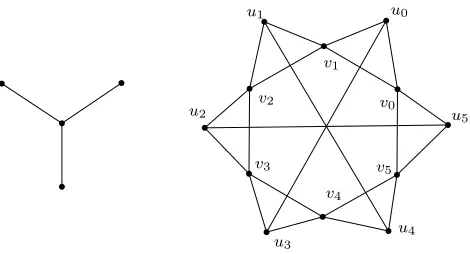
Figure 7: A claw K1,3 and the induced K1,3-saturated graphG
4
Claws
We now turn our attention to the claw graph K1,3 (Figure 7). We build a graph that is inducedK1,3-saturated.
Construction 4.1. Let G be a 6-cycle on the vertices {v0, . . . , v5}. To this set, we add the
vertices {u0, . . . , u5} and for each i join ui to vi, vi+1, and ui+3 with addition taken modulo 6 (Figure 7).
It is easy to see that the graph in Construction 4.1 is claw-free. We can now prove the following theorem.
Theorem 4.2. For all n ≥12, there is a graph on n vertices that is induced K1,3-saturated
and is non-complete graph.
Proof. First we demonstrate that the graphGin Construction 4.1 is inducedK1,3-saturated. If we join ui to uj then ui is the center of a claw with neighbors uj, ui+3, and vi. If we join
ui to vj then vj has pairwise nonadjacent neighbors ui, vj−1 or vj+1, and either uj or uj−1. Finally, if edge vivj is added to G thenvi is the center of a claw along withvj, ui, and ui−1. Since the disjoint union of inducedK1,3-saturated graphs is itself induced K1,3-saturated we can generate a graph on n vertices with disjoint copies of G and possibly a complete connected component.
5
Future Work
Further, as we have considered paths and claw graphs in this paper the study of induced saturation could be furthered by considering the family of trees.
We wish to thank the referees for their very helpful comments and suggestions, which improved this manuscript measurably.
References
[1] M.S. Chung, T. Jiang, D.B. West “Induced Tur´an problems: Largest Pm-free graphs with bounded degree”, Preprint.
[2] H.S.M. Coxeter, R. Frucht, D.L. Powers “Zero-symmetric graphs: Trivalent graphical regular representations of groups”, New York: Academic Press(1981).
[3] P. Erd˝os, A. Hajnal, J.W. Moon “A problem in graph theory”, Amer. Math. Monthly 71 (1964),1107-1110.
[4] J.R. Faudree, R.J. Faudree, J.R. Schmitt “A survey of minimum saturated graphs”,
Elec. J. of Comb. DS19 (2011), 36 pp.
[5] M. Ferrara, M. Jacobson, K. Milans, C. Tennenhouse, P. Wenger “Saturation numbers for families of graph subdivisions”, J. Graph Theory 71,4 (2012), 416-434.
[6] R. Frucht “A canonical representation of trivalent Hamiltonian graphs”,J. Graph The-ory 1,1 (1976), 45-60.
[7] M.S. Jacobson, C. Tennenhouse “Oriented graph saturation”, J. Comb. Math. Comb. Comp. 80 (2012), 157-169.
[8] J. Lederberg “DENDRAL-64: A System for Computer Construction, Enumeration and Notation of Organic Molecules as Tree Structures and Cyclic Graphs. Part II. Topology of Cyclic Graphs”,Interim Report to the National Aeronautics and Space Administration
(1965).
[9] W. Mantel, “Problem 28”, solution by H. Gouwentak, W. Mantel, J. Teixeira de Mattes, F. Schuh, W.A. Wythoff, Wiskundige Opgaven 10 (1907), 60-61.
[10] R.R. Martin, J.J. Smith “Induced saturation number”, Disc. Math. 312 21 (2012),
3096-3106.
[11] W. Stein et al. “Sage Mathematics Software (Version 5.8)”, The SAGE Development
Team (2013), http://www.sagemath.org.
![Figure 2: The graph G2, which has LCF notation [5, −5]15, with an induced C20](https://thumb-us.123doks.com/thumbv2/123dok_us/8838081.1793112/5.612.213.403.87.274/figure-graph-g-lcf-notation-induced-c.webp)