R E S E A R C H
Open Access
Algorithm of a new variational inclusion
problem and strictly pseudononspreading
mapping with application
Wongvisarut Khuangsatung and Atid Kangtunyakarn
**Correspondence:
[email protected] Department of Mathematics, Faculty of Science, King Mongkut’s Institute of Technology Ladkrabang, Bangkok 10520, Thailand
Abstract
The purpose of this research is to modify the variational inclusion problems and prove a strong convergence theorem for finding a common element of the set of fixed points of a
κ-strictly pseudononspreading mapping and the set of solutions of a finite
family of variational inclusion problems and the set of solutions of a finite family of equilibrium problems in Hilbert space. By using our main result, we prove a strong convergence theorem involving aκ
-quasi-strictly pseudo-contractive mapping in Hilbert space. We give a numerical example to support some of our results.Keywords: variational inclusion problems;
κ-strictly pseudononspreading mapping;
equilibrium problem; resolvent operator; fixed point problem1 Introduction
Throughout this article, letHbe a real Hilbert space with inner product·,·and norm·. LetCbe a nonempty closed convex subset ofH. LetS:C→Cbe a nonlinear mapping. A pointu∈Cis called afixed pointofSifSu=u. The set of fixed points ofSis denoted byFix(S) :={u∈C:Su=u}. A mappingSis callednonexpansiveif
Su–Sv ≤ u–v, ∀u,v∈C.
In , Kohsaka and Takahashi [] introduced the nonspreading mapping in Hilbert spaceHas follows:
Su–Sv≤ Su–v+u–Sv, ∀u,v∈C. (.)
It is shown in [] that (.) is equivalent to
Su–Sv≤ u–v+ u–Su,v–Sv, ∀u,v∈C. (.)
The mappingS:C→Cis called aκ-strictly pseudononspreading mappingif there exists
κ∈[, ) such that
Su–Sv≤ u–v+κ(I–S)u– (I–S)v+ u–Su,v–Sv, ∀u,v∈C.
This mapping was introduced by Osilike and Isiogugu [] in . Clearly every non-spreading mapping is aκ-strictly pseudononspreading mapping.
Remark . LetCbe a nonempty closed convex subset ofH. Then a mappingS:C→C
is aκ-strictly pseudononspreading if and only if
–κ
(I–S)u– (I–S)v
≤(I–S)u– (I–S)v,u–v+(I–S)u, (I–S)v,
for allu,v∈C.
Proof Letu,v∈CandSbe aκ-strictly pseudononspreading mapping, then there exists
κ∈[, ) such that
Su–Sv≤ u–v+κ(I–S)u– (I–S)v+ u–Su,v–Sv. (.)
Since
(I–S)u– (I–S)v=Su–Sv– Su–Sv,u–v+u–v, (.)
then we have
Su–Sv=(I–S)u– (I–S)v+ Su–Sv,u–v–u–v. (.)
From (.) and (.), we have
(I–S)u– (I–S)v+ Su–Sv,u–v–u–v
≤ u–v+κ(I–S)u– (I–S)v+ u–Su,v–Sv.
It follows that
( –κ)(I–S)u– (I–S)v≤u–v– Su–Sv,u–v+ u–Su,v–Sv
= (I–S)u– (I–S)v,u–v+ u–Su,v–Sv.
Then
–κ
(I–S)u– (I–S)v
≤
(I–S)u– (I–S)v,u–v+(I–S)u, (I–S)v.
On the other hand, letu,v∈Cand
–κ
(I–S)u– (I–S)v
≤(I–S)u– (I–S)v,u–v+u–Su,v–Sv
=u–v–Su–Sv,u–v+u–Su,v–Sv.
Then
It follows that
Su–Su,u–v ≤u–v– ( –κ)(I–S)u– (I–S)v
+ u–Su,v–Sv. (.)
From (.), we have
Su–Sv,u–v=Su–Sv+u–v–(I–S)u– (I–S)v. (.)
From (.) and (.), we have
Su–Sv+u–v–(I–S)u– (I–S)v
≤u–v– ( –κ)(I–S)u– (I–S)v+ u–Su,v–Sv.
Then
Su–Sv≤ u–v+κ(I–S)u– (I–S)v+ (I–S)u, (I–S)v.
Example . LetS: [,∞)→[,∞) be defined by
Su=sinu, ∀u∈[,∞).
ThenSis aκ-strictly pseudononspreading mapping whereκ∈[, ).
Example . LetS: [,∞)→[,∞) be defined by
Su= u
+ u, ∀u∈C.
ThenSis a-strictly pseudononspreading mapping.
The mappingA:C→His calledα-inverse strongly monotoneif there exists a positive real numberαsuch that
Au–Av,u–v ≥αAu–Av,
for allu,v∈C.
LetB:H→Hbe a mapping andM:H→H be a multi-valued mapping. The varia-tional inclusion problemis to findx∈Hsuch that
θ∈Bx+Mx, (.)
LetM:H→Hbe a multi-valued maximal monotone mapping, then the single-valued
mappingJM,λ:H→Hdefined by
JM,λ(x) = (I+λM)–(x), ∀x∈H,
is called theresolvent operatorassociated withM, whereλis any positive number andIis an identity mapping; see [].
Let:C×C→Rbe a bifunction. The equilibrium problem foris to determine its equilibrium point. The set of solution of equilibrium problem is denoted by
EP() =u∈C:(u,v)≥,∀v∈C. (.)
Finding a solution of an equilibrium problem can be applied to many problems in physics, optimization, and economics. Many researchers have proposed some methods to solve the equilibrium problem; see, for example, [, ] and the references therein.
In , Zhanget al.[] introduced an iterative scheme for finding a common element of the set of solutions of the variational inclusion problem with multi-valued maximal monotone mapping and inverse strongly monotone mappings and the set of fixed points of nonexpansive mappings in Hilbert space as follows:
⎧ ⎨ ⎩
vn=JM,λ(wn–λAwn),
wn+=αnw+ ( –αn)Svn, ∀n≥,
and they proved a strong convergence theorem of the sequence{wn}under suitable con-ditions of the parameters{αn}andλ.
In , Kangtunyakarn [] introduced an iterative algorithm for finding a common element of the set of fixed points of aκ-strictly pseudononspreading mapping and the set of solutions of a finite family of variational inequality problems as follows:
wn+=αnu+βnPC
I–λn(I–S)
wn+γnSwn, ∀n∈N,
and proved a strong convergence theorem of the sequence{wn}under suitable conditions of the parameters{αn},{βn},{γn}, and{λn}.
Very recently, Suwannaut and Kangtunyakarn [] have modified (.) as follows:
EP N
i= aii
=
u∈C: N
i= aii
(u,v)≥,∀v∈C
, (.)
wherei:C×C→Ris for bifunctions andai> with
N
i=ai= for everyi= , , . . . ,N.
It is obvious that (.) reduces to (.), ifi=, for alli= , , . . . ,N. They also introduced
an iterative method for finding a common element of the set of fixed points of an infinite family ofκi-strictly pseudo-contractive mappings and the set of solutions of a finite family
of an equilibrium problem and a variational inequalities problem as follows: ⎧
⎨ ⎩
N
i=aii(zn,y) +rny–zn,zn–wn ≥, ∀y∈C,
wn+=βn(αnμ+ ( –αn)Snwn) + ( –βn)PC(I–ρn
N
Under some appropriate conditions, they proved a strong convergence theorem of the se-quence{wn}converging to an element of a setNi=EP(i)∩
N
i=VP(Ai,C)∩
∞
i=Fix(Si)
whereAiis a strongly positive linear bounded operator for everyi= , , . . . ,N.
Fori= , , . . . ,N, letAi:H→H be a single-valued mapping and letM:H→H be
a multi-valued mapping. From the concept of (.), we introduce the problem of finding
u∈Hsuch that
θ∈ N
i=
aiAiu+Mu, (.)
for allai∈(, ) with
N
i=ai= andθis a zero vector. This problem is calledthe modified variational inclusion. The set of solutions of (.) is denoted byVI(H,Ni=aiAi,M). If
Ai≡Afor alli= , , . . . ,N, then (.) reduces to (.).
In this paper, motivated by the research described above, we prove fixed point theory involving the modified variational inclusion and introduce iterative scheme for finding a common element of the set of fixed points of aκ-strictly pseudononspreading mapping and the set of solutions of a finite family of variational inclusion problems and the set of solutions of a finite family of equilibrium problem. By using the same method as our main theorem, we prove a strong convergence theorem for finding a common element of the set of fixed points of aκ-quasi-strictly pseudo-contractive mapping and the set of solutions of a finite family of variational inclusion problems and the set of solutions of a finite family of equilibrium problem in Hilbert space. Applying such a problem, we have a convergence theorem associated with a nonspreading mapping. In the last section, we also give numerical examples to support some of our results.
2 Preliminaries
In this paper, we denote weak and strong convergence by the notations ‘’ and ‘→’, re-spectively. In a real Hilbert spaceH, recall that the (nearest point) projectionPCfromH
ontoCassigns to eachu∈Hthe unique pointPCu∈Csatisfying the property
u–PCv=min
v∈Cu–v.
For a proof of the main theorem, we will use the following lemmas.
Lemma .([]) Given u∈H and v∈C,then PCu=v if and only if we have the inequality
u–v,v–z ≥, ∀z∈C.
Lemma .([]) Let{pn}be a sequence of nonnegative real numbers satisfying
pn+≤( –an)pn+bn, ∀n≥,
where{an}is a sequence in(, )and{bn}is a sequence such that
() ∞n=an=∞, () lim supn→∞bn
an ≤or
∞
Lemma . Let H be a real Hilbert space.Then
u+v≤ u+ v,u+v,
for all u,v∈H.
Lemma .([]) Let H be a Hilbert space.Then for all u,v∈H and αi∈[, ]for i=
, , . . . ,n such thatα+α+· · ·+αn= the following equality holds:
αw+αw+· · ·+αnwn=
n
i=
αiwi–
≤i,j≤n
αiαjwi–wj.
For finding solutions of the equilibrium problem, assume a bifunction:C×C→R
to satisfy the following conditions:
(A) (u,v) = for allu∈C;
(A) is monotone,i.e.,(u,v) +(v,u)≤for allu,v∈C; (A) for eachu,v,z∈C,
lim
t↓
tz+ ( –t)u,v≤(u,v);
(A) for eachu∈C,v→(u,v)is convex and lower semicontinuous.
Lemma .([]) Let C be a nonempty closed convex subset of H and letbe a bifunction of C×C intoRsatisfying(A)-(A).Let r> and u∈H.Then there exists z∈C such that
(z,v) +
rv–z,z–u ≥, ∀v∈C.
Lemma .([]) Assume that:C×C→Rsatisfies(A)-(A).For r> ,define a map-pingr:H→C as follows:
r(u) =
z∈C:(z,v) +
rv–z,z–u ≥,∀v∈C
,
for all u∈H.Then the following hold:
(i) ris single-valued;
(ii) ris firmly nonexpansive,i.e.,for anyu,v∈H,
r(u) –r(v)
≤r(u) –r(v),u–v
;
(iii) Fix(r) =EP();
(iv) EP()is closed and convex.
Lemma .([]) Let C be a nonempty closed convex subset of a real Hilbert space H.For i= , , . . . ,N,leti:C×C→Rbe bifunctions satisfying(A)-(A)with
N
i=EP(i)=∅. Then
EP N
i= aii
=
N
i=
EP(i),
Remark .([]) From Lemma .,
Fix(r) =EP
N
i= aii
=
N
i=
EP(i),
whereai∈(, ), for eachi= , , . . . ,N, andNi=ai= .
Lemma . Let C be a nonempty closed convex subset of a real Hilbert space H. Let
N
i=aii: C×C→ Rbe bifunctions satisfying (A)-(A) where ai∈ (, ),for each i= , , . . . ,N andNi=ai= .For every n∈N,let <c≤rn≤d with rn→r as n→ ∞. Thenrnu–ru →as n→ ∞for all u∈H.
Proof For everyn∈N, let <c≤rn≤dwithrn→rasn→ ∞, from which it follows that
<c≤r≤d. For everyu∈H, by Lemma ., we have
N
i=
aii(rnu,v) +
rnv–rnu,rnu–u ≥, ∀v∈C
and
N
i=
aii(ru,v) +
rv–ru,rnu–u ≥, ∀v∈C.
In particular, we have
N
i=
aii(rnu,ru) +
rn
ru–rnu,rnu–u ≥ (.)
and
N
i=
aii(ru,rnu) +
rrnu–ru,ru–u ≥. (.)
Summing up (.) and (.) and using (A), we have
rrnu–ru,ru–u+
rn
ru–rnu,rnu–u ≥.
It follows that
rnu–ru,
ru–u
r –
rnu–u rn
≥.
This implies that
≤
ru–rnu,rnu–u– rn
r(ru–u)
=
ru–rnu,rnu–ru+
–rn
r
(ru–u)
It follows that
ru–rnu≤
–rn
r
ru–rnu
ru+u
.
Then we have
ru–rnu ≤
r|r–rn|L,
whereL=sup{ru+u}. Sincern→rasn→ ∞, we have
rnu–ru → asn→ ∞.
Remark . Let S : H → H be a κ-strictly pseudononspreading mapping with Fix(S)=∅. Define T:H→H byTu:= (( –λ)I+λS)u, whereλ∈(, –κ). Then the
following hold:
(i) Fix(S) =Fix(T) =Fix(I–λ(I–S)); (ii) for everyu∈Handv∈Fix(S),
Tu–v ≤ u–v.
Proof (i) It is easy to see thatFix(S) =Fix(T) =Fix(I–λ(I–S)).
(ii) Next, we show thatTu–v ≤ u–v. For everyu∈Handv∈Fix(S), we have
Tu–v =I–λ(I–S)u–v
=( –λ)(u–v) +λ(Su–v)
= ( –λ)u–v+λSu–v–λ( –λ)Su–u
≤( –λ)u–v+λu–v+κ(I–S)u
–λ( –λ)Su–u
=u–v+κλSu–u–λ( –λ)Su–u
=u–v+λλ– ( –κ)Su–u
≤ u–v.
Lemma .([]) u∈H is a solution of variational inclusion(.)if and only if u=JM,λ(u–
λBu),∀λ> ,i.e.,
VI(H,B,M) =FixJM,λ(I–λB)
, ∀λ> .
Further,ifλ∈(, α],thenVI(H,B,M)is a closed convex subset in H.
Lemma .([]) The resolvent operator JM,λassociated with M is single-valued,
nonex-pansive for allλ> and-inverse strongly monotone.
mapping withη=mini=,,...,N{αi}and
N
i=VI(H,Ai,M)=∅.Then
VI H, N i= aiAi,M
=
N
i=
VI(H,Ai,M),
whereNi=ai= ,and <ai< for every i= , , . . . ,N.Moreover,JM,λ(I–λ N
i=aiAi)is a nonexpansive mapping,for all <λ< η.
Proof ClearlyNi=VI(H,Ai,M)⊆VI(H,Ni=aiAi,M). Letu∈VI(H,
N
i=aiAi,M) and letu∗∈
N
i=VI(H,Ai,M). From Lemma ., we have
u∈Fix
JM,λ
I–λ N i= aiAi .
Since Ni=VI(H,Ai,M)⊆VI(H,
N
i=aiAi,M), we haveu∗∈VI(H,
N
i=aiAi,M). From
Lemma ., we have
u∗∈Fix
JM,λ
I–λ N i= aiAi .
From the nonexpansiveness ofJM,λ, we have
u∗–u
= JM,λ
I–λ N
i= aiAi
u∗–JM,λ
I–λ N
i= aiAi
u ≤
I–λ N
i= aiAi
u∗–
I–λ N i= aiAi u =
u∗–u–λ
N
i=
aiAiu∗–
N i= aiAiu
≤u∗–u– λ N
i=
aiu∗–u,Aiu∗–Aiu+λ N
i=
aiAiu∗–Aiu
≤u∗–u– λ N
i=
aiαiAiu∗–Aiu+λ N
i=
aiAiu∗–Aiu
≤u∗–u– λη N
i=
aiAiu∗–Aiu+λ N
i=
aiAiu∗–Aiu
=u∗–u
+λ N
i=
ai(λ– η)Aiu∗–Aiu
. (.)
This implies that
λ N
i=
Then
Aiu∗=Aiu, ∀i= , , . . . ,N. (.)
Sinceu∈VI(H,Ni=aiAi,M), we have
θ∈Mu+ N
i=
aiAiu. (.)
Fromu∗∈VI(H,Ni=aiAi,M), we have
θ∈Mu∗+
N
i=
aiAiu∗. (.)
From (.) and (.), we have
θ∈Mu+
N
i=
aiAiu–Mu∗–
N
i=
aiAiu∗. (.)
From (.) and (.), we have
θ∈Mu–Mu∗. (.)
Sinceu∗∈Ni=VI(H,Ai,M) and we have (.) and (.),
θ∈Mu–Mu∗+Mu∗+Aiu∗=Mu+Aiu,
for alli= , , . . . ,N. It implies thatu∈i=N VI(H,Ai,M).
Hence
VI
H,
N
i= aiAi,M
⊆
N
i=
VI(H,Ai,M).
Applying (.), we can conclude thatJM,λ(I–λ N
i=aiAi) is a nonexpansive mapping for
alli= , , . . . ,N.
3 Main result
Theorem . Let C be a nonempty closed convex subset of a real Hilbert space H.Let M:H→H be a multi-valued maximal monotone mapping.For every i= , , . . . ,N,let i:C×C→Rbe a bifunction satisfying(A)-(A)and Ai:H→H beαi-inverse strongly monotone mapping withη=mini=,,...,N{αi}.Let S:H→H be aκ-strictly pseudonon-spreading mapping.Assume:=Fix(S)∩Ni=EP(i)∩
N
i=VI(H,Ai,M)=∅.Let the se-quences{wn}and{zn}be generated by w,μ∈H and
⎧ ⎪ ⎪ ⎨ ⎪ ⎪ ⎩
N
i=aii(zn,y) +rny–zn,zn–wn ≥, ∀y∈C,
wn+=αnμ+βnwn+γnJM,λ(I–λ N
i=biAi)wn
+ηn(I–ρn(I–S))wn+δnzn, ∀n≥,
where{αn},{βn},{γn},{ηn},{δn} ⊆(, )andλ> withαn+βn+γn+ηn+δn= , <α< , and≤ai,bi≤,for every i= , , . . . ,N,rn∈[c,d]⊂(, ), <p≤βn,γn,ηn,δn≤q< , ρn∈(, –κ)for all n≥.Suppose the following conditions hold:
(i) limn→∞αn= and∞n=αn=∞,
(ii) ∞n=ρn<∞,
(iii) <λ< η,whereη=mini=,,...,N{αi},
(iv) Ni=ai=Ni=bi= , (v) ∞n=|αn+–αn|<∞,
∞
n=|βn+–βn|<∞,
∞
n=|γn+–γn|<∞,
∞
n=|ρn+–ρn|<∞,∞n=|δn+–δn|<∞,n=∞ |rn+–rn|<∞. Then the sequences{wn}and{zn}converge strongly toω=Pμ.
Proof The proof of Theorem . will be divided into five steps: Step . We show that the sequence{wn}is bounded.
SinceNi=aiisatisfies (A)-(A), and
N
i=
aii(zn,y) +
rny–zn,zn–wn ≥, ∀y∈C,
by Lemma . and Remark ., we havezn=rnwnandFix(rn) =
N
i=EP(i).
Letω∈. From Lemma . and Lemma ., we have
ω=JM,λ
I–λ N
i= biAi
ω.
From the nonexpansiveness ofJM,λ(I–λ N
i=biAi), we have
JM,λ
I–λ N
i= biAi
wn–ω
≤ wn–ω. (.)
From Remark ., we have I–ρn(I–S)
wn–ω
=( –ρn)wn+ρnSwn–ω
≤ wn–ω. (.)
From the definition ofwn, (.), and (.), we have
wn+–ω=
αnμ+βnwn+γnJM,λ
I–λ N
i= biAi
wn
+ηn
I–ρn(I–S)
wn+δnzn–ω
≤αnμ–ω+βnwn–ω+γn
JM,λ
I–λ N
i= biAi
wn–ω
+ηnI–ρn(I–S)
wn–ω+δnzn–ω
≤αnμ–ω+ ( –αn)wn–ω
By mathematical induction, we havewn–z ≤K,∀n∈N. It implies that{wn}is bounded and so is{zn}.
By continuing in the same direction as in Step of Theorem . in [], we have
Swn–ω ≤
+κ
–κwn–ω. (.)
From (.), we can conclude that{Swn}is bounded.
Step . PutG=Ni=biAiandP=I–S. We will show thatlimn→∞wn+–wn= . From the definition ofwn, we have
wn+–wn=αnμ+βnwn+γnJM,λ(I–λG)wn+ηn(I–ρnP)wn
+δnzn–αn–μ–βn–wn––γn–JM,λ(I–λG)wn–
–ηn–(I–ρn–P)wn––δn–zn–
≤ |αn–αn–|μ+βnwn–wn–+|βn–βn–|wn–
+γnJM,λ(I–λG)wn–JM,λ(I–λG)wn–
+|γn–γn–|JM,λ(I–λG)wn–
+ηn(I–ρnP)wn– (I–ρn–P)wn–+|ηn–ηn–|( –ρn–P)wn–
+δnzn–zn–+|δn–δn–|zn–
≤ |αn–αn–|μ+βnwn–wn–+|βn–βn–|wn–+γnwn–wn–
+|γn–γn–|JM,λ(I–λG)wn–+|ηn–ηn–|(I–ρn–P)wn–
+ηn
wn–wn–+ρnPwn–Pwn–+|ρn–ρn–|Pwn–
+δnzn–zn–+|δn–δn–|zn–
≤ |αn–αn–|μ+βnwn–wn–+|βn–βn–|wn–+γnwn–wn–
+|γn–γn–|JM,λ(I–λG)wn–+|ηn–ηn–|(I–ρn–P)wn–
+ηnwn–wn–+ρnPwn–Pwn–+|ρn–ρn–|Pwn–
+δnzn–zn–+|δn–δn–|zn–. (.)
By continuing in the same direction as in Step of Theorem . in [], we have
zn–zn– ≤ wn–wn–+
d|rn–rn–|zn–wn. (.)
By substituting (.) into (.), we obtain
wn+–wn ≤ |αn–αn–|μ+βnwn–wn–+|βn–βn–|wn–+γnwn–wn–
+|γn–γn–|JM,λ(I–λG)wn–+|ηn–ηn–|(I–ρn–P)wn–
+ηnwn–wn–+ρnPwn–Pwn–+|ρn–ρn–|Pwn–
+δnzn–zn–+|δn–δn–|zn–
+|γn–γn–|JM,λ(I–λG)wn–+|ηn–ηn–|(I–ρn–P)wn–
+ηnwn–wn–+ρnPwn–Pwn–+|ρn–ρn–|Pwn–
+δn
wn–wn–+
d|rn–rn–|zn–wn
+|δn–δn–|zn–
≤ |αn–αn–|μ+ ( –αn)wn–wn–+|βn–βn–|wn–
+|γn–γn–|JM,λ(I–λG)wn–+|ηn–ηn–|(I–ρn–P)wn–
+ρnPwn–Pwn–+|ρn–ρn–|Pwn–
+
d|rn–rn–|zn–wn+|δn–δn–|zn–. (.)
Applying Lemma ., (.), and the conditions (i), (ii), (v), we have
lim
n→∞wn+–wn= . (.)
Step . We show thatlimn→∞zn–wn=limn→∞(I–ρnP)wn–wn=limn→∞JM,λ(I–
λG)wn–wn= . By the definition ofwn, (.), and (.), we have
wn+–ω =αnμ+βnwn+γnJM,λ(I–λG)wn
+ηn(I–ρnP)wn+δnzn–ω
≤αnμ–ω+βnwn–ω+γnJM,λ(I–λG)wn–ω
+ηn(I–ρnP)wn–ω
+δnzn–ω–βnδnwn–zn
–βnγnJM,λ(I–λG)wn–wn
=αnμ–ω+ ( –αn)wn–ω–βnδnwn–zn
–βnγnJM,λ(I–λG)wn–wn
≤αnμ–ω+wn–ω–βnδnwn–ωn
–βnγnJM,λ(I–λG)wn–wn
.
It implies that
βnδnzn–wn≤αnμ–ω+wn–ω–wn+–ω
–βnγnJM,λ(I–λG)wn–wn
≤αnμ–ω+
wn–ω+wn+–ωwn+–wn.
From the condition (i) and (.), we have
lim
n→∞zn–wn= . (.)
By continuing in the same direction as (.), we have
lim
From the definition ofwn, we have
wn+–wn=αn(μ–wn) +γn
JM,λ(I–λG)wn–wn
+ηn
(I–ρnP)wn–wn+δn(zn–wn).
From the condition (i), (.), (.), and (.), we have
lim
n→∞I–ρn(I–S)
wn–wn= . (.)
Step . We will show thatlim supn→∞μ–ω,wn–ω ≤, whereω=Pμ. To show this, choose a subsequence{wnk}of{wn}such that
lim sup
n→∞ μ–ω,wn–ω=k→∞limμ–ω,wnk–ω. (.)
Without loss of generality, we can assume thatwnk ξask→ ∞. From (.), we obtain
znk ξask→ ∞.
First, we will show thatξ ∈Ni=VI(H,Ai,M). Assume thatξ ∈/ Ni=VI(H,Ai,M). By Lemmas . and .,Ni=VI(H,Ai,M) =Fix(JM,λ((I–λG))). Thenξ =JM,λ(I–λG)ξ, whereG=Ni=biAi. By the nonexpansiveness ofJM,λ((I–λG)), (.), and Opial’s con-dition, we obtain
lim
k→∞infwnk–ξ<k→∞liminfwnk–JM,λ
(I–λG)ξ
≤ lim
k→∞infwnk–JM,λ
(I–λG)wnk
+JM,λ
(I–λG)wnk–JM,λ
(I–λG)ξ
≤ lim
k→∞infwnk–ξ.
This is a contradiction. Then we have
ξ∈ N
i=
VI(H,Ai,M). (.)
Next, we will show thatξ∈Fix(S). Assume thatξ∈/Fix(S). From Remark .(i), we get Fix(S) =Fix(I–ρnk(I–S)). Thenξ= (I–ρnk(I–S))ξ. From the condition (ii), (.), and
Opial’s condition, we obtain
lim
k→∞infwnk–ξ<k→∞liminfwnk–
I–ρnk(I–S)
ξ
≤ lim
k→∞infwnk–
I–ρnk(I–S)
wnk
+I–ρnk(I–S)
wnk–I–ρnk(I–S)
ξ
≤ lim
k→∞infwnk–
I–ρnk(I–S)
wnk
+wnk–ξ+ρnk(I–S)wnk– (I–S)ξ
= lim
This is a contradiction. Then we have
ξ∈Fix(S). (.)
Since <c≤rn≤d,∀n∈N, then we havernk→rask→ ∞with <c≤r≤d.
Ap-plying Lemma ., we havernkwnk –rwnk → ask→ ∞. Next, we will show that ξ∈Ni=EP(i). Assume thatξ∈/
N
i=EP(i). From Remark ., we haveξ∈/Fix(r). By
Opial’s condition and (.), we have
lim
k→∞infwnk–ξ<k→∞liminfwnk–rξ
≤ lim
k→∞inf
wnk–rnkwnk
+rnkwnk–rwnk+rwnk–rξ
≤ lim
k→∞infwnk–ξ.
This is a contradiction. Then we have
ξ∈ N
i=
EP(i). (.)
From (.), (.), and (.), we can conclude thatξ∈.
Sincewnk ξask→ ∞andξ∈. By (.) and Lemma ., we have
lim sup
n→∞ μ–ω,wn–ω=k→∞limμ–ω,wnk–ω
=μ–ω,ξ–ω
≤. (.)
Step . Finally, we will show thatlimn→∞wn=ω, whereω=Pμ. From the definition of
wn, we have
wn+–ω =αnμ+βnwn+γnJM,λ(I–λG)wn+ηn(I–ρnP)wn+δnzn–ω
≤αn(μ–ω) +βn(wn–ω) +γn
JM,λ(I–λG)wn–ω
+ηn
(I–ρnP)wn–ω+δn(zn–ω)
≤βnwn–ω+γnJM,λ(I–λG)wn–ω+ηn(I–ρnP)wn–ω
+δnzn–ω
+ αnμ–ω,wn+–ω
≤( –αn)wn–ω+ αnμ–ω,wn+–ω.
From the condition (i), (.), and Lemma ., we can conclude that the sequence{wn}
converges strongly toω=Pμ. By (.), we find that{zn}converges strongly toω=Pμ.
This completes the proof.
As a direct proof of Theorem ., we obtain the following results.
i:C×C→Rbe a bifunction satisfying(A)-(A)and let A:H→H be anα-inverse strongly monotone mapping.LetS:H→H be aκ-strictly pseudononspreading mapping.
Assume:=Fix(S)∩Ni=EP(i)∩VI(H,A,M)=∅.Let the sequences{wn}and{zn}be generated by w,μ∈H and
⎧ ⎪ ⎪ ⎨ ⎪ ⎪ ⎩
N
i=aii(zn,y) +rny–zn,zn–wn ≥, ∀y∈C,
wn+=αnμ+βnwn+γnJM,λ(I–λA)wn
+ηn(I–ρn(I–S))wn+δnzn, ∀n≥,
(.)
where{αn},{βn},{γn},{ηn},{δn} ⊆(, )andλ> withαn+βn+γn+ηn+δn= , <α< , and≤ai≤,for every i= , , . . . ,N,rn∈[c,d]⊂(, ), <p≤βn,γn,ηn,δn≤q< , ρn∈(, –κ)for all n≥.Suppose the following conditions hold:
(i) limn→∞αn= and
∞
n=αn=∞,
(ii) ∞n=ρn<∞,
(iii) <λ< α, (iv) Ni=ai= ,
(v) ∞n=|αn+–αn|<∞,
∞
n=|βn+–βn|<∞,
∞
n=|γn+–γn|<∞,
∞
n=|ρn+–ρn|<∞,∞n=|δn+–δn|<∞,n=∞ |rn+–rn|<∞. Then the sequences{wn}and{zn}converge strongly toω=Pμ.
Proof PutAi≡Afor alli= , , . . . ,N in Theorem .. So, from Theorem ., we obtain
the desired result.
Corollary . Let C be a nonempty closed convex subset of a real Hilbert space H and let M:H→Hbe a multi-valued maximal monotone mapping.Let:C×C→Rbe a bifunction satisfying(A)-(A).For every i= , , . . . ,N,Ai:H→H beαi-inverse strongly monotone mapping withη=mini=,,...,N{αi}.Let S:H→H be aκ-strictly pseudonon-spreading mapping.Assume:=Fix(S)∩EP(F)∩Ni=VI(H,Ai,M)=∅.Let the sequences
{wn}and{zn}be generated by w,μ∈H and
⎧ ⎪ ⎪ ⎨ ⎪ ⎪ ⎩
(zn,y) +rny–zn,zn–wn ≥, ∀y∈C,
wn+=αnμ+βnwn+γnJM,λ(I–λ N
i=biAi)wn
+ηn(I–ρn(I–S))wn+δnzn, ∀n≥,
(.)
where{αn},{βn},{γn},{ηn},{δn} ⊆(, )andλ> withαn+βn+γn+ηn+δn= , <α< , and≤bi≤,for every i= , , . . . ,N,rn∈[c,d]⊂(, ), <p≤βn,γn,ηn,δn≤q< , ρn∈(, –κ)for all n≥.Suppose the following conditions hold:
(i) limn→∞αn= and
∞
n=αn=∞,
(ii) ∞n=ρn<∞,
(iii) <λ< η,whereη=mini=,,,...,N{αi},
(iv) Ni=bi= ,
(v) ∞n=|αn+–αn|<∞,
∞
n=|βn+–βn|<∞,
∞
n=|γn+–γn|<∞,
∞
n=|ρn+–ρn|<∞,
∞
n=|δn+–δn|<∞,
∞
n=|rn+–rn|<∞. Then the sequences{wn}and{zn}converge strongly toω=Pμ.
4 Applications
In this section, we utilize our main theorem to prove a strong convergence theorem for finding a common element of the set of fixed points of a κ-quasi-strictly pseudo-contractive mapping and the set of solutions of a finite family of variational inclusion prob-lems and the set of solutions of a finite family of equilibrium problem in Hilbert space. To obtain this result, we recall some definitions, lemmas, and remarks as follows.
Definition . LetCbe a subset of a real Hilbert spaceHand letS:C→Cbe a mapping. ThenSis said to beκ-quasi-strictly pseudo-contractiveif there exists a constantκ∈[, ) such that
Su–p≤ u–p+κu–Su, ∀u∈Cand∀p∈Fix(S).
Sis said to bequasi-nonexpansiveif
Su–p ≤ u–p, ∀u∈Cand∀p∈Fix(S).
The class ofκ-quasi-strictly pseudo-contractions includes the class of quasi-nonexpan-sive mappings.
Remark . IfS:C→Cbe aκ-strictly pseudononspreading mapping withFix(S)=∅, thenSis aκ-quasi-strictly pseudo-contractive mapping.
Example . LetS: [, ]→[, ] be defined by
Su=u+
, for allu∈[, ].
ThenSis aκ-strictly pseudononspreading mapping whereκ∈[, ). Since ∈Fix(S),S is alsoκ-quasi-strictly pseudo-contractive mapping.
Next, we give the example to show that the converse of Remark . is not true.
Example . LetS: [–, ]→[–, ] be defined by
Su= –
u, ∀u∈[–, ].
First, show thatSis aκ-quasi-strictly pseudo-contractive mapping for allu∈[–, ]. Observe thatFix(S) ={}. Letu∈[–, ], we have
|Su–S|=– u–
=
|u|
and
|u– |+
(I–S)u
=|u|+ u+
u
=|u|+ u
=|u|+ |u|
=
|u|.
ThenSis a
-quasi-strictly pseudo-contractive mapping. Next, we show thatS is not a
-strictly pseudononspreading mapping.
Chooseu= andv=–, we have
S –S – =– + – =– = ,
|u–v|= + = , (I–S)
– (I–S) – = + – – + – = || = and
(I–S)
, (I–S) – = + , – + – = ()(–) = –.
Then we have
|Su–Sv|>|u–v|+
(I–S)u– (I–S)v
+ u–Su,v–Sv.
By changingS from being aκ-strictly pseudononspreading mapping withFix(S)=∅ into aκ-quasi-strictly pseudo-contractive mapping, we obtain the same result as in Re-mark ..
Remark . Let S : H → H be a κ-quasi-strictly pseudo-contractive mapping with Fix(S)=∅. Define T:H→H byTu:= (( –λ)I+λS)u, whereλ∈(, –κ). Then the following hold:
(i) Fix(S) =Fix(T) =Fix(I–λ(I–S)); (ii) for everyu∈Handv∈Fix(S),
Tu–v ≤ u–v.
In , Kangtunyakarn and Suantai [] introduced theS-mapping generated byS,S,
Definition .([]) LetCbe a nonempty convex subset of a real Banach space. Let{Si}Ni=
be a finite family of (nonexpansive) mappings ofCinto itself. For eachj= , , . . . , letαj=
(αj,αj,αj)∈I×I×IwhereI= [, ] andαj+αj+αj= . Define the mappingS:C→C
as follows:
U=I,
U=αSU+αU+αI,
U=αSU+αU+αI,
U=αSU+αU+αI,
.. .
Un–=αN–SN–UN–+αN–UN–+αN–I,
S=Un=αN SNUn–+αNUn–+αNI.
This mapping is called theS-mappinggenerated byS,S, . . . ,SNandα,α, . . . ,αN.
Lemma .([]) Let C be a nonempty closed convex subset of a real Hilbert space H.Let
{Si}Ni= be a finite family of nonspreading mappings of C into itself with
N
i=Fix(Si)=∅ and letαj= (αj,α
j ,α
j
)∈I×I×I where I= [, ],α j +α
j +α
j = ,α
j ,α
j
∈(, )for all j= , , . . . ,N– andαN ∈(, ],αN ∈[, ),αj∈(, )for all j= , , . . . ,N.Let S be the S-mapping generated byS,S, . . . ,SNandα,α, . . . ,αN.ThenFix(S) =
N
i=Fix(Si)and S is a quasi-nonexpansive mapping.
Remark . From Lemma . it still holds ifC≡H.
Theorem . Let C be a nonempty closed convex subset of a real Hilbert space H.Let M:H→H be a multi-valued maximal monotone mapping.For every i= , , . . . ,N,let i:C×C→Rbe a bifunction satisfying(A)-(A)and Ai:H→H beαi-inverse strongly monotone mapping withη=mini=,,...,N{αi}.LetS:H→H be aκ-quasi-strictly pseudo-contractive mapping.Assume:=Fix(S)∩Ni=EP(i)∩
N
i=VI(H,Ai,M)=∅.Let the sequences{wn}and{zn}be generated by w,μ∈H and
⎧ ⎪ ⎪ ⎨ ⎪ ⎪ ⎩
N
i=aii(zn,y) +rny–zn,zn–wn ≥, ∀y∈C,
wn+=αnμ+βnwn+γnJM,λ(I–λ N
i=biAi)wn
+ηn(I–ρn(I–S))wn+δnzn, ∀n≥,
(.)
where{αn},{βn},{γn},{ηn},{δn} ⊆(, ),andλ> withαn+βn+γn+ηn+δn= , <α< and≤ai,bi≤,for every i= , , . . . ,N,rn∈[c,d]⊂(, ), <p≤βn,γn,ηn,δn≤q< , ρn∈(, –κ)for all n≥.Suppose the following conditions hold:
(i) limn→∞αn= and
∞
n=αn=∞,
(ii) ∞n=ρn<∞,
(iii) <λ< η,whereη=mini=,,...,N{αi},
(iv) Ni=ai=
N i=bi= ,
(v) n=∞ |αn+–αn|<∞,∞n=|βn+–βn|<∞,∞n=|γn+–γn|<∞, ∞
n=|ρn+–ρn|<∞,
∞
n=|δn+–δn|<∞,
∞
Proof Using Remark . and the same method of proof in Theorem ., we have the
de-sired conclusion.
Theorem . Let C be a nonempty closed convex subset of a real Hilbert space H.Let M:H→H be a multi-valued maximal monotone mapping.For every i= , , . . . ,N,let i:C×C→Rbe a bifunction satisfying(A)-(A), and let Ai:H→H beαi-inverse strongly monotone mapping withη=mini=,,...,N{αi}. Let Si:H→H, for i= , , . . . ,N be a finite family of nonspreading mappings with := Ni=Fix(Si)∩
N
i=EP(i)∩
N
i=VI(H,Ai,M)=∅. Let θj= (αj,α j ,α
j
)∈I ×I × I, j = , , . . . ,N, where I = [, ], αj +αj+αj = , αj,αj ∈(, ) for all j = , , . . . ,N – , and αN ∈ (, ], αN ∈[, ),
αj∈(, )for all j= , , . . . ,N, and let S be the S-mapping generated byS,S, . . . ,SN
andθ,θ, . . . ,θN.Let the sequences{wn}and{zn}be generated by w,μ∈H and
⎧ ⎪ ⎪ ⎨ ⎪ ⎪ ⎩
N
i=aii(zn,y) +rny–zn,zn–wn ≥, ∀y∈C,
wn+=αnμ+βnwn+γnJM,λ(I–λ N
i=biAi)wn
+ηn(I–ρn(I–S))wn+δnzn, ∀n≥,
(.)
where{αn},{βn},{γn},{ηn},{δn} ⊆(, )andλ> withαn+βn+γn+ηn+δn= , <α< and≤ai,bi≤,for every i= , , . . . ,N,rn∈[c,d]⊂(, ), <p≤βn,γn,ηn,δn≤q< , ρn∈(, )for all n≥.Suppose the following conditions hold:
(i) limn→∞αn= and∞n=αn=∞,
(ii) ∞n=ρn<∞,
(iii) <λ< η,whereη=mini=,,...,N{αi},
(iv) Ni=ai=Ni=bi= ,
(v) ∞n=|αn+–αn|<∞,∞n=|βn+–βn|<∞,∞n=|γn+–γn|<∞,
∞
n=|ρn+–ρn|<∞,
∞
n=|δn+–δn|<∞,
∞
n=|rn+–rn|<∞. Then the sequences{wn}and{zn}converge strongly toω=Pμ.
Proof From Theorem . and Remark ., we obtain the desired conclusion.
5 Numerical results
The purpose of this section we give a numerical example to support our some result. The following example is given for supporting Theorem ..
Example . LetRbe the set of real numbers. For everyi= , , . . . ,N, leti:R×R→R, Ai:R→Rbe defined by
i(u,v) =i(v–u)(u+v),
Aiu=iu ,
for allu,v∈Rand letS:R→Rbe defined by
Su= ⎧ ⎨ ⎩
–u
For everyi= , , . . . ,N, suppose thatJM,λ=I,λ=N,ai=i+NN,bi=i+NN. Let{wn}
and{zn}be generated by (.), whereαn=n ,βn=(n–)n ,γn=(n–)n ,ηn=(n–)n ,δn= n–
n,rn= n
n+, andρn=
n for everyn∈N. Then the sequences{wn}and{zn}converge strongly to .
Solution. It is easy to see thatSis aκ-strictly pseudononspreading mapping. Sinceai=
i+NN, we obtain
N
i=
aii(u,v) = N
i=
i +
NN
i(v–u)(v+ u).
It is easy to check thatisatisfies all the conditions of Theorem . andEP(
N
i=aii) =
N
i=EP(i) ={}. Then we have
Fix(S)∩
N
i=
EP(i) ={}. (.)
PutS=Ni=(i+NN)i, then we have
≤
N
i=
aii(zn,y) +
rn
y–zn,zn–wn
=S(y–zn)(y+ zn) +
rn(y–zn)(zn–wn)
⇔ ≤Srn(y–zn)(y+ zn) + (y–zn)(zn–wn)
=Srny+ (zn+ rnSzn–wn)y+znwn– rnSzn–zn.
LetG(y) =Srny+ (zn+ rnSzn–wn)y+znwn– rnSzn–zn.G(y) is a quadratic function
ofywith coefficienta=Srn,b=zn+ rnSzn–wn, andc=znwn– rnSz
n–zn. Determine
the discriminantofGas follows:
=b– ac
= (zn+ rnSzn–wn)– (Srn)znwn– rnSzn–zn
=zn+ rnSzn+ rnSzn– znwn– rnSznwn+wn
= (zn+ Srnzn–wn).
We know thatG(y)≥,∀y∈R. If it has at most one solution inR, then≤, so we obtain
zn= wn
+ Srn
, (.)
whereS=Ni=(i+ NN)i.
SinceAiu=iuandbi=i+NN,
N
i=
biAiu=
N
i=
i+
NN
iu
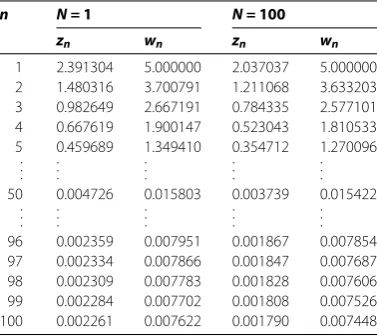
Table 1 The values of the sequences{zn}and{wn}with initial valuesμ=w1= 5
n N= 1 N= 100
zn wn zn wn
1 2.391304 5.000000 2.037037 5.000000 2 1.480316 3.700791 1.211068 3.633203 3 0.982649 2.667191 0.784335 2.577101 4 0.667619 1.900147 0.523043 1.810533 5 0.459689 1.349410 0.354712 1.270096
. .
. ... ... ... ...
50 0.004726 0.015803 0.003739 0.015422 . . . . . . . . . . . . . . . 96 0.002359 0.007951 0.001867 0.007854 97 0.002334 0.007866 0.001847 0.007687 98 0.002309 0.007783 0.001828 0.007606 99 0.002284 0.007702 0.001808 0.007526 100 0.002261 0.007622 0.001790 0.007448
From (.) and the definition ofAi, we have
Fix(S)∩
N
i=
EP(i)∩ N
i=
VI(H,Ai,M) ={}. (.)
For everyn∈N,αn=n ,βn=(n–)n ,γn= (n–)n , ηn=n–n, δn= (n–)n , rn=n+n ,
andρn=n. Then the sequences{αn},{βn},{γn},{ηn},{δn},{rn}, and{ρn}satisfy all the
conditions of Theorem .. For everyn∈N, from (.), we rewrite (.) as follows:
wn+=
nμ+
(n– ) n wn+
(n– ) n
wn–
N N i= i+
NN
iwn
+(n– ) n
I–
n(I–S)
wn
+n– n
wn
+ (Ni=(i+NN)i)n+n
. (.)
Using the algorithm (.) and choosingμ=w= withN= andN= , we have the numerical results in Table .
Conclusion
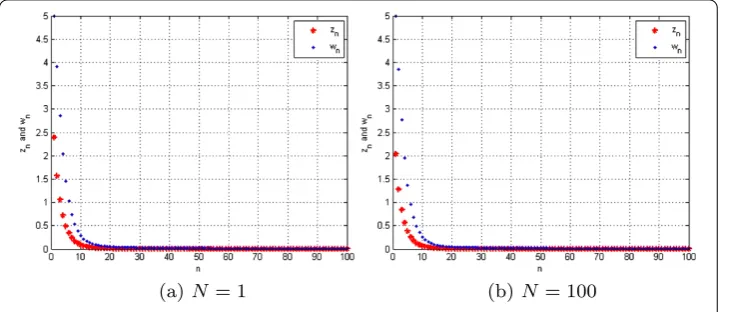
. The sequences{wn}and{zn}converge to as shown in Table and Figure . . From Theorem ., we can conclude that the sequences{wn}and{zn}, in
Example ., converge to .
Next, we give the numerical example to support our some result in a three dimensional space of real numbers.
Example . Let an inner product·,·:R×R→Rbe defined byw,y=w·y=w· y+w·y+w·y and a usual norm · :R→Rdefined byw=
w+w+w
for allw= (w,w,w),y= (y,y,y)∈R. For everyi= , , . . . ,N, let
i:R×R→R, Ai:R→Rbe defined by
i(w,y) =i(y–w)·(w+y), Aiw=
Figure 1 The convergence of{zn}and{wn}with initial valuesμ=w1= 5.
for allw= (w,w,w)∈R,y= (y,y,y)∈Rand letS:R→Rbe defined by
Sw= ⎧ ⎨ ⎩
(–w
, –w
, –w
) ifwi∈[,∞) for alli= , , ,
(w,w,w) ifwi∈(–∞, ) for alli= , , .
For every i= , , . . . ,N, suppose thatJM,λ=I, λ= N, ai= i + NN, bi= i + NN. Let
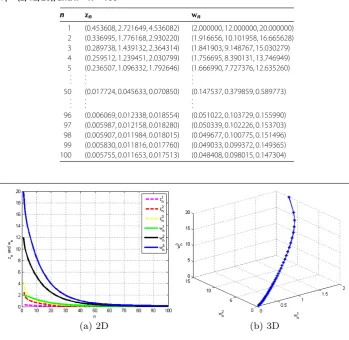
wn= (wn,wn,wn) andzn= (zn,zn,zn) be generated by (.), whereαn=n ,βn=(n–)n , γn= (n–)n , ηn= (n–)n , δn= n–n,rn= n+n , and ρn= n for everyn∈N. Then the sequenceswn= (wn,wn,wn) andzn= (zn,zn,zn) converge strongly towhere= (, , ). Solution. It is easy to see thatSis a-strictly pseudononspreading mapping. Sinceai=
i+NN, we obtain
N
i=
aii(w,y) = N
i=
i+
NN
i(y–w)·(y+ w),
for allw= (w,w,w)∈R,y= (y,y,y)∈R. It is easy to check that
isatisfies the
condition of Theorem . andEP(Ni=aii) =
N
i=EP(i) ={}. Then we have
Fix(S)∩
N
i=
EP(i) ={}. (.)
PutS=Ni=(i+NN)i, we have
≤
N
i=
aii(zn,y) +
rn
y–zn,zn–wn
=S(y–zn)·(y+ zn) +
rn(y–zn)(zn–wn)
=Sy–zn,y–zn,y–zn·y+ zn,y+ zn,y+ zn
+
rn
y–zn,y–zn,y–zn·zn–wn,zn–wn,zn–wn