S U R V E Y
Open Access
A survey of practical adversarial example
attacks
Lu Sun, Mingtian Tan and Zhe Zhou
*Abstract
Adversarial examples revealed the weakness of machine learning techniques in terms of robustness, which moreover inspired adversaries to make use of the weakness to attack systems employing machine learning. Existing researches covered the methodologies of adversarial example generation, the root reason of the existence of adversarial examples, and some defense schemes. However practical attack against real world systems did not appear until recent, mainly because of the difficulty in injecting a artificially generated example into the model behind the hosting system without breaking the integrity. Recent case study works against face recognition systems and road sign recognition systems finally abridged the gap between theoretical adversarial example generation methodologies and practical attack schemes against real systems. To guide future research in defending adversarial examples in the real world, we formalize the threat model for practical attacks with adversarial examples, and also analyze the restrictions and key procedures for launching real world adversarial example attacks.
Keywords: AI systems security, Adversarial examples, Attacks
Introduction
Artificial intelligence (AI) is quickly permeating into our daily life, snatching working opportunities from, but per-forming better and more efficiently than human being. Specifically, AI is blossoming in many and increasingly more fields, from robotic trading to intelligent diagno-sis, from advertisement recommendation to autonomous driving. Unsurprisingly, it also has been applied to system security related areas, like spam filtering, face authen-tication, etc. AI intrudes those fields and emancipates those professionals from brain works, but also outper-forms the professionals in many ways, making it preferred and increasingly more widely accepted.
Machine learning (ML), thede factoapproach to achieve artificial intelligence, provides a convenient way for AI practitioners to rapidly implant intelligence to machines, with the help of labeled data, and without needing to make clear the logics and theory behind data. All in a sudden, the convenient approach was acquired by professionals in nearly every fields. People continually collect data from their users, train machine learning models using the col-lected data and pack the trained models to their products
*Correspondence:[email protected]
Fudan University, Shanghai, People’s Republic of China
to provide better service to their users. The intelligent ser-vice, in turn, attracts more users and usages, and simulta-neously provides more data to refine the machine learning models, resulting in a virtuous circle that absorbing users and practitioners.
Deep neural networks (DNN), an algorithm class for machine learning with breakthrough in accuracy, gained a great success in fields like image processing, natural lan-guage processing etc, however has security risks. For a lot of problems, solutions employing DNN outperform human beings Sun et al. (2014), making DNNs so popular. A key factor of such an achievement is that DNN fea-tures a cascade of many layers, which makes the neurons inside the network very hard to be understood even by their designers. Though the indigestibility does not affect its wide application, it indeed increased the difficulty for researchers to analyze the vulnerabilities of DNN mod-els and fortify the security. What’s worse, adversaries may make use of those vulnerabilities to attack DNN models.
A huge risk results from crafted malicious inputs. An assumption of DNN is that the test data fall to the same distribution of the training data. Therefore, it is not surprising that the output of a model for data from a
ial examples were firstly noticed and formally defined in Szegedy et al. (2013), when the authors found that the mappings of DNNs are so discontinuous. They designed an optimization approach to search perturbations such that a natural input adding a small perturbation together can lead the model to output differently from when the input is the natural input only. The perturbation can be small enough, so human beings can barely notice the existence of the perturbation.
Research around adversarial examples developed from different directions, including defenses against adversar-ial examples or attacks with the examples. Some works focus on the defense mechanism to avoid the generation of adversarial examples, while some others aim at design-ing algorithms to generate examples satisfydesign-ing all kinds of requirements. Researchers defend adversarial examples mainly by masking the gradient, through which adver-saries’ optimizers are expected to fail to move toward malicious. However, this mechanism was proven to be null and void, as a bunch of works got around this kind of protection and successfully generated effective examples, mainly by training substitutional models to remove the mask. This is even true for recent works (Buckman et al.
2018; Ma et al.2018; Guo et al.2017; Dhillon et al.2018; Xie et al.2017; Song et al.2017; Samangouei et al.2018). For the second direction, researchers proposed different norms to measure the conspicuousness of perturbation (Papernot et al.2015; Nguyen et al.2015; Goodfellow et al.
2014).
There are still technical barriers between a generated adversarial example and a successful exploit to a sys-tem. Even for commercially deployed models, it is not difficult for an attacker to generate effective adversarial examples with the help of gradient descending optimizers. However, there are only several works where real world systems were cracked because of adversarial examples, mainly because that only little research concerned how an example can be input to the target model, which usually resides inside the target system without direct interface to attackers. To have a successful and practical attack, attackers must mount the worked out perturbation to con-struct an example, which is usually difficult for different scenarios.
The largest challenge for practical adversarial exam-ple attackers lie in that the input interface of the target model does not expose to adversaries. The adversarial examples calculated by adversaries require pixel modifi-cations to input images. However, in a lot of practical
to make up herself to feed such an pixel level modified image to the target face authentication system. It is obvi-ously less practical to find an interface to directly inject the image to the model behind the face authentication system.
To shed light on future working direction, we completed a comprehensive survey on existing physical and practical adversarial example attacks, including two attacks against face recognition models, one for road sign models. The only existing works against real systems concerning adver-sarial example share a lot in their assumptions, meth-ods and restrictions, and nonetheless conquered different challenges when facing different systems. In this survey, we summarize their works and abstract the threat model their attacks shared in common, and formalize the key techniques a success adversarial example attack should have. We also propose possible future work direction in our opinion.
In this survey, we firstly introduce some background knowledge about adversarial examples. Then we compare the theoretical adversarial example attack model and that of the practical one. Following we introduce the routines existing practical adversarial example attacks mainly fol-low. At last, we show some existing practical adversarial example works.
Adversarial example
The concept of adversarial example was first men-tioned and defined in Szegedy et al. (2013). In that paper, the authors found two counter-intuitive proper-ties of neural networks. One of the properproper-ties is that the input-output mappings of DNN is fairly discontinu-ous to a significant extent. Therefore, the author made the network misclassify the images by applying cer-tain hardly perceptible perturbations. And the mixture of original inputs with a little perturbation in order to maximize the prediction error is so-called adversarial example.
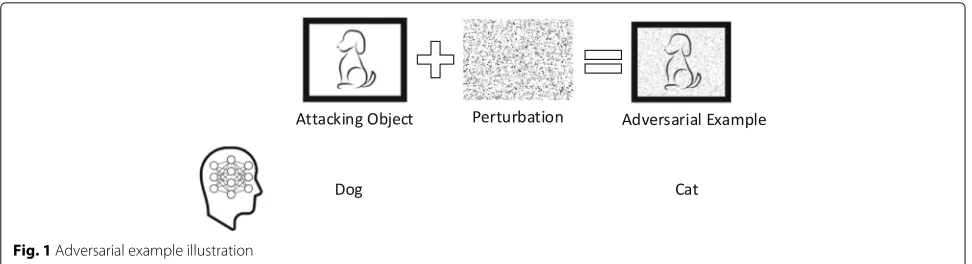
Figure1 illustrate an adversarial example that mislead a machine learning model to recognize a photo of a dog with mixture of perturbations as a cat.
Generating methods of adversarial examples
Fig. 1Adversarial example illustration
problem, with the objective function defined for malicious purpose.
arg min
r
J(f(x+r),y)+QualityPenalty(r) (1)
Where J is the loss function measuring the distance between outputs of the model.f represents the model and yis the target output.ris the perturbation andx+ris the adversarial example. Quality Penalty is usually a kind of norm ofr, which will be introduced later.
The optimization problem can be solved with a gradient optimizer. After an optimizer having minimized the objec-tive, the examplex+rcould be regarded as adversarial if only the loss fall below a given threshold, indicating that the output of the model is close enough to the attacker’s target when she inputs the adversarial example to the model. The state of the art adversarial example generat-ing method is C&W’s Carlini and Wagner (2017b). There are also adversarial example generating methods without the help of gradient optimizers (Su et al.2017). Even when there is no details about the target model, adversaries can still generate adversarial examples Bhagoji et al. (2017).
The author of Yuan et al. (2017) summarized main stream adversarial example generating method.
Distance metrics of adversarial perturbations
The quality of the generated perturbations can be weighted by the norms of the perturbation. When search-ing adversarial perturbations, researchers mainly use three distance metricsL0,L2,L∞to weight the quality.
Minimizing different distances results in different per-turbations. For example, minimizingL0can get
perturba-tions with minimum number of pixels differing from those on the original input. And Jacobian-based Saliency Map (JSMA) Papernot et al. (2015) is an instance for it. Mini-mizingL2helps adversaries obtain perturbations that have
the minimum norm, in terms of Euclidean distance, across all pixels. Using this metric, Nguyen et al. (2015) proposed an interesting attack that adds perturbations on a blank image to fool recognition systems. Besides,L∞helps find-ing perturbations with the smallest maximum-change to pixels. Under this metric, the adversary is allowed to
freely make changes to pixels if only no change exceeds the L∞ distance. An example of this kind of attack is Fast Gradient Sign Method (FGSM) Goodfellow et al. (2014), which iteratively updates perturbations by step-ping away a small stride along with the direction of the gradient.
Detecting adversarial examples
Realized the consequences of adversarial examples, researchers proposed to detect adversarial examples.
People proposed to detect adversarial examples by introducing an extra classifier to pick out adversarial examples, which is called adversarial training, recent related works include Gong et al. (2017). In this kind of defense, people should generate a set of adversarial exam-ple for the model to be protected, and then train an adver-sarial example detector with the generated adveradver-sarial examples.
People also proposed to remove the gradient of the model to be protected Papernot et al. (2016), which is called defensive distillation. This method prevents adver-saries from generating adversarial examples with gradient optimizers.
Recent researches also uses the noise levels of the given input to pick out adversarial examples Meng and Chen (2017). The authors found that adversarial examples carry a higher recovery error when passing through an auto-encoder trained with all normal examples. Or, for some other cases, the noise removed example results in a totally different model output.
These methods, however, all turned to not effective enough by Carlini and Wagner (2017a), mainly because adversaries can adapt their adversarial example generating methods accordingly.
Practical adversarial example attacks
doors if the face authentication models were compro-mised. Autonomous vehicles may overspeed if the road sign recognition models inside were compromised.
Threat models
An adversarial example generated by the aforementioned methods cannot be directly used to attack a real world system, because of their utterly different threat models. In this section, we compare the their models in detail and hight light the model used for practical adversarial example attacks.
Threat model for theoretical attacks
White box attacks.
As shown by Fig.2, for theoretical attacks, it is assumed that the model to be attacked is trained, fixed and directly exposed to attackers. Therefore, an attacker can gener-ate perturbations by minimizing the loss over the model between the target (the cat) and the sum of the attacking object (the dog) and the perturbation.
The attack is thought to be successful when the output of the model is indeed the target in stead of the attacking object, regardless of how the perturbation is added into the image of attacking object.
Black box attacks.
In some cases, the model is not transparently exposed to attackers, in which case the attacker can only query the model with images input and get the result returned. In this setting, the attacker still only needs to work out a per-turbation for the target, such that the model outputs the target Bhagoji et al. (2017).
Untergeted attacks
For some scenarios, attackers do not have a specific tar-get that must be output by the victim model. Instead, they only want the output is not correct, i.e., output whatever rather than dogs. This kind of attack was called untargeted attacks.
should be assumed with more restrictions.
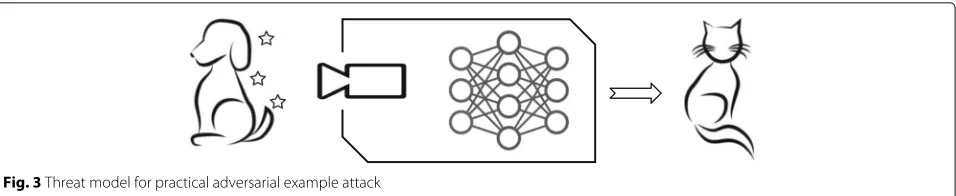
As shown by Fig. 3, the biggest difference lies in that the input of model is not directly exposed to attackers. Instead, the system using the model exposes its capture interfaces to attackers. In this case, attackers cannot break the integrity of the system to directly inject input data to the model inside. Attackers can only manipulate the object in front of the camera (the dog). The goal is still the same: wanting the output of the system to be the target chosen by the attacker (cat).
For this scenario, attackers even face more challenges: the system may impose detection modules between the model and the front end input camera to detect poten-tial attacks. For instance, in a face authentication system, there exists liveness detection modules to examine if the object in front of the camera is a live human being or a printed photo. Considering those mechanisms, attackers usually firstly place a object that can pass the detection and then apply small perturbations that won’t fail the front end examinations.
Similar to theoretical attacks, practical attacks may also differ in black box and white box settings. usually, researchers assume white box settings first where the model structure and weights are known to attackers and come up with supporting black box extension to ease the assumption. For instance, attackers may firstly train a substitutional model by querying the black box. Then they can generate adversarial examples for the substitu-tional mode, which by expectation will also be valid for the model inside the black box Papernot et al. (2016).
Attack routines
The known practical adversarial example attacks also employ optimizers to work out perturbations, but with more restrictions related to implementation considera-tions. A practical adversarial example attack consists of several steps: 1) Constructing loss function for optimizers. 2) Adversarial example Searching and implementation.
Fig. 3Threat model for practical adversarial example attack
We first introduce the restrictions should be taken into consideration in a practical attacking setting and then illustrate how attackers can construct schemes to work out and implement perturbations that under those restrictions.
Attack restrictions
We firstly introduce some restrictions that may met in practical scenarios but was not considered in theoretical adversarial example cases.
Printability.
The first issue the attacker should pay attention to is how perturbations can be presented on the attacking object. In theoretical settings, perturbation pixels are assumed to be directly laid over the image of the attacking object. How-ever, attackers cannot overlay skins with arbitrarily color on the attacking object, when launching attacks in the real world. As a result, adversarial example generating method not limiting the color of perturbation cannot be directly borrowed to launch practical attacks.
To counter the color issue, attackers must restrict the perturbations generated to be printable on the attack-ing object. The restriction is also tightly related to the method the attacker is going to deploy perturbation. For instance, the colors a perturbation has must be inside the color triangle of the printer, if the attacker is plan-ing to print the perturbation into a sticker and paste the sticker on the attacking object. The perturbation should be of the specific color if the attacker is going to modulate perturbations by using mono color light source.
To restrict the perturbation to be printable. The attacker could add to the loss an item representing the difficulty of printing the perturbation, which is firstly defined and called in Sharif et al. (2016) as NPS (non-printability score), shown in Eq. 2. According to its definition , the value will be low when the pixel pˆ is close to a printable colorpchosen from the printable color set P. Evtimov et al. (2017) later upgraded it to generate smooth road sign adversarial example.
NPS(pˆ)=
p∈P
|ˆp−p| (2)
With the item in loss, the optimizer will try its best to generate perturbations that is prone to printable.
Perturbation precision
In theoretical adversarial example generating schemes, example pixels can be independently modified. However, in real world, when launching attacks, attackers can hardly precisely control the perturbed image captured by cam-eras in a pixel level accuracy without breaking the integrity of the victim system. Usually, the attackers must restrict the smoothness (precision) of the perturbation generated by the optimizer.
To get around the pixel level precision issue, attacks may introduceSmoothing restrictions to the examples to be generated. This can be achieved by also adding a fac-tor measuring the variance of the perturbations, which is called and defined as TV in Mahendran and Vedaldi (2015). Sharif et al. (2016) employed this value to restrict the smoothness of their perturbations.
TV(r)=
i,j
(ri,j−ri+1,j)2+(ri,j−ri,j+1)2
1
2 (3)
The adversary may employ a model to produce fully smooth perturbation without pixel precision problem. For example, Zhou et al. (2018) designed an infrared dot model to make sure the perturbation is Gaussian smooth. This may be extended to help attackers to bypass more restrictions. Specifically, attackers may also construct a model describing the printable perturbations with param-eters outlet to optimizers. In this way, the optimizers will no longer optimize the loss over the pixels of an attack image. Instead, it will optimize over the parameters of the model. The model should guarantee that the generated perturbations are always implementable if only the param-eters are in the correct range. The idea is pretty similar with C&W’s clipped and smooth function i.e., tanh Carlini and Wagner (2017b).
r=model(position,shape, ...) (4)
Attack procedures
implementability.
arg min
r
J(x+r,y)+
i
Penaltyi(r) (5)
Where the functionJ represent the loss (or distance) between the adversarial example and the target from the perspective of the target model. Each penalty function weights the difficulty of implementing the perturbation under each restriction.
3. The attack chooses an attacking objectx and his targety, after which he can run a gradient optimizer to work out a perturbationr.
4. The attacker can print the solved perturbation into using his mounting method and start to attack the system.
Existing practical attacks
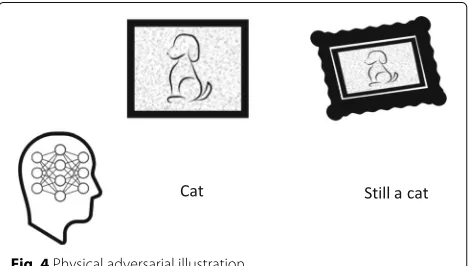
Adversarial examples worked out by optimizers were firstly found to be also recognizable by models in phys-ical world in 2016 Kurakin et al. (2016), where a photo of washer was printed on a paper and the paper was rec-ognized by a classification model as safe or loudspeaker. Figure4illustrates this kind of attack.
Though it is not an attack to a real world system, it did inspire researchers to explore ways to attack real systems using adversarial examples. We introduce some attacks using physical adversarial examples according to their perturbation mounting methods.
Eyeglasses frame
Sharif et al. proposed a scheme to attack face classification system Sharif et al. (2016) in 2016 for both targeted and untargeted, white box and black box. They have two goals:
Fig. 4Physical adversarial illustration
turbed attacker and himself, while for the impersonation, they minimize the loss between the attacker and the victim target. The loss was also added penalties for print-ability, smoothness, robustness.
With the help of the gradient descend algorithm, An attacker can easily get the values of the pixels on the frame, which can then be printed on paper frames by a com-mercial printer. In theory, the attacker gets a successful attack when the cross entropy part of the loss is opti-mized to below (for impersonation) or over (for dodging) a threshold. The attacker needs only wear the frame like wearing glasses and sitting in front of the camera of the target system. The system will take photos for the attacker and pass the photo to back end photo for prediction. The photo with no doubt contains not only the attacking object but also perturbations, which results to the model’s mis-leading. By expectation, the model will classify the photo with the attacker’s willing, as the expected cross entropy is already satisfied. Figure5illustrate this kind of attack.
As a extension of their main work, they proposed a query based method and employed a Particle Swarm opti-mizer to attack classification model in a black box model.
Road sign
Evtimov et al. proposed a white box adversarial exam-ple attack against their own trained road sign recognition models Evtimov et al. (2017). They trained several CNN models, including LISA-CNN and GTSRB-CNN models, to recognize road signs, which then were used as target models. They proposed two kinds of perturbation mount-ing methods for the road sign scenario, i.e., poster and sticker, which are both proved as effective, according to their experiments. They followed Sharif et al. (2016)’s method to construct loss functions which also considered printability and restricted the mounting positions.
Their scenario slightly differs from previous works because they need consider the varying viewing angles for their drive-by requirements. Surprisingly, their evaluation results showed that they got a 100% attack success rate for the drive-by experiments with the poster mounting method, as Fig.6shows.
Infrared
Fig. 5Impersonation attacks with eyeglasses
peak, which can light the attacker’s face with some dots from the perspective of cameras, but cannot be noticed by nearby people. With this technique, they successfully attacked face authentication system in a white box setting. Different from previous two works, they didn’t directly optimize perturbation. they built a model describing the infrared dot produced by LED lights with positions, radius and brightnesses as parameters. Therefore, optimizers can optimize over the parameters to precisely search pertur-bations close to real infrared dots.
They also developed a real time feedback system for attackers to adjust the positions of the LEDs to help them better implement perturbations. This work also dif-fers from previous two in that they don’t need to print
Fig. 6Adversarial road signs valid in different view of angle
perturbation for each target. Instead, attackers need only adjust the device to attack different targets.
Future work directions
We believe that practical adversarial example attacks will outbreak in the near future, with the permeation of machine learning into our life. We think future research could be conducted through the following two directions.
Mounting methods
In different scenarios, attackers need different methods to deploy perturbations, which is the key step for practical adversarial example attacks. It’s mainly due to the lack of a kind of generic perturbation mounting method.
Defending adversarial examples from the model side is still an unsolved problem. Researcher tried all kinds of method but they rarely take effect Athalye et al. (2018), because of the nature of machine learning.
We believe methods less relying on machine learn-ing could be useful in detectlearn-ing adversarial examples. Therefore, people can put the detection in between the image capturing and the model to tick out adversarial example attacks. For instance, liveness detection method may help systems employing face recognition model to find unusual stuffs on face like the frames or other printed objects.
Conclusion
Protections on systems with AI are still far from enough, as recent three pieces of attack we surveyed showed. Attackers can easily generate perturbations by upgrad-ing theoretical adversarial example generatupgrad-ing methods. More importantly, they can devise perturbation mount-ing schemes for specific scenarios, so that attackers can mount the generated perturbations to attack real world systems. We surveyed their works, abstracted their mod-els and proposed direction for future works.
We believe the consequences of practical adversarial example attacks would be severe if the principles behind the attacks are not made clear. To avoid so, researchers must untangle all possible perturbation mounting vec-tors and system designers must attach enough attention to adversarial examples when integrating AI models.
Acknowledgments
We thanks any the reviewers for your precious time and comments. To clearly illustrate the works we surveyed, we directly used the original equations in the relevant referenced works.
Funding
This work is partially sponsored by Shanghai Sailing Program No.18YF1402200.
Authors’ contributions
All authors read and approved the final manuscript.
Competing interests
The authors declare that they have no competing interests.
Publisher’s Note
Springer Nature remains neutral with regard to jurisdictional claims in published maps and institutional affiliations.
Received: 14 August 2018 Accepted: 15 August 2018
Learning Representations
Carlini N, Wagner D (2017a) Adversarial examples are not easily detected: Bypassing ten detection methods. In: Proceedings of the 10th ACM Workshop on Artificial Intelligence and Security. ACM, Dallas. pp 3–14
Carlini N, Wagner D (2017b) Towards evaluating the robustness of neural networks. In: 2017 38th IEEE Symposium on Security and Privacy (SP). IEEE, San Jose. pp 39–57
Dhillon GS, Azizzadenesheli K, Lipton ZC, Bernstein J, Kossaifi J, Khanna A, Anandkumar A (2018) Stochastic activation pruning for robust adversarial defense. arXiv preprint arXiv:1803.01442
Evtimov I, Eykholt K, Fernandes E, Kohno T, Li B, Prakash A, Rahmati A, Song D (2017) Robust physical-world attacks on deep learning models. CoRR abs/1707.08945:1–11.http://arxiv.org/abs/1707.08945
Gong Z, Wang W, Ku WS (2017) Adversarial and clean data are not twins. arXiv preprint arXiv:1704.04960
Guo C, Rana M, Cissé M, van der Maaten L (2017) Countering adversarial images using input transformations. arXiv preprint arXiv:1711.00117 Goodfellow IJ, Shlens J, Szegedy C (2014) Explaining and Harnessing
Adversarial Examples. ArXiv e-prints:1–11
Kurakin A, Goodfellow I, Bengio S (2016) Adversarial examples in the physical world. arXiv preprint arXiv:1607.02533
Ma X, Li B, Wang Y, Erfani SM, Wijewickrema S, Houle ME, Schoenebeck G, Song D, Bailey J (2018) Characterizing adversarial subspaces using local intrinsic dimensionality. arXiv preprint arXiv:1801.02613
Mahendran A, Vedaldi A (2015) Understanding deep image representations by inverting them. In: Computer Vision and Pattern Recognition (CVPR), 2015 IEEE Conference on. IEEE, Boston. pp 5188–5196
Meng D, Chen H (2017) Magnet: a two-pronged defense against adversarial examples. In: Proceedings of the 2017 ACM SIGSAC Conference on Computer and Communications Security. ACM, Dallas. pp 135–147 Nguyen A, Yosinski J, Clune J (2015) Deep neural networks are easily fooled:
High confidence predictions for unrecognizable images. In: Proceedings of the IEEE Conference on Computer Vision and Pattern Recognition. IEEE, Boston. pp 427–436
Papernot N, McDaniel PD, Jha S, Fredrikson M, Celik ZB, Swami A (2015) The limitations of deep learning in adversarial settings. CoRR
abs/1511.07528:1–16
Papernot N, McDaniel P, Wu X, Jha S, Swami A (2016) Distillation as a defense to adversarial perturbations against deep neural networks. In: Security and Privacy (SP), 2016 IEEE Symposium on. IEEE, San Jose. pp 582–597
Papernot N, McDaniel PD, Goodfellow IJ, Jha S, Celik ZB, Swami A (2016) Practical black-box attacks against deep learning systems using adversarial examples. CoRR abs/1602.02697
Samangouei P, Kabkab M, Chellappa R (2018) Defense-gan: Protecting classifiers against adversarial attacks using generative models. CoRR abs/1805.06605:1–17.http://arxiv.org/abs/1805.06605
Sharif M, Bhagavatula S, Bauer L, Reiter MK (2016) Accessorize to a crime: Real and stealthy attacks on state-of-the-art face recognition. In: Proceedings of the 2016 ACM SIGSAC Conference on Computer and Communications Security. ACM, Vienna. pp 1528–1540
Song Y, Kim T, Nowozin S, Ermon S, Kushman N (2017) Pixeldefend: Leveraging generative models to understand and defend against adversarial examples. arXiv preprint arXiv:1710.10766
Su J, Vargas DV, Kouichi S (2017) One pixel attack for fooling deep neural networks. arXiv preprint arXiv:1710.08864
Sun Y, Wang X, Tang X (2014) Deep learning face representation from predicting 10,000 classes. In: Proceedings of the IEEE Conference on Computer Vision and Pattern Recognition. pp 1891–1898
Xie C, Wang J, Zhang Z, Ren Z, Yuille A (2017) Mitigating adversarial effects through randomization. arXiv preprint arXiv:1711.01991
Yuan X, He P, Zhu Q, Bhat RR, Li X (2017) Adversarial examples: Attacks and defenses for deep learning. arXiv preprint arXiv:1712.07107