R E S E A R C H
Open Access
Apolipoprotein E expression is elevated by
interleukin 1 and other interleukin
1-induced factors
Ling Liu
1, Orwa Aboud
1, Richard A Jones
1, Robert E Mrak
4, W Sue T Griffin
1,2,3*and Steven W Barger
1,2,3Abstract
Background:We have previously outlined functional interactions, including feedback cycles, between several of the gene products implicated in the pathogenesis of Alzheimer’s disease. A number of Alzheimer-related stressors induce neuronal expression of apolipoprotein E (ApoE),b-amyloid precursor protein (bAPP), and fragments of the latter such as amyloidb-peptide (Ab) and secreted APP (sAPP). These stressors include interleukin-1 (IL-1)-mediated neuroinflammation and glutamate-mediated excitotoxicity. Such circumstances are especially powerful when they transpire in the context of anAPOEε4 allele.
Methods:Semi-quantitative immunofluorescence imaging was used to analyze rat brains implanted with IL-1b slow-release pellets, sham pellets, or no pellets. Primary neuronal or NT2 cell cultures were treated with IL-1b, glutamate, Ab, or sAPP; relative levels of ApoE mRNA and protein were measured by RT-PCR, qRT-PCR, and western immunoblot analysis. Cultures were also treated with inhibitors of multi-lineage kinases–in particular MAPK-p38 (SB203580), ERK (U0126), or JNK (SP600125)–prior to exposure of cultures to IL-1b, Ab, sAPP, or glutamate.
Results:Immunofluorescence of tissue sections from pellet-implanted rats showed that IL-1binduces expression of
bAPP, IL-1a, and ApoE; the latter was confirmed by western blot analysis. These protein changes were mirrored by increases in their mRNAs, as well as in those encoding IL-1b, IL-1b-converting enzyme (ICE), and tumor necrosis factor (TNF). IL-1balso increased ApoE expression in neuronal cultures. It stimulated release of sAPP and glutamate in these cultures too, and both of these agents–as well as Ab–stimulated ApoE expression themselves, suggesting that they may contribute to the effect of IL-1bon ApoE levels. Inhibitors of MAPK-p38, ERK, and JNK inhibited ApoE induction by all these agents except glutamate, which was sensitive only to inhibitors of ERK and JNK. Conclusion:Conditions of glial activation and hyperexcitation can elevate proinflammatory cytokines, ApoE, glutamate,bAPP, and its secreted fragments. Because each of these factors promotes glial activation and neuronal hyperexcitation, these relationships have the potential to sustain self-propagating neurodegenerative cycles that could culminate in a progressive neurodegenerative disorder such as Alzheimer’s disease.
Keywords:Alzheimer’s disease (AD), amyloid beta (Aβ), apolipoprotein E (ApoE), beta amyloid precursor protein (βAPP), excitotoxicity, glutamate, interleukin-1 (IL-1β), neuroinflammation, neuronal stress, secreted amyloid precur-sor protein (sAPP)
* Correspondence: [email protected]
1
Department of Geriatrics, University of Arkansas for Medical Sciences, Little Rock AR 72205, USA
Full list of author information is available at the end of the article
Introduction
The pluripotent glial cytokine interleukin-1 (IL-1) and the CNS-abundant, lipid-cholesterol-carrying protein apolipoprotein E (ApoE) are key participants in the pathogenesis of Alzheimer’s disease (AD). ApoE contri-butes both to learning and to recovery from neural injury [1], perhaps by enhancing synaptogenesis by influencing Reelin signaling [2,3]. In humans, single-nucleotide polymorphisms in the coding region of the ApoE gene (APOE) yield three alleles (ε2, ε3, ε4) that translate into three distinct protein sequences, ApoE2, ApoE3, and ApoE4. Inheritance of the particular isoform of ApoE encoded by the ε4 variant of theAPOE gene confers significant risk for precocious development of AD [4,5]: those with two copies of theε4 allele of APOE have a 50-90% chance of developing AD by the age of 85, and even one copy confers a three-fold increase in risk over individuals with no ε4 alleles [6]. Though ApoE is primarily expressed in astrocytes in the healthy brain, stressors can induce its expression in neurons [7,8].
Although not as strongly associated with AD risk as possession of ApoE4 sequences, specific polymorphisms in the genes encoding IL-1a and IL-1bare also asso-ciated with increased AD risk. Specifically, variations in the promoter region ofIL1Aand in the coding region of IL1Binfluence AD risk when homozygous in one gene or heterozygous in both [9-13]. Glial activation marked by excess production of both IL-1a andbis a constant feature in several conditions associated with increased risk for precocious development of AD: i) traumatic brain injury (TBI) [14],ii) systemic viral disease, e.g., AIDS [15];iii) the neuronal hyperexcitability of epilepsy [16-19]; iv) chromosome 21 anomalies such as Down’s syndrome [20]; and v) advancing age [21-23]. Each of these stressors is associated with precocious develop-ment of AD [18,24,25], especially in those who have inherited one or moreε4 alleles ofAPOE[1,26-29].
Excess production and secretion of IL-1belevates neu-ronal expression of the precursors of each of the changes characteristic of AD. These neurodegeneration-related precursors includeb-amyloid precursor protein (bAPP), which may lead in vivo to deposition of Ab[30] and further induction of IL-1b[31]; ApoE, which is pre-sent in plaques [32] and necessary for the accumulation of Abdeposits [33]; and hyperphosphorylated tau [5], the principal component of neurofibrillary tangles. IL-1 also inducesa-synuclein [34], the Lewy body precursor.
Despite the potential for contributing to the produc-tion of Ab, elevations ofbAPP may participate in com-pensatory responses. bAPP is elevated in response to stressors beyond IL-1b, including excitotoxins and age itself, yet AD pathology is correlated with a deficiency
in bAPP expression [35]. ApoE appears to mediate the compensatory induction ofbAPP; blocking ApoE synth-esis or its receptors inhibits the effect of glutamate on bAPP [35]. bAPP knockout mice show learning and memory deficits [36] and die prematurely [37]; secreted bAPP (sAPP) is generally neuroprotective [38]. Taken together, these findings suggest that possession of anε4 allele or ApoE insufficiency compromises neurological parameters and exacerbates injury-induced deficits at least in part by limiting inductions of bAPP. ApoE, especially ApoE3, may also serve to keep inflammatory reactions in check [39-41]. A possible mechanism is suggested by the ability of ApoE to suppress the proin-flammatory activity of sAPP [31].
In AD, activated microglia overexpressing IL-1 are present in diffuse Ab deposits prior to the appearance of ApoE [32]. With normal aging, the brain shows increased microglial activation and expression of IL-1 [21], as well as neuronal expression of both ApoE and bAPP [35]. The ability of IL-1bto inducebAPP expres-sion [30,42] raises the question of whether this is a direct mechanism or an indirect phenomenon resulting from ApoE induction, similar to the effect of glutamate [35]. In view of the relations between the AD-related stressors and the importance of ApoE in risk for devel-opment of AD, together with the neuropathological changes observed in AD patients, we tested the hypoth-esis that ApoE would be elevated in CNS neurons sec-ondary to several AD-related stressors associated with excessive expression of IL-1. Specifically, rat primary cortical neurons and a neuropotent human cell line (NTera2) were assessed for ApoE expression after treat-ment with IL-1b, sAPP, glutamate, or Ab. To delineate the roles of multi-lineage kinase (MLK) pathways in the induction of neuronal ApoE expression, we utilized inhi-bitors of p38-MAPK, ERK, and JNK pathways. To deter-mine if such changes in ApoE expression might be observed in vivo, and the potential relationship of such changes to other proteins that are induced by IL-1, we measured the expression of ApoE,bAPP, and other neu-roinflammatory proteins in rat brains exposed to excess IL-1b.
Materials and methods
Pellet Implantation
Sprague-Dawley rats, weighing 264 ± 6 g, were randomly assigned to three groups. Eight rats received implants of 21-day timed-release IL-1b-containing pellets, seven rats received sham (vehicle) pellets, and six rats served as unoperated controls. Twenty-one days after implanta-tion, cortices from left hemispheres were collected for protein and mRNA isolation. For histological study, brain tissues were fixed in 10% formalin, embedded in paraffin, sectioned at 7μm, and prepared for immuno-histochemical analysis. All animal studies were con-ducted in accordance with a protocol reviewed and approved by the Institutional Animal Care and Use Committee of the Central Arkansas Veterans Healthcare System.
Reagents
Rat recombinant mature IL-1b(IL-1b holoprotein clea-vage product) was purchased from Sigma (St. Louis MO), secreted APP (sAPP) was purified from a recombi-nant expression system as described previously [42], and L-glutamate was from Sigma (St. Louis MO). Ab1-42, from US Peptide Inc. (Rancho Cucamonga CA), was dis-solved in DMSO and then incubated at 4°C overnight prior to use. Rabbit anti-mouse IL-1b antibody was from Chemicon (Temecula CA); goat anti-human apoli-poprotein E was from Calbiochem (Sunnyvale CA). Inhi-bitors of the p38-MAPK (SB203580), ERK (U0126), and JNK (SP600125) pathways were from Calbiochem. Med-ium, serum, and B27 supplement for cell cultures were from Invitrogen/Life Technologies (Grand Island NY). The antibodies used were rabbit anti-human IL-1a (Peprotech 4:1000), goat anti-human APP (ADI 1:50), goat anti-Human APO E (Invitrogen 1:50), diluted in antibody diluent (Dako, Carpiteria CA).
Immunofluorescence
For immunofluorescent analysis of brain tissues, paraffin blocks were sectioned at 7 μm and placed on pre-cleaned microscope slides (Fischer). Then, sections were deparaffinized in xylene, rehydrated in graduated etha-nol solutions to deionized water. For IL-1a immunor-eactions, sections were placed in boiling sodium citrate buffer (0.01 M, pH 6.0) for 20 minutes. Sections for bAPP and ApoE were placed in trypsin solution for 10 minutes at 37°C, all sections were blocked using protein block (Dako). For each antibody, sections were incu-bated overnight at room temperature. The secondary antibodies, Alexa Fluor donkey anti-goat and donkey anti-rabbit were diluted in antibody diluent (Dako) and sections were incubated for 60 minutes. The sections were then washed in three changes 5 minutes each of distilled H2O and then coverslipped with prolong Gold with DAPI (Invitrogen).
Image Analysis
Similar to our previous study [35], a quantitative approach was used to examine mean intensities of immunoreactions. Three representative images per slide (40× magnification) from IL-1-pellet, sham, and unoper-ated rat brains were obtained at identical exposure set-tings, using a Nikon Eclipse E600 microscope equipped with a Coolsnap monochrome camera. Each of the three images in each tissue section spanned a total area of 37241.5 μm2. These images were from hippocampal CA1 and two cortical regions, one at the midline and another at the superior aspects of the temporal cortex and were acquired and analyzed using NIS-Elements BR3 software (Nikon.com). All cells of a type were cap-tured, and images were thresholded. Data obtained from cells in each of the three regions were averaged, thus providing a single value for each image, and this value was used for statistical analysis. Data were analyzed by ANOVA to assess difference among groups. A statistical value of p≤0.05 was defined as being significant.
Cell Cultures
Primary neuronal cultures were derived from cerebral cortex of fetal Spraque-Dawley rats (embryonic day 18), as previously described [43]. Experiments using primary neuronal cell cultures were performed after 10-14 days in culture. Highly purified cultures of rat microglia and astrocytes were generated from the cortical tissue of neo-natal (0-3 days) Sprague-Dawley rats, as described pre-viously [43,44]. The NTera2 human cell line (Stratagene, La Jolla, CA) was maintained in Dulbecco’s modified Eagle medium (DMEM; Invitrogen/Life Technologies, Grand Island, NY) supplemented to 10% with fetal bovine serum (FBS). For specific experiments, SB203580 (5μM), U0126 (5μM), or SP600125 (5 μM) was applied to cul-tures one hour before application of a stimulus. Gluta-mate released in the culture medium was assayed with a kit that utilizes a glutamate dehydrogenase-coupled color reaction (Roche Diagnostics, Indianapolis IN).
Reverse Transcription (RT) Reaction and Polymerase Chain Reaction (PCR) Amplification
ensure that maximal cycle number fell within the linear phase of amplification. Real-time (quantitative) RT-PCR was performed as described previously [35]. RT utilized random hexamers for priming, and PCR was performed with the Power SYBR-Green PCR Master Mix in an ABI 7900 HT Fast Real-time PCR System (Applied Biosys-tems, Foster City, CA). Signals were interpolated within standard curve reactions performed for each primer set, and the result for ApoE was expressed as a fraction of the 18S signal for each sample. All primer sequences, annealing temperatures, and number of cycles are pro-vided in Table 1.
Western Immunoblot Assay
Cellular fractions were prepared by application of a lysis buffer (50 mM Tris-HCl, pH 7.5, 150 mM NaCl, 1% Nonidet P40, 0.5% sodium deoxycholate and 0.1% SDS) to the cultures after a wash with cold PBS. Tissue sam-ples were prepared by homogenization in RIPA buffer
(Cell Bioscience) as described previously [35,42]. Lysates were quantified using a Micro BCA assay reagent kit (Pierce, Rockford IL) as described previously [43]. Ali-quots (100μg each) were resolved by SDS-PAGE, sub-jected to electrophoresis at 70 V for 20 minutes and 90 V for 1.5 h, and transferred to nitrocellulose mem-branes. After transfer, each blot was stained with Pon-ceau S to ensure even loading of protein across lanes. Blots were then blocked in I-Block Buffer (Applied Bio-system Inc., Bedford, MA) for 45 minutes, then incu-bated overnight at 4°C with goat anti-human ApoE (1:2000) primary antibody, incubated for 1 h at room temperature with alkaline phosphatase-conjugated sec-ondary antibody, and developed using the Western-Light™ Chemiluminescent Detection System (Applied Biosystem Inc) and exposure to x-ray film. Digital images were captured and analyzed using NIH Image software, version 1.60.
Statistical Analysis
Comparisons between two conditions were made via unpairedt-test, and experiments with a greater number of variables were subjected to ANOVA with Fisher’s post hoctest. Differences were considered significant at p-values≤0.05.
Results
Chronic IL-1bincreases the expression of ApoE,bAPP, and neuroinflammatory factors in rat brain
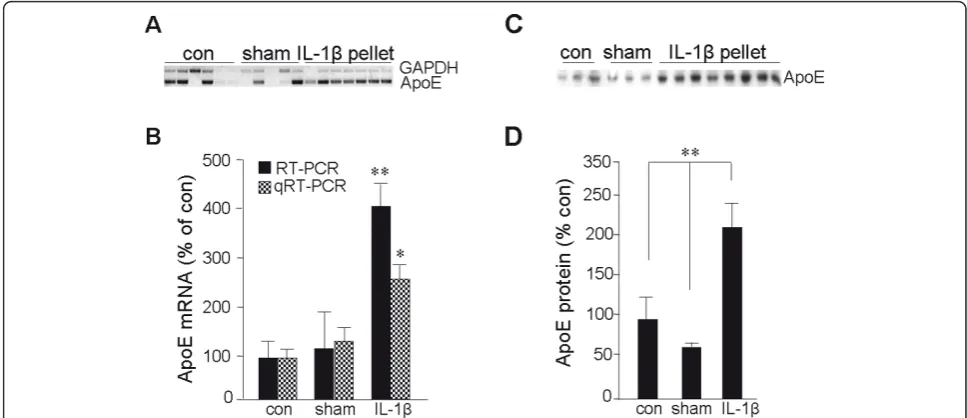
Rats were implanted with either slow-release (21-day) IL-1b-impregnated pellets or vehicle-impregnated sham pellets. Cerebral cortices from these rats, as well as unoperated control rats, were processed for protein or mRNA tissue level analyses or were fixed and processed for immunofluorescent image analyses. Rat brains implanted with IL-1b-containing pellets had markedly elevated steady-state levels of ApoE mRNA (Figure 1A, B) and of ApoE protein (Figure 1C,D) compared to those in rats implanted with sham pellets or to unoper-ated controls (p< 0.01).
Neuroinflammatory conditions and models thereof often exhibit chain reactions of multiple effectors work-ing sequentially, in parallel, or in feedback loops fomenting a persistent and progressive situation. In this vein, the ability of IL-1bto elevate the levels of IL-a prompted an examination of gene-expression indices of neuroinflammation in this chronic IL-1bdelivery para-digm. The increase in IL-1a immunofluorescence noted above was found to be reflected at the mRNA level (Fig-ure 2). Chronic IL-1b also elevated mRNA levels of endogenous IL-1b, as well as its cleavage enzyme ICE (Figure 2). Along with these changes in IL-1-related molecules, the mRNA for the proinflammatory cytokine Table 1 RT-PCR primers
Gene Sequences Annealing
temp. (°C) Cycle
no.
Gel-based PCR, rat
ApoE F: TGT TGG TCC CAT TGC TGA CAG GAT
60 25 R: TGG TGT TTA CCT CGT TGC GGT
ACT
bAPP F: CCC TGA CGC AGT CGA CAA GT 61 25 R: TGT CAT AAC CTG GGA CCG GAT
GAPDH F: CAA CGG ATT TGG CCG TAT TG 61 25 R: TGG GGG TAG GAA CAC GGA A
ICE F: ACA AAG AAG GTG GCG CAT TTC 61 28 R: CCT TGT TTC TCT CCA CGG C
IL-1a F: GAG TCA ACT CAT TGG CGC TTG 60 27 R: GGG CTG ATT GAA ACT TAG CCG
IL-1b F: TGA CTC GTG GGA TGA TGA CG 61 27 R: CTG GAG ACT GCC CAT TCT CG
TNF F: GCA CAG AAA GCA TGA TCC GAG 64 28 R: CCT GGT ATG AAG TGG CAA ATC G
Gel-based PCR, human
ApoE F: TTC TGT GGG CTG CGT TGC TG 60 25 R: TAC ACT GCC AGG CGC TTC TG
GAPDH F: AGG TCG GAG TCA ACG GAT TTG 61 25 R: TGG CAG GTT TTT CTA GAC GGC
Real-time PCR (rat)
ApoE F: CTG GTT CGA GCC GCT AGT G 60 N.A. R: CCT GTA TCT TCT CCA TTA GGT TTG
C
TNF was elevated. These proinflammatory changes were accompanied by induction of bAPP mRNA (Figure 2), consistent with the immunofluorescence results and prior studies of IL-1/bAPP interactions.
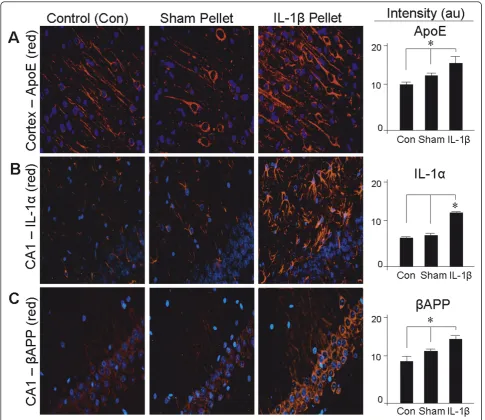
The induction of ApoE in the cortex by IL-1bpellets was also detectable by immunofluorescence (Figure 3A), which demonstrated neuronal localization. IL-1bpellets also elevated expression of IL-1ain the CA1 of hippo-campus (Figure 3B). This IL-1a induction was localized principally to cells with astrocytic morphology. Pyrami-dal neurons of the CA1 overexpressedbAPP in response to the chronic delivery of IL-1b(Figure 3C).
Tissue culture studies reveal potential for indirect impacts of IL-1bon ApoE
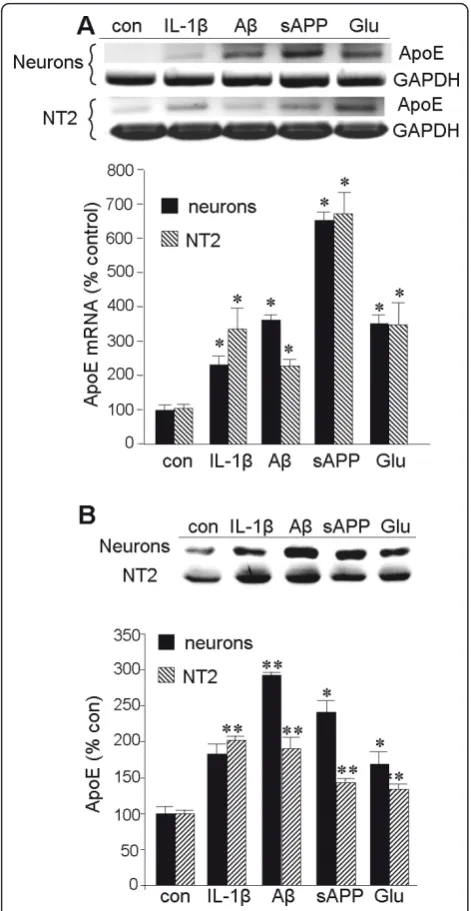
To examine the impact of IL-1bon ApoE expression in greater temporal and mechanistic detail, we utilized two types of neuronal cell culture: primary cultures of rat cortical neurons and the human NTera2 (NT2) cell line. We previously demonstrated that glutamate elevates bAPP expression via a mechanism that requires the bio-logical activity of ApoE [35]. Moreover, IL-1bhas been shown to influence the processing ofbAPP [46]. There-fore, we tested whether ApoE expression was responsive to these agents and another derivative ofbAPP: Ab1-42. In both culture types, expression of ApoE mRNA was elevated approximately two-fold by exposure to IL-1b, Ab1-42, or glutamate for 20 h; the induction by sAPP Figure 1IL-1binduces ApoE expressionin vivo. Proteins were extracted from the left cerebral cortex of unoperated rats (con), of rats implanted in the right cerebrum with a pellet containing vehicle alone (sham), and of rats implanted in the right cerebrum with a slow-release pellet containing 100 ng IL-1b(IL-1bpellet).A:RNA was extracted from the left cerebral cortex of con (n = 6), sham (n = 5), and IL-1bpellet (n = 7) rats and subjected to gel-based RT-PCR for ApoE and GAPDH.B:Quantification of the ApoE mRNA (relative to that for GAPDH) by densitometry of the RT-PCR image or by quantitative (real-time) RT-PCR (qRT-PCR); values reflect the percent of control as mean ± SEM.C:
Proteins were extracted from con (n = 3), sham (n = 3), and IL-1bpellet (n = 8) rats and subjected to western immunoblot analysis for ApoE.D:
Quantification of autoradiography; values reflect percent of control as mean ± SEM. *p≤0.05; **p< 0.01 versus control.
Figure 2IL-1binduces increases in mRNAs encoding ApoE, bAPP, and the proinflammatory factors IL-1b, ICE, IL-1a, and TNF. RNA was extracted from the left cerebral cortex of unoperated rats (Control), rats implanted in the right cerebrum with a pellet containing vehicle alone (Sham), and rats implanted in the right cerebrum with a slow-release pellet containing 100 ng IL-1b(IL-1b Pellet);A:semi-quantitative RT-PCR was performed on the RNA.B:
exceeded six-fold (Figure 4A). All of these agents were found to elevate ApoE protein levels as well (Figure 4B).
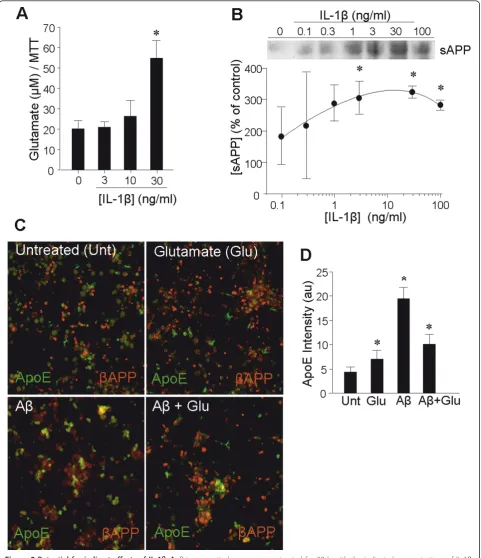
The ability of glutamate and bAPP fragments to impact ApoE was given additional relevance by demon-stration of impacts of IL-1bon these agents. Levels of glutamate released into neuronal culture medium was elevated by IL-1b(Figure 5A). Likewise, IL-1belevated the levels of sAPP in the culture medium of primary neurons in a dose-dependent fashion (Figure 5B). Gluta-mate induction of ApoE in primary neurons was con-firmed by immunofluorescence, which also documented
a larger induction by Ab1-42(Figure 5C,D). Intriguingly, coapplication of glutamate in combination with Ab1-42 reduced the induction to one on par with that of gluta-mate alone (Figure 5D).
Regulation of ApoE expression by IL-1b, Ab, sAPP, and glutamate is via multi-lineage kinase pathways
induction of such ApoE expression, we focused on multi-lineage kinases (MLKs) previously shown to regu-late cytokine-induced AD-reregu-lated proteins [47]. Primary neurons and NT2 cells were incubated with inhibitors of three principle MLK pathways, viz., the MEK/ERK
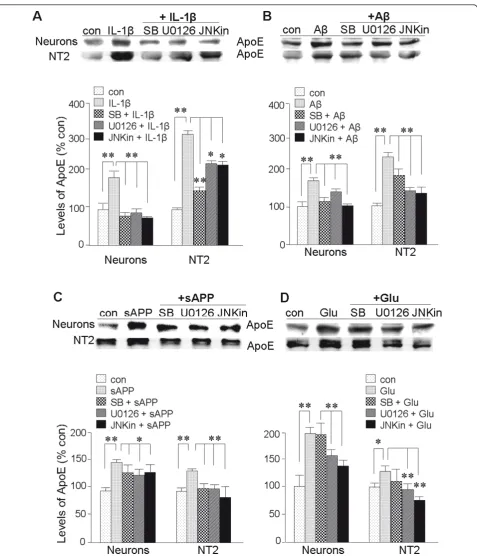
(U0126), MAPK-p38 (SB203580), and JNK (SP600125) pathways. Constitutive expression of ApoE in both pri-mary neurons and NT2 cells was unaffected by treat-ment with these inhibitors (data not shown). However, each of these MLK inhibitors suppressed induction of ApoE by IL-1b(Figure 6A), Ab1-42(Figure 6B), and sAPP (Figure 6C) in both types of culture. Induction of ApoE by glutamate in both NT2 and primary neurons was not inhibited by SB203580, a MAPK-p38 inhibitor. Thus, reg-ulation of ApoE expression by MLK pathways appears to be somewhat selective and dependent on the effector of its induction; in the case of glutamate, ERK and JNK activity is involved but not MAPK-p38 (Figure 6D).
Discussion
The neuroinflammagenic potential of IL-1b is shown here through its induction of synthesis of itself and other proinflammatory cytokines including TNF, IL-1a, IL-1b, as well as the latter’s maturation enzyme ICE. The additional impact of IL-1bon neuronal ApoE pro-duction shown here suggests that in neurological condi-tions where the expression of proinflammatory cytokines is elevated, the expression of IL-1-driven AD-related proteins such as ApoE would be elevated as well. Multiple MLKs–ERK, p38-MAPK, and JNK–were shown to be involved in elevated expression of ApoE in neu-rons exposed to IL-1b, Ab, or sAPP. The increased expression of ApoE induced by glutamate was mediated by ERK and JNK, but not by MAPK-p38. Together, these findings have several implications for AD patho-genesis, particularly with respect to conditions in which neuroinflammation is prominent, especially those influ-enced byAPOEgenotype.
The actions of IL-1 and the other agents tested here– sAPP, Ab, and glutamate–create the possibility for com-plex loops of influence analogous to the vicious circle of neuroinflammatory events we have termed the Cytokine Cycle [48]. Glutamate can elevate neuronal expression of bAPP and its conversion to sAPP [42]. bAPP is ele-vated in dystrophic neurites in and around plaques [49]; its breakdown into both sAPP and Ab can result in induction of IL-1bin microglia [31,50]. In addition to inducing IL-1bexpression and release, sAPP and Ab also stimulate microglia to release biologically relevant levels of glutamate and its cooperative excitatory amino acid D-serine [44,51,52]. Thus, future studies should address the potential for each of these agents to act indirectly through the elaboration of a key agent or agents that can directly stimulate ApoE expression.
Key to interpretation of our findings–and, indeed, to the role of APOE genotype in AD–is determining whether elevation of ApoE levels would be beneficial or harmful. Possession of the ε4 allele is associated with enhanced deposition of Ab[53], consistent within vitro Figure 4 Elevation of ApoE expression in neuronal cells by
stimuli relevant to Alzheimer’s disease. Primary cortical neurons or NT2 cells were treated with IL-1b(30 ng/ml), Ab1-42(10μM),
sAPP (30 nM), or Glu (50μM) for 20 h.A:RNA was extracted from the cultures for RT-PCR of ApoE and GAPDH as illustrated. The results were quantified by densitometry, and values represent the mean ± SEM for the ApoE amplimer relative to that for GAPDH.B:
Figure 5Potential for indirect effects of IL-1b.A:Primary cortical neurons were treated for 20 h with the indicated concentrations of IL-1b, and glutamate levels were assessed in the medium (*p< 0.05).B:Primary cortical neurons were treated for 20 h with the indicated
concentrations of IL-1b, and sAPP levels were assessed in concentrated aliquots of the culture medium by western blot; *p< 0.05.C:Primary cortical neurons were treated for 20 h with glutamate (50μM) and Ab1-42(10μM) alone, or with a combination of the two; immunofluorescence
Figure 6Roles for p38-MAPK, ERK, and JNK in elevation of ApoE expression by IL-1b, Ab1-42, sAPP, and glutamate. Cultures of primary
cortical neurons or NT2 cells were treated for 20 h withA:IL-1b(30 ng/ml),B:Ab1-42(10μM),C:sAPP (30 nM),D:or glutamate (50μM). In
studies wherein ApoE was shown to enhance Ab fibril-logenesis [54]. In this regard, ApoE4 has been shown to be more effective than ApoE3, fostering speculation that replacement of the ε3 allele byε4 merely enhances an activity already present in ApoE3. This has been described as a toxic gain of function, implying that over-abundance of any ApoE–even ApoE2 or ApoE3–would also create a gain in this function and thus be detrimen-tal. Moreover, transient increases in cellular ApoE occur in response to injuries that promote AD, e.g., traumatic brain injury [55] and stroke [56]. ApoE4 is generally reported to be present at higher steady-state levels than ApoE3 in CSF or brain parenchyma [57-61], though some studies have reported lower levels of total ApoE in ε4-positive individuals [62,63].
In contrast to these connections to pathology, ApoE provides neuroprotection in many paradigms, and ApoE deficiency has proved detrimental in several respects [64]. Therefore, inductions of ApoE by the stimuli we tested may represent a compensatory response, meaning that the distinction between ApoE3 and ApoE4 repre-sents loss of a beneficial function. ApoE has anti-inflam-matory effects, and even its interaction with Ab can attenuate glial activation by the latter [65]. However, ApoE3 is more effective than ApoE4 as an anti-inflam-matory agent [31,65,66], so this putative compensatory response may be inadequate in ε4-positive individuals and thus allow more extensive propagation of the Cyto-kine Cycle. Such an allele-specific compensatory response may also extend to direct neuroprotective activity. We previously reported that ApoE3 induces bAPP expression but ApoE4 does not [35], confirming the findings of Ezraet al.[67]. In this regard, elevations of ApoE by the process of neuroinflammation, or other stressors, would reflect a requisite role for the lipopro-tein in enhancing the beneficial roles ofbAPP and/or other acute-phase response proteins. Thus, it would be the inability of ApoE4 to participate in this chain of salutary events that makes it detrimental. We have pre-viously shown that the increase in ApoE brain levels that occurs with aging continues to occur in AD, with a large fraction being deposited in plaques [35]. This increase in ApoE levels is distinguishable from changes inbAPP, which rises with age but declines markedly in AD [35]. This disease-associated severance of the coor-dinate regulation of ApoE andbAPP further strengthens the correlation of brain health with the coregulation of these two proteins; to wit, with ApoE expression itself, provided that the ApoE is not ApoE4.
Multi-lineage kinase pathways may be invoked in the regulation of ApoE expression, and can themselves be invoked by ApoE [68,69], suggesting a feedback loop between MLK pathways and ApoE expression in neu-rons. Our findings of involvement of multiple MLKs–
ERK, p38-MAPK, and JNK–in expression of ApoE in neurons exposed to IL-1b, Ab, or sAPP, together with previous reports of ERK pathway invocation of ApoE expression and vice versa, are consistent with the exis-tence of a complex feedback system that may be impor-tant in acute-phase responses to neuronal injury as well as potential exacerbation of neurodegenerative events. Our finding that glutamate regulates ApoE expression via ERK and JNK, but not by p38-MAPK pathways may be indicative of a correlation between glutamatergic induction of ApoE and neuronal survival. Excitotoxic effects of glutamate are largely dependent upon activa-tion of extrasynaptic NMDA receptors, p38-MAPK, and the inhibition of ERK signaling; synaptic receptors, on the other hand, appear to activate ERK and promote survival [70-72].
In conclusion, the induction of neuronal ApoE by either neuroinflammatory or excitotoxic agents or neu-rotoxins, acting through MLK pathways suggests that alterations in these signaling pathways, together with other neuropathological entities in AD brain, may have consequences for ApoE expression. Differences in this expression may be critical, considering the role ofAPOE genotype in AD risk. The response of ApoE to IL-1bwe show here in rodent brain suggests that elevation of IL-1 leads to the increases in ApoE that we and others have observed in the AD brain. This may have added significance with regard to the self-propagating nature of IL-1-driven cascades, especially when such cascades are instigated in the context of an ε4 allele of APOE. While induction of ApoE2 or ApoE3 may be anti-inflammatory or neuroprotective, and thereby act as a self-limiting influence on IL-1-driven cascades, ApoE4 may fail to participate and leave the brain vulnerable to prolonged activation of a maladaptive cycle.
Acknowledgements
The authors thank John McGinness, Quinton Palmer, Dr. Jin G. Sheng, Sue Woodward, and Weiwen Ye for technical support. This work was supported in part by NIH grants AG12411, AG19606, HD37989, AG17498, and AG033215; by a grant from the Alzheimer’s Association; and by endowments from The Alexa and William T. Dillard, the Windgate Foundation, and the Donald W. Reynolds Foundation.
Author details 1
Department of Geriatrics, University of Arkansas for Medical Sciences, Little Rock AR 72205, USA.2Neurobiology and Developmental Sciences, University
of Arkansas for Medical Sciences, Little Rock AR 72205, USA.3Geriatric Research Education and Clinical Center, Central Arkansas Veterans Healthcare System, Little Rock AR 72205, USA.4Department of Pathology, University of Toledo Health Science Campus, Toledo OH 43614, USA.
Authors’contributions
study and interpretation of the results and completed the final draft of the manuscript. All authors read and approved the final manuscript.
Competing interests
S.W.B. receives royalty payments from Sigma-Aldrich Corp., which manufactures some of the reagents utilized in this study. The authors have no other conflicts to declare.
Received: 21 June 2011 Accepted: 15 December 2011 Published: 15 December 2011
References
1. Blackman JA, Worley G, Strittmatter WJ:Apolipoprotein E and brain injury: implications for children.Dev Med Child Neurol2005,47:64-70.
2. D’Arcangelo G:Apoer2: a reelin receptor to remember.Neuron2005,
47:471-473.
3. D’Arcangelo G, Homayouni R, Keshvara L, Rice DS, Sheldon M, Curran T:
Reelin is a ligand for lipoprotein receptors.Neuron1999,24:471-479. 4. Strittmatter WJ, Bova Hill C:Molecular biology of apolipoprotein E.Curr
Opin Lipidol2002,13:119-123.
5. Strittmatter WJ, Saunders AM, Goedert M, Weisgraber KH, Dong LM, Jakes R, Huang DY, Pericak-Vance M, Schmechel D, Roses AD:Isoform-specific interactions of apolipoprotein E with microtubule-associated protein tau: implications for Alzheimer disease.Proc Natl Acad Sci USA1994,
91:11183-11186.
6. Bu G:Apolipoprotein E and its receptors in Alzheimer’s disease: pathways, pathogenesis and therapy.Nat Rev Neurosci2009.
7. Boschert U, Merlo-Pich E, Higgins G, Roses AD, Catsicas S:Apolipoprotein E expression by neurons surviving excitotoxic stress.Neurobiol Dis1999,
6:508-514.
8. Xu Q, Bernardo A, Walker D, Kanegawa T, Mahley RW, Huang Y:Profile and regulation of apolipoprotein E (ApoE) expression in the CNS in mice with targeting of green fluorescent protein gene to the ApoE locus.J Neurosci2006,26:4985-4994.
9. Du Y, Dodel RC, Eastwood BJ, Bales KR, Gao F, Lohmuller F, Muller U, Kurz A, Zimmer R, Evans RM,et al:Association of an interleukin 1 alpha polymorphism with Alzheimer’s disease.Neurology2000,55:480-483. 10. Grimaldi LM, Casadei VM, Ferri C, Veglia F, Licastro F, Annoni G, Biunno I,
De Bellis G, Sorbi S, Mariani C,et al:Association of early-onset Alzheimer’s disease with an interleukin-1alpha gene polymorphism.Ann Neurol2000,
47:361-365.
11. Nicoll JA, Mrak RE, Graham DI, Stewart J, Wilcock G, MacGowan S, Esiri MM, Murray LS, Dewar D, Love S,et al:Association of interleukin-1 gene polymorphisms with Alzheimer’s disease.Ann Neurol2000,47:365-368. 12. Rebeck GW:Confirmation of the genetic association of interleukin-1A
with early onset sporadic Alzheimer’s disease.Neurosci Lett2000,
293:75-77.
13. Bertram L, Tanzi RE:Thirty years of Alzheimer’s disease genetics: the implications of systematic meta-analyses.Nat Rev Neurosci2008,
9:768-778.
14. Griffin WS, Sheng JG, Gentleman SM, Graham DI, Mrak RE, Roberts GW:
Microglial interleukin-1 alpha expression in human head injury: correlations with neuronal and neuritic beta-amyloid precursor protein expression.Neurosci Lett1994,176:133-136.
15. Stanley LC, Mrak RE, Woody RC, Perrot LJ, Zhang S, Marshak DR, Nelson SJ, Griffin WS:Glial cytokines as neuropathogenic factors in HIV infection: pathogenic similarities to Alzheimer’s disease.J Neuropathol Exp Neurol
1994,53:231-238.
16. Sheng JG, Boop FA, Mrak RE, Griffin WS:Increased neuronal beta-amyloid precursor protein expression in human temporal lobe epilepsy: association with interleukin-1 alpha immunoreactivity.J Neurochem1994,
63:1872-1879.
17. Griffin WS, Yeralan O, Sheng JG, Boop FA, Mrak RE, Rovnaghi CR, Burnett BA, Feoktistova A, Van Eldik LJ:Overexpression of the neurotrophic cytokine S100 beta in human temporal lobe epilepsy.J Neurochem1995,65:228-233.
18. Mackenzie IR, Miller LA:Senile plaques in temporal lobe epilepsy.Acta Neuropathol (Berl)1994,87:504-510.
19. Vezzani A, Balosso S, Ravizza T:The role of cytokines in the pathophysiology of epilepsy.Brain Behav Immun2008,22:797-803.
20. Griffin WS, Stanley LC, Ling C, White L, MacLeod V, Perrot LJ, White CL, Araoz C:Brain interleukin 1 and S-100 immunoreactivity are elevated in Down syndrome and Alzheimer disease.Proc Natl Acad Sci USA1989,
86:7611-7615.
21. Sheng JG, Mrak RE, Griffin WS:Enlarged and phagocytic, but not primed, interleukin-1 alpha-immunoreactive microglia increase with age in normal human brain.Acta Neuropathol (Berl)1998,95:229-234. 22. Blasko I, Stampfer-Kountchev M, Robatscher P, Veerhuis R, Eikelenboom P,
Grubeck-Loebenstein B:How chronic inflammation can affect the brain and support the development of Alzheimer’s disease in old age: the role of microglia and astrocytes.Aging Cell2004,3:169-176.
23. Gee JR, Ding Q, Keller JN:Age-related alterations of Apolipoprotein E and interleukin-1beta in the aging brain.Biogerontology2006,7:69-79. 24. Esiri MM, Biddolph SC, Morris CS:Prevalence of Alzheimer plaques in
AIDS.J Neurol Neurosurg Psychiatry1998,65:29-33.
25. Graham DI, Gentleman SM, Nicoll JA, Royston MC, McKenzie JE, Roberts GW, Griffin WS:Altered beta-APP metabolism after head injury and its relationship to the aetiology of Alzheimer’s disease.Acta Neurochir Suppl1996,66:96-102.
26. Gouras GK, Relkin NR, Sweeney D, Munoz DG, Mackenzie IR, Gandy S:
Increased apolipoprotein E epsilon 4 in epilepsy with senile plaques. Ann Neurol1997,41:402-404.
27. Teasdale GM, Murray GD, Nicoll JA:The association between APOE epsilon4, age and outcome after head injury: a prospective cohort study.Brain2005,128:2556-2561.
28. Corder EH, Robertson K, Lannfelt L, Bogdanovic N, Eggertsen G, Wilkins J, Hall C:HIV-infected subjects with the E4 allele for APOE have excess dementia and peripheral neuropathy.Nat Med1998,4:1182-1184. 29. Prasher VP, Farrer MJ, Kessling AM, Fisher EM, West RJ, Barber PC, Butler AC:
Molecular mapping of Alzheimer-type dementia in Down’s syndrome. Ann Neurol1998,43:380-383.
30. Sheng JG, Ito K, Skinner RD, Mrak RE, Rovnaghi CR, Van Eldik LJ, Griffin WS:
In vivo and in vitro evidence supporting a role for the inflammatory cytokine interleukin-1 as a driving force in Alzheimer pathogenesis. Neurobiol Aging1996,17:761-766.
31. Barger SW, Harmon AD:Microglial activation by Alzheimer amyloid precursor protein and modulation by apolipoprotein E.Nature1997,
388:878-881.
32. Sheng JG, Mrak RE, Griffin WS:Apolipoprotein E distribution among different plaque types in Alzheimer’s disease: implications for its role in plaque progression.Neuropathol Appl Neurobiol1996,22:334-341. 33. Bales KR, Verina T, Cummins DJ, Du Y, Dodel RC, Saura J, Fishman CE,
DeLong CA, Piccardo P, Petegnief V,et al:Apolipoprotein E is essential for amyloid deposition in the APP(V717F) transgenic mouse model of Alzheimer’s disease.Proc Natl Acad Sci USA1999,96:15233-15238. 34. Griffin WS, Liu L, Li Y, Mrak RE, Barger SW:Interleukin-1 mediates
Alzheimer and Lewy body pathologies.J Neuroinflammation2006,3:5. 35. Barger SW, DeWall KM, Liu L, Mrak RE, Griffin WS:Relationships between
expression of apolipoprotein E and beta-amyloid precursor protein are altered in proximity to Alzheimer beta-amyloid plaques: potential explanations from cell culture studies.J Neuropathol Exp Neurol2008,
67:773-783.
36. Senechal Y, Kelly PH, Dev KK:Amyloid precursor protein knockout mice show age-dependent deficits in passive avoidance learning.Behav Brain Res2008,186:126-132.
37. Dawson GR, Seabrook GR, Zheng H, Smith DW, Graham S, O’Dowd G, Bowery BJ, Boyce S, Trumbauer ME, Chen HY,et al:Age-related cognitive deficits, impaired long-term potentiation and reduction in synaptic marker density in mice lacking the beta-amyloid precursor protein. Neuroscience1999,90:1-13.
38. Mattson MP:Cellular actions of beta-amyloid precursor protein and its soluble and fibrillogenic derivatives.Physiol Rev1997,77:1081-1132. 39. Laskowitz DT, Matthew WD, Bennett ER, Schmechel D, Herbstreith MH,
Goel S, McMillian MK:Endogenous apolipoprotein E suppresses LPS-stimulated microglial nitric oxide production.Neuroreport1998,9:615-618. 40. Lynch JR, Morgan D, Mance J, Matthew WD, Laskowitz DT:Apolipoprotein
E modulates glial activation and the endogenous central nervous system inflammatory response.J Neuroimmunol2001,114:107-113. 41. Koistinaho M, Kettunen MI, Holtzman DM, Kauppinen RA, Higgins LS,
amyloid precursor protein-induced ischemic susceptibility.Stroke2002,
33:1905-1910.
42. Li Y, Liu L, Kang J, Sheng JG, Barger SW, Mrak RE, Griffin WS:Neuronal-glial interactions mediated by interleukin-1 enhance neuronal
acetylcholinesterase activity and mRNA expression.J Neurosci2000,
20:149-155.
43. Li Y, Wang J, Sheng JG, Liu L, Barger SW, Jones RA, Van Eldik LJ, Mrak RE, Griffin WS:S100 beta increases levels of beta-amyloid precursor protein and its encoding mRNA in rat neuronal cultures.J Neurochem1998,
71:1421-1428.
44. Wu SZ, Bodles AM, Porter MM, Griffin WS, Basile AS, Barger SW:Induction of serine racemase expression and D-serine release from microglia by amyloid beta-peptide.J Neuroinflammation2004,1:2.
45. Li Y, Liu L, Barger SW, Mrak RE, Griffin WS:Vitamin E suppression of microglial activation is neuroprotective.J Neurosci Res2001,66:163-170. 46. Buxbaum JD, Oishi M, Chen HI, Pinkas-Kramarski R, Jaffe EA, Gandy SE,
Greengard P:Cholinergic agonists and interleukin 1 regulate processing and secretion of the Alzheimer beta/A4 amyloid protein precursor.Proc Natl Acad Sci USA1992,89:10075-10078.
47. Sheng JG, Jones RA, Zhou XQ, McGinness JM, Van Eldik LJ, Mrak RE, Griffin WS:Interleukin-1 promotion of MAPK-p38 overexpression in experimental animals and in Alzheimer’s disease: potential significance for tau protein phosphorylation.Neurochem Int2001,39:341-348. 48. Griffin WS, Sheng JG, Royston MC, Gentleman SM, McKenzie JE, Graham DI,
Roberts GW, Mrak RE:Glial-neuronal interactions in Alzheimer’s disease: the potential role of a‘cytokine cycle’in disease progression.Brain Pathol1998,8:65-72.
49. Mrak RE, Sheng JG, Griffin WS:Correlation of astrocytic S100 beta expression with dystrophic neurites in amyloid plaques of Alzheimer’s disease.J Neuropathol Exp Neurol1996,55:273-279.
50. Meda L, Baron P, Prat E, Scarpini E, Scarlato G, Cassatella MA, Rossi F:
Proinflammatory profile of cytokine production by human monocytes and murine microglia stimulated with beta-amyloid[25-35].J Neuroimmunol1999,93:45-52.
51. Barger SW, Mattson MP:Isoform-specific modulation by apolipoprotein E of the activities of secreted beta-amyloid precursor protein.J Neurochem
1997,69:60-67.
52. Wu S, Basile AS, Barger SW:Induction of serine racemase expression and D-serine release from microglia by secreted amyloid precursor protein (sAPP).Curr Alzheimer Res2007,4:243-251.
53. Schmechel DE, Saunders AM, Strittmatter WJ, Crain BJ, Hulette CM, Joo SH, Pericak-Vance MA, Goldgaber D, Roses AD:Increased amyloid beta-peptide deposition in cerebral cortex as a consequence of apolipoprotein E genotype in late-onset Alzheimer disease.Proc Natl Acad Sci USA1993,90:9649-9653.
54. Wisniewski T, Castano EM, Golabek A, Vogel T, Frangione B:Acceleration of Alzheimer’s fibril formation by apolipoprotein E in vitro.Am J Pathol
1994,145:1030-1035.
55. Horsburgh K, Fitzpatrick M, Nilsen M, Nicoll JA:Marked alterations in the cellular localisation and levels of apolipoprotein E following acute subdural haematoma in rat.Brain Res1997,763:103-110.
56. Kay A, Petzold A, Kerr M, Keir G, Thompson E, Nicoll J:Temporal alterations in cerebrospinal fluid amyloid beta-protein and apolipoprotein E after subarachnoid hemorrhage.Stroke2003,34:e240-243.
57. Lambert JC, Perez-Tur J, Dupire MJ, Galasko D, Mann D, Amouyel P, Hardy J, Delacourte A, Chartier-Harlin MC:Distortion of allelic expression of apolipoprotein E in Alzheimer’s disease.Hum Mol Genet1997,
6:2151-2154.
58. Hesse C, Larsson H, Fredman P, Minthon L, Andreasen N, Davidsson P, Blennow K:Measurement of apolipoprotein E (apoE) in cerebrospinal fluid.Neurochem Res2000,25:511-517.
59. Fukumoto H, Ingelsson M, Garevik N, Wahlund LO, Nukina N, Yaguchi Y, Shibata M, Hyman BT, Rebeck GW, Irizarry MC:APOE epsilon 3/epsilon 4 heterozygotes have an elevated proportion of apolipoprotein E4 in cerebrospinal fluid relative to plasma, independent of Alzheimer’s disease diagnosis.Exp Neurol2003,183:249-253.
60. Bray NJ, Jehu L, Moskvina V, Buxbaum JD, Dracheva S, Haroutunian V, Williams J, Buckland PR, Owen MJ, O’Donovan MC:Allelic expression of APOE in human brain: effects of epsilon status and promoter haplotypes.Hum Mol Genet2004,13:2885-2892.
61. Darreh-Shori T, Modiri N, Blennow K, Baza S, Kamil C, Ahmed H, Andreasen N, Nordberg A:The apolipoprotein E varepsilon4 allele plays pathological roles in AD through high protein expression and interaction with butyrylcholinesterase.Neurobiol Aging2009.
62. Beffert U, Cohn JS, Petit-Turcotte C, Tremblay M, Aumont N, Ramassamy C, Davignon J, Poirier J:Apolipoprotein E and beta-amyloid levels in the hippocampus and frontal cortex of Alzheimer’s disease subjects are disease-related and apolipoprotein E genotype dependent.Brain Res
1999,843:87-94.
63. Bertrand P, Poirier J, Oda T, Finch CE, Pasinetti GM:Association of apolipoprotein E genotype with brain levels of apolipoprotein E and apolipoprotein J (clusterin) in Alzheimer disease.Brain Res Mol Brain Res
1995,33:174-178.
64. Kim J, Basak JM, Holtzman DM:The role of apolipoprotein E in Alzheimer’s disease.Neuron2009,63:287-303.
65. Guo L, LaDu MJ, Van Eldik LJ:A dual role for apolipoprotein e in neuroinflammation: anti- and pro-inflammatory activity.J Mol Neurosci
2004,23:205-212.
66. Colton CA, Brown CM, Cook D, Needham LK, Xu Q, Czapiga M, Saunders AM, Schmechel DE, Rasheed K, Vitek MP:APOE and the regulation of microglial nitric oxide production: a link between genetic risk and oxidative stress.Neurobiol Aging2002,23:777-785.
67. Ezra Y, Oron L, Moskovich L, Roses AD, Beni SM, Shohami E,
Michaelson DM:Apolipoprotein E4 decreases whereas apolipoprotein E3 increases the level of secreted amyloid precursor protein after closed head injury.Neuroscience2003,121:315-325.
68. Hoe HS, Harris DC, Rebeck GW:Multiple pathways of apolipoprotein E signaling in primary neurons.J Neurochem2005,93:145-155. 69. Ohkubo N, Mitsuda N, Tamatani M, Yamaguchi A, Lee YD, Ogihara T,
Vitek MP, Tohyama M:Apolipoprotein E4 stimulates cAMP response element-binding protein transcriptional activity through the extracellular signal-regulated kinase pathway.J Biol Chem2001,276:3046-3053. 70. Hardingham GE, Fukunaga Y, Bading H:Extrasynaptic NMDARs oppose
synaptic NMDARs by triggering CREB shut-off and cell death pathways. Nat Neurosci2002,5:405-414.
71. Soriano FX, Martel MA, Papadia S, Vaslin A, Baxter P, Rickman C, Forder J, Tymianski M, Duncan R, Aarts M,et al:Specific targeting of pro-death NMDA receptor signals with differing reliance on the NR2B PDZ ligand.J Neurosci2008,28:10696-10710.
72. Xu J, Kurup P, Zhang Y, Goebel-Goody SM, Wu PH, Hawasli AH, Baum ML, Bibb JA, Lombroso PJ:Extrasynaptic NMDA receptors couple
preferentially to excitotoxicity via calpain-mediated cleavage of STEP.J Neurosci2009,29:9330-9343.
doi:10.1186/1742-2094-8-175
Cite this article as:Liuet al.:Apolipoprotein E expression is elevated by interleukin 1 and other interleukin 1-induced factors.Journal of Neuroinflammation20118:175.
Submit your next manuscript to BioMed Central and take full advantage of:
• Convenient online submission
• Thorough peer review
• No space constraints or color figure charges
• Immediate publication on acceptance
• Inclusion in PubMed, CAS, Scopus and Google Scholar
• Research which is freely available for redistribution