
www.biogeosciences.net/11/7291/2014/ doi:10.5194/bg-11-7291-2014
© Author(s) 2014. CC Attribution 3.0 License.
iMarNet: an ocean biogeochemistry model intercomparison project
within a common physical ocean modelling framework
L. Kwiatkowski1,2, A. Yool3, J. I. Allen4, T. R. Anderson3, R. Barciela5, E. T. Buitenhuis6, M. Butenschön4,
C. Enright6, P. R. Halloran7, C. Le Quéré6, L. de Mora4, M.-F. Racault4, B. Sinha3, I. J. Totterdell5, and P. M. Cox1 1College of Engineering, Mathematics and Physical Sciences, University of Exeter, Exeter EX4 4QF, UK
2Department of Global Ecology, Carnegie Institution for Science, 260 Panama Street, Stanford, California 94305, USA 3National Oceanography Centre, University of Southampton Waterfront Campus, European Way,
Southampton SO14 3ZH, UK
4Plymouth Marine Laboratory, Prospect Place, West Hoe, Plymouth PL1 3DH, UK 5Hadley Centre, Met Office, Exeter EX1 3PB, UK
6Tyndall Centre for Climate Change Research, School of Environmental Sciences, University of East Anglia, Norwich, UK 7College of Life and Environmental Sciences, University of Exeter, Exeter EX4 4RJ, UK
Correspondence to: L. Kwiatkowski ([email protected])
Received: 5 June 2014 – Published in Biogeosciences Discuss.: 10 July 2014
Revised: 15 November 2014 – Accepted: 17 November 2014 – Published: 19 December 2014
Abstract. Ocean biogeochemistry (OBGC) models span a wide variety of complexities, including highly sim-plified nutrient-restoring schemes, nutrient–phytoplankton– zooplankton–detritus (NPZD) models that crudely represent the marine biota, models that represent a broader trophic structure by grouping organisms as plankton functional types (PFTs) based on their biogeochemical role (dynamic green ocean models) and ecosystem models that group organisms by ecological function and trait. OBGC models are now integral components of Earth system models (ESMs), but they compete for computing resources with higher resolu-tion dynamical setups and with other components such as at-mospheric chemistry and terrestrial vegetation schemes. As such, the choice of OBGC in ESMs needs to balance model complexity and realism alongside relative computing cost. Here we present an intercomparison of six OBGC models that were candidates for implementation within the next UK Earth system model (UKESM1). The models cover a large range of biological complexity (from 7 to 57 tracers) but all include representations of at least the nitrogen, carbon, alka-linity and oxygen cycles. Each OBGC model was coupled to the ocean general circulation model Nucleus for European Modelling of the Ocean (NEMO) and results from physically identical hindcast simulations were compared. Model skill was evaluated for biogeochemical metrics of global-scale
bulk properties using conventional statistical techniques. The computing cost of each model was also measured in stan-dardised tests run at two resource levels. No model is shown to consistently outperform all other models across all met-rics. Nonetheless, the simpler models are broadly closer to observations across a number of fields and thus offer a high-efficiency option for ESMs that prioritise high-resolution cli-mate dynamics. However, simpler models provide limited in-sight into more complex marine biogeochemical processes and ecosystem pathways, and a parallel approach of low-resolution climate dynamics and high-complexity biogeo-chemistry is desirable in order to provide additional insights into biogeochemistry–climate interactions.
1 Introduction
Table 1. Biogeochemical cycles represented in each candidate model.
HadOCC Diat-HadOCC MEDUSA-2 PlankTOM6 PlankTOM10 ERSEM
N √ √ √ √ √ √
P √ √
Si √ √ √ √ √
Fe √ √ √ √ √
C √ √ √ √ √ √
Alkalinity √ √ √ √ √ √
O2
√ √ √ √ √ √
in physical properties and CO2-induced ocean acidification. Understanding and quantifying the response of ocean bio-geochemistry to global changes and their feedbacks with the Earth system is essential to improve our capacity to maintain ecosystem services this century and beyond.
With the recent publication of the Intergovernmental Panel on Climate Change (IPCC) fifth assessment report (AR5), global efforts are already underway to develop the next gen-eration of Earth system models (ESMs) to support climate policy development and any further IPCC assessment report. Ocean biogeochemistry (OBGC) models coupled to ESMs can help address a series of overarching scientific questions such as: how will the ocean contribute to atmospheric trace gas composition (e.g. CO2, CH4, N2O, DMS) in a changing climate? Are there tipping points in marine biogeochemistry (e.g. oceanic anoxic events, methane hydrate release) that could be triggered by a changing climate? Are there interac-tions between ESM processes and society’s management of resources (e.g. fisheries, land use, agriculture) in the marine environment? Furthermore, as ESMs are increasingly being evaluated based on their capacity to understand past variabil-ity (Braconnot et al., 2012), further questions might include: what controlled variations in atmospheric trace gas concen-trations and isotopic composition over the geological past?
For an anticipated sixth IPCC assessment report it is generally agreed that these global-scale questions, with direct implications for climate policies, will again be the main focus of ocean biogeochemical models within ESMs. In addition, the ESM model archive is increasingly being used for activities within the Inter-Sectoral Impact Model Intercomparison Project (http://www.pik-potsdam. de/research/climate-impacts-and-vulnerabilities/research/ rd2-cross-cutting-activities/isi-mip/scientific-publications) to address socio-economically directed questions such as: How will climate change affect ocean primary production (e.g. Bopp et al., 2013), fisheries (Barange et al., 2014; Cheung et al., 2012) and harmful algal and jellyfish blooms (e.g. Codon et al., 2013, Gilbert et al., 2014)? What is the potential for geoengineering schemes such as ocean fertilisation (Buesseler and Boyd, 2003) and alkalinity addition (Kheshgi, 1995; Harvey, 2008) to affect the climate system, and how do they affect the rest of the Earth system?
Table 2. Composition of the marine ecosystems represented in each candidate model along with the total number of biogeochemical tracers
(including those detailed in Table 1).
HadOCC Diat-HadOCC MEDUSA-2 PlankTOM6 PlankTOM10 ERSEM
Generic phytoplankton √ √ √ √
Diatoms √ √ √ √ √
Large phytoplankton √
Picophytoplankton √ √ √
Coccolithophores √ √ √
N2fixers
√
Flagellates √
Phaeocystis √
Generic zooplankton √ √
Microzooplankton √ √ √ √
Mesozooplankton √ √ √ √
Macrozooplankton √
Heterotrophic nanoflagellates √
Picoheterotrophs √ √ √
Tracers 7 13 15 25 39 57
still constrained by the use of a single ocean circulation and by a bespoke gradation of model complexity (PlankTOM6 and PlankTOM10 partially inform this). Nonetheless, this study represents an intercomparison along separate lines to those previously conducted.
2 Method
2.1 Experimental design
All participating models made use of a common version (v3.2) of the Nucleus for European Modelling of the Ocean (NEMO) physical ocean general circulation model (Madec, 2008) coupled to the Los Alamos sea–ice model (CICE) (Hunke and Lipscomb, 2008). This physical framework is configured at approximately 1◦×1◦ horizontal resolution (ORCA100; 292×362 grid points), with a focusing of res-olution around the equator to improve the representation of equatorial upwelling. Vertical space is divided into 75 fixed levels, which increase in thickness with depth from approxi-mately 1 m at the surface to more than 200 m at 6000 m. Par-tial level thicknesses are used in the specification of seafloor topography to improve the representation of deep water cir-culation. Vertical mixing is parameterized using the turbulent kinetic energy scheme of Gaspar et al. (1990), with modifica-tions made by Madec (2008). To ensure that the simulamodifica-tions were performed by the different modelling groups using an identical physical run, a flexible configuration management (FCM) branch of this version of NEMO was created, and all biogeochemical models were implemented in parallel within this branch and run separately.
Simulations were initialised at the year 1890 from an ex-tant physics-only spin-up (ocean and sea–ice) to minimise undesirable transient behaviour in ocean circulation. In terms
of ocean biogeochemistry, all model runs made use of a com-mon data set of three-dimensional fields for the initialisation of major tracers. Nutrients (nitrogen, silicon and phospho-rus) and dissolved oxygen in this data set were drawn from the World Ocean Atlas 2009 (Garcia et al., 2010a, b), while dissolved inorganic carbon (DIC) and alkalinity were drawn from the Global Ocean Data Analysis Project (GLODAP) (Key et al., 2004). GLODAP does not include a DIC field that is directly valid for 1890, so a temporally interpolated field was produced based on GLODAP’s “pre-industrial” (i.e. ∼1800) and “1990s” fields of DIC. As there is currently no comprehensive spatial data set of the micronutrient iron, participating models were permitted to make use of differ-ent initial distributions of iron (typically those routinely used by the models in other settings). All other biogeochemical fields (e.g. plankton, particulate or dissolved organic mate-rial) were initialised to arbitrarily small initial conditions.
After initialisation at the year 1890, the models were run for 60 years (1890–1949 inclusive) under the so-called “nor-mal year” of version 2 forcing for common ocean–ice refer-ence experiments (CORE2-NYF; Large and Yeager, 2009). Subsequently, the models were run under transient interan-nual forcing from the same data set (CORE2-IAF) for a fur-ther 58 years (1950–2007 inclusive). CORE2 provides obser-vationally derived geographical fields of downwelling radia-tion (separate long and short wave), precipitaradia-tion (separate rain and snow) and surface atmospheric properties (tempera-ture, specific humidity and winds) and is used in conjunction with bulk formulae to calculate net heat, freshwater and mo-mentum exchange between the atmosphere and the ocean.
Figure 1. Observational (Takahashi et al., 2009; top left) and modelled annual average surface oceanpCO2(µatm) for the year 2000. Mean field values: observations 357.7; HadOCC 368.8; Diat-HadOCC 369.2; MEDUSA 368.5; PlankTOM6 349.8; PlankTOM10 349.5; ERSEM 343.0.
Figure 2. Observational (World Ocean Atlas, 2009; top left) and modelled annual average surface ocean dissolved inorganic nitrogen
[image:4.612.128.469.400.677.2]Figure 3. Observational (SeaWiFS; top left) and modelled annual average surface ocean chlorophyll (mg m−3)for the period 2000–2004. To avoid biasing the plots, observational data and model output are only shown for regions in which all months were represented at least once across all of the sampled years. Mean field values: observations 0.215; HadOCC 0.347; Diat-HadOCC 1.170; MEDUSA 0.346; PlankTOM6 0.312; PlankTOM10 0.160; ERSEM 0.501.
as HadOCC and MEDUSA, may have benefited from being previously tuned within the NEMO framework (although in a different version and grid configuration).
Figure S7 in the Supplement shows an intercomparison of the common NEMO physics with observations (temperature, Locarnini et al., 2010; salinity, Antonov et al., 2010; mixed layer depth, Monterey and Levitus, 1997) for several key physical fields. In terms of SST, NEMO represents observed patterns well despite simulating a warmer Gulf Stream and noticeably cooler temperatures in the vicinity of the Labrador Sea. In conjunction with fresher salinities in the north At-lantic (results not shown), these differences result in shal-lower depths of the mixed layer and pycnocline in this region. In contrast, in the Southern Ocean both mixed layer depths and the modelled pycnocline are markedly deeper than in ob-servations. This latter regional bias has biogeochemical con-sequences across all of the models examined here (see later).
2.2 Candidate model structures
The models evaluated within this study vary significantly in biological complexity. The key features of the participating models are summarised below.
2.2.1 HadOCC (Palmer and Totterdell, 2001)
The Hadley Centre ocean carbon cycle model (HadOCC) model is a simple NPZD representation that uses N nutri-ent as its base currency but with coupled flows of C, alka-linity and O2. The model was the ocean biogeochemistry component of the UK Met Office’s HadCM3 climate model and was used for the first-ever fully coupled carbon–climate study (Cox et al., 2000).
2.2.2 Diat-HadOCC (Halloran et al., 2010)
The Diat-HadOCC model is a development of the HadOCC model that includes two phytoplankton classes (diatoms and “other phytoplankton”) and representations of the Si and Fe cycles, as well as a dimethyl sulphide (DMS) sub-model. The model is the ocean biogeochemistry component of HadGEM2-ES (Collins et al., 2011), the UK Met Office’s Earth system model used to run simulations for CMIP5 and the Intergovernmental Panel on Climate Change (IPCC) fifth assessment report (AR5).
2.2.3 MEDUSA-2 (Yool et al., 2011, 2013)
an “intermediate complexity” plankton ecosystem model designed to incorporate sufficient complexity to ad-dress key feedbacks between anthropogenically driven changes (climate, acidification) and oceanic biogeochem-istry. MEDUSA-2 resolves a size-structured ecosystem of small (nanophytoplankton and microzooplankton) and large (microphytoplankton and mesozooplankton) compo-nents that explicitly includes the biogeochemical cycles of N, Si and Fe nutrients as well as the cycles of C, alkalinity and O2. As such, MEDUSA-2 is broadly similar in structure to Diat-HadOCC but includes several more recent parame-terisations.
2.2.4 PlankTOM6 and PlankTOM10 (Le Quéré et al., 2005)
PlankTOM is a dynamic green ocean model that represents lower-trophic level marine ecosystems based on PFTs. A hi-erarchy of PlankTOM models exists that vary in the number of PFTs resolved. Two members drawn from this stable were used in this study. PlankTOM6 includes six PFTs – diatoms, coccolithophores, mixed phytoplankton, bacteria, protozoo-plankton and mesozooprotozoo-plankton – while PlankTOM10 in-cludes an additional four PFTs – nitrogen fixers, Phaeocys-tis, picophytoplankton and macrozooplankton (Le Quéré et al. 2005; Buitenhuis et al., 2013). The models include the marine cycles of C, N, O2, P, Si, a simplified Fe cycle and three types of detrital organic pools, including their ballast-ing properties and estimates of the air–sea fluxes of CO2, O2, DMS and N2O. PlankTOM6 and PlankTOM10 were devel-oped by an international community of ecologists and mod-ellers to quantify the interactions between climate and marine biogeochemistry, particularly those mediated through CO2. They make use of extensive synthesis of data for the param-eterisation of growth rates of PFTs (e.g. Buitenhuis et al., 2006, 2010) and for the model evaluation (Buitenhuis et al., 2013).
2.2.5 ERSEM (Baretta et al., 1995; Blackford et al., 2004)
European regional seas ecosystem model (ERSEM) is a generic lower-trophic level model designed to represent the biogeochemical cycling of C and nutrients as an emergent property of ecosystem interaction. The ecosystem is subdi-vided into three functional types – producers (phytoplank-ton), decomposers (bacteria) and consumers (zooplankton) – and then further subdivided by trait – size and silica up-take – to create a food web. Physiological (ingestion, respira-tion, excretion and egestion) and population (growth, migra-tion and mortality) processes are included in the descripmigra-tions of functional group dynamics. Four phytoplankton (picophy-toplankton, nanophy(picophy-toplankton, diatoms and non-siliceous macrophytoplankton), three zooplankton (microzooplank-ton, heterotrophic nanoflagellates and mesozooplankton) and
one bacterium are represented, along with the cycling of C, N, P, Si and O2 through pelagic (Blackford et al., 2004) and benthic (Blackford, 1997) ecosystems. ERSEM, used for shelf sea water quality monitoring and climate impact assess-ment, has been coupled to fisheries models (e.g. Barange et al., 2014) and is run operationally by the UK Met Office (e.g. Siddorn et al., 2007).
The intercomparison process required limited changes to model organisation and code, and models retained dis-parate parameterisations for several overlapping processes, including ocean carbonate chemistry and air–sea exchange (HadOCC, Diat-HadOCC – Dickson and Goyet, 1994; Nightingale et al., 2000; MEDUSA – Blackford and Gilbert, 2007; PlankTOM-6, PlankTOM-10 – Edmond and Gieskes, 1970, Broecker et al., 1982, Wanninkhof, 1992; ERSEM – Artoli et al., 2012). In the case of calcium carbonate (CaCO3)production, the models utilised a range of different parameterisations. HadOCC and Diat-HadOCC use a sim-ple empirical relationship that ties CaCO3production to pri-mary production. MEDUSA relates CaCO3 production to export production with a PIC:POC ratio (particulate inor-ganic carbon : particulate orinor-ganic carbon ratio) dependent on calcite saturation state. In PlankTOM-6 and PlankTOM-10, coccolithophore algae are explicitly modelled with a fixed PIC:POC ratio. ERSEM relates CaCO3production to export production driven by nanophytoplankton losses with a vari-able PIC:POC ratio dependent on temperature, nutrient lim-itation and calcite saturation state. Meanwhile, CaCO3 dis-solution was a simple exponential function of depth in the HadOCC models, with the other models modifying similar vertical dissolution with reference to the ambient saturation state of CaCO3.
The representation of biogeochemical cycles and biota in each model is summarised in Tables 1 and 2 respectively.
2.3 Model evaluation
Assessment against observational data sets was made for a set of bulk ocean biogeochemical properties that were com-mon across all models:pCO2, alkalinity, DIC, dissolved in-organic nitrogen (DIN), chlorophyll and primary production. In all cases, model results were regridded to the same geo-graphical grid (World Ocean Atlas) and guided by literature on appropriate skill metrics (e.g. Doney et al., 2009; Stow et al., 2009). Model skill was assessed through statistical tech-niques such as global surface field standard deviation and spatial pattern correlation coefficients. In the biogeochemical regions of the north Atlantic, equatorial Pacific and Southern Ocean, depth profiles of model outputs were also assessed against observations within the top 1000 m of the water col-umn.
Figure 4. Frequency distributions of best to worst performances for
each model in terms of correlation coefficients and normalised stan-dard deviations of annual surface fields and depth integrated pri-mary productivity.
biogeochemicalimportance and the diversity in published es-timates, observational primary production is an average of three empirical models – Behrenfeld and Falkowski (1997), Carr et al. (2006) and Westberry et al. (2008) – which are all estimates derived from satellite ocean colour and SST. The observational fields of chlorophyll and primary produc-tion used here represent averages over the 2000–2004 time period. This same period is used throughout the following analysis as a standard interval except in the case of DIC and alkalinity, which are analysed over the mean 1990–1999 pe-riod corresponding to the GLODAP data product.
These fields were selected for several reasons. Firstly, they are ocean or biogeochemical bulk properties for which there are global-scale observations. Secondly, these fields broadly represent foundational aspects of marine biogeochemical cy-cles. For instance, nutrients play a critical role in regu-lating the distribution and occurrence of marine plankton, while phytoplankton photosynthesis represents the vast ma-jority of the primary energy source to marine ecosystems. Thirdly, the measurement of these fields is relatively well defined with long-established standard methodologies. Prop-erties that are directly related to biological entities, for in-stance biomass abundances, can be less precisely defined,
difficult to match up with modelled quantities or even ab-sent from some models examined here. That said, the obser-vational field of global-scale primary production used here has a relatively high uncertainty because it is drawn from three methodologies that exhibit a large range (cf. Yool et al., 2013). Finally, the examined properties are those which, if modelled poorly, legitimately cast doubt over the wider util-ity of a biogeochemical model in an Earth systems context. Model results always depart from observations, but system-atic disagreement with these basic observations is strongly suggestive of problems with process representation within a model. The model comparison focuses on the mean and sea-sonal cycle. It does not include evaluation of variability over interannual or longer timescales, in part because of limited data availability.
3 Results
3.1 Model skill assessment 3.1.1 Surface fields
Figures 1–3 (and Figs. S1–S3 in the Supplement) show an-nual average fields from each of the models for a series of ocean properties together with comparable observational fields. The figures also include a panel that shows the corre-sponding model–observation Taylor diagram (Taylor, 2001). These illustrate both the correlation between (azimuthal po-sition) and relative variability of (radial axis) of model and observations, such that models more congruent with obser-vations generally appear closer to the reference marker on thexaxis of the diagram. As Taylor diagrams do not account for mean field biases (Joliff et al., 2009), these are provided separately in figure legends.
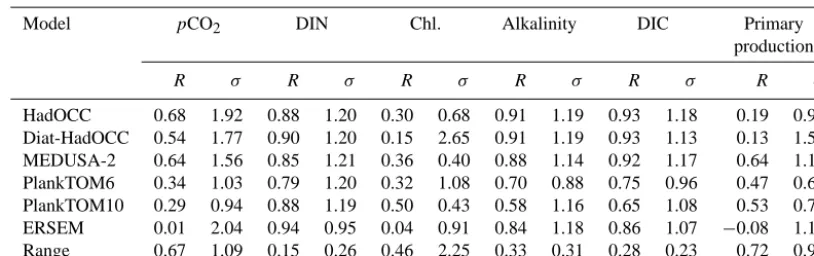
Table 3. Model–observation correlation coefficients (R)and standard deviations normalised by the standard deviation of observations (σ )
for all examined annual surface fields and depth-integrated primary productivity.
Model pCO2 DIN Chl. Alkalinity DIC Primary
production
R σ R σ R σ R σ R σ R σ
HadOCC 0.68 1.92 0.88 1.20 0.30 0.68 0.91 1.19 0.93 1.18 0.19 0.92 Diat-HadOCC 0.54 1.77 0.90 1.20 0.15 2.65 0.91 1.19 0.93 1.13 0.13 1.51 MEDUSA-2 0.64 1.56 0.85 1.21 0.36 0.40 0.88 1.14 0.92 1.17 0.64 1.10 PlankTOM6 0.34 1.03 0.79 1.20 0.32 1.08 0.70 0.88 0.75 0.96 0.47 0.61 PlankTOM10 0.29 0.94 0.88 1.19 0.50 0.43 0.58 1.16 0.65 1.08 0.53 0.74 ERSEM 0.01 2.04 0.94 0.95 0.04 0.91 0.84 1.18 0.86 1.07 −0.08 1.12 Range 0.67 1.09 0.15 0.26 0.46 2.25 0.33 0.31 0.28 0.23 0.72 0.90
The negativepCO2biases in the equatorial Pacific exhib-ited by the PlankTOM6, PlankTOM10 and ERSEM mod-els may be explained, at least in part, by the positive biases that these models show for surface alkalinity in this region (Fig. S3). The models with positivepCO2biases in the equa-torial Pacific (HadOCC, Diat-HadOCC and MEDUSA-2) do not have negative surface alkalinity biases in this region, but values are much closer to observations (Fig. S3). The root of these alkalinity biases lies in variation in PIC production by the models in this region as discussed in greater detail below. Figure 2 illustrates model performance of annual aver-age surface dissolved inorganic nitrogen (DIN) concentra-tions. Here, all models capture global patterns relatively well, with correlation coefficients > 0.8, in part because of the ini-tialisation from observations in 1890. The model with the highest spatial pattern correlation coefficient is ERSEM, al-though it slightly underestimates the global variability of DIN. The other models have lower spatial pattern correlation coefficients and generally overestimate the global variabil-ity of DIN. PlankTOM6 performs below other models, while PlankTOM10 has a similar performance to the simpler mod-els. In general, aside from ERSEM and PlankTOM10, most models show elevated Pacific DIN, and the simpler models, MEDUSA-2 in particular, exhibit high equatorial anomalies. Finally, while ERSEM shows good agreement throughout most of the world ocean, both the north Atlantic and north Pacific show anomalously low annual average DIN concen-trations.
Surface DIN concentrations are influenced by both the ef-ficiency of primary production and the efef-ficiency of reminer-alization, both of which differ between models. Although we do not explore the differences in remineralization, the mod-els which show positive DIN biases in the equatorial Pa-cific (HadOCC, Diat-HadOCC and MEDUSA-2) are gener-ally shown to also have positive integrated primary produc-tion biases in this region (Fig. S1). To a lesser extent, the reverse is true of the models with negative DIN biases in the equatorial Pacific (PlankTOM10 and ERSEM).
Figure 3 shows low correlation (r< 0.5) for annual surface chlorophyll concentrations for all models. The models with the highest correlation coefficients are PlankTOM10 (0.49) followed by MEDUSA-2 (0.36). All other models have cor-relation coefficients < 0.2. Anomalously high chlorophyll values in the equatorial Pacific and especially the Southern Ocean significantly elevate the spatial variability of Diat-HadOCC above that of observations (and all other models). More generally, with the exception of PlankTOM10, all of the models show some degree of excess chlorophyll in the Southern Ocean, with Diat-HadOCC exhibiting very high concentrations in this relatively unproductive region.
In addition to the ocean properties shown in Figs. 1– 3, complementary figures for alkalinity, DIC and primary production can be found in the supplementary material (Figs. S1–S3). In each case, global annual average fields are shown together with the corresponding Taylor diagram.
Table 3 shows the correlation coefficients and standard de-viations normalised relative to observations of the models for all six of the ocean properties (five surface fields plus depth-integrated primary production). The range of correlation co-efficients over all of the models is shown for each field. As already suggested above, model performance varies both be-tween fields and bebe-tween models. All models perform con-sistently and relatively well for DIN and DIC in part because of the “memory” of initial distributions. Model performance varies more widely forpCO2 and primary production and varies most widely for chlorophyll, although it is consistently poor across all models.
Figure 5. Monthly Taylor plots forpCO2, dissolved inorganic nitrogen (DIN), chlorophyll and primary production for all models relative to observations. Annual averages are shown in black. Note that negative correlation coefficients are not shown in the Taylor plot.
of six fields the best performing model in terms of correlation coefficients is a simpler model (i.e. HadOCC, Diat-HadOCC or MEDUSA-2) and for five out of six fields the best per-forming model in terms of normalised standard deviations is a more complex model (i.e. PlankTOM6, PlankTOM10 or ERSEM).
These findings in annual average model performance are found to be consistent when examined at monthly timescales (Fig. 5).
3.1.2 Depth profiles
While the majority of biological activity in the ocean is con-centrated in its surface layers, biogeochemical fields in the deep ocean have a complex structure created through the in-teraction of ocean physics with biologically mediated pro-cesses such as export and remineralization. As such, model performance cannot be solely assessed from surface fields of ocean BGC properties. To examine this, Figs. 6 and 7 show the annual average depth profiles of DIC and alkalin-ity for three important regions: the north Atlantic (Atlantic 0–60◦N), Southern Ocean (≥60◦S) and equatorial Pacific (Pacific Ocean 15◦S–15◦N).
In Fig. 6, all models are shown to capture the DIC pro-file in the equatorial Pacific, though HadOCC, Diat-HadOCC and MEDUSA-2 are somewhat closer to observations than
ERSEM and the PlankTOM models. A similar situation is seen in the north Atlantic where the depth profiles of MEDUSA-2, HadOCC and Diat-HadOCC are closest to ob-servations, although surface agreement is greater than that at depth. All models are shown to perform relatively poorly in the Southern Ocean, with much weaker gradients with depth than observations. HadOCC, Diat-HadOCC and ERSEM show gradients that are marginally closer to those observed, but all of the models consistently fail to reproduce the ob-served > 100 mmol m−3surface–1000 m increase. As Fig. S7 in the Supplement shows, this common problem of vertical homogeneity between the models is driven by systematic bi-ases in vertical mixing in this region as well as known errors in ocean circulation (e.g. Yool et al., 2013).
Figure 6. Observed (black; GLODAP) and modelled profiles of
dis-solved inorganic carbon (mmol C m−3)in the north Atlantic (0 to 60◦N), Southern Ocean (90 to 60◦S) and equatorial Pacific (15◦S to 15◦N). Vertical scaling is logarithmic (log10).
depth in the PlankTOM6, PlankTOM10 and ERSEM mod-els and is higher than observations in near-surface waters (> 100 meq m−3). This excess alkalinity may explain the broadly lower pCO2 values visible in this region in Fig. 1. The source of this bias in surface alkalinity is, at least in part, due to disparity in modelled CaCO3 production in this re-gion. As Figs. S8–S10 in the Supplement show, PlankTOM6, PlankTOM10 and ERSEM export negligible particulate in-organic carbon (PIC; Fig. S9) relative to particulate in-organic carbon (POC; Fig. S8) in this region. This results in low rain ratios (Fig. S10) and the divergence of DIC and alkalinity performance of these models in this region. The lack of PIC export in these models runs contrary to observations (e.g. Dunne et al., 2007) but reflects the current difficulty in mod-elling CaCO3production – which HadOCC, Diat-HadOCC and MEDUSA-2 circumvent by simplistic empirical param-eterisations.
The depth profiles of DIN and O2are given in the Supple-ment (Figs. S4–5).
3.2 Computational benchmarking
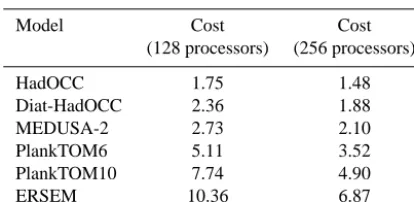
[image:10.612.308.550.65.245.2]Computational timing tests (CPU time) were carried out rel-ative to the ocean component of the HadGEM3 (Hewitt et al., 2011) model (ORCA1.0L75), on standard configurations of 128 and 256 processors on an IBM Power7 machine. As would be intuitively expected, the cost of candidate ocean biogeochemical models is found to be higher for models with more tracers regardless of the number of processors used. While there are deviations in both directions between the models, there is a broadly linear relationship between num-ber of model tracers and compute cost (Fig. S6 in the Sup-plement), reflecting the significant cost of applying advection and mixing terms to each tracer.
Figure 7. Observed (black; GLODAP) and modelled profiles of
alkalinity (meq m−3)in the north Atlantic (0 to 60◦N), Southern Ocean (90 to 60◦S) and equatorial Pacific (15◦S to 15◦N). Verti-cal sVerti-caling is logarithmic (log10).
Using ERSEM (the computationally most expensive model) increases computational cost approximately 6-fold relative to HadOCC when 128 processors are used. This rel-ative increase in computational cost is reduced to approxi-mately 4.5-fold when 256 processors are used. PlankTOM10 has the greatest relative reduction (36.6 %) in computational cost when run on 256 processors as opposed to 128, although this model would still increase the total cost of the ocean component by a factor of 5 relative to a physics-only ocean, compared to a factor of 1.5 for HadOCC (Table 4).
4 Discussion
Our model comparison suggests that for global annual av-erage surface fields, global monthly avav-erage surface fields and annual average depth profiles in three oceanographic re-gions, there is little evidence that increasing the complexity of OBGC models leads to improvements in the representa-tion of large-scale ocean patterns of bulk properties. In some cases, the comparison suggests that simpler OBGC are closer to observations than intermediate or complex models for the standard assessment metrics used here.
Table 4. Computational cost of each candidate model when coupled
to the ocean component of HadGEM3, relative to a physics-only simulation with the same ocean model (ORCA1.0L75). A cost of 2 indicates that adding the biogeochemistry model doubles total sim-ulation cost. Timings are shown for simsim-ulations carried out on 128 and 256 processors of an IBM Power7 machine.
Model Cost Cost
(128 processors) (256 processors)
HadOCC 1.75 1.48
Diat-HadOCC 2.36 1.88
MEDUSA-2 2.73 2.10
PlankTOM6 5.11 3.52
PlankTOM10 7.74 4.90
ERSEM 10.36 6.87
and alkalinity. The biologically simpler models are shown to generally best capture the depth profiles of DIC and alka-linity in the north Atlantic and equatorial Pacific (Figs. 6–7), possibly because their biological export production can more easily be tuned to maintain the observed vertical gradients.
There are, however, ocean biogeochemical fields where models of greater biological complexity tend to equate to im-proved model skill. The annual and monthly global correla-tion coefficients of the PlankTOM models are shown to be closest to observations for chlorophyll and primary produc-tion fields (Fig. 3 and Table 4). These PlankTOM models do not consistently produce the annual chlorophyll and primary production field standard deviations closest to observations (Table 4); however, at monthly resolution their field standard deviations are the most consistent across models (Fig. 5).
The comparison of depth profiles shows that despite all models being initialised from the same observational fields, there is quite a lot of divergence even at depths of less than 1000 m. In some cases, such as alkalinity in the Southern Ocean (Fig. 7), all models have a similar systematic bias compared to observations. This is suggestive of the influence of errors within the physical ocean model. That is, the ocean biogeochemistry may be influenced to a greater extent by the physical ocean model and hence there is a common response across models. For other fields such as DIN in the South-ern Ocean and equatorial Pacific (Fig. S5), models have both positive and negative biases compared to observations, sug-gestive of a greater relative role of the OBGC model than the physical model.
It is clear that more biologically complex models are re-quired to more completely assess the impacts of environ-mental change on marine ecosystems. By representing pro-cesses that are not present in simpler models, the more com-plex models are also able to represent additional factors such as climatically active gases (e.g. DMS, N2O). Assessment of such representations, however, fell outside the scope of this paper. Models of intermediate complexity (e.g. Diat-HadOCC and MEDUSA-2) are shown in this
intercompari-son to reproduce large-scale ocean biogeochemistry features relatively well, yet minimise computational cost and have sufficient biological complexity to allow important ESM questions to be explored, including those that require an ex-plicit iron cycle (e.g. ocean iron fertilisation).
It should be noted that models implemented within the NEMO physical ocean framework prior to this intercompar-ison project had an advantage over those new to this frame-work. This is a somewhat unavoidable consequence of what is also one of this intercomparison study’s main strengths, namely that the models were adapted to use the same ocean physics framework. Specifically, the HadOCC and MEDUSA-2 model developers were familiar with NEMO v3.2 and had some previous opportunity to tune models. Linked to this is the question of how dependent the results were on parameter values. Although model developers were afforded a limited opportunity to tune parameters, given fur-ther time to tune one would expect improved performance, especially for those models that had not been previously im-plemented within NEMO v3.2.
The rationale for the chosen fields of intercomparison was, as stated previously, that they are common across all mod-els and are key facets of global marine biogeochemistry. It could, however, be argued that these bulk fields were insuf-ficient to adequately assess all models and in particular the most complex models. Further analysis beyond the scope of this paper will be necessary to evaluate mechanistically the implications of the different biological components in each model.
Finally, although computational cost is discussed as a pragmatic driver of OBGC model selection, it should be noted that computer power is continuously increasing and the intercomparison results presented here may differ for an al-ternative spatial resolution ocean grid requiring greater com-putational resources. In addition, ongoing efforts to transport passive ocean tracers on degraded spatial scales (e.g. Levy et al., 2012) have the potential to result in computational savings that would realistically permit the implementation of higher complexity OBGC models within ESMs.
5 Conclusions
The six ocean biogeochemical models analysed within this intercomparison cover a large range of ecosystem complex-ity (from 7 tracers in HadOCC to 57 in ERSEM), and there-fore result in a range of approximately five in computational costs (from increasing the cost of the physical ocean model by a factor of 2 to a factor of 10). Results suggest little evi-dence that higher biological complexity implies better model performance in reproducing observed global-scale bulk prop-erties of ocean biogeochemistry.
climate modelling community to maintain a diverse suite of ocean biogeochemical models.
One priority for the next generation of Earth system mod-els (CMIP6) is to enhance model resolution in the hope that it will resolve some of the existing biases in climate mod-els. This puts pressure on the computing time available for representing biological complexity. Our results suggest that intermediate complexity models (such as MEDUSA-2 and Diat-HadOCC) offer a good compromise between the repre-sentation of biological complexity (through their inclusion of an iron cycle) and computer time given their relatively good performance in reproducing bulk properties. However, intermediate complexity models are limited in the detail to which they can address climate feedbacks, and it may be that more complex models can in future provide additional in-sight based on ongoing measurements and data syntheses.
The quest for increasing resolution in ESMs is unlikely to end soon, as the resolution needed to resolve eddies in the ocean (1/8◦ or less) needs to be achieved before im-portant improvements in representing climate dynamics are achieved. Most ESMs being developed for the next CMIP phase will have a grid of 1/2 to 1/4◦. Even with increasing computational power and schemes for accelerating transport of passive tracers (Levy et al., 2012) available, other prior-ities (e.g. ensemble simulations for risk assessments) may still make it difficult to prioritise the representation of bio-geochemical complexity in ESMs. In order to achieve scien-tific progress on important questions of the interactions be-tween marine biogeochemistry and climate, it is important that lower resolution ESMs that prioritise biogeochemical complexity are maintained and used in CMIP exercises in parallel- to higher-resolution models.
The Supplement related to this article is available online at doi:10.5194/bg-11-7291-2014-supplement.
Acknowledgements. This work was funded by the UK Natural
Environmental Research Council Integrated Marine Biogeochem-ical Modelling Network to Support UK Earth System Research (i-MarNet) project (NE/K001345/1) and the UK Met Office. MFR was partially funded by the EC FP7 GreenSeas project.
Edited by: J. Middelburg
References
Antonov, J. I., Seidov, D., Boyer, T. P., Locarnini, R. A., Mishonov, A. V., Garcia, H. E., Baranova, O. K., Zweng, M. M., and John-son, D. R.: World ocean atlas 2009, volume 2: Salinity, in: NOAA Atlas NESDIS 69, edited by: Levitus, S., US Government Print-ing Office, WashPrint-ington, DC, USA, 184 pp., 2010.
Artioli, Y., Blackford, J. C., Butenschön, M., Holt, J. T., Wakelin, S. L., Thomas, H., Borges, A. V., and Allen, J. I.: The carbonate system in the north sea: Sensitivity and model validation, J. Mar. Syst., 102, 1–13, 2012
Barange, M., Merino, G., Blanchard, J. L., Scholtens, J., Harle, J., Allison, E. H., Allen, J. I., Holt, J., and Jennings, S.: Im-pacts of climate change on marine ecosystem production in so-cieties dependent on fisheries, Nat. Clim. Change, 4, 211–216, doi:10.1038/NCLIMATE2119, 2014.
Baretta, J. W., Ebenhoh, W., and Ruardij, P.: The European Regional Seas Ecosystem Model, a complex marine ecosystem model, Neth. J. Sea Res. 33, 233–246, 1995.
Behrenfeld, M. J. and Falkowski, P. G.: Photosynthetic rates de-rived from satellite-based chlorophyll concentration, Limnol. Oceanogr., 42, 1–20, 1997.
Blackford, J. C.: An analysis of benthic biological dynamics in a North Sea ecosystem model, J. Sea Res., 38, 213–230, 1997. Blackford, J. C. and Gilbert, F. J.: pH variability and CO2induced
acidification in the North Sea, J. Mar. Syst., 64, 229–241, 2007. Blackford, J. C., Allen, J. I., and Gilbert, F. J.: Ecosystem dynamics
at six contrasting sites: a generic modelling study, J. Mar. Syst., 52, 191–215, 2004.
Bopp, L., Resplandy, L., Orr, J. C., Doney, S. C., Dunne, J. P., Gehlen, M., Halloran, P., Heinze, C., Ilyina, T., Séférian, R., Tjiputra, J., and Vichi, M.: Multiple stressors of ocean ecosys-tems in the 21st century: projections with CMIP5 models, Biogeosciences, 10, 6225–6245, doi:10.5194/bg-10-6225-2013, 2013.
Braconnot, P., Harrison, S. P., Kageyama, M., Bartlein, P. J., Masson-Delmotte, V., Abe-Ouchi, A., Otto-Bliesner, B., and Zhao, Y.: Evaluation of climate models using palaeoclimatic data, Nat. Clim. Change, 2, 417–424, 2012.
Broecker, W. S., Spencer, D. W., and Craig, H.: Geosecs Pacific Expedition. vol. 3, Hydrographic Data 1973-1974, Superinten-dent of documents, U.S. government printing office, Washington D.C., 137 pp., 1982.
Buesseler, K. O. and Boyd, P. W.: Will ocean fertilisation work?, Science, 300, 67–68, 2003.
Buitenhuis, E., Le Quéré, C., Aumont, O., Beaugrand, G., Bunker, A., Hirst, A., Ikeda, T., O’Brien, T., Piontkovski, S., and Straile, D.: Biogeochemical fluxes through mesozooplankton, Global Biogeochem. Cy., 20, GB2003, doi:10.1029/2005GB002511, 2006.
Buitenhuis, E., Rivkin, R., Sailley, S., and Le Quere, C.: Biogeo-chemical fluxes through microzooplankton, Global Biogeochem. Cy., 24, GB4015, doi:10.1029/2009GB003601, 2010.
Buitenhuis, E. Vogt, M., Moriarty, R., Bednaršk, N., Doney, S., Leblanc, K., Le Quéré, C., Luo, Y. -W., O’Brien, C., O’Brien, T., Peloquin, J. Schiebel, R., and Swan, C.: MAREDAT: towards a world atlas of MARine Ecosystem DATa, Earth System Science Data, 5, 227–239, 2013.
comparison of global estimates of marine primary production from ocean color, Deep-Sea Res.-Pt. II, 53, 741–770, 2006. Cheung, W. W. L., Sarmiento, J. L., Dunne, J. P., Frölicher, T. L.,
Lam, V. W. Y., Palomares, M. L. D., Watson, R. and Pauly, D.: Shrinking of fishes exacerbates impacts of global ocean changes on marine ecosystems, Nat. Clim. Change, 3, 254–258, 2012. Condon, R., Duarte, C. M., Pitt, K. A., Robinson, K., Lucas, C. H.,
Sutherland, K. R., Mianzan, H. W., Bogeberg, M., Purcell, J. E., Decker, M. B., Uye, S., Madin, L. P., Brodeur, R. D., Haddock, S. H. D., Malej, A., Parry, G. D., Eriksen, E., Quiñones, J. Acha, M., Harvey, M., Arthur, J. M., and Graham, W. M. :Recurrent jellyfish blooms are a consequence of global oscillations, P. Natl. Acad. Sci. USA, 110, 1000–1005, 2013.
Collins, W. J., Bellouin, N., Doutriaux-Boucher, M., Gedney, N., Halloran, P., Hinton, T., Hughes, J., Jones, C. D., Joshi, M., Lid-dicoat, S., Martin, G., O’Connor, F., Rae, J., Senior, C., Sitch, S., Totterdell, I., Wiltshire, A., and Woodward, S.: Develop-ment and evaluation of an Earth-System model – HadGEM2, Geosci. Model Dev., 4, 1051–1075, doi:10.5194/gmd-4-1051-2011, 2011.
Cox, P. M., Betts, R. A., Jones, C. D., Spall, S. A., and Totterdell, I. J.: Acceleration of global warming due to carbon-cycle feed-backs in a coupled climate model, Nature, 408, 184–187, 2000. Dickson, A. G. and Goyet, C.: Handbook of methods for the
analy-sis of the various parameters of the carbon dioxide system in sea water, Version 2 (No. ORNL/CDIAC–74).,Oak Ridge National Lab., TN (United States), 1994.
Doney, S. C., Lima, I., Moore, J. K., Lindsay, K., Behrenfeld, M. J., Westberry, T. K., Mahowald, N., Glover, D. M., and Takahashi, T.: Skill metrics for confronting global upper ocean ecosystem-biogeochemistry models against field and remote sensing data, Skill assessment for coupled biological/physical models of ma-rine systems, J. Mar. Syst., 76, 95–112, 2009.
Dunne, J. P., Sarmiento, J. L., and Gnanadesikan A.: A synthesis of global particle export from the surface ocean and cycling through the ocean interior and on the seafloor, Global Biogeochem. Cy., 21, GB4006, doi:10.1029/2006GB002907, 2007.
Edmond, J. M. and Gieskes, J. M. T. M.: On the calculation of the degree of saturation of sea water with respect to calcium car-bonate under in situ conditions, Geochim. Cosmochim. Ac., 34, 1261–1291, 1970.
Friedrichs, M. A. M., Dusenberry, J. A., Anderson, L. A., Arm-strong, R. A., Chai, F., Christian, J. R., Doney, S. C., Dunne, J., Fujii, M., Hood, R., McGillicuddy, D. J., Moore, J. K., Schar-tau, M., Spitz, Y. H., and Wiggert, J. D.: Assessment of skill and portability in regional marine biogeochemical models: Role of multiple planktonic groups, J. Geophys. Res.-Oceans, 112, C08001, doi:10.1029/2006JC003852, 2007.
Garcia, H. E., Locarnini, R. A., Boyer, T. P., Antonov, J. I., Bara-nova, O. K., Zweng, M. M., and Johnson, D. R.: World Ocean Atlas 2009, Volume 3: Dissolved Oxygen, Apparent Oxygen Uti-lization, and Oxygen Saturation, edited by: Levitus, S., NOAA Atlas NESDIS 70, US Government Printing Office, Washington DC, 344 pp., 2010a.
Garcia, H. E., Locarnini, R. A., Boyer, T. P., Antonov, J. I., Zweng, M. M., Baranova, O. K., and Johnson, D. R.: World Ocean Atlas 2009, Volume 4: Nutrients (phosphate, nitrate, silicate), edited by: Levitus, S., NOAA Atlas NESDIS 71, US Government Print-ing Office, WashPrint-ington DC, 398 pp., 2010b.
Gaspar, P., Grégoris, Y., and Lefevre, J.-M.: A simple eddy kinetic energy model for simulations of the oceanic vertical mixing: Tests at station Papa and long-term upper ocean study site, J. Geophys. Res.-Oceans, 95, 16179–16193, 1990.
Glibert, P. M., Allen, J. I., Artioli, Y., Beusen, A., Bouwman, L., Harle, J., Holmes, R., and Holt, J.: Vulnerability of coastal ecosystems to changes in harmful algal bloom distribution in re-sponse to climate change: projections based on model analysis, Global Change Biol., 20, 3845–3858, doi:10.1111/gcb.12662, 2014.
Halloran, P. R., Bell, T. G., and Totterdell, I. J.: Can we trust em-pirical marine DMS parameterisations within projections of fu-ture climate?, Biogeosciences, 7, 1645–1656, doi:10.5194/bg-7-1645-2010, 2010.
Harvey, L. D. D.: Mitigating the atmospheric CO2 increase and ocean acidification by adding limestone powder to upwelling regions, J. Geophys. Res.-Oceans, (1978–2012), 113, C04028, doi:10.1029/2007JC004373, 2008.
Hewitt, H. T., Copsey, D., Culverwell, I. D., Harris, C. M., Hill, R. S. R., Keen, A. B., McLaren, A. J., and Hunke, E. C.: Design and implementation of the infrastructure of HadGEM3: the next-generation Met Office climate modelling system, Geosci. Model Dev., 4, 223–253, doi:10.5194/gmd-4-223-2011, 2011.
Hunke, E. C. and Lipscomb, W. H.: CICE: The los alamos sea ice model, documentation and software user’s manual, version 4.0, Los Alamos National Laboratory Tech. Rep. LA-CC-06, 2008. Jackson , D. A., Peres-Neto, P. R., and Olden. J. D.: What controls
who is where in freshwater fish communities – the roles of biotic, abiotic, and spatial factors, Can. J. Fish. Aquat. Sci., 58, 157– 170, 2001.
Jolliff, J. K., Kindle, J. C., Shulman, I., Penta, B., Friedrichs, M. A. M., Helber, R., and Arnone, R.A.: Summary diagrams for cou-pled hydrodynamic-ecosystem model skill assessment, J. Marine Syst., 76, 64–82, 2009.
Key, R. M., Kozyr, A., Sabine, C. L., Lee, K., Wanninkhof, R., Bullister, J. L., Feely, R. A., Millero, F. J., Mordy, C., and Peng, T.-H.: A global ocean carbon climatology: results from Global Data Analysis Project (GLODAP), Global Biogeochem. Cy., 18, GB4031, doi:10.1029/2004GB002247, 2004.
Kheshgi, H. S.: Sequestering atmospheric carbon dioxide by in-creasing ocean alkalinity, Energy, 20, 915–922, 1995.
Kriest, I., Khatiwala, S., and Oschlies, A.: Towards an assessment of simple global marine biogeochemical models of different com-plexity, Prog. Oceanogr., 86, 337–360, 2010.
Large, W. and Yeager, S.: The global climatology of an interannu-ally varying air–sea flux data set, Clim. Dynam., 33, 341–364, 2009.
Le Quéré, C., Harrison, S. P., Prentice, I. C., Buitenhuis, E. T., Au-mont, O., Bopp, L., Claustre, H., Da Cunha, L. C., Geider, R., Giraud, X., Klaas, C., Kohfeld, K. E., Legendre, L., Manizza, M., Platt, T., Rivkin, R. B., Sathyendranath, S., Uitz, J., Wat-son, A. J., and Wolf-Gladrow, D.: Ecosystem dynamics based on plankton functional types for global ocean biogeochemistry models, Glob. Change Biol., 11, 2016–2040, doi:10.1111/j.1365-2486.2005.1004.x, 2005.
Locarnini, R. A., Mishonov, A. V., Antonov, J. I., Boyer, T. P., Gar-cia, H. E., Baranova, O. K., Zweng, M. M., and Johnson, D. R.: World ocean atlas 2009, volume 1: Temperature, in: NOAA At-las NESDIS 68, edited by: Levitus, S., US Government Printing Office, Washington, DC, USA, 184 pp., 2010.
Madec, G.: NEMO reference manual, ocean dynamic component: NEMO–OPA, Note du Pôle de modélisation, Institut Pierre Si-mon Laplace, Technical Report 27, Note du pôle de modélisa-tion, Institut Pierre Simon Laplace, France, No. 27, ISSN No. 1288–1619, 2008.
Monterey, G. and Levitus, S.: Seasonal Variability of Mixed Layer Depth for theWorld Ocean, NOAA Atlas NESDIS 14, US Gov. Printing Office, Washington DC, 96 pp., 1997.
Nightingale, P., Malin, G., Law, C., Watson, A., Liss, P., Liddicoat, M., Boutin, J., and Upstill-Goddard, R.: In situ evaluation of air-sea gas exchange parameterizations using novel conservative and volatile tracers, Global Biogeochem. Cy., 14, 373–387, 2000. O’Reilly, J. E., Maritorena, S., Mitchell, B. G., Siegal, D. A.,
Carder, K. L., Garver, S. A., Kahru, M., and McClain, C.: Ocean color chlorophyll algorithms for SeaWiFS, J. Geophys. Res., 103, 24937–24953, 1998.
Palmer, J. R. and Totterdell, I. J.: Production and export in a global ocean ecosystem model, Deep-Sea Res.-Pt I, 48, 1169–1198, 2001.
Popova, E.E., Yool, A., Coward, A.C., Dupont, F., Deal, C., Elliott, S., Hunke, E., Jin, M., Steele, M., and Zhang, J.: What controls primary production in the Arctic Ocean? Re-sults from an intercomparison of five general circulation models with biogeochemistry. J. Geophys. Res.-Oceans 117, C00D12, doi:10.1029/2011JC007112, 2012.
Reid, P. C., Fischer, A. C., Lewis-Brown, E., Meredith, M. P., Spar-row, M., Andersson, A. J., Antia, A., Bates, N. R., Bathmann, U., Beaugrand, G., Brix, H., Dye, S., Edwards, M., Furevik, T., Gangstø, R., Hátún, H., Hopcroft, R. R., Kendall, M., Kasten, S., Keeling, R., Le Quéré, C., Mackenzie, F. T., Malin, G., Mau-ritzen, C., Ólafsson, J., Paull, C., Rignot, E., Shimada, K., Vogt, M., Wallace, C., Wang, Z., and Washington, R.: Chapter 1 Im-pacts of the Oceans on Climate Change, Adv. Mar. Biol., 56, 1–150, 2009.
Siddorn, J. R., Allen, J. I.,Blackford, J. C., Gilbert, F. J., Holt, J. T., Holt, M. W., Osborne, J. P., Proctor, R., and Mills, D. K.: Modelling the hydrodynamics and ecosystem of the North-West European continental shelf for operational oceanography, J. Mar. Syst., 65, 417–429, doi:10.1016/j.jmarsys.2006.01.018, 2007.
Steinacher, M., Joos, F., Frölicher, T. L., Bopp, L., Cadule, P., Cocco, V., Doney, S. C., Gehlen, M., Lindsay, K., Moore, J. K., Schneider, B., and Segschneider, J.: Projected 21st century de-crease in marine productivity: a multi-model analysis, Biogeo-sciences, 7, 979–1005, doi:10.5194/bg-7-979-2010, 2010. Stow, C. A., Jolliff, J., McGillicuddy Jr., D. J., Doney, S. C., Allen,
J. I., Friedrichs, M. A. M., Rose, K. A., and Wallhead, P.: Skill as-sessment for coupled biological/physical models of marine sys-tems, Skill assessment for coupled biological/physical models of marine systems, J. Mar. Syst., 76, 4–15, 2009.
Takahashi, T., Sutherland, S. C., Wanninkhof, R. Sweeney, C., Feely, R. A., Chipman, D. W., Hales, B., Friederich, G., Chavez, F., Sabine, C., Watson, A., Bakker, D. C. E., Schuster, U., Metzl, N., Yoshikawa-Inoue, H., Ishii, M. Midorikawa, T., Nojiri, Y., Kortzinger, A., Steinhoff, T., Hoppema, M., Olafsson, J., Arnar-son, T. S., Tillbrook, B., Johannessen, T., Olsen, A., Bellerby, R., Wong, C. S., Delille, B., Bates, N. R., and de Baar, H. J. W.: Climatological mean and decade change in surface oceanpCO2, and net sea-air CO2flux over the global oceans, Deep-Sea Res.-Pt. II, 56, 554–577, doi:10.1016/j.dsr2.2008.12.009, 2009. Taylor, K. E.: Summarizing multiple aspects of model performance
in a single diagram, J. Geophys. Res., 106, 7183–7192, 2001. Wanninkhof, R.: Relationship between wind speed and gas
ex-change over the ocean, J. Geophys. Res.-Oceans, 97, 7373–7382, 1992.
Westberry, T., Behrenfeld, M. J., Siegel, D. A., and Boss, E.: Carbon-based primary productivity modeling with vertically re-solved photoacclimation, Global Biogeochem. Cy., 22, GB2024, doi:10.1029/2007GB003078, 2008.
Yool, A., Popova, E. E., and Anderson, T. R.: Medusa-1.0: a new in-termediate complexity plankton ecosystem model for the global domain, Geosci. Model Dev., 4, 381–417, doi:10.5194/gmd-4-381-2011, 2011.







![{N [1 (1H Benzimidazol 2 yl)ethylidene κN3] 3 (1H imidazol 1 yl)propan 1 amine κN}dibromidomercury(II)](data:image/gif;base64,R0lGODlhAQABAIAAAP///wAAACH5BAEAAAAALAAAAAABAAEAAAICRAEAOw==)