Persian Version of the Emotion Regulation Questionnaire: Factor
Structure, Reliability and Validity
Jafar Hasani
11 Department of Clinical Psychology, Faculty of Psychology and Educational Sciences, Kharazmi
University, Tehran, Iran
Submitted: 17 August 2016
Accepted: 26 February 2017
Int J Behav Sci. 2016; 10(3): 108-113
Corresponding Author: Jafar Hasani
Ph.D. Department of Clinical Psychology, Faculty of Psychology and Educational Sciences, Kharazmi University Tehran,
Iran
E-mail: [email protected]
Abstract
Introduction: The main purpose of this research was to develop a Persian version of the Emotion Regulation Questionnaire (ERQ, Gross & John, 2003) and to examine its factor structure, reliability and validity.
Method: The English version of the ERQ was translated and back-translated prior to its administration to 540 (260 females) Iranian participants recruited from the Kharazmi and Zanjan Universities with an age range from 18 to 36.The reliability of the Persian version of the Emotion Regulation Questionnaire (ERQ-P) was assessed via internal consistency, item-rest correlations and test-retest reliability. Also, a principal component analysis with Varimax-rotation, confirmatory factor analysis, correlations between subscales and criterion validity was applied.
Results: The results showed that the Persian version of the Emotion Regulation Questionnaire (ERQ-P) had good psychometric properties. Explanatory and confirmatory factor analysis supported the original ERQ two factor model (factor loadings ranged from .32 to .67). All of the item scores significantly correlated with the total score of the corresponding subscales(r=.46 to r =.75). The reliability of the two ERQ-P subscales was satisfactory as indicated by the level of internal consistency (.81 to .91) and the high test-retest correlations (.51 to .77) across a 5-week interval. With respect to the criterion validity, ERQ-P subscales were uniquely associated with affective outcomes. As a result, suppression predicted lower emotional well-being while reappraisal predicted higher emotional well-being.
Conclusion: Taken together, the results of the current study indicates that ERQ-P is a reliable and valid measure of emotion regulation strategies that could be used in research and clinical situations.
Keywords: Emotion Regulation, Reappraisal, Suppression, Persian, Factor Structure
Introduction
Emotions are often useful. They sometimes need to be regulated in order to reach certain goals. Emotion regulation includes a wide range of processes that can be applied to decrease, increase, or preserve emotional experiences or expressions (1-5).
Ineffectiveemotionregulationplays a critical role invarious psychopathology and mental health domains(6-9), with links to major depressive disorder(10, 11), bipolar disorder(12), generalized anxiety disorder (13), social anxiety disorder (14), borderline personality disorder (15), eating disorders(16-18), and substance-related disorders(19, 20). Conversely, suitable emotion regulation is associated with appropriately coping with environmental demands (2, 21-24), and higher social functioning (25) and work performance(26, 27). Consequently, some form of emotion regulation training is integrated into various therapeutic approaches (28) such as emotion focused therapy (8), acceptance and mindfulness-based therapy(29, 30), dialectical behavioral therapy(31), and emotion-regulation therapy (9).
According to this model, emotion regulation strategies can be differentiated along the time of emotional response manifestation. At the broadest level, the process model distinguishes between antecedent-focused and response-focused emotion regulation strategies. Previous researches have often focused on cognitive reappraisal, an antecedent-focused strategy that consists of attempts to think about the situation so as to alter its meaning and emotional impact and expressive suppression, a response-focused strategy which consists of attempts to inhibit or reduce ongoing emotion-expressive behavior (5, 32).
Gross and John (39) developed the Emotion Regulation Questionnaire (ERQ) to assess individual differences in use of reappraisal and suppression. Confirmatory factor analyses identified this underlying two-factorial structure (39) and showed that reappraisal and suppression are two independent regulatory strategies that different individuals use to varying degrees (40). The ERQ reappraisal and suppression scales have good reliability and validity and have been useful in testing hypotheses drawn from the process model of emotion regulation. Studies employing the ERQ have shown that individual differences in emotion regulation are associated with differences in conceptually related measures of coping strategies(41). Habitual use of reappraisal is related to positive reinterpretation and mood repair (42), whereas suppression is related to less focusing emotion and venting, less attention to emotion, less clarity, and no repair efforts (40), as well as greater inauthenticity and rumination (39, 43). In addition, moderate correlations have been found between the ERQ and the two broad personality traits most related to affect (Big Five Inventory, (44)): Reappraisal is negatively related to neuroticism, and suppression is negatively related to extraversion.
Overall, there is substantial evidence to suggest that the ERQ is a reliable instrument in many cultures that can be used to measure individual differences in reappraisal and suppression use. However, there is currently no validated versions of the ERQ that can be used in the Iranian culture. Given the demonstrated importance of emotion regulation in different normal and abnormal psychological process, it is useful to be able to assess individual differences in reappraisal and suppression in the Iranian society. Thus, the main purpose of the present research was to develop a Persian version of the Emotion Regulation Questionnaire (ERQ-P) and to assess its psychometric properties, including the factor structure, reliability, and validity.
Method
In terms to the research design, this study is considered to be correlational. The participants were recruited from the Kharazmi and Zanjan Universities in Iran. All participants were volunteers and received no credit for their participation in the study. Undergraduate and graduate students came from six faculties (Psychology, Humanity sciences, Mathematics, Computer Sciences, Basic Science and Agricultural). The combined sample consisted of 540 members (260 females and 280 male)
with an age range from 18 to 36 (with age mean = 23.25;
SD = 4.75).
Emotion Regulation Questionnaire (ERQ): The ERQ (39) is a 10-item self-report questionnaire which consists of two scales corresponding to two different emotion regulation strategies: cognitive reappraisal (6 items) and expressive suppression (4 items). The reappraisal subscale assesses individuals’ tendencies to regulate emotions by changing thoughts, whereas the suppression subscale assesses individuals’ tendencies to inhibit their expression of emotion. Instructions ask the subject some questions about their emotional life, in particular, how they control (that is, regulate and manage) their emotions. The 10 items are rated on a 7-point-Likert scale from strongly disagree to strongly agree. The reappraisal and suppression scales have been shown to have good internal consistency (.79 and .73, respectively), high 3-month test-retest reliability (.69 for both scales), and evidence of validity (39).
In the current study, a double-translation technique (using two independent translators) was used to develop the Persian version of the ERQ (ERQ-P). Discrepancies emerging from this procedure were discussed and adjustments to the Persian translation of the ERQ were made.
Positive and Negative Affect Schedule (PANAS): The PANAS (45) is the most frequently used instrument to assess positive and negative effects. The PANAS is constituted of 20 positive and negative adjectives. In the general format of administration, subjects are rated on a 5-point Likert scale regarding how much they usually feel as indicated by the adjectives. This scale has been previously translated into Persian language and has demonstrated good psychometric properties(46).
Beck Depression Inventory II (BDI-II):The BDI-II (47) is a widely used tool for assessing the severity of depressive symptomatology. The Persian version which was used in this study was established by Ghassemzadeh,
Mojtabai, Karamghadiri, and Ebrahimkhani (2005) and
has shown good reliability and validity proprieties (48).
Beck Anxiety Inventory (BAI): The BAI is a self-report instrument consisting of 21 items which are rated on a 4-point scale ranging from 0 (“not at all”) to 3 (“severely, I could barely stand it”). The summed score of all items on the BAI (ranging from 0-63) taps the severity of anxiety symptoms. The Persian version of BAI has been shown to be a significantly reliable (.83) and valid (.72) instrument with high internal consistency (.93)(49).
In order to analyze the data, factor analysis method, Cronbach's alpha coefficients, and Pearson correlations were applied using Statistical Package for the Social Sciences, 16.0 for Windows (SPSS,Chicago, IL, USA) and Lisrel 8.54 programs.
Results
scales and total ERQ-P indicated high levels of consistency for both subscales (in all cases over .80).
Item-rest correlations (i.e. the correlations between an item and the total score of the corresponding scale without adding the item involved) were computed to assess the degree to which a certain item fits with the rest of the scale. The range of item-rest correlations are provided in Table 1. Most item-total correlations were well over .40, suggesting that the scales are homogenous and none of the items within the scales should be removed. In addition, a bivariate correlation revealed that the subscales have an orthogonal relationship (r = .07).
The ERQ-P was administered twice to one group of participants (n=150) with a 5-week interval between the two measurements. The data of this group was used to compute test-retest correlations (shown in Table 1). These values were approximately .7, suggesting that scores on both subscales are relatively stable over time.
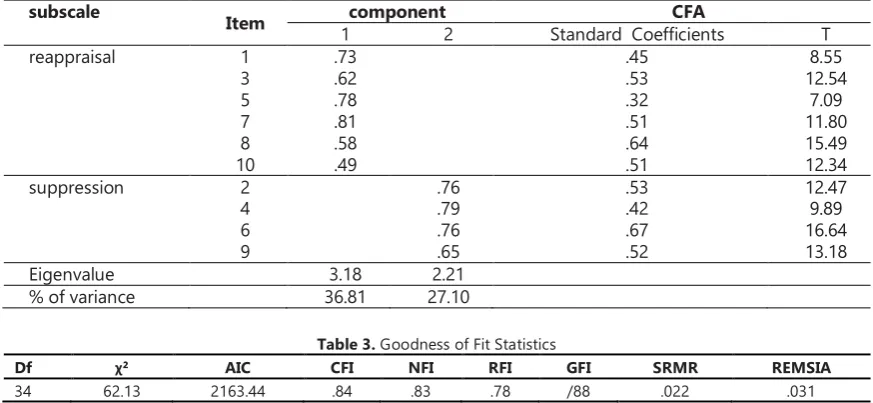
The factor (dimensional) structure of ERQ-P was assessed using both explanatory and confirmatory factor analysis. Principal Component Analysis (PCA) with Varimax-rotation was performed on item level. Based on the results of KMO=.88 and Bartlett's test (Chi-square (45) =795.04; p <.001), factor analysis can be used. The values of the communalities ranged from .57 to .86. Inspection of the scree plot suggested a two-factor solution. The factor loadings are presented in Table 2. The two-factor solution accounted for 63.91% of the variance. The correlation between the two factors was .06.
Table 2 shows that the found factors were consistent with the original two-factor structure of ERQ. All items were loaded on the expected dimension with a factor loading exceeding .40.
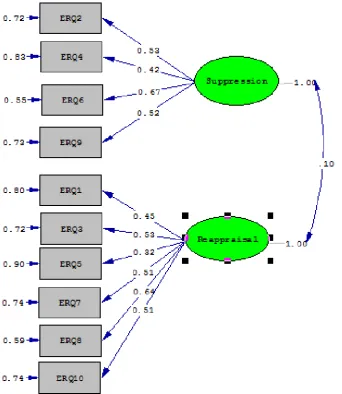
In order to test how well the identified model of the original version of the ERQ fits the Persian translation, a Confirmatory Factor Analysis (CFA) with the Maximum Likelihood (ML) method was performed on the variance-covariance matrix of item responses (50) using LISREL software (version 8.54). Several test statistics were used in the CFA to determine the adequacy of the model to fit data such as chi-square test, root mean square error of approximation (RMSEA), Normed Fit Index (NFI), Relative Fit Index (RFI), Comparative Fit Index (CFI) and Goodness of Fit Index (GFI). Results of the CFA suggested a good overall fit (Table 3). Goodness of fit was tested with χ² (a
non-significant value corresponds to an acceptable fit). But χ² are known to increase with the sample size and
degree of freedom (51). For these reasons, the χ² was
complemented by examining other indices that depend on a conventional cut-off. Hu and Bentler (1999) have recommended the use of two fit indices: The Standardized Root Mean Square Residual (SRMR) and the Root Mean Square Error of Approximation (RMSEA). The combination of these two indices is valuable because the SRMR is sensitive to the misspecification of the factor covariance, whereas the RMSEA is sensitive to the misspecification of the factor loadings. Schermelleh-Engel et al. (51) consider that an SRMR between 0 and .05 indicates a good fit and one between .05 and .10 indicates an acceptable fit. An RMSEA between 0 and .05 indicates a good fit and one between .05 and .08 indicates an acceptable fit. A CFI between .97 and 1.00 indicates a good fit and one between .95 and .97 indicates an acceptable fit.
Table1. Means, Standard deviations, Cronbach’s alpha coefficients, Item-rest correlations and Test-retest reliabilities of the ERQ-P
scale Male Female total Cronbach's alpha Item-rest correlation r12 M(SD) M (SD) M (SD) Male Female total Male Female total
suppression 14.58 (4.83) 13.33 (5.78) 13.98 (5.34) .83 .81 .85 .44-.62 .38-.65 .38-.61 .68 reappraisal 26.86 (6.27) 26.88 (6.05) 26.87 (6.16) .89 .88 .87 .56-.66 .62-.70 .50-.71 .71 Total ERQ-P 41.35 (8.42) 40.21 (9.00) 40.84 (8.72) .90 .89 .91 .57-.62 .61-.65 .62-.72 .69 Note: r12= Test-retest coefficients computed across a 5-week interval.
Table 2. Factor loadings PCA after Varimax rotation and CFA factor loadings
subscale Item component CFA
1 2 Standard Coefficients T
reappraisal 1
3 5 7 8 10
.73 .62 .78 .81 .58 .49
.45 .53 .32 .51 .64 .51
8.55 12.54
7.09 11.80 15.49 12.34
suppression 2
4 6 9
.76 .79 .76 .65
.53 .42 .67 .52
12.47 9.89 16.64 13.18
Eigenvalue 3.18 2.21
% of variance 36.81 27.10
Table 3. Goodness of Fit Statistics
Df χ² AIC CFI NFI RFI GFI SRMR REMSIA
Note: AIC=Akaike Information Criterion; CFI=Comparative Fit Index; NFI= Normed Fit Index; RFI= Relative Fit Index; GFI= Goodness of Fit Index; SRMR= Standardized Root Mean Square Residual; RMSEA=Root Mean Square Error of Approximation.
The SRMR, RMSEA and other fit indices in Table 3 suggest that the two-factor model of ERQ-P is acceptable. In addition, the correlation between the suppression and reappraisal latent variables suggested that the constructs are quite distinct (r=.10).
In order to test the construct validity of the ERQ-P, we examined the correlations with various affect-related
measures (i.e., positive affect, negative affect, depression and anxiety). As shown in Table 4, reappraisal was associated with more positive effect and less negative affect, depression, and anxiety. In contrast, suppression was associated with greater negative affect and depression. Unexpectedly, suppression was also associated with less anxiety.
Figure1. Standardized factor loadings for CFA
Table 4. Pearson correlation between ERQ-P with other constructs
Scale Positive affect Negative affect Depression Anxiety
reappraisal .74*** -.58*** -.62*** -.47***
suppression .06 .36*** .42*** .62***
*** p < .001.
Discussion
In this study, we examined the factor structure, reliability and validity of the Persian version of the Emotion Regulation Questionnaire (ERQ-P). The results showed that ERQ-P has acceptable psychometric properties (i.e., reliability, validity and factor structure) in the Iranian society. There was a clear replication of the two-factor structure of the ERQ originally found by Gross and John
are consistent with Balzarotti, John, & Gross (2010) in Italy (52) and Melka, Lancaster, Bryant & Rodriguez (53).
The pattern of relations with affect states, depression, and anxiety revealed evidence of the validity of the ERQ-P. Reappraisal was related to experience of positive affect and less negative affect, anxiety and depression. Conversely, suppression was associated with greater negative affect and depression. Unexpectedly, suppression was also associated with less anxiety. These findings are consistent with previous research done using the ERQ in American samplers which found that individuals who typically regulate their emotions through the use of reappraisal, report more positive affect, less negative affect, and greater psychological well-being than others (39). In contrast, individuals who typically regulate their emotions through the use of suppression report less positive affect, more negative affect, less social support, and more depression (40).
It thus might be expected to modify the entire temporal course of the emotional response. Suppression is a response-focused strategy that intervenes once an emotion is already under way and after the response tendencies have already been fully generated. It might be expected to require repeated efforts to manage emotional responses as they continually arise, taxing the individual’s resources (40).
Conclusion
To conclude, this study provided evidence that the ERQ-P is a reliable and valid self-report measure for assessing
reappraisal and suppression as emotion regulation strategies in the Iranian society. However, the present research has some limitations that should be noted. First, this study used a sample of university students, and therefore is limited regarding its generalizability to samples of differing ages, education, and socioeconomic status. Future factor analytic research employing clinical samples or older participants may prove informative. Second, the measures used in this study were self-report in format. Such a format is inherently prone to reporting biases. Future researchers examining the psychometric properties of the ERQ-P should also use more sophisticated measures of such constructs such as structured clinical interviews, peer or family ratings, and direct behavioral assessments. Third, given that the current study was cross-sectional, we cannot make inferences about causality. In order to determine whether pre-existing emotion regulation strategies influence the severity and duration of positive affect, negative affect, depressive and anxious symptoms, longitudinal studies are needed. Fourth, although the ERQ-P exhibited adequate levels of internal consistency for use in research, future research should aim to strengthen the internal consistency of the ERQ-P to confirm the findings. Finally, the use of other psychometric validation procedures is recommended to further investigate the characteristics of this measure in different normal and abnormal populations.
References
1. Kring AM, Sloan DM. Emotion regulation and psychopathology: A transdiagnostic approach to etiology and treatment: Guilford Press; 2009.
2. Gross JJ. The emerging field of emotion regulation: an integrative review. Review of general psychology. 1998;2(3):271.
3. Gross JJ, Thompson RA. Emotion regulation: Conceptual foundations. 2007.
4. Barrett LF, Ochsner KN, Gross JJ. On the automaticity of emotion. Social psychology and the unconscious: The automaticity of higher mental processes. 2007;173:217.
5. Gross JJ, Jazaieri H. Emotion, emotion regulation, and psychopathology an affective science perspective. Clinical Psychological Science. 2014;2(4):387-401.
6. Kring AM, Bachorowski J-A. Emotions and psychopathology. Cognition & Emotion. 1999;13(5):575-99.
7. Berenbaum H, Raghavan C, Le HN, Vernon LL, Gomez JJ. A taxonomy of emotional disturbances. Clinical Psychology: Science and Practice. 2003;10(2):206-26.
8. Greenberg LS. Emotion-focused therapy: Coaching clients to work through their feelings: American Psychological Association; 2002. 9. Mennin DS, Fresco DM. Emotion regulation as an integrative
framework for understanding and treating psychopathology. Emotion regulation and psychopathology: A transdiagnostic approach to etiology and treatment. 2009:356-79.
10. Nolen-Hoeksema S, Wisco BE, Lyubomirsky S. Rethinking rumination. Perspectives on psychological science. 2008;3(5):400-24.
11. Rottenberg J, Gross JJ, Gotlib IH. Emotion context insensitivity in major depressive disorder. Journal of abnormal psychology. 2005;114(4):627.
12. Johnson SL. Mania and dysregulation in goal pursuit: A review. Clinical psychology review. 2005;25(2):241-62.
13. Mennin DS, Holaway RM, Fresco DM, Moore MT, Heimberg RG. Delineating components of emotion and its dysregulation in anxiety and mood psychopathology. Behavior Therapy. 2007;38(3):284-302.
14. Kashdan TB, Breen WE. Social anxiety and positive emotions: A
prospective examination of a self-regulatory model with tendencies to suppress or express emotions as a moderating variable. Behavior Therapy. 2008;39(1):1-12.
15. Lynch TR, Trost WT, Salsman N, Linehan MM. Dialectical behavior therapy for borderline personality disorder. Annu Rev Clin Psychol. 2007;3:181-205.
16. Bydlowski S, Corcos M, Jeammet P, Paterniti S, Berthoz S, Laurier C, et al. Emotion‐ processing deficits in eating disorders. International Journal of Eating Disorders. 2005;37(4):321-9. 17. Clyne C, Blampied NM. Training in emotion regulation as a
treatment for binge eating: A preliminary study. Behaviour Change. 2004;21(04):269-81.
18. Polivy J, Herman CP. Causes of eating disorders. Annual review of psychology. 2002;53(1):187-213.
19. Fox H, Axelrod S, Paliwal P, Sleeper J, Sinha R. Difficulties in emotion regulation and impulse control during cocaine abstinence. Drug and alcohol dependence. 2007;89(2):298-301.
20. Sher KJ, Grekin ER. Alcohol and Affect Regulation. In: Gross JJ, editor. Handbook of emotion regulation. New York: Guilford Press; 2007. p. 560−80.
21. Gross JJ, Muñoz RF. Emotion regulation and mental health. Clinical Psychology: Science and Practice. 1995;2(2):151-64.
22. Campbell-Sills L, Barlow DH. Incorporating emotion regulation into conceptualizations and treatments of anxiety and mood disorders. 2007.
23. Cole PM, Martin SE, Dennis TA. Emotion regulation as a scientific construct: Methodological challenges and directions for child development research. Child development. 2004;75(2):317-33. 24. Gratz KL, Roemer L. Multidimensional assessment of emotion
regulation and dysregulation: Development, factor structure, and initial validation of the difficulties in emotion regulation scale. Journal of psychopathology and behavioral assessment. 2004;26(1):41-54.
25. Etkin A, Büchel C, Gross JJ. Emotion regulation involves both model-based and model-free processes. Nature Reviews Neuroscience. 2016.
26. Brackett MA, Salovey P. Measuring emotional intelligence with the Mayer-Salovey-Caruso Emotional Intelligence Test (MSCEIT). 2004.
Handbook of emotion regulation. 2007:351-72.
28. Fernandez KC, Jazaieri H, Gross JJ. Emotion Regulation: A Transdiagnostic Perspective on a New RDoC Domain. Cognitive Therapy and Research. 2016;40(3):426-40.
29. Roemer L, Orsillo SM, Salters-Pedneault K. Efficacy of an acceptance-based behavior therapy for generalized anxiety disorder: evaluation in a randomized controlled trial. Journal of consulting and clinical psychology. 2008;76(6):1083.
30. Segal ZV, Williams JMG, Teasdale JD. Mindfulness-based cognitive therapy for depression: A new approach to preventing relapse. New York: Guilford Press; 2002.
31. Linehan M. Cognitive-behavioral treatment of borderline personality disorder: Guilford Press; 1993.
32. Gross JJ. The extended process model of emotion regulation: Elaborations, applications, and future directions. Psychological Inquiry. 2015;26(1):130-7.
33. Demaree HA, Robinson JL, Pu J, Allen JJ. Strategies actually employed during response-focused emotion regulation research: Affective and physiological consequences. Cognition and Emotion. 2006;20(8):1248-60.
34. Egloff B, Schmukle SC, Burns LR, Schwerdtfeger A. Spontaneous emotion regulation during evaluated speaking tasks: associations with negative affect, anxiety expression, memory, and physiological responding. Emotion. 2006;6(3):356.
35. Folkman S, Moskowitz JT. Coping: Pitfalls and promise. Annu Rev Psychol. 2004;55:745-74.
36. Krompinger JW, Moser JS, Simons RF. Modulations of the electrophysiological response to pleasant stimuli by cognitive reappraisal. Emotion. 2008;8(1):132.
37. Diener E, Lucas RE, Scollon CN. Beyond the hedonic treadmill: revising the adaptation theory of well-being. American psychologist. 2006;61(4):305.
38. Perbandt K. Differential effects of incongruent anger expression on memory performance. Journal of Individual Differences. 2007;28(3):129-37.
39. Gross JJ, John OP. Individual differences in two emotion regulation processes: implications for affect, relationships, and well-being. Journal of personality and social psychology. 2003;85(2):348. 40. John OP, Gross JJ. Healthy and unhealthy emotion regulation:
Personality processes, individual differences, and life span development. Journal of personality. 2004;72(6):1301-34. 41. Aldao A. Introduction to the special issue: Emotion regulation as a
transdiagnostic process. Cognitive Therapy and Research.
2016;40(3):257-61.
42. Salovey P, Mayer JD, Goldman SL, Turvey C, Palfai TP. Emotional attention, clarity, and repair: Exploring emotional intelligence using the Trait Meta-Mood Scale. Emotion, disclosure, and health. 1995;125:154.
43. Trapnell PD, Campbell JD. Private self-consciousness and the five-factor model of personality: distinguishing rumination from reflection. Journal of personality and social psychology. 1999;76(2):284.
44. John OP, Srivastava S. The Big Five trait taxonomy: History, measurement, and theoretical perspectives. Handbook of personality: Theory and research. 1999;2(1999):102-38.
45. Watson D, Clark LA, Tellegen A. Development and validation of brief measures of positive and negative affect: the PANAS scales. Journal of personality and social psychology. 1988;54(6):1063. 46. Bakhshi Poor A, Dejkam M. The factor analysis of positive and
negative affect scale (PANAS). Journal of Psychology. 2004;36:351-65.
47. Beck AT, Steer RA, Brown GK. Beck depression inventory-II. San Antonio, TX. 1996:78204-2498.
48. Ghassemzadeh H, Mojtabai R, Karamghadiri N, Ebrahimkhani N. Psychometric properties of a Persian‐ language version of the Beck Depression Inventory‐ Second edition: BDI‐ II‐ PERSIAN. Depression and anxiety. 2005;21(4):185-92.
49. Kaviani H, Mousavi A. Psychometric properties of the Persian version of Beck Anxiety Inventory (BAI). Tehran University Medical Journal TUMS Publications. 2008;66(2):136-40. 50. Jöreskog KG, Sörbom D. LISREL 8.80 for Windows [Computer
software]. Lincolnwood, IL: Scientific Software International. 2006. 51. Schermelleh-Engel K, Moosbrugger H, Müller H. Evaluating the fit of structural equation models: Tests of significance and descriptive goodness-of-fit measures. Methods of psychological research online. 2003;8(2):23-74.
52. Balzarotti S, John OP, Gross JJ. An Italian adaptation of the emotion regulation questionnaire. European Journal of Psychological Assessment. 2010.