Impact of Knowledge-based Components on Total
Factor Productivity of MENA Countries
Hamid Sepehrdoust1, Saber Zamani Shabkhaneh2
Received: 2015/10/17 Accepted: 2015/11/17
Abstract
rom the viewpoint of economic theories, total factor productivity (TFP) is the most important component that leads to economic growth and development. The main purpose of this study was to evaluate the impact of knowledge-based economy on total factor productivity in the member countries of the Middle East and North Africa (MENA) region. For this purpose, the panel data regression analysis has been designed to analyze the effect of knowledge-based economy components on total factor productivity in 14 member countries of MENA region for the period of 1995-2012. the results show that the growth of knowledge-based economy index such as education (coefficient= 0.51), information and communication technology ICT (coefficient= 0.31), innovation (coefficient= 0.62), and economic incentive and institutional regime (coefficient= 1.05) have positive and significant effects on total factor productivity of middle east and North Africa (MENA) member countries for the time period of the study.
Keywords: Total Factor Productivity, Knowledge-based Economy, MENA region, panel data.
JEL: O31. O47
1.
Introduction
The term ―Knowledge-based Economy‖ results from a fuller recognition of the role of knowledge and technology in economic growth and can be defined as production and services based on knowledge-intensive activities that contribute to an accelerated pace of technical and scientific advance, as well as rapid obsolescence. Generally, that is used to define an economic system in which knowledge is generated, disseminated and used by firms, institutions, individuals and the society to reach an advanced social and economic development with greater reliance on intellectual capabilities than on physical input or natural resources. The initial foundation for the knowledge economy was introduced in 1966 by Drucker in a book named
1 Associate Professor, Department of Economics, Bu-Ali-Sina University, Iran (Corresponding Author: [email protected])
2 MSc. in Economics, Department of Economics, Bu-Ali-Sina University, Iran ([email protected])
―The Effective Executive‖, where he describes the difference between the manual worker and the knowledge worker. According to him, the manual worker works with his or her hands and produces goods or services. In contrast, a knowledge worker works with his or her head, not hands, and produces ideas, knowledge, and information (Walter, Powell and Snellman, 2014). Many economists believe that the knowledge economy is the latest stage of development in global economic restructuring, which has been marked by the upheavals in technological innovations and the globally competitive need for innovation with new products and processes that develop from the research community, R&D factors, universities, labs, and educational institutes. On the other hand, the World Bank Institute illustrates that the technology requirements for an innovative system must be able to disseminate a unified process by which a working method may converge scientific, technological, and organizational solutions (Tho et al., 2006).
Though factors of production, including physical and human capital accumulations, are both certainly critical for economic growth, as a result of the progress in economics, the importance of knowledge, for example in the usage of capital formation and especially skilled labor force, is increasing day by day. In the knowledge-based economy, the specialized labor force is characterized as computer literate and well-trained in handling data, and innovating on processes and systems. Porter (1998) asserts that today‘s economy is far more dynamic and that comparative advantage is less relevant than competitive advantage which rests on ―making more productive use of input, which requires continual innovation". According to the World Bank Institute's definition, such innovation would further enable the World Bank Institute's vision outlined in their Millennium Development Goals. Though it is not proper to consider information society as interchangeable with knowledge society, i.e., information is usually not equivalent to knowledge and its use is "economy-dependent", the United Nations Commission on Science and Technology for Development (UNCSTD, 1997) reports that for developing countries to successfully integrate ICTs and sustainable development in order to participate in the knowledge economy, they need to intervene collectively and strategically (Flew, 2008).
biologists, mathematicians, and scientific inventors, who are vital in global economies, connect locally with linked industries, manufacturers, and other entities that are related by skills, technologies, and other common input. With Earth‘s depleting natural resources, the need for green infrastructure, a logistics industry forced into just-in-time deliveries, growing global demand, regulatory policy governed by performance results, and a host of other items, a high priority is given to knowledge and research becomes paramount (Katz et al., 2008). Hence, it is common to recognize knowledge as the connective tissue in developed as well as developing economies; however, the degree of incorporation of information and knowledge into economic processes is so great today that it causes substantial structural changes in the way economy operates and is organized (Brinkley, 2006).
Considering the importance of total factor productivity and the role that knowledge-based economy index can play in this regard, a question may arise: does the development of knowledge-based economy have an impact on the Total Factor Productivity growth in the member countries of the Middle East and North Africa (MENA) region? Therefore, the purpose of this study was to investigate the impact of knowledge-based economy components on Total Factor Productivity in the countries of the MENA region, using the econometric method of panel data for analyzing data gathered from 14 member countries of the MENA region for the period of 1995-2012.
2.
Theoretical Background
The application of knowledge in areas such as entrepreneurship and innovation, R&D, software, and product design to improve people‘s education and skill level, is now being recognized as one of the key sources of growth in the global economy (Chen and Dahlman, 2005). The process becomes more complicated with the role of knowledge in the economic growth process. Obviously, knowledge accounts for a part of the growth that is not accounted for by the other factors of production; namely capital and labor (Ahmed, 2006: 118). In growth theory, the so-called Solow residual is an unexplained residual of labor and capital that is attributable to the growth of total factor productivity (TFP). When growth accounts fail to consider improvements in the quality of labor input due to education, these improvements would be assigned to total factor productivity. Unmeasured improvements in the stock of physical capital would also be assigned to total factor productivity (Economy Master Plan, 2002). Therefore, it can be concluded that the knowledge-based economy has affected economic features and social activities, and brought about major changes in many economies.
this provides a useful rubric for understanding its evolution, assessing its current and future performance, and avoiding the pitfalls of technological determinism and hype. It also provides a helpful counterweight to over-determined accounts of ICTs in governments which postulate very general new principles linked to the broader evolution of a knowledge society or economy (Mulgan, 2005). Moreover, Mulgan emphasizes that ICT has ramifications in terms of employment patterns, contributing decisively to the high degree of obsoleteness of jobs in the production industries and, more acutely now, in the services sector. With the development of ICT, new social agents, new forms of work relationships, and new professions are emerging. It makes production closer to cheaper sources of labor, new forms of control, and increasing competition. Capital surfs the cyberspace in search of new business opportunities and new markets, with greater productivity.
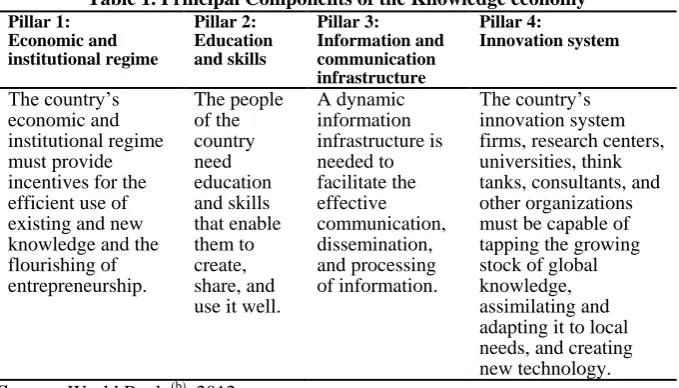
On the other hand, the Economic Incentive and Institutional Regime (EIR) index comprises incentives that promote the efficient use of existing and new knowledge and the flourishing of entrepreneurship. An efficient innovation system made up of firms, research centers, universities, think tanks, consultants, and other organizations can tap into the growing stock of global knowledge, adapt it to local needs, and create new technological solutions. An educated and appropriately trained human resource is capable of creating, sharing and using knowledge. A modern and accessible information and communication technology infrastructure serves to facilitate the effective communication, dissemination, and processing of information. Each of these principal components (4 pillars) or KEI sub-indexes is based on three indicators that serve as proxies for the performance of that component (pillar) as shown in Table 1.
Table 1. Principal Components of the Knowledge economy
Pillar 1: Economic and institutional regime Pillar 2: Education and skills Pillar 3: Information and communication infrastructure Pillar 4: Innovation system The country‘s economic and institutional regime must provide incentives for the efficient use of existing and new knowledge and the flourishing of entrepreneurship. The people of the country need education and skills that enable them to create, share, and use it well.
A dynamic information infrastructure is needed to facilitate the effective communication, dissemination, and processing of information. The country‘s innovation system firms, research centers, universities, think tanks, consultants, and other organizations must be capable of tapping the growing stock of global knowledge, assimilating and adapting it to local needs, and creating new technology. Source: World Bank (b), 2012
(pillar) on total factor productivity based on the most common approach of modeling termed as ‗special capital‘ model (Schreyer, 2000). The model treats a particular input as yielding network economic externalities or spillovers, which imply a social rate of return significantly above the private market rate. The starting point of analysis introduces the production function as illustrated in Equation 1.
Qit = Ait F (Lit Kit) (1)
where Q is the real output, L is the labor input (hours worked), K is the capital input, A stands for technology shift parameter, and i and t denote industries and time respectively. However, there is a growing consensus among economic growth and development thinkers that technology innovation and diffusion can play a critical role in stimulating economic growth and productivity (Kraemer and Dedrick, 1999). Romer (1990) argues that economic growth and technological changes are inextricably linked to each other and, therefore, widespread technology diffusion creates the possibility for increasing returns to investment (Arthur, 1996). Information and communication technology (ICT) investment was defined as total spending for computer hardware, software, and services within a country. Many studies found a significant relationship between economic growth rates between information and communication technology investment and both productivity and economic growth at the national level (Ahmed, 2006).
On the other hand, education affects growth indirectly through its impact on total factor productivity growth. Most of the literature and policy discussions have focused on the role played by education in facilitating the transfer, adoption, and utilization of technologies and productivity enhancing measures. One may demonstrate the dynamic effect of human capital on productivity growth by focusing on convergence in total factor productivity rather than the standard paradigm of income convergence. It follows that while the proximate cause of differences between countries appears to be the level of productivity, the ultimate cause may be varying levels of human capital. More recently several empirical papers, such as Benhabib and Speigel (1994), have argued that the relationship between human capital and income growth is best viewed in the context of the positive effect that human capital has on total factor productivity, rather than its direct effect as an aggregative factor in the production function.
hypotheses made, the present study expects to find that the rate of growth of each MENA country‘s total factor productivity is a positive function of the gap between its current actual total factor productivity level and the potential total factor productivity level, while the potential level of total factor productivity is a function of Knowledge Economy Index.
3.
Literature review
In the past few years, many studies have focused on productivity-led economic growth and its determinants. A major reason for this is the widespread belief that, due to rapid factor accumulation, economic growth is subject to diminishing returns and, hence, not sustainable. Recently, there has been a growing interest in the contribution of knowledge to total factor productivity growth and to sustainable long-term economic development (Dragomir and Irena, 2011). Also, there are several studies relevant to the literature of Total Factor Productivity (TFP) and Knowledge-based Economy. Most of the studies attempt to explain the relationship between Knowledge-based Economy and total factor productivity.
Mankiw, Romer, and Weil (1992) purported to show that the Solow model, when augmented to include human capital as a factor of production, did a reasonable job of explaining the variations in per capita real income that are observed across a large and heterogeneous sample of countries. They found that factor accumulation could account for a majority of differences in income per capita under the assumption that all countries shared a common level of productivity.
Klenow and Rodriguez-Clare (1997) calculated the total factor productivity for a sample of countries after accounting for the contributions made by labor, physical capital and human capital. They then decomposed the variance of per capita income into that attributable to differences in factors of production and that attributable to differences in total factor productivity. Using a number of formulations they concluded that, in general, differences in total factor productivity play a greater role.
Hall and Charles (2011) corroborated the results of Klenow and Rodriguez-Clare's (1997) study and found that the lion‘s share of the variation in incomes across the world could be strongly explained by differences in total factor productivity, not in factors of production.
technologies. They suggest that education plays a crucial role in determining the capability of developing countries to adopt new technologies in order to catch up with developed countries. In addition, these studies do not examine the effect of health capital on the growth rate of total factor productivity.
Han, Kalirajan and Singh (2003) compared the sources of growth in East Asia with the rest of the world, using a methodology that allows one to decompose total factor productivity (TFP) growth into technical efficiency changes (catching up) and technological progress. It applies a varying coefficients frontier production function model to aggregate data for the period of 1970-1990, for a sample of 45 developed and developing countries. Their results are consistent with the view that East Asian economies were not outliers in terms of total factor productivity growth. Of the high-performing East Asian economies, their methodology identifies South Korea as having the highest total factor productivity growth, followed by Singapore, Taiwan, and Japan. Their methodology also allows us to separately estimate technical efficiency change, which is a component of total factor productivity growth, and they find that, in general, the estimated technical efficiency of the high-performing East Asian economies was not out of line with the rest of the world.
Scarpetta and Tressel (2004) presented their empirical evidence on the determinants of industry-level multifactor productivity growth. They focused on 'traditional factors' including the process of technological catch up, human capital, and research and development (R&D), as well as institutional factors affecting labor adjustment costs, based on harmonized data for 17 manufacturing industries in 18 industrial economies over the past two decades. The disaggregated analysis reveals that the process of technological convergence takes place mainly in low-tech industries, while in high-tech industries, country leaders tend to pull ahead of the others. The link between R&D activity and productivity also depends on the technological characteristics of the industries.
Polder (2009) found that ICT is an important driver of innovation in both manufacturing and services. Doing more R&D has a positive effect on product innovation in manufacturing. Organizational innovation has the strongest productivity effects. They found positive effects of product and process innovation when combined with an organizational innovation.
Mastromarco and Ghosh (2009) studied the effective factors responsible for the Total Factor Productivity of 57 developing countries, using panel data econometric analysis. In their study they have come to the conclusion that variables such as found Foreign Direct Investment, import of capital, R&D and human capital have effects on total factor productivity. Also, the effect of human capital is more significant in these countries.
productivity, but that the impact of process innovation is more ambiguous, suggesting that the firms being analyzed possess some market power.
4.
Materials and Methods
Various factors such as innovation, education and many other factors affect the total factor productivity. To calculate the total factor productivity of production, the Solow residual method was used according to equation 2.
TFP = Q – αl – βk (2)
where L represents the labor; K, the volume of capital; and Q, the gross domestic product. The coefficients α and β show the contribution of labor and capital in production, which, according to similar empirical studies, are considered equivalent to 0.4 and 0.6 respectively (O‘Mahony and Vecchi, 2002).
In order to study the impact of the development of knowledge-based economy on the growth of the total productivity of the factors of production, two models were formed: in the first model, the impact of Knowledge Economy Index (KEI), as an independent variable, is considered the dependent variable (i.e., total productivity of factors of production). The World Bank defined and calculated indices of the variables of economic incentive and institutional regime, innovation, education, information, and communication technology (ICT), which are major components of Knowledge Economy Index for many countries since 1995. In the second model, to evaluate and compare the effectiveness of the subsets of knowledge-based economy (major components), indicators of economic incentive and institutional regime, innovation, education, information, and communication technology (ICT) are considered an independent variable; and the impact of these variables on the total productivity of the factors of production is examined. To study the impact of the growth of independent variables on the dependent variable, the logarithmic form of variables is used in both models.
On the basis of the literature review explained above, it is expected that the total productivity of the factors of production be a positive function of all the independent variables in both models. Therefore, the two following models are suitable for estimating the coefficients of independent variables introduced as presented in Equations (3) and (4).
TFPit = β0 + β1KEIit + εit (3)
TFPit = β0 + β1ICTit + EDit + EIit + INit + εit (4)
In equations (3) and (4), the variables are defined as: TFP: total factor productivity
KEI: knowledge-based economy index
ED: education
EI: indicators of economic incentive and institutional regime IN: innovation
Further, based on the data published by the World Bank for the years of 1995 to 2012, separated for 14 member countries of the MENA region, panel data were formed, and the generalized least square (GLS) method was used to estimate the intended coefficients. One major advantage of the GLS method is that in both cases of random effect and fixed effect, its performance is sufficient for a good estimation of the model. In addition, by giving appropriate weight to the model variables, this method can eliminate the problem of heteroscedasticity of variance and the results of the estimate would be reliable. Therefore, this method is one of the most widely used methods in models panel data, which has also been used in this study. It should be noted that the use of panel data is possible when countries are homogeneous. According to the World Bank Organization's reports, all of the MENA region countries are classified as middle income countries and their economic structures are approximately similar. Also, for the period of 1995 – 2012, the rank of MENA countries in KEI index fluctuated smoothly.
Before estimating the model‘s coefficients of variables, one must examine the stationary status of variables. Hence, the unit root test was performed using the method of Levin, Lin, and Chu. The results of this test were reported in Table 2.
Table 2. Unit Root Test
TFP KEI
ICT ED
EI IN
Variables
-2.42 -3.55
-22.04 -2.22
-4.08 -8.23
Statistic
0.01 0.00
0.00 0.01
0.00 0.00
Prob. Research findings
In addition, after the null hypothesis (hypothesized relations in 5) on the homogeneity of cross sections is examined and tested, it will be clear that the pool data method would be used in the case of the homogeneity of cross sections, and otherwise the method of panel would be used.
H0: αi = αN (5)
H1: αi ≠ αj , i ≠ j
In the hypothesized relations above, αi expresses the individual impacts,
for which Leamer F Test can be used (Equation 6).
F N-1, N (T-1) - K = (RRSS-URSS) * (N*T-N-K) / (N-1) * (URSS) (6)
of explanatory variables. N is the number of cross sections, and NT is the total number of observations.
After completing the Leamer F Test, the results suggest the need to estimate the model using panel data. Since t-statistic is greater than the critical point at the 5% level, then null hypothesis based on homogeneous cross sections is rejected and therefore it is concluded that the panel method would be an accurate method for the estimation. Results of Leamer F Test are shown in Table 3.
Table 3. Results of Leamer F test
Result Prob
Statistic Leamer F Test
Panel data 0.00
38.20 Model 1
Panel data 0.00
35.93 Model 2
Research findings
In what follows, to determine whether the random effect or the fixed effect performance is sufficient for a good estimation of the models, Hausman test is designed. The results of Hausman test are shown in Table 4. According to the results of Hausman test, the fixed effect method is suitable for both of the models.
Table 4. Results of Hausman test
Result Prob
Chi-Sq. Statistic Hausman test
Fixed effect 0.00
43.01 Model 1
Fixed effect 0.00
54.30 Model 2
Research findings
5.
Results and Findings
growth of the total productivity of the factors of production during the period under study in 14 member countries of the MENA region (Table 5).
Table 5. Coefficient estimation output of first model Variable Coefficient Std. Error t- Statistic Prob.
KEI 0.36 0. 27 3.14 0.00
R2 0.91
D.W 1.83
Research findings
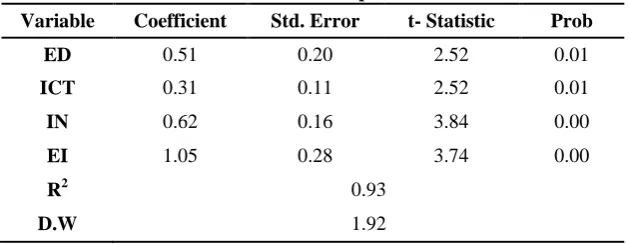
In the second model estimation, all the independent variables showed positive and meaningful effects on the dependent variable at the 5% level test. The results show that variables such as education (with a coefficient of 0.51), ICT (with a coefficient of 0.31), innovation (with a coefficient of 0.62), and economic incentive and institutional regime (with a coefficient of 1.05) have the greatest impact on the growth of productivity of the factors of production in the study period (Table 6).
Table 6. Coefficient estimation output of the second model Variable Coefficient Std. Error t- Statistic Prob
ED 0.51 0.20 2.52 0.01
ICT 0.31 0.11 2.52 0.01
IN 0.62 0.16 3.84 0.00
EI 1.05 0.28 3.74 0.00
R2 0.93
D.W 1.92
Research findings
The R-squared index in both models indicates the good fitting of the models. In addition, Durbin-Watson critical value indicates that there is no autocorrelation problem in both models.
6.
Conclusions
of great importance for developing economies. Therefore, it has become important to examine and compare the impact of knowledge-based economy index on the growth of total productivity of the factors of production especially in developing countries of MENA region.
In the past, relevant studies such as Miller and Upadhyay (2002), Nelson (1966), Mankiw (1992), Romer (1990), and Phelps (1966) have substantially attempted to explain the relationship between knowledge based economy and total factor productivity. These studies emphasized that the variant principal components of the knowledge-based economy, including economic and institutional regime, education and skills, information and communication infrastructure, and innovation system have efficacious and positive roles in the improvement of total factor productivity in different regions. Comparatively, the results of the present study confirm the conclusions made by the aforementioned studies for the developing economies of MENA region countries and showed that the growth of knowledge-based economy has a positive and significant impact on the growth of the total productivity of the factors of production in the member countries of the MENA region in the time interval of 1995 to 2012. On the other hand, comparative analysis of the impact of four major components of knowledge based economy showed that the variables of education, ICT innovation, economic incentives, and institutional regime have the greatest impact on the productivity growth of the factors of production in the period studied. Therefore, greater attention to the knowledge based economy can greatly help to achieve the developmental goals for the member countries of the MENA region. The impact level of the components of the knowledge based economy can also show a model to prioritize the development of each component of knowledge based economy for the member countries of the Middle East and North Africa (MENA) region.
the key solution for preventing the waste of knowledge resources and improving TFP in MENA countries, especially Iran.
References
1. Ahmed, E. M. (2006). ‗ICT and Human Capital Role in Achieving Knowledge-Based Economy: Applications on Malaysia‘s Manufacturing‘. Journal of Information and Knowledge Management, Vol. 5, No. 2, pp. 117–128.
2. Arthur, W. B. (1996). ‗Increasing Returns and the New World of Business‘. Harvard Business Review, (July–August), 100–109.
3. Bronwyn H. Hall. (2011), Innovation and Productivity, Nordic Economic Policy Conference on productivity and competitiveness. Helsinki, Finland, pp. 167 -195.
4. Brinkley, I. (2006). Defining the Knowledge Economy. The Work Foundation, London.
5. Benhabib, J. and Speigel, M.M. (1994). ‗The Role of Human Capital in Economic Development: Evidence from Aggregate Cross-Country Data‘. Journal of Monetary Economics. 34(2), 143-173.
6. Chen, D. H. and Dahlman, C.J. (2005). The Knowledge Economy, the KAM Methodology and World Bank Operations. World Bank Institute Working Paper, No. 37256, Washington, DC: The World Bank, worldbank.org/KFDLP/Resources/KAM_Paper_WP.pdf (accessed January 30, 2011).
7. Dragomir, S and Irena, F. K. (2011). ‗Knowledge Economy Factors and the Development of Knowledge-based Economy‘. Croatian Economic Survey, Vol. 13, No. 1, pp. 105-141.
8. Economy Master Plan.(2002). Knowledge-based Economy Master Plan; Annual Report Various Issues. Government of Malaysia Printers, Kuala Lumpur.
9. Flew, T. (2008). New Media: An Introduction (3rd Ed.). New York: Oxford University Press. ISBN 978-0-19-555149-5.
10.Hall, R. and Charles I. J. (2011). ‗Why Do Some Countries Produce So Much More Output per Worker Than Others?‘ Quarterly Journal of Economics, An earlier version of this paper was called ―The Productivity
of Nations‖ NBER working paper 5812.
11.Han, G., Kalirajan, K. and Singh, N. (2003). Productivity, Efficiency and Economic Growth: East Asia and the Rest of the World, Santa Cruz Centre for International Economics. Working Paper, 03-02. [http://repositories.cdlib.org/sccie/03-02]
12.Katz, B., Muro, M., Rahman, S., and David Warren, D. (2008). Metro Policy: Shaping a New Federal Partnership for a Metropolitan Nation Report. The Brookings Institution.
14.Kraemer, K.L. and Dedrick, J. (1999). Information Technology and Productivity: Results and policy implications of cross-country studies. Working Paper: #PAC-144, Center for Research on Information Technology and Organizations, University of California.
15.Mulgan, G. (2005). The Network Society from Knowledge to Policy. Washington, DC: Johns Hopkins Center, chapter 8, pp. 225-241.
16.Mastromarco, C. and Ghosh, S. (2009). ‗Foreign Capital, Human Capital, and Efficiency: A Stochastic Frontier Analysis for Developing Countries‘. World Development, Vol. 37, PP 482-502.
17.Mankiw, N. G., Romer, D. and Weil, D. (1992). ‗A Contribution to the Empirics of Economic Growth‘. Quarterly Journal of Economics, Vol. 107, No. 3541, pp. 407–437.
18.Miller, S.M. and Upadhyay, M.P. (2002). Total Factor Productivity, Human Capital and Outward Orientation: Differences by Stage of Development and Geographic Regions. University of Connecticut Department of Economics Working Paper Series, Working Paper 2002-33. [http://www.econ.uconn.edu/working/2002-2002-33.pdf].
19.Nelson, R. and Phelps, E. (1966). ‗Investments in Human Capital, Technological Diffusion and Economic growth‘. American Economic Review, Vol. 56, No.12, pp.69-75.
20. O‘Mahony, M. and Vecchi, M. (2002). Is There an ICT Impact on TFP? A heterogeneous dynamic panel approach, discussion papers-national institute-cite seer. Available at; http://citeseerx.ist.psu.edu/messages/downloadsexceeded.html 21.Polder, M. Leeuwen, G. Mohnen, P and Raymond, W. (2009).
Productivity Effects of Innovation Modes. Publisher: Statistics Netherlands, Henri Faasdreef 312 2492 JP, Hague.
22.Porter, M.E. (1998). ‗Clusters and the New Economics of Competition‘.
Harvard Business Review. 77–90.
23.Romer, P.M. (1990). ‗Endogenous Technological Change‘. Journal of Political Economy, 98(5), Part 2, Reprinted in JM Buchanan and JY Yong (Eds.). The Return to Increasing Returns. pp. 287–318. Ann Arbor: University of Michigan Press.
24.Scarpetta, S. and Tressel, T. (2004). Boosting Productivity via Innovation and Adoption of New Technologies: Any Role for Labor Market Institutions? The World Bank, Policy Research Working Paper Series: 3273.
25.Schreyer, P. (2000). The Contribution of Information and Communication Technology to Output Growth: A Study of the G7 Countries. OECD Directorate for Science, Technology and Industry, STI Working Paper No. 2.
Fuzzy Ontology Generation for Semantic Web. IEEE Transactions on Knowledge and Data Engineering 18 (6): 842–856.
28.Walter W. Powell, W.W. and Snellman, K. (2014). The Knowledge Economy. Stanford University.
29.World Bank(a) (2012). Knowledge Economy Index (KEI) 2012 Rankings, available at www.worldbank.org/kam.