in the population sciences published by the Max Planck Institute for Demographic Research
Konrad-Zuse Str. 1, D-18057 Rostock·GERMANY
www.demographic-research.org
DEMOGRAPHIC RESEARCH
VOLUME 18, ARTICLE 13, PAGES 377-408
PUBLISHED 16 MAY 2008
http://www.demographic-research.org/Volumes/Vol18/13/ DOI: 10.4054/DemRes.2008.18.13
Research Article
Effects of single parenthood on educational
aspiration and student disengagement in Korea
Hyunjoon Park
c
°2008 Hyunjoon Park.
1 Introduction 378
2 Extending literature of single parenthood in non-Western societies 379
3 Research questions 380
4 Contexts of single parenthood in Korea 381
4.1 Recent trends in divorce 381
4.2 The public welfare system and labor market 382
4.3 The extended family system 383
4.4 Post-divorce living arrangements in Korea 384
5 Data and methods 386
6 Results 390
6.1 Prevalence of single parenthood 390
6.2 Effects of single parenthood on educational aspiration 393 6.3 Effects of single parenthood on school disengagement 397
6.4 A supplementary analysis 399
7 Conclusion 401
8 Acknowledgements 404
Effects of single parenthood on educational aspiration
and student disengagement in Korea
Hyunjoon Park1
Abstract
The recent rapid increase in divorce, along with its distinctive cultural and welfare en-vironments for single-parent families, makes Korea an interesting case for examining effects of single parenthood on children’s education. Using data from Korean 9th and 12th graders, I compare the levels of educational aspiration and student disengagement between students with two parents and those with a single parent, distinguishing di-vorced single fathers, widowed single fathers, didi-vorced single mothers, and widowed single mothers. Logistic regression analyses show that students with a divorced single parent, regardless of gender of the parent, are much less likely to aspire to four-year university education and more likely to be disengaged than their counterparts with two parents. The effects of widowhood disappear once control variables are held constant. Lower household income among single-parent families explains in part the poorer educa-tional outcomes of their children. Parent-child interaction is another important mediating factor for the effect of single fatherhood but not for single motherhood. The relevance of the extended family system and distinctive features of post-divorce living arrangements in Korea is discussed to understand the effects of single parenthood.
1. Introduction
Along with substantial prevalence of single parenthood, researchers in the United States and Western Europe have extensively examined consequences of growing up with a sin-gle parent for children’s education (e.g., Scott, 2004; Ermisch & Francesconi, 2001; McLanahan & Sandefur, 1994). Although single parenthood is negatively associated with children’s educational outcomes in most Western countries, recently comparative studies show that thestrength of the negative relationship varies significantly across countries (Hampden-Thompson & Pong, 2005). Even some studies of non-Western developing so-cieties have found no apparently negative effects of single parenthood. Lloyd and Blanc (1996) found that in sub-Saharan Africa countries, children in female-headed households tended to have greater educational opportunities in terms of school enrollments and at-tainment relative to children in male-headed households.
Compared to the large number of studies on single parenthood in Western industrial countries and even in some developing countries, little research has addressed the issue in societies that have recently experienced dramatic changes in family structure, especially the rapid increase in divorce in East Asia. In particular, Korea, along with Japan, has long been recognized with its very low level of divorce and low incidence of births outside of marriage linked with strong family ties (Park & Cho, 1995; Kumagai, 1995). During the recent decade, however, Korea has experienced a rapid increase in divorce, which makes no longer peripheral the question of single parenthood and its impacts on children’s education and well-being (see Raymo, Iwasawa, & Bumpass, 2004).
2. Extending literature of single parenthood in non-Western societies
In examining the relationship between single parenthood and children’s education, this study distinguishes single-parent families by the causes of single parenthood (i.e., whether through the death of a parent or marital disruption) and also by sex of single parents (i.e., whether it is the father or the mother who is absent). Literature in Western countries has highlighted substantial heterogeneity in the effect of single parenthood among different types of single-parent families. In the United States, evidence suggests that children from single-mother families due to the death of the father show similar levels of educational and occupational attainment compared to those from two-parent families, which are sig-nificantly higher than the levels of those from divorced single-mother families (Biblarz & Gottainer, 2000; Amato & Keith, 1991a). A few studies in Europe have also found the more negative effects of divorce than the death of a parent, especially among single-mother families (Borgers, Dronkers, & Van Praag, 1996; Kiernan, 1992; Bosman a& Louwes, 1988). A study by Pong (1996), which is a rare study conducted in non-Western context that made a distinction between divorced and widowed single mothers, also pro-vides evidence of the relative advantages of children in Malaysia living with a widowed mother over those living with a divorced mother.
The distinction between father-absence and mother-absence families is another im-portant dimension to be considered. In the Netherlands, a study found better educational outcomes of children from single-father families than children from single-mother fam-ilies (Borgers et al. 1996). In the United States, although some studies showed lower educational attainment of children from father families than children from single-mother families (Biblarz & Raftery, 1999), the general consensus is that children from single-mother and single-father families do not show significant differences in educa-tional outcomes (Downey, Ainsworth-Darnell, & Dufur 1998; Amato 1993). Because most previous literature on single-parent families in non-Western societies has focused only on father absence, very little is known about the consequences of mother absence in these societies.
Another limitation of previous research on single-parent families in non-Western so-cieties is its lack of attention to the mechanisms through which family structure affects children’s outcomes. Numerous studies in Western countries have pointed out the impor-tance of poverty and economic insecurity for explaining lower educational achievement of children from single-parent families (McLanahan & Sandefur, 1994). Single-parent families tend to be poorer than are two-parent families. Given that family economic sta-tus is an important determinant of children’s education, it is evident that differences in economic standing between children from the two different family types explain some of the educational differences between them.
does not explain all of the disadvantages associated with single parenthood (Mulkey, Crain, & Harrington, 1992). Compared to married couples, single parents tend to have the lower level of involvement in children’s education as indicated by less supervision and monitoring of the child’s school work (Astone & McLanahan, 1991). Given the positive influence of parental involvement on children’s educational outcomes (Scott, 2004; Kim 2002), the lower level of parental involvement among single-parent families is considered to be another major reason for poorer educational outcomes of children with a single par-ent (McLanahan & Sandefur, 1994). Not only parpar-ental involvempar-ent in education but also the overall relationship between a parent and his or her child likely affects psychological well-being and thus ultimately educational outcomes of the child. Interparental conflict resulting in divorce tends to deteriorate parent-child relationship as well (Amato & Keith, 1991b), which will negatively affect the child’s educational achievement.
In short, the social relationship between a child and his or her parent is another im-portant mechanism through which the disadvantages associated with single parenthood occur. Compared to economic factors, very little attention has been paid to the role of parent-child interaction in non-Western societies, which is in part attributable to limited data. Detailed measures of parenting behaviors and involvement in children’s school and other activities are usually not found in data available for studying family and education in non-Western countries.
3. Research questions
In this study, I examine the effects of single parenthood on children’s educational out-comes in Korea using data from a national representative survey of middle-school (ju-nior high school) se(ju-nior (9th graders) and high-school se(ju-nior (12th graders) students con-ducted in 2004 (the Korean Education and Employment Panel: KEEP).1 I particularly focus on children’s educational aspiration and student disengagement as two educational outcomes. I explicitly address variations among different types of single-parent families by comparing the effects of single parenthood across four types of single-parent families in comparison to two-(biological)-parent families: divorced single-father families, wid-owed single-father families, divorced single-mother families, and widwid-owed single-mother families.
Thus, the first aim of this study isto provide a comprehensive and extensive descrip-tionof differences in educational aspiration and student disengagement between children from two-parent families and those from each type of single-parent family. Then, I move
1Most studies available to the present in Korea have not used data collected at the national level with a probability
to explain how the disadvantages associated with single parenthood, if any, occur. I particularly focus on the extent to which household income and parent-child interaction account for the effects of single parenthood. Various measures of family’s economic conditions and parent-child interaction contained in the KEEP survey facilitate an ex-amination of the relative role that each aspect of family background plays in explaining differences in student outcomes across different types of family.
4. Contexts of single parenthood in Korea
4.1 Recent trends in divorce
Figure 1: Trends in crude divorce rate in Korea
Source:Korea National Statistical Office (2005)
The Statistical Yearbook of the Economic Commission for Europe 2003
went up again to 3.5 in 2003. In other words, during this 12-year period, the rate increased by about a factor of three. It is notable that in recent years Korea has shown a rate similar to or even higher than the rate in most Western countries except for the United States. The comparison clearly indicates that Korea is no longer a country of low divorce rate.
The dramatic increase in divorce is expected to have led to the increase of single-parent families overall, other factors being held constant. It is also expected that among total single-parent families the relative share of single-parent families due to divorce has increased, while the relative share of single-parent families resulting from the death of a parent has decreased along with a significant decline in mortality.2 Because data are not available at the level of household or family, I can only present the change in the proportion of specific age groups by marital status to gauge the trend of prevalence of single-parent families. Between 1975 and 2000, the percentage of those aged 40-44 (note that the respondents in KEEP are middle-school seniors (14 years old) and high-school seniors (17 years old)) who were married declined from 92.9 to 89.7 (Chang & Min, 2002). During this period, the proportion of those divorced increased four times from 1.0 percent to 4.3 percent, while the proportion of those widowed decreased from 5.7 percent to 2.2 percent. In result, in 2000 the proportion of those aged 40-44 who were single due to divorce was twice as high as the proportion due to widowhood. The rapid increase of the proportion of divorce on the one hand and the decline of the proportion of the widowed on the other hand is also found among aged 45-49. In general, the statistics suggest the substantial increase of single-parent families overall and the increasing proportion of single parenthood due to divorce among recent single-parent families.
4.2 The public welfare system and labor market
The significant increase of single parenthood raises an important issue of educational dis-advantages among children growing up with a single parent, given the overall low level of public provisions for children and family in Korea. Korea has a conservative social wel-fare system with very low levels of spending by the government on social programs. For instance, public expenditure on family (including both cash and other kinds of benefits) as a percentage of GDP (Growth Domestic Product) was only 0.1 percent in Korea in 2000 showing the lowest level among OECD countries, whereas the corresponding percentage in Denmark, Finland, and Norway was over 3 percent (OECD, 2004). An indicator of public support for children’s education tells a similar story. In Korea, private funds that came from individuals or households accounted for 77 percent of total expenditures on tertiary education in 2000, the highest among the OECD countries providing expenditure
2The crude death rate, which indicates the total number of deaths per 1000 people, has declined from 8.0 in 1970
data. Indeed, except for Korea, only two countries, Japan (55 percent) and the U.S. (66 percent) had more than half of the expenditure on tertiary education funded by the private sector, while in other OECD countries most of the expenditure on tertiary education was from public sources (OECD, 2003). In addition to the overall low levels of social wel-fare provision, substantial social policies particularly geared toward single-parent families have not been implemented in Korea.
The vulnerable conditions of children living with a single parent, associated with the low level of public support, are expected to be particularly severe among those with a single mother. Although the rate of Korean women’s labor participation has steadily increased over time, still only a half of women in working age are in labor force (48.9% in 2003; KNSO, 2005). Moreover, the Korean economy is distinct with a comparably high proportion of women engaged in unpaid family work or self-employment, which indicates the overall unstable and informal features of women’s employment (Brinton, 2001). Even within the formal sector of employment, women are more likely to be in positions with much lower incomes than their male counterparts (Monk-Turner & Turner, 2000). In sum, the employment structure in Korea is characterized by the marginalization of women in the labor market and a wage system based on the male-breadwinner model. These characteristics of the employment environment in Korea imply that children with a single mother are at particularly high risk of economic deprivation.
In addition to severe economic deprivation that children in single-parent families may face, a strong negative stigma attached to the children of single parents is apparent in Ko-rea. Despite recent changing views on single parenthood in Korea along with the growing prevalence (Yoo, 2006), young children growing up with a single parent, particularly a divorced parent, still suffer from various psychological difficulties caused by negative attitudes from school and peer groups. Even young adults often encounter a barrier to marriage due merely to the fact that they were reared in single-parent families (Chang & Min, 2002). These economic and cultural conditions of children growing up with a single-parent in Korea lead to an expectation of the evident educational gap between stu-dents from single-parent and two-parent families.
4.3 The extended family system
from extended family and kin members as well as welfare provision by the state. Influenced by Confucianism that regards family as the pivotal unit of society, Korea has traditionally maintained relatively strong family ties (Park & Cho, 1995). Although urbanization and industrialization have considerably weakened family ties in contem-porary Korean society, the traditional family values still posit substantial influences on individuals’ behaviors. Studies show a substantial degree of private transfers among ex-tended family members, especially toward those economically disadvantaged (Goh, Kang & Sawada, 2005). Although the share of multigenerational families among total family types has significantly decreased over time, the most recent census shows that in 2005, still 14 percent of all children under age 18 live in multigenerational households consist-ing of three or more generations of parents and their children (KNSO, 2008).
Living arrangements with grandparents should be particularly important for children of single parents. The KEEP data reveal that in Korea, about 9 percent of middle school and high school seniors who live with two parents have at least one grandparent in the same household. The percentage is much higher among children of a single father: a third of children living with a divorced father have at least one grandparent present, while a fifth of children who live with a widowed father do so. The figures can be compared to the fact that 11 percent of American children under age 18 who live with a single father have at least one grandparent present in household (Fields 2003). Considering that co-residence with grandparents tends to increase among families with younger children, the prevalence of co-residence with grandparents among middle school and high school seniors who live with a single father in the United States should be even lower than 11 percent for all children under age 18. Having grandparents present may be significant for well-being of children living with a single father, given that grandparents may provide emotional and social assistance to those children. Interestingly, however, among children who live with a single mother, the share of those with at least one grandparent in households seems similar between the two countries. Only 9 percent of middle school and high school seniors living with a single mother in Korea have at least one grandparent in households.
4.4 Post-divorce living arrangements in Korea
chil-dren are much more likely to live with their mother than father after parental divorce (Kim et al. 2005). A national survey of fertility in Korea shows that in 2003, almost half of children of divorced couples lived with their father (Kim et al. 2005), while in the United States, only 17 percent of children whose parents were divorced lived with their father (Saluter and Lugaila 1998). A study of Dutch family showed that 17 percent of students from primary and secondary schools lived with their father after parental divorce (Borgers et al., 1996).
The substantial proportion of children living with a single father after parental divorce has an important implication for understanding children’s well-being in single-parent fam-ilies in Korea. A study in the Netherlands found few important differences in several outcomes of education between children living with a divorced single father and children living with two parents. Although fairly small in the magnitude, educational outcomes of children living with a divorced single mother were generally poorer than those of chil-dren living with two parents (Borgers et al., 1996). Some studies in the United States showed no significant differences in indicators of well-being between children living with a divorced single father and children living with a divorced single mother (Downey et al., 1998; Amato 1993). In other words, studies in Western countries generally find that children living with a divorced single father fare better or at least are not worse off than children living with a divorced mother. The finding, however, may reflect selectivity. In the context where most children happen to live with their mother after parental divorce, single fathers who have custody may be a selective population in regard to their commit-ment to parenting and other socioeconomic characteristics, which may reduce the negative consequences of living with a single parent (Borgers et al., 1996).
In the Korean context where prevalence of parental custody is much substantial, the selectivity associated with custodial fathers may not play a role as much as it does in the context where paternal custody is relatively rare. In contrast, Korean single mothers who get custody may be more selective in their characteristics than single mothers in the Western context, given that maternal custody in Korea is not as predominant as maternal custody in Western countries. In sum, the distinctive feature of post-divorce arrangements in Korea should be taken into account when children’s well-being is compared across different types of single-parent families.
relation-ships with a non-resident parent may help children deal with parental divorce, children of divorced parents in Korea are significantly disadvantaged with limited contacts with a non-resident parent.
5. Data and methods
Data The data for this study come from a national representative survey, the Korean Education and Employment Panel (KEEP), conducted by the Korea Research Institute for Vocational Education and Training (KRIVET) in 2004. The stratified cluster sampling method was used to select respondents: regions were first stratified, schools were selected within each region in proportion to the number of students residing in the region, and fi-nally students were sampled within each school.3The sampling was conducted separately for each group of the targeted population: middle school seniors (9th graders), academic high school seniors (12th graders), and vocational high school seniors (12th graders), as of 2004, yielding the final sample of 2,000 students for each group (i.e., a total of 6,000 students). Among total 6,000 respondents in KEEP, 262 respondents did not report living arrangement or/and the reason for not living together with a parent and thus their family types could not be identified.
To better understand the targeted populations, brief information on educational struc-ture in Korea is in order. After six years of compulsory primary education and three years of compulsory lower secondary education in middle school, students proceed to either academic high schools or vocational high schools, mostly depending on their grades and needs. Compared to US secondary schools where students take different courseswithin
schools, students in Korea are separated into academic or vocational high schools. Aca-demic high schools prepare students for post-secondary education, while vocational high schools focus on occupational training for students who enter job markets after gradua-tion. Given the importance of college degrees for life chances in Korea, academic high schools are perceived as more prestigious than are vocational high schools (Park, 2004).
In 2004, the ratio of the number of students in academic and vocational high schools was about 7:3 (KEDI, 2005). Therefore, selecting the same number of students (2,000) from each of academic and vocational high schools for the final sample of KEEP resulted in oversampling students in vocational high schools. To infer parameters for population of high school seniors (12th graders), the appropriate weight variable should be used to take into account the oversampling of vocational high school students.
The interview with a selected student was administered using PDA (Personal
Digi-3The overall response rate was quite high, as much as 93.8 percent for the student survey. The KEEP website
tal Assistant), which is an advanced version of CATI (Computerized Assisted Telephone Interview), in order to collect a large set of information including student’s school life, ed-ucational outcomes, and eded-ucational and occupational aspirations. A household member of the student (usually a mother or a father) completed a household questionnaire, which provided information on the household’s cultural, economic, educational, and social en-vironments. As a panel survey, KEEP will be tracking sampled students’ educational and occupation trajectories over coming years. At the time when this manuscript was prepared, only data of the baseline year (2004) were available.
Two outcome variables Educational attainment is a major outcome on which most studies of family structure have focused in order to examine the effects of single par-enthood. Given that the KEEP study has conducted only the baseline-year survey at this time, the current study is not able to assess the extent to which children from single-parent families are disadvantaged, for example, in actually attending or completing four-year col-leges, compared to their counterparts from two-parent families.4 Instead, I examine two other outcomes related to education: educational aspiration and student disengagement. A large body of research based on status attainment models has shown that a student’s educational aspiration is a critical factor predicting her or his subsequent educational and occupational attainment (Sewell, Haller, & Portes, 1969; Sewell & Hauser, 1975). Nu-merous studies in various countries have examined the variation in educational aspiration by family social status, gender, and race/ethnicity (Marjoribanks, 2005; Johnson, Cros-noe, & Elder, 2001). In the KEEP study, respondents were asked to indicate the highest level of educational attainment they would like to achieve. I constructed the outcome variable of educational aspiration as coded 1 if students wanted to complete four-year university education and 0 otherwise.
In addition to educational attainment or aspiration, researchers have been interested in student disengagement indicated by school attendance and punishment as an important dimension of educational outcomes, exploring individual-level and school-level deter-minants of student disengagement (Pellerin, 2005; National Research Council and the Institute of Medicine, 2004). Punishment is a straightforward measure of students’ mis-behavior in schools. As a good measure indicating the degree of commitment to study and school (Astone & McLanahan, 1991), unexcused absence has been seriously consid-ered as one of the early warning signs of educational failure, often leading to suspension, expulsion, truancy, and dropping out (CFFC 2002). I operationalize student disengage-ment as a dichotomous variable having 1 if respondents were absent from school at least
4KEEP did not directly administer any standardized ability or achievement tests. Although there are some
one day during the last school year or they received any kinds of punishment from school during their middle school or high school years. Note that 79 percent of total respondents in KEEP reported no absence at all during the last school year.5
Family structure Using information on whether the student lived with a biological fa-ther and/or a biological mofa-ther at the time of survey and on the reason for not living with both, obtained from the household survey, I distinguish five types of family configuration: respondents living with (1) both biological parents, (2) a father only due to parental di-vorce, (3) a father only due to the death of the mother, (4) a mother only due to parental divorce, and (5) a mother only due to the father’s death. In this study, I exclude students living in stepfamilies. Reflecting the very small proportion of stepfamilies in the Ko-rean family structure, the current data have only very small numbers of respondents who live in stepfamilies, which makes difficult a reasonable analysis of this group (see Ta-ble 1 below). Therefore, this study limits its focus to comparisons between single-parent and two-(biological)-parent families with the distinction of single parenthood by parent’s gender and the causes of single parenthood.
Control variables The effects of single parenthood are estimated after controlling for parental education, gender of the respondent, and number of siblings. Parental education is the higher level of educational attainment of the parents (or educational attainment of a single parent), and it is included in the models as a continuous variable of the years of education completed. I recognize potential variation by gender in the relationship between family structure and educational outcomes. I first examined the relationship separately for female and male students, and the results showed a similar pattern between the two groups in the ways in which each type of single-parent family is associated with the educational outcomes. Thus, I decided to include both female and male students in the same model, treating gender as a control variable.6
Household income To measure the economic condition of the family, I include house-hold income. This information is obtained from the househouse-hold survey. Househouse-hold income
5In KEEP, students were asked to indicate how many days they were absent from school without specifying
reasons. Therefore, some of the absence might be health-related. However, literature in the United States has suggested that much of the absence is caused by disengagement (CFFC 2002). Moreover, in preliminary analysis of predicting school disengagement, I included student’s health status to somewhat control for the absence caused by health-related issues. The results were basically the same what are reported in the current study.
6It is notable, however, that the relative advantage of students living with a single parent due to the death of a
indicates the average monthly income from all household members in the previous year (i.e., 2003). I classify students into three groups depending on their locations at the dis-tribution of the household income: low (the first quartile) household income, middle (the second quartile), and high (the third and the fourth quartile). I used different categoriza-tions of household income and also a continuous form of it but the results were very robust to different specifications of household income.
6. Results
6.1 Prevalence of single parenthood
Table 1: Distributions of respondents by family structure (weighted)
Middle School & Middle School High School High School
Seniors Seniors Seniors
Family Structure (%) (%) (%)
Two-biological parents 90.7 87.4 89.1
Single parent 7.6 10.9 9.2
Father only due to divorce 2.6 3.4 3.0
Father only due to mother’s death 0.1 0.7 0.4
Mother only due to divorce 2.5 3.6 3.1
Mother only due to father’s death 2.3 3.2 2.7
Stepfamilies 1.7 1.8 1.7
Biological father and stepmother
due to divorce 0.8 0.7 0.8
Biological father and stepmother
due to biological mother’s death 0.1 0.3 0.2
Biological mother and stepfather
due to divorce 0.3 0.6 0.4
Biological mother and stepfather
due to biological father’s death 0.4 0.2 0.3
Total % 100 100 100
Unweighted N 1736 3190 5738
a single mother due to the death of the father. Most of single-father families are due to parental divorce. Note that because the sample size in the data is extremely small, I exclude children living in stepparent families from the analysis and focus on differences between children from single-parent and two-parent families.
Examining the distribution separately between middle school and high school seniors shows that single parenthood is slightly more prevalent among high school seniors (11 %) than middle school seniors (8 %). However, the relative share of each type of single parenthood is similar. Among both middle school and high school seniors who live with a single parent, parental divorce is the dominant cause of single parenthood among single-father families, while divorce and widowhood equally account for single motherhood.
Socioeconomic conditions and parenting practices by family types It is useful to look at socioeconomic conditions and parent-child interaction of the four types of single-parent families in order to assess the extent to which differences in the two factors ac-count for variation in educational outcomes across students from different types of fam-ily. Table 2 presents descriptive statistics on parental education, household income, and four measures of parent-child interaction across two-parent families and the four types of single-parent families. Apparently, students from two-parent families enjoy socioeco-nomic advantages compared to their counterparts from single-parent families, indicated by higher levels of both parental education and household income. About half of students from two-parent families belong to the category of “high” household income (3rd and 4th quartiles of the overall distribution), while the corresponding proportion is 15 percent among divorced-father families. The proportion is even less than 10 percent among the other three groups of single-parent families. Among the single-parent families, students from single-father families report relatively higher household income than do those from single-mother families. This pattern reflects the Korean employment and wage structure that favor men workers over women as discussed earlier.
The relative advantage of students from two-parent families is also obvious in regard to parent-child interaction. The extent to which parents know their child’s grade/schooling and their child’s plan after high school graduation is greater among students from two-parent families than those from single-two-parent families. The percentage of students whose families have a TV rule is highest among students with two parents. The level of student’s satisfaction with family life is also highest among students with two parents.
that their families have a TV rule. Although students with a divorced mother report the similar level of life satisfaction as students with a widowed father, evident is the relatively high level of life satisfaction among students with a widowed mother.
In the bottom of the table, 85 percent of students from two-parent families aspire to four-year university education, whereas less than 60 percent of students from divorced father families do so. The degree to which students from other types of single-parent families aspire to four-year university education is between. Students with two parents are less likely to be disengaged than their counterparts who grow up with a single parent. In addition to the lowest level of educational aspiration, students from divorced single- father families show the highest level of disengagement. Evident from the table is that students with two parents are better off in both educational outcomes. Next, I turn to multivariate analyses to address the extent two which differences in two educational outcomes between students from two-parent and single-parent families remain after con-trolling for socioeconomic conditions, parent-child interaction, and other characteristics of students and their families.
6.2 Effects of single parenthood on educational aspiration
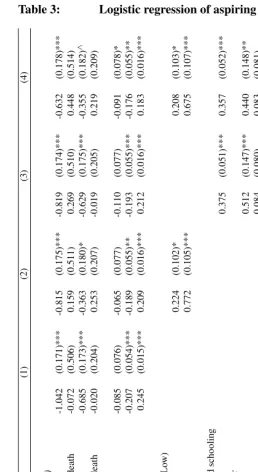
Table 3 reports estimates obtained from four logistic regression models of predicting whether the respondent aspire to four-year university education among middle school and high school seniors combined.7According to Model 1, net of parental education, gender, and number of siblings, living with a divorced single father decreases the log odds of as-piring to four-year university education by 1.042. Stated differently, the odds of asas-piring to four-year university education among students with a divorced single father are 0.35 times the odds among students with two parents (e−1.042= 0.35), holding gender,
num-ber of siblings, and parental education constant. The odds among students with a divorced single mother are a half of the odds among students with two parents (e−0.685= 0.50).
In contrast to the comparison between two-parent and divorced single-parent families, differences in educational aspiration between students with two parents and those with a widowed single father and with a widowed single mother are not statistically significant.
7I first estimated the models separately for middle school seniors and high school seniors. The results showed that
Earlier, descriptive statistics in Table 2 showed that differences between students with two parents and those with a widowed single parent were substantial before gender, number of siblings, and parental education were controlled.8 The additional analyses (not shown) revealed that among the three control variable, parental education was most relevant in explaining the difference between children from two-parent families and children from a widowed single parent.
In Models 2 through 4, I examine the extent to which household income and parent-child interaction account for the differences by family type revealed in Model 1, by adding to Model 1 household income (Model 2), four indicators of parent-child communication (Model 3), and both (Model 4). In order to facilitate interpretation of results in Table 3, I transformed the coefficients to the odds ratios (Figure 2). The odds ratio of 1 indicates no difference in the likelihood of aspirating to four-year university education between students with two parents and those with a single parent compared. The odds ratio less than 1 indicates that students from single-parent families are less likely to aspire to four-year university education than students from two-parent families. As the odds ration becomes closer to 1, the difference in educational aspiration between students from two-parent families and those from single-two-parent families becomes narrower.
The first set of bars for the difference between students with a divorced single father and students with two parents shows that by controlling for household income, the odds ratio increases from 0.35 to 0.44, indicating the decreasing gap between students from the two types of families. Controlling for parent-child interaction in addition to gender, number of siblings, and parental education increases the odds ratio as much as does con-trolling for household income. Finally, the odds ratio increases from 0.35 in Model 1 to 0.53 in Model 4 when both household income and parent-child interaction are taken into account. Note, however, that the lower level of educational aspiration among students from divorced single-father families remains still significant (see Table 3).
The next set of bars shows the change in the odds ratio for the comparison between students with a widowed single father and those with two parents. After either household income or parent-child interaction is controlled, the odds ratio becomes greater than 1 indicating that students with a widowed single father are more likely to aspire to four-year university education. However, the small number of students with a widowed single father (N= 43) renders the difference statistically non-significant, requiring a caution in interpreting the result. An interesting observation, though, is that the extent to which parent-child communication mediates the effect of single fatherhood due to divorce seems
8Note that without the three variables controlled the difference between students with two parents and those with
Figure 2: The odds ratio of aspiring to four-year university education (Compared to students from two-parent families)
Divorced Single Father
Widowed Single Father
Divorced Single Mother
Widowed Single Mother
0.2 0.4 0.6 0.8 1.0 1.2 1.4 1.6
M1: control variables M2: M1 + household income M3: M1 +parent-child interaction
M4: M1 + household income + parent-child interaction N.S.
N.S. N.S.
N.S.
N.S. N.S.
N.S. N.S.
greater than does household income as indicated by the larger degree of change in the odds ratio.
The change in the odds ratio for the comparison between students with a divorced sin-gle mother and students with two parents is presented in the third set of bars. Controlling for household income increases the odds ratio from 0.50 in Model 1 to 0.70 to Model 2. It indicates a significant role of economic insecurity in explaining the lower level of edu-cational aspiration among students from divorced single-mother families. Contrastingly, the extent to which parent-child interaction accounts for the lower level of educational aspiration among students with a divorced single mother is negligible. The less likelihood of aspiring to four-year university education among students from divorced single-mother families remains significant at the 0.10 level even after both household income and parent-child interaction are taken into account (see Table 3).
divorced single mother, parent-child interaction does not seem to play a significant role in accounting for the effect of single motherhood due to the death of a father (the odds ratio hardly changes).
6.3 Effects of single parenthood on school disengagement
Table 4 presents the results for student disengagement as measured by school absence and punishment. Model 1, which includes only the three control variables, shows that students from divorced single-father families and from divorced single-mother families are more likely to be disengaged compared to students from two-parent families. Although the co-efficient of 0.570 associated with single fatherhood due to the death of a mother seems to be substantial in the size, it is not statistically significant reflecting the small sample size. Students living with a widowed mother do not show significant difference in disengage-ment as compared to those living with two parents.
Figure 3: The odds ratio of student disengagement
(Compared to students from two-parent families)
Divorced Single Father
Widowed Single Father
Divorced
Single Mother Single MotherWidowed
0.8 1.0 1.2 1.4 1.6 1.8 2.0 2.2 2.4 2.6
M1: control variables M2: M1 + household income
M3: M1 + parent-child interaction M4: M1 + household income + parent-child interaction N.S.
N.S. N.S. N.S.
N.S. N.S. N.S. N.S.
addition to gender, the number of siblings, and parental education, the higher likelihood of disengagement for students with a divorced father or a divorced mother as compared to those with two parents remains significant. Controlling for those variables does not change non-significant differences between students with two-parents and those with a widowed parent.
In terms of the relative roles that household income and parent-child interaction play in accounting for the differences in student disengagement, notable is the relative im-portance of parent-child interaction over household income among students with a single father. For instance, the comparison between students with a divorced single father and students with two parents shows that the odds ratio decreases from 2.52 in Model 1 to 2.35 in Model 2 with household income additionally controlled, while the odds ratio de-creases from 2.52 in Model 1 to 2.09 in Model 3 with the four indicators of parent-child interactions controlled. The same pattern is found among students with a widowed sin-gle father, although the effects of sinsin-gle fatherhood due to the death of a mother are not statistically significant. Contrastingly, parent-child interaction accounts for little of the difference between students with a widowed single mother and students with two parents. The relative explanatory power between household income and parent-child interaction among students with a divorced mother is similar. It is worth mentioning that the extent to which the two mediating variables, particularly household income, explain the effects of single parenthood on student disengagement is substantially smaller than the effects on educational aspiration. Indeed, adding household income to Model 1 to predict student disengagement does not significantly improve the model fit at the 0.05 level.9
6.4 A supplementary analysis
The existing literature of single parenthood and its consequences for children’s well-being has not systematically examined the potential impact of the extended family system for moderating the negative consequences of growing up with a single parent. The igno-rance may be partially attributable to the relatively small size of single-parent families with grandparent present in the United States and some Western societies. Considering that substantial numbers of children in single-parent households live with grandparents in Korea, the question of how the extended family system, especially co-residence with grandparents, mediates the effects of single parenthood on children’s education can be of interest. The hypothesis of particular interest is that having at least a grandparent present in households should be associated with better educational outcomes of children and the effect of grandparents should be strong especially for single-parent families.
9The likelihood ratio statistic (G2) for model comparison is 4.9 with 2 degrees of freedom (6280.6 in Model 1
-6275.7 in Model 2).G2is asymptotically distributed as chi-square with the degrees of freedom. ThePvalue
However, the fairly small size of sample used in the current study prevented a serious examination of the issue. Sample sizes for single-parent families were considerably small even before being separated by the presence of grandparent (refer to unweighted Ns in the bottom of Table2). There were only 10 students who lived with a widowed single father and at least a grandparent. Similarly, the sample size of students living with a widowed single mother and at least a grandparent was only 14. Therefore, I first looked at the simple bivariate relationships between co-residence with grandparents and educational outcomes. For most types of family, co-residence with grandparent showed either no sig-nificant relationships or even slightly negative relationships with educational outcomes. Despite the sample sizes, furthermore, I conducted multivariate analyses that included interaction terms between the presence of grandparents and family structure. The re-sults (not shown here) revealed that for children with two parents the effect of co-resident grandparent was negligible, and none of the interaction effects between co-resident par-ents and family types were statistically significant because of large standard errors caused by the small sample sizes. More importantly, similar to the bivariate results, the direction of interaction effects mostly indicated that children of single parents who had at least a grandparent in households were actually worse off than children of single parents who did not have a grandparent present.10
Although the negligible or negative effect of living with a grandparent on children’s education is somewhat unexpected, the pattern has already been reported in several studies with cross-sectional data. Examining the effect of a co-resident grandparent on 15-year-old students’ test scores in 30 countries, Marks (2007) found the negative association between having a co-resident grandparent and test scores in most countries. Another cross-national study of 4th and 8th graders’ math scores by Moyi, Pong, and Frick (2004) also showed that the negative association was predominant among 25 countries and more-over, the pattern was consistent across different family types.
The results suggest that co-residence with a grandparent may reflect particularly vul-nerable conditions of families. For instance, a divorced single mother who does not have her parents in households may indicate more favorable economic and psycholog-ical conditions of the single mother than the other single mother who has her parents in households to take care of her children. In other words, when single parents and their children have more serious problems, grandparents may likely move in the households to help them. Therefore, even if some observed socioeconomic characteristics are taken into account, unobserved characteristics of families with a grandparent present may
ren-10Given the results in this study that the cause of single parenthood, rather than the gender of single parent, is
der negative the association between co-resident grandparents and children’s education. This kind of selectivity cannot be appropriately addressed with cross-sectional data. By comparingchangesover time in educational outcomes between children with and without co-resident grandparents using longitudinal information, the causal effect of co-resident grandparents may be better assessed.
7. Conclusion
In this study I compared educational aspiration and student disengagement between stu-dents from two-parent families and those from single-parent families with the detailed distinction among single-parent families by the causes of single parenthood and gender of the parent with whom the student lives. The findings highlight the heterogeneity among single-parent families. For both single-mother and single-father families, divorce has more detrimental impacts on children’s educational aspiration and disengagement than does the death of a parent. The lower likelihood of aspiring to four-year university edu-cation and the higher likelihood of disengagement among students from divorced single-parent families, regardless of gender of the single-parent, remain significant even after household income, parent-child interaction and other background variables are taken account. On the other hand, the gross difference between students with a widowed single parent and stu-dents with two parents disappear once gender, number of siblings, and parental education are held constant.
In understanding consequences of single parenthood, researchers have been concerned about selectivity associated with single parenthood. In the United State or some Euro-pean countries where single fatherhood is much less normative than single motherhood (Downey et al. 1998; Borgers et al. 1996), the effect of single fatherhood is particularly likely affected by selectivity. Hence, the finding that children from divorced single-father families fare better or at least do not show worse outcomes than children from divorced single-mother families may reflect selective, omitted characteristics of divorced single fathers, rather than show the causal effect of single fatherhood.
motherhood, suggesting that the detrimental effects as reported here might be actually underestimated.
In order to explore some of mechanisms through which the effect of single parent-hood originates, this study examined the extent to which differences in socioeconomic conditions accounted for variation in educational outcomes among children from differ-ent types of family. The result for educational aspiration shows that lower household income is an important factor for accounting for the difference in the likelihood of aspir-ing to four-year university education between students with a saspir-ingle parent and those with two parents. Compared to educational aspiration, the explanatory power of household income for the difference in student disengagement seems to be rather weak.
Finally, parent-child interaction explains little of the difference in educational aspira-tion between students with a single mother and students with two parents once other con-trol variables are held constant. The difference in disengagement between students with a widowed single mother and those with two parents hardly changes even if parent-child interaction is additionally taken into account. In contrast to the pattern for single-mother families, however, the mediating role of parent-child interaction is relatively substantial for single-father families. The extent to which parent-child interaction mediates the ef-fect of single fatherhood is similar to or even greater than the extent to which household income does.
The relative insignificance of parent-child interaction for single-mother families re-flect the fact that once other control variables, particularly parental education, are held constant, differences in the four indicators of parent-child interaction between students with a single mother and students with two parents are substantially reduced or even dis-appear. In the Korean context, single mothers seem to be involved in monitoring and supervising children’s education and other activities as much as parents in intact families, once parental education is held constant. Descriptive statistics presented in Table 1 al-ready showed the relative advantages of students with a single mother over those with a single father in regard to parent-child interaction. It seems that single mothers may com-pensate for their disadvantaged environments for children’s education by becoming more interested in and more involved in children’s education. Although this tendency may re-flect the overall high level of Korean mothers’ involvement in children’s education, widely documented in literature (Sorensen, 1994), it deserves more research to investigate in de-tail the pattern and the cause of involvement in children’s education among Korean single mothers.
educational and other disadvantages. In the changing demographic environment, family structure is emerging as an important mechanism through which intergenerational trans-mission of socioeconomic status occurs. Given that household income explains a part of the negative effect of single parenthood on educational aspiration and student disengage-ment, income support for single-parent families seems to be a critical policy. However, the finding that the negative effects of single parenthood especially due to divorce remain significant even after controlling for household income suggests that other social and cul-tural programs should be available for parents and their children to deal with parental divorce. Moreover, the relative importance of parent-child interaction for single-father families implies that special policy focus should be directed to strengthen the positive relationship between a single father and his children.
Finally, some limitations of this study should be addressed. First, as discussed in the supplementary analysis above, future research should pay more serious attention to the role of extended family system in explaining the well-being of children in single-parent families with longitudinal data that have information on the timing and duration of co-residence, and outcomes of well-being measured at several time points. Another important aspect of family that may condition the effect of living with a single parent is sibship configuration. The presence of older siblings, for instance, may help children go through emotional difficulties associated with parental divorce and the death of a parent. In the current study, I only included the number of siblings without reference to their birth order. My preliminary analysis (not shown) revealed that having an older sibling was negatively associated with educational outcomes consistently across all different types of family. However, the data used for the current study do not provide information on specific age and gender of siblings, which prevents more detailed analyses of how sibship configuration may mediate the effect of single parenthood.
8. Acknowledgements
References
Amato, P. R. (1993). Children’s adjustment to divorce: Theories, hypotheses, and empir-ical support.Journal of Marriage and the Family, 55:23–38.
Amato, P. R. and Keith, B. (1991a). Separation from a parent during childhood and adult socioeconomic attainment. Social Forces, 70:187–206.
Amato, P. R. and Keith, B. (1991b). Parental divorce and the well-being of children: A meta analysis.Psychological Bulletin, 110:24–46.
Astone, N. M. and McLanahan, S. (1991). Family structure, parental practices and high school completion.American Sociological Review, 56(309-320).
Biblarz, T. J. and Gottainer, G. (2000). Family structure and children’s success: A com-parison of widowed and divorced single-mother families.Journal of Marriage and the Family, 62:533–548.
Biblarz, T. J. and Raftery, A. (1999). Family structure, educational attainment, and so-cioeconomic success: Rethinking the “pathology of matriarchy”.American Journal of Sociology, 105:321–365.
Borgers, N., Dronkers, J., and Van Praag, B. M. S. (1996). The effects of different forms of two- and single-parent families on the well-being of their children in dutch secondary education.School Psychology of Education, 1:147–169.
Bosman, R. and Louwes, W. (1988). School careers of children from one-parent and two-parent families: An empirical inquiry into the effects of belonging to a one-parent family on the educational attainment of children. Netherlands’ Journal of Sociology, 24:98–116.
Brinton, M. C., editor (2001). Women’s Working Lives in East Asia. Stanford, CA: Stanford University Press.
Byun, H. (1996). A study of measures for divorced families. Research report, Korean Women’s Development Institute (in Korean).
Chang, H. and Min, G. (2002). A study on policies for helping divorced women’s parental roles and childrearing. Research report no. 240-13., Korean Women’s Development Institute (in Korean).
Colorado Foudation For Families and Children (2002). Youth out of school: Linking absence to delinquency. Educational Policy Paper. Denver, CO.
60:878–893.
Ermisch, J. F. and Francesconi, M. (2001). Family structure and children’s achievement.
Journal of Population Economics, 14:249–270.
Fields, J. (2003). Children’s living arrangements and characteristics: March 2002. Current population reports, US Census Bureau.
Ginther, D. K. and Pollak, R. A. (2003). Does family structure affect children’s educa-tional outcomes? Naeduca-tional Bureau of Economic Research, Working Paper 9628. Goh, C., Kang, S. J., and Sawada, Y. (2005). How did korean households cope with
negative shocks from economic crisis? Journal of Asian Economics, 16:239 – 254. Hampden-Thompson, G. and Pong, S. (2005). Does family environment moderate the
ef-fect of single-parenthood on children’s academic achievement? A study of 14 European countries.Journal of Comparative Family Studies, 36:227–248.
Johnson, M. K., Crosnoe, R., and Elder, G. H. J. (2001). Students’ attachment and aca-demic engagement: The role of race and ethnicity. Sociology of Education, 74:318– 340.
Kiernan, K. E. (1992). The impact of family disruption in childhood on transitions made in young adult life.Population Studies, 46:213–234.
Kim, E. (2002). The relationship between parental involvement and children’s educational achievement in the Korean immigrant family.Journal of Comparative Family Studies, 33:529–540.
Kim, M., Won, Y., Lee, H., and Chang, H. (2005). Recent divorce trend in Korea and policy measures for the divorced families. Research report, Seoul: Korea Institute for Health and Social Affairs (in Korean).
Korea National Statistical Office (KNSO) (2005). Extracted as of june 2005 from http://www.nso.go.kr/.
Korea National Statistical Office (KNSO) (2008). Extracted as of february 2008 from http://www.nso.go.kr/.
Korean Educational Development Institute (KEDI) (2005). Educational statistics system:. http://cesi.kedi.re.kr/jcgi-bin/index.jsp.
Ku, I. and Kim, S. (2003). The effect of family background on adolescences’ educational achievement: Family structure and poverty. Paper presented at the annual conference of the KLIPS. Seoul, Korea (in Korean).
Lloyd, C. and Blanc, A. (1996). Children’s schooling in sub-Saharan Africa: The role of fathers, mothers, and others. Population and Development Review, 22:265–298. Marjoribanks, K. (2005). Family background, adolescent’s educational aspirations, and
australian young adults’ educational attainment. International Education Journal, 6:104–112.
Marks, G. N. (2007). Differential effects of living with a grandparent: Cross-national evidence. Journal of Comparative Family Studies, 38:169–177.
Marsiglio, W., Amato, P., and Day, R. D. (2000). Scholarship on fatherhood in the 1990s and beyond.Journal of Marriage and the Family, 62:1173–1191.
McLanahan, S. and Sandefur, G. D. (1994).Growing Up with a Single Parent. Cambridge, Mass.: Harvard University Press.
Monk-Turner, E. and Turner, C. G. (2000). The relative pay of men and women in South Korea.Journal of Asian Economics, 11:223–236.
Moyi, P., Pong, S.-L., and Frick, W. (2004). Co-resident grandparents and grandchildren’s academic performance. Paper presented at the annual meeting of American Sociologi-cal Association, San Francisco, August 2004.
Mulkey, L. M., Cain, R. L., and Harrington, A. J. C. (1992). One-parent households and achievement: Economic and behavioral explanations of a small effect. Sociology of Education, 65:48–65.
National Research Council and the Institute of Medicine (2004).Engaging Schools: Fos-tering High School Students’ Motivation to Learn. Washington, DC: The National Academy Press.
Oh, K. and Kim, K. (2001). Effects on children’s academic achievement of family struc-ture.Journal of Sociology of Education, 11:101–123. (in Korean).
Organization for Economic Co-Operation and Development (OECD) (2003). Education at a glance. Paris: OECD.
Organization for Economic Co-Operation and Development (OECD) (2004). Social ex-penditure database 1980-2001. www.oecd.org/social/exex-penditure.
Park, H. (2004). Educational expansion and inequality in Korea. Research in Sociology of Education, 14:33–58.
Park, I. and Cho, L. (1995). Confucianism and the Korean family.Journal of Comparative Family Studies, 26:117–134.
Pellerin, L. A. (2005). Student disengagement and the socialization style of high schools.
Phang, H. and Kim, K. (2003). Trends and differentials in educational stratification in Korea.Korean Journal of Sociology, 37:31–65. (in Korean).
Pong, S. (1996). School participation of children from single-mother families in Malaysia.
Comparative Education Review, 40:231–249.
Pong, S. and Ju, D. (2000). The effects of change in family structure and income on dropping out of middle and high school.Journal of Family Issues, 21:147–169. Raymo, J. M., Iwasawa, M., and Bumpass, L. (2004). Marital dissolution in Japan: Recent
trends and patterns.Demographic Research, 11:395–420.
Reher, D. S. (1998). Family ties in Western Europe: Persistent contrast. Population and Development Review, 24:203–234.
Saluter, A. F. and Lugaila, T. A. (1998). Marital status and living arrangements: March 1996. Current population reports, US Census Bureau.
Sandefur, G. D., McLanahan, S., and Wojtkiewicz, R. A. (1992). The effects of parental marital status during adolescence on high school graduation. Social Forces, 71:103– 121.
Scott, J. (2004). Family, gender, and educational attainment in Britain: A longitudinal study.Journal of Comparative Family Studies, 35:565–589.
Sewell, W. H., Haller, A. O., and Portes, A. (1969). The educational and early occupa-tional attainment process.American Sociological Review, 34:82–92.
Sewell, W. H. and Hauser, R. M. (1975).Education, Occupation, and Earnings: Achieve-ment in the Early Career. New York: Academic Press.
Sorensen, C. W. (1994). Success and education in South Korea.Comparative Education Review, 38:10–35.
United Nations Economic Commission for Europe (UNECE) (2005). The statistical year-book of the economic commission for europe 2003. http://www.unece.org/stats/trends/. Wolfe, B., Haveman, R., Donna Ginther, D., and An, C. B. (1996). The ’window problem’ in studies of children’s attainments: A methodological exploration. Journal of the American Statistical Association, 91:970–982.
Wu, L. W. (1996). Effects of family instability, income, and income instability on the risk of premarital birth.American Sociological Review, 61:386–406.