1965
Measuring Students’ Perceptions Of Online
Learning In Higher Education
Ayman Bassam NassouraAbstract: Online learning has become a global platform for collaboration. In search of better economical ways to train and educate people, universities and enterprises have expanded their use of online learning. The purpose of this paper is to measure students' perceptions of online learning in higher education. Data was collected by distributing a questionnaire among 300 students from different universities in the UAE to measure the critical factors. This paper attempted to measure critical aspects such as, instructor characteristics (IC), social presence (SP), instructional design (ID), and trust (TR). The results indicated that the critical factors influence students’ perceptions. This work will benefit designers, teachers, and universities to create a more effective online curriculum.
Index Terms— Online Learning, Instructor Characteristics, Social Presence, Instructional Design, Trust.
—————————— ——————————
1.
INTRODUCTION
nline learning or E-learning is learning whose implementation is supported by electronic services such as telephone, audio, videotape, satellite transmission or computer. [1] stated that e-learning is learning that uses online (internet-based) as an intermediary medium between instructors and students. Learning through online will make it easier for both parties because the delivery of teaching materials is faster, easier, and more efficient compared to other ways. E-learning facilitates interaction among students and subjects. Similarly, the interaction among students and instructors along with other students can share information or opinions on a variety of learning issues and students' personal development needs [1]. The instructor may place learning materials and assignments to be made by students in certain areas of the website and accessible to students. If necessary, the instructor can also give students the opportunity to access certain learning materials and exam questions that are only available to students once for a period of time [2]. The online learning market has been surpassed 165 billion USD in 2015 and is likely to increase by 5% between 2016 to 2023, exceeding 240 billion USD [3]. In the ever-changing world of Information and Communication Technology (ICT), the Internet is critical when it comes to receiving instructions from other locations [4, 5, 6]. The usage of the Internet in higher education has increased exponentially [7]. [8] stated that the Internet offers access to substantial learning content, which additionally offers ways for people to contact each other and pool their ideas, as well as talk on forums with users from all around the world. The usage of the Internet in face-to-face learning contexts has an impact on the learning process in terms of developing the skills acquired by students [9]. A meta-analysis comparing academic results from online courses and face-to-face courses generally shows that there is no common difference between the two formats, but there are big differences in effect, with several online courses give better results than face-to-face courses [9]. A recent meta-analysis of the highest high-quality study [10] suggested that e-learning leads to similar or better outcomes than face-to-face learning, although the author noted that the optimistic effect of e-learning outcomes was stronger than in face-to-face courses.
2.
THEORETICAL
FRAMEWORK
Internet self-efficacy, learner control, self-efficacy, instructional design, and confidence. Using the previously described aspects to look into student ideologies regarding online learning, this paper attempts to create a scale which would be able to be used effectively to show modern online learning circumstances. described instructor properties of them being empathetic, helpful, and sensitive to student needs. [23] stated that students did not take an active role in the e-learning system without guidance, and this was brought on through instructors who were additionally active throughout e-learning systems. When students and instructors communicate, greater social presence allows students to be more encouraged, have stronger feelings, cognitive function and learning outcomes [24]. [14] put forward the notion that the instructor offers feedback consistently, and becomes involved in discussions. [25] felt that the online trainer was the mediator, the planner, the trainer, and communicator all together. [26] examined the quality of online instruction, learning motivation, and learning engagement as key elements that affect course results of the online learning program. As a result, the instructor is critical when it comes to online learning environments. A person's mental activity to interact with a specific piece of information is called cognitive load. This cognitive load must be examined in-depth when planning instructional resources, particularly for the eLearning setting. The cognitive load theory focuses on the restrictions that a human’s working memory presents when it comes to establishing the effectiveness of instruction, and has been seen as a structure with which researches on the process cognitive and pedagogical design can be built on [27]. The theory puts forward the notion that instruction should be planned under the scope of working memory to reach the optimal learning outcomes [28]. Working memory (WM) is seen as a collection of small pieces of information that a learner is can hold for a short period in their mind, while at the same time providing rapid access to newer, or extra information gathering [29]. Once the data on offer surpasses the level of mental effort that a learner can show, WM is exceeded, and learning is restricted. Conversely, in cases where the data provided is too limited, the mental effort taken on by the learners is also less, and then learning efficiency drops [30]. There is a limited amount of data that users engage within such a way that their current memory is changed to involve new data and save it for the future [31]. Internal, external, and relevant cognitive loads are different categories used to measure mental effort. Specifically, Internal load is directly tied to the nature of the level of complication in the content that learners receive and their expertise [27]. External load is related to the
external elements set out throughout the instruction, which can establish deeper efforts in WM and can have an indirect negative effect on learning [32]. Lastly, relevant cognitive load describes the additional effort that learners put in, to bring about learning [27]. [33] underlined the fact that an instructional design of a course is not always effective once learners have cognitive overload (which is the collection of the extraneous, intrinsic, and germane load when it surpasses the learners' cognitive ability). [34] put forward the notion of student-centered course design, able to limit anxiety levels as they are tied to online courses. As a result, a well-designed online course can show the course designer’s elaborate design process in addition to teaching experiences that are absorbed on the cognitive loads described in particular above. [35] stated that trust was the solid reliance of an entity to take action in a reliable, safe, and consistent way, in a specific situation (p. 4). Wang (2014) highlighted that creating and upholding trust is critical when it comes to online courses being beneficial, as they can limit the dropout rate. [36]. Additionally, underlined that when students feel that an online course offers advantages, they will have greater enjoyment in it. The studies described above show that trust towards online learning is a critical element in a student’s view of online learning. To conclude, there are key aspects to online learning which were not examined earlier. This paper attempts to use these critical aspects, namely instructor characteristics (IC), social presence (SP), instructional design (ID), and trust (TR), and to create and confirm the validity of our scale.
3.
METHODOLOGY
3.1 Participants and Data Collection
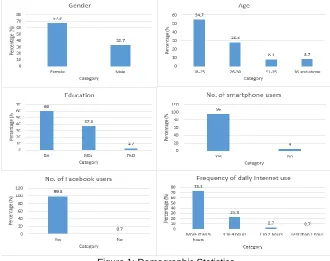
1967 Figure 1: Demographic Statistics
Table 1: Survey Items
3.2 Item Generation
The survey tool employed in this paper included six items of personal data, with a further 16 items split across four categories, namely (IC), (SP), (ID), and (TR) (see Table 1 for descriptions of every aspect). To preserve the validity of the content of the instrument, a group of four experts examined the elements contained in these aspects. The IC category was made up of five items found through [23]. The SP dimension is made up of five items using the work of [23, 36]. The ID dimension was made up of three items using the work of [37]. The TR dimension consisted of three items from [38] and [39]. In addition to the demographic information presented, the survey elements were considered using a five-point Likert scale, with 1 representing strong disagreement and 5 representing that they strongly agree.
3.3 Data Analysis
4.
RESULTS
4.1 (PCA) and (CFA)
(PCA) with varimax rotation was used to find out the factor structure stemming from the gathered data. The primary analysis was completed to gather the eigenvalues for the data's different factors. [40] states that the elements which have an eigenvalue (EV) over 1 are thought to be representative. The four factors made up 62.809% of the
overall variance. The first factor, which was IC, had an (EV) of 7.052, covered five items (α= .934). The second factor, ―SP,‖ had an (EV) of 2.343, covered five items (α = 0.89). The third factor, ―ID,‖ had an (EV) of 1.304, covered three items (α = 0. 0.727). The fourth factor, ―TR,‖ had an (EV) of 1.211, covered three items (α = 0.732). Table 2 describes the factor loadings following rotation.
Table 2: Factor Analysis and Cronbach's Alpha
Item Factor 1 Factor 2 Factor 3 Factor 4
Factor 1: (IC)
IC 1 0.843
IC 2 0.856
IC 3 0.912
IC 4 0.811
IC 5 0.798
Factor 2: (SP)
SP 1 0.911
SP 2 0.823
SP 3 0.812
SP 4 0.811
SP 5 0.712
Factor 3: (ID)
ID 1 0.745
ID 2 0.653
ID 3 0.612
Factor 4: (TR)
TR 1 0.684
TR 2 0.663
TR 3 0.645
EV 7.052 2.343 1.304 1.211
% of variance 42.342 12.112 4.432 3.923
(α) 0.934 0.89 0.727 0.732
(CFA) was performed to find the structural validity of the scale. As given in Table 3, the CFA produced an acceptable index (χ2 (96) = 166.834, p < 0.001) representing that the four-factor model, attained in EFA, was the optimum of the corresponding.
Table 3: Factor Analysis and Cronbach's Alpha
Fit Index POSTOL Recommended Value
Chi-square(χ2) 166.834 -
Degree of freedom(DF) 96 -
χ2 / DF 1.737 ≤ 5
4.2 Convergent and Discriminant Validity
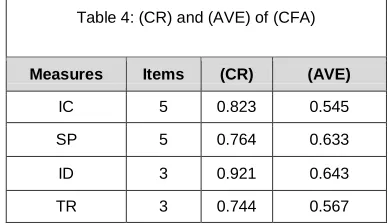
Together with the model fit indices, the validity of the scale is looked into, and it is required that Composite Reliability (CR) is examined, along with average variance extracted (AVE), gathered from CFA [40]. [40] stated that when it comes to convergent validity, the factor loadings of the items must be more than 0.7, with CR a minimum of 0.7 and AVE more than 0.5. The factor loadings gathered from (CFA) were more than 0.7, offering proof that there is convergent validity. Table 4 shows that CR values for IC, SP, ID, and TR were 0.823, 0.764, 0.921, and 0.744,
respectively, meeting the minimum value requirement of 0.7. The AVE for IC, SP, ID, and TR were over 0.5. [40] stated that, when it comes to discriminant validity, the square root of the AVE of the constructs must be over the correlation of the construct and other constructs in the model, with a minimum value of 0.5. From Table 5, it is revealed that the square root of the AVE of all constructs is substantially greater than the result of inter-construction correlation. This supports convergent and discriminatory scale validity.
Table 4: (CR) and (AVE) of (CFA)
Measures Items (CR) (AVE)
IC 5 0.823 0.545
SP 5 0.764 0.633
ID 3 0.921 0.643
1969 Table 5: Correlations among constructs
Measures IC SP ID TR
IC 0.689
SP 0.134 0.831
ID 0.478 0.687 0.811
TR 0.293 0.645 0.687 0.712
5
DISCUSSION AND CONCLUSION
This paper effort to build a scale with which to measure students’ perception of online learning in higher education. The survey was shared with 300 students from various universities in the UAE, to try to maximize reliability and validity. The exploratory factor analysis was able to show a four-factor structure solution, covering 62.809% of the overall variance. Following this, the CFA was behind the four-factor structure involving IC, SP, ID, and TR. The structures met the requirements of reliability and discriminant validity. statistical analyzes have shown that scale is a powerful and useful tool. However, this differs from earlier scales created by [18] and [21], as the current scale showed a greater number of contemporary factors critical to the student's feelings towards online learning. Instructors take on numerous responsibilities stemming from the provision of beneficial learning to support the active engagement of the students. This result is echoed in the work of [23]. SP can assist instructional designers to keep the quality of their online learning experience high, in line with the work of [41]. The ID aspects cover individual differences and student-centered course design, able to encourage students to take part in online learning, in line with the earlier study completed by [34]. Learners’ trust in online courses was considered to be the most important aspect when it comes to successful employment of e-learning. This finding is matched with the outcomes shown that, when learners are fulfilled with an online course, they have a greater level of enjoyment [36]. It is suggested that any future research should examine the link between demographic variables and students’ feelings regarding online learning, which can also allow for different planning of course design in online learning, to offer new benefits to students. The current scale attempted to surpass the downsides of the earlier studies when it comes to the planning of modern online courses, such as IC, SP, ID, and TR. This paper encourages educational designers, educators and institutions to improve the quality of online courses existing currently and in the future.
6
REFERENCES
[1] Darmawan, Pengembangan E-Learning Teori danDesain, Bandung: PT: Remaja Rosdakarya, 2014. [2] Darman, Dampak dan tantangan implementasi e-learning sebagai media pembelajaran pada program studi administrasi pendidikan universitas muhammadiyah kendari, 2019.
[3] Docebo, ―Elearning market trends and forecast 2017-2021,‖ Docebo, 2016.
[4] Davies, R. S., Dean, D. L. and Ball, N, ―Flipping the classroom and instructional technology integration in a college-level information systems spreadsheet course,‖ Educational Technology Research and Development,
vol. 61, p. 563–580, 2013.
[5] S. Jones, C. Johnson-Yale, S. Millermaier and F. S. Pérez, ―Academic work, the Internet and U.S. college students,‖ The Internet and Higher Education, vol. 11, no. 3-4, p. 165–177, 2008.
[6] B. Means, Y. Toyama, R. Murphy and M. Baki, ―The effectiveness of online and blended learning: A meta-analysis of the empirical literature,‖ Teachers College Record, vol. 115, no. 3, pp. 1-47, 2013.
[7] OECD, Higher education in regional and city development: The Autonomous region of Catalonia, Spain. Catalonia: OECD Publishing, 2010.
[8] C. Crook, Web 2.0 technologies for learning: the current landscape – opportunities, challenges and tensions, London, UK: Becta: University of Nottingham, 2008.
[9] R. M. Bernard, P. C. Abrami, Y. Lou, E. Borokhovski, A. Wade, L. Wozney, P. A. Wallet, M. Fiset and B. Huang, ―How does distance education compare with classroom instruction? A Meta-analysis of the empirical literature. Review of Educatio,‖ Review of Educational Research, vol. 74, no. 3, p. 379–439. , 2004.
[10] M. Barbara, T. Yukie, M. Robert, B. Marianne and J. Karla, ―Evaluation of evidence-based practices in online learning: A meta-analysis and review of online learning studies,‖ U.S. Department of Education, 2010. [11] B. Khan, Managing e-learning strategies: Design,
delivery, implementation and evaluation, Hershey, PA: Idea Group Inc., 2005.
[12] F. Gürsul and H. Keser, ―The Effects of online and face-to-face problem-based learning environments in mathematics education on students’ academic achievement,‖ Procedia: Social and Behavioral Sciences, vol. 1, no. 1, pp. 2817-2824, 2009.
[13] D. W. Hofman, ―Internet-based distance education learning in higher education,‖ TechDirections, vol. 62, no. 1, p. 28–32, 2002.
[14] C. Vrasidas and M. S. McIsaac, ―Principles of pedagogy and evaluation for Web-based learning,‖ Educational Media International, vol. 37, no. 2, p. 105– 112, 2000.
[15] D. Schoech, ―Teaching over the Internet: Results of one doctoral course,‖ Research on Social Work Practice, vol. 10, no. 4, pp. 467-487, 2000.
[16] C. Sagin, ―Students’ attitudes towards integration of ICTs in a reading course: A Case in Turkey,‖ Computers & Education, vol. 51, no. 1, p. 200–211, 2008.
[17] F. Michau, S. Gentil and M. Barrault, ―Expected benefits of Web-based learning for engineering education: Examples in control engineering,‖ European Journal of Engineering Education, vol. 26, no. 2, pp. .151-169, 2001.
[18] P. J. Smith, K. L. Murphy and S. E. Mahoney, ―Towards identifying factors underlying readiness for online learning: An exploratory study,‖ Distance Education, vol. 24, no. 1, pp. 57-67, 2003.
bachelor’s degree completion program,‖ Unpublished Doctorial Dissertation, Nova Southeastern University, Florida, 2000.
[20] P. J. Smith, ―Learning preferences and readiness for online learning,‖ Educational Psychology, vol. 25, no. 1, p. 3–12, 2003.
[21] M. L. Hung, C. Chou, C. H. Chen and Z. Y. Own, ―Learner readiness for online learning: Scale development and student perceptions.,‖ Computers & Education, vol. 55, no. 3, p. 1080–1090, 2010.
[22] B. Lee, J. O. Yoon and I. Lee, Principles and practice of structural equation modelling, New York, NY, (2nd Ed.). : . (2009).: Guilford Press, 2009.
[23] B. C. Y. Lim, K. S. Hong and K. W. Tan, ―Acceptance of e-learning among distance learners: A Malaysian perspective,‖ in ASCILITE , Melbourne, 2008.
[24] C. Kim, S. W. Park and J. ozart, ―Affective and motivational factors of learning in online mathematics courses,‖ British Journal of Educational Technology, vol. 45, no. 1, pp. 171-18, 2013.
[25] B. P. Heuer and K. P. King, ―Leading the band: The role of the instructor in online learning for educators,‖ The Journal of Interactive Online Learning, vol. 3, no. 1, pp. 1-11, 2004.
[26] D. H. Lim, M. L. Morris and S. W. Yoon, ―Combined effect of instructional and learner variables on course outcomes within an online learning environment,‖ Journal of Interactive Online Learning, vol. 5, no. 3, pp. 255-269, 2006.
[27] F. Paas, A. Renkl and J. Sweller, ―Cognitive load theory and instructional design: Recent developments,‖ Educational Psychologist, vol. 38, no. 1, pp. 1-4 , 2003. [28] P. A. Kirschner, ―Cognitive load theory: Implications of cognitive load theory on the design of learning,‖ Learning & Instruction, vol. 12, pp. 1-10, 2002.
[29] N. Cowan, Working memory capacity, New York, NY: Psychology Press, 2005.
[30] M. P. Cook, ―Visual representations in science education: The Influence of prior knowledge and cognitive load theory on instructional design principles,‖ Science Education, vol. 90, p. 1073–1091, 2006. [31] L. Lohr, Creating graphics for learning and
performance: Lessons in visual literacy, 2nd ed., Upper Saddle River, NJ: Prentice Hall Press, 2008.
[32] R. E. Mayer, Multimedia learning, 2nd ed., New York, NY: Cambridge University Press, 2009.
[33] Y. F. Wu, ―An Exploration of concise redundancy in online multimedia learning,‖ University of Northern , Colorado, Colorado, 2011.
[34] A. Y. Wang and M. H. Newlin, ―Predictors of web-student performance: The Role of self-efficacy and reasons for taking an online class,‖ Computers in Human Behavior, vol. 8, no. 2, p. 151–163, 2002. [35] T. Grandison and M. Sloman, ―A Survey of trust in
Internet applications,‖ Communications Surveys & Tutorials, vol. 3, no. 4, pp. 2-16, 2000.
[36] I. Sahin and M. Shelley, ―Considering students’ perceptions: The Distance education student
satisfaction model,‖ Educational Technology & Society, vol. 11, no. 3, pp. 216-223, 2008.
[37] G. Mullen and M. Tallent-Runnels, ―Student outcomes and perceptions of instructors’ demands and support in online and traditional classrooms,‖ The Internet and Higher Education, vol. 9, no. 4, pp. 257-266, 2006. [38] L. House, R. Weldon and A. Wysocki, ―Student
perceptions of online distance education in undergraduate agricultural economic programs,‖ Journal of Agricultural and Applied Economics, vol. 39, no. 2, pp. 275-284, 2007.
[39] R. .. Otter, S. Seipel, T. Graeff, B. Alexander, C. Boraiko, J. Gray, K. Petersen and K. Sadler, ―Comparing student and faculty perceptions of online and traditional courses,‖ The Internet and Higher Education, vol. 19, pp. 27-35, 2013.
[40] J. F. Hair, W. C. Black, B. J. Babin, R. E. Anderson and R. L. Tatham, Multivariate data analysis, 6th ed., Upper Saddle River, NJ: Pearson Prentice Hall, 2006. [41] C. W. Wei, N. S. Chen and Kinshuk, ―A Model for
social presence in online classrooms,‖ Educational Technology Research and Development, vol. 60, no. 3, pp. 529-545, 2012.
[42] A. Baddeley, ―The Episodic buffer: A New component of working memory?,‖ Trends in cognitive science, vol. 4, no. 11, p. 417–423, 2000.
[43] E. Zhu, R. McKnight and N. Edwards, ―Principles of online design,‖ Florida Gulf Coast University, Florida , 2009.
[44] L. Harasim, 2012, New York, NY: Routledge Press, Learning theory and online technologies.
[45] L. T. Hu and P. M. Bentler, ―Cutoff criteria for fit indexes in covariance structure analysis: Conventional criteria versus new alternatives. Structural Equation Modelling,‖ A Multidisciplinary Journal, vol. 6, no. 1, p. 1–55, 1999.