Desert 21-1 (2016) – 91-101
Influence of hydrogel polymer and NO3-: NH4+ ratios on dill
(Anethum graveolens L.) seed essential oil composition and yield
H. Shekofteh
a*, N. Salari
ba
Soil Science Department, Vali-e-Asr Rafsanjan University of Rafsanjan, Rafsanjan, Iran
b Islamic Azad University of Jiroft, Jiroft, Iran
Received:14 November 2015; Received in revised form: 13March 2016; Accepted: 4 May 2016
Abstract
To evaluate the effects of hydrogel polymer levels (0, 10, 20, 30 g m-2) and NO
3:NH4 ratios (0: 100, 25: 75, 50: 50, 75:
25, and 100: 0) on dill seed yield and its essential oil constituents, an experiment was conducted in October 2012 in the experimental field of Islamic Azad University, Jiroft, Iran. Results showed that using 30 g m-2 hydrogel polymer with
75NO3-: 25 NH4+ ratio produced maximum seed yield and the same plus 100NO3-:0NH4+ led to a max essential oil yield.
GC-MS analysis indicated that major constituents of dill seed oil were carvone, limonene, dillapiole, α-phellandrene, and trans-dihydrocarvone. The interactive effects of concurrent use of hydrogel polymer and NO3-:NH4+ ratios on the constituents were evaluated: non-use of super-absorbent polymer reduced components like α-terpinene, limonene, dillapiol, and carvone, whereas its addition to such compounds as α-phellandrene, p-cymene, carvone, and trans-dihydrocarvone left a negative effect. In most cases, application of nitrate above 50℅ and reducing ammonium positively increased the compounds.
Keywords: Medicinal plant; Nitrogen; Nutrition; Iran; Water
1. Introduction
Since the Middle Ages, essential oils have been widely used for medicinal and cosmetic applications. Especially nowadays, they are used in pharmaceutical, sanitary, cosmetic, and agricultural and food industries (Orhan et al., 2013). They are volatile, natural, complex compounds and formed by aromatic plants as secondary metabolites (Bakkali et al., 2008). Dill (Anethum graveolens L.), one of these aromatic plants, is a biennial or annual herb of the parsley family (Apiaceae or Umbelliferae) coming from southwest Asia or southeast Europe and cultivated since ancient times (Wander and Bouwmeester, 1998). The dill seed contains 2.1% and 5.6% of
Corresponding author. Tel.: +98 913 3481945,
Fax: +98 34 31312061.
E-mail address: [email protected]
essential oil in India and Russia, respectively (Embong et al., 1977; Gonzalez-Garcia et al., 2009; Singh, 2012). Major components of dill seed are carvone and limonene (Bakkali et al., 2008; Orhan et al., 2013). Comparing the results from the analysis of planted dill essential oil in Iran with other countries, Iranian dill essential oil rate is less, yet it has a higher quality; concerning the major components of dill, Iran has more α-phellandrene, limonene, and carvone rates (Sefidkon, 2001). Since dill essential oil compounds play a crucial role in nutrients consumption, it is necessary to provide better conditions for increasing the compounds both qualitatively and quantitatively.
dihydrochalcone, compose more than 95% of dill essential oils (Sefidkon, 2001). The growth of dill and its essential oil composition are affected by genetic makeup and environmental factors (Simon
et al., 1992). The important environmental factors are the quantity of water and fertilizers (Nurzynska-Wierdak, 2013) like N (Sifola and Barbieri, 2006).
The optimization of irrigation for the production of fresh herbs and essential oils is important as water is a major component of the fresh produce and affects both mass and quality (Jones and Tardien, 1998). Deficiency in water supply reduces growth and yield due to the reduction in photosynthesis and plant biomass and in the case of aromatic plants may cause changes in the yield and composition of their essential oils (Woodhouse and Johnson, 1991; Said-Al Ahl et al., 2009). Also, because most areas of Iran are located in arid and semi-arid regions, it is essential to improve the utilization efficiency of water resources and fertilizer nutrients. Use of hydrogels for effective utilization of water in arid and semi-arid regions is one way to deal with water stresses; Hydrogel polymers which hold water for plant roots induce the heaviest total fresh mass and yield (El-Hady and Wanas, 2006; Han et al., 2013; Wu et al., 2008).
Hydrogel polymers are a group of new water-saving materials and soil conditioners (Bai et al., 2010) that can absorb and retain aqueous fluids up to several times their own weight (Foster and Keever, 1990; Han et al., 2013). Woodhouse and Johnson (1991) investigated the effect of hydrogel polymers on the establishment and growth of lettuce and barely. They found that using this polymer would increase available water, water use efficiency, dry matter production and water absorption in the presence of salts. Also, evidence showed that polymers can help the plants survive under drought conditions (Woodhouse and Jonhson, 1991). Huttermann et al. (1999) observed that use of various ratios of superabsorbent hydrogels when halfpennies were under water stress led to an exponential increase in soil water retention.
Hydrogels can also reduce irrigation water consumption and improve fertilizer retention in soil (El-Hady and Wanas, 2006) and enhancement of plant growth (Foster and Keever, 1990; Woodhouse and Jonhson, 1991). The required N content for optimum dill seed yield is 80–100 kg ha−1. N used by plants plays a key role in the biosynthesis of numerous compounds which are
essential oil constituents (Omer et al., 2005; Said-Al Ahl et al., 2009, Nurzynska-Wierdak, 2013). The absorbable N form significantly affects the plant essential oil constituents (Hornok, 1980). The absorbable N forms are ammonium (NH4+) or
nitrate (NO3-) ions (Omer et al., 2005;
Gonzalez-Garcia et al., 2009). The availability of these forms to the plant is an important environmental variable which affects plant growth. Root proliferation and overall growth rate (Abbes et al., 1995) and plant yields (Wang et al., 2009) are usually greater with a mixture of NH4+ and NO3
-than with either form alone (Omer et al., 2005). Gonzalez-Garciaet al (2009) studied the effect of different NH4+: NO3- ratios (0: 100, 20: 80, 40: 60
and 100: 0) on the growth, production, and quality of chives and basil. They reported that the best results were obtained from the 0: 100 and 20: 80 ratios in chives and basil, respectively.
To our knowledge, studies on agronomic factors such as using hydrogel and NH4+: NO3
-ratio on yield and essential oils of dill have not been investigated thoroughly until now. This study was performed to evaluate the effects of different levels of hydrogel and various NO3-:
NH4+ ratios on yield and some of the essential oil
constituents of Anethum graveolens L. in Jiroft, south of Kerman province in Iran.
2. Materials and Methods
2.1. Field test plots
In October 2012, a 1200 m2 region was selected in
the experimental field of Islamic Azad University of Jiroft, Iran. The region is located between 28° 32' N, 57° 32' E and 675 m above sea level, with an arid and semi-arid climate. The mean annual precipitation of the region is 175 mm, while the average relative humidity is 55-60% with a maximum temperature of 49°C and a minimum of 1°C, which can rarely be -2 °C. The factorial experiment was conducted based on randomized complete block designs with two factors and 3 replicates. Before sowing, soil physicochemical characteristics of the field were determined (Table 1). The first factor―N fertilizer― was added to the soil about 150 kg ha-1 at five levels of NO
3-:
NH4+ ratios (0: 100, 25: 75, 50: 50, 75: 25, and
100: 0) ―as potassium nitrate for nitrate and ammonium sulfate for ammonium―along with the secondary factor hydrogel―superabsorbent (A200)―at four levels (0, 10, 20 and 30 g m-2).
length; the distance between each row was 25 cm with 10 cm between seeds in each row. Each plot was 50 cm away from another with 1 m between replicates. Before planting, the superabsorbent polymer was placed into the 20 cm depth of the soil heavily irrigated to be swollen. To prevent the potassium influence, it was separately added with the same amount of all treatments (except for the
ones that already received potassium nitrate). Sampling was taken from the middle parts of each plot, not from the margins. Harvesting of dill was performed when the seeds got a golden brown color and characteristics of the seeds were examined: seed yield (kg ha-1) and essential oil
content (%).
Table 1. Soil physical and chemical characteristics of the field
Data were analyzed using Statistical Analysis System (SAS). Means were compared using Duncan multiple range test. The graphs were drawn using Excel software. A value of P < 0.05 was selected to represent statistical significance.
2.2. Apparatus and Analysis
The dried seeds were ground and added to water and boiled in a Clevenger-type apparatus for some hours; they were ordinarily hydro-distilled in the apparatus to extract the essential oils. After being cooled, the collected oil was measured for its volume and weight; the extracted essential oils were dried over anhydrous sodium sulfate and stored in dark bottles in a refrigerator at 4 °C until gas-liquid chromatography (GLC) analyses. The essential oil was analyzed via a Shimadzu, Japan, model GC-9A system joined to a Varian 3400 mass-spectrometer. Separations were carried out using a DB-5 capillary column (30 m × 0.25 mm i.d., 0.25µm film thicknesses). The injector and detector temperatures were maintained at 290 °C. The column temperature was initially kept at 50 °C for 5 minutes and then gradually increased to 250°C at the rate of 3°C min-1. Helium was used
as carrier gas at a constant flow of 1.0 ml min-1.
By calculating Kovats retention indices (RI) (for the identification of compounds (from retention times of n-alkanes (C6–C24) and measuring sample components, the peak point was identified. The components were identified via comparison of their mass spectra with those of NIST3.0 libraries supplied with the computer-controlling GC/MS system and published literature. The main compounds of the essential oil were identified by matching their retention times with those of the authentic samples that were injected under the same conditions. The relative percentage of each
compound was calculated from the peak area corresponding to each compound. The relative percentage of the oil constituents was calculated from GC peak areas (Guenther, 1961).
3. Results and Discussion
3.1. Seed yield
Based on the results, use of hydrogel had a significant effect on the seed yield (Table 2). Maximum yield with 721.15 kg ha-1 was obtained
from 20 g m-2 superabsorbent polymer and a
minimum of 399.04 kg ha-1 from non-use of the
polymer. Yield increase due to the risen polymer can be a result of increased plants available water (Woodhouse and Jonhson, 1991); water is absorbed by the polymers that increase the water retention capacity of soils (El-Hady and Wanas, 2006; Bai et al., 2010; Han et al., 2013). Polymers gradually release water and nutrients to increase the efficiency of water and fertilizer consumption as well as plant yields (Islam et al., 2011); this accords with El-Hady et al. (2006) on cucumber and El-Badea et al. (2011) on potato yield.
Furthermore, hydrogels can reduce
evapotranspiration (Islam et al., 2011), improve soil structure (Han et al., 2013), result in better respiration, soil water conservation around roots, and nutrient supplies (El-Hady et al., 2006) and organic matter conservation (Han et al., 2013). Also different ratios of NO3-: NH4+ had a
significant effect on seed yield (Table 3). Maximum seed yield (840.4 kg ha-1) was gained
by using 50NO3-: 50NH4+ and the least yield
(206.89 kg ha-1) were related to using 100%
ammonium and no consumption of nitrate. The interaction between different levels of hydrogel polymers and ratios of nitrate to Depth(cm) Soil texture (%) Textural class Bulk density
(g/cm3) pH EC (dS/m)
Organic carbon (%)
Available P (ppm)
Available K (ppm) sand silt clay
0-20 81.6 15 3.4 Sand 1.47 8.4 0.64 0.25 11 163
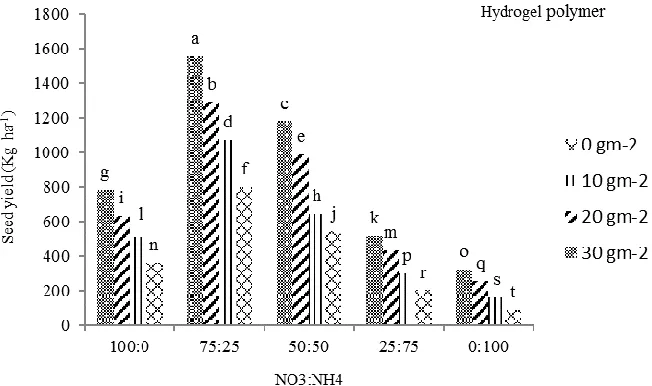
ammonium had significant influences on the seed yield (Figure 1). Use of 30 g m-2 hydrogel
polymer and 75NO3-: 25NH4+ ratio led to a
maximum dill seed yield of 1556.6 Kg ha-1.
Hydrogel polymers with negative charge surfaces raised the soil cation exchange capacity and water absorption and improved cationic nutrient material because fertilizers were not leached out. Our results accorded with Abraham and Pillai (1995) and demonstrated that the use of hydrophilic polymers caused ammonium to be less leached from the soil and thus kept in it. If the accumulation of NH4+ is high on hydrogel
polymers, dill seed yield declines. This accumulation leaves the following effects on the plants:
1- Acidification of the soil of the rhizosphere (Tabatabaei et al., 2006; Gonzalez-Garcia et al., 2009) which leads to a decrease in photosynthesis (Tabatabaei et al., 2006); greater photosynthetic rates at low NH4+ concentrations likely originate
from changes in plant water relations.
2- Increase in the antagonistic effects of the interaction between absorption and translocation of NH4+ and other cations (Hamlin et al., 1999)
like Ca+2, Mg+2, K+, and also P (Gonzalez-Garcia
et al., 2009), which reduce plant growth and, consequently, plant development, as reported by Rothstein and Cregg (2005) in Fraser fir, Abbes et al. (1995) in onions and Tabatabaei et al. (2006) in strawberry.
3- Fine-root production is disturbed, problematizing water transport and plant nutrition (Rothstein and Cregg, 2005).
4- Decrease in stomata conductance (possibly due to the increased root to shoot ratios) and water uptake in a variety of plant species (Lu et al., 2005) and
5- Decrease in root hydraulic conductivity and elevated abscisic acid levels under NH4+ nutrition
have also been implicated (Jeschke and Hartung, 2000).
Also, Garcia-Gonzalez et al. (2009) reported that the supplied N form directly influences nutrient absorption and pH of the rhizosphere. For most plant species, low quantities of NH4+
accompanied by a supply of NO3- are favorable
for growth, but the response depends on the species and the age of the plant. Mengel and Kirkby (1987) reported that plant species grow better when nitrogen is supplied as NO3- instead
of NH4+. They also showed that growth and
production of biomass in chives decreased when NH4+ was used. According to their findings, some
herbs like basil and Japanese mint showed different responses for the production of essential oils and oil components when fertilized with NO3
-N and -NH4-N. Zhang et al. (1996) indicated that
ammonium was unfavorable to saponin formation (a secondary metabolite) on the ginseng cell growth.
Table 2. The effect of hydrogel polymer on seed yield, seed essential oil yield, and essential oil constituents
d il l et h er tra n s-d ih y d ro car v o n e tra n s carv o ne α -t er p in en e p -c y m en e d il la p io l li mo n en e carv o n e α -p h el lan d ren e β -p in en e α -p in en e See d E ss en ti al o il y ie ld ( % ) See d y iel d ( K g / h a) H y d ro g el p o ly m er ab 1.41 b 3.09 d 2.64 b 2.31 b 1.44 c 3.49 c 24.03 b 58.75 a 3.13 a 1.20 a 1.11 b 3.52 d 399.04 0 a 1.45 a 3.47 c 2.87 b 2.31 a 1.50 a 3.77 a 24.60 a 59.19 b 3.05 a 1.19 a 1.08 d 3.39 c 538.96 2
10 g/ m
b 1.34 c 2.94 a 3.08 b 2.29 b 1.46 b 3.65 c 24.04 c 58.00 c 2.99 a 1.20 a 1.12 c 3.47 a 721.15 2 20 g/m ab 1.42 b 3.09 b 2.92 a 2.49 b 1.43 b 3.66 b 24.39 c 57.91 b 3.05 a 1.22 a 1.13 a 3.65 b 592.58 2 30 g/m
Within each column, means followed by the same letters are not significantly different at 5% level
Table 3. The effect of NO3:NH4 on seed yield, seed essential oil yield, and essential oil constituents
d il l et h er tr an s-d ih y d ro ca rv o n e Tr an s ca rv o ne α -t er p in en e p -c y me n e d il la p io l li m o n en e ca rv o n e α -p h el la n d re n e β -p in en e α -p in en e S ee d Essen ti al o il y ie ld (%) S ee d y ie ld (K g /h a) 4 :N H 3 NO b 1.39 b 3.58 b 3.17 b 2.37 bc 1.42 e 3.51 b 24.64 b 58.73 b 3.08 a 1.22 a 1.17 a 4.54 c 573.34 100:0 b 1.35 a 3.99 d 2.81 c 2.29 a 50 1. d 3.54 c 24.11 ab 59.03 a 3.19 ab 1.19 a 1.10 b 4.99 b 830.40 75:25 a 1.55 d 3.28 c 2.95 c 2.29 a 1.50 a 3.86 a 24.90 a 59.09 c 3.02 b 1.18 a 1.11 c 3.51 a 840.40 50:50 b 1.36 c 3.41 e 2.21 a 2.51 c 1.40 b 3.69 d 23.84 b 58.7 d 2.97 ab 1.19 a 1.08 d 3.00 d 363.41 25:75 b 1.37 e 1.50 a 3.24 c 2.30 b 1.43 c 3.60 d 23.84 c 57.71 c 3.02 ab 1.21 a 1.09 e 2.49 e 206.89 0:100
Fig. 1. Interaction effect of hydrogel polymer and NO3-:NH4+ ratio on dill seed yield
3.2. Essential oil percentage
In the present study, a supply of 30 g m-2 polymer
led to a maximum yield of 3.65℅ and with 10 g m-2, the minimum rate was 3.39℅ for dill seed
essential oil (Table 2). Also different ratios of NO3-: NH4+ had a significant effect on essential oil
percentage (Table 3). Maximum essential oil percentage (4.54) was gained by using 100% nitrate and no consumption of ammonium. Due to the rise in the nitrate consumption as a result of the growth and the increase in the seed yield, the essence increases accordingly.
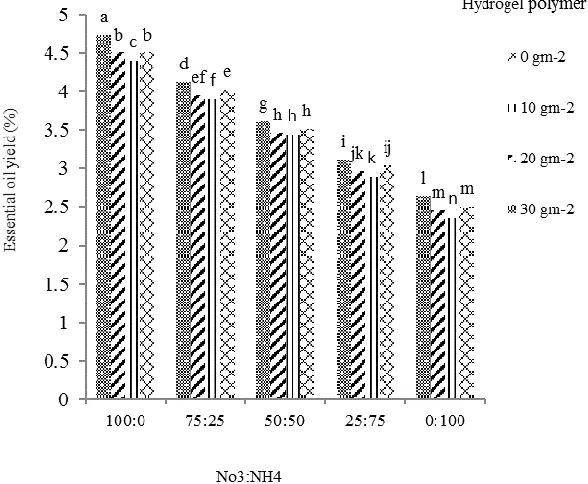
In addition, the interactive effect of the simultaneous use of various nitrate to ammonium ratios and superabsorbent polymers considerably affected the dill seed essential oil (Figure 2). The highest rate for the essential oil (4.74℅) came from 100℅ nitrate without ammonium application and 30 g m-2 superabsorbent; the lowest rate
(2.36℅) originated from 100℅ ammonium without nitrate application and 10 g m-2
superabsorbent (Figure 1). Such essential oil yields are possibly affected by dill seed yield (the reasons were mentioned previously). Increase in the dill seed essential oil is a result of the rise in nitrate and hydrogel due to rise in seed yield. Our results agreed with Singh et al. (1987) findings on dill and Saeid-Al Ahl et al. (2009) on anise, indicating that water deficiency has reduced the essential oil yield of these plants.
3.3. Essential oil constituents
In our study, use of superabsorbent polymers had a considerable bearing on dill essential oil
constituents. Maximum rates for carvone (59.19%), limonene (24.6%), dill apiol (3.77%), trans-dihydrocarvone (3.47%), p-cymene (1.50%) and dill ether (1.45%) came from 10 g m-2
superabsorbent polymer, whereas maximum rates for α-terpinene (2.49%), trans-carvone (3.08%), and α-phellandrene (3.13%) were respectively obtained from 30, 20 g m-2 and non-use of
polymer (Table 2). The assumption is that the formation and accumulation of some compounds like limonene and carvone in plants, similar to Forouzandeh et al. (2012) on basil, increase under arid environmental conditions (Simon et al., 1992; Vineeta et al., 2013). Moreover, polymer application did not significantly affect α- and β-pinene (Table 2).
Using different ratios of nitrate to ammonium did not have any significant effect on α- pinene. The highest β-pinene (1.22%) was obtained from the use of 100% nitrate and lack of ammonium use. The ratio of 75NO3-: 25NH4+ resulted in the
highest α-phellandrene (3.19%) and trans-dihydrocarvone (3.99%) and the ratio of 50NO3-:
50NH4+ resulted in the highest rate of limonene
(24.90%), dill apiol (3.86%), carvone (59.09%), dill ether (1.55%) and p-cymene (1.50%). Furthermore, lack of nitrate use and 100% ammonium led to the highest rate of trans-carvone (3.24%). The maximum rate of α-terpinene (2.51%) resulted from 25NO3-: 75NH4+ (Table 3).
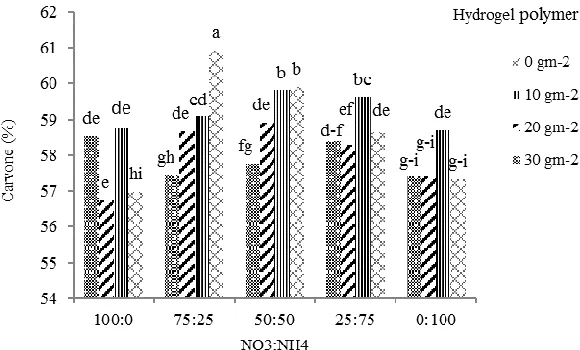
non-use of superabsorbent polymer (Figures 3 and 4). The highest rates for carvone (60.93%), trans-dihydrocarvone (4.83%), and p-cymene (1.60%) from 75NO3-:25NH4+ ratio respectively resulted
from non-use, 30 20 g m-2 of polymer (Figures 5,
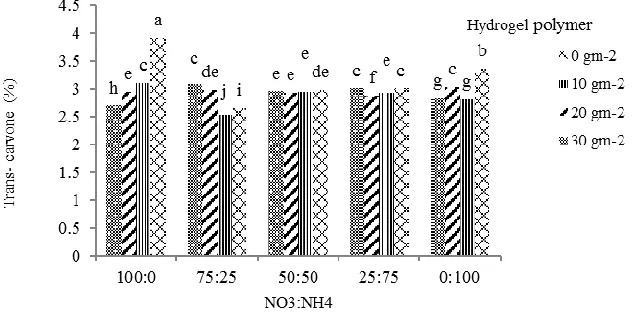
6 and 7). Using 100℅ nitrate with non-use of ammonium, maximum rates for dill apiol (3.94%) and trans-carvone (3.91%) were obtained from 10 g m-2 and non-use of polymer, respectively
(Figures 8 and 9). Furthermore, the highest rate for α-terpinene (2.76%) was gained via combining 25℅ nitrate, 75℅ ammonium, and 30 g m-2
polymer (Figure 10). The interactive effects on α- and β-pinene, dill ether were not significant. In other words, increase or decline in the hydrogel, ammonium, and nitrate had no effect on these constituents. Researches including Lee et al.
(2005) have had reports on the reduction of terpenes (compounds similar to limonene) concentrations due to the increased fertilizers consumed; with nutrient deficiency, terpene rises in rate, but with increased N its concentration declines. In general, terpene concentration and composition responses to changes in fertility depend on plant species, growth stages, and environmental conditions.
The reason why in this study use of a nitrate-contained fertilizer better affects most of the essential oil compounds than ammonium is
debatable. Concerning the reasons, with additional rates of ammonium and hydrogel in the soil, as hydrogel has negative charges, it absorbs a great deal of ammonium. This way, other required cations for the plant become leached out and unavailable to it (ammonium and cations affect one another antagonistically). Calcium is one leached-out element that has a positive influence on the constituents.
Lee et al. (2005) reported that Mg+2 is known
as a co-factor in tobacco terpenes biosynthesis; or in basil, calcium is highly related to herbal oils but nitrate does not have such antagonistic effects. For instance, because limonene is an intermediate compound in the biosynthesis of carvone and the di-hydrogenase enzyme (that converts limonene to trans-carveol and then to carvone) needs a high pH, and some compounds like carvone are oxygenated ones, therefore, use of nitrate (as an oxygenated compound) raises pH, and its use has a more positive influence on the carvone rate of the plant more than that of ammonium. Results from the experiments on dill seeds indicated that carvone, limonene, dillapiol, α-phellandrene, and trans-dihydrocarvone constituted approximately 90℅ of the seed essential oil compounds, which agreed with Embong et al. (1977) and Sefidkon (2001).
Fig. 3. Interaction effect of hydrogel polymer and NO3-:NH4+ ratio on α-phellandrene percentage
Fig. 4. Interaction effect of hydrogel polymer and NO3-:NH4+ ratio on limonene percentage
Fig. 6. Interaction effect of hydrogel polymer and NO3-:NH4+ ratio on trans-diydrocarvone percentage
Fig. 7. Interaction effect of hydrogel polymer and NO3-:NH4+ ratio on p-cymene percentage
Fig. 9. Interaction effect of hydrogel polymer and NO3-:NH4+ ratio on trans-carvone percentage
Fig. 10. Interaction effect of hydrogel polymer and NO3-:NH4+ ratio on α –terpinen percentage 4. Conlusion
Based on our results, generally, the highest dill seed yield was obtained from 75NO3-: 25NH4+
and 30 g m-2 polymer consumption. Maximum dill
essential oil percentage was also achieved by 100℅ nitrate and non-use of ammonium accompanied by 30 g m-2 of superabsorbent
(Figure 1, Tables 2, 3). The evaluation of the interactive effects of the concurrent application of N forms and hydrogel polymer on dill essential oil compounds showed that use of the superabsorbent polymer raised α-terpinene, limonene, dillapiol, and trans-carvone, whereas adding this polymer to α-phellandrene, p-cymene, carvone and
rapid growth of the roots, and finally an increase in yield are all driven by the superabsorbent. The superabsorbent has no nutritional role in soil, and plant growth after using polymer is a result of improvement in the soil's physical conditions. The water-soluble compounds with a low molecular weight (like nutrients) can be absorbed by the superabsorbent and gradually release to be assimilated by the roots. Thus, applying this matter in water-deficient areas can raise yield and reduce negative effects of the drought stress. When the only fertilizer source for the soil is ammonium-type, the photosynthetic materials made in the aerial organs produce amino acids of low molecular weights and their accumulation suppresses photosynthesis. Nitrate is the most common fertilizer source for plantation, and it is considered superior in its inducing better plant growth, even if other sources are available with appropriate ratios. The high NH4 concentration in
the soil induces ammonium toxicity due to ambient acidification, which affects the assimilation status of other minerals and brings about the shortage of nutrients.
Our results indicated that lack of ammonium or its extreme rate is not appropriate for dill growth and yield. Moreover, the significance of the interactive effect of nitrate to ammonium ratio and super-absorbent polymer on dill seed yield and yield components signifies the super-absorbent role in absorbing and conserving water for the plant, leading to an increase in dill yield and yield components.
Nevertheless, excessive fertilizer consumption has negative influences on the environment; for instance, nitrate that is leached out from the soil enters the underground waters and pollutes them. Therefore, it is recommended that biofertilizers or a mixture of organic and inorganic fertilizers be used instead of chemical N ones.
References
Abbes, C., L.E. Parent, A. Karam, D. Isfan, 1995. Effect of NH4+: NO3- ratios on growth and nitrogen
uptake by onions. Plant and Soil, 171; 289-296. Abraham, J., V.N.R. Pillai, 1995. N'-methylene bisacrylamide-cross linked poly-acrylamide for controlled release urea fertilizer formulations. Communications in Soil Science and Plant Analysis, 26 (19-20); 3231-3241.
Bai, W., H. Zhang, B. Liu, Y. Wu and J. Song, 2010. Effects of super-absorbent polymers on the physical and chemical properties of soil following different wetting
and drying cycles. Soil Use and Management, 26; 253–
260.
Bakkali, F., S. Averbeck, D. Averbeck, M. Idaomar, 2008. Biological effects of essential oils – A review. Food and Chemical Toxicology, 46; 446–475.
El-Hady, O.A., S.A. Wanas, 2006. Water and fertilizer use efficiency by Cucumber grown under stress on sandy soil treated with acrylamide hydrogels. Journal of Applied Sciences Research, 2(12); 1293- 1297.
Embong, M.B., D. Hadziyev, S. Molnar, 1977. Essential oils from spices grown in alberta dill seed oil, Anethum graveolens, L, (Umbelliferae). Journal de l'Institut Canadien de Science et Technologie Alimentaire, 10(3); 208-214.
El-Badea, E.A., A.A. El-Awady, H.M.I. Ahmed, 2011. Improving nitrogen utilization efficiency by potato (solanum tuberosum L). Nature and science, 9(7); 34-42.
Forouzandeh, M., M. Fanoudi, E. Arazmjou, H. Tabiei, 2012. Effect of drought stress and types of fertilizers on the quantity and quality of medicinal plant Basil
(Ocimum basilicum L.). Indian Journal of Innovations
and Developments, 1(9); 696-699.
Foster, W.J., G.J. Keever, 1990. Water absorption of hydraulic polymers (hydrogels) reduced by media amendments. Journal of Environmental Horticulture, 8(3); 113- 114.
Gonzalez-Garcia, J.L., M.N. Rodriguez-Mendoza, P. Sanchez-Garcia, B. Osorio-Rosales, L.I. Trejo-Téllez, G. Alcantar-Gonzalez, M. Sandoval-Villa, 2009. Ammonium/Nitrate ratios in hydroponic production of aromatic herbs. Acta Horticulture, 843; 123-128.
Guenther, E., 1961. The essential oils. Vol. I, 4 Editions. D. van Nostrand Company, Inc. Princeton, New Jersey. Toronto, New York, London.
Hamlin, R.L., H.A. Mills, W.N. Randle, 1999. Growth and nutrition of pansy as influenced by N-form ratio and temperature. Journal of Plant Nutrition, 22(10); 1637-1650.
Han, Y., X. Yu, P. Yang, B. Li, Ch. Wang, 2013. Dynamic study on water diffusivity of soil with super- absorbent polymer application. Environmental Earth Science, 69; 289- 296.
Hornok, L, 1980. Effect of nutrition supply on yield of dill (Anethum graveolens) and the essential oil content. Acta Horticulture, 96; 337-342.
Huopalahti, R., R.R. Linko, 1983. Composition and content of aroma compounds in dill, Anethum
graveolens L., at three different growth stages.J. Agric.
Food Chem. 31; 331-333.
Huttermann, A., M. Zommorodi, K. Reise, 1999. Addition of hydrogels to soil for prolonging the survival of Pinus halepensis seedlings subjected to drought. Soil & Tillage Research, 50; 295-304.
Islam. M., S. Robiul Mao, X. Xue, 2011. A lysimeter study of nitrate leaching, optimum fertilization rate and growth responses of corn (Zea mays L.) following soil amendment with water-saving super-absorbent polymer. J .Sci. Food .Agr, 91(11); 1990–1997.
Jones, H.G., F. Tardien, 1998. Modelling water relations of horticultural crops: a review. Sci. Hort, 74; 21-46.
Lee, K.D., M.S. Yang, Supanjani, D.L. Smith, 2005. Fertilizer effect on the yield and terpene components from the flowerheads of Chrysanthemum boreale M.
(Compositae). Agron. Sustain. Dev, 25; 205–211.
Lu, Y.X., C.J. Li, F.S. Zhang, 2005. Transpiration, potassium uptake and flow in tobacco as affected by nitrogen forms and nutrient levels. Ann. Bot, 95; 991– 998.
Mengel, K., E.A. Kirkby, 1987. Principle of plant nutrition, 4th edition. Bern, Switzerland: International Potash Institute.
Nurzyńska-Wierdak, R, 2013. Does mineral fertilization modify essential oil content and chemical composition in medicinal plants? Acta Sci. pol, Hourtorum Cultu, 12(5); 3-16.
Omer, E.A., A.A. Elsayed, A. EL-Lathy, M.E. Khattab.
A.S. Sabra, 2008. Effect of the nitrogen fertilizer forms and time of their application on the yield of herb and
essential oil of Ocimum americanum L.Kerla Polonica,
54(1); 34-46.
Orhan, I.E., F.S. Senol, N. Ozturk, S.A. Celik, A. Pulur, and Y. Kan, 2013. Phytochemical contents and enzyme inhibitory and antioxidant properties of Anethum
graveolens L. (dill) samples cultivated under organic
and conventional agricultural conditions. Food and chemical toxicology, 59; 96-103.
Rothstein, D.E., B.M. Cregg, 2005. Effects of nitrogen form on nutrient uptake and physiology of Fraser fir (Abies fraseri). Forest Ecology and Management, 219; 69–80.
Said-Al Ahl, H.A.H., E.A. Omer, N.Y. Naguib, 2009. Effect of water stress and nitrogen fertilizer on herb and essential oil of oregano. Int. Agrophysics, 23; 269-275.
Sefidkon, F, 2001. A quantitative and qualitative evaluation of dill in Iran. Construction and research journal, 51; 73-77.
Sifola, M.I., G. Barbieri, 2006. Growth, yield and essential oil content of three cultivars of basil grown under different levels of nitrogen in the field. Sci. Hor,
108; 408–413.
Simon, J.E., D.R. Bubenheim, R.J. Joly, D.J. Charles, 1992. Water stress-induced alterations in essential oil content and composition of sweet basil. Journal of Essential Oil Research, 4(1); 71-75.
Singh, A., G.S. Randhawa, R.K. Mahey, 1987. Oil content and oil yield of dill (Anethum graveolens L.) herb under some agronomic practices. Acta Horticulturae, 208; 51-60.
Singh, S., 2012. Chemical constituents of essential oil from
Anethum Sowa Kurz seed. Journal of chemical and
pharmaceutical research, 4(9); 4156-4160.
Tabatabaei, S.J., L.S. Fatemi, E. Fallahi, 2006. Effect of ammonium: nitrate ratio on yield, calcium concentration, and photosynthesis rate in strawberry. Journal of Plant Nutrition 29(7); 1273-1285.
Vineeta, Kewalanand, Vandana and Vishwanath. 2013. Effect of irrigation, FYM levels and storage conditions on oilconstituents of European Dill (Anethum
graveolens L.). Indian J. Applied & Pure Bio, 28 (2):
157-164.
Wander, J.G.N., H.J. Bouwmeester, 1998. Effects of nitrogen fertilization on dill (Anethum graveolens L.) seed and carvone production. Industrial Crops and Products, 7; 211-216.
Wang, J., Y. Zhou, C. Dong, Q. Shenand, R. Putheti, 2009. Effects of NH4+
: NO3
ratios on growth, nitrate uptake and organic acid levels of spinach (Spinacia
oleracea L.). African Journal of Biotechnology, 8(15);
3597-3602.
Wu, L., M. Liu, R. Liang, 2008. Preparation and properties of a double-coated slow-release NPK compound fertilizer with superabsorbent and water-retention. Bioresource technology 99; 547-554.
Woodhouse, J., M.S. Johnson, 1991. Effect of superabsorbent polymers on survival and growth of seedlings. Agricultural water management, 20; 63-70. Zhang, Y.H., J.J. Zhong, J.T. Yu, 1996. Effect of Nitrogen Source on Cell Growth and Production of Ginseng Saponin and Polysaccharide in Suspension Cultures of Panax notoginseng. Biotechnology Progress, 12; 567-571.