Using Discourse Structure-Based Graphic Organizers (GOs) in Developing EFL
Learners’ Reading Comprehension
Bahman Gorjian
Associate Professor, Department of ELT, Abadan Branch, Islamic Azad University, Abadan, Iran *Corresponding author ([email protected])
Abstract
This study investigated the effectiveness of discourse structure-based graphic organizers (GOs) on intermediate students’ reading comprehension. It also compared the students who used discourse structure-based GOs as a post-reading activity to those who were involved in conventional method of reading post-activities. Ninety second year students were non-randomly selected at Azad Abadan University. They enrolled in Reading III classes. Oxford Quick Placement Test (OQPT) was administered to assess the learners' proficiency level. Thus 70 learners whose scores indicated their level of proficiency was intermediate were randomly divided in two equal experimental and control groups. They took a pre-test of reading comprehension designed based on their text book "Active Skills for Reading 3", developed by Anderson (2008). The experimental group analyzed the textual structures based on the frameworks of GOs and discussed the cohesive and coherent devices in each passage while the control group read the passage and do the textbook exercises including using new words, fill in the blanks, true/false, comprehension questions, etc. After 15 sessions of treatment, both groups took a post-test of reading comprehension. Data were analyzed through Independent and Paired Samples t-test. Results revealed that the students who worked on discourse structure-based GOs as a post-reading activity performed significantly better than their counterparts do. The implications of this study for EFL teachers could be used in reading comprehension classrooms to familiar the learners with graphical structures of the reading passages and discover textual structures of various text types.
Key Words: Discourse structure, graphic organizers (GOs), reading comprehension
1.Introduction
Graphic organizers (GOs) refer to schematized models namely charts, diagrams and lines in a pictorial manner to show the discoursal structures of reading contents, structures and key conceptual relationships. The use of discourse structures facilitates following the flow of ideas in a text in an effective manner, teachers might guide their students to be alert to text structures and text organization in reading comprehension courses.
1.1 Graphic Organizers
A graphic organizer is a diagram that represents a relationship directed by a thinking-skill verb. The verb “sequence” calls for a diagram of a series of boxes connected by arrows that shows the “event” of one box leading to the “event” of another box (Hibbard &Wagner, 2003). In 1992, Jay McTighe in his book, Graphic Organizers: Collaborative Links to Better Thinking, outlined three main ways teachers may use graphic organizers in their teaching and a number of ways that students can use them to aid their learning process. In the reading process, graphic organizers can be used at three levels: Before instruction, during instruction and after instruction. Before instruction, graphic organizers are used to understand the level of the students in terms of the content. During instruction, graphic organizers allow students to approach the content cognitively because they assist thinking. It also allows students to construct maps that are appropriate to their learning styles. After instruction, they help students as a summarization tool or technique and they help the students to understand their improvement in terms of understanding passage. If a student can connect prior knowledge with what was learned and identify relationships between those ideas, it means graphic organizers have successfully assisted them in the course of their learning process.
Graphic organizers are representations, pictures or models used for processing textual information. Graphic organizers have been classified into five major categories according to their structures: star web, chart matrix, tree map, chain, and sketch. Graphic organizers provide teachers with tools to help students on the road to higher achievement in their reading comprehension skills. Graphic organizers that target critical and creative thinking elements help develop students in their ability to comprehend and understand the meaning of a text. The focus of the students in content is improved and they can classify the content into small understandable units. Graphic organizers provide new language that facilitates classroom communication, as well as deepen understanding of the content that teachers work to transmit. The effectiveness of graphic organizers is proved in the analysis done by Marzano, Pickering and Pollock (2001).
1.2 Statement of the Problem and the Purpose of the Study
whether the use of discourse structure-based graphic organizers affect students’ reading comprehension and investigate the difference between using graphic organizers and the conventional reading comprehension method in developing EFL learners’reading comprehension.
2. Literature Review
Graphic organizers are defined as “visual and spatial displays designed to facilitate the teaching and learning of textual material through the use of lines, arrows and a spatial arrangement that describe text content, structure and key conceptual relationships” (Kim, Vaughn, Wanzek, & Wei, 2004, p. 105). In educational settings, they have been perceived as valuable instructional tools because “a good graphic representation can show at a glance the key parts of a whole and their relations, thereby allowing a holistic understanding that words alone cannot convey” (Jiang & Grabe, 2007, p. 34). Since there is a manageable number of repeating patterns (description, definition, sequence, procedure, cause-effect, classification, comparison-contrast, problem-solution) in expository texts, they lend themselves to being used along with graphic organizers to direct students’ attention to text structures and help to enhance reading comprehension (Grabe, 2009).
While comprehending a passage, most students mentally translate the content into their first language. Students may even respond to the comprehension questions through the time-consuming process of thinking in their first language and then translate it into English. Students cannot verify the accuracy of their translation of the meaning of the passage into their mother tongue (Lin & Chen, 2006). Using graphic organizers gives students alternatives to these inefficient methods of reading or comprehending a passage. In contrast to their usual approach to reading or comprehending a passage, they classify the content of the passage and then try to decode it. This study explores how classifying a reading passage using graphic organizers has shown better results compared with reading a passage without using these organizers.
Tomlinson (1999) explains that teachers can modify three aspects of teaching: Content, Process, and Product. By using graphic organizers, teachers modify the product. It is a universal fact that students in a class are not likely to learn to read at the same rate. Some will learn faster than others will, and some will be able to demonstrate their understanding in ways that are more complex sooner than others are. For all children to learn at an optimal pace, teachers must match children with a reinforcing activity that allows each child to be successful in reading comprehension at a cognitively appropriate level. According to Rawson and Kintsch (2005), comprehension skills aided by graphic organizers help a reader develop his/her reading abilities. Therefore, incorporating graphic organizers in reading comprehension helps students in developing their comprehension skills.
Learning through visuals helps students in comprehending passages more effectively than other reading strategies like skimming, scanning, note making, etc. According to Slavin (2011), research in pedagogy and psychology demonstrates that visual learning is among the most effective methods for teaching comprehension skills to students of all ages. Helping students organize the content helps, they had better comprehend texts for information such as main ideas supporting details, facts, opinions, comparisons and contradictions.
It might be simplistic to think of a text as comprising only linguistic elements such as semantics and syntax. Structure, pragmatic nature, intentionality, content and topic have roles to play in the reconstruction of the intended meaning of the author by the reader (Bernhardt, 1998). Grabe (2009) highlights the importance of discourse structure awareness in relation to this reconstruction of meaning. Discourse structures are viewed as knowledge structures, text structures or basic rhetorical patterns in texts. In this article, discourse structures and text structures will be used interchangeably. An understanding of these top-level structures might be associated with having an insight into the inter-relatedness of ideas in a text and forming a correct interpretation of what the writer has set out to express. Skilled readers of L1 and L2 with discourse structure sensitivity are alert to the specific ways in which information is organized and identify the signaling mechanisms for this, as well as able to distinguish main ideas from the minor ones as they read. Moreover, they use their text structure knowledge to guide their comprehension, which in return equips them with an organized, a coherent and a more global understanding of the text. However, not all EFL readers are proficient enough to perform such a challenging task without outside intervention and support. Taking this observation into consideration, it makes sense in EFL settings to make use of graphic organizers in order to provide a visual scaffold for text organization and foster reading comprehension.
The primary purpose of this literature review was to examine the related research on visual learning and graphic organizers to determine the findings from the related studies indicated about the effects these visual tools which had on the students’ achievement, critical thinking, comprehension, and writing.
3. Methodology
3.1 Participants
The study was conducted at Abadan Azad University, Iran. The participants of the study were 90 students who enrolled in three intact classes of Reading comprehension III. They took Oxford Quick Placement Test (OQPT) and 75 learners who got the band score of intermediate level were selected as the participants of the study. Five learners were given the pre and post-test to evaluate the reliability of the test. They were with the age ranging from 19 to 48 years old. The rest of the participants were randomly divided into two groups of experimental and control, each included 35 participants. The sampling method was based on systematic random sampling.
3.2 Instrumentation
In this study, three tests were used including the OQPT, the pre-test and the post-test. OQPT included 60 items of reading comprehension, grammar and vocabulary. The pre-test to determine the learners’ level of reading comprehension of selected texts at the beginning of research period and a post-test to determine the effect of discourse structure-based graphic organizers on students reading comprehension of selected texts. The reliability of the tests were calculated through KR-21 formula as (r=.720, and r=.798 respectively).
3.3 Materials
The materials used in this study were four reading texts (School on Water, Marital Art, Pet Heros, and Old San Juan) that were chosen from a reading text book, Connect (Jack C. Richards, 2009). While selecting the reading passages, the researcher made an effort to create a combination of texts that had different discourse structures as the aim was to expose the students to as many discourse patterns as possible during the course of the study. The text structures of the four reading passages that were used in the study included description, definition, sequence, procedure, cause-effect, classification, and various graphic organizers that reflected the discourse structures of these texts, a homogeneity test, that was used as the pre-test and a post-test were administered.
3.4 Procedure
As mentioned previously, the text structures of the four reading passages that were used in the study included description, definition, sequence, procedure, cause-effect, classification. In each text, two or three of these structures were nested within one another. The researchers developed graphic organizers that directly reflected the discourse structures of the selected texts. In order to understand whether these graphic organizers were appropriately designed, the opinions of five teachers were sought. They all agreed on the appropriateness of the graphic organizers developed by the researcher. In order to test the practicality of the graphic organizers, four reading teachers from the pre- intermediate level were asked to sit down and complete the graphic organizers with the texts; they all successfully completed the graphic organizers.
Both the selection of the texts and the development of the related graphic organizers were done by the researcher. During 15 sessions of instruction, 90 minutes each, the texts were worked. In the experimental group at the beginning of the instruction, the researcher familiarized the students with what graphic organizers are and how to use them effectively while reading a text. The students were also trained to use different organizers for different types of passages. The students learned a variety of existing graphic organizers and they started creating their own organizers. In the following sessions, the participants in the experimental group structured their own graphic organizers for reading texts studied in the class hour and presented them to their classmates in groups. The students to the whole class also presented some of the graphic organizers by drawing on the board. In the final session of the treatment, a post-test was administered; pre-test was modified for the post- test. It was 20 open-ended questions from reading texts for each group .they replied those questions during 90 minutes. The reliability of the tests were calculated through KR-21 formula Then the data was statistically analyzed.
3.5 Data Analysis
the effects of the discourse structure-based graphic organizers on students’ reading comprehension, parametric statistical methods were used for the analysis as the data were normally distributed. Independent and Paired Samples t-test were conducted in order to explore how the discourse structure-based graphic organizer treatment affected the participant students’ comprehension of each text as well as the students’ overall reading performance in the study.
4. Results
4.1 Results of the Pre and Post-tests
Paired and Independent Sample t-tests were performed to evaluate the impact of the two instructional approaches – using graphic organizer and the conventional comprehension method on all participants’ answers to comprehension questions. Table 1 shows the descriptive statistics in the pre-test.
Table 1. Descriptive Statistics (Pre-test)
Groups N Mean Std. Deviation Std. Error Mean
Experimental 35 14.28 2.606 .521
Control 35 13.84 2.478 .496
The means presented in Table 1 showed that the mean ofexperimental (M=14.28) and control (M=13.84) groups were same. The results of the pre-test also proved that the comprehension skills of both the groups were at the same level. The results of the pre-test were illustrated in Table 2.
Table 2. Independent Samples t-Test (Pre-test, Experimental vs. Control )
t-test for Equality of Means
95% Confidence Interval of the Difference
t t t df Sig.
(2-tailed)
Mean Difference
Std. Error Differenc e
Lower Upper
Equal variances
assumed
.612 68 .544 .440 .719 -1.006 1.886
The mean scores of the experimental and control groups were compared by using an Independent Samples t-test. Since the observed t (.612) was less than the critical t (2.064) with df =68, the differences between the groups’ pre-tests were not significant. Table 3 shows the results on the post-test.
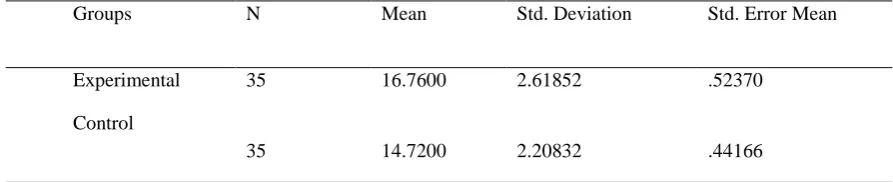
Table 3. Descriptive Statistics (Post-test, Experimental vs. Control )
Groups N Mean Std. Deviation Std. Error Mean
Experimental
Control
35 16.7600 2.61852 .52370
35 14.7200 2.20832 .44166
the experimental and control groups were compared the difference by using an Independent Samples t-test in Table 4.
Table 4. Independent Samples t-Test (Post-test, Experimental vs. Control )
t-test for Equality of Means
95% Confidence Interval of the Difference
t df Sig.
(2-tailed)
Mean Differe nce
Std. Error Difference
Lower Upper
Equal variances assumed 2.97 68 .005 2.04 .685 .662 3.41
Since the observed t (2.978) was greater than the critical t (2.021) with df 68, the differences between the groups’ post-tests were significant at the level of (p<0.05) and the experimental group performed significantly better than the control group on the post-test. It was thought that it would be appropriate to make one single comparison by comparing pre and post- test scores of experimental group with pre and post- test scores obtained by the control group. The aim was to arrive at a conclusion about the effectiveness of the graphic organizer treatment.
5. Discussion and Conclusion
5.1 Discussion
The findings of the current study with reference to the literature review are discussed in this section. Moreover, the research questions are answered and the findings will be justified regarding the differences between using graphic organizer and the conventional comprehension method.
Question One: How does the use of discourse structure-based graphic organizers affect students reading comprehension of selected texts?
The quantitative data gathered from the students’ performance, which were administered at the end of each procedure during the treatment sessions of treatment, shed some light on the use of the discourse structure-based graphic organizers in reading comprehension. The post-test scores of the two groups for both the graphic organizer and the conventional performances were calculated and compared with each other to see the effects of the graphic organizer treatment. This comparison indicated that the learners performed better on post-tests when they completed discourse structure-based graphic organizers as a post-reading activity in comparison to those that took part in a conventional method. The success of the graphic organizer treatment was consistent across the four texts used in the study. This finding supports what the literature indicates about the use of graphic organizers in reading comprehension.
The findings of the current study are also in line with the propositions of the Paivio (1991) Dual Coding Theory. The theory posits that enhanced processing of information can take place if linguistic input is presented with congruent visual input because this facilitates dual coding of information. Since the graphic organizers used in the present study included lines, arrows and spatial arrangement, the students had an opportunity to store the contents of the texts in the form of both verbal information and visual images. This might be one of the reasons that led to the higher scores in the post-tests given after the students had been involved in graphic organizer activities. A study carried out by Suzuki et al. (2008) found that the spatial graphic display enhanced EFL readers’ comprehension of sentences more than the sentential display did. The results of the current study appear to support their finding.
from these, it is a necessity to present the content of the text in a way that is closest to the original while developing discourse structure-based graphic organizers. If the graphic organizers in question are partially completed, the teacher should make sure that they have effective clues for the blanks. If the texts and the related graphic organizers used in this study are scrutinized, it could be observed that the graphic organizers meet the criteria proposed by Grabe and Jiang (2010). This might have been one of the reasons that caused the experimental group to perform significantly better than the control group.
The findings of previous studies (e.g., Wang & Cao, 2009) are in line with the findings of the present study and link between drawing students’ attention to discourse structures in texts and facilitating improved reading comprehension. Martinez (2002) also investigated the use of text structure as a tool to facilitate and improve EFL students’ reading comprehension of a text written in English. He concluded that when EFL readers were made to consciously focus on the discourse structure of a text, their performance in reading comprehension was positively affected and they were able to reproduce more ideas from the text in question. Similarly, in the current study, the experimental students were able to reproduce more macro and micro level ideas from the texts in the summaries they wrote after completing the discourse structure-oriented graphic organizers.
Question Two: What is the difference between using graphic organizer and the conventional comprehension methods in developing EFL Learners’ reading comprehension?
Graphic organizers as a reading exam task seem to discriminate better between weak and strong readers. They can help raise awareness of discourse structure, may be a good way to test reading fluency and seem to require readers to confront the text for information rather than relying on a series of questions to guide them. While conventional method is concerned with the teacher being the controller of the learning environment. The teacher holds power and responsibility and they play the role of instructor (in the form of lectures) and decision maker (in regards to curriculum content and specific outcomes). They regard students as having 'knowledge holes' that need to be filled with information. In short, the conventional teacher views that it is the teacher who causes learning.
The findings of the current study are in line with Tang (1992) experiment that explored the effect of graphic representation of knowledge structure of classification on intermediate level ESL students’ comprehension of content knowledge. The subjects dealt with the same passage in two different groups: the graphic and the non-graphic group. The written recall protocols, which were used as post-tests, showed that the graphic group performed significantly better than the non-graphic group in terms of the information recalled from the text. Similarly, in the current study, the post-test summaries indicated that the graphic organizer group was able to produce a higher number of macro and micro level ideas when compared with the discussion group. This finding also supports the conclusions of a study conducted by Kools et al. (2006). The results of their study showed that graphic organizers had a strong effect on text comprehension at both macro and micro levels.
The findings of this study are also in line with Carrell, Pharis and Liberto (1989) study that attempted to test the effect of using semantic mapping as a post-reading activity. After reading the passage, one of the students in the experimental group was asked to develop a class post-reading map on the board by gathering input from the rest of the class. When the students were required to answer open- ended questions as part of a post-test, the semantic mapping group did significantly better than the control group. In the present study, after the students completed the graphic organizers on their worksheets in pairs, individual students took turns to fill in the same graphic organizers on the board. This activity might have facilitated more exposure to and more involvement with the four texts. The aforementioned possibility could be taken into consideration while explaining the higher post-test scores gained after the graphic organizer performances.
5.2 Conclusion
References
Anderson, N. J. (2008). Active skills for reading, book 3 (2nd ed.). Boston: Heinle Cengage.
Bernhardt, E. B. (1998). Reading development in a second language: Theoretical, empirical, classroom
perspectives. Norwood, New Jersey: Ablex Publishing Corporation.
Carrell, P. L., Pharis, B. G., & Liberto, J. J. (1989). Metacognitive strategy training for ESL reading. TESOL Quarterly, 23(4),647-678.
Grabe, W. (2009). Reading in a second language: Moving from theory to practice. New York: Cambridge University Press.
Grabe, W., & Jiang, X. (2010). Preparing teachers to teach discourse knowledge. Paper presented at the AAAL Conference.
Hibbard, K. M., & Wagner, E. A. (2003). Assessing and teaching reading comprehension and writing K-3
(Vol.2). New York: Eye on Education.
Jiang, X. (2007). The impact of graphic organizer instruction on college EFL students'reading comprehension.
Unpublished Doctoral Thesis, Northern Arizona University, Flagstaff, AZ.
Jiang, X., & Grabe, W. (2007). Graphic organizers in reading instruction: Research findings and issues. Reading in a Foreign Language, 19(1), 34-55.
Kim, A.-H., Vaughn, S., Wanzek, J., & Wei, S. (2004). Graphic organizers and their effects on the reading comprehension of students with LD. Journal of Learning Disabilities, 37(2), 105-118.
Kools, M., Van De Wiel, M., Ruiter, R. A. C., Crüts, A., & Kok, G. (2006). The effect of graphic organizers on subjective and objective comprehension of a health education text. Health Education & Behavior, 20, 1-13.
Martinez, A. C. L. (2002). Empirical examination of EFL readers' use of rhetorical information. English for Specific Purposes, 21(1), 81-98.
Marzano, R. J., Pickering, D. J., & Pollock, J. E. (2001). Classroom instruction that works. For Supervision and Curriculum Development.
Rawson, K. A., & Kintsch, W. (2005). Rereading effects depend upon time of test. Journal of Educational Psychology, 97, 70-80.
Slavin, R. E. (2011). Educational psychology: Theory and practice. NY: Pearson. Tang, G. (1992). The effect of graphic representation of knowledge structures on ESL reading. Studies in Second Language
Acquisition, 14, 177-195.
Tomlinson, C. A. (1999). Differentiating instruction: Responding to the needs of all learners. Alexandria, VA: Association for Supervision and Curriculum Development.