Synthesis of Binary Ti-Si Mixed Oxides Nanoparticles
with Rutile Structure as Selective Catalyst for
Epoxidation of Alkenes
Z. Fakhroueian,
1F. Farzaneh,
1,*and M. Ghandi
21
Department of Chemistry, Alzahra University, Vanak, Tehran, Islamic Republic of Iran
2
School of Chemistry, University College of Science, University of Tehran, Tehran, Islamic Republic of Iran
Abstract
The nanoparticles of Ti-Si mixed oxides (NTSO) with Rutile structure were
prepared by sol-gel method in a mixture of alcohol and water as solvent. The solid
product was characterized by XRD, FTIR, SEM, TEM, UV, TGA and laser
Raman spectroscopy. The catalytic activity of NTSO (5-10 nm) was investigated
in the epoxidation of cis stilbene, trans stilbene, and norbornene by using oxidants
such as tert-butylhydroperoxide (TBHP), molecular oxygen (O
2)/isobutyraldehyde
(IBA) and hydrogen peroxide (H
2O
2). It was found that epoxides of trans-stilbene
and
norbornene
were
formed
quantitatively
with
the
green
H
2O
2oxidant
during
12
h.
Keywords: Epoxidation; Alkenes; Ti-Si mixed oxides; Nanoparticles; Heterogeneous catalysis
*
Corresponding author, Tel.: +98(21)88258977, Fax: +98(21)66495291, E-mail: [email protected] 1. Introduction
Direct epoxidation of olefins on Ti-containing porous dioxide such as zeolites, mixed oxides and mesoporous materials (MCM’S) has received considerable attention during the last few years. Ti-substituted silicalite-1(TS-1) was found to be a good catalyst for epoxidation of small size olefins with H2O2. It was also found that a
variety of Ti-zeolites such as TS-2, Ti-ITQ, Ti-ZSM-12 were active catalysts for epoxidation of olefins [1-5]. The special activity of TS-1 was assigned to the tetrahedrally coordinated Ti in the framework, its hydrophobic nature, and Lewis acidic Ti (IV) sites. Ti- MCM-type materials are another group of catalysts for double bond epoxidation. By grafting complex to Ti-MCM-41, the higher activity and selectivity was obtained.
The TiO2-SiO2 mixed oxides have been reported to
have higher catalytic activity and selectivity with respect to pure TiO2 [6-9]. TiO2 and SiO2 mixed oxides
have been used as catalysts for a number of different reactions such as phenol amination [10], butene isomerization [11], cumene dealkylation [8,12], and olefin epoxidation [13]. Recently, nanocatalysts have attracted much attention due to their higher activity and selectivity which have been attributed to their large specific surface area, high percentage of surface atoms and special crystal structures [14].
In this study, synthesis of NTSO and their catalytic activities for epoxidation of olefins with different oxidants will be discussed.
2. Experimental
2.1. Materials
Table 1. Results of catalytic epoxidation of some olefins with TBHP in the presence of NTSO
Olefin Time (h) Total Conversion (%) Epoxy (%) Others (%) TONa
Trans-stilbene 9 86 100 – 54
12 100 100 63
Cis-stilbene 9 45 100 – 57
12 73 100 92
Norbornene 9 55 100 – 688
12 100 100 1250
Reaction conditions: trans-stilbene, cis-stilbene, norbornene, 1 mmol, 2 mmol, 20 mmol, respectively. a
TON: mmol product/mmol catalyst.
(35%), methanol, tetraethylorthosilicate (TEOS) (99%), titanium (IV) isopropoxide (TIPO) (97%), 2-propanol, cis and trans-stilbene, norbornene and IBA were purchased from Merck Chemical Company, and used without further purification.
2.2. Instrumentation
Powder X-ray diffraction (XRD) data were recorded on XRD 3003 PTS Seifert with Cu Kα radiation (λ=1.54Å). FTIR spectra were measured on KBr disks with a Bruker-Tensor 27 2002 spectrometer. Scanning electron micrograph (SEM) images were taken by XL-30 Phillips (1992). High resolution transmission electron microscopy (HRTEM) was performed by using TECNAI F20 field emission gun microscope operating at 200 KeV and equipped with Gatan 794 slow scan charge-coupled device camera. Nitrogen adsorption and desorption isotherm was carried out on an ASAP 2000 micrometritics gas sorption analyzer. Surface areas were calculated by the Brunauer-Emmett-Teller (BET) method by N2 gas with Quanta chrome chembet 3000.
The pore size was calculated using the Barrett-Joyner- Hatenda (BJH) model. The bond-gap energy was measured to be 2.91 eV by Epps 2000 stellar Net Inc photo spectrometer. TGA thermal curve was studied by Perkin-Elmer Pyrif 1. The oxidation products were analyzed by GC and GC-Mass using Agilent 6890 series, with FID detector and HP-5ms 6890 Network GC system respectively. The Raman spectrum was record by using the Almega Dispersive Raman Spectrometer Thermo-NICOLET 2003 American.
2.3. Preparation NTSO
The reported procedure for the synthesis of Ti-Si mixed oxides was adopted and partially modified as
After stirring for several minutes, deionized water (11 ml) was injected during 3-4 h by a syringe pump. The solid product was then separated, dried and calcined at 850°C for 8 h.
2.4. Oxidation of Alkenes with THBP or H2O2: General Procedure
A mixture of catalyst (0.24 g) and appropriate amount of alkene (see Table 1) was stirred in CH3CN (8
ml) under nitrogen atmosphere. TBHP (24 mmol), or H2O2 (1.2 ml, 30%) was then added and the mixture was
refluxed for 9 and 12 h. After filtration, the solid was washed with solvent and the filtrate was then subjected to GC and GC-Mass analysis.
2.5. Oxidation of Alkenes with O2 / IBA: General Procedure
To a mixture of catalyst (0.24 g) and alkene (20 mmol in 8 ml CH3CN) was added IBA (24 mmol). The
mixture was refluxed under O2 atmosphere for 12 h. It
was then filtered, washed with fresh CH3CN and the
filtrate was subjected to GC and GC-Mass analysis.
3. Results and Discussion
3.1. Characterization of Catalyst
Figure 1 shows the X-ray powder diffraction pattern of calcined NTSO at 850°C which is exactly consistent with Rutile structure [15,16].
The nitrogen adsorption-desorption isotherm plots of calcined NTSO is shown in Figure 2. The isotherms indicate that at low relative pressures P/Po, adsorption
Barrett-Joyner-Hatenda (BJH) model [9,17,18],and mercury techniques. It can be observed that the pore sizes of the sample concentrate in a range of 5-10 nm and mean pore size is 7 nm and the total pore volume is 0.1 cm3/g and wall thickness is 0.5 nm.
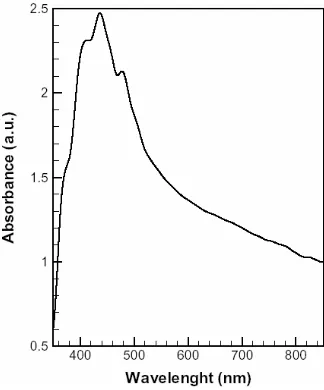
The UV-Vis spectrum of the calcined NTSO is shown in Figure 3. As seen, one broad intense band appears at 440 nm is characteristic of titanium atoms in a tetrahedral coordination sphere [15].
The FTIR spectrum of NTSO is shown in Figure 4. Two bands appear at 466 and 1087 cm−1 are assigned to the Si-O-Si bending mode and asymmetric stretching vibration respectively. The band at 948 cm−1 represents the Ti-O-Si linkage. The peaks observed at 1623 and 3234 cm−1 are assigned to the stretching vibrations of OH group and molecular H2O [9,15,18].
Figure 5 shows the TGA curve of NTSO. A weight loss at around 100°C, is due to desorption of physically bonded water and surface dehydroxylation. By increasing the temperature, the TGA curve becomes smooth and the weight lose is completely constant at around 600°C. The results indicate that water and organic residues in the mixed oxide were completely removed above 200°C [19].
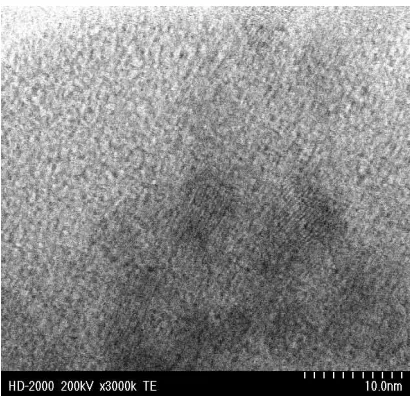
Transmission electron microscopy (TEM) image of calcined NTSO is shown in Figure 6. The lattice fringe of ~0.35 nm was observed, which corresponds to the lattice spacing of a plane in the Rutile phase [20].
Laser Raman spectrum of NTSO is shown in Figure 7. It exhibits two sharp peaks at 650 and 750 cm−1 and a broad peak at 430 cm−1, which are consistent with Rutile spectrum of TiO2. The position of peaks shifts to
higher wave numbers due to the silicon incorporation into the sample [15].
3.2. Catalytic Activity
3.2.1. NTSO as Catalyst for Epoxidation of Trans-stilbene, Cis-stilbene and Norbornene with TBHP Oxidant
Results obtained in the epoxidation of trans-stilbene, cis-stilbene, and norbornene with TBHP as oxidant in the presence of NTSO catalyst are shown in Table 1. As seen in Table 1, trans-stilbene and norbornene quantitatively and cis-stilbene about 73% are converted to the corresponding epoxides during 12 h. Such observation is not surprising on the basis of the reaction mechanism (vide infra). The formation of epoxide with 100% selectivity in these cases is remarkable.
Figure 1. XRD pattern of NTSO with Rutile structure.
Figure 2. Nitrogen adsorption isotherms and pore size distribution of NTSO.
Figure 4. FT-IR of TiO2-SiO2 calcined at 850°C.
Figure 5. TGA curve of Ti-Si mixed oxides up to 850°C.
Figure 7. Laser Raman spectrum of NTSO.
3.2.2. NTSO as Catalyst for Epoxidation of Trans-stilbene and Norbornene with O2/IBA and H2O2
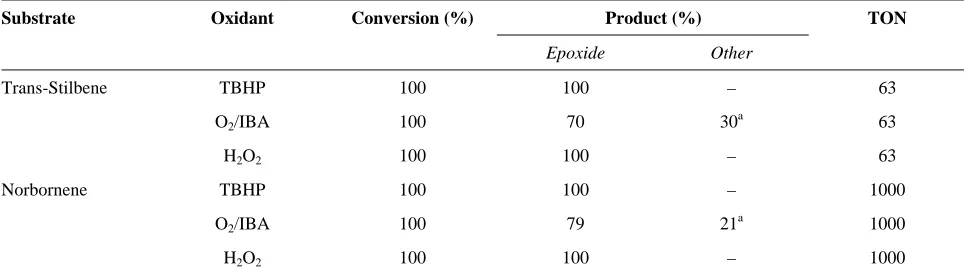
As seen in Table 2, utilization of oxygen with isobutyraldehyde in acetonitrile as solvent, will lead to 100% conversion of trans-stilbene and norbornene with 70-79% selectivity toward the corresponding epoxides. Surprisingly, trans-stilbene and norbornene have quantitatively been converted to the corresponding epoxides by using H2O2 as oxidant (see Table 2). Since
H2O2 is a green oxidant, the formation of the epoxides
in 100% yields is promising.
It was found that 2-cyclohexene-1-one and cyclohex-2-enyl-1-tert-butyl peroxide (mixed peroxide) were formed as the major products in the oxidation of cyclohexene with TBHP in the presence of NTSO catalyst. Based on the work of Sherington and his co-workers, the formation of the mixed peroxide is a strong evidence of t-BuOO radical implication in oxidation reaction [21]. Our previous experience is in agreement with Sherington’s viewpoint since the operation of a radical pathway mechanism in cyclohexene oxidation with TBHP catalyzed by immobilized Vitamin B12
within MCM-41 affording 2-cyclohene-1-one and cyclohex-2-enyl-1-tert-butyl peroxide products was supported by observing the total quenching of the products in the presence of Ph2NH radical scavenger
Table 2. The results of epoxidation of trans-stilbene and norbornene with different oxidants
Substrate Oxidant Conversion (%) Product (%) TON
Epoxide Other
Trans-Stilbene TBHP 100 100 – 63
O2/IBA 100 70 30a 63
H2O2 100 100 – 63
Norbornene TBHP 100 100 – 1000
O2/IBA 100 79 21
a
1000
H2O2 100 100 – 1000
Reaction conditions: trans-stilbene, 1 mmol, norbornene, 20 mmol, time, 12 hours; TON: mmol products/mmol catalyst. a
Unidentified product(s).
Cyclohexene * Ph
Ph OO-t-Bu
* t-BuOH
Norbornene
OO-t-Bu * (Not formed)
*
O
+
* = RadicalStilbene cis or trans
t-BuOH H+
+
t-BuOO*NTSO Electron transfer TBHP
+
2-Cyclohexene-1-one NTSO
+
+
NTSONTSO O Ph
Ph
+
NTSO NTSO-TBHP, H+
-H+
H+
Cyclohex-2-enyl-1-tert-butyl peroxide
+
NTSO
+
NTSO-Scheme 1
yield the oxidation products (Scheme 1). On the other hand, since cis and trans-stilbenes do not contain allylic hydrogens in their molecular structures, addition of peroxy radical to double bond with subsequent epoxide formation is inevitable (Scheme 1). That norbornene containing allylic hydrogens in the molecular structure affords the corresponding epoxide is easily inferred by knowing the fact that the formation of the unstable bridgehead radical is not possible under the reaction conditions (Scheme 1) [23].
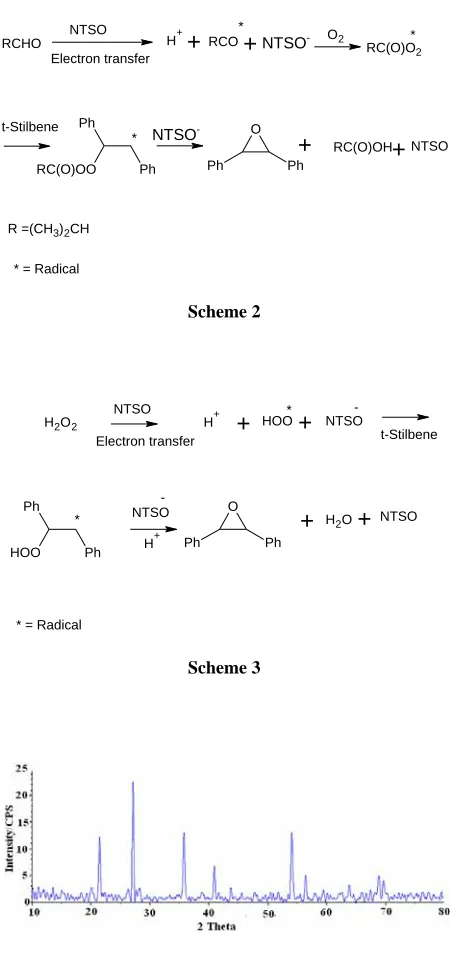
It seems likely to believe that isobutylperoxy radical as the key oxidant has probably been produced via
outer-sphere electron transfer from aldehyde to NTSO (Scheme 2) [24]. Addition of this radical to trans-stilbene with subsequent degradation affords the corresponding epoxide.
To make insight into the oxidation reaction mechanism with H2O2, we used the oxygen-radical trap
Ph2NH. Using an equimolar of trapping agent with H2O2
O Ph Ph
* = Radical
H+
+
Electron transfer RCHONTSO
RCO *
O2
RC(O)O*2 t-Stilbene
+
RC(O)OH R =(CH3)2CHNTSO
-Ph RC(O)OO Ph
* NTSO
-+
NTSO+
Scheme 2
NTSO Electron transfer
H2O2 H+
+
HOO* PhPh HOO
* NTSO -H+
+
H2O+
NTSO OPh Ph * = Radical
t-Stilbene
+
NTSO-Scheme 3
Figure 8. X-ray diffraction pattern of NTSO after using as catalyst for four times.
Although catalytic activity of Ti(IV)/SiO2 has been
reported to be superior due to an increase in Lewis acidity, it is ineffective catalyst for epoxidation with aqueous hydrogen peroxide [24]. This effect arises by the strongly coordinating ligands, especially water [24]. On the contrary, our NTSO catalysis system is
aqueous H2O2 is attributed to site-isolation of Ticenters
in the hydrophobic pores of silicates which allows for the simultaneous adsorption of the oxidant and the hydrophobic alkene in the presence of water [24]. The difference between Ti(IV)/SiO2 and NTSO might arise
either from crystallinity of the latter in comparison to the former or the very higher calcination temperature of 850°C which we used in NTSO synthesis.
Therefore, approach of H2O2 to Ti in the absence of
deactivating water molecules present in the vicinity of reaction center produces the peroxy radical via one-electron transfer process. Subsequent addition to alkene double bond and elimination of water affords the corresponding epoxide (Scheme 3).
3.3. Characterization and Identification of Catalyst after Recycling of NTSO
In order to evaluate the activity of the recycled NTSO, the epoxidation reactions were carried out for four times. The catalyst was recalcined before each step in order to eliminate the adsorbed products. It was found that the catalytic activity remained almost constant after fourth runs and the products yields were similar. Moreover, no Ti was detected in solution. Particularly significant is the fact that no structural changes occurred in the catalyst (NTSO) throughout the cycles based on the XRD pattern (Fig. 8). Therefore, it can be concluded that the nanoparticles of NTSO exhibit good stability under the reaction conditions. It was regenerated repeatedly without losing activity.
Conclusion
In this work, we have prepared the nanoparticles of NTSO with Rutile structure in a mixture of alcohol and water. It shows excellent catalytic activity and selectivity for epoxidation of trans-stilbene and norbornene with TBHP, O2/IBUA and eco-friendly
H2O2 oxidants.
Acknowledment
The authors gratefully acknowledge University of Alzahra for financial support.
References
1. Sheldon R.A. J. Mol. Catal. A: Chem., 107: 75 (1996). 2. Taramasso M., Perego G., and Notari B. US Patent, 4:
Catal., 184: 280 (1999).
5. Deng Y. and Maier W.F. Ibid., 199: 115 (2001). 6. Corma A. Top. Catal., 4: 249 (1997).
7. Davies L.S., Mc. Morn P., Bethell D., Bulman Page P.C., King F., Hancock F.E., and Hutchings G.J. J. Catal., 198: 319 (2001).
8. Cagnoli M.V., Casuscelli S.G., Alvarez A.M., Bengoa J.F., Gallegos N.G., Samaniego N.M., Crivello M.E., Ghione G.E., Perez C.F., Herreo E.R., and Marchetti S.G.
Appl. Catal. A: Gen., 287: 227 (2005).
9. Eimer G.A., Casucelli S.G., Ghione G.E., Crivello M.E., and Herrero E.R. Ibid., 298: 232 (2006).
10. Itoh M., Hattori H K., and Tanabe K. J. Mol. Catal., 35: 225 (1974).
11. Nakabayahi H. Bull. Chem. Soc. Japn., 65: 914 (1992). 12. Hutter R., Mallat T., and Baiker A. J. Catal., 153: 177
(1995).
13. Sohn J.R., and Jang H.J. Ibid., 132: 563 (1991).
14. Martinez-Mendez S., Heriquez Y., Dominguez O.,
D’ornelas L., and Krentzien K. J. Mol. Catal. A: Chem.,
252: 226 (2006).
15. Liu Z., and Davis R.J. J. Phys. Chem., 98: 1253 (1994). 16. Zhang X., Zhang F., and Yu Chan K. Appl. Catal. A:
Gen., 284: 193 (2005).
17. Lynch J. Physico-Chemical Analysis of Industrial Catalysts. Edition Technip, Paris, 6-22 (2003)
18. Beck C., Mallat T., Burgi T., and Baiker A. J. Catal., 204: 428 (2001).
19. Xie C., Xu Z., Yang Q., and Xue B.J. Du Zhang J, Mater. Sci. and Eng. B, 112: 34 (2004).
20. Kwon C.H., Kim J.H., Jung I.S., Shin H., and Yoon K.H.
Ceramics International, 29: 851 (2003).
21. Olason G. and Sherrington D.C. Reactive & Functional Polymers, 42: 163 (1999).
22. Farzaneh F., Taghavi J., Malakooti R., and Ghandi M. J. Mol. Catal. A: Chem., 244: 252 (2006).
23. March J. Advanced Organic Chemistry. Third Edition, John Wiley & Sons, New York, p. 616 (1985).