Please cite this article as: M. Najimi, F. Haji Aboutalebi, H. Beheshti, Stress Intensity Factor Determination in Functionally Graded Materials, Considering Continuously Varying of Material Properties, International Journal of Engineering (IJE), TRANSACTIONSC: Aspetcs Vol. 29, No. 12, (December 2016) 1741-1746
International Journal of Engineering
J o u r n a l H o m e p a g e : w w w . i j e . i rStress Intensity Factor Determination in Functionally Graded Materials, Considering
Continuously Varying of Material Properties
M. Najimi, F. Haji Aboutalebi*, H. Beheshti
Department of Mechanical Engineering, University of Isfahan, Isfahan, Iran
P A P E R I N F O
Paper history: Received 29 August 2016
Received in revised form 30 September 2016 Accepted 11 November 2016
Keywords: J-Integral
Stress Intensity Factor Functionally Graded Material Strain Energy Release Rate
A B S T R A C T
In this paper, the plates made of functionally graded material (FGM) with and without a crack are numerically simulated, employing the finite element method (FEM). The material property variations are defined to be fully continuous; therefore, the elements can be as small as required. For this purpose, variations of the material properties are applied in both the integration points and in the nodes by implementing a subroutine in the ABAQUS software and hence, the stress field in the singular points such as crack tip is accurately achieved. First, the stresses in the plate without a crack are numerically determined and the accuracy of FGM behavior is validated. Then, the J-integral is investigated and the stress intensity factor (SIF) of the plate with a crack is calculated, using the strain energy release rate (SERR) and the J -integral. In the following, dependency of the J-integral on the path is studied and the results are compared with the contour independent J-integral. Finally, it is shown that if the selected path limits toward zero, the results of the J-integral, the SERR, and the contour independent J-integral are all the same. This is due to considering the continuously varying of material properties and the effect of fining the mesh at the crack tip. doi: 10.5829/idosi.ije.2016.29.12c.13
1. INTRODUCTION1
Because of the some special circumstances in many structures, it is necessary to have various mechanical properties in some points or different directions. For this purpose, various materials are used in the manufacturing process of the structures. Putting layers of different materials together, leads to the internal stress when the structure is under any load. This problem can be solved if a continuous variation of material properties is implemented which it can postpone the stress concentration and the destruction of boundaries. Such materials with continuous variation of material properties are called functionally graded materials (FGMs) [1]. For the first time in 1984, the Japan aerospace laboratory prepared the materials that were made with heterogeneous microstructure and their mechanical properties gradually and continuously changed from one surface to another. Due to the
1*Corresponding Author’s Email: [email protected] (F.
Haji Aboutalebi)
absence of sharp and abrupt interface, residual stresses decreased [2] and the strength of the connection increased [3]. The suitable application of these new materials causes the lower stress concentration factor and the stress intensity factor (SIF) at different loading conditions. The previous researches reveal that the most common mode of failure in these materials is crack initiation and its growth [4].
the modified contour independent J-integral for two-dimensional stress and displacement fields [8].
Furthermore, Anlas et al. numerically calculated the SIF of FGM, considering the material property variations by number of discrete layers and applying the elastic material properties only in the integration points which reduced the accuracy of results [9]. Walters et al. extracted the SIF for a 3D FGM body and curved cracks by interaction integral procedures [10]. On the other hand, Bodaghi and Saidi conducted buckling behavior of moderately thick FGM plates resting on elastic foundation subjected to linearly varying in-plane loading [11].
Besides, the SIF was also taken into account by Bayesteh and Mohammadi, utilizing the incompatible interaction integral method [12]. Engaging the three point bending test and FEM, Desouky and EL-Wazery examined zirconia-nickel FGM and realized that the SIFs for the FGM are less than those for non-graded composite [13]. Rakideh et al. estimated the natural frequencies of a cracked beam and revealed that the neural network is a powerful method to determine the location and depth of crack [14].
Meanwhile, Eftekhari et al. applied the conjugate gradient method (CGM) for identifying the parameters of crack in a functionally graded beam from natural frequency measurement and proved the efficiency of CGM algorithm in terms of accuracy and the convergence speed [15]. A parametric study of the free vibration and stability analysis of beams made of FGMs containing open edge cracks was performed by Sherafatnia et al. [16].
Finally, Kumar et al. gained the J-integral approach to find out the SIF in a particulate type FGM plate subjected to uniform distributed tensile load at top and bottom edges of the plate. The Young’s modulus of the plate was assumed to vary as per the gradation laws (power law) through the width of plate, and the Poisson's ratio was taken as constant [17].
In this paper, the main goal is to propose a new approach to increase the accuracy of the J-integral and reduce the dependency of the results on the number of layers, in spite of the previous investigations. Hence, the final results are achieved in the first step. Additionally, the aim of this research is to accurately determine the SIF of a cracked FGM plate, considering continuously varying of material properties by applying the continuous properties in both the integration points and in the nodes. Moreover, the contour independent integral is extracted and compared with the results of J-integral. Finally, the SIF is computed via different methods and the results are compared.
2. J-INTEGRAL
When a crack grows at the constant displacement, the
strain energy release rate (SERR) is determined as below [18]:
dA dU
G (1)
U and A respectively are the energy and area of the crack face. For the plane strain case, the SIF is achieved through the next correlation [18]:
2 2
1
tip
I
GE
K (2)
In which, Etipis Young’s modulus at the crack tip. In
the homogeneous materials, the SERR is equal to the J-integral which is obtained through the next equation [19]:
ds x u WnJ ( ij j)
1
1 (3)
For 2D cracked plates, is a favorite path begins from the lowest edge and ends at the highest edge of crack.
W,uj, and njare the SERR, displacement component ,
and the component of the unit vector normal to the path, correspondingly. Neglecting the body forces, crack face tractions (crack surface assumed to be traction free) and thermal strains, the J-integral is path independent for homogeneous materials. For these materials, the SERR, G, and the J-integral are similar.
3. INDEPENDENT J-INTEGRAL
For the nonhomogeneous case, the SERR in addition to strain is dependent on x (W(x)W((x),x)). For this
reason, to obtain the contour independent J-integralJ~, an extra term needs to be subtracted from the classical J-integral as follows [20]:
A jij x ds W qdA
u Wn
J 1
1
1 ) ,
(
~
(4)
In which, is a favorite path begins from the lowest edge and ends at the highest edge of crack and A is the area surrounded by the contour. W,1, denotes partial differentiation of W with respect to the x variable. The J-integral gives null magnitude for a closed contour in the homogeneous and nonhomogeneous materials. Hence, in the fracture problems, it is permanently independent of path as it was analytically proved by Honein and Herrmann [20]. Ignoring the crack surface tractions and thermal stresses, the FEM formulation of the independent contour integral J~ is constructed as the following discretized form, suggested by Li et al. [21]:
A N p p k i i i ij x q W q W u J 1 1 1 1 , , 1 , 1 1, ) ]det }
{[(
~
In which,p is the weight function of the corresponding Gaussian integration points and W,1is partial differentiation of W with respect to x, exists when the Young's modulus E is an expilicit function of x
(EE(x)). For the specified material property variation, analytically drive of the expression is simple.
Meanwhile, in the accolade, all of the quantities are considered at the integration points for any element with the opted contour. N is defined the number of integration points of element and q1 is a parameter, employed to simplify the calculation of a contour integral in the FEM. In overall, a nodal value of 0 or 1 is given to Q1, while, q1can be signified through the next
relation [21]:
41 1 1
i i iQ N
q (6)
In which,Nirepresents the interpolation functions.
4. UNCRACKED FGM PLATE
As extracted in Figure 1, a rectangular edge-cracked FGM plate under uniform displacement or traction loading is numerically simulated in the ABAQUS commercial FEM code.
Poisson's ratio is taken as constant and the gradient of material is assumed to exponentially change in the x
direction as:
x e
x
( ) 1 (7)
is the shear modulus, 1is the shear modulus at x=0,
and is a material dependent constant, indicates the scale of length over variations of the properties. For validation of the FE model, the magnitudes of the normal stress are numerically estimated on the symmetry plane of the uncracked plate and compared with the exact solution of Erdogan and Wu [7].
4. 1. Uniform Displacement Loading According to the Figure 1, an uncracked FGM plate (b=0) with the width of 1 m and length to width ratio of 2 is considered. Because of the symmetry, only half of the geometry is modeled and symmetry conditions are applied on the symmetry line. The material is defined as a FGM with Young’s modulus of E x Eex
1
)
( along the
x-axis (E1represents the Young’s modulus of x=0) and
constant Poisson’s ratio of0.3.
In order to achieve suitable accuracy for stress field at the singular points such as crack tip, the material properties variation are defined fully continuous at the integration points and nodes by implementing a subroutine in the ABAQUS FEM code. For discretizing the plate, number of 2500 four nodes bilinear plane
strain quadrilateral elements with reduced integration and hourglass control are employed. Moreover, a uniform displacement V0 is applied in the y direction at the top of the plate and results are revealed for the two cases of E2/E12,10(E2indicates the Young’s modulus of x=h). Then, the magnitudes of stress in the
y direction are normalized by yyh(12)/E1V0 relation and compared with the exact solution of Erdogan and Wu [7], as illustrated in Figures 2 and 3.
Figure 1. A rectangular edge-cracked FGM plate under uniform loading
Figure 2. Comparison between the FEM results and exact solution [7], for the case of E2/E12 and uniform displacement
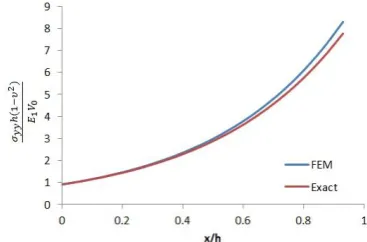
Figure 4. Comparison between the FEM results and exact solution [7], for the case of E2/E12 and uniform traction
Figure 5. FE model of edge-cracked FGM plate with the ratio ofb/h0.4
Figure 6. Normalized J-integral vs. number of contours for different paths, b/h0.4and uniform traction
According to the figures, as the E2/E1 ratio increases, the percentage of errors enhances and the maximum error occurs at the end of the plate (x/h1) which are 1.7 and 6.8 percent, respectively. Therefore, it is concluded that the numerical results of simulations are in a good agreement with the exact solution [7].
4. 2. Uniform Traction Loading The previous rectangular uncracked FGM plate is reconsidered. This time, instead of the uniform displacement, uniform traction of 0 is applied in the y direction for the case
ofE2/E12. Then, the magnitudes of stress in the y
direction are normalized by yyh/0 relation and
compared with the exact solution of Erdogan and Wu [7] according to Figure 4. In this case, the maximum error is about 1.5 percent, which reveals a high accuracy of FE model of the FGM.
5. FGM EDGE-CRACKED PLATE
Following, an nonhomogeneous edge-cracked plate with an initial crack length of 0.4 m and the ratio of b/h0.4 is studied. Figure 5 shows the FE model of the plate. As demonstrated in the figure, number of 3782 four nodes bilinear plane strain quadrilateral elements with reduced integration and hourglass control were used to discretize the geometry.
In general, the J-integral for the nonhomogeneous materials is path dependent. Applying the ABAQUS FEM code, the contour J-integral is determined and the changes of normalized J-integral vs. the number of contours is depicted in Figure 6 for various cases of
10 , 5 , 2 / 1
2 E
E . As the figure illustrates, the J-integral significantly depends on the path.
6. DETERMINATION OF SIF
Obtaining the results of cracked plate in the cases ofE2/E12,0.5, the SIF are determined via three various approaches of the SERR, the contour J-integral, and the path independent contour integralJ~. All mentioned approaches are compared with the analytical results and reveal the following relation:
) 0 ( ~ lim
0JGJJ
(8)
The graphs of normalized J and J~for two cases of 5
. 0 , 2 / 1 2 E
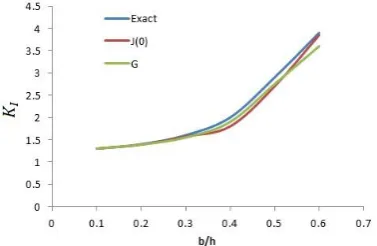
E are respectively plotted in Figures 7 and 8. According to the figures,J is contour dependent while, J~ is contour independent. It should be noted that the magnitudes of J and J~ in the first and the second contours generally are not accurate and due to the numerical errors, it is strongly recommended to use of the third and other contours in the FEM. From the above mentioned figures, it is clear that limit of the value ofJ , named J(0) is near to the path independent integralJ~. The SIF, determined from the energy quantities are compared with the analytical results and should be normalized via the relation proposed by Erdogan and Wu [7]. For the uniform displacement, the normalized SIF isKI KI/0 b, where0 E1V0/h(12).
Figure 7. Comparison between theJ and J~for the case of 2
/ 1 2 E
E and uniform traction
Figure 8. Comparison between theJ and J~for the case of 5
. 0 / 1
2 E
E and uniform traction
Figure 9. Comparison of the numerical and exact normalized SIF [7] for the case of E2/E12and uniform displacement
7. CONCLUSIONS
In this paper, the cracked and uncracked FGM plates with continuously varying of material properties were studied. Poisson's ratio was assumed to be constant and the gradient of material was exponentially changed. Varying of the material properties were continuously implemented in both the integration points and in the nodes, the stress field in the crack tip was accurately
obtained. The stresses in an uncracked FGM plate were determined and compared with the exact solutions. Comparison of the results revealed that the FEM could precisely predict the behavior of the material and the FGM model was validated. After the validation, the J-integral was studied and showed that it was path dependent. To achieve a path independent parameter, theJ~integral was utilized and the new results were compared with the J-integral. It was concluded that due to implementing the continuous material properties and feasibility of fining the elements at the crack tip, when the selected path limits to zero, the dependent and independent J-integral will have the same results.
8. REFERENCES
1. Shukla, A., "Dynamic fracture mechanics, World Scientific Publishing Company Incorporated, (2006).
2. Erdogan, F., "Fracture mechanics of functionally graded materials", MRS Bulletin, Vol. 20, No. 01, (1995), 43-44. 3. Chwa, S. and Kim, K., "Adhesion property of copper nitride film
to silicon oxide substrate", Journal of Materials Science
Letters, Vol. 17, No. 21, (1998), 1835-1838.
4. Noda, N., "Thermal stresses in functionally graded materials", Journal of Thermal Stresses, Vol. 22, No. 4-5, (1999), 477-512.
5. Delale, F. and Erdogan, F., "The crack problem for a nonhomogeneous plane", Journal of Applied Mechanics, Vol. 50, No. 3, (1983), 609-614.
6. Konda, N. and Erdogan, F., "The mixed mode crack problem in a nonhomogeneous elastic medium", Engineering Fracture
Mechanics, Vol. 47, No. 4, (1994), 533-545.
7. Erdogan, F. and Wu, B., "The surface crack problem for a plate with functionally graded properties", Journal of Applied
Mechanics, Vol. 64, No. 3, (1997), 449-456.
8. Chen, J., Wu, L. and Du, S., "A modified j integral for functionally graded materials", Mechanics Research
Communications, Vol. 27, No. 3, (2000), 301-306.
9. Anlas, G., Santare, M. and Lambros, J., "Numerical calculation of stress intensity factors in functionally graded materials", International Journal of Fracture, Vol. 104, No. 2, (2000), 131-143.
10. Walters, M. C., Paulino, G. H. and Dodds, R. H., "Interaction integral procedures for 3-D curved cracks including surface tractions", Engineering Fracture Mechanics, Vol. 72, No. 11, (2005), 1635-1663.
11. Bodaghi, M. and Saidi, A. R., "Buckling analysis of functionally graded mindlin plates subjected to linearly varying in-plane loading using power series method of frobenius", International
Journal of Engineering-Transactions A: Basics, Vol. 25, No.
1, (2011), 89-106.
12. Bayesteh, H. and Mohammadi, S., "XFEM fracture analysis of orthotropic functionally graded materials", Composites Part B:
Engineering, Vol. 44, No. 1, (2013), 8-25.
13. EL-Desouky, A. and El-Wazery, M., "Mixed mode crack propagation of zirconia/nickel functionally graded materials", International Journal of Engineering-Transactions B:
Applications, Vol. 26, No. 8, (2013), 885-894.
network", International Journal of Engineering-Transactions
C: Aspects, Vol. 26, No. 12, (2013), 1433-1444.
15. Eftekhari, M., Eftekhari, M. and Hosseini, M., "Crack detection in functionally graded beams using conjugate gradient method", International Journal of Engineering-Transactions C:
Aspects, Vol. 27, No. 3, (2013), 367-374.
16. Sherafatnia, K., Farrahi, G. and Faghidian, S. A., "Analytic approach to free vibration and buckling analysis of functionally graded beams with edge cracks using four engineering beam theories", International Journal of Engineering-Transactions
C: Aspects, Vol. 27, No. 6, (2013), 979-990.
17. Kumar, B., Sharma, K. and Kumar, D "Evaluation of stress intensity factor in functionally graded material (FGM) plate under mechanical loading", The Indian Society of Theoretical and Applied Mechanics (ISTAM), JAIPUR, (2015).
18. Jin, Z.-H. and Batra, R., "Some basic fracture mechanics concepts in functionally graded materials", Journal of the
Mechanics and Physics of Solids, Vol. 44, No. 8, (1996),
1221-1235.
19. Rice, J. R., "A path independent integral and the approximate analysis of strain concentration by notches and cracks", Journal
of Applied Mechanics, Vol. 35, No. 2, (1968), 379-386.
20. Honein, T. and Herrmann, G., "Conservation laws in nonhomogeneous plane elastostatics", Journal of the
Mechanics and Physics of Solids, Vol. 45, No. 5, (1997),
789-805.
21. Li, F. Z., Shih, C. F. and Needleman, A., "A comparison of methods for calculating energy release rates", Engineering
Fracture Mechanics, Vol. 21, No. 2, (1985), 405-421.
Stress Intensity Factor Determination in Functionally Graded Materials, Considering
Continuously Varying of Material Properties
M. Najimi, F. Haji Aboutalebi, H. Beheshti
Department of Mechanical Engineering, University of Isfahan, Isfahan, Iran
P A P E R I N F O
Paper history: Received 29 August 2016
Received in revised form 30 September 2016 Accepted 11 November 2016
Keywords: J-Integral
Stress Intensity Factor Functionally Graded Material Strain Energy Release Rate
ديكچ ه
ديذحمءاسجا شير زا ٌدافتسا ات ٍلاقم هیا رد ،
کرت یاراد ي کرت ذقاف یعتات جرذم داًم سىج زا تاحفص ٍت
یدذع ترًص
ٍیثض یزاس یم ًض و ٍت ٌدام ظاًخرییغت .ذ رعت ٍتسًیپ لاماک ترًص
فی ،ٌذیدرگ ناملا ٌزاذوا هیارتاىت یم اَ
زایو درًم ذح ات ذواًت
.دًض کچًک ٍت
،رًظىم هیمَ لارگتوا طاقو رد ٌدام ظاًخرییغت
ٌرگ ي یریگ مرو رد ٍماورتریز کی طسًت اَ لامعا سًکاتآ راسفا
صىت ناذیم ٍجیتو رد ي ٌذیدرگ ٍت کرت کًو ذىوام هیکت طاقو رد
لصاح یتسرد یم
دًض تا . صىت ،اذت کرت نيذت ٍحفص رد اَ ٍت
یدذع ترًص دام راتفر تحص ي ٌذیدرگ ٍثساحم
ٌ یعتات جرذم یجىسراثتعا
یم لارگتوا ،سپس .دًض یج
رارق یسررت درًم
ٍتفرگ ، کرت ٍحفص یارت صىت تذض ةیارض یشروا صیاَر خرو زا ٌدافتسا ات راد
یطورک لارگتوا ي یج یم ٍثساحم ددرگ .
سپس گتوا یگتستاي ، لار
یج ریسم ٍت ٍعلاطم لارگتوا ات جیاتو ي ٌذض یج
ریسم زا لقتسم یم ٍسیاقم
ٌداد ناطو ،رخآ رد .ددرگ
یم ،ذىک لیم رفص تمس ٍت ٌذض باختوا ریسم رگا ٍک دًض جیاتو
لارگتوا یج یشروا صیاَر خرو ، یطورک
لارگتوا ي یج لقتسم
ذَاًخ ناسکی ریسم زا دًت
. ٍت رما هیا رد ٍتسًیپ لیلد هتفرگرظو
رییغت ظاًخ ٌدام ي ریثات ناملا ندرکسیر کرت کًو رد اَ
یم
-.ذضات
![Figure 4. Comparison between the FEM results and exact solution [7], for the case of E2/E12 and uniform traction](https://thumb-us.123doks.com/thumbv2/123dok_us/212312.2015643/4.595.70.268.102.239/figure-comparison-fem-results-exact-solution-uniform-traction.webp)