hookah use among male students: using the extended
parallel process model
Hosein Ebrahimipour1, Reza Izi2, Hamid Allahverdipour3, Ali Vafaee Najar1, Habibolah Esmaeili4, Zabiholah Gharlipour5,
Mohammad Vahedian Shahrooudi6
Abstract
The prevalence of hookah uses increasing in the world, such that its sharper incremental trend compared to cigarette use has been observed in recent years. This study was conducted to assess hookah use by the extended parallel process model (EPPM) among male students in Mashhad. In this descriptive cross-sectional study which was conducted, 400 undergraduate students in two different universities of Mashhad participated based on stratified simple random sampling. Data were collected by a self-report questionnaire and analyzed by regression analysis. 30.8% of the students reported that they had used hookah in the last two months. The mean score of the perceived susceptibility, perceived severity and self-efficacy to hookah use consequences was more in hookah non-user students than in hookah users. Mean score of the perceived effectiveness in hookah user students was less than that in hookah non-user students. Our findings showed that messages with efficient solutions to counter the threat are efficient when they are associated with perceived threat. Generally, lower scores of the variables of extended parallel process model in relation to students 'health threat indicated increased probability of hookah use.
Keywords: Health Education, Health Promotion, Hookah Smoking, Student
Journal of Research & Health
Social Development & Health Promotion Research Center
Vol. 4, No.3, Atumun 2014 Pages: 788-794
Original Article
1. Associate Professor, Health Sciences Research Center, Department of Health and Management, School of Health, Mashhad University of Medical Sciences, Mashhad, Iran
2. Correspondence to: MSc Student, Student Research Committee, School of Health, Mashhad University of Medical Sciences, Mashhad, Iran
Tel/Fax: +98 51 38514549 Email: [email protected]
3. Professor of Health Education & Promotion Department, School of Health, Tabriz University of Medical sciences, Tabriz, Iran
4. Associate Professor, Health Sciences Research Center, Department of Health and Management, School of Health, Mashhad University of Medical Sciences, Mashhad, Iran
5. Lecturer of Public Health Department, School of Health, Qom University of Medical Sciences, Qom, Iran
6. Assistant Professor, Health Sciences Research Center, Department of Health and Management, School of Health, Mashhad University of Medical Sciences, Mashhad, Iran
Received: 4 Feb 2013 Accepted: 1 Jun 2013
How to cite this article: Ebrahimipour H, Izi R, Allahverdipour H, Vafaee Najar A, Esmaeili H, Gharlipour Z, Vahedian Shahrooudi M. Perception of fear and adoption of risk control for hookah use among male students: using the extended parallel process model.
J Research Health2014; 4(3): 788-794.
Introduction
According to a report released by World Health Organization, everyday between eighty thousand to one hundred thousand young people start to use tobacco products [1], the majority
than cigarette, its easy access, lower cost and other factors. Using hookah increases heart rate as well as systolic and diastolic blood pressure [4]. When hookah is used by an individual, the volume of smoke that enters the lungs is about 10 times more than when cigarette is used [5]. Nicotine found in hookah smoke is 36 times greater than nicotine in cigarette smoke and contains higher concentrations of heavy metals [6]. It has become clear that there is a relationship between hookah smoke and increased risk of cancers of oral cavity, stomach, esophagus, lung; reduced respiratory system function and reduced fertility [3]. The prevalence of hookah use among young university students varies from 32% to 62.6% [7]. Other studies on students in public universities of Iran reported the prevalence of hookah use 40.3% [8]. Based on scientific documents, training is one of the basic tools and methods to prevent smoking [9] and the most efficient training program is based on theory-based approaches that are rooted in patterns of behavior change. Health education is an instrument that enables people to have more control on their health and factors affecting their health [10,11]. Because of their complicated nature and cultural, social and individual factors involved in their development, hookah use need educational programs to promote skills to resist hookah use by emphasizing behavior change theories and based on effective educational planning [12]. Theories based on fear, specially Extended Parallel Process Model (EPPM), are one of the most effective solutions to prevent the adoption of unhealthy behaviors [13,14]. EPPM proposes three conclusions by considering threat assessment process and efficiency: A) Failure to respond when the perceived threat is the minimum value, B) The cognitive risk control process that leads to adoption of health warning messages, when there perceived threat and perceived efficacy are in their maximum value, C) The cognitive fear control process which leads to the rejection of the health warning messages when the perceived threat is high, but the perceived efficacy is low. In fact, fear of threat makes people adopt
solutions for dealing with health risk [12]. If the threat assessment and its consequent solution efficacy evaluation are realized, the possibility of attitude change, behavioral intention and behavior will increase [15]. White evaluated the cognitive and emotional mechanisms in success, failure and fear motivation on the prevention of cigarette smoking. The results of the study supported EPPM generally and showed that there is a relationship between fear and fear control responses and it has no direct relationship with risk control response. Due to the high prevalence of hookah use among students and serious complications attributed to it and the importance of implementing interventions such as educational interventions (with theoretical framework) to reduce the prevalence of hookah use in students, the current research was performed with the aim of determining the perception of fear and adoption of risk control process of hookah use among male students in Mashhad.
Method
items and items related to EPPM theoretical variables including perceived susceptibility, perceived severity, perceived effectiveness and perceived self-efficacy [12]. The perceived susceptibility and perceived severity each had 6 items, perceived effectivenesshad5 items and perceived efficacy had 6 items. To determine its validity, face and content validity were used by a panel of experts (10 health education specialists) and to determine reliability, a pilot study was conducted on 30 students and Cronbach's alpha coefficient was obtained for the constructs of the perceived susceptibility 0.75, perceived severity 0.74, perceived effectiveness0.79 and perceived self-efficacy0.81. If a variable obtains risk ratio Exp (B)>1 in regression analysis, there is a risk for the behavior and the risk increases when this figure is higher. While, if it is less than one, this factor has a protective role for the behavior, i.e. the higher is the score; the likelihood of the behavior will be weaker. Data collected by logistic regression method and student's t-test were analyzed by SPSS software.
Results
The results showed that 30.8% of students (n=123) had used hookah in the last two months. Also, the mean age of their first hookah use experience was 16 years old. Furthermore, 74.5%of students (n=298) reported that their friends had used hookah and 59.8% of them were currently hookah users. 20%of the students (n=80) mentioned that their fathers were hookah users. Also, 91.2% of the students (n=365) stated that hookah was offered to them
by their hookah user friends. The results of the current research showed that 86.7% of the hookah user students (n=104) used fruity tobacco and only 13.3% of the hookah user students (n=16) used classic tobacco. Also, 40.2% of the hookah user students (n=161) stated that they started hookah smoking in traditional restaurants for the first time. Findings showed that 63.2%of the hookah user students (n=253) used hookah for the first time with their friends and 25.5% (n=102) started hookah smoking alone.
Total mean score of the students 'perceived susceptibility was moderate (52.9±9.93). Mean score of the students 'perceived severity to the consequences of hookah use was moderate (54.6±12.06). Students 'mean perceived effectiveness to the recommended solutions was ‘not hookah smoking’ 61.3±9.76 and perceived self efficacy 73.83±11.13 in all students under study. Perceived susceptibility obtained the lowest and perceived self-efficacy obtained the highest score among constructs of the model.
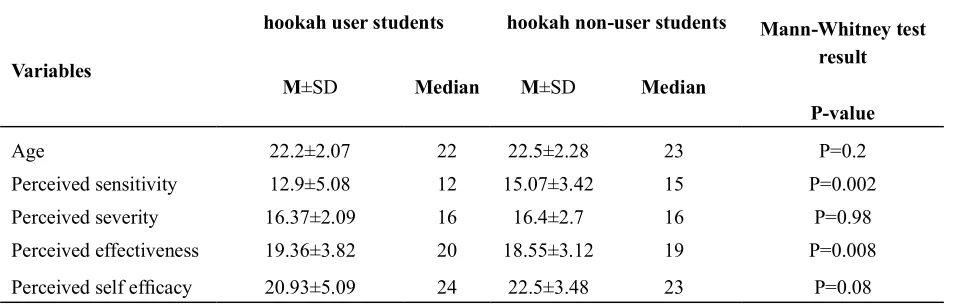
Information presented in Table 1 indicates that the mean age difference in two groups is not statistically significant. Also, the mean of the perceived sensitivity and effectiveness in hookah user students was significantly lower than hookah non-users students group (P=≤0.001, P=0.007), while there was no difference between the mean constructs of the perceived severity of hookah use complications and consequences and perceived self-efficacy (P=0.98, P=0.08).
Variables
hookah user students hookah non-user students Mann-Whitney test
result
P-value
M±SD Median M±SD Median
Age 22.2±2.07 22 22.5±2.28 23 P=0.2
Perceived sensitivity 12.9±5.08 12 15.07±3.42 15 P=0.002
Perceived severity 16.37±2.09 16 16.4±2.7 16 P=0.98
Perceived effectiveness 19.36±3.82 20 18.55±3.12 19 P=0.008
Perceived self efficacy 20.93±5.09 24 22.5±3.48 23 P=0.08
Figure 1 Comparison of the mean score of variables under study on two groups of hookah user and hookah non-user students Figure 1 indicates that the mean score of the
perceived severity in hookah user students was lower than that in the other group and the mean score of variables of the perceived effectiveness
and perceived self-efficacy in hookah user students was lower than that of hookah non-user students.
Also, frequency distribution of the students under study showed that the fathers of 30% of hookah user students and 16% of hookah non-user students were self-employed. In addition, 14.1% of the hookah user students reported that their fathers were unemployed while this figure was 0.1%forhookah non-user students (P<0.001, =26.61). Also, there was a significant
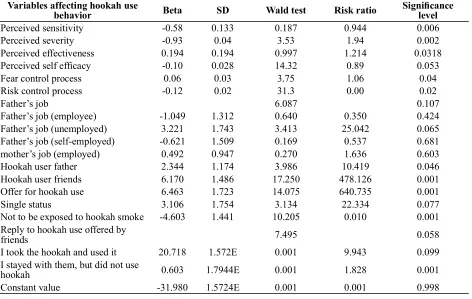
relationship (P=0.05, =38.8) between mother's employment and child hookah use in future. 52.2% of the hookah user students and 18.7% of the hookah non-user students reported that their mothers were employed. The results showed that there is a direct and significant relationship between hookah using of students with hookah user father, having
Significance level Risk ratio Wald test SD Beta Variables affecting hookah use
behavior 0.006 0.944 0.187 0.133 -0.58 Perceived sensitivity 0.002 1.94 3.53 0.04 -0.93 Perceived severity 0.0318 1.214 0.997 0.194 0.194 Perceived effectiveness 0.053 0.89 14.32 0.028 -0.10 Perceived self efficacy
0.04 1.06
3.75 0.03
0.06 Fear control process
0.02 0.00
31.3 0.02
-0.12 Risk control process
0.107 6.087 Father’s job 0.424 0.350 0.640 1.312 -1.049 Father’s job (employee)
0.065 25.042
3.413 1.743
3.221 Father’s job (unemployed)
0.681 0.537
0.169 1.509
-0.621 Father’s job (self-employed)
0.603 1.636
0.270 0.947
0.492 mother’s job (employed)
0.046 10.419
3.986 1.174
2.344 Hookah user father
0.001 478.126
17.250 1.486
6.170 Hookah user friends
0.001 640.735
14.075 1.723
6.463 Offer for hookah use
0.077 22.334 3.134 1.754 3.106 Single status 0.001 0.010 10.205 1.441 -4.603 Not to be exposed to hookah smoke
0.058 7.495
Reply to hookah use offered by friends 0.099 9.943 0.001 1.572E 20.718 I took the hookah and used it
0.001 1.828
0.001 1.7944E
0.603 I stayed with them, but did not use
hookah 0.998 0.001 0.001 1.5724E -31.980 Constant value
hookah user friends and the individual hookah user marital status (P<0.001, =13.42).
Regression test showed higher students’ perceived susceptibility decreases the possibility of hookah use. Furthermore, higher mean score of students’ perceived effectiveness reduces the possibility of hookah use. Also, father’s office work has a protective role for hookah use and if father is self-employed or unemployed, it is a risk factor for the students 'behavior. If mother is employed, it is a risk factor for student’s hookah use. Having hookah user father, hookah user friends, student’s single status, hookah use suggestion by friends and presence among hookah user people even if they do not use hookah are potential risk factors for the individuals to try hookah in future when desired conditions are met.
To determine the critical point regarding the fact that participants are in which stage of the threat control process (risk control or fear control), the mean scores of the perceived efficacy were subtracted from the mean scores of the perceived threat. If the obtained diagnostic value is a positive number (more than zero) it indicates that the individual is dealing with the risk control process and if the number is negative (less than zero), it shows that the individual is in fear control process [12]. The diagnostic value in all students under study was more than zero (1.15±0.3) which indicates that most students are in risk control process. Also the diagnostic value of hookah user students was obtained more than zero (1.23±0.06) which indicates that hookah user students are dealing with risk control process and their mean scores of the perceived threat is low.
Discussion
Development of hookah use and youth eagerness particularly students to use hookah is one of the recent problems. Given the importance of students 'physical and mental health, and their professional role and the need for healthy workforce to run the country in future, this research was conducted on students. Several studies have been conducted on hookah use and its related factors in student population
than hookah non-user students. The fact that the critical point in all hookah user students was obtained a positive number shows that most students are dealing with risk control process. Therefore, for people who are dealing with risk control process, health messages should emphasize on the harmful effects in addition to increasing perceived efficacy. Allahverdi Pour et al. reported students’ low mean perceived threat [16].Low perceived susceptibility and severity of the students can make them susceptible to use hookah. In this study, all students 'mean score of the perceived efficacy wasmoderate.But the mean score of the perceived threat was low. Studies have shown that messages with efficient solutions to counter the threat are efficient when they are associated with increased perceived threat [13, 22].Mean score of the self-efficacy in all students under study was moderate to high. Self efficacy resistance to use hookah can be useful in prevention of hookah use. Therefore, students who have low perceived threat should be convinced to severity and susceptibility of the threat. To increase perceived susceptibility and severity of the threat, messages and trainings should include information about the consequences and complications of the threat or health risk, the possibility of infection, or experience threat or health risk as well as raising awareness and improved attitude of students about complications and consequences of hookah use. Also, mean behavior intention in all students was reported high. Allahverdi pour et al.reported the increase of behavior intention as pre stage of behavior can be a strong risk factor for not rejecting drug abuse [16]. Mean perceived susceptibility and perceived effectiveness were significantly lower in hookah user students than hookah non-user students. Mean perceived susceptibility and perceived effectiveness to the suggested solutions were significantly lower in hookah user students than the other group. The increase of the mean of these two constructs will lead to weaker behavior and it has a stronger protective role toward perceived severity and perceived self-efficacy to apply resistance skills for hookah
use in students. Fear control process had a higher risk ratio than the risk control process. Risk control process has a stronger protective role than fear control processing hookah use. Generally, lower score of the variables in the extended parallel process model related to health threat in the students increases the possibility of hookah use and affects their health to a greater extent. The study of Gharlipour et al. confirms this issue [19].
Conclusion
Training skills to resist peer pressure and skills to detect risky situations with emphasis on perceived threat can be useful in prevention of hookah use. Hence many risk factors for hookah use can be prevented by this model. Using messages arousing fear and increasing students 'perception and belief related to the importance of the issue and efficient factors in addition to increasing perceived self-efficacy and effectiveness can have an efficient role in prevention of hookah use.
Acknowledgement
This study is a part of MSc thesis of Reza Izi which has financial support of Deputy of Research, Mashhad University of Medical Sciences, (Code:910936) The authors appreciate the supporters of School of Health Dean, Dr Ali Taghipour, and the dormitories authorities of Ferdowsi University of Mashhad.
Contributions
Study design: HE, HA, MVS
Data collection and analysis: RI, AV, HE Manuscript preparation: RI, AV, HE
Conflict of interest
"The authors declare that they have no competing interests."
References
1. Poyrazoglu S, Sarli S, Gencer Z, Günay O. Water pipe (Narghile) smoking among medical and non-medical university students in Turkey. Ups J Med Sci2010; 115(3): 210-6.
Hookah (narghile) smoking: a new emerging cause of secondary polycythemia. Am J Hematol2011; 86(8):719-20. 3. Jackson D, Aveyard P. Water pipe smoking in students: prevalence, risk factors, symptoms of addiction, and smoke intake. Evidence from one British university.
BMC Public Health2008; 8(1): 174.
4. Jarrett T, Blosnich J, Tworek C, Horn K. Hookah use among U.S. college students: results from the national college health assessment II. Nicotine Tob Res2012. 14(10):1145-53.
5. Uyanik B, Arslan ED, Akay H, Ercelik E, Tez M. Narghile (Hookah) smoking and carboxy hemoglobin levels. The Journal of emergency medicine. J Emerg Med2011; 40(6):679.
6. Jacob P 3rd, Abu Raddaha AH, Dempsey D, Havel C, Peng M, Yu L, Benowitz NL.. Nicotine, carbon monoxide, and carcinogen exposure after a single use of a water pipe. Cancer Epidemiology Biomarkers Prev2011; 20(11): 2345-53.
7. Grekin ER, Ayna D. Water pipe smoking among college students in the United States: a review of the literature. J Am Coll Health2012; 60(3): 244-9.
8. Hamdiye, M, Yaghobi N. Predictor of smoking Shisha in public universities. Journal of Guilan University of Medical Sciences2011; 4(34): 249-56. [In Persian] 9. Grekin ER, Ayna D. Argileh use among college students in the United States: an emerging trend. J Stud Alcohol Drugs2008; 69 (3): 472-5.
10. Rogers RW, Mew born CR. Fear appeals and attitude change: Effects of a threat’s noxiousness, probability of occurrence, and the efficacy of coping responses. J Pers Soc Psycho1976; 34 (1): 54.
11. Sabahy A, Divsalar K, Bahreinifar S, Marzban M, Nakhaee N. Water pipe tobacco use among Iranian university students: correlates and perceived reasons for use. Int J Tuberc Lung Dis2011; 15 (6): 844-7.
12. Witte K. Fear control and danger control: A test of the extended parallel process model (EPPM).
Communications Monographs1994; 61 (2): 113-34. 13. Witte K. Putting the fear back into fear appeals: The extended parallel process model. Communications Monographs1992; 59(4): 329-49.
14. Glanz K, Rimer BK, Viswanath K. Health behavior and health education: theory, research, and practice: Jossey-Bass; John Wiley & Sons, 2008; 61 (31): 399-418. 15. Witte K, Allen M. A meta-analysis of fear appeals: Implications for effective public health campaigns.
Health Educ Behav2000; 27(5):591-615.
16. Allahverdi pour H, MacIntyre R, Hidarnia A, Shafii F, Kzamnegad A, Ghaleiha A, et al. assessing protective factors against drug abuse among high school students: Self-control and the extended parallel process model.
Journal of addictions nursing2007; 18 (2): 65-73. 17. Bajracharya SM, Ferretti A, Jones L, Onisk J, Rosato G. Misperception about Hookah and Its use among American College Students. 2011; 62(4):146-50. 18. Ferretti A, Jones L, Onisk J, Rosato G. A needs assessment of Ithaca college students awareness,
knowledge, behaviors and attitudes toward smoking hookah, department of health promotion and physical education, 2007. Available at URL: http://eportfolios. ithaca.edu/jonisk1/docs/hookay_project.pdf. Accessed date: 13/10/2013.
19. Moeini B, Poorolajal J, Gharlipour Gharghani Z. Prevalence of Cigarette Smoking and Associated Risk Factors among Adolescents in Hamadan City, West of Iran In 2010. J Res Health Sci2012; 12(1):31-7. 20. Nakkash R, Khalil J. Health warning labelling practices on narghile (shisha, hookah) water pipe tobacco products and related accessories. Tob Control2010; 19(3): 235-9.
21. Tamim H, Terro A, Kassem H, et al . Tobacco use by university students, Lebanon, 2001. Addiction2003; 98(7): 933-9.