VOLUME NO. 3 (2013), ISSUE NO. 03 (MARCH) ISSN2231-5756
A Monthly Double-Blind Peer Reviewed (Refereed/Juried) Open Access International e-Journal - Included in the International Serial Directories
Indexed & Listed at:
Ulrich's Periodicals Directory ©, ProQuest, U.S.A., EBSCO Publishing, U.S.A., Cabell’s Directories of Publishing Opportunities, U.S.A., Open J-Gage, India [link of the same is duly available at Inflibnet of University Grants Commission (U.G.C.)],
VOLUME NO. 3 (2013), ISSUE NO. 03 (MARCH) ISSN2231-5756
INTERNATIONAL JOURNAL OF RESEARCH IN COMMERCE, IT & MANAGEMENT
CONTENTS
CONTENTS
CONTENTS
CONTENTS
Sr.No.
TITLE & NAME OF THE AUTHOR (S)
Page No.
1. EXTENT OF ABSOLUTE POVERTY IN RURAL SECTOR OF HIMACHAL PRADESH: A MEASURE OF UNEMPLOYMENT
RAMNA
1
2. THE ENTREPRENEURSHIP CORE COMPETENCES FOR DISTRIBUTION SERVICE INDUSTRY
SU-CHANG CHEN, HSI-CHI HSIAO, JEN-CHIA CHANG, CHUN-MEI CHOU, CHIN-PIN CHEN & CHIEN-HUA SHEN
5
3. THE RELATIONSHIP BETWEEN MACROECONOMIC VARIABLES AND CEMENT INDUSTRY RETURNS: EMPIRICAL EVIDENCE FROM PAKISTANI CEMENT INDUSTRY
MUHAMMAD IMRAN & QAISAR ABBAS
10
4. OUTLOOK OF MANAGEMENT STUDENTS TOWARDS EFFICIENCY OF ONLINE LEARNING-A CASE STUDY OF SHIVAMOGGA CITY, KARNATAKA STATE
SANDHYA.C, R. HIREMANI NAIK & ANURADHA.T.S
17
5. TRAFFIC RELATED MORTALITY AND ECONOMIC DEVELOPMENT
MURAT DARÇIN
21
6. SUBSCRIBER’S PERCEPTION TOWARDS CUSTOMER CARE SERVICE IN MOBILE TELECOMMUNICATION WITH SPECIAL REFERENCE TO TUTICORIN CITY
S. ANTHONY RAHUL GOLDEN. & DR. V. GOPALAKRISHNAN
27
7. A STUDY OF WAVELET BASED IMAGE COMPRESSION ALGORITHMS
CHETAN DUDHAGARA & DR. KISHOR ATKOTIYA
31
8. A STUDY OF CONSUMER’S IMPULSE BUYING BEHAVIOUR WITH REFERENCE TO EFFECT OF PROMOTIONAL TOOL IN THE OUTLETS OF CHHATTISGARH
DR. MANOJ VERGHESE & POOJA G. LUNIYA
37
9. STUDY OF CONSUMER BEHAVIOR IN CELL PHONE INDUSTRY
DR. ARUNA DEOSKAR
41
10. ANOTHER APPROACH OF SOLVING UNBALANCED TRANSPORTATION PROBLEM USING VOGEL’S APPROXIMATION METHOD
DILIP KUMAR GHOSH & YASHESH ZAVERI
45
11. PROBLEM OF NON-PERFORMING ASSETS OF STATE BANK OF INDIA: A CASE STUDY OF NAGPUR DISTRICT
DR. N. K. SHUKLA & M. MYTRAYE
49
12. INVESTMENT STRATEGY OF LIC OF INDIA AND ITS IMPACT ON PROFITABILITY
T. NARAYANA GOWD, DR. C. BHANU KIRAN & DR. CH. RAMAPRASADA RAO
59
13. PREDICTION OF DHAKA TEMPERATURE BASED ON SOFT COMPUTING APPROACHES
SHIPRA BANIK, MOHAMMAD ANWER & A.F.M. KHODADAD KHAN
65
14. SET THEORETIC APPROACH TO FUNDS FLOW STATEMENTS – A STUDY WITH REFERENCE TO STATE BANK OF INDIA
DR. PRANAM DHAR
71
15. STRATEGIES FOR THE SUCCESS OF BRAND EXTENDED PRODUCT : AN ANALYTICAL STUDY OF DEHRADUN DISTRICT WITH SPECIAL REFERENCE TO FMCG
DR. AMIT JOSHI, DR.SAURABH JOSHI, DR. PRIYA GROVER & PARVIN JADHAV
80
16. VALUE ADDED TAX AND ECONOMIC GROWTH: THE NIGERIA EXPERIENCE (1994 -2010)
DR. OWOLABI A. USMAN & ADEGBITE TAJUDEEN ADEJARE
85
17. CORPORATE SOCIAL RESPONSIBILITY INITIATIVES BY POWER GRID CORPORATION OF INDIA LIMITED: A STUDY
DR. S. RAGHUNATHA REDDY & MM SURAJ UD DOWLA
90
18. METADATA MANAGEMENT IN DATA WAREHOUSING AND BUSINESS INTELLIGENCE
VIJAY GUPTA & DR. JAYANT SINGH
93
19. QUALITY OF WORK LIFE - A CRITICAL STUDY ON INDIAN HOSPITALS
B.UMA RANI & M. SARALA
97
20. BUSINESS ETHICS: WAY FOR SUSTAINABLE DEVELOPMENT OF ORGANISATION
DR. SATYAM PINCHA & AVINASH PAREEK
105
21. USE OF ICT TOOLS IN HIGHER EDUCATION
SANDEEP YADAV & KIRAN YADAV
108
22. CONSTRUCTING CONFIDENCE INTERVALS FOR DIFFERENT TEST PROCEDURES FROM RIGHT FAILURE CENSORED NORMAL DATA
V. SRINIVAS
111
23. RECOGNISING CUSTOMER COMPLAINT BEHAVIOUR IN RESTAURANT
MUHAMMAD RIZWAN, MUHAMMAD AHMAD ATHAR, MUBASHRA WAHEED, ZAINAB WAHEED, RAIMA IMTIAZ & AYESHA MUNIR
116
24. SOCIO-CULTURAL EFFECTS OF ALCOHOL CONSUMPTION BEHAVIOUR OF YOUNG COMMERCIAL DRIVERS IN SOUTH WEST NIGERIA
DR. ADEJUMO, GBADEBO OLUBUNMI
123
25. MEAN-SHIFT FILTERING AND SEGMENTATION IN ULTRA SOUND THYROID IMAGES
S. BINNY
126
26. E-TAILING, ONLINE RETAILING ITS FACTORS AND RELATIONS WITH CUSTOMER PERSPECTIVE
WASIMAKRAM BINNAL
131
27. THE KNOWLEDGE MANAGEMENT AND THE PARAMETERS OF THE TECHNOLOGICAL INNOVATION PROCESS: APPLICATION IN THE TUNISIAN CASE
MLLE MAALEJ RIM & HABIB AFFES
134
28. THE RELATIONSHIP BETWEEN CORPORATE SOCIAL RESPONSIBILITY AND CORPORATE FINANCIAL PERFORMANCE: META-ANALYSIS
ASMA RAFIQUE CHUGHTAI & AAMIR AZEEM
139
29. AN EMPIRICAL STUDY ON STRESS SYMPTOMS OF ARTS, ENGINEERING AND MANAGEMENT STUDENTS IN TIRUCHIRAPALLI DISTRICT, TAMIL NADU
S. NAGARANI
144
30. PURCHASE INTENTION TOWARDS COUNTERFEIT PRODUCT
MUHAMMAD RIZWAN, SYEDA RABIA BUKHARI, TEHREEM ILYAS, HAFIZA QURAT UL AIN & HINA GULZAR
152
VOLUME NO. 3 (2013), ISSUE NO. 03 (MARCH) ISSN2231-5756
INTERNATIONAL JOURNAL OF RESEARCH IN COMMERCE, IT & MANAGEMENT
CHIEF PATRON
CHIEF PATRON
CHIEF PATRON
CHIEF PATRON
PROF. K. K. AGGARWAL
Chancellor, Lingaya’s University, Delhi
Founder Vice-Chancellor, Guru Gobind Singh Indraprastha University, Delhi
Ex. Pro Vice-Chancellor, Guru Jambheshwar University, Hisar
FOUNDER
FOUNDER
FOUNDER
FOUNDER PATRON
PATRON
PATRON
PATRON
LATE SH. RAM BHAJAN AGGARWAL
Former State Minister for Home & Tourism, Government of Haryana
Former Vice-President, Dadri Education Society, Charkhi Dadri
Former President, Chinar Syntex Ltd. (Textile Mills), Bhiwani
CO
CO
CO
CO----ORDINATOR
ORDINATOR
ORDINATOR
ORDINATOR
AMITA
Faculty, Government M. S., Mohali
ADVISORS
ADVISORS
ADVISORS
ADVISORS
DR. PRIYA RANJAN TRIVEDI
Chancellor, The Global Open University, Nagaland
PROF. M. S. SENAM RAJU
Director A. C. D., School of Management Studies, I.G.N.O.U., New Delhi
PROF. M. N. SHARMA
Chairman, M.B.A., Haryana College of Technology & Management, Kaithal
PROF. S. L. MAHANDRU
Principal (Retd.), Maharaja Agrasen College, Jagadhri
EDITOR
EDITOR
EDITOR
EDITOR
PROF. R. K. SHARMA
Professor, Bharti Vidyapeeth University Institute of Management & Research, New Delhi
CO
CO
CO
CO----EDITOR
EDITOR
EDITOR
EDITOR
DR. BHAVET
Faculty, Shree Ram Institute of Business & Management, Urjani
EDITORIAL ADVISORY BOARD
EDITORIAL ADVISORY BOARD
EDITORIAL ADVISORY BOARD
EDITORIAL ADVISORY BOARD
DR. RAJESH MODI
Faculty, Yanbu Industrial College, Kingdom of Saudi Arabia
PROF. SANJIV MITTAL
University School of Management Studies, Guru Gobind Singh I. P. University, Delhi
PROF. ANIL K. SAINI
Chairperson (CRC), Guru Gobind Singh I. P. University, Delhi
DR. SAMBHAVNA
VOLUME NO. 3 (2013), ISSUE NO. 03 (MARCH) ISSN2231-5756
INTERNATIONAL JOURNAL OF RESEARCH IN COMMERCE, IT & MANAGEMENT
DR. MOHENDER KUMAR GUPTA
Associate Professor, P. J. L. N. Government College, Faridabad
DR. SHIVAKUMAR DEENE
Asst. Professor, Dept. of Commerce, School of Business Studies, Central University of Karnataka, Gulbarga
ASSOCIATE EDITORS
ASSOCIATE EDITORS
ASSOCIATE EDITORS
ASSOCIATE EDITORS
PROF. NAWAB ALI KHAN
Department of Commerce, Aligarh Muslim University, Aligarh, U.P.
PROF. ABHAY BANSAL
Head, Department of Information Technology, Amity School of Engineering & Technology, Amity
University, Noida
PROF. A. SURYANARAYANA
Department of Business Management, Osmania University, Hyderabad
DR. SAMBHAV GARG
Faculty, Shree Ram Institute of Business & Management, Urjani
PROF. V. SELVAM
SSL, VIT University, Vellore
DR. PARDEEP AHLAWAT
Associate Professor, Institute of Management Studies & Research, Maharshi Dayanand University, Rohtak
DR. S. TABASSUM SULTANA
Associate Professor, Department of Business Management, Matrusri Institute of P.G. Studies, Hyderabad
SURJEET SINGH
Asst. Professor, Department of Computer Science, G. M. N. (P.G.) College, Ambala Cantt.
TECHNICAL ADVISOR
TECHNICAL ADVISOR
TECHNICAL ADVISOR
TECHNICAL ADVISOR
AMITA
Faculty, Government M. S., Mohali
FINANCIAL ADVISORS
FINANCIAL ADVISORS
FINANCIAL ADVISORS
FINANCIAL ADVISORS
DICKIN GOYAL
Advocate & Tax Adviser, Panchkula
NEENA
Investment Consultant, Chambaghat, Solan, Himachal Pradesh
LEGAL ADVISORS
LEGAL ADVISORS
LEGAL ADVISORS
LEGAL ADVISORS
JITENDER S. CHAHAL
Advocate, Punjab & Haryana High Court, Chandigarh U.T.
CHANDER BHUSHAN SHARMA
Advocate & Consultant, District Courts, Yamunanagar at Jagadhri
SUPERINTENDENT
SUPERINTENDENT
SUPERINTENDENT
SUPERINTENDENT
SURENDER KUMAR POONIA
VOLUME NO. 3 (2013), ISSUE NO. 03 (MARCH) ISSN2231-5756
INTERNATIONAL JOURNAL OF RESEARCH IN COMMERCE, IT & MANAGEMENT
CALL FOR MANUSCRIPTS
CALL FOR MANUSCRIPTS
CALL FOR MANUSCRIPTS
CALL FOR MANUSCRIPTS
Weinvite unpublished novel, original, empirical and high quality research work pertaining to recent developments & practices in the area of Computer, Business, Finance, Marketing, Human Resource Management, General Management, Banking, Insurance, Corporate Governance and emerging paradigms in allied subjects like Accounting Education; Accounting Information Systems; Accounting Theory & Practice; Auditing; Behavioral Accounting; Behavioral Economics; Corporate Finance; Cost Accounting; Econometrics; Economic Development; Economic History; Financial Institutions & Markets; Financial Services; Fiscal Policy; Government & Non Profit Accounting; Industrial Organization; International Economics & Trade; International Finance; Macro Economics; Micro Economics; Monetary Policy; Portfolio & Security Analysis; Public Policy Economics; Real Estate; Regional Economics; Tax Accounting; Advertising & Promotion Management; Business Education; Management Information Systems (MIS); Business Law, Public Responsibility & Ethics; Communication; Direct Marketing; E-Commerce; Global Business; Health Care Administration; Labor Relations & Human Resource Management; Marketing Research; Marketing Theory & Applications; Non-Profit Organizations; Office Administration/Management; Operations Research/Statistics; Organizational Behavior & Theory; Organizational Development; Production/Operations; Public Administration; Purchasing/Materials Management; Retailing; Sales/Selling; Services; Small Business Entrepreneurship; Strategic Management Policy; Technology/Innovation; Tourism, Hospitality & Leisure; Transportation/Physical Distribution; Algorithms; Artificial Intelligence; Compilers & Translation; Computer Aided Design (CAD); Computer Aided Manufacturing; Computer Graphics; Computer Organization & Architecture; Database Structures & Systems; Digital Logic; Discrete Structures; Internet; Management Information Systems; Modeling & Simulation; Multimedia; Neural Systems/Neural Networks; Numerical Analysis/Scientific Computing; Object Oriented Programming; Operating Systems; Programming Languages; Robotics; Symbolic & Formal Logic and Web Design. The above mentioned tracks are only indicative, and not exhaustive.
Anybody can submit the soft copy of his/her manuscript anytime in M.S. Word format after preparing the same as per our submission guidelines duly available on our website under the heading guidelines for submission, at the email address: [email protected].
GUIDELINES FOR SUBM
GUIDELINES FOR SUBM
GUIDELINES FOR SUBM
GUIDELINES FOR SUBMISSION OF MANUSCRIPT
ISSION OF MANUSCRIPT
ISSION OF MANUSCRIPT
ISSION OF MANUSCRIPT
1. COVERING LETTER FOR SUBMISSION:
DATED: _____________ THE EDITOR
IJRCM
Subject: SUBMISSION OF MANUSCRIPT IN THE AREA OF .
(e.g. Finance/Marketing/HRM/General Management/Economics/Psychology/Law/Computer/IT/Engineering/Mathematics/other, please specify)
DEAR SIR/MADAM
Please find my submission of manuscript entitled ‘___________________________________________’ for possible publication in your journals.
I hereby affirm that the contents of this manuscript are original. Furthermore, it has neither been published elsewhere in any language fully or partly, nor is it under review for publication elsewhere.
I affirm that all the author (s) have seen and agreed to the submitted version of the manuscript and their inclusion of name (s) as co-author (s).
Also, if my/our manuscript is accepted, I/We agree to comply with the formalities as given on the website of the journal & you are free to publish our contribution in any of your journals.
NAME OF CORRESPONDING AUTHOR: Designation:
Affiliation with full address, contact numbers & Pin Code: Residential address with Pin Code:
Mobile Number (s): Landline Number (s): E-mail Address: Alternate E-mail Address:
NOTES:
a) The whole manuscript is required to be in ONE MS WORD FILE only (pdf. version is liable to be rejected without any consideration), which will start from the covering letter, inside the manuscript.
b) The sender is required to mention the following in the SUBJECT COLUMN of the mail:
New Manuscript for Review in the area of (Finance/Marketing/HRM/General Management/Economics/Psychology/Law/Computer/IT/ Engineering/Mathematics/other, please specify)
c) There is no need to give any text in the body of mail, except the cases where the author wishes to give any specific message w.r.t. to the manuscript. d) The total size of the file containing the manuscript is required to be below 500 KB.
e) Abstract alone will not be considered for review, and the author is required to submit the complete manuscript in the first instance.
f) The journal gives acknowledgement w.r.t. the receipt of every email and in case of non-receipt of acknowledgment from the journal, w.r.t. the submission of manuscript, within two days of submission, the corresponding author is required to demand for the same by sending separate mail to the journal. 2. MANUSCRIPT TITLE: The title of the paper should be in a 12 point Calibri Font. It should be bold typed, centered and fully capitalised.
3. AUTHOR NAME (S) & AFFILIATIONS: The author (s) full name, designation, affiliation (s), address, mobile/landline numbers, and email/alternate email address should be in italic & 11-point Calibri Font. It must be centered underneath the title.
VOLUME NO. 3 (2013), ISSUE NO. 03 (MARCH) ISSN2231-5756
INTERNATIONAL JOURNAL OF RESEARCH IN COMMERCE, IT & MANAGEMENT
5. KEYWORDS: Abstract must be followed by a list of keywords, subject to the maximum of five. These should be arranged in alphabetic order separated by commas and full stops at the end.
6. MANUSCRIPT: Manuscript must be in BRITISH ENGLISH prepared on a standard A4 size PORTRAIT SETTING PAPER. It must be prepared on a single space and single column with 1” margin set for top, bottom, left and right. It should be typed in 8 point Calibri Font with page numbers at the bottom and centre of every page. It should be free from grammatical, spelling and punctuation errors and must be thoroughly edited.
7. HEADINGS: All the headings should be in a 10 point Calibri Font. These must be bold-faced, aligned left and fully capitalised. Leave a blank line before each heading.
8. SUB-HEADINGS: All the sub-headings should be in a 8 point Calibri Font. These must be bold-faced, aligned left and fully capitalised. 9. MAIN TEXT: The main text should follow the following sequence:
INTRODUCTION
REVIEW OF LITERATURE
NEED/IMPORTANCE OF THE STUDY
STATEMENT OF THE PROBLEM
OBJECTIVES
HYPOTHESES
RESEARCH METHODOLOGY
RESULTS & DISCUSSION
FINDINGS
RECOMMENDATIONS/SUGGESTIONS
CONCLUSIONS
SCOPE FOR FURTHER RESEARCH
ACKNOWLEDGMENTS
REFERENCES
APPENDIX/ANNEXURE
It should be in a 8 point Calibri Font, single spaced and justified. The manuscript should preferably not exceed 5000 WORDS.
10. FIGURES & TABLES: These should be simple, crystal clear, centered, separately numbered & self explained, and titles must be above the table/figure. Sources of data should be mentioned below the table/figure. It should be ensured that the tables/figures are referred to from the main text.
11. EQUATIONS: These should be consecutively numbered in parentheses, horizontally centered with equation number placed at the right.
12. REFERENCES: The list of all references should be alphabetically arranged. The author (s) should mention only the actually utilised references in the preparation of manuscript and they are supposed to follow Harvard Style of Referencing. The author (s) are supposed to follow the references as per the following:
•
All works cited in the text (including sources for tables and figures) should be listed alphabetically.•
Use (ed.) for one editor, and (ed.s) for multiple editors.•
When listing two or more works by one author, use --- (20xx), such as after Kohl (1997), use --- (2001), etc, in chronologically ascending order.•
Indicate (opening and closing) page numbers for articles in journals and for chapters in books.•
The title of books and journals should be in italics. Double quotation marks are used for titles of journal articles, book chapters, dissertations, reports, working papers, unpublished material, etc.•
For titles in a language other than English, provide an English translation in parentheses.•
The location of endnotes within the text should be indicated by superscript numbers.PLEASE USE THE FOLLOWING FOR STYLE AND PUNCTUATION IN REFERENCES: BOOKS
•
Bowersox, Donald J., Closs, David J., (1996), "Logistical Management." Tata McGraw, Hill, New Delhi.•
Hunker, H.L. and A.J. Wright (1963), "Factors of Industrial Location in Ohio" Ohio State University, Nigeria.CONTRIBUTIONS TO BOOKS
•
Sharma T., Kwatra, G. (2008) Effectiveness of Social Advertising: A Study of Selected Campaigns, Corporate Social Responsibility, Edited by David Crowther & Nicholas Capaldi, Ashgate Research Companion to Corporate Social Responsibility, Chapter 15, pp 287-303.JOURNAL AND OTHER ARTICLES
•
Schemenner, R.W., Huber, J.C. and Cook, R.L. (1987), "Geographic Differences and the Location of New Manufacturing Facilities," Journal of Urban Economics, Vol. 21, No. 1, pp. 83-104.CONFERENCE PAPERS
•
Garg, Sambhav (2011): "Business Ethics" Paper presented at the Annual International Conference for the All India Management Association, New Delhi, India, 19–22 June.UNPUBLISHED DISSERTATIONS AND THESES
•
Kumar S. (2011): "Customer Value: A Comparative Study of Rural and Urban Customers," Thesis, Kurukshetra University, Kurukshetra.ONLINE RESOURCES
•
Always indicate the date that the source was accessed, as online resources are frequently updated or removed.WEBSITES
VOLUME NO. 3 (2013), ISSUE NO. 03 (MARCH) ISSN2231-5756
INTERNATIONAL JOURNAL OF RESEARCH IN COMMERCE, IT & MANAGEMENT
PROBLEM OF NON-PERFORMING ASSETS OF STATE BANK OF INDIA: A CASE STUDY OF NAGPUR DISTRICT
DR. N. K. SHUKLA
PROFESSOR & HEAD
DEPARTMENT OF MBA
LAKSHMI NARAIN COLLEGE OF TECHNOLOGY
JABALPUR
M. MYTRAYE
RESEARCH SCHOLAR
DEPARTMENT OF ECONOMICS
RANI DURGAVATI UNIVERSITY
JABALPUR
ABSTRACT
The banking sector is the back bone of the financial system of the country. The State Bank of India being the biggest Public Sector Bank having largest national and international presence with highest consumer base and heading on its way to implement BASEL-II recommendations of the best international banking practices, Reserve Bank of India has release guidelines for meeting deadline for implementing BASEL-II norms. Now, the growing size of NPA is a matter of grave concern especially when State Bank of India is the largest Gross NPA holder in which huge amount of funds are blocked, crunching fund availability for credit creation and channelization of funds from excess to the needy sector of society, thereby hindering the growth prospects of the bank in particular and economy as a whole. However, the bank is undergoing transition period from conventional banking to International best practices, according to which the percentage of gross NPA should come down 9% to 3% another important necessary of reducing burgeoning NPAs is, when commercial banks are already under heavy pressure to maintain high statutory reserves under Cash Reserve Ratio, Statutory Liquidity Ratios in addition to 9% of Credit to Risk Weighted Assets Ratio of total lending, consequent upon this a substantial part of active fund kept under aforesaid reserves leaving the banks with short of funds for credit creation, in such situation huge bulk of burgeoning Gross NPA cant be afforded especially when a lot of instruments for reducing NPA is available in the market such as Special Purpose Vehicles, Corporate Debt Restructuring and SARFESI Act by Govt. of India. The importance of study of subject with reference to the State Bank of India in the Nagpur district i.e in Vidarbha Region arises when the State Bank of India’s NPA is touching its all time high due to severe crop failure in whole of the Vidarbha Region. The subject is of great relevance and importance not only for banking industry in the region but also for which operating all over India. RBI in one of its report on the subject has stated that the reduction of NPAs to be treated as “National Priority”
KEYWORDS
NPA Non Performing Assets, SARFESISecuritization and Reconstruction of Financial Assets and Enforcement of Security Interest, STDStandard Assets, DOUB -Doubtful Assets, EA-Enforcement Agents.
INTRODUCTION
he State Bank of India being the biggest Public Sector Bank having largest national and international presence with highest consumer base and heading on its way to implement BASEL-II recommendations of the best international banking practices. The growing size of NPA is a matter of grave concern especially when State Bank of India is the largest Gross NPA holder in which huge amount of funds are blocked, crunching fund availability for credit creation and channelization of funds from excess to the needy sector of society, thereby hindering the growth prospects of the bank in particular and economy as a whole. However, the bank is undergoing transition period from conventional banking to International best practices, according to which the percentage of gross NPA should come down 9% to 3% another important necessary of reducing burgeoning NPAs is, when commercial banks are already under heavy pressure to maintain high statutory reserves under Cash Reserve Ratio, Statutory Liquidity Ratios in addition to 9% of Credit to Risk Weighted Assets Ratio of total lending, consequent upon this a substantial part of active fund kept under aforesaid reserves leaving the banks with short of funds for credit creation, in such situation huge bulk of burgeoning Gross NPA can’t be afforded especially when a lot of instruments for reducing NPA is available in the market such as Special Purpose Vehicles, Corporate Debt Restructuring and SARFESI Act by Govt. of India.
OBJECTIVES
1. To study the loan profile, pattern and causes of NPA in the Nagpur Region.
2. To examine the recovery procedure of loan and exact causes of default in the repayment of loans by beneficiaries of State Bank of India in study area. 3. To probe into the credit availability and the end use.
4. To work out optimum tools and solution to alleviate the size of NPA by making bad loans to good loans of State Bank of India in Nagpur District. The objective of study of NPA is to work out institution and problem specific effective measures to contain the problem of NPA.
RESEARCH METHODOLOGY
AREA OF STUDY
The area of study is Nagpur District, Vidarbh region Maharashtra.
PERIOD OF STUDY
The period chosen is from March 2005 to March 2008. To analyses the relation between the social-economic characteristic of beneficiary and defaulter.
SOURCES OF DATA
The data sources used in this dissertation are basically taken as the secondary data. The data are collected through various books, magazines, articles, journals, internet etc. The important source of data for the research work is as follows:
o Annual report of Reserve Bank of India.
o Annual Report of State Bank of India.
o Report on Trends Progress in the Banking Sector.
o Various magazines and journals.
Analysis Procedure: In this study a sample of six blocks of Nagpur and has been taken out of a total 13 blocks and they are: • Nagpur City
• Kamti
• Katol
VOLUME NO. 3 (2013), ISSUE NO. 03 (MARCH) ISSN2231-5756
INTERNATIONAL JOURNAL OF RESEARCH IN COMMERCE, IT & MANAGEMENT
• Narkhed
• Kalmeshwer
• Saoner
The selection is based on the fact that the above districts represent about 80% of total industries in and about of total bank credit sanctioned to various quarters. The study has been divided into two phases:
STATE BANK OF INDIA
State Bank of India was formed in 1955 by an Act of the Parliament, the State Bank of India Act 1955 (Act). A Central Board of Directors was constituted according to the Act. The Board is headed by the Chairman, appointed under section 19(a) of SBI Act. The Chairman and Managing Directors are whole time Directors. There were 9 other directors on the Board including eminent personalities from academics and industry. These included representatives of shareholders and staff of the Bank, nominee officials of Government of India and Reserve Bank of India and directors nominated by the Government of India under Section 19(d) of the State Bank of India Act. 1955.
2 Directors elected by the shareholders under Section 19 C
1 Director, appointed by the GOI U/s 19(ca), representing workman staff of the Bank. 1 Director, appointed by GOI U/s 19(cb), representing non-workmen staff of the Bank. 3 Directors nominated by the Central Government under Section 19(d)
1 Director nominated by the Central Government under Section 19(e) 1 Director nominated by the Reserve Bank of India under section 19(f)
The composition of the board complied with the provisions laid down in Clause 49.
SHAREHOLDING PATTERN OF SBI- TABLE-9 COMPOSITION OF THE BOARD
The State Bank of India is committed to the best practices in the area of corporate governance, in letter and in spirit. The Bank believes that good corporate governance is much more than complying with legal and regulatory requirements. Good governance facilities effective management and control of business, enables the Bank to maintain a high level of business ethics and to optimize the value for all its stakeholders. The following is the list of top ten shareholder of the Bank as on 31.03.2008
NAGPUR DISTRICT
Nagpur is known as the second capital of Maharshtra State and the geographical centre of Indian Subcontinent. The total area of Nagpur district, 228 sq kms comprises of 13 blocks of Tehsils namely, Kuhi, Mauda, Ramtek, Saoner, Nagpur Rural, Umerer, Katol, Kalameshwar, Narkhed, Bhiwapur, Parsivni, and Kamti. Nagpur became capital of Central Provinces in 1861 later in 1950 Nagpur declared as the capital of Madhya Pradesh, but in 1960 again Nagpur city the district were transferred to Maharashtra State, as a part of state reorganization. The surrounding region is an undulating plateau rising northward to the Satpura Range, from 889 to 2,142 feet (271 to 663m) high and is drained by the Kanhan and Pench rivers in the centre, the Wardha in the west, and the Wainganga in the east. Both these rivers later merge as tributaries into the Godavari River. The soil is fertile black (cotton) in the west and the north and alluvial in the east, this way. The foundation of Cotton Market was laid in 1950. The average annual rainfall is 45 inches, with more rain in east than in the west. In the west, the hills are forested. In the northeast are the hills of Ramtek. The main agricultural crops in the district along with the cropping period and market area are given below. The banking sector can play leading role in development of the region. The State Bank of India is having highest branch net work of 271 branches amongst the commercial banks in Nagpur District.
Nagpur District comprises of 13 blocks or Tehsils as discussed above. However, Following is the administrative set of State Bank of India, Nagpur Zone which is comprised of 12 districts of Vidarbha region (Including Nagpur District) as shown below.
REGIONS/DISTRICT
Region-1 Nagpur City, Bhandara and Gondia Region-2 Nagpur Rural, Chandrapur and Gadchiroli
Region-3 Buldana
Region-4 Akola and Washim
Region-5 Amravati
Region-6 Yavatmal and Wardha
NON PERFORMING ASSETS
The banking industry has undergone a sea change after the first phase of economic liberalization in 1991 and on aspects like credit management, interest rate deregulation, reduction in reserve requirements; barriers to entry, prudential norms and risks based supervision. But progress on structural institutional aspects has been much slower and is a cause for concern. The sheltering of weak institutions while liberalizing operational rules of the game is making implementation of operational changes difficult and ineffective. Changes required to tackle the NPA problem would have to span the entire gamut of judiciary, polity and the bureaucracy to be truly effective.
Today the Net NPAs of State Bank of India (which account for around three-fourths of the total assets of Public Sector Banks) are as low as 0.72 percent and gross NPAs are at 2.5 percent. However, Nitsure (2007) contends that once there is a slowdown in private expenditure and corporate earnings growth, companies on these banks’ books will not be in a position to service their debts on time and there is a strong likelihood of generation of new NPAs. Moreover, he also suggests that with rising interest rates in the government bond market, the banks’ treasury incomes have declined considerably. So banks will not have enough profits to make provisions for NPAs. Under these circumstances, management of NPAs is a difficult task. Therefore, my study focused on the problem of NPAs being faced by the State Bank of India and its management with a reference to the Nagpur District.
ASSET CLASSIFICATION
With a view to moving towards international best practices and to ensure greater transparency, it has been decided that 90 days overdue norms for identification of NPA’s from the year ending 31st March 2004 should be adopted. NPA’s classified into three categories:
(i) Sub-standard assets: - A loan asset that has remained non- performing for a period less than or equal to 12 months. (ii) Doubtful assets :- A loan asset that has remained sub- standard category for a period less than or equal to 12 months (iii) Loss assets: - A loan asset where loss has been identified but the amount has not been identified.
Earlier as mentioned above we had only four categories of assets but now as another step towards mitigating NPA account, another category of account has been introduced, the details about which is discussed below.
• OVERDUE
Any amount due to the bank under any credit facility is ‘overdue’ if it is not paid on the due date fixed by the bank.
• ‘Out of order’ status: An account should be treated as ‘out of order’ if:
a) The outstanding balance remains continuously in excess of the sanctioned Limit / Drawing Power, or
b) If the outstanding balance in the principal operating account is less than the sanctioned Limit / Drawing Power, but there are no credits continuously for 90 days as on the date of Balance Sheet, or
VOLUME NO. 3 (2013), ISSUE NO. 03 (MARCH) ISSN2231-5756
INTERNATIONAL JOURNAL OF RESEARCH IN COMMERCE, IT & MANAGEMENT
Banks should classify an account as NPA only if the interest charged during any quarter is not serviced fully within 90 days from the end of the quarter.OBSERVATION AND ANALYSIS
Expansion of credit is a must for a region like Nagpur, but as mentioned above, high credit growth may lead to high NPAs. Policymakers, therefore, face the dilemma as to how to minimize such risks that arise from dilution in credit quality, while still allowing bank lending to contribute to higher growth and efficiency. There is no gainsaying in the fact that every commercial organization exists with a motive to earn profit and banks are no exception. The objective function is therefore to maximize profit or the Net Interest Margin. Commercial banks use the deposits to extend loans and advances. The figure1 shows that how a bank can maximize profit (assuming existence of Pure Competition Market):
FIG. 1
In Figure 1, MC is the Marginal Cost to the banks, AC is the Average Cost, i is the interest rates on loans, point B represents the cost of funds and the shaded portion is the profit. To maximize profits, a purely competitive bank issues loans such that the marginal cost of an additional loan equals the marginal revenue from such loans. The marginal revenue from an additional loan is simply the market determined interest rate. Profits are maximized when MC equals interest rate. Therefore, it is evident that profits can be maximized if more and more loans are extended at a given rate of interest. This may result in poor assessment of the borrower leading to fresh generation of NPAs.
TABLE-1: OVER ALL NPA POSITION - NAGPUR REGION STATE BANK OF INDIA
It is observed that, as on 30 March 2008 block wise bad loans and number of defaulting companies in the sample blocks of Kamti, Narkhed, Saoner, Kalmeshwar, Nagpur and Katol are the worst sufferers as far as quantum of bad loans is concerned. As on 30 March 2008, the total quantity of bad loans was Rs 152 Cr in Nagpur and Rs 93 Cr in the Katol blockwise. If all the districts are taken then this figure stood at Rs 407 Cr as on the same date. Therefore, the bad loans in Nagpur was about 37.3% of total such loans in all the sample blocks and the same figure is about 23% in the Katol block and together they constitute about 60% of total bad loans. This figure may be taken as the representation of Nagpur district as a whole as these blocks combined have the highest concentration of industries. Moreover, these figures reveal that about 94% of total such loans is concentrated in Nagpur city and Katol.
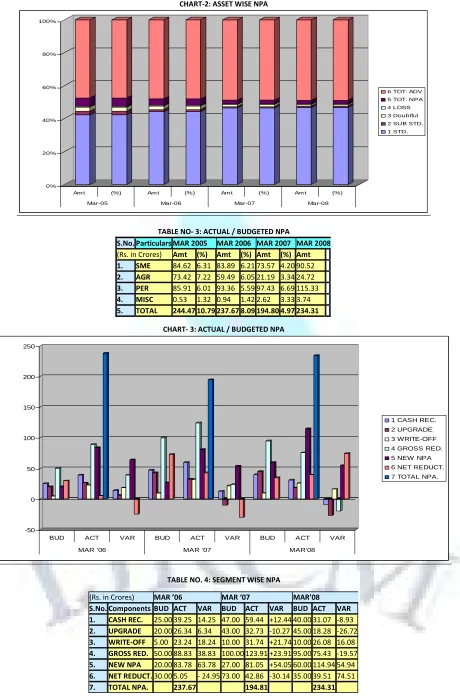
We can see the gross reduction in quantity of NPA on opening balance on YoY basis, from 242.72Cr in March 2006 to 194.80Cr. March 2008, net decrease of 42.92 cr. due to the various contributing factors in bringing down the NPAs of State Bank of India’s targeted approach the following was being one of their action plan.
As per the NBG Policy Guidelines 2007-08, target set for the year 2007-08. The NPA should be brought down to the following levels.
1. Fresh NPA slippages (to total advances as on 31.03.2007). < 1%
2. Reduction in Gross NPAs (Net of fresh slippages) > 10%
3. Gross NPA Ratio (reduction by). 1%
4. Recovery from AUCA & Non AUCA Accounts to increase over 2006-07 recoveries by. 25% 5. Gross NPA in Personal loans Segment should come down from March ’07 level) by at least. 10%
6. Gross NPA in SME Segment should be brought down to. 1%
7. Gross NPA in AGL Segment should be brought down to. 3%
The above target has contributed greatly on surge in Reduction of NPA from Rs.88.83 cr in March 2006 to Rs. 123.92 cr. March 2007. Then again we can see reduction activity loosing grip and significant surge in New NPAs on March 2008 as evident in Table-1. There by plotting net increase of 39.51 % over –ve growth of March 2007. The reason for addition of New NPA accounts is discussed chapters to follow.
S.No. Particulars (Rs. in Crores) MARCH 2006 MARCH 2007 MARCH 2008 1. Op. Level 242.72 237.67 194.80
2. Less: Redn. 88.83 123.92 75.43
3. Add: New NPAs 83.78 81.05 114.94
4. Net Inc.(3-2) - 5.05 - 42.87 39.51
VOLUME NO. 3 (2013), ISSUE NO. 03 (MARCH) ISSN2231-5756
INTERNATIONAL JOURNAL OF RESEARCH IN COMMERCE, IT & MANAGEMENT
In the year 2005, the State Bank of India had around 50% of their NPA profile in the 5 to 10 % category which has been totally eliminated by 2007 wherein about 75% of their total NPA is below 2% mark. The performance has steadily improved over the period after the enactment of the Securitization Act, 2002. However, available data point to the fact that majority of the loans are recovered through the Debt Recovery Tribunals.The figure reveals that as far as recovery is concerned, Debt Recovery Tribunals are the most effective means of loan recovery. From 2003-04 to 2005-06 though the number of cases referred to the DRTs have reduced as compared to that under the Securitization Act the percentage of recovery is almost double as compared to the Securitization Act. The percentage recovery through the DRTs has increased from 17.2% to about 77% as compared to the recoveries through the Securitization Act where it increased from 14.7% to about 35%. This can be attributed to the absence of any structured market for selling the distressed assets which are securitized under the SARFAESI Act. Moreover, selling sticky assets is a problem due to differences between the seller and the buyer in the valuation of such loans. Apart from this any dissatisfied borrower against whom the Securitization Act has been initiated can take recourse to court of law and file a suit against the lender thereby making the lender to fall in what is termed as ‘legal trap’. On the other hand recovery through the DRTs is much speedier. Though there is a provision of filing a suit against the lender as under the Securitization Act, but here the borrower filing the suit has to deposit 25% of the amount involved for further processing and hearing of the case. This provision ensures that only the genuine cases are taken up by the DRTs.
NON-PERFORMING ASSETS IN THE PRIORITY SECTOR
Priority sector was regarded as a “People Sector” by policymakers, regulators and banks till 1990. As one of the prime objectives of nationalization of banks was radical development of the society in general and ‘certain sectors’ in particular, credit flow to these sectors was ensured. This directed lending did not come without a cost. While granting credit to these sectors, institutional viability was neglected, low interest rates were charged. This resulted in huge over dues from priority sector. The recommendations of the Narsimham Committee were not accepted in-toto especially to reduce the mandatory 40% lending norm to the priority sector to 10% level. TABLE- 4 shows Sector wise NPAs in the State Bank of India. Regarding Farm loans, all the commercial, Co-operative and Rural banks have mandate of loan conversion. State Bank of India is strictly adhering to the mandate; farmers can get conversion up to 3 times.
The Credit-Deposit Ratio in Nagpur District is almost half that as compared to the ratio on Maharashtra State basis and there has been a stagnation in the figure. This is despite the fact that there has been a tremendous appetite for bank credit from all sectors due to the various social- economic reasons.
It is observed from figure 7 that maximum credit was sanctioned to the Personal Segment and second largest in Small and Medium Enterprise sector.. In the year 2007-08, the total credit sanctioned to these sectors was Rs 115.33 Cr and Rs.90.55 Cr. for SBI which registers an increase of 16.51% in personal loans from the year 2005’s Rs. 85.91 cr. and SME segment registers an increase of 07.14% over 2005’s Rs 84.62 Cr in 2006.
CAUSES OF NPA
IMMEDIATE CAUSES
1. Repayment Risk: There was a sudden spurt in disbursal of Personal/ Retail Loan segment like Car loan, Home loan, Consumer loans etc. most of borrowers were having repayment schedule through post dated cheques, which leading to spurt in cheque bouncing cases, although bankers have clear protection against such cases under Section 138 of Negotiable Instruments Act 2002, since the number of case are enormous and slow and tedious legal system adding to the plight. However, it takes at least 2-3 years to settle a single case of cheque bouncing in such case banker have no option but to declare the account NPA.
2. Low Credit Quality: The low credit quality in State Bank of India’s portfolio particularly in the dominant Sub-Sectors of the Nagpur region. The high incidence of NPAs in State Bank of India is result of many factors, including poor credit analysis, lending skills and lending decisions, external shocks e.g. unexpected slowdown in economic activities, credit crunch), and shortcomings in the legal and judicial system that prevent the timely exercise of creditor rights.
3. Lack of Effective Executive Mechanism: The State Bank of India in the regions lacks the strong supporting legal and regulatory environment, effective leadership, operational independence, appropriately structured incentives and commercial orientation.
4. Delay in One Time Settlement policy announcement: The last time Reserve Bank of India has come up with One Time Settlement Scheme is in 2004, since then it has not come out with scheme of any such resolution scheme, this again is one of the main reason for accumulation of NPA in various segments.
5. Various Government Schemes: Agriculture is having huge chunk of NPA because of various Government scheme, with the mere announcement of such schemes the farmers stop repaying their installments on presumption of their loans were being waived. However, such government schemes increases the burden of NPAs at bankers part, same is the case of cause and effect happened recently with debt relief package.
6. Poor State of Asset Reconstruction Companies: The Asset Reconstruction Companies in Nagpur district are almost absent and whatever exists, just in nascent state. Otherwise It could have helped greatly to resolve NPAs in the area of study, as it has huge potential to contain the bad assets and easy way out in their resolution, such vehicles provides an effective mechanism of pooling together the scarce skill of managing and disposing off of impaired assets.
7. Understatements: State Bank of India has been plagued by a large stock of NPAs. Where NPAs/ Credit ratio before provisioning was 12.5% of gross credit. This ratio was brought down sharply from the peak of 25% in 2004, mainly on account of a rapid growth in the volume of credit (i.e. the denominator) rather than a decrease in the level of NPAs (numerator). Net of provisions, NPAs still accounts for a sizeable 6.66% of net credit.
8. Slow Legal Procedure: Slow legal procedures adding up to the problem of NPA resolution at banker’s part. The Courts are not reliable enforcement vehicles, 90% of State Bank of India’s NPA cases are pending with the civil court, yet to pass the decree. The reported NPA numbers are also believed to understate the true magnitude of impaired assets. The private sector analyst believe that NPA levels for PSBs especially (State Bank of India in the region) are significantly higher at 20 to 25 percent of the total loans rather than the reported 12.5 % , even further picture would be little gloomy, if more conservative classifications standards are adopted more of ever- greened loans would be identified as impaired assets.
9. Poor Human Resource Management: The state of affairs in Human Resource Management is still poor, most of the front end staff is not computer literate, those who are having not willing to work. The age profile of the staff is the cause of poor human resource. At the same time frequency training sessions are also low.
10. Poor Infrastructure: In terms of providing basic infrastructure like power, roads housing etc. The poor infrastructure facilities like power, adding to the huge chunk of bad assets- as the production get hampered with long hour of power cuts, corporate are not able to repay installments of loans in scheduled time. Likewise, other infrastructural problems adding up to the bad loans in the region.
ACTION TAKEN REPORT BY STATE BANK OF INDIA- NAGPUR
VOLUME NO. 3 (2013), ISSUE NO. 03 (MARCH) ISSN2231-5756
INTERNATIONAL JOURNAL OF RESEARCH IN COMMERCE, IT & MANAGEMENT
S. No.
Particulars No. Amt. In cr.
Action Plan devised on 15.05.2008 1 Writing off-100%
provision accounts
533540.13Writing off exercise to be completed by 31st May, 2008. 2 a. Housing Loans 255560.21Housing Loans :
1) Photo Notices to be issued in all cases. Notices under SARFAESI Act to be issued in all cases.2) Action u/s 13(4) to be initiated after expiry of 60 days. Services of Enforcement Agents to be engaged and auction of
propertiesto be arranged the Salary disbursing authorities to be notified regarding defaulting borrowers. 2) Car / Education / Personal/ Consumer Loans :
5) Photo Notices to be issued in all cases. Services of Seizure Agents to be engaged and auction of vehicles to be arranged Salary disbursing authority to be notified regarding defaulting borrowers.
b.Car Loans 880 8.66 c. Education Loans 576 9.04 d.Personal Loans 670231.05 e. Consumer Loans174 0.60
3 SME Accounts 929890.521) Photo Notices to be issued in all cases.
Where immovable properties are available, action under SARFAESI Act to be initiated. Action u/s 13(4) to be initiated after expiry of 60 days. Services of Enforcement Agents to be engaged and auction of properties to be arranged. 4 Agriculture
Accounts
690524.72To ensure Restructure of dues/ Compromise settlements 5 Bank Adalat - - To hold Bank Adalats–each Region every month. 6 Compromise
Settlements
- - To settle at least 25 cases per Region per month 7 Outsourcing
Recovery
- - Monthly targets to be given to Recovery Agents
CONCLUSIONS AND SUGGESTIONS
A. Recommendations for reducing NPAs of State Bank of India in Nagpur Dist.
1. Effective and regular follow-up of the end use of the funds sanctioned is required to ascertain any embezzlement or diversion of funds. This process can be undertaken every quarter so that any account converting to NPA can be properly accounted for.
2. Combining traditional wisdom with modern statistical tools like Value-at-risk analysis and Markov Chain Analysis (as detailed below) should be employed to assess the borrowers.
3. This is to be supplemented by information sharing among the bankers about the credit history of the borrower. In case of new borrowers, especially corporate borrowers, proper analysis of the cash flow statement of last five years is to be done carefully.
4. A healthy Banker-Borrower relationship should be developed. Many instances have been reported about forceful recovery by the banks, which is against corporate ethics. Debt recovery will be much easier in a congenial environment.
5. A well functioning Asset Reconstruction/ Recovery mechanism wherein the bad assets are sold to an Asset Reconstruction Company (ARC) at an agreed upon price. There is an absence of strong of hold of such mechanism in Vidarbh region, However whatever exists in Nagpur district still is in nascent stage. One problem that can be accorded is the pricing of such loans. Therefore, there is a need to develop a common prescription for pricing of distressed assets so that they can be easily and quickly disposed. The ARCs should have clear ‘financial acquisition policy’ and guidelines relating to proper diligence and valuation of NPA portfolio.
6. Some tax incentives like capital gain tax exemption, carry forward the losses to set off the same with other income of the Qualified Institutional Borrowers (QIBs) should be granted so as to ensure their active participation by way of investing sizeable amount in distressed assets of banks and financial institutions.
7. So far the Public Sector Banks have done well as far as lending to the priority sector is concerned. However, it is not enough to make lending to this sector mandatory; it must be made profitable by sharply reducing the transaction costs. This entails faster
embracing of technology and minimizing documentation.
8. The Bank should be allowed to come up with their own measures to address the problem of NPAs. This may include waiving and reducing the principal and interest on such loans, or extending the loans, or settling the loan accounts. They should be fully authorized and they should be able to apply all the preferential policies granted to the asset management companies.
9. Another way to manage the NPAs by the SBI is Compromise Settlement Schemes or One Time Settlement Schemes Reserve Bank of India can come up frequently with such schemes. However, under such schemes the banks keep the actual amount recovered secret. In such circumstances, it is necessary to bring more transparency in dealings and procedures to be followed, so that all sorts of shortcomings and flaws could be checked and resolved immediately.
B. Markov Transition Matrix and Loan Tracking
Markov Transition theory deals with the probability of variable at a given state at any given time to move to another state at a time t+1. We can, therefore, define a transition matrix, P = [pij], as a matrix of probability showing the likelihood of credit quality staying unchanged or moving into R-1 category over a given time horizon, where R is a set off discrete categories into which all observations can be ordered.
Let me frame a matrix:
P11 P12 P13…………..P1R
P21 P22 P23…………..P2R
Pij = ………
………
PR1 PR2 PR3………….PRR
Where Pij are the state at any given time.
The above matrix can be used by credit officers to monitor the loan assets and take preventive steps to control the slippage of a loan asset to any lower category.
Based on the asset classification viz. Standard Assets (STD), Sub-standard Assets (SUB), Doubtful Assets (DOUB) and Loss Assets (LOSS), a matrix can be formed with a given probability (Das & Bose, 2005):
Time t+1
STD SUB DOUB LOSS STD P11 P12 P13 P14
SUB P21 P22 P23 P24
DOUB P31 P32 P33 P34
VOLUME NO. 3 (2013), ISSUE NO. 03 (MARCH) ISSN2231-5756
INTERNATIONAL JOURNAL OF RESEARCH IN COMMERCE, IT & MANAGEMENT
Since the probability of a loss asset being converted to any higher asset category is zero, p41 = p42 = p43 = 0 and thus p44 = 1.This transition matrix can be used to assess the loan quality of a firm level borrower by evaluating the financial position. However, this matrix will be difficult to apply to assess individual borrowers because unlike a firm level borrower, financial data of an individual is not available. Therefore, this matrix can be better applied for a firm level or corporate level borrower.
REFERENCES
1. Bhatia(1988):‘Predicting Corporate Sickness in India’, Studies in Banking & Finance.
2. Bhattacharya, H (2001): ‘Banking Strategy, Credit Appraisal & Lending Decisions’, Oxford University Press, New Delhi.
3. Bloem, A.M., & Goerter, C.N (2001): ‘The Macroeconomic Statistical Treatment of Non-Performing loans’, Discussion Paper, Statistics Department of the IMF.
4. Das, A., & Ghosh, S (2003):‘Determinants of Credit Risk’, Paper presented at the Conference on Money, Risk and Investment held at Nottingham Trent University, November 2003.
5. Das, S & Bose, S.K (2005): ‘Risk Modelling- A Markovian Approach’, The Alternative, Vol.IV, No.1, March 2005, pp 22-27. 6. ‘Finance for Industrial Growth : Reserve Bank of India Bulletin, March.
7. Gupta, L.C (1983): ‘Financial Ratios for Monitoring Corporate Sickness’, Oxford University Press, New Delhi.
8. Jansen, D & Baye, M (1999): ‘Money, Banking & Financial Markets -An Economics Approach’, AITBS Publishers and Distributors, New Delhi. 9. McGoven, J (1998): ‘Why Bad Loans happen to Good Banks’, The Journal Of Commercial Lending, Philadelphia, February 1998, Vol.78. 10. Mohan, R (2003): ‘Transforming Indian Banking - In search of a better tomorrow’, Reserve Bank of India Bulletin, January.
11. Muniappan, G (2002): ‘The NPA Overhang Magnitude, Solution and Legal Reforms’, Reserve Bank of India Bulletin, May. 12. Nitsure, R.R (2007): ‘Corrective Steps towards Sound Banking’, Economic & Political Weekly, Vol.XLII, No.13, March.
13. Rajaraman, I & Vashistha, G (2002): ‘Non-Performing Loans of Indian Public Sector Banks - Some Panel Results’, Economic & Political Weekly, February. 14. Reddy, Y.V (2004): ‘Credit Policy, Systems and Culture’, RBI Bulletin, March.
ANNEXURE
FIG.- 1: OVER ALL NPA POSITION - NAGPUR REGION STATE BANK OF INDIA
TABLE-2: ASSET WISE NPA
Jan-00 Feb-00 Apr-00 May-00 Jul-00 Sep-00
(Rs . in Crores )
Op. Level Les s : Redn. Add: New
NPAs
Net Inc.(3-2) Cl. Level
1 2 3 4 5
Mar-06 Mar-07 Mar-08
S.No. Particulars MAR 2005 MAR 2006 MAR 2007 MARCH 2008
(Rs. in Crores) Amt (%) Amt (%) Amt (%) Amt (%)
1. STD. 2022.29 89.21 2698.98 91.91 3725.19 95.03 4837.98 95.39
2. SUB STD. 104.35 4.60 82.33 2.80 70.15 1.79 117.18 2.31
3. Doubtful 118.64 5.23 130.50 4.44 107.03 2.73 96.85 1.90
4. LOSS 21.48 0.95 24.85 0.85 17.62 0.45 20.28 0.40
VOLUME NO. 3 (2013), ISSUE NO. 03 (MARCH) ISSN2231-5756
INTERNATIONAL JOURNAL OF RESEARCH IN COMMERCE, IT & MANAGEMENT
CHART-2: ASSET WISE NPA
TABLE NO- 3: ACTUAL / BUDGETED NPA
CHART- 3: ACTUAL / BUDGETED NPA
TABLE NO. 4: SEGMENT WISE NPA
0% 20% 40% 60% 80% 100%
Am t (%) Am t (%) Am t (%) Am t (%)
Mar-05 Mar-06 Mar-07 Mar-08
6 TOT. ADV 5 TOT. NPA 4 LOSS 3 Doubtful 2 SUB STD. 1 STD.
-50 0 50 100 150 200 250
BUD ACT VAR BUD ACT VAR BUD ACT VAR
MAR ’06 MAR ‘07 MAR’08
1 CASH REC. 2 UPGRADE 3 WRITE-OFF 4 GROSS RED. 5 NEW NPA 6 NET REDUCT. 7 TOTAL NPA.
S.No. Particulars MAR 2005 MAR 2006 MAR 2007 MAR 2008
(Rs. in Crores) Amt (%) Amt (%) Amt (%) Amt
1. SME 84.62 6.31 83.89 6.21 73.57 4.20 90.52
2. AGR 73.42 7.22 59.49 6.05 21.19 3.34 24.72
3. PER 85.91 6.01 93.36 5.59 97.43 6.69 115.33
4. MISC 0.53 1.32 0.94 1.42 2.62 3.33 3.74
5. TOTAL 244.47 10.79237.67 8.09 194.80 4.97 234.31
(Rs. in Crores) MAR ’06 MAR ‘07 MAR’08
S.No. ComponentsBUD ACT VAR BUD ACT VAR BUD ACT VAR 1. CASH REC. 25.00 39.25 14.25 47.00 59.44 +12.44 40.00 31.07 -8.93
2. UPGRADE 20.00 26.34 6.34 43.00 32.73 -10.27 45.00 18.28 -26.72
3. WRITE-OFF 5.00 23.24 18.24 10.00 31.74 +21.74 10.00 26.08 16.08
4. GROSS RED. 50.00 88.83 38.83 100.00 123.91 +23.91 95.00 75.43 -19.57
5. NEW NPA 20.00 83.78 63.78 27.00 81.05 +54.05 60.00 114.94 54.94
6. NET REDUCT.30.00 5.05 - 24.95 73.00 42.86 -30.14 35.00 39.51 74.51
VOLUME NO. 3 (2013), ISSUE NO. 03 (MARCH)
INTERNATIONAL JOURNAL OF RESEARCH IN COMMERCE
Column1 % 2002 2003 2004 2005 2006 2007 0 50 100 150 200 250 Amt (%) Mar-05
0
50
100
2002 2003 2004
S.No.Particulars MAR 2005
(Rs. in Crores) No. of Brs. 1. >20% 84
2. 15-20% 38
3. 10-15% 42
4. 5-10% 46
5. <5% 27
6. 0% 02
7. TOTAL 239
)
INTERNATIONAL JOURNAL OF RESEARCH IN COMMERCE, IT
CHART- 4: SEGMENT WISE NPA (Rs. in Crores)
Source: Primary data
TABLE-5: NPA DENSITY IN BRANCHES
Source: Primary data
TABLE- 6: CREDIT- DEPOSIT RATIO Column1 Column2 Column3 Column4
CREDIT- DEPOSIT RATIO.
% All India Eastern Region Nagpur 2002 58 38 25
2003 59 40 25
2004 58 42 26
2005 65 46 30
2006 72 50 33
2007 75 51 35
CHART- 5: CREDIT- DEPOSIT RATIO
(%) Amt (%) Amt (%) Amt
Mar-05 Mar-06 Mar-07 Mar-08
SEGMENT WISE NPA
All India %
2005 2006 2007
All India %
Eastern Region %
Nagpur %
MAR 2005 MAR 2006 MAR 2007 MAR 2008 No. of Brs. Amt No. of Brs.Amt No. of Brs. Amt No. of Brs. Amt
107.39 51 68.57 03 10.97 02 5.84
34.20 27 32.78 11 11.86 10 31.08
41.85 54 46.28 32 52.45 21 27.58
43.53 68 61.61 82 67.99 73 92.12
17.50 38 28.43 108 51.54 131 77.69
0.00 01 0.00 03 0.00 25 0.00
239 244.47239 237.67 239 194.81262 234.31
ISSN2231-5756
& MANAGEMENT
SME AGR PER MISC TOTALAll India %
Eastern Region %
VOLUME NO. 3 (2013), ISSUE NO. 03 (MARCH) ISSN2231-5756
INTERNATIONAL JOURNAL OF RESEARCH IN COMMERCE, IT & MANAGEMENT
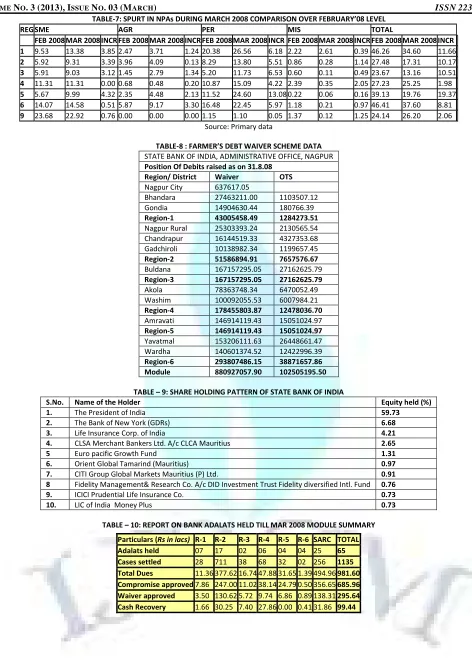
TABLE-7: SPURT IN NPAs DURING MARCH 2008 COMPARISON OVER FEBRUARY’08 LEVEL REG SME AGR PER MIS TOTAL
FEB 2008 MAR 2008INCR FEB 2008 MAR 2008INCR FEB 2008 MAR 2008INCRFEB 2008 MAR 2008INCR FEB 2008 MAR 2008INCR
1 9.53 13.38 3.85 2.47 3.71 1.24 20.38 26.56 6.18 2.22 2.61 0.39 46.26 34.60 11.66
2 5.92 9.31 3.39 3.96 4.09 0.13 8.29 13.80 5.51 0.86 0.28 1.14 27.48 17.31 10.17
3 5.91 9.03 3.12 1.45 2.79 1.34 5.20 11.73 6.53 0.60 0.11 0.49 23.67 13.16 10.51
4 11.31 11.31 0.00 0.68 0.48 0.20 10.87 15.09 4.22 2.39 0.35 2.05 27.23 25.25 1.98
5 5.67 9.99 4.32 2.35 4.48 2.13 11.52 24.60 13.08 0.22 0.06 0.16 39.13 19.76 19.37
6 14.07 14.58 0.51 5.87 9.17 3.30 16.48 22.45 5.97 1.18 0.21 0.97 46.41 37.60 8.81
9 23.68 22.92 0.76 0.00 0.00 0.00 1.15 1.10 0.05 1.37 0.12 1.25 24.14 26.20 2.06
Source: Primary data
TABLE-8 : FARMER’S DEBT WAIVER SCHEME DATA
STATE BANK OF INDIA, ADMINISTRATIVE OFFICE, NAGPUR
Position Of Debits raised as on 31.8.08 Region/ District Waiver OTS
Nagpur City 637617.05
Bhandara 27463211.00 1103507.12
Gondia 14904630.44 180766.39
Region-1 43005458.49 1284273.51
Nagpur Rural 25303393.24 2130565.54
Chandrapur 16144519.33 4327353.68
Gadchiroli 10138982.34 1199657.45
Region-2 51586894.91 7657576.67
Buldana 167157295.05 27162625.79
Region-3 167157295.05 27162625.79
Akola 78363748.34 6470052.49
Washim 100092055.53 6007984.21
Region-4 178455803.87 12478036.70
Amravati 146914119.43 15051024.97
Region-5 146914119.43 15051024.97
Yavatmal 153206111.63 26448661.47
Wardha 140601374.52 12422996.39
Region-6 293807486.15 38871657.86 Module 880927057.90 102505195.50 TABLE – 9: SHARE HOLDING PATTERN OF STATE BANK OF INDIA
S.No. Name of the Holder Equity held (%)
1. The President of India 59.73
2. The Bank of New York (GDRs) 6.68
3. Life Insurance Corp. of India 4.21
4. CLSA Merchant Bankers Ltd. A/c CLCA Mauritius 2.65
5 Euro pacific Growth Fund 1.31
6. Orient Global Tamarind (Mauritius) 0.97
7. CITI Group Global Markets Mauritius (P) Ltd. 0.91
8 Fidelity Management& Research Co. A/c DID Investment Trust Fidelity diversified Intl. Fund 0.76
9. ICICI Prudential Life Insurance Co. 0.73
10. LIC of India Money Plus 0.73
VOLUME NO. 3 (2013), ISSUE NO. 03 (MARCH) ISSN2231-5756
INTERNATIONAL JOURNAL OF RESEARCH IN COMMERCE, IT & MANAGEMENT
CHART-6: BANK ADALATS HELD TILL MARCH 2008 MODULE SUMMERY (Rs in lacs)
FIGURE- 2: HIREARCHY OF DEBT RECOVERY TRIBUNAL- NAGPUR
0 500 1000 1500 2000 2500 3000 3500
R-1 R-2 R-3 R-4 R-5 R-6 SARC TOTAL
BANK ADALAT SETTLEMENT
Cash Recovery
Waiver approved
Compromise approved
Total Dues
Cases settled
Adalats held
Rs in lacs
Presiding Officers
Registrar
RO
RO
VOLUME NO. 3 (2013), ISSUE NO. 03 (MARCH) ISSN2231-5756
INTERNATIONAL JOURNAL OF RESEARCH IN COMMERCE, IT & MANAGEMENT
REQUEST FOR FEEDBACK
Dear Readers
At the very outset, International Journal of Research in Commerce, IT and Management (IJRCM)
acknowledges & appreciates your efforts in showing interest in our present issue under your kind perusal.
I would like to request you to supply your critical comments and suggestions about the material published
in this issue as well as on the journal as a whole, on our E-mail i.e.
for further
improvements in the interest of research.
If you have any queries please feel free to contact us on our E-mail
.
I am sure that your feedback and deliberations would make future issues better – a result of our joint
effort.
Looking forward an appropriate consideration.
With sincere regards
Thanking you profoundly
Academically yours
Sd/-
VOLUME NO. 3 (2013), ISSUE NO. 03 (MARCH) ISSN2231-5756