intergenerational interaction program on mental
health of elderly
Zeanat Ebrahimi1, Mohamad Reza Esmaeilzadeh Ghandehary1, Kourosh Veisi2
Abstract
Wellness is defined as physical, psychological and social well-being, not just the lack of disease and physical handicap. This study aimed at comparing the effects of two intergenerational programs and yoga exercises on the mental health of the elderly. The research was based on a quasi-experimental approach with control group and posttest design. The statistical population consisted of Young and old people living. 175 elders were selected using a randomized cluster sampling method and then randomly assigned to two experimental groups and one control group. Demographic questionnaires, socio-economic status and general health (GHQ-28) were used as research tools. Data were analyzed in two stages before and three months after intervention. The elderly included 95 males, 80 females aged 71.89 ± 8.38 years and 60 youth aged 21.45 ± 0.35 years on mean. The results showed that the intergenerational program and yoga exercises significantly improved scores for mental health and all its subscales. The intergenerational program with a substantial reduction in scores in two sub-scales of social dysfunction and depression had the same effect as yoga exercises. But it had less impact on somatic symptoms and anxiety-sleep disorders. Considering the research findings in confirming the effectiveness of intergenerational programs and yoga exercises on elderly people's mental health, it is suggested that these programs be considered by planners in health and welfare organizations and institutions.
Keywords: Elderly, Intergenerational, Interaction, Mental Health, Yoga
Journal of Research & Health
Social Development & Health Promotion Research Center
Vol. 9, No. 5, Sep & Oct 2019 Pages: 401- 410 DOI: 10.29252/jrh.9.5.401
Original Article
1. Department of Physical Education and Sport Science, Faculty of Humanities and Literature, Mashhad Branch, Islamic Azad University, Mashhad, Iran
2. Department of Physical Education and Sport Science, Faculty of Humanities and Literature, Sanandaj Branch, Islamic Azad University, Sanandaj, Iran
Correspondence to: Mohamad Reza
Esmaeilzadeh Ghandehary, Department of Physical Education and Sport Science, Faculty of Humanities and Literature, Mashhad Branch, Islamic Azad University,
Mashhad, Iran
Email: [email protected]
Received: 23 Dec 2018 Accepted: 12 Feb 2019
How to cite this article: Ebrahimi Z,
Esmaeilzadeh Ghandehary MR, Veisi K. Comparing the efficacy of Yoga exercise and intergenerational interaction program on mental health of elderly. J Research & Health2019; 9(5): 401- 410.
Introduction
Considering the research findings in confirming the effectiveness of intergenerational programs and yoga exercises on elderly mental health, it is suggested that these programs be considered by planners in health and welfare organizations and institutions [1] and many social and psychological factors are influenced [2]. The
well-is becoming increasingly widespread with the growing elderly population.
Health is not only a lack of physical disease and physical disability, it is also defined as physical, psychological and social well-being [4]. Recent research has shown that successful aging is more than constant factors like the genetic status of the individual, influenced by factors like social interactions, attitudes and levels of physical activity [5]. Experts believe that every effort will help elderly people avoid the complex problems of being in this group and improve their self-esteem [2]. Intergenerational plans as a social activity are therefore useful ways of increasing the presence of older people in society [2]. With intergenerational initiatives and the creation of equal opportunities for all people from participating in physical mobility programs such as remembering and remembering past memories, these programs have a positive impact on health [6]. These programs increase self-esteem and life satisfaction [7], decrease loneliness and improve the depression of the elderly, improve the personality of the child, strengthen the system of youth value and their positive attitude towards the elderly [8]. Gaggioli et al. showed remarkable changes in terms of loneliness, self-esteem and quality of life in relation to perceived levels of the elderly [3]. Japanese researchers also reported an increase in elderly's sense of satisfaction [9]. In internal studies, Hasani sadi and Vaezi have shown that these exercises reduce anxiety and improve the quality of the sleep of the subjects [5]. Behzadi also identified yoga exercises as an effective factor in improving elderly morale and reducing anxiety symptoms; which has a positive effect on breathing, reducing muscle tension, evacuating thoughts and negative emotions, reduces hormone stress and improves physical, mental and sleep quality [10]. Arabameri et al. in the study of the effect of water exercise exercises on elderly women's general health, using randomized group pretest-posttest design, improved dynamic and static balance, muscle strength and depression after exercise protocol [11]. Depression is one
of the most common mental disorders in the elderly, its effects can specifically aggravate diseases and reduce their quality of life and effectiveness, and increase physical and mental disorders and ultimately mortality [12]. Yoga exercises as a sporting activity with a positive effect on the mind and body will lead to a balance of energy in the body and improve patient health [13]. Anxiety and depression are recommended as a non-invasive method for the effective treatment of sleep disorders [5]. Therefore, attention should be paid to the importance and necessity of the subject and its impact on the achievement of healthy aging, the need for research to determine the factors affecting the mental health of the elderly, as well as care that can improve this after health. Considering that students of primary school were used in intergenerational interaction programs in most previous studies. Therefore, this study aimed to compare the effects of yoga exercises and intergenerational interaction on mental health of the elderly.
Method
individual's health.
A medical questionnaire was used to identify patients with severe motor problems and exclude them from the study. The lack of regular attendance at the training sessions (more than two absence sessions), the incidence of pain and other physical or psychological problems that continued throughout the period were also criteria for withdrawal. Ethical considerations in all phases of the study include participants ' awareness of the subject matter and procedure before the start of the study, obtaining informed consent from the samples, ensuring the confidentiality of the subject's personal information, interpreting personal results for enthusiastic individuals, lack of financial burden for participants and non-contradictory research was taken into account by the religious and cultural standards of the subject. The researcher completed the research questionnaires for all elderly people after presenting clear and simple explanations about the objectives of the study and its implementation and securing the confidentiality of information. When the questionnaire was completed, each question was first read by the researcher and the elderly chose the option after giving the necessary explanation. For all questions, this process was carried out. It should be noted that if the participants were unable to complete the questionnaire due to lack of literacy, the researcher indicated the choice of the participants by reading the questionnaire questions in simple language for the elderly and providing the necessary explanations. After collecting the demographic characteristics and completing the questionnaires, the elderly were randomly divided into three equal groups in the first stage, including two experimental and yoga groups and one control group. The following is intended to make it easy for groups with yoga group titles, interaction group and control group to write.
The following tools were used to measure the variables:
1) Demographic characteristics questionnaire
Includes variables such as age, gender, marital status, income, level of education, occupation
and number of children; validity of instrument was measured by method of content validity. 2) Socio-economic status questionnaire
consisted of 10 questions for the head of household and wife of the household, family expenses, housing, facilities and leisure time in four fields of education and employment care. The correlation of these factors has been obtained with a total score of 0.87. The questionnaire score was calculated to divide the people into three groups with poor socioeconomic status, mean and good points of 30, 50 and 70%. People have been placed in the relevant group below these points. People below the threshold of 30%, for example, were considered weak. Garmaroudi and Moradi conducted the validity of this questionnaire by studying 1000 households in Tehran in a cross-sectional fashion. The internal consistency of the questionnaire was evaluated using the Cronbach alpha index to determine the reliability of the questions in each domain. Using the method of factor analysis, structural validity was calculated. Facilities and leisure variables (α=0.71), household head and wife characteristics (α=0.67), housing characteristics (α=0.66) and costs and income (α=0.34) was 0.80 for Cronbach's alpha in this study [14].
3) General Health Questionnaire (GHQ-28)
alpha, showing reliability coefficients of 0.70, 0.93 and 0.90, respectively [17]. In this study, the alpha of Cronbach was calculated to be 0.863 for the total test.
In this study, two types of programs were conducted, including an intergenerational program and yoga exercise program as an independent variable on elderly mental health. The interacting group youth, using public calling and advertising at Mashhad Universities, were 60 eligible participants (30 males and 30 females) mean 21.45 ± 0.35 years of age, and available in selected intergenerational programs. The lack of antidepressant drugs and the willingness to take part in the study were the criteria for their entry into the study. In addition, the lack of regular attendance at meetings (more than two sessions of absence) and the lack of willingness to continue their work were also criteria for withdrawal from the study. In view of the fact that the present study was semi-experimental with intervention, based on the research background, in order to have a better influence on the participants, independent variables were selected for a period of three months, three weekly sessions for 90 minutes [5].
In the first experimental group, 60 elderly (men and women) also 60 young people from both genders participated in the intergenerational interaction program in order to interact with each elderly person in the same gender. In this group, in the form of an interactive communication program to interact with the elderly, the participants spent three months, weekly three sessions for 90 minutes in a friendly community. Interaction includes any young person's active involvement with an elderly person and fulfilling the wishes of the elderly individually for 45 minutes. Then in the rest of the time, all group members participated in group programs. These activities were carried out in selected centers on individual days for 36 sessions.
The independent variable included a special yoga program for elderly people (60 men and women) in the second experimental group. The participants included the elderly without the youth; they were trained at the center of the
center at 9:00 a.m. for three months, three weeks, three 90-minute sessions and trained by a nurse yoga instructor. The ability to do seniors was moderated in all yoga movements. These exercises include three stages of body heating with tensile and rotary joints for 20 minutes; the main part of the workout, which consists of 50 minute physical and respiratory movements with two parts of it: Standing and exercising along the wall (reinforcing arms, arms and legs) and pranayama (easy respiration, abdominal diaphragm, throat, wart, sun and moon). Ultimately, relaxation and thinking were performed for 20 minutes (Shawassana: Body and Peace, Mention, Universal Yoga Prayer) [14].
The questionnaire was completed again by the participants of the three groups immediately after the end of the three-month period. Finally, on general health, the effectiveness of these two programs was evaluated. It should be noted that the control group did not have any activity in any of the above programs, and only did their daily activities in accordance with the previous routine. The data were analyzed by descriptive and inferential statistics after completing and collecting questionnaires in two stages before and after the three-month period.
Two-way ANOVA has been used to determine the interactive effect on total score and health subscales of gender and group levels. Multivariate analysis of variance analysis was used to compare the mean of variables in the three older groups and finally the post-hoc test of Bonferroni was used to show the difference between the groups. Also used for data normalization was the Kolmogorov-Smirnov test. Data analysis was carried out using α= 0.05 probability and SPSS-25.
Results
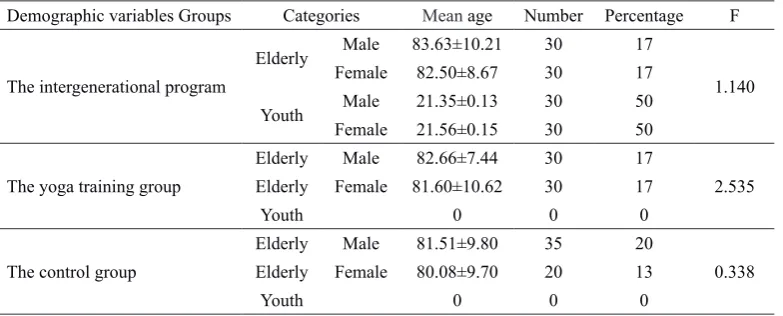
60 elderly with the same number of men and women in the intergenerational program group without yoga and 55 elderly people, including 35 men and 20 women in the control group. Variance variables were homogeneous in all variables. Normality of the data obtained from the demographic questionnaires was analyzed by Kolmogorov-Smirnov test (F (169, 5)= 0.0524, p≥0.05). Analysis of variance was used in three groups to analyze the socio-economic status of the elderly. In different socioeconomic situations, homogeneous homogeneity analysis of variances was not significant using the Loon
test in the pretest stage. So, the assumption of homogeneity of variances was confirmed (F (172, 2)= 0.350, p=0.705). There was no statistically significant difference between the three groups in determining the difference between different socioeconomic statuses of the elderly (F (172, 2)= 0.204, p=0.815). Therefore, Bonferroni’s post hoc test was not performed. Results of variance analysis in comparison of sample members' semantic characteristics in the matched groups showed that there was no statistically significant difference in any of the variables (Table 2).
Table 1 Demographic characteristics of samples based on age and sex
Demographic variables Groups Categories Mean age Number Percentage F
The intergenerational program
Elderly Male 83.63±10.21 30 17
1.140
Female 82.50±8.67 30 17
Youth Male 21.35±0.13 30 50
Female 21.56±0.15 30 50
The yoga training group
Elderly Male 82.66±7.44 30 17
2.535 Elderly Female 81.60±10.62 30 17
Youth 0 0 0
The control group
Elderly Male 81.51±9.80 35 20
0.338 Elderly Female 80.08±9.70 20 13
Youth 0 0 0
Table 2 Analysis of variance of demographic characteristics of sample members in peer groups
Variables squaresSum of Degrees of freedom squaredMean F
Age 367.869 172,2 73.574 1.030
Previous employment status 3.564 172,2 0.713 1.003
Economic situation 1.605 172,2 0.321 0.974
Level of education 36.674 172,2 7.335 1.060
Number of children 1.457 172,2 0.291 0.662
The status of elderly life 1.1223 172,2 0.225 0.855
Income 1.899 172,2 0.380 0.612
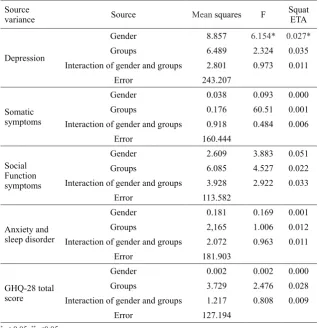
Two-way factorial ANOVA analyzed the interactive effects of categorical variables (gender and group levels) on mental health and their subscales (Table 3). No significant interactive effect between group levels and gender was observed in the results. But in the independent study, with the exception of the subscale of depression, which had a statistically significant difference between the two sexes, there was no significant
subscales of anxiety and insomnia, depression and total score.
Table 3 Analysis of two-way variance of gender variables and levels of groups on mental health and its subscales
Source
variance Source Mean squares F Squat ETA
Depression
Gender 8.857 6.154* 0.027*
Groups 6.489 2.324 0.035
Interaction of gender and groups 2.801 0.973 0.011
Error 243.207
Somatic symptoms
Gender 0.038 0.093 0.000
Groups 0.176 60.51 0.001
Interaction of gender and groups 0.918 0.484 0.006
Error 160.444
Social Function symptoms
Gender 2.609 3.883 0.051
Groups 6.085 4.527 0.022
Interaction of gender and groups 3.928 2.922 0.033
Error 113.582
Anxiety and sleep disorder
Gender 0.181 0.169 0.001
Groups 2,165 1.006 0.012
Interaction of gender and groups 2.072 0.963 0.011
Error 181.903
GHQ-28 total score
Gender 0.002 0.002 0.000
Groups 3.729 2.476 0.028
Interaction of gender and groups 1.217 0.808 0.009
Error 127.194
*p< 0.05, **p<0.05
Table 4 Distribution of the frequency of mental disorder and severity of symptoms in the subscales of the GHQ-28 questionnaire in the pretest of the elderly group
Severity of mental disorder Without disorder Mild Moderate Severe
Somatization 13.7 42.3 24 20
Social dysfunction 6.9 13.7 48.6 30.9
Anxiety and sleepiness 12 25.1 27.4 35.4
Depression 22.9 18.9 14.9 43.4
Total score of GHQ-28 9.7 37.1 37.1 16
There was a significant difference between the severity of symptoms in p<0.05 <p<0.001
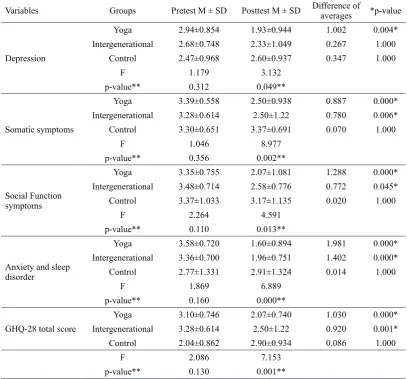
Finally, the effect on the overall health score and its scales of different types of intervention was analyzed using variance analysis (Table 5). The assumption of homogeneity of variances was confirmed in the assessment of the equality of variances in the scales and the overall health score by using the Levin test in the pretest stage (p≤0.05). The results of analysis and variance analysis in the evaluation of the difference between groups showed a significant difference
Table 5 In-group and out-of-group variance analysis in mental health dimensions of the elderly
Variables Groups Pretest M ± SD Posttest M ± SD Difference of averages *p-value
Depression
Yoga 2.94±0.854 1.93±0.944 1.002 0.004*
Intergenerational 2.68±0.748 2.33±1.049 0.267 1.000
Control 2.47±0.968 2.60±0.937 0.347 1.000
F 1.179 3.132
p-value** 0.312 0.049**
Somatic symptoms
Yoga 3.39±0.558 2.50±0.938 0.887 0.000*
Intergenerational 3.28±0.614 2.50±1.22 0.780 0.006*
Control 3.30±0.651 3.37±0.691 0.070 1.000
F 1.046 8.977
p-value** 0.356 0.002**
Social Function symptoms
Yoga 3.35±0.755 2.07±1.081 1.288 0.000*
Intergenerational 3.48±0.714 2.58±0.776 0.772 0.045*
Control 3.37±1.033 3.17±1.135 0.020 1.000
F 2.264 4.591
p-value** 0.110 0.013**
Anxiety and sleep disorder
Yoga 3.58±0.720 1.60±0.894 1.981 0.000*
Intergenerational 3.36±0.700 1.96±0.751 1.402 0.000*
Control 2.77±1.331 2.91±1.324 0.014 1.000
F 1.869 6.889
p-value** 0.160 0.000**
GHQ-28 total score
Yoga 3.10±0.746 2.07±0.740 1.030 0.000*
Intergenerational 3.28±0.614 2.50±1.22 0.920 0.001*
Control 2.04±0.862 2.90±0.934 0.086 1.000
F 2.086 7.153
p-value** 0.130 0.001**
*There is a difference in the group, **There is a difference between groups
Discussion
The results showed that the scorecard for depression had a statistically significant difference between the two sexes, which was more than that of women, contrary to the results of previous research in men [9]. Differences in personality structure, hormone, multiple responsibilities, and role of marriage, motherhood, housekeeping, work, and social expectations are the causes of depression prevalence in women, which can be attributed as effective factors to other causes due to the contradiction in the outcome of this study. In terms of depression. Depression in the elderly with marital status, lifestyle satisfaction, drug use and communication satisfaction [18]. In addition, the level of diplomas and lower education has been reported as a risk factor and female gender, having a spouse and a common life as a protective role against depression [19].
system improve attitudes towards oneself and life, increase self-esteem, energy and ultimately improve overall health [20]. Intergenerational interaction also leads to a sense of solidarity and belonging to the group by participating in group meetings and accompanying peers, creating emotional states, changing attitudes, improving relationships with others, and building social relationships [8]. Contrary to Sardar et al. results, Ghodsbin et al., which showed no significant changes in the scale [23,24]. This discrepancy's causes include the elderly's physical, mental, and social fitness [25], as well as the time and intensity of their study activity. The results showed that the changes in anxiety and sleep depersonalization in the yoga group were greater than the changes in the interaction and control group. The scores of this scale were significantly higher in the yoga group compared to the intra-group pair than in the group. This suggests that the effects of more yoga exercises [10,11,26] on elderly people's anxiety and insomnia were linked to intergenerational interactions [27,28]. Previous researchers have also shown that mental health, anxiety, and cognitive improvement in the elderly can be reduced by intergenerational programs [27,28]. Unlike the results, however, Mcauley has shown that while exercise plays a positive role in health, it has no significant effect on anxiety, stress and depression [29]. The reasons for the result inconsistency can be attributed to the participants emotional state, quality of sleep, and mood. We can point out the beneficial effects of group activities in the elderly when explaining these results. Having a crowd of friends and young people, creating a space for them, led to negative thoughts, resulting in a reduction in symptoms of depression and anxiety. Yoga exercises also have a positive effect on breathing improvement, muscle tension reduction, evacuation of thoughts and negative emotions [23,26] and reduction of stress hormones, improvement of physical, mental and sleep quality [10].
Scale Somatic symptoms in the yoga group were significantly different from the two groups in terms of interaction and control, in line with the results of Khemka et al. [30]; Mousavi Gilani et al [31]; Sardar et al. [24]; Ghodsbin et al. [31]
But it contradicted the results of Hosseini and his colleagues and Arabameri et al. [11,32]. The use of athlete students ' statistical community in Hosseini and the research of colleagues was a non-significant cause of their results, indicating the positive effect of exercise and the presence of sports teams on mental disorders [32]. Arabameri et al. study also includes fewer lessons per week, water activities and various exercise protocols [11]. Yoga exercises can reduce pain and increase physical activity in the elderly by affecting physical factors such as decreasing muscle tension, decreasing blood pressure and increasing blood flow throughout the body and enhancing the sense of physiological mechanisms that maintain effective balance [10]. These positive changes resulted in an improved attitude and reduced ratings among the elderly. As the research limitations, some socio-economic status and family conditions of participants were out of control and also, it should be more cautious in generalizing its results due to the implementation of the study at the Rehabilitation Center. So we suggest implementing these programs for elderly people outside rehabilitation centers.
Conclusion
Acknowledgments
We would like to thank the participating elderly and university students, the dear authorities of the elderly care centers and Mashhad Islamic Azad University, and all those involved in this study. This study forms part of the first author's doctoral.
Authors’ contributions Design Study: ZE, ME
Analysis and Collection Data: ZE, KV Manuscript Preparation: ZE, ME
All authors have read and approved the final version.
Conflict of Interests
"The authors declare that have no competing interests"
Funding
The author (s) received no financial for the research authorship and/or publication of manuscript.
Availability of data and materials
The datasets used and/or analyzed during this study are available from the corresponding author on reasonable request.
Reference
1- Mirzaei M, Shams Ghahfarokhi M. Demography of elder population in Iran over the period 1956 To 2006.
Salmand, Iranian Journal of Ageing2007; 2(3): 326–31.
2- Mirzaei F, Khodabakhshi-Koolaee A. The relationship between sleep quality and perceived social support with loneliness in elderly men. Journal of Gerontol2018; 2(3): 11–20.
3- Ageing and health - World Health Organization. 2018. Available at: https://www.who.int/news-room/fact-sheets/ detail/ageing-and-health. Accessed Oct 16, 2018.
4- Keyvanara M, Hagheghatian M, Alibabaiy M. The relationship between social capital and mental health amonge the Citizens of Shahr-e-Kord. Scientific Journal
of Ilam University of Medical Sciences2015; 22(7): 47–
55.
5- Hasani Sadi S, Vaezi Ali Akbar. Study of the effect of yoga exercises on anxiety and sleep quality of patients with chronic heart failure in Kerman city in 2015. Daneshvar
Medicine2017; 24(126): 35-44.
6- Elhakeem A, Hardy R, Bann D, et al. Intergenerational
social mobility and leisure-time physical activity in adulthood: A systematic review. J Epidemiol Community
Health2017; 71(7): 673–80.
7- Gaggioli A, Morganti L, Bonfiglio S, et al. Intergenerational group reminiscence: a potentially effective intervention to enhance elderly psychosocial wellbeing and to improve children’s perception of aging.
Educ Gerontol2014; 40(7): 486–98.
8- Ronzi S, Orton L, Pope D, et al. What is the impact on health and wellbeing of interventions that foster respect and social inclusion in community-residing older adults? A systematic review of quantitative and qualitative studies. Syst Rev2018; 7(1): 26.
9- Murayama Y, Ohba H, Yasunaga M, et al. The effect of intergenerational programs on the mental health of elderly adults. Aging Ment Health2015; 19(4): 306–14. 10- Behzadi A. Assessment of laugter therapy on rate of General health in men older in Hasheminezhad Hospital. Tehran, Iran: Tabatabaie University; 2010.
11- Arabameri E, Taheri M, Irandoust K. The effect of water-based exercise programs and KSD protocol on general health questionnaire and optimal physical fitness factors affecting female elders balance. Motor
Behavior2014; 16: 15–28.
12- Ashrafi K, Sahaf R, Mohammadi Shahbalaghi F, et al. Prevalence of depression in Turk Azeri older adults of Iran. Journal of Sabzevar University of Medical
Sciences2017; 23(6): 856–65.
13- Falahdar A. Comparison of the effect of water therapy and yoga exercises on the mental health of elderly women. presented In: The first national conference on the development of sport sciences in the area of health, prevention and Heroism; 2016; Imam Khomeini International University, Tehran, Iran; 2016. pp: 1-7. 14- Garmaroudi GR, Moradi A. Article Title: Socio-Economic status in Iran: a study of measurement index.
Payesh2010; 9(2): 137–44.
15- Noorbala AA, Bagheri Yazdi SA, Mohammad K. The validation of general health questionnaire- 28 as a psychiatric screening tool. Hakim Health System
Research Journal2009; 11(4): 47-53.
16- Shayan Z, Pourmovahed Z, Najafipour F, Abdoli AM, Mohebpour F, Najafipour S. Factor structure of the General Health Questionnaire-28 (GHQ-28) from infertile women attending the Yazd Research and Clinical Center for Infertility. Int J Reprod Biomed (Yazd)2015; 13(12): 801-8.
17- Koohboomi M, Norasteh AA, Samami N. Effect of yoga training on physical fitness and balance in elderly females. Salmand, Iranian Journal of Ageing2015; 10(3): 26–35.
University of medical sciences. Journal of Holistic Nursing
Midwifery2007; 17(1): 16–22.
19- Manzori L, Babak A, Marathi MR. The depression status of the elderly and its related factors in Isfahan in 2007.
Salmand, Iranian Journal of Ageing2009; 4(4): 27–33.
20- Rahman M, El Werfalli R, Lehmann-Waldau F. Current evidence and use of physical activity in the treatment of mental illness: a literature review. Dtsch Z Sportmed2017; 68(4): 93–100.
21- Vecchio N, Radford K, Fitzgerald JA, Comans T, Harris P, Harris N. Intergenerational care: an exploration of consumefr preferences and willingness to pay for care.
Aging Ment Health2017; 22(8): 996-1004.
22- Yasunaga M, Murayama Y, Takahashi T, et al. Multiple impacts of an intergenerational program in Japan: evidence from the research on productivity through intergenerational sympathy project. Geriatr Gerontol Int2016; 16(S1): 98–109.
23- Ghodsbin F, Sharif Ahmadi Z, Jahanbin I, Sharif F. The effects of laughter therapy on general health of elderly people referring to jahandidegan community center in Shiraz, Iran, 2014: a randomized controlled trial. Int J
Community Based Nurs Midwifery2015; 3(1): 31–8.
24- Sardar MA, Sohrabi M, Shamsian AA, Amin Zadeh R. The effect of aerobic exercise on mental health, physical dimensions, anxiety, insomnia, social dysfunction and depression in patients with type 2 diabetes. Iranian Journal
of Endocrinology & Metabolism2009; 11(3): 251–6.
25- Morga P, Traczyk J, Wittenbeck K, Zygmont A.
Review of research on the impact of physical activity on mental state of the elderly. Physiotherapy2015; 23(2): 42–53.
26- Fleming KM, Herring MP. The effects of pilates on mental health outcomes: A meta-analysis of controlled trials. Complement Ther Med2018; 37: 80–95.
27- Barshan A, Soltaninejad A, Sadeghzadeh A, Rajabi T, Mirhosseini M, Safavi S. The effect of Art therapy on the quality of life and social participation of older adults in Kerman nursing homes. Jornal of Geontology2017; 2(2): 18–25.
28- Särkämö T, Tervaniemi M, Laitinen S, et al. Cognitive, emotional, and social benefits of regular musical activities in early dementia: randomized controlled study.
Gerontologist2013; 54(4): 634–50.
29- Mcauley G. Physical activity, fitness and anxiety.
Human Kinetic1994; 57(5): 551–68.
30- Khemka SS, Ramarao NH, Hankey A. Effect of integral yoga on psychological and health variables and their correlations. Int J Yoga2011; 4(2): 93–9.
31- Mortazavi SS, Eftekhar Ardebili H, EshaghiSR, Dorali Beni R, Shahsiah M, Botlani S. The effectiveness of regular physical activity on mental health in elderly.
Journal of Isfahan Medical School2012; 29(161):
1519-28.
32- Hosseini SH, Kazemi SH, Shahbaznezhad L. Evaluation of mental health in athletic and nonathletic students. Journal of Mazandaran University of Medical
Sciences2006; 16(53): 97–104.