A Quantum Identity Authentication Protocol Based on
Optical Transmission & Face Recognition
https://doi.org/10.3991/ijoe.v14i04.8374
Dexin Zhu, Xiaohui Li
Changchun University, Changchun, Jilin Province, China
Xiaohong Li
Jilin Province Economic Management Cadre College, Changchun, Jilin Province,China
Rongkai Wei, Jianan Wu
Changchun University, Changchun, Jilin Province, China
Lijun Song!!"#
Jilin Engineering Normal University, Changchun, Jilin Province, China
Jilin Engineering Laboratory for Quantum Information Technology, Changchun, Jilin Province, China
Abstract—Specific to security issues concerning identity authentication of mobile applications, a quantum identity authentication protocol based on opti-cal transmission and face recognition is put forward in this paper with consider-ation of the unconditional security characteristic of quantum key. As for this protocol, optical transmission technology is adopted to acquire quantum key and identity authentication encrypted by quantum key can thus be realized, for which key feature points of face image and user password serve as dual authen-tication factors. Experimental result and security analysis indicate that this pro-tocol can resist illegal attack and ensure security of identity authentication of mobile applications, which also has great operating efficiency.
Keywords—Optical Transmission, Face Image, Quantum Key, Identity Au-thentication
1
Introduction
of all security issues and plays a very important role in overall Internet security. Iden-tity authentication is used by both sides in communications to recognize each other’s identity in order to prevent illegal user from using network information system and prevent any user from using such system illegally. At present, identity authentication technologies mainly include static password-based authentication technology, dyna-mic password-based authentication technology, biological characteristic-based au-thentication technology, PKI-based auau-thentication technology, etc.Griffin [1] descri-bes biometric-based cryptographic techniques for providing confidential communica-tions and strong, mutual and multifactor authentication on the Internet of Things, Anamonye [2] put forwardthe designing and implementing a stand-alone identity authentication device using fingerprint technique, Tabassum [3] suggests the authen-tication mechanism of Kerberos protocol under HDFS and provide security to the communication channel with help of RSA, YU [4] aims to design a face recognition system that can be used in the exam identity authentication system.Although various researches provided some relatively feasible plans for identity authentication, the currently used keys are generated by computers in a pseudo-random way and thus follow a certain rule. With rapid development of computer technology, especially emergence of quantum computer, it becomes very difficult for the method of classic key generation and encryption to meet requirements of identity authentication in those occasions requiring a high class of confidentiality.
Basic thought of quantum communication was successively put forward by Ben-nett et al. in the 1980s and 1990s, mainly including quantum key distribution (QKD) [5] and quantum teleportation [6]. Quantum key distribution can establish secure quantum password and realize point-to-point secure classic communication through the “one-time pad” encryption method. Security described herein refers to security strictly proved by mathematical method, which can’t be done by classic communica-tion so far. At present, Sharma [7] proposes a quantum identity based authenticacommunica-tion and key agreement scheme for cloud server architecture, Tanizawa [8] proposes a new solution for developing secure network infrastructure based on QKD technology to accommodate multiple applications. The proposed solution introduces 3 functions: (1) a directory mechanism to manage multiple applications hosted on the QKD net-work, (2) a key management method to share and to allocate the keys for multiple applications, and (3) a cryptography communication library enabling existing crypto-graphic communication software to be ported to the QKD network easily. However, quantum keys are currently acquired via wired network.
2
Protocol Architecture
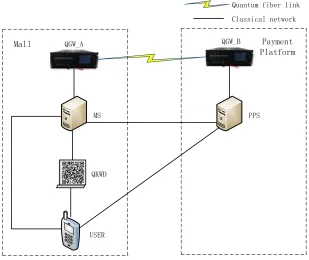
The architecture of a quantum identity authentication protocol based on optical transmission and face recognition is indicated in Figure 1 and the protocol is compo-sed of Mall (Shopping Mall) and PP (Payment Platform), in which type of network for Mall is local area network, for which participants include QGW_A(QuantumGateWay Alice), MS (Mall Server), QKWD (Quantum Key Write Device) and USER; type of network for Payment Platform is local area net-work, for which participants include QGW_B(QuantumGateWay Bob) and PPS (Payment Platform Server). QGW_A and QGW_B can generate symmetrical quan-tum keys via a quanquan-tum optical fiber link. Quanquan-tum key at the QGW_A side is stored in MS, while quantum key at the QGW_B side is stored at PPS; QKWD is used to convert quantum key into QR code.
!
Fig. 1. Protocol Architecture
1.Quantum key distribution. QGW of Mall and PP realizes quantum key distribution through quantum optical fiber link and generates quantum key.
2.Quantum key management. Quantum keys generated by QGW_A and QGW_B are stored in MS and PPS and managed by MS and PPS based on use of quantum keys.
3.Quantum key writing. Based on optical transmission technology, QKWD can ac-quire quantum key from MS and PPS based on quantum key reac-quired by identity authentication. Embedded technology is adopted to convert quantum key into the form of QR code.
4.Identity authentication. USER at the Mall side can collect facial feature infor-mation through camera, acquire quantum key by scanning QKWD based on such facial feature information, encrypt data by adopting “one-time pad” scheme and send such data to PP side finally. PPS at the PP side should verify validity of iden-tity of USER.
3
Protocol Scheme
This quantum identity authentication protocol is established at system application layer based on conceptual design, including two phases, namely registration and iden-tity authentication. Registration phase refers to the phase in which a new user uses the system and each user only has one registration process. Identity authentication is the critical operation in which a user logs on to the system, for which system will deter-mine validity of user’s identity based on result of identity authentication.
3.1 User Registration Phase
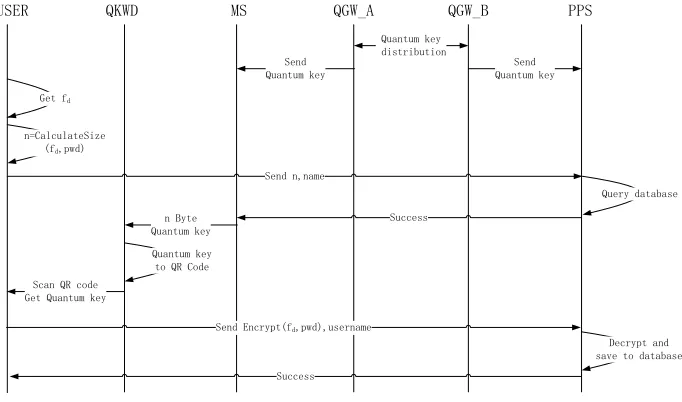
User registration refers to the process in which USER applies for a valid identity, for which the process is indicated in Figure 2.
Major steps are described as follows:
Step 1: QGW_A and QGW_B conduct quantum key distribution through quantum optical fiber line. Quantum key distribution protocol adopts BB84 protocol [5], which selects a certain physical quantity of single photon to carry single-bit information and uses two different groups of orthogonal bases for two-dimensional Hilbert space of single-photon polarization state, for which two groups of bases have the following relation:
%%$$%%(( ##$$""%%$$
%%$$%%((
%%####
%%$$%%((
$$
%%$$)) !!''
(($$ %%$$%%((
%%$$%%(( $$
$$%%$$%%((
""((!!$$!!''%%##""
""((!!$$ ##&&$$ $$## %%####
%%""(($$##
Fig. 2. User Registration Process
Step 2: QGW_A and QGW_Bgenerate quantum keys and , in which is stored into MS and is stored into PPS. Herein and are binary symmetric keys and expressed as:
(2)
Step 3: USER can analyze information about key feature points of face images captured by mobile phone by using face recognition technology.
Step 4: USER enters name and pwd and then calculates number of bytes occupied by and pwd. Herein: Unit of n is byte; pwd is user’s password; name is user’s name; is information about key feature points of face images, which can be
ex-pressed as .
Step 5: USER sends n and name to PPS.
Step 6: PPS makes an inquiry in personnel database of payment platform in order to check whether the “name” exists. If such “name” is valid, MS success status will be returned; otherwise, failure status will be returned.
Step 7: MS should make a judgment on return status of PPS. If return status is suc-cess, MS should send quantum key with n bytes to QKWD.
y i
Step 8: QKWD converts quantum key with n bytes into a QR code.
Step 9: USER activates QR code scanning program and scans the QR code dis-played by QKWD in order to acquire encryption quantum key .
Step 10: Through encryption formula , USER can encrypt key feature points of face image and user’s password pwd by using quan-tum key and send encrypted data and name to PPS through classic optical fiber line,
in which represents encrypted data.
Step 11: PPS reads quantum key with n bytes and acquires decrypted
infor-mation through decryption formula , in
which decrypted information includes information about key feature point of face image and user’s password pwd. PPS inserts name, and pwd into personnel database of payment platform.
Step 12: PPS returns status of successful registration to USER.
3.2 Identity Authentication Phase
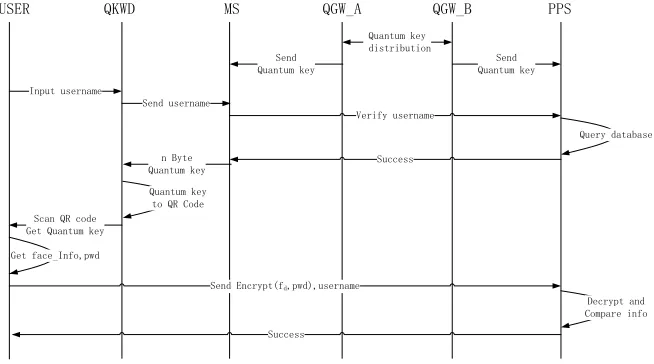
Identity authentication is a process in which USER and PPS recognize each other’s valid identity and require encryption of data through using quantum key in order to ensure data security. Process of user identity authentication is indicated in Figure 3.
%%$$%%'' ##$$""%%$$ %%$$%%'' %%#### %%$$%%''
$$!!&& %%##""
''$$ %%$$%%''
""''%%##""
%%$$%%'' $ $ $$%%$$%%''
""''!!$$!!&&%%##""
""''!!$$ !!""
%%####
%%""''$$##
!!%%$$%%##""
Steps are described as follows:
Step 1: QGW_A and QGW_B distribute quantum key and generate real-time
quantum keys and .
Step 2: is stored into MS and is stored into PPS.
Step 3: In order to acquire quantum key , USER should enter name into QKWD and click the button GetQKey to acquire quantum key.
Step 4: QKWD sends the name entered by USER to MS in order to determine whether the user is a valid user.
Step 5: MS sends name to PPS and then PPS makes an inquiry in the personnel da-tabase of payment platform in order to check whether the user exists. If the user ex-ists, quantum key number n of this user and Success will be returned to MS; other-wise, “Failed” should be returned.
Step 6: MS sends quantum key with n bytes to QKWD.
Step 7: QKWD converts quantum key with n bytes into QR code.
Step 8: USER activates QR code scanning program and scans the QR code dis-played by QKWD in order to acquire encryption quantum key .
Step 9: USER analyzes information about key feature point of face image cap-tured by mobile phone by using face recognition technology. Encryption formula
is adopted to conduct quantum key encryption of information about key feature point of face image and user’s password pwd, and encrypted data and name should be sent to PPS through classic optical fiber link.
Step 10: PPS reads quantum key with n bytes and acquires decrypted
infor-mation through decryption formula . PPS
then makes a comparison between decrypted and and information about this user in the personnel database of payment platform. If such information compari-son is successful, then go to Step (k); otherwise, identity authentication fails.
Step 11: Identity authentication is successful.
4
Security Analysis
This protocol has a relatively high degree of security, for which specific analysis is provided as follows.
4.1 Security of Quantum Key
Non-cloning Theorem [9]. This protocol enables both sides to acquire secure shared key and can realize absolutely secure secret communication under strict mathematical proof.
4.2 Brute Force Attack
Security of this protocol depends on secure sharing of quantum key and the “one-time pad” encryption mechanism. In this mechanism, quantum key with a length equal to message is used to generate random output without any statistical relation with the original text and such quantum key can only be used for once. Shannon pro-ves that: “One-time pad” mechanism can realize perfect confidentiality and has been deemed as unbreakable [10].
5
Experimental Result & Analysis
5.1 Experimental Scheme
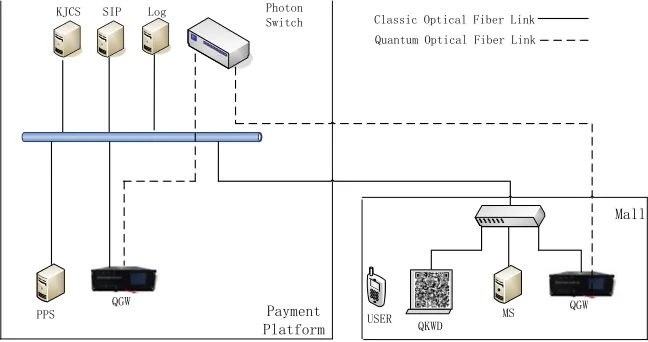
In this experiment, quantum key distribution device adopts quantum security gate-way with a working frequency of 40M and 1*4 matrixed photon switcher. Topologi-cal structure of network is indicated in Figure 4. Herein: KJCS represents key genera-tion control server, which is used to control quantum key distribugenera-tion process for the entire quantum optical fiber link; SIP represents SIP server, which is used to establish SIP user; Log represents log server, which is used to check operating state of the entire quantum optical fiber line.
Quantum key distribution device generates quantum key through quantum optical fiber link and classic optical fiber link can store quantum keys of both sides into PPS and MS.
##
%%##
&&## ##!!
"""" ##!! $$##$$ ##!!
QKWD uses ARM9 mini2440 development board and major parameters of equipment are indicated in Table 1. See Table 2 for major parameters of USER’s mobile device.
Table 1. Major Parameters of QKWD
Parameters ofHardware
OS CPU SDRAM Nand Flash Touch screen Fedora14 S3C2440 64M 256M 4.3Inch
Table 2. Major Parameters of USER’s Mobile Device
Major Parameters of USER’s Mobile Device
OS CPU RAM Android5.1 8-core, 1.5GHz 2.0GB
5.2 Result & Analysis
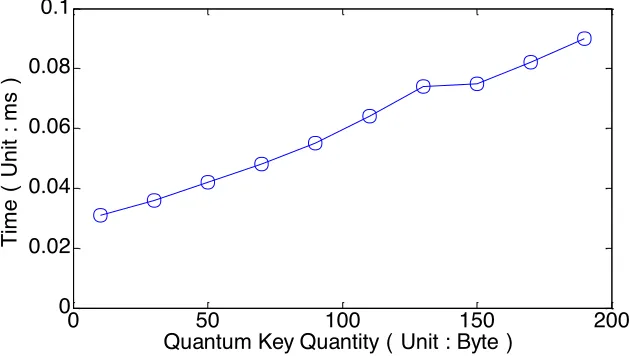
QKWD converts quantum key of different bytes into QR code, for which the rela-tion between number of bytes of quantum key and time of QR code generarela-tion is indicated in Figure 5.
0
50
100
150
200
0
0.02
0.04
0.06
0.08
0.1
Quantum Key QuantityUnit : Byte
Ti
m
e
Un
it :
m
s
Fig. 5. Time of QR code generation
0 50 100 150 200 0.6
0.7 0.8 0.9 1
Quantum Key Quantity (Unit : Byte)
Tim
e
(Un
it :
m
s)
Fig. 6. Time of QR code scan
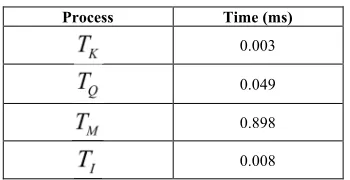
As for this protocol, four eye corners of two eyes, tip of nose, two corners of mouth, points of intersection between extension line of two corners of mouth and facial contour in a face image are selected as 9 key feature points, and length of user’s password should be 6 characters. According to the “one-time pad” encryption scheme, 78 bytes of quantum key are needed. For the purpose of making an assess-ment on operating efficiency of this protocol, the following symbols are adopted in this paper to represent time needed by each operation: represents time needed by QKWD for acquiring quantum key from MS; represents time needed for realizing conversion of quantum key into QR code; represents time needed by mobile de-vice for scanning QR code; represents time needed for completing authentication of user’s identity. Overhead time of each phase is indicated in Table 3. It can be seen that life cycle of the entire protocol is 1ms, so this protocol has very high operating efficiency.
Table 3. Overhead Time of Protocol
Process Time (ms)
0.003
0.049
0.898
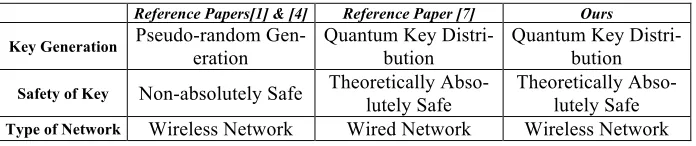
As indicated in Table 4, through comparison between this paper and some existing reference papers such as Griffin [1], Yu [4] and Sharma [7], only the author of this paper put forward the method of acquiring quantum key via optical transmission technology and conducting absolutely safe identity authentication.
Table 4. Comparison between This Paper & Other Reference Papers
Reference Papers[1] & [4] Reference Paper [7] Ours
Key Generation Pseudo-random Gen-eration Quantum Key Distri-bution Quantum Key Distri-bution
Safety of Key Non-absolutely Safe Theoretically Abso-lutely Safe Theoretically Abso-lutely Safe
Type of Network Wireless Network Wired Network Wireless Network
6
Conclusion
In this paper, a quantum identity authentication protocol based on optical transmis-sion and face recognition is put forward, which integrates various technologies such as optical transmission, face recognition and quantum key. As for this protocol, opti-cal transmission technology is adopted to acquire quantum key and face recognition technology can recognize 9 key feature points of face image. Based on the “one-time pad” encryption scheme, quantum key is used to encrypt and decrypt key feature points of face image and user’s password. This protocol can ensure authenticity and confidentiality of user’s information during registration phase and authentication phase and can achieve a relatively high degree of security against illegal attack. Me-anwhile, this protocol has great operating efficiency.
7
Acknowledgment
This work is supported by the Science and technology of Jilin province develop-ment plan projectswith grants No. 20170204023GX.
8
References
[1]GriffinPhillip, H. (2013). Secure authentication on the Internet of Things. Southeastcon, pp1-5.
[2]Anamonye, U. G., Eyenubo, O. J. (2017). DESIGN OF EMBEDDED IDENTITY AUTHENTICATION SYSTEM. JOSTE, 5(1):81–86.
[3]Tabassum, R., Tyagi, D. N. (2017). Hadoop Identity Authentication using Public Private Key Concept. IJETT, 45(9): 436–442. https://doi.org/10.14445/22315381/IJETT-V45P283
[5]Bennett, C. H., Brassard, G. (1984). Quantum cryptography: public key distribution and coin tossing. Proceedings of theIEEE International Conference on Computers, Systems, and SignalProcessing, 175-179.
[6]Bennett, C. H., Brassard, G., Crépeau, C., Jozsa, R., Peres, A., Wootters, W. K.(1993). Teleporting an unknown quantum state via dual classical and EinsteinPodolsky-Rosen. Phys Rev Lett, 70(13):1895–1899. https://doi.org/10.1103/PhysRevLett.70.1895
[7]Sharma, G., Kalra, S. (2016). Identity based secure authentication scheme based on quan-tum key distribution for cloud computing. Peer-to-Peer Netw. Appl., 1-15.
[8]Tanizawa, Y., Takahashi, R., Sato, H., Dixon, A. R., Kawamura, S. (2016). A Secure Communication Network Infrastructure Based on Quantum Key Distribution Technology. Ieice Transactions on Communications, 99(5):1054-1069. https://doi.org/10.1587/transco m.2015AMP0006
[9]Wootters, W. K., Zurek, W. H. (1982). Asinglequantum cannot be cloned. Nature, 299(5886): 802-803. https://doi.org/10.1038/299802a0
[10]Shannon, C. E. (2014). Communication theory of secrecy systems. Bell System Technical Journal, 28(4):656-715. https://doi.org/10.1002/j.1538-7305.1949.tb00928.x
9
Authors
Dexin Zhu is lecturer at the School of College of Computer Science and Technol-ogy, Changchun University, Changchun 130021, China, with the research fields of Computer applications and Quantum communication. Email address is [email protected].
Xiaohui Li is associate professor at the School of College of Computer Science and Technology, Changchun University, Changchun 130021, China, with the research fields of Computer applications and Quantum communication.
Xiaohong Li is associate professor at the School of Public Teaching Department, Jilin Province Economic Management Cadre College, Changchun 130021, China, with the research fields of Computer test.
Rongkai Wei is lecturer at the School of College of Computer Science and Tech-nology, Changchun University, Changchun 130021, China, with the research fields of Computer networking technology.
Jianan Wu is associate professor at the School of College of Computer Science and Technology, Changchun University, Changchun 130021, China, with the research fields of Computer networking technology.
Lijun Song is professor at the School of Institute for Interdisciplinary Quantum In-formation Technology, Jilin Engineering Normal University, Changchun 130021, China, with the research fields of Quantum information.