Chapter 12
COMPUTERS AND COMPUTING
Early Evolution of Computers at the University of Michigan
T
HE nature of computing activitieswithin the department has very much been influenced by hardware and software availableoutside the department, partic-ularly during the period 1955–1985.† Thus, to gain perspective on the computing scene in chemical engineering, it is appropriate to examine both the history of the University of Michigan Computing Center, which housed successivecentralized mainframe machines, and the subsequent College of Engineering Computer-Aided Engineering Network (CAEN), which specialized in distributed computing. Note, however, that the first use of a digital computer by one of our doctoral students was that of the ENIAC at the Aberdeen Proving Ground by Roland O. Gumprecht, who worked in the area of light scattering. Gumprecht published his doctoral dis-sertation, Determination of Particle Sizes in Smokes in 1953, as detailed in the article “Another Michigan Chemical Engineering First,” by Cedomir M. Sliepce-vich, on page 323.Until the early 1980s, the electronic digital-computing resources available to the department were essentially those at the central U–M Computing Center. The scene from the early 1950s until 1971 is particularly well described in The University of Michigan Computing Center brochure of October 1971, from which much of this section is adapted.
The MIDAC. The success of the early electronic machines built elsewhere— particularly ENIAC (Electronic Numerical Integrator and Computer) and one of its successors—SEAC (Standards’ Eastern Automatic Computer), the National Bureau of Standards’ machine—led the University of Michigan Willow Run Labo-ratories to design and build a hopefully improved but somewhat unsuccessful ma-chine, MIDAC (Michigan Digital Automatic Computer‡), which, with its mercury † This chapter was compiled by Jim Wilkes, who gratefully acknowledges the following sources: (a) the brochureThe University of Michigan Computing Center, edited by Mary Ann Wilkes and published by the Computing Center for the dedication of their new building on North Campus in October 1971, (b) Brice Carnahan’s two-part article “Computing in Engineering Education,” published in the fall 1991 and winter 1992 issues ofChemical Engineering Education, (c) Peter Lederman’s recollections of the Ford Foundation Project, and (d) personal recollections of Brice Carnahan and Bernard Galler. The reader is also referred to an excellent summary,A Brief History of Computing in Chemical Engineering, written by J.D. (“Bob”) Seader, when he was the recipient of the 20th Donald L. Katz Lectureship at the U–M in April 1990.
‡ The MIDAC acronym was sometimes uncharitably taken to mean “Machine is Down Almost Continuously.”
delay-line storage, became operational in 1952. The machine was used primarily for sponsored research, but some student use was arranged. U–M mathematics faculty member Prof. John W. Carr, III, was an early proponent of MIDAC, and offered an introductory computing course in fall 1953.
The first ChE student to use MIDAC was Ronald Crozier‡, who performed calculations for the AIChE Distillation Tray Efficiency Project. Although it was a large machine at that time, MIDAC was extremely small and slow by present standards, and the electronic technology of the period was barely adequate to permit a minimal level of reliability. Working under the supervision of Brymer Williams, Crozier published his Ph.D. dissertation,Froth Stratification and Liquid Mixing in a Bubble Tray Column, in 1956.
News & Information Services, Box A–11, Bentley Historical Library, U–M
MIDAC computer at the U–M Willow Run Laboratory.
In this same era, in 1952, the U–M also acquired one of the first commercial computers—an early blend of mechanical punched-card equipment and electronic arithmetic circuitry produced by IBM and called theCard Programmed Calculator (CPC). This machine was installed in the unit that then handled administrative and statistical services, the “Tabulating Service.”
The IBM 650 computer. The use of these diverse facilities further in-creased the faculty and staff awareness of the potential impact of computing and, when IBM made a reliable, intermediate-size computer (the Model 650) readily
Early Evolution of Computers at the University of Michigan 269
available to universities in 1956, one was installed in the Statistical Research Lab-oratory, a unit of the Horace H. Rackham School of Graduate Studies.
Nov. 1957 ChE graduate booklet
One-up on the slide rule. Research assistant Marvin L. Katz uses a Monroe electro-mechanical calculator in the chemical engineering “computing room” for finned-tube research.
In a sense—since it was on the campus—this machine really marked the be-ginning of the present era, and was used by students in the offerings of the U–M’s introductory computing course (Math 73), taken by Jim Wilkes when first taught by Prof. Bernard A. Galler in winter 1956, and by Brice Carnahan soon afterwards. Here is a picture of what students did during that year:
• Each of us learned to operate the computer and then signed up for—at most— one hour per week to solve our problems.
• The IBM 650 had no keyboard or printer—just a card reader and a card punch. All communication was through punched cards or directly with keys on the console (the lights displayed information inbiquinary format—you might want to look that one up!).
• All programming was in the machine’s language; each operation code contained an operation code plus two addresses, one for an operand and another for locating the next instruction in the memory.
only feedback available to the programmer/operator, and the repeated light patterns from infinite loops were fascinating to watch (although, of course, we never had any of those ourselves).
News & Information Services, Box B–1, Bentley Historical Library, U–M
The IBM 650 (left and rear), the Computing Center’s first machine, in the basement of the Rackham Building. Students signed up to reserve time on the machine, and then they op-erated it themselves, but only between 8 and 5 o’clock and “never” during lunch hours or on weekends. But, however much computing may have changed, student ingenuity seems to have remained much the same. Those who used the 650 quickly discovered the window (at the rear), and began letting one another in to use the machine after hours. Professor Bernard A. Galler, who started a long and distinguished ca-reer in computer science at the U–M in 1955, is operating the punched-card input/output machine at the right.
Early Evolution of Computers at the University of Michigan 271
a Macintosh would respond to the following directions?
“If the instruction address is an even number, the data address should be three word positions later (on any cylinder) and the next instruction address should be four word positions beyond that. Since there are 50 word positions around the cylinder, the correct drum rotation angle for the next instruction is 50.4◦ . . . . If the instruction address is odd, the data address should be three word positions later and the next instruction address should be five positions beyond that, so the drum rotation angle for the next instruction is 57.6◦.”
• Fortunately, the SOAP (Symbolic Optimal Assembly Program) assembler ar-rived and relieved us of the drudgery of calculating all those nasty drum po-sitions. That was real living!
• MITILAC was used on the IBM 650—it was an interpretive program (MIT Instrumentation Laboratory Automatic Computer) that solved systems of or-dinary differential equations.
Paul Jaronski
Brice Carnahan and Robert Bartels, 7 Oct. 2000.
• About late 1957, spurred by general interest in the use of a symbol-oriented assembly language, GAT (Generalized Algebraic Translator) became available. Written by Robert M. Graham and Bruce W. Arden of the U–M Statistical Research Laboratory, and Bernard A. Galler of the Mathematics Department, GAT consisted of an algebraic language and its associated assembler, with symbolic names for operation codes and addresses, but still leaving the drum-angle determination to the programmer. The resultant relative ease of pro-gramming greatly enlarged the user population on the U–M campus and at other universities where the language was used.
two-dimensional heat-conduction problem in an L-shaped section of a furnace wall, governed by Laplace’s equation, ∇2T = 0.
The Computing Center
Robert C.F. Bartels
Strong interest in the IBM 650 soon demonstrated the fea-sibility of using it to solve many classroom problems, and it was quickly apparent that the combined demand for re-search and instructional computing greatly exceeded the capability of the machine. Therefore, in 1959, the com-puting service and development functions of the Statistical Research Laboratory were transferred to the newly created Computing Center, which occupied a portion of the bottom floor of the North University Building. Professor Robert C.F. Bartels was the first director of the Computing Cen-ter, a position he held until his retirement in 1978. A native of Brooklyn, he had been a member of the mathematics faculty since 1938, when he received a doctorate in mathe-matics from the University of Wisconsin. His professional interests were in the application of mathematics to elasticity, hydrodynamics, and numerical analysis.
During World War II, Prof. Bartels served as an aero engineer with the Navy Department. It was during a sabbatical leave in 1954 at the Oak Ridge Institute of Nuclear Studies that he first became involved with digital computers, using them for numerical studies of magnetohydrodynamic instability. His qualities as a teacher are perhaps best expressed in the words of a former student, later a professor at the U–M: “He [Bartels] was an exceptionally gifted lecturer, his pre-sentations being noteworthy for their clarity and careful attention to detail. In my whole career as a student, he stood out as one of that small handful of teachers that I can genuinely call outstanding.”
The Computing Center 273
executive system were produced in cooperation with the General Motors Technical Center, which was working on similar developments. The results of these efforts were:
1. The MAD (Michigan Algorithm Decoder) language and compiler, authored by Bruce Arden and Bob Graham, assisted by Bernard Galler.
2. The UMES (U–M Executive System) operating system, which although based on the General Motors operating system, involved rewriting about 90% of the GM system, a task undertaken by Bernard Galler.
IBM 704 computer at the Computing Center in the North University Building Station (NUBS). Bruce W. Arden is with the printer (left) and Bernard A. Galler sits at the console (right), with tape drives in the background. NUBS was demol-ished in 2002 to make way for a new Life Sciences Building.
The growing competence of the users and the widening spectrum of use led to the need for a greater variety of peripheral storage and input/output devices, with a concomitant increase in complexity of the controlling programs. In October 1961, the IBM Model 709, which had been installed at Willow Run Laboratories for a short period of time, was transferred to the Computing Center to replace the Model 704. This successor machine had connected to it independent, special-ized computers, called channels, which managed the peripheral equipment. As a result, the operating system was complicated by the need to manage a number of simultaneously operating devices—a preview of things to come. This system augmentation placed the university in a good position to capitalize on the transis-torized version of the machine, the IBM 7090, which was installed in September 1962.
The MAD Programming Language
In support of the 1958 ALGOL effort, the Computing Center started to try to implement 1958 ALGOL, to see what difficulties it introduced into language development. The 1958 ALGOL committee had announced that they would meet again in 1960 to listen to what was learned in the interim. The Computing Center found that there were several features specified in 1958 ALGOL that were either too hard to implement, impossible to implement, or too inefficient when done. Bruce Arden, Bob Graham, and Bernard Galler changed the language in each of these areas, so as to get something working, and by the time they were finished, they believed that it was too far from 1958 ALGOL to be called by that name, so they thought up their own name—MAD (Michigan Algorithm Decoder). MAD first began working correctly in about February 1960, and was initially implemented on the IBM 704.
MAD was at least ten years ahead of FORTRAN in its structure, sophistica-tion, and simplicity, and the following were some of its features:
1. It allowed a complete range of Boolean expressions.
2. In addition to formatted input and output, simplified I/O statements were also permitted. For example, PRINT RESULTS A, X(5)...X(10) would print not only the values of the variable A and six elements of the array X using appropriate fields, but would also clearly identify what was being printed. 3. ItsWHENEVER,OR WHENEVER,OTHERWISE, andEND OF CONDITIONALstatements
allowed great flexibility of conditional structures, anticipating by many years theIF,ELSE IF,ELSE, and END IFstatements of FORTRAN–77.
4. Recursive functions were allowed
The MAD Programming Language 275
dollar sign) were blue, and the rest had the usual pink stripe at the top! The last three numbers of the identification cards specified a maximum execution time of five seconds, no more than five pages of output, and zero cards to be punched on output. All letters were upper-case only.
Table 24 A Sample MAD Program, with Control Cards and Data.
1 2 3 4 5 6
123456789012345678901234567890123456789012345678901234567890123456 DONALD LAVERNE KATZ D066N *05 005 000 DONALD LAVERNE KATZ D066N *05 005 000 $ COMPILE MAD, EXECUTE, DUMP, PRINT OBJECT
R MAIN PROGRAM THAT CALLS ON EXTERNAL FUNCTION CALC, R WHICH FINDS THE MEAN OF THE N VALUES X(1)...X(N)
INTEGER N
BOOLEAN CALC., NEGTIV DIMENSION X(100)
START READ AND PRINT DATA N, X(1)...X(N) NEGTIV = CALC.(N, X, MEAN)
PRINT RESULTS N, X(1)...X(N), MEAN, NEGTIV TRANSFER TO START
END OF PROGRAM
$ COMPILE MAD, PRINT OBJECT
R CALC. RETURNS AS ITS VALUE THE BOOLEAN CONSTANT 1B R (TRUE) OR 0B (FALSE), DEPENDING ON WHETHER OR NOT THERE R IS AT LEAST ONE ELEMENT OF THE ARRAY Y THAT IS NEGATIVE.
EXTERNAL FUNCTION (N, Y, AVG) INTEGER N, I
BOOLEAN NEGTIV ENTRY TO CALC. AVG = 0. NEGTIV = 0B
THROUGH LOOP, FOR I = 1, 1, I.G.N AVG = AVG + Y(I)
LOOP WHENEVER Y(I) .L. 0., NEGTIV = 1B AVG = AVG/N
FUNCTION RETURN NEGTIV END OF FUNCTION
$ DATA
A punched card with the holes shown in black. A total of 63 characters (printed at the top) could be represented, each needing either a single, double, or triple punch in its column. The punched card was the main source of significant program input at the University of Michigan until 1982.
An Important Analog Computing Facility
The Applied Dynamics (an Ann Arbor company) model 16-PB analog com-puter was a significant addition to the computing facilities of the department for solving sets of non-linear, ordinary differential equations. Perhaps the most com-mon student decom-monstration was the solution of the second-order, ordinary differen-tial equation that described the dynamic response of a simple mass-spring-damper (MSD) system. In “repetitive operation mode,” the analog computer would pro-duce a continuous solution that could be displayed in a fraction of a second on an oscilloscope. The user could change system parameters (such as the amount of damping in the MSD system) by adjusting the setting of the appropriate poten-tiometer (center of accompanying photograph). As the parameter (damping) was changed, the effect on the dynamic response was displayed “instantly” and the stu-dent could reproduce the complete range of MSD-responses from “over-damped” to “oscillatory” with the turn of a single dial. This demonstration was much faster and more effective for teaching purposes than calculating digital solutions on the university’s new IBM 7090 computer, which required a deck of punched cards that was usually processed overnight. It also gave the students some experience with basic electrical engineering since they had to design an appropriate electrical circuit to solve their problem; also, each of the up to 16 amplifiers (being adjusted at top of photo), up to 20 potentiometers (center of computer), and resistors, etc., had to be interconnected individually by inserting a “patch cord” into the appropriate “hole” on the removable patch-board (center, bottom).
The IBM 360/67 Computer 277
process in the department’s Process Dynamics and Control Laboratory, the stu-dents could proceed to an experimental investigation of the same system using the actual pilot-plant equipment.
U–M Chem/Met graduate booklet, Dec. 1963
D. Grant Fisher (Ph.D. 1965) using the Applied Dynamics analog computer, which was one of the key additions to the 1963 expansion and upgrade of the department’s Process Dynamics and Control Laboratory in the East Engineering Building.
For more advanced “hybrid” applications, the electronic industrial measure-ment sensors and control valves on the new pilot plants could be interfaced directly to a user-designed controller programmed on the analog computer and run in real time. Although it seems primitive from today’s perspective, these hybrid com-puter applications could not be done at that time with student-programmable digital computers, and represented the beginnings of real-time, sensor-based, user-designed computer control applications.
The IBM 360/67 Computer
of the then-new IBM System 360 series of computers was selected. This system, which became known as the Model 67, looked attractive to many universities, but the time from conception to successful exploitation of the new features proved to be longer than anticipated. When IBM’s own efforts to provide operating-system support for this novel configuration were delayed, the Computing Center was able, because of its earlier system development expertise and some experience with multiple-use programs on a small System 360 machine acquired to support the 7090 system, to start to develop an operating system that came to be known as MTS (Michigan Terminal System).
From its beginning in mid–1966 on the small support machine, MTS continued to improve in performance and ease of use over a 20–year period. In January 1967 a single-processor Model 67 was installed. In November of the same year, systems programs using the virtual-memory features became operational, with a dramatic increase in the number of computing tasks that could be handled “simultaneously.” Individual programs were assigned short “time-slices” of processor use in round-robin fashion. In August 1968, a second processor and additional storage were added to the system—more than doubling its capacity. In the succeeding years, additional file storage, remote-entry batch stations, and interactive terminals were added until the system reached its configuration that existed at the time of the move to North Campus in October 1971. MTS, which continued to evolve over the ensuing years, was unique in that it provided an incredibly stable mainframe computing environment until it was eventually phased out in the mid 1990s.
Since in some sense 1971 was in the middle of the “Golden Age” of the Uni-versity of Michigan Computing Center, it is worthwhile recalling the equipment that was installed there in 1971.†
1. Two IBM 360/67 central processors. Instruction times for each processor were of the order of one microsecond. The control unit of each processor partially decoded several instructions in advance of the one actually being executed.
2. Six magnetic-core memory units or memory boxes, each subdivided into 64 parts of equal capacity called pages. Each page contained 4,096 bytes, or the equivalent of 1,024 full words of memory. Thus, there was a total of 384 pages or somewhat more than 1.5 megabytes of fast memory. The fetch and decoding time for an instruction word was about 750 nanoseconds (billionths of a second).
3. Two high-speed drum memories, shared by the two 360/67 processors. Each drum had a capacity of 900 pages of 4,096 bytes each, giving a total drum store of 7,373,800 bytes.
4. Three IBM 2314 disk files. Each file had eight disk drives equipped with removable disk packs, each of which had a storage capacity of approximately 29 megabytes, for a total of about 700 megabytes.
The IBM 360/67 Computer 279
5. Two data cells containing magnetic strips on which information could be written or read, for a total capacity of 800 megabytes.
6. Ten magnetic tape drives, eight of which were equipped to handle 9-track tapes (standard for the IBM 360 system, and two to accommodate 7-track tapes (the standard for older IBM computers).
7. Four IBM 1403line printers, each of which had a maximum printing speed of 900 lines per minute, with a carriage width of 132 columns.
8. Four IBM 2501card readers, each with a maximum reading speed of 1,000 cards per minute.
9. One IBM 2540 card read/punch unit, with a maximum reading speed of 1,000 cards per minute and a maximum punching speed of 300 cards per minute. 10. One IBM 2671 high-speed paper-tape reader, which could read 5–, 6–, 7–, or 8–channel paper tape.
11. One audio-response unit, which could generate audible (and intelligible!) sounds under computer control for transmission over the telephone network. It could also accept input signals from the tone generators of a touch-tone telephone. 12. One IBM 2701communications terminal, which could accept synchronous signals from computers or other devices over the standard telephone network. Its primary role was to serve as the communications link between the IBM 360/67 system and small IBM computers or IBM 2780 terminals that allowed the entry of batch jobs on cards at remote locations. It could also send line images from the central computer to the remote computing facilities for printing.
James Wilkes
Model 35KSR teletypewriter, third floor, East Engineering.
The IBM 360/67 Computer 281
telephone lines in half-duplex mode. This unit was the principal communication device between the IBM 360/67 system and remote time-sharing terminals—in particular, the IBM 2741 and 1050 terminals, the Model 33 and 35 Bell teletype-writers, and the Friden and Datel terminals.
14. Onedata concentrator, which was a modified PDP-8 computer that could service 16 telephone lines in full-duplex mode (send and receive simultaneously). The data concentrator could communicate directly with either of the central pro-cessors, and could service a variety of terminal devices, including the IBM 2741, Model 33 and 35 Bell teletypewriters, and small digital computers.
15. Two IBM 2260 graphical terminals, each with a typewriter-like keyboard and a television screen for character display.
16. One IBM 360/20computer, for preparing printed listings of punched cards and for reproducing and interpreting card decks.
17. One Calcomp 780/763 digital plotter, an off-line device that could record graphical information (from magnetic tape prepared by the IBM 360/67 computer) on 30–inch plotting paper.
18. One DEC–338 and one DEC-339 graphical processor, being stand-alone computers for manipulating graphical information (with cathode-ray display) that could operate in time-sharing mode with the IBM 360/67 computing system. In-formation could be entered by various devices, including a “light pen” that allowed the user to “draw” on the face of the TV-like screen.
A typical FORTRAN batch job from this era follows. In this context, the pseudo-device names*SOURCE*and*SINK*meant the card reader and line printer, respectively. The logical input/output unitsSCARDS,SPRINT, andSPUNCHreferred respectively to the source of the input card images, the destination of the output print lines, and the destination of the output card images (in this case, to a file).
$RUN *FORTRAN SCARDS=*SOURCE* SPRINT=*SINK* SPUNCH=OBJFILE
(Punched cards with the FORTRAN program)
$ENDFILE
$RUN OBJFILE MAP 5=*SOURCE* 6=*SINK* T=10 P=20 C=0
(Punched cards with the input data)
$ENDFILE
telephone lines operating with asynchronous signals at data transmission rates of up to 1,200 baud (bits/second) and up to 12 devices operating over high-capacity lines with synchronous signals at transmission rates of up to 9,600 baud. The three data concentrators could handle a wide variety of remote devices in full-duplex mode over approximately 120 telephone lines. There were remote batch stations in the North University Building on the Main Campus (“NUBS”), at the Flint Campus, and at the Dearborn Campus.
In subsequent years, more powerful mainframe computers were in use at the in-dicated dates (although the exact year of installation may be slightly earlier): 1979, Amdahl 470V/7; 1984, Amdahl 5860; 1986, Amdahl 5860 and Amdahl 470/V8; 1987, IBM 3090–400; 1991, IBM SE9000–720 (with six central-processing units, each with a main random-access memory of 256 megabytes, a cycle time of 14.5 nanoseconds, individual machine instruction times varying from 14.5 to about 150 nanoseconds, and executing about 30 million machine instructions per second). By 1994, the days of a central mainframe computer for everyday use in the College of Engineering were over and MTS was phased out shortly afterwards.
Donald Katz’s Two Pioneering Digital-Computer Projects
The Ford Foundation project. By the late 1950s, some research projects, particularly those depending on intensive computation such as the finite-difference solution of partial differential equations, had started to use first the IBM 650 and then the IBM 704 computers. However, problems assigned in courses still depended primarily on the slide rule for numerical solutions.
Donald L. Katz
Donald Katz’s Two Pioneering Digital-Computer Projects 283
$900,000 feasibility study of broad-scale integration of computer use into under-graduate engineering curricula that would make recommendations, prepare teach-ing materials, and train faculty.
Grants were made available for people both at Michigan and other universities throughout the country, who would come to Ann Arbor to participate in the Ford Foundation project. All these people developed problems that would illustrate the various uses of computers in engineering problems and their solutions, enabling students to play the “what if?” game, which is so common today, but which was really not done in the 1950s. Slide rules and comptometers were the common tools of the trade, but options and sensitivity analysis were a rare thing, because it was just too time consuming with the traditional tools.
Nov. 1961 ChE graduate booklet
Graduate student Stanley C. Jones using the Ford Foun-dation Project Bendix G–15 computer to solve reser-voir engineering problems involving unsteady-state flow of water in porous beds.
faculty. The project greatly helped to place our department and university in a leadership position in digital computation.
Brice Carnahan’s first contact with the Ford Foundation project occurred in the summer of 1959, when Don Katz offered him a full-time job with his project. Brice’s acceptance put his doctoral thesis “on hold” and delayed his Ph.D. by “an unconscionable number of years,” but he never regretted the decision because of the opportunities that it provided him.
Elliott Organick and James Wilkes, Univer-sity of Houston, July 1963.
The principal recommendations of the Ford project, which are still largely on the mark 40 years later, were to:
1. Train faculty to use computers.
2. Provide “free” time-shared computing services to all students. 3. Require a computer-programming course.
4. Teach numerical and optimization methods.
5. Integrate computing assignments into all engineering, science, and design courses.
Donald Katz’s Two Pioneering Digital-Computer Projects 285
Elliott I. Organick
Don Katz was the director of the project throughout its duration, from 1959–1963; the three assistant directors were Elliott I. Organick (1959–1960), Sylvio Navarro (1960–1961), and Brice Carnahan (1961–1963). Elliott Organick had previously been a doctoral student in our department, working with Prof. Katz. He published his Ph.D. dissertation, Hydrocarbon Vapor-Liquid Equilib-rium, in 1950. Elliott went on to positions of distinc-tion at the University of Houston and the University of Utah; Sylvio Navarro very sadly died in an airplane crash soon after leaving the project. The Ford Foun-dation Project and Don Katz gave us the start to what has now become the standard in the engineering pro-fession: to use computers to provide us with solutions to difficult problems. We have evolved from punching cards and programming in FORTRAN and MAD (Michigan Algorithm Decoder) and a room full of computer equipment with communications by submitting punch cards through a window, to a PC on nearly every desk and in nearly every home to solve the most complex problems. Those who participated in this pioneer project will always remember it as a fun and challenging time.
LGP–30 computer, used by the Ford Foundation Project.
computers and programming, first in “MAD” and later in FORTRAN; one mem-orable lecture was given in a Batman costume to compensate for a time conflict with the premier hour of the Batman television series. These evolving lectures were attended each term by about 300 students, faculty, staff, and lay persons who needed a quick, non-credit introduction to computers and programming; the series began in 1960 and lasted for 25 years, until fall 1984, well into the PC era. Jim Wilkes also presented several of these lectures in the final years of the series. Computers in engineering design education. A pilot project to study the use of computers and optimization techniques in engineering design education was organized in the fall of 1964 and based in the chemical engineering department at the U–M, under the auspices of the Commission on Engineering Education. This project, supported by the National Science Foundation and modeled after the earlier Ford Foundation project, had three major objectives:
1. The training of engineering design teachers in subjects related to computer-aided design.
2. The study of the role of the computer in engineering design education. 3. The generation of a substantial number of completely documented
computer-oriented design problems.
Throughout the project, “Computers in Engineering Design Education,” Don Katz was the director and Brice Carnahan was the associate director, from 1964– 1966. Warren D. Seider, then a doctoral student in our department was a graduate assistant, and his involvement with the project led directly to his appointment as a faculty member with expertise in computer-aided design at the University of Pennsylvania.
In the fall of 1964, engineering design teachers with a substantial amount of computing experience were invited to apply for an intensive nine-week program to be held at the U–M during the summer of 1965. An advisory committee of the Commission on Engineering Education assisted in selecting from among the applicants 29 engineering design teachers from 23 different engineering schools.
Five weeks of the summer program were devoted to formal presentations of computation, numerical mathematics, modeling and simulation, mathematical op-timization techniques, problem-oriented languages, man/machine interaction, eco-nomics, and industrial design practice. During the remaining four weeks, each participating professor solved and documented one or more individual design prob-lems appropriate for inclusion in an engineering design course in his own field. The primary disciplines represented were chemical, civil, electrical, industrial, and me-chanical engineering.
Donald Katz’s Two Pioneering Digital-Computer Projects 287
James Wilkes
Prof. H.A. Luther at Texas A&M Uni-versity, June 1964.
1. Development of introductory computing courses.
2. Incorporation of computing work into upper-level courses.
3. The need for numerical and statistical mathematics, mathematical modeling, optimization techniques, special-purpose computing languages, and the ma-nipulation of graphical information.
4. The commonality of engineering design techniques across various engineering disciplines.
5. The need for special-purpose problem-oriented languages (e.g., chemical pro-cess simulators).
6. The need for rapid interaction between designer and computer, especially when tackling open-ended problems.
7. The need for time-sharing computers in conjunction with graphical displays. 8. The fact that designer/computer interaction now allows the student to gain
useful “engineering experience” before he or she enters a true industrial envi-ronment.
9. The need for a larger proportion of university budgets to be allocated to the rapidly expanding field of digital computing.
Applied Numerical Methods
Nationally, Brice Carnahan and Jim Wilkes are probably best known for their coauthorship ofApplied Numerical Methods. The venture was conceived in typical style by Don Katz, who suggested near the end of the Ford Foundation Project that Brice and Jim write up “a few notes” on numerical methods for computers. They were joined by mathematician Prof. H.A. Luther from Texas A&M University.
Title page of “Applied Numerical Methods” (reformatted).
After 18 months of very hard work, a paper-back preliminary edition of “ANM” was published locally in 1964; it contained eight chapters, 790 large (81/
2 by 11)
CAEN—The Computer-Aided Engineering Network 289
A related graduate course on numerical methods for solving engineering prob-lems, ChE 508, has been taught by Brice and/or Jim every year from 1967–2001. It has proved quite popular, and has attracted students from outside chemical engineering. Because of strong opposition from some faculty in the U–M math-ematics department (somebody said it was “a cancer in our midst”)—probably because they thought we were infringing on their turf!—the introduction of ChE 508 was actually voted down at an engineering faculty meeting in about 1967, so we taught it that year in disguise as a “special topics” course. At the next faculty meeting, there was no opposition. Less frequently, a second course, ChE 608, has been offered for instruction in more advanced numerical topics.
James Wilkes
Chemical engineering senior Heidi Bautista with (left-to-right) telephone and acoustic coupler, hard drive and Amdek color monitor, IBM PC and green monochrome monitor, and Epson printer. April 1983, 3146 H.H. Dow Building.
CAEN—The Computer-Aided Engineering Network
A new vision for computing in our College of Engineering came first in 1983, when our dean, James J. Duderstadt, brought together a group of faculty (includ-ing Brice Carnahan) to plan the “complete integration” of comput(includ-ing into the life of the college. The group concluded that:
The group decided that a networked personal-computer/workstation infras-tructure was the first prerequisite for effective implementation of the broad goal of “computing in the curriculum.” In 1984, the college began to implement the plan by:
• Starting to build a college network connected to, but otherwise independent of the university’s central mainframe computing facilities.
• Creating a college network management structure that would foster personal, academic, and research use of the new facilities, including a full-time network staff and an executive committee representing the faculty. An “applications sector” concept for supporting general-purpose commercial productivity and discipline-oriented professional software (e.g., CAD, design, control) was also initiated.
• Putting a networked personal computer on the desk of every faculty member in the college. The dean sent out the word that electronic mail should be the principal means of communication for the faculty and staff (although— surreptitiously—some of us did still talk to one another!)
• Establishing a long-range financial plan. The college made a firm commitment to maintain state-of-the-art facilities, replacing outdated equipment and soft-ware with the current “best” affordable. The plan did call for a surcharge on student tuition, but we believe that it was a better option than the strategy at many other universities—that of requiring each student to purchase a com-puter at the beginning of his/her college education and hoping somehow that it would suffice for the next four years.
Professor Bartels’ successor as director of the Computing Center was invited to join the project, but still clung to the concept of one central facility; thus, the College of Engineering spearheaded the networked concept and for several years enjoyed high-quality distributed facilities unavailable to the rest of the U–M.
Since its inception in 1984, the college network grew substantially, and by 1990 it included the following:
1. A 100 mbps FDDI (fiber distributed-data interface) optical-fiber token-ring backbone.
2. Two IBM token-ring LANs (local-area networks) interfaced to the backbone. 3. Over 30 Ethernets (at least one in each engineering building) interfaced to the
backbone.
4. Three bridged Apollo workstation 15 mbps optical-fiber token rings, gatewayed through Ethernets to the FDDI backbone.
5. Subsidiary LANs (e.g., office Apple Talk networks gatewayed to building Eth-ernets).
6. About 2,000 attached machines distributed as follows:
Freshman Computing Instruction 291
• 700 in departmental teaching and research laboratories, principally for graduate student and faculty research.
• 650 on faculty and professional staff desks, and for college and departmen-tal administrative and clerical staffs.
The public workstations in 1990 included a mix of IBM PS/2 (386DX and 386SX) and Macintosh II computers, and workstations by Apollo, DEC, Sun, Hewlett Packard, and IBM (RS6000).
Freshman Computing Instruction
For various extended periods since 1967—and continuously over the 15-year period 1981–1996—Brice Carnahan and Jim Wilkes were responsible for organizing and supervising all freshman engineering digital-computing courses at the U-M and maintaining the freshman engineering computing (FEC) laboratories. The main-frame computer at the Computing Center was used exclusively in these courses until 1982 (the year in which punched cards were abandoned!), when two IBM PC laboratories were installed in East Engineering.
Configuration of the IBM PS/2s in the FEC and CAEN laboratories.
the Ethernet communication protocols. Four PC/XT computers, each with a 10-megabyte hard disk, functioned as network servers. Each of the IBM/PCs could also communicate via secondary communications processors (modified DEC LSI– 11 microcomputers) and the state-funded MERIT packet-switching network to the U–M’s large Amdahl 5860 mainframe computer at the Computing Center. Each of the IBM/PC computers was equipped with:
1. An Intel 8088 microprocessor and 256K bytes of main memory.
2. A keyboard, and an Epson dot-matrix printer with Graftrax, enabling the printer to generate graphical images.
3. A Zenith green-screen monitor with a color graphics board, thus allowing graphical images to be displayed on the monitor screen.
4. Two single-sided floppy disk drives with 180K bytes per diskette. 5. An RS–232 port to the MERIT network.
6. A 3com Ethernet connection board. 7. A battery-powered time-of-day clock.
8. A game board that allowed future use of a mouse or other pointing device. When the basement of the Herbert H. Dow building was finished in 1985, these computers were moved at that time to North Campus, occupying two class-room/laboratories (1210 and 1214 Dow) and one open-computing laboratory (1218 Dow). New IBM PS/2 computers were acquired in 1989. A further move occurred in 1992 to the basement of the North Campus Commons (later renamed the Pier-pont Commons), where the facilities that we designed included two 38-station class-room/laboratories (B505 and B507 NCC), an open-computing laboratory (B521 NCC), an office for the student instructors, an office for the laboratory assistants, and a storage room.
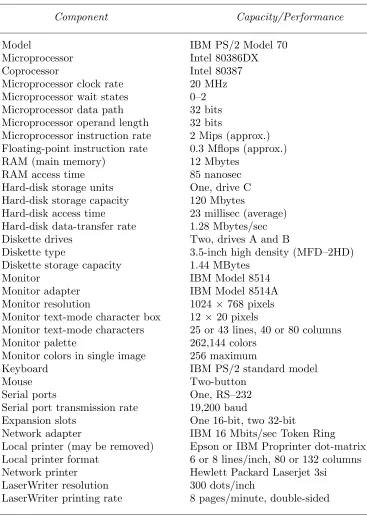
By 1992, there were 70 IBM PS/2 computers in the FEC laboratories, and their configuration is shown in Table 25†.
Each PS/2 was attached to a 16–Mbps IBM token ring local-area network (LAN) through a token-ring adapter. Two IBM PS/2 Model 80 computers with hard-disk storage capacities of 314 Mbytes each were also attached to the token ring and functioned as network servers. Additional connectors also allowed access to computing resources outside the FEC laboratories.
The enterprise had constantly grown in magnitude and complexity, to the point where it occupied about half of Brice and Jim’s professional time for the decade 1986–1996. During this period these courses were taught, very successfully, by an all-student cadre of instructors, many of whom were either U–M undergraduates or had moved on to graduate work at the U–M. Thus, most of the instructors were
Freshman Computing Instruction 293
Table 25 Configuration of the FEC IBM PS/2 Computers
Component Capacity/Performance
Model IBM PS/2 Model 70
Microprocessor Intel 80386DX
Coprocessor Intel 80387
Microprocessor clock rate 20 MHz Microprocessor wait states 0–2 Microprocessor data path 32 bits Microprocessor operand length 32 bits
Microprocessor instruction rate 2 Mips (approx.) Floating-point instruction rate 0.3 Mflops (approx.)
RAM (main memory) 12 Mbytes
RAM access time 85 nanosec
Hard-disk storage units One, drive C Hard-disk storage capacity 120 Mbytes
Hard-disk access time 23 millisec (average) Hard-disk data-transfer rate 1.28 Mbytes/sec
Diskette drives Two, drives A and B
Diskette type 3.5-inch high density (MFD–2HD) Diskette storage capacity 1.44 MBytes
Monitor IBM Model 8514
Monitor adapter IBM Model 8514A
Monitor resolution 1024×768 pixels Monitor text-mode character box 12 ×20 pixels
Monitor text-mode characters 25 or 43 lines, 40 or 80 columns
Monitor palette 262,144 colors
Monitor colors in single image 256 maximum
Keyboard IBM PS/2 standard model
Mouse Two-button
Serial ports One, RS–232
Serial port transmission rate 19,200 baud
Expansion slots One 16-bit, two 32-bit
Network adapter IBM 16 Mbits/sec Token Ring Local printer (may be removed) Epson or IBM Proprinter dot-matrix Local printer format 6 or 8 lines/inch, 80 or 132 columns Network printer Hewlett Packard Laserjet 3si
LaserWriter resolution 300 dots/inch
very sympathetic to the problems and concerns of our college freshmen, and often acted as mentors to them.
The general excellence of these student instructors showed in their teaching evaluations, which were significantly higher on average than those for the engineer-ing faculty. At any time durengineer-ing this period, Brice and Jim typically worked with approximately 15 student instructors and 30 laboratory assistants; management of the computers was very ably supervised by Jim Rennell, who had graduated with his B.S.E. from the EECS department at the U–M, and eventually worked at CAEN.
The following 21 photographs depict several of the prominent student instruc-tors and administrative personnel from 1987–1996.
Nabil Abdel-Jabbar (ChE) Melissa Babcock (ChE) Brice Carnahan (ChE)
Freshman Computing Instruction 295
Matt Houser (Comp Engr) Brian Kirby (Aero) Debbie Lenz (NAME)
Robert Lepler (NAME) David Nagle (EECS) Scot Osburn (Aero)
Julie Scherer (EECS) Bennett Stone Tim Westman (EECS)
Jim Wilkes (ChE) Tom Williams (ME&AM) Annie Wu (EECS)
Typically, about 1,100 students enrolled each year (including the spring half term in May/June) in about 30 sections of four different courses, with a maxi-mum enrollment of 38 students per section. The courses were chosen to respond to the needs of the various departments. Three of them were four-credit hour courses: Engr. 103 (FORTRAN based), Engr. 104 (C based), and Engr. 106 (in-cluding Matlab and C); the fourth course was Engr. 105, which offered a one-credit introduction to the Michigan computing scene for transfer students.
After substantial and continuing consultation with college faculty, the follow-ing topics were included in Engr. 103, 104, and 106:
• General computer “literacy.”
Freshman Computing Instruction 297
• Basic productivity software to be used later in the students’ academic careers, regardless of their discipline: word processing, drawing, drafting, plotting, spreadsheeting, symbolic mathematics, and data-base manipulation.
• Programming in a procedure-oriented language.
• Solution of problems designed to expose students to topics from different en-gineering disciplines.
• Participation in a group activity, typically cooperative design and implemen-tation of a problem solution on the computer.
Group of freshman engineering computing instructors at the home of Jim and Mary Ann Wilkes, 12 April 1993. Back row (left to right): Nabil Abdel-Jabbar, Matt Houser, Jim Wilkes, Brian Kirby, Melissa Babcock, Jim Rennell. Front row: Bill Cosnowski, “Fuss,” Scott Arens, Debbie Lenz, Scott Carr, Scot Os-burn, Neil Chintamaneni, Glen Forbis, Rob Lepler.
Jim relinquished supervision of the freshman-computing organization in 1996, after many challenging but happy years.
James Wilkes
Brice Carnahan and Jim Wilkes with the many books they have co-authored. Taken on 24 April 1996—just before the renovation of the Walter J. Podbielniak Room. See the Chapter 4 article on WJP for information on the Frank Stella lithograph in the background.
Department Computing, 1995–2002 299
Department Computing, 1995–2002
Michael Africa
In the mid-1980s, we hired our first computer sys-tems administrator, who was responsible for sup-porting all the desktop computers in the depart-ment. By the early to mid-90s, desktop computers (“PCs”) had replaced typewriters and word pro-cessors as the main tool of an efficient office. To-day, PCs are essential not only to teaching and research, but also to the staff and administrators supporting the department. A U–M 1994 chemical engineering graduate, current Computer Systems Administrator Michael Africa originally joined the department as a temporary staff member authoring multimedia programs for Prof. Susan Montgomery. In 1995 he received a permanent appointment as the department’s computer systems administrator. Michael’s fascination with computer technology be-gan in 1988 with the arrival of the first operating system to popularize the graph-ical user interface: the Macintosh operating system (successor to the Lisa, also developed by Apple Computer).
In his current position, Michael Africa has found a workable balance between his interest in chemical engineering and the challenge of computer-system ad-ministration. Michael provides broad support for the department’s computers and network, including everything from writing databases to installing and trou-bleshooting machines, to training staff on new software applications. Despite his own preference for the Mac, Michael says that each platform has its strengths and weaknesses, and in fact at home he owns both an Apple (running Mac OS†) and a Dell (running Windows). Machines today share the same hardware, such as hard drives, RAM, fans, etc.—the BIOS and ROM being the main differences. The worldwide trend toward smaller, faster computers has been reflected in the working styles of chemical engineering faculty, staff, and students. In the past 3–4 years, for instance, laptop computers have become so compact, durable, and reliable that 75 percent of faculty regularly use one in their teaching and research. Inexpensive desktop machines and faster connections for home use, including cable modems and DSL, enable faculty and staff to work from almost any location.
Today’s ChE network consists of approximately 270 computers, 70 percent of which are in the laboratories. About 80 percent of the machines run the Macin-tosh OS; the rest run some version of MicroSoft Windows (mostly used for data
handling) or Unix. All staff, and all but one faculty member, use Macintosh com-puters as their primary desktop machines. One of the most significant changes in terms of operating systems was the fall 2001 implementation of Mac OS X, which is based on the powerful open-source BSD Unix. Also in the fall of 2001, CAEN began responding to heavy (and slow!) network traffic by re-wiring the engineering buildings for data transmission. The H.H. Dow Building was among the first to benefit from these much-needed upgrades. The department’s computers are con-nected via peer-to-peer filesharing (as opposed to the client-server model) over a 100 MB Ethernet backbone. Wiring is mainly copper, except where fiber optic cables are used to link the ChE section of the network to the ATM cloud, which has a much higher bandwidth.
Despite the proliferation of technology, some 40 network printers keep the de-partment in paper up to its knees. In addition, the dede-partment has one color laser printer and numerous inkjet printers, which are now inexpensive and of sufficiently high quality for everyday use. Popular applications include all the latest business software: Microsoft Office (Word, Excel, and PowerPoint), and Filemaker and 4th Dimension for database applications. The department also heavily uses some non-business applications, especially Matlab, Mathematica, and Maple. Although most monitors are CRTs (with varying resolutions, depending upon the computer’s video card), flat TFT displays are becoming more popular and affordable (and in fact, Apple no longer makes CRTs!). Peripheral devices such as 100-megabyte “Zip” drives, external hard drives, and Superdisk drives are so portable and inex-pensive that the university does not even insure them against theft or loss. Michael expects the trend toward smaller, faster, less expensive computers to continue, and the department’s reliance on technology to increase continually. The most obvious changes he sees coming are improvements in voice-recognition technology, wearable computers, and videoconferencing technology.
Computer-Based Research
The topic of computer-based instruction within the chemical engineering de-partment is covered in Chapter 11 in the article “Educational Innovations.”
Over the past 45 years, the general thrust of computer-based research has been the simulation of physical events, primarily to extend experimental work and to make predictions in cases in which experiments would be excessively costly or would extend over unacceptably long time frames. There have been two primary themes:
1. The solution of the partial differential equations that govern fluid mechanics and heat transfer, with a wide variety of applications to situations such as polymer processing and reservoir waterflooding.
Computer-Based Research 301
Our progress in computer-based research is best summarized in Table 26, which gives as complete a list as possible of doctoral dissertations that involved very significant amounts of digital computation. The initials that follow the title indicate the faculty member(s) directing the work.‡ A dagger (†) indicates that significant laboratory work complemented the computer studies.
Table 26 Computer-Oriented Doctoral Dissertations
Student, Date, Title, Supervisor(s) Important Computing Features
R.O. Gumprecht, 1953, Determination of particle sizes in smokes. (CMS)†
Used the ENIAC at Aberdeen Prov-ing Ground for three volumes of mathematical tables on light scat-tering functions, Riccati-Bessel func-tions, and partial derivatives of Leg-endre polynomials.
William R. Martini, 1956,Natural convec-tion inside a horizontal cylinder. (SWC)†
Pioneering numerical work, limited to 80 internal grid points, using an IBM 650 computer, with lineariza-tion of equalineariza-tions needed.
Arthur E. Ravicz, 1959, Non-ideal stage multicomponent absorber calculations by automatic digital computer. (JTB)
Used General Motors IBM 704 to ex-amine heat and mass transfer from data and predict Murphree tray effi-ciencies forindividual components. Jesse D. Hellums, 1960, Finite difference
computation of natural convection heat transfer. (SWC)
Investigation of transient natural convection at a vertical wall and in-side a horizontal cylinder. FOR-TRAN with an IBM 704 computer. James O. Wilkes, 1963. Finite-difference
computation of natural convection in an enclosed rectangular cavity. (SWC)
MAD program, IBM 7090. Implicit alternating direction method & suc-cessive overrelaxation, fully 2-D vor-ticity/stream function formulation. Clifton S. Goddin, Jr., 1965.
Two-dimensional flow of two immiscible in-compressible fluids in a stratified porous medium. (MRT, JOW)†
Capillary-pressure and gravitational induced crossflow between different rock strata during water-flooding of partly depleted reservoirs.
D. Grant Fisher, 1965. Frequency re-sponse of flow forced heat exchangers. (RHK)†
Dynamic modeling, computer simu-lation, and frequency-response anal-ysis were confirmed by experiments on pilot-plant heat exchangers. Warren D. Seider, 1966 Confined jet
mix-ing in the entrance region of a tubular re-actor. (SWC)†
MAD program, IBM 7090. Implicit alternating direction method to solve momentum equations; mass transfer by Crank-Nicolson method.
Andrew S. Teller, 1996. Heat transfer in solidifying bars. (JOW)†
Zone refining of indium antimonide. MAD program on IBM 7090 in-cluded heat and momentum trans-port with phase change at curved in-terface.
Li-Chiu Tien, 1967, Freezing of a con-vective liquid in a crystal growth tube. (JOW)†
Finite-difference solution included natural convection in the melt. Agreed with experiment for growth of single crystal of naphthalene. Thomas G. Smith, 1969. An investigation
of free-surface flow into a vertical cylin-drical enclosure. (JOW)†
Marker-and-cell and DuFort-Frankel methods gave accurate predictions of velocities and free-surface profiles for injection of Newtonian polymers. Lilan L-Y. Chan, 1972. Experimental
observations and numerical simulation of the Weissenberg climbing effect. (JOW, JDG)†
FORTRAN program on IBM 360/67 used the Rivlin-Ericksen fluid model to predict velocities and interface shapes for a polyacrylamide solution. Thomas L. Gould, 1972. Vertical
two-phase flow in oil and gas wells. (MRT)†
FORTRAN IV program on IBM 360/67 accounted for five possible flow regimes and used comprehensive routines for physical properties. Peter E. Parker, 1974. A dynamic
ecosys-tem simulator. (RHK)†
An extension of modular process simulation techniques to the analy-sis of data from a dynamically and spatially varying ecosystem..
Luis A. Lopez, 1974. DYSCO: An inter-active executive program for dynamic sim-ulation and control of chemical processes. (BC, DEB)
Computer-Based Research 303
Surendra P. Singh, 1976. AGPSS: A graphical process simulation system. (BC)
The first nonproprietary interactive graphical interface for a process sim-ulator. Output used as input for the process simulator PACER
Antonio Valle, 1979. The finite-element method and the Stefan problem. (RDP, JOW)
2,752 FORTRAN statements em-ployed the finite-element method and satisfactorily confirmed the ex-perimental results of Tien (1967). David E. Hammer, 1984. An engineering
model of wetland/wastewater interactions. (RHK)†
Finite-difference dynamic simulation of water and nutrient flows and their interaction with plant growth in wet-lands.
John C. Fagley, Jr., 1984. Flexibility and efficiency in modular dynamic chemical plant simulation. (BC)
The program structure allowed for modular integration of large, stiff plant models involving thousands of ordinary differential equations. Michael J. Beffel, 1986. Finite-element
in-vestigations into the general energy equa-tion. (JOW)
FORTRAN 77 program on Apollo DN660 computer employed 2– and 3–D finite-element simulations of so-lidification in various metal castings. David B. Bartus, 1987. Parameter
esti-mation in dynamic systems. (BC)
Parameter estimation in models of dynamic systems characterized by sets of non-linear and stiff ordinary differential equations.
Rosemarie D. Wesson Williams, 1988. Computer-aided analysis of viscoelastic flows. (TCP, JOW)
Solved 2–D die-swell problem at high Weissenberg numbers, using FOR-TRAN with remote access to CRAY X–MP supercomputer in San Diego. Jolly S. Ahluwalia, 1988. Wellbore storage
effects in the transient flow-testing of gas wells. (JOW)
Method of characteristics to investi-gate sonic transients, unloading and storage effects, and pseudo steady-state. Agreement with field data. Edsel D. McGrady, 1988, Coagulation
and breakup of droplets in turbulent Cou-ette flow: theory, simulation, experiment. (RZ)†
Kristen Fichthorn, 1989, Monte-Carlo methods in surface science and catalysis. (RZ)
Monte-Carlo simulations on 1024 × 1024 lattices required about two years of CPU time on the Apollo DN660 computer network.
Nitin R. Anturkar, 1990. Mechanics and stability of multilayer extrusion. (JOW)
FORTRAN 77 program employed Oldroyd B model and Carreau vis-cosity function to delineate stable modes of operation of multilayer ex-truders.
Richard Dennis Vigil, 1990, Kinetics of aggregation-fragmentation processes. (RZ)
Pascal program for simulating parti-cle clustering and breakup, with an Apollo Domain 4000 computer. Nikolaos Malamataris, 1991. Computer
aided analysis of flows on moving and unbounded domains: phase change fronts and liquid leveling. (TCP)
Employed free boundary condition and inverse finite-element method to study continuous casting, composite processing, and liquid leveling, etc. Kevin R.J. Ellwood, 1991. The
mechan-ics and stability of liquid jets and films. (JOW)
Used the finite-element method to study the instability of 2– and 3–D jets, also electrohydrodynamic jets, and leveling of Oldroyd-B coatings. Seyed M. Alaie, 1992, Manufacturing of
polymer films and fibers: fluid mechan-ics, rheology, and computer-aided analy-sis. (TCP)
Used the finite-element method and the Papanastasiou/Scriven/Macosko model to investigate film casting, fiber-spinning, and film blowing. Elizabeth C. Hainey, 1993, Temperature
and pressure distributions of natural gas in aquifer storage reservoirs. (JOW)
Some 6,000 lines of FORTRAN 77 using finite-element method to study Joule-Thomson cooling and hydrate formation over many yearly cycles. Joseph P. Greene, 1993. Fiber orientation
during injection molding of glass-fiber-reinforced thermoplastics: an experimen-tal and numerical investigation. (JOW)†
Modified FLOW–3D marker-and-cell method to predict free-surface locations and fiber orientations for injection molding of a rectangular plate.
Benjamin Brosilow, 1993, Monte Carlo simulation of surface reactions (transition metals). (RZ)
Computer-Based Research 305
Nabil M. Abdel-Jabbar, 1996. Paral-lel simulation and state estimation algo-rithms for dynamic systems on multicom-puters. (BC, CK)
General dynamic simulator frame-work and software for parallel mod-ular integration. Involved large scale stiff process-equation system. Tahmid I. Mizan, 1996, A Molecular
in-vestigation of supercritical water and sol-vation of the hydroperoxyl radical therein. (PES, RZ)
Molecular dynamics simulations pro-vided molecular-level insights into supercritical water and its use as a reaction medium.
Richard H.J. Blunk, 1996. Surface-tension-driven flows of coatings: bondline readout formation. (JOW)†
Comprehensive study of leveling of paint films, involving mass, heat, and momentum transport, coupled with the motion of a free surface. Naoko Akiya, 2001, Molecular-level
in-sights into chemical reactions in high-temperature water. (PES)
The role of water in specific chemical reactions was elucidated by compu-tational quantum chemistry and by molecular dynamics simulations. Lei Li, 2001, Molecular dynamics of
di-lute polymer solutions with applications. (RGL)†
Brownian dynamics simulations of bead-spring model enable the prop-erties of polymer solutions to be pre-dicted quantitatively.
Cattaleeya Pattamaprom, 2001, Quantifi-cation of polymer melt dynamics. (RGL)†
Molecular modeling of the rheolog-ical properties of polymer melts. Finite-difference solutions of partial differential equations.
Manish Chopra, 2001, Dilute-solution DNA micro-hydrodynamics. (MAB and RGL)†
Use of Brownian dynamics simula-tions to understand the behavior of DNA molecules close to a surface and in the presence of flow.
Christian D. Lorenz, 2002, Percolation theory and its applications to chemical en-gineering problems. (RZ)
Computer-based Monte-Carlo simu-lations for precise predictions rele-vant to percolation theory.
Michael Zaldivar, 2002, Lattice based Monte Carlo simulations of polymer-surfactant systems. (RGL)