Software Project
Management
4th Edition
Selection of an appropriate project
approach
Selection of project approaches
• In-house development: most of these issues resolved by IS planning and
standards
• Software houses: more applicable as
different customers have different needs • Selection of approach governed by:
– uncertainties of the project
General approach
• Look at risks and uncertainties e.g.
– are requirement well understood?
– are technologies to be used well understood?
• Look at the type of application being built e.g.
– information system? embedded system? – criticality? differences between target and
development environments?
• Clients’ own requirements
Choice of process models
• ‘waterfall’ also known as ‘one-shot’, ‘once-through’
• incremental delivery
• evolutionary development
Waterfall
Waterfall
• the ‘classical’ model
• imposes structure on the project
• every stage needs to be checked and signed off
• BUT
V-process model
Evolutionary delivery:
prototyping
‘ An iterative process of creating quickly and
inexpensively live and working models to test out requirements and assumptions’
Sprague and McNurlin main types • ‘throw away’ prototypes
• evolutionary prototypes what is being prototyped?
Reasons for prototyping
• learning by doing
• improved communication • improved user involvement
• a feedback loop is established
• reduces the need for documentation
• reduces maintenance costs i.e. changes after the application goes live
Prototyping: some dangers
• users may misunderstand the role of the prototype
• lack of project control and standards possible
• additional expense of building prototype • focus on user-friendly interface could be
Other ways of categorizing
prototyping
• what is being learnt?
– organizational prototype
– hardware/software prototype (‘experimental’) – application prototype (‘exploratory’)
• to what extent
– mock-ups
– simulated interaction
Incremental delivery
design build install evaluate
design build install evaluate
design build install evaluate
increment 1 increment 2 increment 3
first incremental delivery
second incremental delivery
third incremental delivery
The incremental process
Incremental approach:benefits
• feedback from early stages used in developing latter stages
• shorter development thresholds • user gets some benefits earlier
• project may be put aside temporarily • reduces ‘gold-plating’:
BUT there are some possible disadvantages • loss of economy of scale
The outline incremental plan
• steps ideally 1% to 5% of the total project • non-computer steps should be included
• ideal if a step takes one month or less: – not more than three months
• each step should deliver some benefit to the user
Which step first?
• some steps will be pre-requisite because of physical dependencies
• others may be in any order
• value to cost ratios may be used – V/C where
– V is a score 1-10 representing value to customer
V/C ratios: an example
step value cost ratio
profit reports 9 1 9 2nd
online database 1 9 0.11 5th
ad hoc enquiry 5 5 1 4th
purchasing plans 9 4 2.25 3rd
profit- based pay for managers
‘Agile’ methods
structured development methods have some perceived advantages
– produce large amounts of documentation which can be largely unread
– documentation has to be kept up to date – division into specialist groups and need to
follow procedures stifles communication
Dynamic system
development method
• UK-based consortium
• arguably DSDM can be seen as
replacement for SSADM
Nine core DSDM principles
1. Active user involvement
2. Teams empowered to make decisions 3. Frequent delivery of products
4. Fitness for business purpose
5. Iterative and incremental delivery 6. Changes are reversible
7. Requirements base-lined at a high level
8. Testing integrated with development
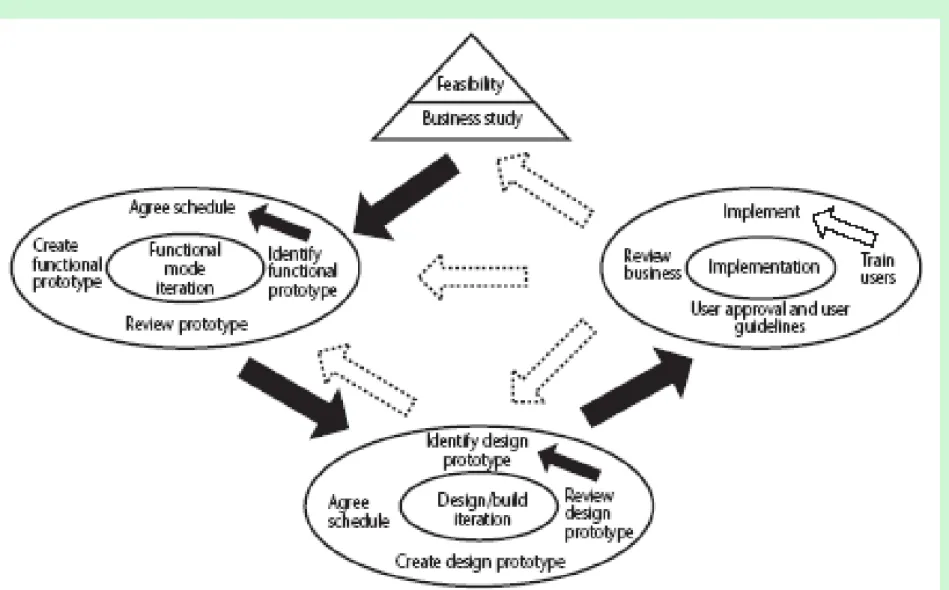
DSDM framework
Figure 4.6 here
DSDM: time-boxing
• time-box fixed deadline by which something has to be delivered
• typically two to six weeks • MOSCOW priorities
– Must have - essential
– Should have - very important, but system could operate without
– Could have
Extreme programming
• increments of one to three weeks
– customer can suggest improvement at any point
• argued that distinction between design and building of software are artificial
• code to be developed to meet current needs only
Extreme programming - contd
• developers work in pairs
• test cases and expected results devised before software design
Grady Booch’s concern
Booch, an OO authority, is concerned that with requirements driven projects:
‘Conceptual integrity sometimes suffers because this is little motivation to deal with scalability, extensibility, portability, or reusability beyond what any vague requirement might imply’
‘rules of thumb’ about approach
to be used
IF uncertainty is high
THEN use evolutionary approach
IF complexity is high but uncertainty is not THEN use incremental approach
IF uncertainty and complexity both low THEN use one-shot
IF schedule is tight
Combinations of approach
yes yes no
yes yes yes
yes yes no
evolutionary incremental evolutionary incremental one-shot one-shot installation co n st ru ct io n
one-shot or incremental installation - any construction approach possible