journal homepage: http://farplss.org
Volume 31, Number 1, 2019
100
Transfer pricing as a means of the state tax base optimization
A. Krutova
Kharkiv State University of Food Technology and Trade
O. Nesterenko
Kharkiv State University of Food Technology and Trade
M.Levina
Institute of Educational Analysis
Article info
Accepted 28.02.2019
Kharkiv State University of Food Technology and Trade, Ukraine
Institute of Educational Analysis
Krutova, A., Nesterenko, O., Levina, M. (2019). Transfer pricing as a means of the state tax base optimization. Fundamental and applied researches in practice of leading scientific schools, 31 (1), 100–107.
This study is aimed at development of the theoretical foundations of transfer pricing mechanism implementation at Ukrainian enterprises.
Methods. The article uses processed by analytical alignment data of pricing methods analysis. Achievement of the objectives was carried out with help of general and special research methods, namely: dialectical approach, analysis and synthesis, systematization and generalization
Results. Developed classification of pricing models is presented in this research with separation of the transfer pricing methods group, which are an effective tool of international tax planning transparency increasing, taxation stability ensuring and eliminating the possibility of moving profits to other tax jurisdictions. Transfer price formation stages matrix is developed which divides transfer pricing process on five stages: data collection, functional analysis, economic analysis, accounting procedures, reporting. The study tested the possibility of implementation in Ukraine of steps 8-10 of the BEPS plan as relevant for solving problems caused by tax base erosion.
Conclusions. Developed in the article matrix of the transfer price formation stages will contribute to effective implementation of BEPS steps relating to pricing control.
Key words: pricing methods; transfer pricing; tax base erosion; profit shifting; tax jurisdiction; related persons; arm’s length” price principle.
Introduction
Effective enterprises’ pricing policies should be planned in line with market trends and ensure that the best results are achieved, taking into account available resources. Today it is not enough for retail enterprises just to determine the strategic prospects of pricing policy and establish a reasonable price, it is important to manage its changes promptly, depending on economic conditions changing as well. It is necessary to pay attention not only in the influence of pricing factors and factors of the market dynamic development, but also to create within accounting system levers of control and management of operational changes in pricing policy for its clear coordination.
The policy of Ukraine in the sphere of pricing is an integral part of the general economic and social policy, and aims at ensuring: equal economic conditions and incentives
for the development of enterprises and organizations of all ownership forms; balance of production means, goods and services market; monopolistic tendencies; improvement of product quality; social guarantees; creation of necessary economic guarantees for producer’s [1, p. 202]. Creation of an optimal price at retail business is a complex cost demanding and time-consuming process, that involves large volumes of information analysis. It does not stop after once occurring setting of prices for selected market, but it suggests further permanent adjustments of prices and temporary price manipulation programs for solving of set of tasks. Modern consumer, whose purchasing power has dropped significantly, is particularly responsive to price changes, because the price itself plays a decisive role in choosing a product.
Volume 31, Number 1, 2019
101
emergence. E-commerce became a fundamentally new system of sales, which involves a high degree of price policy individualization, the scale of price differentiation and price discrimination. Price policy is a part of the overall company’s policy on the market and one of the elements of the marketing block. It contributes significantly to achieving company’s strategic objectives by setting prices for goods and services and their variation. At the time, when companies can freely buy and sell both at the domestic and foreign markets, correct pricing ensuring becomes the key point of successful business. Pricing is one of the most important managerial functions. However, its methodology still remains poorly developed for many enterprises.
The main domestic legislative acts on pricing are the Law of Ukraine "On Prices and Pricing" [2], Resolution of the Cabinet of Ministers of Ukraine "On establishing executive bodies authorities and local authorities’ executive bodies responsibilities to regulate prices (tariffs)"[3].
Price is an economic form in which economic relations in a market economy of production (supply) and consumption (demand) of any product are focused [4, p. 432]. Classical price determination, which remains relevant up to now, was provided by K. Marx as a monetary expression of a product value. Deepening this definition, modern scientific approaches are based on interpretations of price as a component of a market economy, an element of market, a parameter of enterprise activity and a management tool [5, p. 280]. Unlike existing unity of scientists regarding the definition of price, the views of scientists differ in regard to classification of prices.
The goal of this article is to conduct a comprehensive analysis of pricing methods, substantiate integrated approach to transfer pricing in the context of ensuring of participants’ economic interests in transfer pricing process, determine the key factors of transfer pricing applying and develop organizational and methodological measures for the transfer pricing mechanism implementation at Ukrainian enterprises.
The statement of basic materials
Different types of prices can operate in a market economy, which regulate economic relations between different actors in the domestic and international markets. The basis for prices classification is usually laid by such criteria as commodity circulation nature, state regulation influence, level of competition, method of fixation, market type, and validity time [6; 7]. This list of classification features may be extended by criteria of consignment volume, application site, coverage area [8, p. 126-127]. In our opinion, in the modern economic conditions, the determining factor of effective pricing policy formation for trading company is the classification of prices on a purely market basis by the following criterions: transfer, negotiable, based on tangible value of goods, discriminatory, preferential, concessional, prestigious, sales stimulating, market segmentation, based on current prices level, stock exchange, auction.
Typically, sales of goods (products) can occur at free prices, if fixed or regulated prices are not set for these goods (products) by the state as resources that have a decisive
impact on the overall level and dynamics of prices for goods and services, which have a social significance, as well as products, goods, works and services, the production of which is concentrated in enterprises that occupy monopolistic position in the market [9]. In the vast majority of foreign countries, state regulation of prices is not a once occurring operation, it repeats continuously with alternating periods of its amplification and relaxation. In a crisis conditions, destruction of monetary and financial systems, significant shortage of goods and a large surplus of money in circulation, state intervention in price processes is more rigid and voluminous. Thus, in the first post-war years in the UK, state regulation of prices covered up to 60%, and in Austria – almost 100% of goods and services [10].
Other prices of retail enterprises are free-of-charge retail and are set in accordance with the Instruction on the procedure of designating of retail prices for consumer goods [11]. Retail prices are the prices for non-productive consumption goods, for which they are sold independently and directly to customers for their personal non-commercial use. They depend on the manufacturers of the product price; prices of the wholesale trade enterprise; purchase prices; contractual (invoice) value of the imported goods; as well as other expenses related to the purchase of goods, in accordance with national Accounting Standard 9 "Stocks"; and trade margins (which include the actual trade margin and value added tax included in the purchase price).
Price politics is one of the company’s central problems and, since it has to respond to all the diversity of manifestations of life occurring on the market, it may have different goals. [12, p. 131]. Despite the established structure of the retail price, there is a large number of its formation models.
Volume 31, Number 1, 2019
102
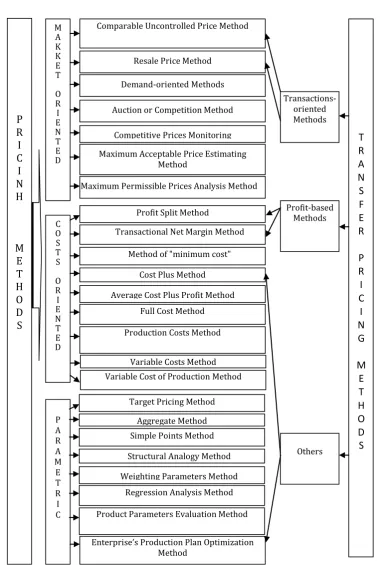
Fig. 1. Pricing methods in trade classification
M A K K E T
O R I E N T E D
C O S T S
O R I E N T E D
P A R A M E T R I C
Comparable Uncontrolled Price Method
Resale Price Method
Demand-oriented Methods
Auction or Competition Method
Competitive Prices Monitoring
Maximum Acceptable Price Estimating Method
Maximum Permissible Prices Analysis Method
Profit Split Method
Transactional Net Margin Method
Method of "minimum cost"
Cost Plus Method
Average Cost Plus Profit Method Full Cost Method
Production Costs Method
T
R
A
N
S
F
E
R
P
R
I
C
I
N
G
M
E
T
H
O
D
S
Variable Costs Method Variable Cost of Production Method
Target Pricing Method
Aggregate Method Simple Points Method
Structural Analogy Method
Weighting Parameters Method Regression Analysis Method
Product Parameters Evaluation Method
Enterprise’s Production Plan Optimization Method
Transactions-oriented Methods
P
R
I
C
I
N
H
M
Е
Т
H
O
D
S
Profit-based Methods
Volume 31, Number 1, 2019
103
The relevance of the transfer pricing features study is confirmed by the inspections carried out by the State Fiscal Service of Ukraine, which resulted in 664 violations detected in the area of controlled operations reporting, as a result of which 175 million UAH penalties were added. During the first quarter of 2018 64 inspections of controlled operations were initiated and 34 inspections were completed, as a results of which 400 million UAH of profit tax were extra charged, a fine of 68 million UAH and a loss of 3.8 billion UAH, 5.8 million UAH VAT were added, VAT refund was reduced by 4.1 million UAH [19]. Concerns over tax avoidance have intensified so much in recent years that international taxation regulation has become a top priority on the agenda of the OECD and G8 country meetings [20]. Analysis of situations proves that the introduction of effective transfer pricing methods is a priority task of our state.
The phenomenon of transfer pricing arose in the second half of the XX century in connection with large Multinational Corporations occurrence and international trade intensification [21, p. 643]. In addition, transfer pricing appearance is connected with necessity to stop the abuse of majority shareholders, who, due to their special position, used to receive significant economic benefits from controlled operations.
Providing such benefits was a hidden distribution of profits and gave the opportunity to restrict the rights of minorities, but was not recognized as a legal payment of dividends and allowed significantly reducing the amount of tax liabilities for majority shareholders.
Application of special legislation in the field of transfer pricing control also has a very significant history. In particular, some of its provisions have been introduced into the practice of US tax administration in the mid-1960s. However, in the most developed countries, transfer pricing control legislation history has a more limited period and, as a rule, its development was carried out with direct implementation of the relevant Organization for Economic Co-operation and Development (OECD) documents [22, p. 43]. According to them controlled operation is a transfer of assets or liabilities or rendering of services between related parties, regardless of whether a price is charged.
Large budget deficits and a sluggish world economy have forced governments worldwide to tighten regulations and intensify corporate audits in the hope of raising tax revenues. [23, p. 171]. Today, more than a third of enterprises are developing transfer pricing systems based on market prices. Contractual prices are used by 10-20% of enterprises. Other transfer pricing methods are used by no more than 5% of companies. Among other transfer pricing methods of certain distribution, mathematical models have been acquired, which are based on the interpretation of transfer prices as parameters of an enterprise’s production plan optimization [24, p. 149].
According to the domestic law, transfer pricing methods are based on the “arm’s length” price principle, which was first introduced in the tax legislation of the United Kingdom and United States. A price between unrelated parties is known as the “arm’s length” price. Therefore, economic content of the “arm’s length” price principle is to establish international rules for assessing and defining the conditions of operations between parties that are in some way
commercially or financially related and to determine the appropriate transfer prices for the purposes of taxation of transactions between them.
The “arm’s length” price principle is aimed at prevention of shifting profit to foreign affiliated companies through undervaluing or overpricing in international transactions. Despite formal imposition of this requirement its effectiveness highly depends on stringency of tax authorities, regarding both the means to confirm the application of the principle and the acceptance of proofs prepared by multinational enterprises to sustain pricing choices [25]. In the 20-30’s of last century the “arm’s length” price principle began to appear in international agreements, and in 1936 it was reflected in Art. 6 of the Concept “On the distribution of profits and property of international companies”, which is generally similar to paragraph 1 of Art. 9 contemporary model conventions of the Organization for Economic Cooperation and Development (OECD) and the United Nations (UN) and relates to a standard double taxation treaty with respect to residents of one or both countries that conclude an agreement.
When applying the “arm’s length” price principle a special significance has conditions comparability. For this purpose, the OECD Manual proposes five factors that should be taken into account in the determination of comparability with relevant factors to be applied both to a controlled transaction and to an agreement between unrelated parties. These factors include: 1) description of the subject of the transaction (for example, in case of immovable property transfer – its physical characteristics, quality, reliability, availability and necessity of service); 2) analysis of the functions performed by the enterprise (for example, design, manufacture, assembling, conducting research, rendering of services, making purchases, distribution of goods, marketing, advertising, transport services, financial services, management) considering assets used and the risks taken; 3) terms of the agreement; 4) economic conditions of the transaction; 5) business strategies of the participants.
In Ukraine, conditions of recognizing of business operations as complying with the “arm’s length” price principle are given in paragraphs. 39.2.1.8 the Tax Code of Ukraine, according to which:
- if the prices (margins) for goods (works, services) are subject to state regulation in accordance with the law, the price is considered to be complying with the “arm’s length” price principle if it is established by the rules of such regulation. This provision does not apply to cases where a minimum (maximum) sale price or an indicative price is established. In such cases price of the operation complying with the “arm’s length” price principle is determined in accordance with this conditions, but may not be lower than minimum or indicative price and higher than maximum;
- if during the transaction the evaluation is mandatory, the value of the object is the basis for establishing of compliance with the “arm’s length” price principle for tax purposes;
Volume 31, Number 1, 2019
104
- if the sale (alienation) of goods, including the property transferred to a pledge by the borrower for the purpose of the creditor claims securing is enforced in accordance with the law, the conditions formed during such sale are recognized as complying with the “arm’s length” price principle [26].
As quite rightly I. Chufarov states (EY Ukraine Head of the transfer pricing practice and international taxation department) transfer pricing is one of the most dynamically developing taxation sectors not only in Ukraine but in the world as well. Transfer pricing rules are subject to change annually. Ukrainian tax authorities, within the limits of their duties, regularly make requests for documentation and conduct inspections. At the same time, international practice of litigation concerning transfer pricing rules application is also constantly being formed [27, p. 3].
K. Markle proved that the difference in profit shifting is driven by a difference in the subset of shifting that involves the parent country and sensitive to reinvestment in the recipient countries [28]. According to the National Bank of Ukraine, more than one third of all foreign direct investments that arrived in Ukraine by the end of 2017 came from low taxation countries, and almost 100% of foreign direct investments from Ukraine were directed to low tax jurisdictions [29]. This situation testifies the propensity of business entities to avoid taxation by erasing the tax base and requires an immediate increase in control over transfer pricing. In addition, while Ukrainian practice suggests that transfer pricing is still used solely for income tax calculation control functions, analysis of the fifteen-year experience of implementing of transfer pricing allows to conclude that the ease of doing business in the country is directly depends on the level of the transfer pricing practices development.
Essential step of Ukraine towards improving of the situation is the accession 01.01.2017 to the Organization for Economic Co-operation and Development of the BEPS (Base erosion and Profit Shifting) plan [30]. To date, Ukraine has
implemented only 4 out of 15 steps aimed at combating harmful tax practices and regimes, improving existing double taxation treaties by introducing norms that would reduce the level of abuse of these agreements, improving transfer pricing rules. However, in our opinion, revision of the requirements for the transfer pricing documentation, initiated in Ukraine, requires the prior coordination of the transfer pricing effects with the value creation in terms of intangible assets, risks and capital, as well as high-risk operations.
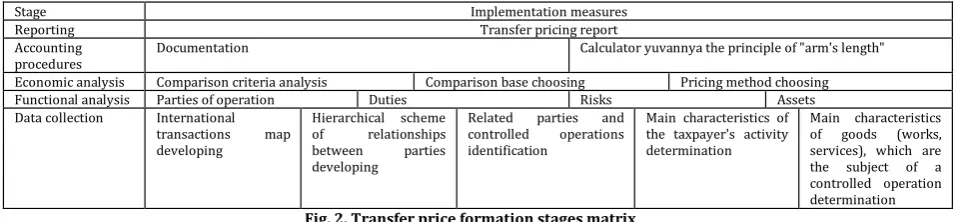
Historically mentioned issues are related to globalization processes, as well as significant increase in the TNCs share in the world economy. Transfer pricing rules are used for solution of potential unconformity of profit diversification and sharing of risks, assets and functions within the whole group [31, p. 43]. Besides transfer pricing regulation is not effective to control transmissions of intangibles [32, p.450], and this may be linked with the issues attributed to the application of current arm’s length system to valuation of these transactions. That is why, the implementation of steps 8-10 of the BEPP plan in our State is relevant for solving problems caused by tax base erosion. Developed matrix of transfer price formation stages will contribute to effective implementation of BEPS steps relating to pricing control (Figure 2).
As we can see, transfer price formation process is carried out in five stages, first of which (data collection) – is an input. It generates a database for further processing in the accounting system during the implementation of the following three stages (functional analysis, economic analysis and accounting) to create the output array of data in form of reporting. Data collection for transfer pricing system starts with construction of enterprise’s international transactions map, which is an effective tax planning tool allowing to develop integrated strategies in the field of international taxation based on application of tax risks initiative management.
Stage Implementation measures
Reporting Transfer pricing report
Accounting
procedures Documentation Calculator yuvannya the principle of "arm's length"
Economic analysis Comparison criteria analysis Comparison base choosing Pricing method choosing
Functional analysis Parties of operation Duties Risks Assets
Data collection International transactions map developing
Hierarchical scheme of relationships between parties developing
Related parties and controlled operations identification
Main characteristics of the taxpayer's activity determination
Main characteristics of goods (works, services), which are the subject of a controlled operation determination Fig. 2. Transfer price formation stages matrix
Proceeding from the order of implementation of the “arm’s length” price principle in the national law four main groups of States can be distinguished: States where this principle is explicitly expressed and defined in legislation; States where it is expressed, but not formally defined; States where it is not expressed, but related legal doctrine applies; States where it is not explicitly expressed, but legislation of which grants tax administration right to make adjustments for the correct presentation of the income (profit) of the taxpayer [33]. International transactions maps are usually designed to rank enterprise’s operations on a basis of participation of counterparties from countries with
significant differences in the practice of reflecting of taxpayers’ income.
Volume 31, Number 1, 2019
105
Fig. 3. Classification of related persons
• controls the taxpayer; • controlled by such a taxpayer; • is under joint control with such a taxpayer
TAXPAYER OFFICIAL
authorized to carry out on behalf of the taxpayer legal actions aimed at establishing, changing or suspending legal relations, as well as members of his family
Spouse
Direct relatives (children or parents) • a physical person
• her husband or wife
Spouse
• of any direct relative of an individual •his/ her husband (wife)
Related parties
LEGAL ENTITY, which
INDIVIDUALS
Who controls the taxpayer?
INDIVIDUAL FAMILLY
MEMBERS
OR
Total amount of economic transactions (for related parties - business transactions for the purchase (sale) of goods (works, services)) with contractors ≥ 50 million hryvna (excluding VAT) f
or the respective accounting year
- one of the legal entities owns corporate rights in the amount of ≥20%;
- an individual possesses the corporate rights of a legal entity in the amount of ≥20%;
- one and the same person owns corporate rights of legal entities in the amount of ≥20%;
- Individuals: spouse, parents (including adoptive parents), children (adults, minors / minors, including adopted children), full-time and part-full-time brothers and sisters, guardian, guardian, child overwhelmed or cared for
- a person has the authority to appoint an individual executive body of a legal entity or appoint ≥50% of its collegial executive body or supervisory board;
- the sole executive bodies of legal persons are appointed by the decision of one and the same person (the owner or an authorized body); - 50% or more of the collegial executive body and / or supervisory board are the same individuals;
- an individual exercises the powers of an individual executive body of a legal entity; - the powers of a sole executive body of legal entities are exercised by the same person Determination of related persons
ye
s
C R I
T E R I A
Counterparty is a related party
Negative value of income tax is declared for the previous tax (reporting) year; Apply special tax regimes as of the beginning of the tax (reporting) year; pays a corporate income tax and / or VAT at a different rate than basic, which is established according to the Tax Code as of the beginning of the tax (reporting) year; was not a taxpayer of corporate
income tax and / or VAT at the beginning of the tax (reporting) year
ye
s
One of the conditions is fulfilled Transactions are
controlled CO Report is required
Transactions are not controlled. CO Report is not required
Resident
y
e s
Non-resident
y e s
n
o
n o
- is registered in the state (on the territory) where the profit tax rate (corporate tax) is 5 and more percentage points lower than in Ukraine;
- pays a profit tax (corporate tax) at a rate of 5 and more percentage points lower than in Ukraine;
- has a tax address (location) on Crimea territory
Non-residential counterparty ye s
ye
s
n
o
n
o
Volume 31, Number 1, 2019
106
transactions between related parties are considered to be controlled, since special conditions are set for their implementation. Assessment of price setting correctness and existence of “relations” between participants in a transaction is carried out by the tax authorities. In international practice the most common link between business entities is a legally established ownership of a share of capital. Definition the fact of relationships is provided in paragraphs 14.1.159 of the Tax Code of Ukraine. In accordance with the provisions of the Tax Code, related parties may be both physical persons and legal entities (Figure 3). Characteristic of related parties within the framework of one operation is the basis for further realization of data collection stage, namely the definition of taxpayer’s activity sphere main characteristics and goods (works, services), which are the subject of a controlled operation. Analytical stages of transfer pricing (functional and economic analysis) allow forming an array of data that requires accounting processing in information systems of controlled operation parties. In accordance with the OECD Transfer Pricing Guidelines for Multinational Enterprises and Tax Administrations, functional analysis is defined as an analysis of the associated functions (taking into account the assets attracted and the risks involved) associated (related) enterprises in controlled operations and independent enterprises in comparative uncontrolled operations (comparable transactions) [34].
The key issue to be addressed by the functional analysis is to identify the party that makes the main functional and material contribution to the value of goods, works and/or services which are the subjects of controlled operation, and whether the revenue received by that party corresponds to performed functions, used assets and incurred risks. Functional analysis is aimed at identifying and comparing economically meaningful actions and commitments that have a significant impact on the controlled operations conditions and/or on the profit derived from these operations.
In the process of economic analysis influence of tax enforcement and market parameters on transfer pricing method choice is investigated [35]. It is an integral part of comparability analysis and a necessary prerequisite for economic analysis procedures implementation since it plays an important role when choosing the method of establishing of correspondence of a controlled operation conditions to the “arm’s length” price principle, determining the appropriateness of pricing method in terms of operation content taking into account that operations and parties are not comparable if their functions / risks / assets are significantly different and not a subject of appropriate adjustments.
In protecting taxpayers from the controlling bodies claims preparation of qualitative documentation can help. Practice of the first inspections testifies it, because all additional payments were made due to the lack of substantiation and mistakes made by taxpayers, including in documentation. National requirements for the compilation and submission by taxpayers of documentation on controlled operations fully comply with the provisions of the OECD Transfer Pricing Guidelines for Multinational Enterprises and Tax Administrations and are based on achieving a balance between usefulness of the data for fiscal bodies in carrying out the risk assessment of the transfer pricing and preventing of unjustified increase of required documentation. Documentation on controlled operations is submitted upon request of the State Fiscal Service of Ukraine is
compiled in an arbitrary form and contains information on the controlled operations specified in the request.
The value of the calculation in competitive conditions as the basis for establishing an adequate pricing policy is extremely important for building enterprise’s accounting system. Properly organized calculation provides managers of enterprises with timely and reliable information for planning, analysis, control and sound management decisions making. It also allows maintaining competitiveness through faster responding to changes in market conditions, rationalization of economic efficiency due to correct choice of pricing methods [36, p. 104]. The calculation is the basis of transfer pricing [37, p. 217]. Transfer price is formed in the process of calculation using pricing method chosen in previous stage.
Conclusions
The influence of changes in the transfer prise parameters is potentially relevant for studies on legislation efficiency and tax audits, and it appears to be a path for further research. The correctness of the transfer price determination depending on the overall financial status of controlled operation parties contribute to:
- increasing of each party in a controlled operation motivation by providing access to any market with defined pricing rules;
- establishing a system for assessing the activities of controlled operations parties, which increases not only their motivation but responsibility too;
- optimization of financial results of controlled operation parties;
- optimization of potential controlled operation party’s resources distribution by identifying the most attractive products, works, and services;
- minimization of tax burden in cooperation with both residents and non-residents;
- providing guarantees that autonomy of each party in a controlled operation will not be violated.
References
Krutova, A.S. (2011). Accounting in the system of electronic commerce: monograph. Kharkiv, KhDUHT.
Zakon Ukrayiny «Pro tsiny i tsinoutvorennya»: pryynyatyy Verkhovnoyu Radoyu Ukrayiny vid 21.06.2012 r. № 5007-VI [The Law of Ukraine "On Prices and Pricing": adopted by the Verkhovna Rada of Ukraine from 21.06.2012, № 5007-VI], available at: http://zakon.rada.gov.ua/laws/show/5007-17. Pro tsinoutvorennya v umovakh reformuvannya ekonomiky:
Postanova Kabinetu Ministriv Ukrayiny vid 21.10.1994 № 733 [On pricing in the conditions of economic reform: Resolution of the Cabinet of Ministers of Ukraine dated October 21, 1994 № 733], available at: http://zakon.rada.gov.ua/laws/show/733-94-%D0% BF
Korman, I.I. (2008). Subject-methodological aspects of pricing. Formation of market economy: Sb. Sciences, Kiev, KNEU, 20, pp. 431-438.
Smol'nyakova, N.M. (2011). Theory of prices as a methodological basis for the formation of modern pricing policy. Economic strategy and prospects for the development of trade and services, 1, pp. 274-283.
Volume 31, Number 1, 2019
107
Pinishko, V.S. (2006). Prices and Pricing: Teach. Manual. Lviv, Intellect-West.
Chernikova, Ya. (2010). Theoretical foundations of the functions of price and price systems in a market economy. Economic analysis, 7, pp. 124-128.
Sus, L.M. (2016). Features of Price Policy and Pricing in Ukraine. Bulletin of the Khmelnytsky National University. Economic Sciences, 1, pp. 272-275.
Hladkykh, D. (2001). State regulation of the economy by means of pricing. Ukraine economy, 1, pp. 50-55.
Instruction on the procedure for designating retail prices for consumer goods: approved by the order of the Ministry of Foreign Economic Relations and Trade of Ukraine dated January 4, 1997 No. 2], available at: https://zakon.rada.gov. ua / laws / show / z0004-97.
P"yatak, I.V. (2012). Pricing and factors of influence on the formation of price policy. Herald of the Berdyansk University of Management and Business, 4, pp. 130-134.
Rybka, N.V. (2018). Accounting and analytical support of innovative economic development: materials of the All-Ukrainian scientific and practical Internet conference, March 14-15, 2018, Lviv, LNAU, pp. 291-293.
Kapinus, L.V., Skryhun, N.P. (2011). The essence and systematization of methods for establishing prices in market conditions.Economics and management of agro-industrial complex), 5 (85), pp. 51-55.
Oklander, M. (2013). Market methods of pricing in retail: targeting buyers and competitors. Economist, 6 (320), pp. 55-58. Podlevs'ka, O.M. (2014). Principles of pricing in e-commerce.
Bulletin of the National University of Water Management and Nature Management. Economy, 1, pp. 311-317.
Yehupova, I.M. (2011). Features of pricing on basic services in the hotel, taking into account the target profit. Scientific herald of Uzhgorod University: Series: Economics, 33, Part 3, pp. 93-99. Kuz'menko, A.V., Kharchenko, V.V. (2017). Price as an economic
category: the order of establishment and methods of pricing in a modern market economy. Economics and Society, 13, pp. 547-552.
Post-release of the forum "Transfer pricing and international tax planning – 2018", available at: http://eucon.ua/1-ukrayins-ka- iv-mizhnarodnij-forum-transfertne-tsinoutvorennya-ta-mizhnarodne-podatkove-planuvannya-2018/
Cameron, D. (2013). Prime Minister David Cameron’s Speech to the World Economic Forum in Davos. 2013. Access mode: http://www.number10.gov.uk/news/prime-minister-david-cameronsspeech-to-the-world-economic-forum-in-davos. Chychulina, K.V., Zinchenko, V.V., Shynkar, Yu.L. (2017). Modern
tendencies of the development of transfer pricing in Ukraine. Global and national problems of the economy, 20, pp. 641-645. Korotun, V.I. (2016). Control over transfer pricing in Ukraine:
problems of formation and prospects of development. Investments: practice and experience), 24, pp. 42-46.
Cristea Anca D., Nguyen Daniel X. (2016). Transfer Pricing by Multinational Firms: New Evidence from Foreign Firm Ownerships. American Economic Journal: Economic Policy, American Economic Association. 2016. Vol. 8 (3). Рр. 170–202. Tkachyk, F.P. (2015). Transfer pricing as an object of monitoring tax
consultants. Scientific Herald of Kherson State University: Series of Economic Sciences), 15, Part 3. pp. 148-151.
Lohse, T., Riedel, N., Spengel, C. (2012). The increasing importance of transfer pricing regulations - a worldwide overview. Oxford Center for Business Taxation Working Paper WP 12/27. 2012.
[Electronic resource]. Access mode:
https://www.researchgate.net/publication/267200989_The_In creasing_Importance_of_Transfer_Pricing_Regulations_-_a_Worldwide_Overview
The Tax Code of Ukraine, of December 2, 2010 №. 2705-VI with
amendments and supplements, available at:
http://zakon3.rada.gov.ua/laws/show/2755-17.
Tax and Legal Directory Tax & Law Reference Transfer Criteria, 2018, 76 p.
Markle, K. A comparison of the tax-motivated income shifting of multinationals in territorial and worldwide countries.
[Electronic resource]. Access mode:
https://doi.org/10.1111/1911-3846.12148
Ukrainian exporters keep foreign exchange earnings on accounts of
foreign companies, available at:
https://dt.ua/ECONOMICS/ukrayinski-eksporteri-zberigayut- valyutnu-viruchku-na-rahunkah-inozemnih-kompaniy-283632_.html
Roadmap for implementing the BEPS Action Plan, available at: https://www.kmu.gov.ua/en/news/249982923.
Korotun, V.I. (2016). Control over transfer pricing in Ukraine: problems of formation and prospects of development, 24, pp. 42-46.
Beer, S., Loeprick, J. (2015). Profit shifting: drivers of transfer (mis)pricing and the potential countermeasures. International Tax and Public Finance, 22(3). Рp. 426–451.
Nepesov, K.L. (2007). Tax aspects of transfer pricing: a comparative analysis of the experience of Russia and foreign countries. Moscow, pp.145-146.
OECD Transfer Pricing Guide], available at:
http://www.afo.com.ua/doc/Nastanovy_OESR.pdf.
Rathke Alex Augusto Timm. Transfer pricing manipulation, tax penalty cost and the impact of foreign profit taxation [Electronic
resource]. Access mode:
https://arxiv.org/ftp/arxiv/papers/1508/1508.03853.pdf. Krutova, A.S., Nesterenko, O.O., Levina, M.V. (2016). Accounting and
Reporting Management of Transaction Costs. Kharkiv, Publisher Ivanchenko I.S.