Available Online at www.ijpret.com
610
INTERNATIONAL JOURNAL OF PURE AND
APPLIED RESEARCH IN ENGINEERING AND
TECHNOLOGY
A PATH FOR HORIZING YOUR INNOVATIVE WORK
PERVASIVE COMPUTING
PRADNYA S. NAGDIVE, PROF. A, B. ROUT
1. M.E. 1st year (CSIT), H.V.P.M college of Engg., S.G.B.A.U. Amravati.
2. Faculty of computer science & Engg., H.V.P.M college of Engg., S.G.B.A.U. Amravati
Accepted Date: 27/02/2014 ; Published Date: 01/05/2014
\
Abstract: Pervasive computing is the human computer interaction paradigm. It is nothing but the
study of how information affects human interactions. .It is also known as ubiquitous computing. The terms ubiquitous and pervasive signify "existing everywhere”. Pervasive computing creates an unobtrusive environment with full and integrated Internet connectivity. A combination of technologies is used to make pervasive computing possible, such as Internet capabilities, voice recognition, networking, artificial intelligence and wireless computing. Pervasive computing devices make day-to-day computing activities extremely easy to access. A number of leading technological organizations are exploring pervasive computing. Xerox's Palo Alto Research Center (PARC), for example, has been working on pervasive computing applications since the 1980s. Pervasive computing also has a number of prospective applications, which range from home care and health, to geographical tracking and intelligent transport systems.
Keywords: Open Source Software, Sixth Sense, Digital World
Corresponding Author: MS. PRADNYA S. NAGDIVE
Access Online On:
www.ijpret.com
How to Cite This Article:
Pradnya Nagdive, IJPRET, 2014; Volume 2 (9): 610-617
Available Online at www.ijpret.com
611 INTRODUCTION
The Pervasive (or ubiquitous) computing which is a concept based on a vision described by
Mark Weiser nearly a decade ago. “The most profound technologies are those that disappear.
They weave themselves into the fabric of everyday life until they are indistinguishable from it” – so began Mark Weiser’s seminal 1991 paper that described his vision of ubiquitous computing, now also called pervasive computing. The aim of Pervasive Computing is for computing available wherever it's needed. It spreads intelligence and connectivity to more or less everything. So conceptually ships, aircrafts, cars, bridges, tunnels, machines, refrigerators, door handles, lighting fixtures, shoes, hats, packaging clothing, tools, appliances, homes and even things like our coffee mugs and even the human body and will embedded with chips to connect to an infinite network of other devices and to create an environment where the connectivity of devices is embedded in such a way that it is unobtrusive and always available. Pervasive computing provides convenient access to relevant information and applications through a new class of ubiquitous, intelligent appliances that have the ability to easily function when and where needed. Thus Pervasive computing means anyone can access ANYTIME and from ANYWHERE, ANYDEVICE, from ANYNETWORK and ANYDATA.
These elements says
Anytime/anywhere: 7 days x 24 hours, global, ubiquitous access.
Any device: PC, Palm/PDA, cell phone, and so forth.
Any network: access, notification, data synchronization, wireless optimization, security, etc.
Available Online at www.ijpret.com
612 Fig.1 Figure showing access to different things by pervasive computing
MATERIAL AND METHODS
The core of pervasive computing Enterprises need to provide seamless user experience across multiple devices as well as multiple access networks. They need to effectively connect and engage end customers through different networks. Analysis of vast amount of data collected through these networks allows organizations to study demographics of their users and cater to them accordingly. For instance, data shows that far more women than men are flocking to Twitter, Facebook etc. The three significant themes that will help in the evolution of pervasive computing are- intelligence, cloud based computing and sensor networks.
Intelligence: The agility with which supply chain is managed will ultimately determine competitive advantage of enterprises. Intelligent technologies help in managing supply chain as a network of collaborating entities using the optimal mix of solutions involving information sharing , collaboration, optimization and transactions.. Artificial intelligence, multi-agents and fuzzy logic based techniques can be used to optimize the supply chain.
Available Online at www.ijpret.com
613 Sensor networks: Sensor networks include the network of nodes that can sense and may control the environment. Organizations are increasingly adopting smart environments. These include smart grids, smart housing, smart transportation systems, smart power systems etc. Smart environments collect sensor data from real world, which Sensor networks facilitate enterprises to sense a phenomenon remotely via sensor nodes and send the information to its peers or the control unit. This is made possible by embedding sensors, controllers, devices and data into the physical world.([2])
Implementing the Pervasive Paradigm
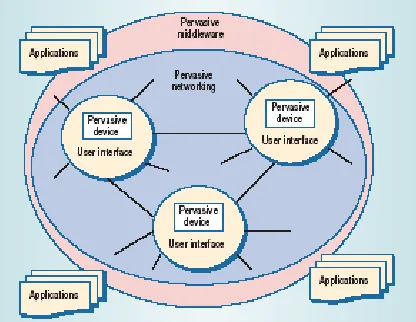
The technological advances necessary to built a pervasive computing environment fall into four broad areas: devices, networking, middleware and applications. Fig.2 given illustrates their relationships
Devices:
Traditional input devices, such as mice or keyboards and output devices such as speakers or LED’s.
Wireless mobile devices such as pagers, personal digital assistants, cell phones, palmtops and so on.
Smart devices such as intelligent appliances, floor tiles with embedded sensors and biosensors.
Pervasive networking:
The number of pervasive devices is multiplying rapidly and will multiply more in future. There will be more vending machines, refrigerators and washing machines embedded with chips and connected to pervasive networks.
Pervasive middleware:
Like distributed computing and mobile computing, pervasive computing requires a middleware “shell” to interface between the networking kernel and the end-user applications running on pervasive devices. As Fig.2 shows, this pervasive middleware will mediate interactions with the networking kernel on the user’s behalf and will keep users immersed in the pervasive computing space.
Pervasive applications:
Available Online at www.ijpret.com
614 Consider heart patient wearing an implanted monitor that communicates wirelessly with computers trained to detect and report abnormalities. The monitor should know when to raise the alarm, based on its knowledge about the environment.([3])
Fig. 2 Pervasive computing framework. Middleware mediates interactions with the networking kernel on the user’s behalf and keeps users immersed in the pervasive space.
RESULTS AND DISCUSSION
Research Thrusts
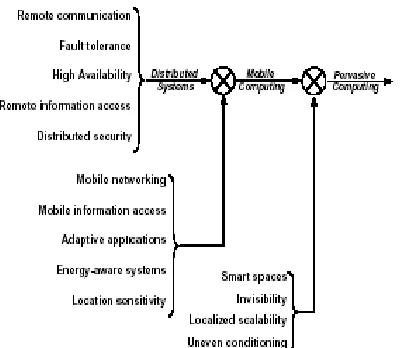
Pervasive computing incorporates four additional research thrusts into its agenda as illustrated by Fig.3.
Effective use of smart spaces:
A space may be enclosed area such as meeting room or corridor or it may be a well-defined open area such as courtyard or a quadrangle. By embedding computing infrastructure in building infrastructure, a smart space brings together two worlds that have been disjoint until now. The fusion of these worlds’ enables sensing and control of one world by the other.
Invisibility:
The idea expressed by Weiser is complete disappearance of pervasive computing technology from a user’s consciousness. In practice, a reasonable approximation to
Available Online at www.ijpret.com
615 Localized scalability:
As smart spaces grow in sophistication, the intensity of interactions between user’s personal computing space and his surroundings increases. This has severe bandwidth, energy and distraction implication for a wireless mobile user. The presence of multiple users will further complicate this problem. Scalability in the broadest sense is thus a critical problem in pervasive computing. Previous works on scalability has typically ignored physical distance-a web server or file server should handle as many clients as possible, regardless of whether they are located next door or across a country.
Masking uneven conditioning:
The rate of penetration of pervasive computing technology into the infrastructure will vary considerably depending on many non-technical factors such as organizational structure, economics and business models. There will persist huge differences in the “smartness” of different environments – which is available in a well-equipped conference room, office or classroom may be more sophisticated than in other locations. This large dynamic range of “smartness” can be jarring to a user, distracting from the goal of making pervasive computing technology invisible.
Fig. 3 Research problem in pervasive computing related to those in mobile computing and distributed systems.
Available Online at www.ijpret.com
616 Applications of Pervasive Computing
Pervasive computing in home:
Pervasive Computing helps us to share information between the objects in the house. UC makes man and object keep in touch continuously. In the coming future Pervasive computing start to begin home automation and entertainment system. It looks after the information which is transmitted and received by the object. It works as the filter for information.
While driving:
This technology can very well help the travelers. A traveler with a PDA and a wireless connection in a city at dinner time if would like to know the list of all the restaurants nearby in the vicinity. Then this technology can help him a lot. It can map his motion, his location and compare it with the location of the restaurants and even it can give him the idea about the hotels of his likings and disliking.
Pervasive computing in industries:
Pervasive computing will help in better business transaction. It has increased ability to retrieve and process rich streams of signals about the organization and its environment. The technology release knowledge work from the constraints of a fixed office location and fixed office hours. Knowledge workers can work with full access to communication, data and computing from any location at any time.([1])
CONCLUSION
1] Pervasive computing provides an attractive vision for the future of computing.
2] In this wireless world we will have instant access to the information and services that we want to access with devices, such as Smart phones, PDAs, set-top boxes, embedded intelligence in your automobile and others, all linked to the network, allowing us to connect anytime, anywhere seamlessly, and very importantly, transparently.
3] Computational power will be available everywhere through mobile and stationary devices that will dynamically connect and coordinate to smoothly help users in accomplishing their tasks.
REFERENCES
1] Thomas C. Agoston, Tatsuro Ueda, Yukari Nishimura, “Pervasive Computing in a Networked World
Available Online at www.ijpret.com
617 3] Debashis Saha and Amitava Mukherjee, “Pervasive Computing : A Paradigm for the 21st Century”.