Available Online at www.ijpret.com 144
INTERNATIONAL JOURNAL OF PURE AND
APPLIED RESEARCH IN ENGINEERING AND
TECHNOLOGY
A PATH FOR HORIZING YOUR INNOVATIVE WORK
STUDY OF JIT IMPLEMENTATION FOR IMPROVING MANUFACTURING
FLEXIBILITY IN INDUSTRY
G. E. CHAUDHARI1, DR. S. G. PATIL2 1. Associate Professor, J.T.Mahajan College of Engineering, Faizpur, Maharashtra ( India)
2. Principal, DRGIT &R , Amravati, Maharashtra (India)
Accepted Date: 15/03/2016; Published Date: 01/05/2016
\
Abstract:Just-in-Time is a name given to an approach of continuous improvement in which non-value-adding activities or wastes are identified and removed for the purposes of reducing cost, improving quality, performance, delivery and flexibility. JIT relies on basic concepts from many disciplines, including statistics, industrial engineering, production management and behavioral science. For successful implementation of JIT all the elements (for example Buffer stock removal, employee empowerment, total quality control, shortly time, standardization etc.) must be properly understood, measured and implemented. JIT is not about automation. Typically, JIT eliminates waste by providing the environment to perfect and simplify the processes. Conceptual details of JIT and other such new approaches to manufacturing management are well known to many Indian firms. However, there is a lack of internalization of these concepts, leading to varying degrees of conviction and clarity at the time of implementation. This has resulted in wide variations in the perception and implementation patterns among Indian firms.
Keywords: JIT - Just in time, LTA – Loss time analysis, OEE – Overall equipment efficiency, Cycle time, FTF –
floor to floor, Rolling.
Corresponding Author: MR. G. E. CHAUDHARI
Access Online On:
www.ijpret.com
How to Cite This Article:
Available Online at www.ijpret.com 145
INTRODUCTION
JIT is defined as management philosophy in order to reduce wastes and produces right amount at the right place at the right time. The wastes produced from the production line get add to it and this ultimately increases the cost without adding the value to the product. JIT is aimed to result better on time delivery performance, lighter equipment utilization, lesser space requirement, lower cost and greater profits.
JIT is originated by Japan in 1970’s. It was developed and perfected by Taiichi Ohno of Toyota. The father of JIT-Taiichi Ohno developed this philosophy as a means of meeting customer demands with minimum delay. The implementation of JIT in Japan is seen to be as integral part of Japanese economic success. Japanese firm believe in the concept that there must be long term competitiveness rather than emphasizing the short term profit.
JIT-The stockless production lowers the inventory level by flowing the material (as they get manufactured) in production line through smooth and unimpeded way. JIT in such a way eliminates the bottlenecks in particular production line.
JIT is most applicable to automobile component production. The reason for this application is that operations or product formation does not change in whole production line cycle. The concept of quality and customer satisfaction is being challenged in recent years and new benchmarks have been established. Customer choice and perceptions had also been changing continuously and Japanese were the first to meet these challenges by introducing many innovations and inventions in manufacturing industries, one among which is JIT So far as the applicability of JIT in Indian firms are concerned, Indian firms has initiated steps towards JIT implementation. In India the size of firms is small comparatively and hence the type of concern could be different. In India economy is under the control of Government and the Govt. policies are not stable. Hence firms develop the short term perspectives and manage the business in accordance with past and current policies of Govt.
2. JIT IMPLEMENTATION
The JIT implementation methodology in any JIT enterprise could be explained under following headings:
People development
Available Online at www.ijpret.com 146
JIT enablers and there implementation technique
2.1 People Development
There are three initiatives in order to follow people development in firms
2.1.1 Personal Development
Make sure to utilized the full potential of each individual and contribute their excellence to the business. It works as strong self motivating factor for individual quality.
2.1.2 Team Working
In team working process there must be strong communication, policy developed and strong leadership. Communication facilitate the efficient cascade and feedback of clear massages about continues improvement.
Strong leadership could be achieved through group leader by Business understanding, Ability to manage change, Known to stall, Personal credibility Policy development makes sure that improvement with organization’s vision, goals, objectives should be exposed to all employees.
2.1.3 Employee Involvement
Employee involvement principles are
Employee must feel that their opinions are listened.
Employee should involve in action that affect them.
2.2 Manufacturing Process Improvement
Manufacturing improvement is directed by an initiative called ‘Production Improvement Directions. There are four initiatives to focus ad prioritize the production improvement.
A) Workplace Practice
B) Production System
C) Process Capabilities
D) Process Optimization
Available Online at www.ijpret.com 147
There are six enablers of JIT are .
3.1 5S
Sort: Clear out all unnecessary items
Shine: Keep it clean, visible and safe
Simplify: A place for everything and everything in place.
Standardize: Establish standard, for sort shine & simplify
Sustain: Seek further improvement
Fig.1: Sequence of activities in 5S implementation.
3.2 Kaizan
Describes a focused and supported event which initiates continuous improvement by giving employees-the skill, encouragement and opportunity to make changes which are positive. There are five critical features that make Kaizan to be successful.
Use people
Available Online at www.ijpret.com 148
Focused effort
Sustain
Use initiatives
The implementation steps for Kaizan are:
Plan
The Kaizan Event
Follow up
3.3 LTA (Loss Time Analysis)
An every production unit there are losses and these losses reduce output .There are six types of losses
Factor that stop the process eg. Machine breakdown.
Setup, machine and process adjustment losses.
Change of shift losses.
Minor stoppages.
Reduce speed losses.
Quality defects.
These above mentioned losses are having different causes & different solutions. To recognize these losses - called as LTA. There are four critical features that LTA programme need in order to be successful.
Use people
Use real data
LTA is incremental
Available Online at www.ijpret.com 149
The bottleneck machine should be analysed to establish the average production level. This production level is compared with the ideal production level. The machine or machining area does not achieve 90% effectiveness must be analyzed and improved through LTA. Once need for LTA is identified a cycle of five steps must be followed. The five steps are:
Data Collection
Data Analysis
Identification of root cause
Creation of action plan
Do -check –act
After following LTA, it is found that machine having cycle time more when compared with the system follow JIT.
3.4 Standard Work
By standardization-work operation & productivity is improved standardization is done by reducing process variability. For standardization following principles must be followed:
Use people
Sustain the gains
Continuous improvement
Display the standards
Make standard work instruction accessible
There are four important steps to implement standard work
Remove wastes
Agree & record standard work
Implement and use standard work
Available Online at www.ijpret.com 150
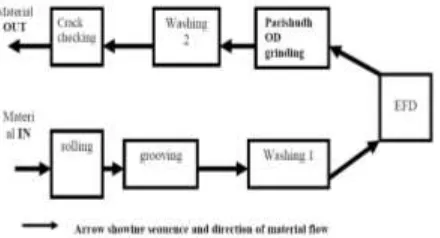
The example given below shows the material in and material out in a sequential way through a process of standardization.
Figure 2 : Block diagram showing layout of cell
There are many tools used to improve the standard work. One among them is cell balancing. Cell balancing redistribute the labour activities within the production cell.
3.5 Cleaning Standard
3.5.1 Autonomous Maintenance
It is defined as incremental process, when knowledge & skill are transferred from maintenance & process specialists to the operator of the machine. The four principles of effective implementation of autonomous maintenance are:
Cost Vs. benefit
Sustain the gains
Continuous improvement
Use People
The autonomous maintenance check sheet gives the description and specification for the process. The autonomous maintenance could be drawn as under:
3.6 Autonomous Maintenance Check Sheet
Continuous improvement
Available Online at www.ijpret.com 151
For implementation of autonomous maintenance there are five steps
Machine improvement activity
For implementation of autonomous maintenance there are five steps as follows:
Machine improvement
Identify tasks and transfer to the operator
Formalize the task
Sustain
Initiate next cycle
3.7 Visual Management
For effective Visual Management there must immediate action taken for immediate negative change. Implementation Steps for visual management are:
Identify what need to be controlled
Design a system of visual indicators
Define & verify the reaction procedure
Implement system
Improve
Following sub steps were taken for implementation of Visual management in our project consideration.
Step - 1. Formation of team.
A team of cross-functional members was formed for implementation of Visual management.
Step- 2. Decide the action plan
Available Online at www.ijpret.com 152
CONCLUSION
JIT makes the company competitive as there is reduction in changeover time, work in process inventory, manpower and manufacturing lead time. The procedure of collection of last time in machine and its analysis has resulted the improvement in consistency (of the machine). Visual management attracts in the line to see the improvement made during process. Weekly meeting of Kaizan gives a sense of total employee involvement As far as the autonomous maintenance is concerned, repair & maintenance is done before failure. Operators are given training in order to make the autonomous maintenance implementation successful. For removal of waste and unwanted material the JIT enabler 5S is to be implemented. The largest JIT factor is the improving manufacturing flexibility by reducing changeover time. Emphases should be placed to reduce the throughout time, elimination of unnecessary activity and simplification. Improvements activities are required to be carried out to survive in a highly competitive market. Emphasis should be placed on reduction of throughput time, elimination of unessential activities and simplification of essential activities while implementing a JIT system. JIT programme began with corporate wide employees development and emphasis on total quality control. Equipments has been modified to improve overall effectiveness. The largest JIT factor has been the improved manufacturing flexibility by reducing changeover time from one model to another.
REFERENCES
1. Prasad B, JIT quality matrices for strategic planning and implementation, Int J Oprati prod manage, 15(1995) 116-142.
2. Vokura R J & R A, just – In –Time : the evolution of a philosophy, Prod Invet manage J, 31 (1996) 57-69.
3. Vart P, M mittal S & Tyagi k, Implementation of JIT in Indian environment: A Delhi study, Productivity , 34 (1993) 251-256.
4. Chandra and Kodali R, Implementation of JIT manufacturing system: an overview, Productivity 38 (1997) 312-321.
5. Deshmukh S G, Just-In-Time: A survey, proc Second SERC School Adv Manufact Technol,
Institute of Technology, Bombay, (December). 9-21, 1996) 148-148.
6. Garg S, vart p & Kanda A, Work Culture in JIT environment, Productivity, 35 (1994) 463-466.