Research Article ISSN 2250-0480 VOL 7/ ISSUE 4/ OCT 2017
L-39
Life science Psychological
EFFECTIVENESS OF TEACHING COPING STYLES ON MARITAL
SATISFACTION, SELF-EFFICACY AND PSYCHOLOGICAL
WELLBEING OF COUPLES
REZA KHALEGHIAN, ELAHEH KHOSHNEVIS*AND HAMIDREZA VATANKHAH
Department of Psychology, College of Humanities, West Tehran Branch, Islamic Azad University, Tehran, Iran
ABSTRACT
Considering the increasing changes and development of social relations in contemporary era, preparing people, particularly young couples, to cope with life predicaments is a vital need. The present research seeks to determine the effectiveness of teaching coping styles on marital satisfaction, self-efficacy, and psychological wellbeing on couples.This is an interventional, quasi-experimental research using pretest – posttest with control group. The research population included all couples resorting to psychological counselling centers of Tehran from March to September 2016. The research sample consisted of 30 couples (60 participants) who took part in the research voluntarily and with due knowledge of the process. They were randomly divided into the case and control group. All participants responded to Enrich’s marital satisfaction questionnaire, Ryff’s psychological wellbeing questionnaire, Shrer’s general self-efficacy questionnaire and the questions associated with demographic specifications both before and after intervention. To analyze the resulting data, first descriptive statistics of mean, standard deviation, and then covariance analytical method in line with inferential analysis were utilized.Covariance analysis has shown that the effect of coping styles on marital satisfaction (F (1 & 58) =233.65, P<0.001, Partial η 2=0.80), couples’ communication (F (1 & 58) =62.56, P<0.0001, Partialη 2=0.51), conflict resolution (F (1&58) =4.98, P<0.0001, Partial η 2=0.22), ideal distortion (F (1 & 58) =5.19, P<0.01, Partial η 2=0.33), self-efficacy (F=58.17, P<0.01, Partial η 2=0.50), psychological well-being (F (1 & 58) =268.13, P<0.0001, Partial η 2=0.82), self-acceptance (F (1 & 58) =118.72, P<0.0001, Partial η 2=0.67), positive relations with others (F (1 & 58) =62.36, P<0.0001, Partial η 2=0.51), autonomy (F (1 & 58) =232.98, P<0.0001, Partial η 2=0.80), purposefulness in life (F (1 & 58) =208.21, P<0.0001, Partial η 2=0.78), personal growth (F (1 & 58) =163.50, P<0.0001, Partial η 2=0.73), environmental mastery (F (1 & 58) =112.29, P<0.0001, Partial η 2=0.65) is significant. As the results of the present research indicate, instructing coping styles has increased marital satisfaction, self-efficacy, and psychological wellbeing among couples. In a theoretical level, the results of the present research confirm the results of previous researches. In a practical level, the results of the present research can be used to develop educational and therapeutic programs.
Keywords: Coping Styles, Marital Satisfaction, Psychological Wellbeing, Self-efficacy, Couples.
INTRODUCTION
Considering the increasing changes and complications and development of social relationships in the current era, psychologists have come to consider preparation of young couples to cope with life predicaments a vital need over recent decades .1 Marital relationships are among the oldest important relationships that have attracted a lot of attention from human society. The quality of this relationship can result in mirth or pain. As researches indicate, a high level of adaptability is
Research Article ISSN 2250-0480 VOL 7/ ISSUE 4/ OCT 2017
L-40
Life science Psychological
average level of satisfaction increases more every year (at least, over the first 10 years).4,5 Furthermore, the variables that couples enter the marital life with also influence their interaction and level of satisfaction.6 Although the correlation between marital satisfaction and general wellbeing is different among men and women and depends on the context where marriage takes place.7 It is generally assumed that people live in families with marital unity where there is a better state of health and psychological wellbeing state.8 Inspired by positive psychology, mental health researchers have chosen a different approach to determining and studying this concept. They consider mental health equal to positive psychological functioning and have conceptualized it as “psychological wellbeing”. They believe that health is a multidimensional concept including the sense of happiness and wellbeing in addition to not being sick and incapacitated.9 The researches based upon the longitudinal studies by Karney & Bradbury (1995) point to the fact the negative path many marriages take is actually the result of couples, lack of knowledge.10 Failures in marital skills such as communication skills, conflict resolution and coping are important predictors of marital break down.2 What’s more, researches have shown that besides exhibiting previous faults in communication skills, most couples lose their communication skills in stressful situations.2 Stress can reduce the time couples spend together, the opportunity they have to gain common experiences, mutual emotional self-expression, affection, satisfied sexual relations and the sense of being “we” among couples. This reduction in the quality of marital relationship will have an adverse influence on couples’ relationships.11 Stressful situations negatively influence positive behaviors such as active listening, expressing love and sympathy in couples, while an increasing trend will be observed in negative behaviors such as criticizing, humiliation and disrespectfulness, hostility and withdrawal. The above-said factors have a great potential to predict weak marital performance and high risk of divorce.12 Without the abilities and skills required to cope with stress, many marital relations will be adversely influenced. In fact, the inability to appropriately deal with stress among couples is one of the main causes of the high rate of divorce.13 These results all indicate that the most harmful variables in friendly relationships are external, acute, mild stressors that infiltrate into friendly and warm relationships. These stressors are responsible for tensions and
Research Article ISSN 2250-0480 VOL 7/ ISSUE 4/ OCT 2017
L-41
Life science Psychological
belief in one’s abilities to organize and undertake a set of actions required to achieve a goal.18 Self-efficacy plays a major role in most of our usual psychological issues and also in the successful interventions to deal with these problems.19 Those who believe strongly in their abilities in dealing with their affairs and tough situations approach them with a sense of great tranquility and problems and obstacles will never be able to devastate them. On the other hand, those who do not have a strong belief in their abilities approach their problems with fear. As a result, the possibility of their effective performance decreases.20 Psychotherapy is associated with professional guided interventions designed to improve mental health. If we admit that self-adjustment plays a major role in all these interventions, we will realize that most professional interventions are designed to enhance self-adjustment as they help us gain (or regain) a sense of efficacy in important aspects of life.21 It is assumed in social cognitive theory and self-efficacy theory that we are capable of changing self-adjustment. A study of those who have managed to overcome difficult behavioral issues without professional help confirms this ability. As a matter of fact, most guiding interventions are designed to improve autonomy as these interventions are mostly about helping improve and restore efficacy in important aspects of life.20 Keeping in mind the importance of the quality of couples’ relationships and behaviors in life ups and downs and the effect of each couple’s self-efficacy on empowering them against problems and the importance of psychological wellbeing which has a direct influence on families’ stability and, also, effectiveness of educational interventions such as coping strategies against incidents, the researchers sought to answer this question whether teaching coping strategies can influence marital satisfaction, self-efficacy, and psychological wellbeing of couples or not.
MATERIALS AND METHODS
This is a quasi-experimental research using pretest – posttest with the control group. The research population included all couples resorting to psychological counselling centers of Tehran from March to September 2016 to settle their marital problems.The research sample consisted of 30 couples (60 participants). Knowing that these educational sessions will be held for free, the participants took part in the research willingly and were randomly divided into case (n=30) and control
(n=30) groups. Initially, 5 specialized centers of family counseling and couple therapy were selected in various regions of Tehran (north, south, east, west and center) from the list of counselling centers provided by Psychology Council Association. Having made the necessary arrangements with chiefs of these centers, an invitation for couples to take part in counselling sessions was prepared and they were duly informed that the classes would be held for free. The volunteers who had applied for classes were registered and marital satisfaction, psychological wellbeing, and self-efficacy questionnaires were distributed among them as pretests. Having studied the questionnaires, those who had scored below the average level were selected and randomly divided into case and control groups after obtaining their consent. The general procedure and goals of research were completely described for participants and they were assured that their information would remain confidential and nobody would ever have access to them. Then, the participants in case group underwent 8 2-hour training sessions (once a week, over two months), while the control group received no instruction or intervention.Instructional protocol was based upon teaching coping reinforcement to couples.11,16 This program consists of 6 parts: 1- introduction to stress and coping, 2- individual coping reinforcement, 3- couple coping reinforcement, 4- exchange and equity in relationship, 5- reinforcing marital relationship, and 6- conflict settlement skills reinforcement plus instruction of problem-based coping and emotion-based coping strategies.22 Instructions were delivered in the form of weekly sessions held in workshops. In the end and after posttest, information was collected through questionnaire. A 3-day workshop was held for control group in order to observed the principles of ethics and the instructional pamphlets were distributed among them. All those who had a low score were provided with pamphlets and educational materials. All instructions and psychological interventions were delivered by a certified psychologist counselor of Psychology and Counselling Organization of Iran and researchers attended and supervised all phases of research.
Data collection
Research Article ISSN 2250-0480 VOL 7/ ISSUE 4/ OCT 2017
L-42
Life science Psychological
meter). Fowers and Olson used this questionnaire to study marital satisfaction as they believe this scale is sensitive to the changes that occur amongst couples. Enrich’s couple questionnaire was executed on 25501 married couples in 2000 by Olson. These alpha coefficients were reported for the following microscales: 0.86 for marital satisfaction, 0.84 for communication, and 0.83 for conflict settlement and ideal distortion. Retest reliability of the questionnaire for each micro-test was 0.86, 0.81, 0.90, and 0.92 respectively. In a research conducted by Asoudeh on 365 couples, the alpha coefficient of the questionnaire was 0.68 (alpha was equal to 0.78 after deletion of question 24), 0.78, 0.62, and 0.77 respectively. This questionnaire consists of 4 separate scores where one overall score is calculated for the total scores of each scale. The raw scores are then converted into percentage. Cronbach’s alpha of this questionnaire in the above-said research was 0.79 which indicates an appropriate level of reliability.Sherer’s general self-efficacy questionnaire: this scale was developed by Sherer, Maddux, Mercandate, Prentice-Dunn, Jacobs & Rogers in 1982.24 The original version of the test included 36 questions where the developers retained those questions with a load of 0.40 in each one of social and general factors. Based on this criterion, 13 questions that didn’t have these specifications were omitted and the test was reduced to 23 questions where 17 questions assessed general self-efficacy with an average and standard deviation of 99.57 and 12.08 respectively. This scale is validated and translated into Persian by Barati. To assess the structural validity of general self-efficacy scale, a correlation was drawn between the scores of this scale and the size of several personality characteristics (Rater’s internal and external control scale, individual control micro-scale, Marlow’s social grade scale, and Rosenberg’s interpersonal merit scale and bound) where the correlation predicted between self-efficacy scale and personality characteristics was average (0.61 and significant in 0.05) and it was in line with confirmation of the structure.25 Using Gatman’s split half and Cronbach’s alpha coefficient, the validity coefficient of the scale was calculated 0.76 and 0.79 respectively. In the research conducted by Vaghari, Cronbach’s alpha is calculated 0.85 in the final assessment of self-efficacy. Najafi et all separated 30 subjects randomly and implemented self-efficacy test on them where Cronbach’s alpha was 0.83. In a research by Ganji & Farahani, the validity coefficient was calculated 0.81 using Cronbach’s
alpha. Cronbach’s alpha of the questionnaire was calculated 0.77 in the present research indicating its validity.Ryff’s psychological wellbeing scale: this scale was first developed by Ryff in 1989.26 This test includes 84 questions and 6 factors. Participants answer questions in a 6-degree (totally disagree to totally agree) scale. 47 questions are scored directly, where 37 are scored reversely. Ryff used this scale to validate tools and measure their correlation with measures that were considered indicators of psychological wellbeing and assessed personality characteristics. The results of correlation of Ryff’s test were acceptable with each of the above-said scales. As a result, this tool is structurally valid.26 The following Cronbach’s alphas were calculated for each factor in Ryff’s study: 0.93 for self-acceptance, 0.91 for positive relation with others, 0.86 for autonomy, 0.90 for mastery of environment, and 0.87 for personal development. In a research conducted in Iran using student samples, internal consistency was calculated using Cronbach’s alpha with the following results: 0.77 for mastery of environment, 0.78 for personal development, 0.77 for positive relationship with others, 0.70 for purposeful life, 0.71 for self-acceptance, 0.78 for autonomy, and 0.82 for the overall score. The validity of this scale was also declared suitable.27 Cronbach’s alpha of this questionnaire in the present research was 0.82 indicating a proper level of validity.Descriptive and inferential statistical methods were used to study and analyze the raw information. Descriptive statistics was used to calculate frequency, determine central indicators, distribution, and draw tables and charts. In inferential statistics, in order to compare the data corresponding to microscales of couples’ marital satisfaction of subjects in both groups, single- and multi-variable covariance analysis test with a confidence level of 95% was used. SPSS.22 was used for all statistical calculations.
RESULTS
Research Article ISSN 2250-0480 VOL 7/ ISSUE 4/ OCT 2017
L-43
Life science Psychological
15 (25%) had a master’s degree. In terms of the length of marital life (years), the following frequencies were observed among subjects: 6 (8.3%) couples with 1 to 5 years, 24 (38.4%)
couples with 5 to 10 years, 26 (45%) couples with 10 to 15 years, and 4 couples (8.3%) with more than 15 years.
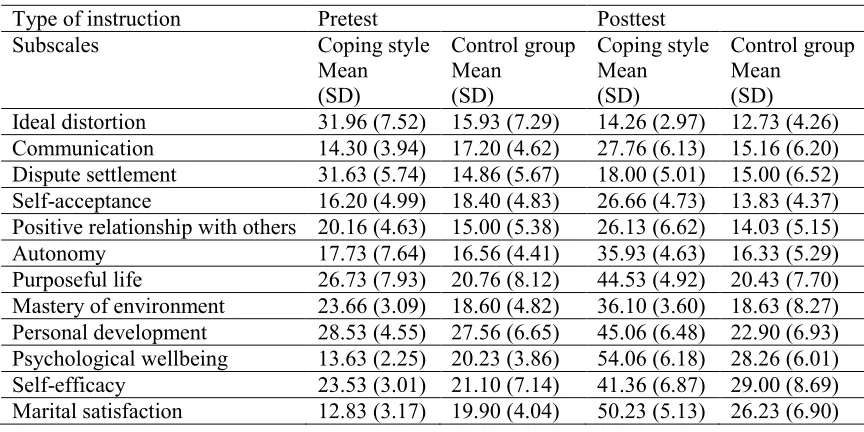
Table 1
Mean, standard deviation of research variables
Type of instruction Pretest Posttest
Subscales Coping style
Mean (SD)
Control group Mean
(SD)
Coping style Mean (SD)
Control group Mean
(SD)
Ideal distortion 31.96 (7.52) 15.93 (7.29) 14.26 (2.97) 12.73 (4.26)
Communication 14.30 (3.94) 17.20 (4.62) 27.76 (6.13) 15.16 (6.20)
Dispute settlement 31.63 (5.74) 14.86 (5.67) 18.00 (5.01) 15.00 (6.52)
Self-acceptance 16.20 (4.99) 18.40 (4.83) 26.66 (4.73) 13.83 (4.37)
Positive relationship with others 20.16 (4.63) 15.00 (5.38) 26.13 (6.62) 14.03 (5.15)
Autonomy 17.73 (7.64) 16.56 (4.41) 35.93 (4.63) 16.33 (5.29)
Purposeful life 26.73 (7.93) 20.76 (8.12) 44.53 (4.92) 20.43 (7.70)
Mastery of environment 23.66 (3.09) 18.60 (4.82) 36.10 (3.60) 18.63 (8.27)
Personal development 28.53 (4.55) 27.56 (6.65) 45.06 (6.48) 22.90 (6.93)
Psychological wellbeing 13.63 (2.25) 20.23 (3.86) 54.06 (6.18) 28.26 (6.01)
Self-efficacy 23.53 (3.01) 21.10 (7.14) 41.36 (6.87) 29.00 (8.69)
Marital satisfaction 12.83 (3.17) 19.90 (4.04) 50.23 (5.13) 26.23 (6.90)
None of the scales is statistically significant in Levene’s Test. We may, therefor, say that both groups were homogeneous in terms of research variables and variance before intervention (P > 0.05). The results of Kolmogorov-Smirnov test to study the normal distribution of data indicate that all subscales of wellbeing, marital satisfaction and self-efficacy follow the assumption of normality (P < 0.01). As none of the subscales of wellbeing, marital satisfaction and self-efficacy are significant in regression homogeneity analysis (P > 0.05), we may conclude that the assumption of regression
homogeneity is confirmed.A review of data characteristics showed that the assumption of variance-covariance matrixes homology doesn’t hold true for marital satisfaction (P < 0.001, Box’s M=77.60). As a result, the Pillay index showed that the group had a significant influence on the linear combination of bound variables (F=138.58, P < 0.0001 & partial ŋ2=0.88). In other words, there is a statistically significant difference between the two groups in terms of at least one of the components of marital satisfaction, self-efficacy, and psychological wellbeing.
Table 2
The results of variance analysis test for scores of marital satisfaction, self-efficacy, and wellbeing in case and control groups
Variable SS Df MS F P
Marital satisfaction 8640 1 8640 233.65 0.0001 Self-efficacy 2294.01 1 2294.01 37.32 0.0001 Psychological wellbeing 9984.60 1 9984.60 268.13 0.0001
Single-variable ANOVA statistics were implemented separately for each dependent variable so that the source of the significance of multi-variable effect can be determined. As you can see in table 2, the group has a significant influence on marital satisfaction (F (1&58)=233.65, P < 0.01 & Partial ), self-efficacy (F (1&58)=37.332, P < 0.0001 & Partial ) and dispute settlement (F (1&58)=268.13, P < 0.0001 & Partial ).
DISCUSSION
As the results of the research indicate, there is a statistically significant difference between the case and control group in terms of marital satisfaction.
Research Article ISSN 2250-0480 VOL 7/ ISSUE 4/ OCT 2017
L-44
Life science Psychological
practically to improve marital relationships. This is in line with the results of the researches conducted by Jafarzadeh et all and Besharat et all.28,29 An interpretation of these results is that the knowledge obtained following the instruction of coping styles helps the individual find useful strategies so that he may tolerate tensions, be flexible to various conditions, accept the responsibility of his decisions, have a good feeling of himself, consider problems as a part of life-developing experiences and encounter problems with a sense of mastery and adequacy. As a result, he will retain his calmness and look for the most appropriate method to cope with an incident. In this process, individuals learn how to accept new responsibilities and deal with fear, anxiety, depression, frustration and mental pressures. Developing coping skills has been noted as the best-known method to build a strong self-concept and flexibility in individuals that facilitates one’s compatibility with new conditions and it is used as a short-term and preemptive intervention in order to enhance life satisfaction. Life satisfaction is an indicator of stability and effectiveness of family system. The health and prosperity of a family depends upon existence of couples’ coping strategies. If the foundation of family is not strong enough, its negative message will be various physical and mental problems.30 In fact, this phenomenon elongates the life expectancy of spouses and results in higher physical and mental health, economic advancement, and life satisfaction. Amity and marital satisfaction is achieved through mutual love, caring for one another, mutual acceptance and understanding, and fulfilling demands.31 These skills encompass a large spectrum of individual’s behaviors, internal and external actions and reactions while dealing with a stressful factor. This is called stressful as it is created in order to reduce or tolerate external or internal factors from pressure.32 The research results indicate a significant difference between the case and control groups in terms of higher levels of couples’ self-efficacy. In other words, coping strategies have yielded higher self-efficacy of the couples in case group compared to the average of control group. The results of the research confirm this assumption and show that this therapeutic approach can be used to enhance marital relationships. This is in line with the results of the researches conducted by Mariana et al and Jafarzadeh et all.22,28 An interpretation of these results is that coping skills enhance self-efficacy believes in couples if couples have sufficient levels of self-efficacy, unfavorable
Research Article ISSN 2250-0480 VOL 7/ ISSUE 4/ OCT 2017
L-45
Life science Psychological
facilitate this process as some researches have considered it useful in treating these diseases. These skills include a large spectrum of behaviors, external and internal actions and reactions of the individual in dealing with a stressful factor created to reduce or tolerate the internal and external issues from pressures.32 It is not possible to change all intervening variables in empirical studies. So, it is possible for the subjects to be influenced by factors beyond the control of researcher. It is also possible that over-answering a questionnaire (pretest - posttest) may have adverse effects on subjects and reduce their answering accuracy. The tool used in
this research was only a questionnaire and using a single tool may be an unreliable method to obtain accurate information. Considering the importance of confirming the effectiveness of interventional approaches to develop their application, it is recommended to repeat this research using a different population and a different research design. Based upon the results of the present research, counselors are recommended to use coping styles in order to maximize settlement of couple’s disputes. Training, internship, retraining the conselors and clinical therapists to use coping strategies is another recommendation put forward in this research.
References:
1. Sabzianpoor B, Ghazanfari Amrai M, Jalali Farahani M, Soheila R, Mahdavi A, Rahmani S. The impact of teaching psychological welfare on marital satisfaction and self-efficacy in nurses. J Med Life. 2015
Dec;8(Spec Iss 4):307-312.
2. Ozouni Davaji R B, Dadkhah A, Khodabakhshi Kolaee A, Dolatshahi B. Effectiveness of group training of couple’s coping skills enhancement on marital relationship quality in distressed couples. Journal of Behavioral Sciences. 2012 Mar; 6 (1): 7-8.
3. Cherlin A. The deinstitutionalization of American marriage. Journal of Marriage and Family. 2004 Oct; 66(4): 848-861.
4. Halford W K & Snyder D K. Universal processes and common factors in couple therapy and relationship education. Behavior Therapy. 2012 Mar; 43(1): 1-12.
5. Polenick CA, Zarit SH, Birditt KS, Bangerter LR, Seidel AJ, Fingerman KL. Intergenerational Support and Marital Satisfaction: Implications of Beliefs About Helping Aging Parents. J Marriage Fam. 2017 Feb; 79(1): 131-146.
6. Lawrence E, Eldridge K A & Christensen A. The enhancement of Traditional Behavioral Couples Therapy: Consideration of individual factors and dyadic development. Clinical Psychology Review. 1998 Sep; 18(6): 745-764.
7. Cohen O, Geron Y & Farchi A. Marital quality and global well-being among older adult Israeli couples in enduring marriages. The American Journal of Family Therapy. 2009 Jun; 37(4): 299-317.
8. Krueger J I, Massey A L & Didonato T E. A matter of trust: From social preferences to the strategic adherence to social norms. Negotiation and Conflict Management Research. 2008 Feb; 1(1): 31-52.
9. Larson J H, Crane D R & Smith C W. Morning and night couples: the effect of wake and sleep patterns on marital adjustment. J Marital Fam Ther. 1991 Jan; 17(1): 53-65.
10. Karney B R, Bradbury T N. The longitudinal course of marital quality and stability: A review of theory, method, and research. Psychol Bull. 1995 Jul; 118: 3-34.
11. Levesque C, Lafontaine M, Caron A, Flesch JL, Bjornson S. Dyadic Empathy, Dyadic Coping, and Relationship Satisfaction: A Dyadic Model. Europe's Journal of Psychology. 2014 Feb; 10(1), 118–134. 12. Gottman J M, Levenson R W. Marital
processes predictive of later dissolution: behavior, physiology, and health. J Pers Soc Psychol. 1992 Aug; 63(2): 221-33.
13. Randall AK, Bodenmann G. The role of stress on close relationships and marital satisfaction. Clin Psychol Rev. 2009 Mar;29(2):105-15.
14. Bowman M L. Coping efforts and marital satisfaction: Mearsuring marital coping and its correlates. J Marriage Fam. 1990 May; 52: 463-74.
15. Badr H. Coping in marital dyads: A contextual perspective on the role of gender and health. Pers Relat. 2004 Apr; 11(2): 197-211.
Research Article ISSN 2250-0480 VOL 7/ ISSUE 4/ OCT 2017
L-46
Life science Psychological
distress based upon stress and coping. Fam Relat. 2004 Sep; 53(5): 477-84.
17. Ghahvehchi F, Fathi-Ashtiani A, Azadfallah P. The Relationship between Meta Cognitive Beliefs and Students’ Test Anxiety Coping Styles, Given the Role of Ambivalent Attachment. rph. 2012 Oct; 6 (3): 10-18. 18. Tonta Y & Kurbanoğlu S. Networked
information in Turkey. Türk Kütüphaneciliği. 1995 Sep; 9(3): 230-234.
19. Juffer F, Bakermans-Kranenburg MJ, van IJzendoorn MH. Pairing attachment theory and social learning theory in video-feedback intervention to promote positive parenting. Curr Opin Psychol. 2017 Jun;15:189-194. 20. Middelkamp J, van Rooijen M, Wolfhagen P,
Steenbergen B. The Effects of a Self-Efficacy Intervention on Exercise Behavior of Fitness Club Members in 52 Weeks and Long-Term Relationships of Transtheoretical Model Constructs. J Sports Sci Med. 2017 Jun 1;16(2):163-171.
21. Frank E, Frank R F. Conceptualization and rationale for consensus definitions of terms in major depressive disorder: remission, recovery, relapse, and recurrence. Archives of general psychiatry. 1991 Sep; 48(9): 851-855. 22. Falconier M K, Jackson J B, Hilpert P, Bodenmann G. Dyadic coping and relationship satisfaction: A meta-analysis. Clinical Psychology Review. 2015 Dec; 42: 28-46.
23. Fowers B J & Olson D H. ENRICH Marital Inventory: A discriminant validity and cross‐validation assessment. Journal of marital and family therapy. 1989 Jan; 15(1): 65-79.
24. Sherer M, Maddux J E, Mercandante B, Prentice-Dunn S, Jacobs B & Rogers R W. The self-efficacy scale: Construction and validation. Psychological reports. 1982 Oct; 51(2): 663-671.
25. Barati H. The correlation between marital relationship patterns and irrational believes of Malayer high school teachers. Psychological reports. 2010 Oct; 4(1): 34-39.
26. Ryff C D. Happiness is everything, or is it? Explorations on the meaning of psychological
well-being. Journal of personality and social psychology. 1989 Jan: 57(6): 1069.
27. Bayani A A, Mohammad Koochekya A, Bayani A. Reliability and Validity of Ryff’s Psychological Well-being Scales. IJPCP. 2008 May; 14 (2) :146-151.
28. Jafarzadeh F, Golzari M, Jomehri F, Poursamar S L, Sahraian K. The Comparison of Coping Strategies with Stress and Marital Satisfaction in Women on the Basis of Infertility Factor. Women's Health Bull. 2015 Apr; 2(2): e25227.
29. Besharat M A, Rezazadeh S M R. Explaning the role of coping styles in marital satisfaction and mental health. Contemporary Psychology. 2006 Jan; 1(1): 48-56.
30. Chowdhury F I, Trovato F. The role and status of women and the timing of marriage in five Asian countries. Journal of Comparative Family Studies. 1994 Jun; 25(2): 143-157. 31. Abedi Shargh N, Bakhshani NM, Mohebbi
MD, Mahmudian K, Ahovan M, Mokhtari M, Gangali A. The Effectiveness of Mindfulness-Based Cognitive Group Therapy on Marital Satisfaction and General Health in Woman With Infertility.Glob J Health Sci. 2015 Aug 6;8(3):230-5.
32. Christensen A, Atkins D C, Berns S, Wheeler J, Baucom D H & Simpson L E. Traditional versus integrative behavioral couple therapy for significantly and chronically distressed married couples. J Consult Clin Psychol. 2004 Apr; 72(2): 176-91.
33. Butler G, Wells A & Dewick H. Differential effects of worry and imagery after exposure to a stressful stimulus, A pilot study. Behav Cogn Psychother. 1995 Jan; 23(1) : 45-56. 34. Masoumi SZ, Khani S, Kazemi F, Kalhori F,
Ebrahimi R, Roshanaei G. Effect of Marital Relationship Enrichment Program on Marital Satisfaction, Marital Intimacy, and Sexual Satisfaction of Infertile Couples. Int J Fertil Steril. 2017 Oct;11(3):197-204.
35. Ryff C D & Keyes C L M. The structure of psychological well-being revisited. J Pers Soc Psychol. 1995 Oct; 69(4): 719-27.