Vol. 12, No. 1, 2016, 41-47
ISSN: 2279-087X (P), 2279-0888(online) Published on 25 July 2016
www.researchmathsci.org
41
Annals of
Solution of Fuzzy Non-linear Equations over Triangular
Fuzzy Number using Modified Secant Algorithm
Md. Yasin Ali1, Kanak Ray Chowdhury2, Abeda Sultana3 and A F M Khodadad Khan4
1
School of Science and Engineering
University of Information Technology & Sciences, Baridhara, Dhaka, Bangladesh E-mail: [email protected]
2
Department of Mathematics, Mohammadpur Model School and College Mohammadpur, Dhaka
3
Department of Mathematics, Jahangirnagar University, Savar, Bangladesh 4
School of Engineering and Computer Science, Independent University Bashundhara R/A, Dhaka, Bangladesh
Received 1 July 2016; accepted 21 July 2016
Abstract. The application of fuzzy non-linear equations has recently increased in many branches of pure and applied mathematics as well as engineering and social sciences. So solution of fuzzy non-linear equations has become an important tool in fuzzy Mathematics. There have been many numerical methods for the solution of fuzzy non-linear equations. In this study, we have solved fuzzy non-non-linear equations over Triangular Fuzzy Numbers (TFNs) using modified secant algorithm. Graphical representation of the solutions has also been drawn so that anyone can achieve the idea of converging to the root of a fuzzy non-linear equation.
Keywords: Fuzzy number, Triangular Fuzzy number, Fuzzy non-linear equation, Modified Secant method.
AMS Mathematics Subject Classification (2010): 90C70 1. Introduction
42
The paper is organized as follows. In section 2 we discuss about basic definitions and notations used in this article. In section 3 we, discuss modified Secant method for solving fuzzy non-linear equations. In section 4, the precise solution of the non-linear fuzzy equation is obtained with the help of the proposed algorithm and its graphical representation has also been shown as well.
2. Preliminaries
In this section, we discuss some definitions, which are needed to read rest of the paper.
Definition 2.1. (Fuzzy set) A fuzzy set A~is defined by ]}.
1 , 0 [ ) ( , : )) ( , {(
~= ∈ ∈
x A x x x
A
µ
Aµ
A In the pair (x,µ
A(x)), the first elementxbelongs to the classical set A the second element
µ
A(x) belongs to the interval [0, 1], called Membership function.Definition 2.2. (Fuzzy number) If a fuzzy set is convex and normalized, and its membership function is defined in R and piecewise continuous, it is called as fuzzy number. So fuzzy number (fuzzy set) represents a real number interval whose boundary is fuzzy. Fuzzy number is expressed as a fuzzy set defining a fuzzy interval in the real numberR. Since the boundary of this interval is ambiguous, the interval is also a fuzzy set. Generally a fuzzy interval is represented by two end points a1 and a3 and a peak point a2 as [a1,a2,a3] (Figure-1)
Figure 1: Fuzzy numbers
Definition 2.3. (Triangular fuzzy number) A fuzzy number A~ on R is said to be a triangular fuzzy number (TFN) or linear real fuzzy number (LRFN) if its membership function
µ
:R→[0,1] has the following characteristics
The triangular fuzzy number is denoted byA~=
µ
(a,b,c). We use TF(R) denote the set of all triangular fuzzy numbers. We note that any real number b can be written as a
Secant Algorithm
43
triangular fuzzy numberr(b), where r(b)=
µ
(b,b,b) and thereforeR . Now it is clear that r(b) represents the real number b itself. Operation, fuzzy function and fuzzy non- linear equations in TF(R) are also defined as follows.Definition 2.4. (Operations onTF(R)) For given two triangular fuzzy numbers )
, , ( 1 1 1 1
µ
a b cµ
= andµ
2 =µ
(a2,b2,c2), we define addition, subtraction, multiplication, scalar multiplication and division by1.
µ
1+µ
2 =µ
(a1+a2,b1+b2,c1+c2); 2.µ
1−µ
2 =µ
(a1−c2,b1−b2,c1−a2);3.
µ
1.µ
2 =µ
(min{a1a2,a1c2,a2c1,c1c2},b1b2,max{a1a2,a1c2,a2c1,c1c2});4. . 1 1 min 1,1,1 , 1, 1,1 ,max 1, 1, 1 ;
2 2 2 2
2 2 2
2 2 2
2 1 2 1
= =
c b a c
b a median c
b a where
µ
µ
µ
µ
µ
µ
where a2,b2,c2 are all non-zero real numbers. 5. k
µ
1=µ
(ka1,kb1,kc1) for k≥0;6. k
µ
1=µ
(kc1,kb1,ka1) for k≤0;Definition 2.5. (Function in TF(R)) If f :R→R is a real-valued function and )
, , (ab c
µ
is a TFN, then triangular fuzzy-valued function ~f :TF(R)→TF(R) is defined as ~f(µ
(a,b,c))=µ
(a~,b~,c~), where a~=min{f(a), f(b), f(c)},)} ( ), ( ), ( { ~
c f b f a f median
b = , c~=max{f(a), f(b),f(c)}.
Definition 2.6. (n-th power of a fuzzy number) A fuzzy number
µ
(a,b,c) of power n is defined as (µ
(a,b,c))n =µ
(an,bn,cn) wherea,b,c≥0.Definition 2.7. (Fuzzy non-linear equation) Fuzzy non-linear equations can be found in many applications, all the way from light diffraction to planetary orbits for example. A non-linear equation over triangular fuzzy number is called a fuzzy non-linear equation. The equation of the form ~f(
µ
x)=0 is called fuzzy non-linear equation, where) ( )
( : ~
R TF R TF
f → is a non-linear function. For example
µ
x3+µ
x2−1=0 is a fuzzy non-linear equation.3. The modified secant method to solve fuzzy non-linear equation
Solving fuzzy non-linear equations over triangular fuzzy numbers of the form 0
) (
~ =
x
f
µ
is possible with a modification of secant method over triangular fuzzy numbers. To solve fuzzy non-linear equation using this modified secant method over triangular fuzzy number, we have begun with two initial approximations for which0 ) ( ~ (n) =
x
44 )
, ,
( (0) (0) (0) ) 0 ( c b a x
µ
µ
= andµ
x(1) =µ
(a(1),b(1),c(1)) for which ( ( )) ~ (0)b r
f and
)) ( ( ~ (1)
b r
f have opposite sign (say ~f(r(b(0)))<0 and ~f(r(b(1)))>0). Hence the method generates the sequences { ( )}∞n=0
n x
µ
by)) ( ( ~ )) ( ( ~( ))( ( ) ( )) ( ~ ) 2 ( ) 1 ( ) 2 ( ) 1 ( ) 1 ( ) 1 ( ) ( − − − − − − − − −
= n n n n n n
x n x b r f b r f b r b r b r f
µ
µ
, for n≥2 (1)The stopping criteria of this method is r(b(n−1))−r(b(n−2)) <
ε
, whereε
is a preset small valueε
=10−7ALGORITHM:
To find a solution to ~f(
µ
x)=0 given initial approximationµ
x(0)andµ
x(1): INPUT: Initial approximations are) , ,
( (0) (0) (0) ) 0 ( c b a x
µ
µ
= and (1) ( (1), (1), (1))c b a
x
µ
µ
= ; tolerance TOL; maximum numberof iterations n
OUTPUT: approximation solution
µ
x(n) =µ
(a(n),b(n),c(n)) or message of failure Step-1: Set i=2Step-2: While i≤n do steps 3-6.
Step-3: Set )) ( ( ~ )) ( ( ~( ))( ( ) ( )) ( ~ ) 2 ( ) 1 ( ) 2 ( ) 1 ( ) 1 ( ) 1 ( ) ( − − − − − − − − −
= n n n n n n
x n x b r f b r f b r b r b r f
µ
µ
(computeµ
x(n))Step-4: If r(b(n−1))−r(b(n−2)) <TOL then
OUTPUT (
µ
x(n)); (The procedure was successful)STOP Step-5: Set i=i+1
Step-6: If ~f(r(b(0))).~f(r(b(n)))<0 then set
( 1) x(n) n
x
µ
µ
− =~f(r(b(n−1)))= ~f(r(b(n))) r(b(n−1))=r(b(n)) Or If ~f(r(b(1))).~f(r(b(n)))<0 then set
µ
x(n−1) =µ
(xn−1) ~f(r(b(n−2)))= ~f(r(b(n))) r(b(n−2)=r(b(n)) Step-7: OUTPUT (“The method failure after n iteration, n” n); (The procedure is unsuccessful.)Secant Algorithm
45 4. Numerical example
Solve a fuzzy non-linear equation
µ
(1,1,1)µ
x3+µ
(1,1,1)µ
x2−µ
(1,1,1)=0Solution: Suppose that ~f(
µ
x)=µ
(1,1,1)µ
x3+µ
(1,1,1)µ
x2−µ
(1,1,1) (2) By the definition of 2.3 we have r(1)=µ
(1,1,1)=1. Now the equation (2) can be written as ~f(µ
x)=µ
x3+µ
x2−1 (3) Let the initial approximations areµ
x(0) =µ
(0,0.5,1) and (0.5,1,1.5)) 1
(
µ
µ
x = , theequation (3) generates the sequence
µ
x(n) of approximate solutions as follows:Iteration-1: ~f
( )
µ
x(0) =µ
3(0,0.5,1)+µ
2(0.5,1,1.5)−1=
µ
(0,0.125,1)+µ
(0,0.25,1)−1=µ
(−1,−0.625,1)<0 ~f( )
µ
x(1) =µ
3(0.5,1,1.5)+µ
2(0.5,1,1.5)−1=
µ
(0.125,1,3.375)+µ
(0.25,1,2.25)−1 =µ
(−0.625,1,4.625)>0Hence the root lies between [
µ
x(0),µ
x(1)].Then we get,
)) ( ( ~ )) ( (
~( ))( ( ) ( ))
( ~
) 0 ( )
1 (
) 0 ( )
1 ( ) 1 ( )
1 ( ) 2 (
b r f b r f
b r b r b r f
x x
− − −
=
µ
µ
=
µ
(0.192307693,0.692307693,1.192307693) where ~f(r(b(2)))<0. Hence the root lies between [ (2), (1)]x
x
µ
µ
.Proceeding in this way we can get the solutions shown in the following table:
Table 1: Approximation solutions of fuzzy non-linear equation over triangular fuzzy number using modified secant algorithm
Itera tion no. n
Root’s interval
Root
µ
(nx ) Sign of)) ( ( ~ (n)
b r f
1 [ (0), (1)]
x
x
µ
µ
=µ
(0.192307693,0.692307693,1.192307693) (−)ve2 [ (2), (1)]
x
x
µ
µ
=µ
(0.2411944883,0.741194488,1.241194488) (−)ve3 [ (3), (1)]
x
x
µ
µ
=µ
(0.251969256,0.751969256,1.251969256) (−)ve4 [ (4), (1)]
x
x
µ
µ
=µ
(0.254263303,0.754263303,1.25263303) (−)ve5 [ (5), (1)]
x
x
µ
µ
=µ
(0.255117059,0.755117059,1.255117059) (+)ve6 [ (5), (6)]
x
x
µ
µ
=µ
(0.254877517,0.754877517,1.254877517) (−)ve7 [ (7), (6)]
x
x
µ
µ
=µ
(0.255093106,0.755093106,1.255093106) (+)ve8 [ (7), (8)]
x
x
µ
µ
=µ
(0.254877666,0.754877666,1.2554877666) (−)ve9 [ (7), (9)]
x
x
µ
46
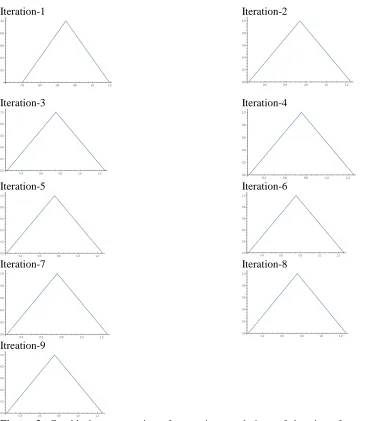
From the table it is clear that
µ
x(10) =µ
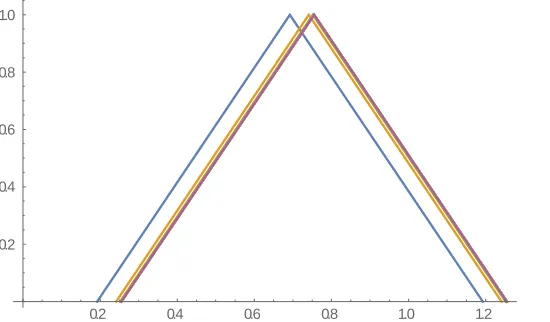
(0.2548776,0.7548776,1.2548776) is the desired root of the given non-linear equation. The graphical representations of the sequence of approximate roots are shown in fig. 3 and the optimum solution of fuzzy non-linear equation is shown in fig. 4.Figure 3: Graphical representation of approximate solutions of the given fuzzy non-linear equation
Iteration-1
0.2 0.4 0.6 0.8 1.0 1.2 0.2
0.4 0.6 0.8 1.0
Iteration-2
0.4 0.6 0.8 1.0 1.2 0.0
0.2 0.4 0.6 0.8 1.0
Iteration-3
0.4 0.6 0.8 1.0 1.2 0.0
0.2 0.4 0.6 0.8 1.0
Iteration-4
0.4 0.6 0.8 1.0 1.2 0.0
0.2 0.4 0.6 0.8 1.0
Iteration-5
0.4 0.6 0.8 1.0 1.2 0.0
0.2 0.4 0.6 0.8 1.0
Iteration-6
0.4 0.6 0.8 1.0 1.2 0.0
0.2 0.4 0.6 0.8 1.0
Iteration-7
0.4 0.6 0.8 1.0 1.2 0.0
0.2 0.4 0.6 0.8 1.0
Iteration-8
0.4 0.6 0.8 1.0 1.2 0.0
0.2 0.4 0.6 0.8 1.0
Itreation-9
0.4 0.6 0.8 1.0 1.2 0.0
Secant Algorithm
47
0.2 0.4 0.6 0.8 1.0 1.2 0.2
0.4 0.6 0.8 1.0
Figure 4: Graphical representation of optimum solution of a fuzzy non-linear equation given in the above example
Acknowledgements: The authors thank to the referees for their suggestions which have made the paper more readable.
REFERENCES
1. R.L.Burden and J.D.Faires, Numerical Analysis, 7th edition, 70-72.
2. F.Rogers and Y.Jun, Fuzzy nonlinear optimization for the linear fuzzy real number system, International Mathematical Forum, 4(12) (2009) 587 – 596.
3. A.K.Adak, M.Bhowmic and M.Pal, Intuitionistic fuzzy block matrix and its some properties, Annals of Pure and Applied Mathematics, 1(1) (2012) 13-31.
4. S.Abbasbandy and B.Asady,Newton’s method for solving fuzzy nonlinear equations, Appl. Math.Comput, 159 (2004) 349-356.
5. G.K.Saha and S.Shirin, Solution of fuzzy non-linear equation using bisection algorithm, Dhaka Univ. J. Sci. 61(1) (2013) 53-58.
6. G.K.Saha and S.Shirin, A new approach to solve fuzzy non-linear equations using fixed point iteration algorithm, Bangladesh Math. Soc., 32 (2012) 15- 21.
7. G.J. Klir and B.Yuan, Fuzzy sets and fuzzy logic Theory and Applications, Prentice-Hall of India Private Limited, New Delhi (1997) 1-117.
8. R.Subash and S.Sathya, Numerical solution of fuzzy modified Newton-Raphson method for solving nonlinear equations, International Journal of Current Research, 3 (11) (2011) 390-392.
9. Avinash J.Kamble and T.Venkatesh, Some results on fuzzy numbers, Annals of Pure and Applied Mathematics, 7(2) (2014) 90-97.