International Journal of Advances in Engineering Research
PERFORMANCE EVALUATION OF OFDM
TRANSCEIVER FOR BPSK & QAM MODULATION
TECHNIQUES
*Dipa Nitin Kokane. # Nitin H Kokane
*Sr. Asst. Prof, Electronics and communication Engineering, ABES Engg College, Ghaziabad, India [email protected]
#Manager, Electronics and communication Engineering, Bharat Electronics Ltd, Ghaziabad, India [email protected]
ABSTRACT
The telecommunication industries insisted on new technology with high transmission abilities standardized by IEEE 802.16 also referred as WiMAX .It has two patterns fixed(802.16d-2004) and mobile(802.16d-2005) which are based on OFDM. This paper is about study and implementation of Convolutional coded WiMAX system comparing different modulation schemes such as BPSK and QAM . The performance has been concluded based on BER and SNR through MATLAB Simulation.
Keywords—BER, BPSK, IFFT, IEEE 802.16 OFDM, QAM, SNR, WiMAX
INTRODUCTION
WiMAX is introduced by the Institute of Electrical and Electronic Engineers(IEEE) which is designated by 802.16 to provide worldwide interoperability for microwave access. There are fixed (802.16d) and mobile(802.16e) WiMAX. This technology offers a high speed, secure, sophisticate, last mile broadband service, ensuring a flexible and cheap solution to certain rural access zones. In a fixed wireless communication, WiMAX can replace the telephone company's copper wire networks, the cable TV's coaxial cable infrastructure. In its mobile variant it can replace cellular networks. In comparison with Wi-Fi and Cellular technology, Wi-Fi provides a high data rate, but only on a short range of distances and with a slow movement of the user. And Cellular offers larger ranges and vehicular mobility, but it provides lower data rates, and requires high investments for its deployment. WiMAX tries to balance this situation. WiMAX fills the gap between Wi-Fi and Cellular, thus providing vehicular mobility, and high service areas and data rates .WiMAX is a standards based technology for wireless MANs conforming to parameters which enable interoperability. WiMAX developments have been rapidly moving forward.
International Journal of Advances in Engineering Research
2. Subcarriers are orthogonal to each other in frequency domain which reduces ISI and frequency-selective fading. The technique is based upon the idea of multi-carrier modulation (MCM) where transmitted data is modulated on several orthogonal carrier frequencies. The subcarriers are closely spaced together but still orthogonal, which means that they are perpendicular in a mathematical sense, and do not interfere with each other
The implementations of OFDM in WIMAX technology today have been done by using FFT and its inverse operation IFFT, uses the formula given below.[1]
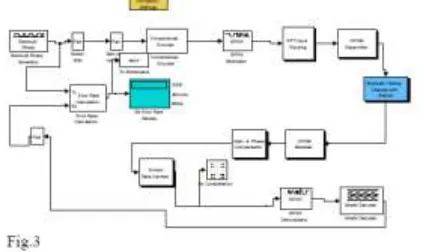
SYSTEM INTEGRATION AND IMPLEMENTATION OF WORK FLOW
International Journal of Advances in Engineering Research
International Journal of Advances in Engineering Research
Transmitter block consists of:1.Input is Bernoulli Binary
2.FEC(Convolution Code, RS Code) 3.Modulation(BPSK and QAM) 4.OFDM Transmitter(IFFT)
Channel can be AWGN,RICIAN and Both.
And Receiver block consists of: 1.OFDM Receiver(FFT)
2.Demodulator
3.Decoder.(Viterbi decoder, RS Decoder)
Parameters for Simulation: Channel Bandwidth is 3.5MHz Cyclic Prefix-1/8
Output Datatype-Boolean Samples per frame-864
The model for convolutional coded WiMAX system using BPSK modulation and QAM modulation is shown.
International Journal of Advances in Engineering Research
The above models are simulated in matlab the simulation rate is .025 and the results are recorded.
1.WITH OUT CHANNEL(QAM) fig.4
Fig 4
2.WITH AWGN CHANNEL(QAM) fig 5
Fig 5
International Journal of Advances in Engineering Research
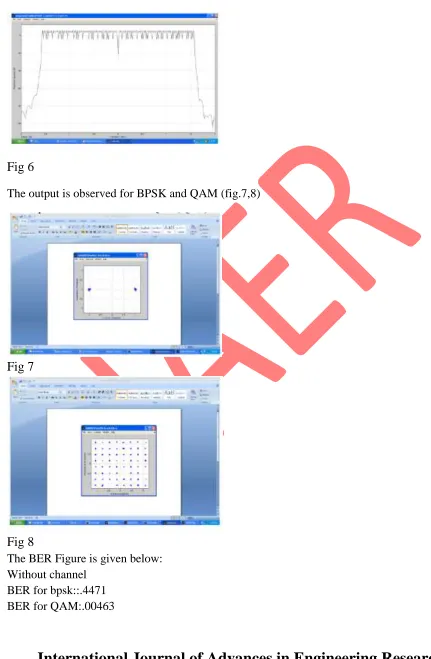
Fig 6
The output is observed for BPSK and QAM (fig.7,8)
Fig 7
Fig 8
The BER Figure is given below: Without channel
International Journal of Advances in Engineering Research
Through channel AWGN For bpsk:BER:.4481 For QAM .08141
Results and graph is given below
Graph is in between different SNR vs BER. For BPSK Modulation Tech.
Table1
Graph 1
QAM Modulation Technique.
International Journal of Advances in Engineering Research
Graph 2
CONCLUSIONS
It is observed that in convolutional coded BPSK system the BER-0.448 ,But it get reduced to ZERO Approximately in convolutional coded QAM system(BER- 0.00463).For further working on the system and sending through AWGN Channel we observed that the BER is less in case of QAM .
REFERENCES
[1] Intel (2006). Orthogonal Frequency Division
Multiplexing.<http://www.intel.com/netcomms/technologie s/wimax/303787.pdf>.
[2] Wikipedia (2006). <http://en.wikipedia.org/wiki/ OFDM>.
[3] WiMAX Forum (2006). http://www.wimaxforum. org/>.
[4] Intel (2006). Understanding Wi-Fi and WiMAX. <http://www.intel.com/netcomms/
technologies/wimax/304471.pdf>.
[5] WiMAX Forum (2004). WiMAX.s technology for LOS and NLOS environments.
<http://www.wimaxforum.org/news/downloads/WiMAXN LOSgeneralversionaug04.pdf>.
[6] IEEE Standard 802.16-2004 (2004). <http://standards.
ieee.org/getieee802/download/802.16-2004.pdf>.
[7] Michael Komara (2004). SDR Architecture Ideally Suited For Evolving 802.16 WiMAX
Standards. <http://www.aircom.com/KomaraWiMAX.pdf>.
[8] J. Heiskala & J. Terry (2001). OFDM Wireless LANs: A Theoretical and Practical Guide.