Vol. 9, No. 2, 2015, 235-243
ISSN: 2320 –3242 (P), 2320 –3250 (online) Published on 8 October 2015
www.researchmathsci.org
235
International Journal of
A New Method to Find Critical Path from Multiple Paths
in Project Networks
Thangaraj Beaula1 and V.Vijaya2 1
Department of Mathematics, T.B.M.L. College
Porayar 609 307, TamilNadu, India; e-mail: [email protected] 1
Corresponding Author 2
Department of Mathematics, A.V.C.College of Engineering Mannampandal, Mayiladuthurai, 609 305, India
e-mail: [email protected]
Received 10 September 2015; accepted 2 October 2015
Abstract. In this paper, we have proposed a method to find the critical path from multiple critical paths where the durations are uncertain. We have formed a linear programming approach for the JKV representation of trapezoidal fuzzy numbers. A real life example is given to illustrate the proposed approach.
Keywords: Trapezoidal fuzzy number, Ranking, Critical Path
AMS Mathematics Subject Classification (2010): 03E72, 90C70, 90C05, 90C08 1. Introduction
When the activity times in the project are deterministic and known, critical path method (CPM) has been demonstrated to be a useful tool in managing projects in an efficient manner to meet this challenge. The purpose of CPM is to identify critical activities on the critical path so that resources may be concentrated on these activities in order to reduce the project length time. The successful implementation of CPM requires the availability of clear determined time duration for each activity. However, in practical situations this requirement is usually hard to fulfill, since many of activities will be executed for the first time. To deal with such real life situations, [10] introduced the concept of fuzzy set. Since there is always uncertainty about the time duration of activities in the network planning, due to which fuzzy critical path method (FCPM) was proposed since the late 1970s.
236
graph with fuzzy arc values. [9] gave a new representation for trapezoidal fuzzy number and found the critical path using the representation.
The paper is organized as follows, the next section deals with the basic definitions, and in section 3, we have discussed the method to calculate the start, finish and float times. We have given the method to formulate the linear programming problem for critical path in section 4. In section 5, we have proposed a method to find a critical path from multiple paths. A numerical example is illustrated in section 6.
2. Preliminaries
Definition 2.1. A fuzzy number with membership function in the form ,
1 ,
( )
,
0 ,
A
x a
a x b b a
b x c x
d x
c x d d c
otherwise
µ
−
≤ < −
≤ <
= −
≤ ≤
− %
is called a trapezoidal fuzzy number A~=(a,b,c,d).
Definition 2.2. A trapezoidal fuzzy number A~=(a,b,c,d) is said to be a zero trapezoidal fuzzy number if and only if a=0,b=0,c=0,d=0.
Definition 2.3. A trapezoidal fuzzy number A~=(a,b,c,d) is said to be non negative trapezoidal fuzzy number if and only if a ≥ 0.
Definition 2.4. Two trapezoidal fuzzy numbers A~=(a1,b1,c1,d1)and )
, , , ( ~
2 2 2 2 b c d
a
B= are said to be equal i.e., A~=B~ if and only if
2 1 2 1 2 1 2
1 a ,b b ,c c ,d d
a = = = = .
2.5. L-R representation of a trapezoidal fuzzy number
L-R representation of a trapezoidal fuzzy number has the membership function of the
form
,
( ) 1 ,
, L
L
L U
A
U U
a x
L x a
x a x a
x a
R a x
α
µ
β
− − ∞ ≤ <
= ≤ ≤
−
≤ < ∞
%
where
α
andβ
are left and right hand spreads. In the closed interval [aL,aU], the membership function is equal to 1. The function L and R are strictly decreasing and uppersemi continuous on supp(A~) {r/ ~(r) A
µ
237 2.6. Arithmetic operations
In this section addition and subtraction operations between two trapezoidal fuzzy numbers are given. Arithmetic operations between (a,b,c,d) type trapezoidal fuzzy numbers.
Let A~1 =(a1,b1,c1,d1)&A~2 =(a2,b2,c2,d2)be two trapezoidal fuzzy numbers. Then ) , , , ( ~ ~ 2 1 2 1 2 1 2 1 2
1 A a a b b c c d d
A ⊕ = + + + +
) , , , ( ~ ~ 2 1 2 1 2 1 2 1 2
1 A a d b c c b d a
AΘ = − − − −
2.7. Arithmetic operations between
(
a
L,
a
U,
α
,
β
)
type trapezoidal fuzzy numbers Let ~1 ( , , 1, 1)&~2 ( , , 2, 2)2 2 1
1 U
α
β
L Uα
β
L a a A a a
A = = be two trapezoidal fuzzy
numbers. Then ) , , , ( ~ ~ 2 1 2 1 2 1 2 1 2
1 + +
α
+α
β
+β
=
⊕ L L U U
a a a a A A ) , , , ( ~ ~ 2 1 2 1 2 1 2 1 2
1 − −
α
+β
β
+α
=
Θ L U U L
a a a a A A
2.8. Ranking function
An efficient approach for comparing the fuzzy numbers is by the use of a ranking function ℜ:F(R)→R,where F(R ) is a set of fuzzy numbers defined on set of real numbers which maps each fuzzy number into the real line. Let (a,b,c,d) be a trapezoidal fuzzy number.
Then ℜ(a,b,c,d)=
4
d c b a+ + +
Definition 2.9. If A~ =(a,b,c,d)is a trapezoidal fuzzy number, then the mode of A~ is given by
2 ~
modeA=b+c
Definition 2.10. If A~ =(a,b,c,d)is a trapezoidal fuzzy number, then the divergence of
A~ is given by DivA~ =d−a
Definition 2.11. If A~=(a,b,c,d)is a trapezoidal fuzzy number, then the Left and Right Spreads of A~ is given by LeftSpread A~=b−aand RightSpread A~ =d−c
Definition 2.12. Let (a,b,c,d) =
(
a
L−
α
,
a
L,
a
U,
a
U+
β
)
be a trapezoidal fuzzy number, then its JKV representation is(
x
,
y
,
α
,
β
)
JKV, where x= aL−α
, y=a
U+
β
.Definition 2.13. A trapezoidal fuzzy number A~=
(
x
,
y
,
α
,
β
)
JKVis said to be zero trapezoidal fuzzy number iff x=0,y=0,α=0,β=0.238
Definition 2.15. Two trapezoidal fuzzy numbersA~1=
(
x
1,
y
1,
α
1,
β
1)
JKVand =2 ~
A
(
x
2,
y
2,
α
2,
β
2)
JKVare said to be equal i.e., 1= ~A 2
~
A if and only if x1=x2, y1=y2, α1=α2, β1=β2.
2.16. Arithmetic operations between JKV trapezoidal fuzzy numbers Let (a1,,b1,c1,d1) and (a2,,b2,c2,d2) be two trapezoidal fuzzy numbers and
JKV
y
x
,
,
,
)
(
1 1α
1β
1 and(
x
2,
y
2,
α
2,
β
2)
JKVbe their JKV representation, then the addition operation is defined as) ,
, ,
( ~ ~
2 1 2 1 2 1 2 1 2
1⊕ A = x +x y + y
α
+α
β
+β
A
Image of ~A1[-A~1] is defined as -A~1=(−y,−x,
β
,α
)2.17. Ranking function for JKV trapezoidal fuzzy numbers
The ranking function defined above for (a,b,c,d) is converted for
(
x
,
y
,
α
,
β
)
JKVasℜ
(
x
,
y
,
α
,
β
)
JKV=2 2
2x+ y+
α
−β
Definition 2.18. If A~ =(a,b,c,d)is a trapezoidal fuzzy number, and
(
x
,
y
,
α
,
β
)
JKV is its JKV representation, then the mode of A~ is given by2 ~
modeA=
α
+x+y−β
Definition 2.19. If A~ =(a,b,c,d)is a trapezoidal fuzzy number, and
(
x
,
y
,
α
,
β
)
JKV is its JKV representation then the divergence of A~ is given by DivA~ = y−xDefinition 2.20. If A~ =(a,b,c,d)is a trapezoidal fuzzy number, and
(
x
,
y
,
α
,
β
)
JKV is its JKV representation then the Left and Right Spreads of A~ is given byα
=A Spread
Left ~ and RightSpread A~ =
β
Example 2.21. If (a,b,c,d)=(60,100,150,180) be a trapezoidal fuzzy number, then its L-R representation is (100,150,40,30) and its JKV representation is (60,180,40,30)
3. Calculating fuzzy time values and critical path in a fuzzy project network
239 fuzzy number tij
~ ∈
T is defined, where tij ~
is the fuzzy time required for the completion of aij. A critical path is a longest path from v1 to vn and an activity aij on the critical path is called a critical activity. Let Ei Li
~ & ~
be the earliest event time for event I, respectively.
Let Ej Lj
~ & ~
be the earliest event time, and the latest event time for event j, respectively.
Let Dj ={i/i∈Vandaij∈A}be a set of events obtained from event j∈V and i<j. We then obtain Ej using the following equations
1
max[ ], , 0
j i ij j
E% = E% ⊕t% i∈D where E% =
Similarly, let Hi ={j/j∈V and aij∈A} be a set of events obtained from event i∈V and i<j. We then obtain Li
~
using the following equations.
min[ ], ,
i j ij i n n
L% = L% Θt% j∈H where L% =E%
The interval [E~i,L~j] is the time during which aij must be completed. When the earliest fuzzy event time and latest fuzzy event time have been obtained, we can calculate the total float of each activity. For activity i-j in a fuzzy network, the total float of the
activity i-j can be computed as Tij Lj Ei tij ~ ~ ~
~ = Θ Θ
For the JKV representation of trapezoidal fuzzy numbers, Earliest start is calculated by using the formula
1
max[ ], , 0
j i ij j
E% = E% ⊕t% i∈D where E% =
Latest finish is calculated by
min[ ( )], ,
i j ij i n n
L% = L% ⊕ −t% j∈H where L% =E%
Total float of each activity can be calculated by )
~ ( ) ~ ( ~ ~
ij i
j
ij L E t
T = ⊕ − ⊕ −
Hence we can obtain the earliest fuzzy event time, latest event time and the total float of every activity by using the above equations.
4. Linear programming approach to find the critical path of a project network The problem of finding critical path in a project network can be formulated as follows
∑
∈A j i
ij ijx
t Max
) , ( Subject to
∑
∑
∈
∈
≠ = −
= =
− A j i j
ji A
j i j
ij
n i if
n i if
i if x
x
) , ( : ) , ( :
, 1 0
1
1 1
5. Proposed Method to find the critical path in a project network
Step 1: Formulate the critical path problem as a linear programming problem.
240
Step 3: If there are alternate solutions, then the total float of each activity can be found and the critical path can be found such that the sum of total floats of the activities in the path is zero.
Step 4: If there is a unique critical path then the solution is achieved.
Step 5: If not, find the mode of the total float and rank the paths such that the path with maximum mode is the critical path.
Step 6: If the modes of all the paths are equal, then find the divergence of the paths and the path with maximum divergence will be the critical path.
Step 7: If the divergence of the paths are same, then compare the left and right spreads of all the paths and the path with maximum spread will be the critical path.
6. Numerical example: critical path for a product sale
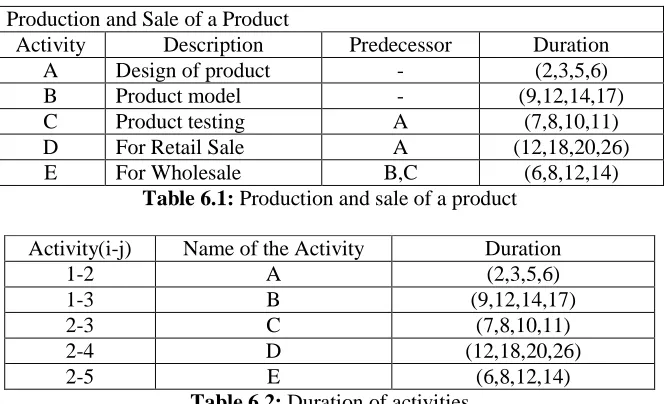
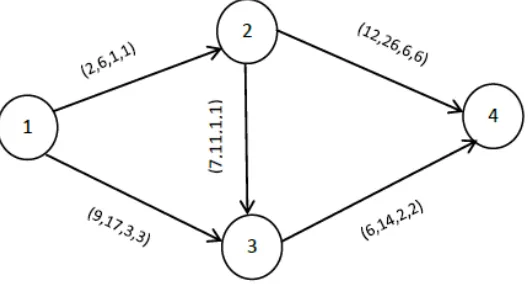
As an example of critical path scheduling, consider the five activities associated with the production of a certain product and its sale as shown in table 6.1 and 6.2, where the durations are uncertain. Figure 6.3 and 6.4 shows the network diagram associated with these five activities.
Production and Sale of a Product
Activity Description Predecessor Duration
A Design of product - (2,3,5,6)
B Product model - (9,12,14,17)
C Product testing A (7,8,10,11)
D For Retail Sale A (12,18,20,26)
E For Wholesale B,C (6,8,12,14)
Table 6.1: Production and sale of a product Activity(i-j) Name of the Activity Duration
1-2 A (2,3,5,6)
1-3 B (9,12,14,17)
2-3 C (7,8,10,11)
2-4 D (12,18,20,26)
2-5 E (6,8,12,14)
Table 6.2: Duration of activities Then its Linear Programming Formulation is given by
23 13
12 (9,17,3,3) (7,11,1,1) )
1 , 1 , 6 , 2
[( x x x
Max JKV ⊕ JKV ⊕ JKV
] ) 6 , 6 , 26 , 12 ( )
2 , 2 , 14 , 6
( JKVx34⊕ JKVx24
⊕
Subject to 1 13 12 +x =
x
0 24 23
12 −x −x =
x
0 34 23
13+x −x =
x
1 34 24 − =− −x x
0 ,
, ,
, 13 23 24 34 12 x x x x ≥
241
Figure 6.3: Network representation of the project
Figure 6.4: Network in JKV Representation. Using the ranking function, the linear programming formulation will be
] 38
20 18
26 8
[( x12 x13 x23 x34 x24
Max ⊕ ⊕ ⊕ JKV ⊕ JKV
Subject to 1 13 12 +x =
x
0 24 23
12 −x −x =
x
0 34 23
13+x −x =
x
1 34 24 − =− −x x
0 ,
, ,
, 13 23 24 34 12 x x x x ≥
x
Using TORA software, it can be found that there are multiple critical paths. The critical paths obtained are
i. 1−2−4 ii. 1−2−3−4 iii. 1−3−4
242 Activity Duration Earliest
Start
Latest Finish Total float 1-2 JKV
)
1
,
1
,
6
,
2
(
(
0
,
0
,
0
,
0
)
JKV(
−
10
,
18
,
2
,
2
)
JKV(
−
16
,
16
,
1
,
1
)
JKV1-3 JKV
)
3
,
3
,
17
,
9
(
(
0
,
0
,
0
,
0
)
JKV(
1
,
25
,
3
,
3
)
JKV(
−
16
,
16
,
0
,
0
)
JKV 2-3 JKV)
1
,
1
,
11
,
7
(
(2,6,1,1)JKV(
1
,
25
,
3
,
3
)
JKV(
−
16
,
16
,
1
,
1
)
JKV 2-4 JKV)
6
,
6
,
26
,
12
(
(2,6,1,1)JKV(
15
,
31
,
5
,
5
)
JKV(
−
17
,
17
,
−
2
,
−
2
)
JKV3-4 JKV
)
2
,
2
,
14
,
6
(
(9,17,3,3)JKV(
15
,
31
,
5
,
5
)
JKV(
−
16
,
16
,
0
,
0
)
JKVTable 6.5: Start, finish and floats of each activity Total Floats of the paths is given in the following table.
Paths Total Float Rank
1-2-4 JKV
)
1
,
1
,
33
,
33
(
−
−
−
01-2-3-4 JKV
)
1
,
1
,
32
,
32
(
−
01-3-4 JKV
)
0
,
0
,
32
,
32
(
−
0Table 6.6: Total float of paths
Since all the paths are of rank zero, we calculate the mode of each path. All the paths have same mode. Hence we calculate the divergence of the paths, from which the critical path can be calculated, which is given below
Paths Total Float Mode Divergence
1-2-4 JKV
)
1
,
1
,
33
,
33
(
−
−
−
0 661-2-3-4 JKV
)
1
,
1
,
32
,
32
(
−
0 641-3-4 JKV
)
0
,
0
,
32
,
32
(
−
0 64Hence it can be found that the critical path of the network is 1-2-4.
7. Conclusion
We have proposed a new method to find the critical path from multiple critical paths by using the JKV representation of trapezoidal fuzzy numbers. A real life problem is considered in this case to illustrate the method. This paves the way for further research.
REFERENCES
243
2. D.Dubois, H.Fargier and V.Galvagonon, On latest starting times and floats in task networks with ill-known durations, European Journal of Operations Research, 147 (2003) 266-280.
3. J.Fortin, P.Zielinski, D.Dubois and H.Fargier, Interval analysis in scheduling, Principles and Practice of Constraint Programming, 11th International Conference, CP 2005, 226-240.
4. H.J.Hsian and C.W.R Lin, A fuzzy PERT approach to evaluate plant construction project scheduling risk under uncertain resource capacity, Journal of Industrial Engineering and Management, 2(1) (2009) 31-47.
5. J.E.Kelley, Critical path planning and scheduling – Mathematical basis, Operations Research, 9 (1961) 296-320.
6. F.A.Loostma, Stochastic and fuzzy PERT, European Journal of Operations Research, 43 (1989) 174-183.
7. K.K.Macak, On fuzzy critical path method, Ekonomicko-matematicky obzor, 27 (1991) 357-366.
8. M.Mares, Network analysis of fuzzy technologies, In: G.W.Evans, W.Karwowski, M.R.Wilhelm (Eds), Applications of Fuzzy Set Methodologies in Industrial Engineering, The Netherlands: Amsterdam Elsevier, 1989, 115-125.
9. T.Beaula and V.Vijaya, Critical path in a project network using a new representation
for trapezoidal fuzzy numbers, Journal of Fuzzy Mathematics, 21(2) (2013) 311-318.