Information Exchanges Among Firms and their Impact on
Competition*
Kai-Uwe Kühn
Xavier Vives
Institut d'Anàlisi Econòmica (CSIC)
Barcelona
June 1994
Revised December 1994
*We are grateful to Paco Caballero, Jim Fairburn, Damien Neven, Pierre Regibeau and DG IV of the European Comission for helpful comments.
Contents
I
Introduction
II A Survey of the Theoretical Literature on Information
Exchange
1 Introduction...2
2 Increasing the Information of a Monopolist...3
2.1 Acquisition of Information about Demand...3
2.2 The Acquisition of Information about Costs...11
3 Sharing Demand Information Among Competitors...13
3.1 Monopolistic Competition...13
3.1.1 Common Shocks to Demand ...14
3.1.2 Individual Shocks to Demand ...22
3.1.3 A Summary of the Effects of Information Sharing in Monopolistic Competition...24
3.2 Oligopoly...25
3.2.1 Common Demand Uncertainty and Quantity Setting...26
3.2.2 Common Demand Uncertainty and Price Setting...27
3.2.3 Quid pro Quo Agreements and Unilateral Information ... Revelation...27
3.2.5 Private Shocks to Demand...29
4 Sharing Information about Costs in Monopolistic Competition and ... Oligopoly 30 4.1 Information Sharing under Quantity Setting...30
4.2 Information Sharing under Price Setting...30
5 Summary 35 5.1 Incentives to Share Information...35
5.2 Welfare Impact of Information Sharing...37
6 Ex-Post Incentives to Exchange Information...40
7 Trade Association Rules ...41
8 Dynamic Aspects of Information Exchange...42
8.1 Exchanging Data on Past Prices or Quantities...42
8.2 Information Exchange and the Scope for Dynamic Collusion...43
8.2.1 Dynamic Collusion with Public Information...48
8.2.2 Dynamic Collusion with Private Information...52
8.2.3 Lessons to be drawn from the Literature on Dynamics Collusion...53
8.3 Exchanging Data on Planned Prices on Quantities...54
III The Competition Policy of Information Sharing
1 Information Sharing as a Concern for Anti Trust Policy
1.1. USA ...59
1.1.1 The Development of Trade Associations in the US ...59
1.1.2 The American Column Case ...62
1.1.3 The Linseed Case...64
1.1.4 The Reversal of Position by the Supreme Court: Cement and Maple Wood Flooring...65
1.1.5 More Recent Cases and Current Policy...66
1.1.6 US Policy Towards Price Preannouncements ...68
1.2 United Kingdom...72
2 EC Antitrust Policy on Information Sharing 2.1 The Legal Framework ...74
2.2 Purposes and Effects of Information Sharing Agreements ...75
2.3 Market Transparency and Hidden Competition...77
2.5 The Role of Market Concentration ...82
2.6 Information Exchange as a Barrier to Entry...83
3 An Analysis of Information Sharing Issues in Important EC Cases 3.1 Wood Pulp...84
3.1.1 Pre-sales Price Announcements to Downstream Agents and Customers...86
3.1.2 Private Communications between Wood Pulp Producers ...88
3.1.3 Information Exchange Between Customers...91
3.1.4 The Debate on "Normal" Market Transparency...92
3.2 Fatty Acids...93
3.3 UK Agricultural Tractor Registration Exchange...96
3.4 Cases of Price Fixing with Information Exchange...102
3.5 Exemptions in Insurance Markets: The Nuovo Cegam Case...105
IV Conclusions and Policy Implications
I Introduction
In order to formulate competition policy prescriptions for dealing with information exchange among firms it is necessary to study the potential effects of information acquisition and exchange on welfare and consumer surplus. The present report addresses the competition policy of information sharing from the point of view of economic analysis and is divided into two parts. In the first part a critical survey of the existing literature on information exchange is presented. This survey discusses the literature on information acquisition and exchange in static models as well as the impact of information exchange in dynamic settings as far as conclusions can be drawn from the literature. Reflecting the state of the literature the main part of the survey is concerned with information exchange in static settings. In the second part of this report the competition policy of information exchange agreements is studied. We first review antitrust policy on information sharing in the US and the UK and then turn to EC policy. Particular attention is devoted to important cases in the EC. Conclusions are summarized in Part IV of the report.
II A Survey o f the Theoretical Literature on Information
Exchange
1 Introduction
Information exchange can be considered as only one particular form of information acquisition. Any form of information acquisition will have three effects. First, it will make decisions of the firm that acquires the information more precisely geared to the environment. Secondly, the change in actions induced by information acquisition will have external effects on consumers in the market. Thirdly, information acquisition by a firm may have external effects on other firms that compete in the same market. We will distinguish between these three effects in our discussion of information acquisition and exchange. For this purpose it is useful to first abstract from the complications of the third effect and analyze the incentives of a monopolist to acquire information and the effects on consumer and social welfare. We will then demonstrate that the effects uncovered in that analysis give us the tools for an intuitive analysis of information exchange in markets with competing firms. We use the framework developed for the monopoly context to discuss the effects of externalities of information acquisition by rival firms and the implications for the information exchange both in monopolistic competition and oligopoly.
The analysis of information exchange in static models is complemented by a discussion of the issues that information exchange raises in dynamic settings. Finally, we study the possibilities for reducing market inefficiencies in markets characterized by moral hazard and adverse selection through information exchange mechanisms. We point out that the significant implications for competition policy arise from the latter set of issues and draw some qualitative conclusions about the type of rules for information exchange agreements that can be supported by economic analysis.
2 Increasing the Information of a Monopolist
In order to understand the effects of information exchange it is useful to try to understand the general principles underlying the effects of information acquisition in the presence of market power, but in the absence of informational externalities on competing firms. This can be done in the context of a simple monopoly model.1 We have to distinguish between two different sources of uncertainty. One is uncertainty about demand, the other is uncertainty about costs. We will discuss both of them in turn.
2.1. Acquisition of Information about Demand
Consider a standard model of monopoly. The monopolist has a linear inverse demand function
p = a - Q
where p is the market price, Q the output produced and a the demand intercept. Consider a situation in which the value of the demand intercept a is random and unknown to the monopolist. We will for simplicity of exposition suppose that there are only two states of demand. When demand is high a = aH, when demand is low a = aL. We denote the
expected value of a by a*. Suppose one could give a monopolist an additional piece of information about his true state of demand a . This will certainly improve the quality of the
1 Note that one can interpret the analysis of monopoly information acquisition as information exchange between firms operating in unrelated markets. In this sense it is information exchange between maximally differentiated firms, a special case of the model of Vives (1984). Most of the results discussed in this section follow from Proposition 6 in that paper.
monopolist's decision making and therefore the monopolist's profits.2 However, improving the quality of a monopolist's decision making is not necessarily socially beneficial. The social benefits of giving a monopolist more information depend on whether a monopolist will use this information to obtain an allocation that is more efficient on average, or whether he instead uses the information to redistribute surplus from consumers to himself more effectively. This would create a greater allocative distortion on average. In other words: Will the monopolist have an incentive to increase profits by increasing the cake or by increasing his share in a smaller cake?
The answer crucially depends on whether the monopolist chooses price or quantity. From the work of Leland (1972), Weitzman (1974) and Browing (1987) we know that, in contrast to the certainty case, price and quantity setting by a monopolist is not equivalent when facing uncertain demand. If there is quantity setting prices have to adjust to the realization of demand (see Figure 1), while under price setting quantities have to adjust to clear the market (see Figure 3). If we give a monopolist better information about demand this will have different effects depending on the decision variable of the monopolist. If the decision variable is quantity, giving more information to the monopolist will lead to more quantity adjustments and less price adjustments. If the decision variable is price, the opposite will be the case.
Figure 1, 2, and 3 illustrate the arguments in the previous paragraph. The two demand curves corresponding to the two true states of demand are drawn as dashed lines. The solid
2 In the terminology of some of the information sharing literature there are two effects. First, the output of the monopolist becomes more variable, which is a negative effect. Secondly, output becomes more correlated with the demand intercept, which is a positive effect. However, the net effect of the two is always positive because improving information will always increase profits. We will continue in the
line is the expected demand curve that a monopolist faces if he has no information about demand. Suppose first, that the monopolist is a quantity setter. If he has no information about the true demand intercept, he will choose the optimal quantity relative to the expected demand curve, Q*. The realized price will lie on the intersections of the vertical line and the dashed demand curve above or below the expected demand curve in Figure 1. What happens, if we give a quantity setting monopolist better information about demand? Suppose for concreteness that with some probability g the true demand state is revealed to him. Then, on average, he will produce more in the high demand state (QH) and less in the low demand state (QL). This reduces dead weight loss in high demand states (by the dashed area to the right of the vertical line) and increases deadweight loss in low demand states (by the dashed area to the left of the vertical line). Note, however, that a small move towards more production in the high demand state leads to a greater reduction in the dead weight loss than the increase in the deadweight loss from a small move towards lower output in the low demand state. This can be seen from the shaded areas in Figure 1. Hence, if the monopolist is a quantity setter, deadweight loss is reduced by improving the monopolist's information.
P
a
H
a
L
Q
Figure 1
Increasing Information is Welfare Enhancing
The Quantity Setting Monopolist
with Demand Uncertainty
Q*
QL QH
a*
It is also possible to show that in this case consumers gain from the quantity setting monopolist having the additional piece of information. To see this consider Figure 2. The consumer gains from higher consumption and lower prices in good states of the world (the upper area) outweighs the loss from lower consumption and higher prices in bad states of the world (the lower dashed area). Essentially, part of the increase in total social surplus is passed on to the consumers in form of lower prices in the good state.
P
a
L
Q* Q
Figure 2
Positive Externalities for Consumers
Negative externalities
for consumers in low demand
states Positive externalities for consumers in high
demand states a*
aH
Q
L QH
The opposite argument is true in the case of price setting, which is illustrated in Figure 3. Starting with no information about the true state of demand the price setting monopolist would set the optimal price relative to the expected demand function, p*. Output would adjust to clear the market at QL and QH for low and high realizations of demand respectively. This leads to large variations in output. Now suppose you give the monopolist a signal that reveals with probability g the true state of demand. On average output will be reduced in the high state (to ˆ Q H) and increased in the low state (to ˆ Q L) of demand. Hence, by exactly the same reasoning as above we will have increases in the average (i.e. expected) dead weight loss. The profits of the monopolist increase but only at costs to the consumer that outweigh these gains.
P
aH
aL
Q
Figure 3
Increasing Information is Welfare Reducing
The Price Setting Monopolist and Demand Uncertainty
QL Q
H
a*
p*
QˆL QˆH
The argument that giving a monopolist additional information about demand will only be socially beneficial with quantity setting, is quite a general one3. It rests on the observation that expected social surplus (and expected consumer surplus as well) generally increase if
output is more responsive to the actual state of the world. From a consumer surplus (and a welfare) point of view uniformity of prices and variability of output is preferred to variability of prices and uniformity of output across different states of demand. Note, that this effect creates a difference between price setting and quantity setting that has nothing to do with the usual difference between price and quantity setting in oligopoly models. This effect is not a strategic effect, but is of great importance in evaluating the welfare effects of information acquisition and information exchange, whenever there is market power.
There is another observation that is of importance for the later analysis. This is the fact that increasing the variability of demand for given expected (i.e. mean) demand will always increase profits of the monopolist if he has some information. Essentially, information of a given quality becomes more valuable under greater demand uncertainty, because the gains from adapting to the true state of demand become greater. This is illustrated in Figure 4 with an example in which the monopolist always perfectly knows the state of demand.
P
aH
aL
Q
Figure 4
The Profit Effect of Observed Demand Variability
a*
The central demand function corresponds to a completely certain demand. "High" and "Low" demand states are the same. Now suppose we have uncertain demand with a high and a low demand intercept. The central line then becomes expected demand. Having greater uncertainty means that the monopolist gains in high demand states and losses in low demand states. However, the gain in high demand states is always larger4. Intuitively, winning sales in high demand states is more valuable than the costs of losing sales when demand is low.
4
2.2 Acquisition of Information about Costs
In the case of cost uncertainty the analysis becomes much simpler. Since the demand function is not random both price and quantity setting lead to the same result . Therefore, we only have to analyze one of the cases to study the welfare impact of increasing a monopolist's information. As in the case of demand uncertainty, increasing information for the monopolist will make output higher in low cost states and lower in high cost states. As can be seen from Figure 5 the marginal benefit of an increase in production in low cost states exceeds the loss of a decrease in production in high cost states. Hence, expected dead weight loss is reduced through information acquisition.
P
H
c
L
Q
Figure 5
Increasing Information is Welfare Improving under Price and Quantity
Setting
The Monopolist with Cost Uncertainty
Q* c*
p*
3 Sharing Demand Information Among Competitors
After having discussed the effects of information acquisition of a monopolist we now introduce the effects of competition between firms with market power. In this section we will concentrate on information exchange of demand information. We will think of information sharing as consisting of two parts from the point of view of a single firm. First, all competitors acquire additional information. We will analyze the externality imposed on the firm by the acquisition of information by competitors. Secondly, the firm itself acquires information through information exchange. This will have the previously noted effect of improving the firm's adaptation to demand shocks. However, there is a third effect of information acquisition. If other firms know that a firm has acquired information, as is the case with information exchange, these firms will adjust their behaviour. This effect is not present under monopolistic competition since a single firm's output or price decisions will not affect the residual demand functions other firms face5. To separate the different effects we will first analyze information exchange under monopolistic competition and then discuss the additional effect generated in oligopoly.
3.1 Monopolistic Competition
In the monopoly case we showed that the monopolist always gains in ex-ante expected profits if the variance of demand is greater for given expected demand6. By analogy we can conclude that anything that makes the residual demand function a firm faces under
5 Under monopolistic competition a single firm has market power but cannot influence market aggregates by its decision. This means that it cannot affect other firms' demand functions. The model of monopolistic competition we consider is the limit of the oligopoly model, when the number of firms becomes arbitrarily large and firms retain some monopoly power.
monopolistic competition (or oligopoly) less variable will hurt a firm that has some information about demand. In contrast, anything that makes the residual demand function more variable will benefit the firm. While this fact was of no importance to our analysis of information acquisition in the monopoly case it becomes important when there is interaction between firms in a market. The reason is that the variability of residual demand that a monopolistically competitive (or an oligopolistic) firm faces depends on the information of its competitors. Acquisition of information by competitors has an external effect on a firm by making the residual demand function it faces more or less variable. We will show that these informational externalities have important effects on the incentives to acquire information through information sharing.
The analysis of information exchange under monopolistic competition is due to Vives (1990). A first complication in the analysis arises because with competition there is a much richer set of possible informational environments. Most importantly, with competing firms, we have to distinguish whether shocks to demand are firm specific ("private values model") or affect demand for all firms in the market in the same way ("common value model"). Common value models are considerably simpler to analyze. We will therefore discuss them first before turning to models with firm specific shocks to demand.
3.1.1 Common Shocks to Demand
Let us illustrate the main point about competitive externalities from information improvements for competitors in an example in which demand faced by each competitor is affected by a common shock. Let demand for the good of firm i be given by
pi = a-(1- d )Qi - dQ ˜
where a is the uncertain demand parameter, Qi is the output of the firm, and ˜ Q is the average output of all other firms in the market. Since we assume monopolistic competition no firm
perceives any influence of its actions on the average output in the market, ˜ Q . This is the "large group assumption" underlying the notion of monopolistic competition. An individual firm's decisions have no impact on the demand of a competitor. However, several firms jointly affect demand. Note, that d is a measure of how differentiated products are in monopolistic competition. With d = 0 there is a pure monopoly situation and everything we have said about monopoly applies. As d goes to 1 goods become perfect substitutes and firms are not able to influence the price. The demand intercept is perceived by firm i as being a - d ˜ Q . If other firms do not have any information about a the only uncertainty in the demand intercept comes from the uncertainty about a .
The Informational Externality of Information Acquisition by Rivals
Let us first consider the case in which firms set quantities. In Figure 6 we have plotted the demand function that firm i faces when other firms in the industry have no information and the state is high as DH = a
DL dL De dH DH pi
Qi
Information Acquisition by Quantity Setting (Common Demand Shocks)
Figure 6
The external effect on residual demand
~ p = α - (1 - δ) Q - d Qi i
The solid line in the middle is as before the expected demand curve. Now suppose that other firms can perfectly condition on the state of demand a because they possess this information. Then they will produce more in states with high a and less in states with low a. This means
˜
Q (aH) > ˜ Q * > ˜ Q (aL) and therefore the demand intercept of firm i is reduced in high states
and increased in low states. Hence, the demand intercept varies less from the point of view of firm 1. In other words, demand for firm i in the high and the low state, dH =a
and dL =a
H - d ˜ Q (aH), will lie closer to expected demand than DH and DL. Demand for firm i
is less variable if other firms have full information of a.
gain in bad states
D
L
dL De dH DH
pi
Qi Q*
loss in good states Information Acquisition by
Rivals
in the Absence of Private Information
Figure 7
First, note from Figure 7 that this would have no effect on firm i if it had no prior information on the state of demand. What is lost by lowered prices in the high state of
demand is gained by higher prices in low states of demand7. This is different, however, if firm i has some private information about demand. Decreasing the variance of demand for given expected demand will then always decrease the profits of the firm as in the monopoly case. Hence, information acquisition by competitors leads to residual demand of a firm becoming less variable if competitors are quantity setters. As a result there is a negative externality of information acquisition. Intuitively, the acquisition of information by competitors makes them react more actively in terms of output to the demand shock. This gives the remaining firm less value from exploiting the information it has about demand. Hence, in the case of quantity setting and common shocks to demand there is a negative external effect on the value of information of firms from the information acquisition of competitors.
The Incentives to Form Industrywide Information Exchange Agreements
We can now consider the effects of industrywide information sharing agreements in situations with common demand uncertainty and quantity setting. Information sharing agreements improve the information of the firms and therefore the quality of their decision making. On the other hand they mean that for each individual firm the variability of demand is decreased, which is bad for firms because it reduces the value of their pre existing information. Furthermore, the more variability is reduced through information sharing the less valuable is the extra information gained. If products are very close substitutes then variability of individual demands is reduced almost to zero and hence the gain from the additional information arbitrarily small. As a result, the loss from reduced variation in demand will outweigh any gains from the improved precision of information about the demand intercept. Hence, firms prefer not to exchange information in monopolistic (quantity) competition with common demand uncertainty when products are close enough substitutes. (See Vives 1990, Lemma 2). On the other hand, as goods become poorer
7
substitutes the effect of competitors' adaptation to demand information has smaller impact on the residual demand variability of a single firm (and it disappears for unrelated monopolies). Hence, variability of demand will be reduced less while the value of acquired information is higher. The incentives to establish an industrywide information exchange agreement will therefore be increased with poorer substitutability of products.
The Reversal of Externalities and Incentives under Price Setting
With price setting firms the argument we have just made is reversed. Increasing the information of other firms, makes the output of those firms less variable with the demand intercept, as we have seen in the monopoly case. As a result, the demand intercept of firm i becomes more variable. With price competition the competitive externality among firms is positive. Information acquisition by rival firms increases the value of existing information for other firms. The effects of gaining more precise information about demand and the positive externality of others acquiring information both give an incentive for industrywide information sharing agreements as long as products are substitutes.
DL dL De dH DH pi
Qi
Information Acquisition by Price Setting Rivals (Common Demand Shocks)
Figure 8
The Effects of Information Exchange Agreements on Welfare and Consumer Surplus
The main welfare effect of information sharing under monopolistic competition is the same as that of information acquisition in monopoly. Information sharing leads to better information for firms, which induces more quantity adjustments when firms set quantities and induces less quantity adjustments when firms set prices. Hence, information sharing leads to a decrease in expected deadweight loss under price setting. We will call this the quantity adjustment effect. However, in contrast to the monopoly case, under monopolistic
competition we have an additional effect due to product differentiation. Product differentiation, in this model, is derived from the assumption that consumers have preference for variety. This means that for any given average output across firms consumers prefer consumption bundles that have less variation of consumption across varieties. In other words, uniformity of output across varieties is valued by the consumer when he has preference for variety. Information exchange has the effect of increasing uniformity of output across varieties, both when firms set quantities and when they set prices. If the information of firms is more correlated, output will be more uniform across firms. This has a positive welfare impact both under price and under quantity setting. We will call this the preference for variety effect.
As a result, under quantity setting, the quantity adjustment effect and the preference for variety effect go in the same direction. Welfare is increased through information sharing. On the other hand, with price setting, the two effects go in opposite direction. Vives (1990) proves that the quantity adjustment effect dominates under monopolistic competition, so that information exchange under price setting is welfare reducing8.
8To make the above argument more precise consider expected total surplus in Vives (1990), which can be written as:
E αQi−δQ Q˜ i −
1−δ 2 Qi
2 ∫ di
+δ Cov Q
( )
i, ˜ Q −1
2Var ˜
( )
Q
where E denotes the expectations operator and Cov and Var denote the unconditional covariance and variance respectively. The term under the integral sign is exactly the same for every i as in the case of monopoly, interpreting a -dQ ˜ as the demand intercept and (1-d) as the slope of demand. Therefore, the effects on total surplus and consumer surplus we discussed in the monopoly section apply to this term. The second term, the difference in the covariance of individual output and average output and half the variance of average output corresponds to the preference for variety effect. This term will generally increase through information sharing. To see this note that generally the covariance between individual
The same two effects are at work in evaluating the impact of information sharing on consumer surplus. Again, the quantity adjustment effect is dominating with price setting firms. As a result, consumer surplus is increased by information sharing when firms are quantity setters and reduced if firms are price setters (see Chart 1, Vives 1990).
3.1.2 Individual Shocks to Demand
To complete the analysis of information sharing about demand in monopolistic competition we have to look at the case in which each firm's demand is affected by an individual shock to the demand intercept. In this case firm i' s demand becomes:
pi=ai - (1- d)Qi -d ˜ Q
where the only difference is that the demand intercept ai is now firm specific. This change
does, however, significantly affect the analysis. Let us suppose that ai is perfectly known by
firm i and that demand intercepts are imperfectly positively correlated across firms. If other firms do not have any information about their competitors a single firm will expect ai and ˜ Q to be positively correlated. Observing a high ai gives firm i the information that other firms,
on average, will also have high realizations of their demand intercepts. Now suppose that
output and average output is smaller than the variance of average output, i.e. 0 < Cov (Qi, ˜ Q ) < Var
( ˜ Q ), whenever firms have different information. However, after information sharing they are the same. Since firms are symmetric in our model they will all produce the same output when they have the same information, which means that individual output is perfectly correlated with average output, i. e. Cov
(Qi, ˜ Q ) = Var ( ˜ Q ). Hence, there is always a gain in welfare ( and consumer surplus) from the preference for variety effect. In the case of price setting the first effect (which we know from the monopoly case) does, however, dominate the preference for variety effect (see Proposition 3, Vives
other firms except for firm i are perfectly informed about the realization of all the demand intercepts. How do these firms react? If the average a in the market is higher than expected firms will decrease output expecting other firms to produce more than anticipated. If average a in the market is lower than expected they will increase output expecting other firms to produce less than anticipated. Hence, after information sharing each output produced for every firm j, and therefore average output, will vary less systematically with a given aj. What are the effects for the variability in the demand intercept that firm i faces? Firm i has full information about ai when setting output. Average output ˜ Q will before information
sharing vary positively with ai because of the correlation between private shocks. After
information sharing ˜ Q varies less systematically with ai , which makes the demand intercept
ai - d ˜ Q more variable from the point of view of firm i. Hence, other firms obtaining
information has a positive external effect on firm i.
Note that this conclusion is unchanged under price setting behaviour. When firms obtain information and are price setters, they will increase prices if they find that demand intercepts are higher than expected, because they expect other firms to set higher prices. The opposite is the case if demand intercepts are lower than expected. However, the average quantity produced will again vary less systematically with an individual demand intercept ai. The positive externality from other firms obtaining information persists.
The Incentives for Information Sharing
The incentives for industrywide information sharing agreements in such a market can again be summarized by looking at information sharing for each firm i as consisting of first informing all other firms, and then improving the information of firm i. We have shown that the first move has a positive external effect on firm i while improving information is always beneficial to the firm given that in monopolistic competition the acquisition of information by a single firm does not affect the behaviour of others. As a result it is profitable for firms to establish industrywide information sharing agreements as shown in Vives (1990, Chart 1).
The Effects of Information Sharing on Welfare and Consumer Surplus
Again we can deduce the main effect of information sharing, the output adjustment effect, from the simple monopoly case. Under quantity setting the variability of output increases for each firm while it decreases under prices setting. However, the preference for variety effect will tend to go in the opposite direction from that in the common value case. Optimal adaptation to demand shocks implies that firms with high realizations of the demand intercept produce more than firms with low realizations of the demand intercept. Information sharing will, therefore, tend to increase the disparity in outputs among different firms. Since there is preference for variety this effect will lower welfare and consumer surplus. In the case of price setting by firms the output adjustment effect and the preference for variety effect both decrease welfare and consumer surplus. Under quantity setting the output adjustment effect again dominates in monopolistic competition yielding an increase in welfare (see Vives 1990, Proposition 3). The effect on consumer surplus is, however, ambiguous because of the preference for variety effect.
3 . 1 . 3 A Summary of the Effects of Information Sharing in Monopolistic Competition
To summarize we note that there are two effects of information sharing for firms in monopolistic competition. First, firms get more information, which is like receiving a better signal. This is always good for firms. On the other hand, other firms get better information. This can be good or bad for firms. There are also two effects of information sharing on welfare and consumer surplus. First, there is an output adjustment effect. Information sharing under quantity setting leads to more output adjustment. This leads to a tendency of deadweight loss being increased from information sharing under price setting and decreased from information sharing under quantity setting. Secondly, there is a preference for variety effect. When there are common shocks to demand information sharing makes outputs across firms more uniform. When there are firm specific shocks to
demand information sharing makes output across firms less uniform. With preference for variety consumers prefer a more uniform distribution of output across varieties. Hence, there is a positive effect on consumer surplus from information sharing when there are common shocks to demand, but a negative effect on consumer surplus when there are firm specific shocks to demand.
Note that the dominating effect on welfare is the output adjustment effect. This effect does depend on whether there is price or quantity setting, but is in no way related to the competitiveness of the market. The expected levels of output are not influenced by information sharing. On the contrary, the dominant effect is also present in the case of pure monopoly. This indicates that in static models the welfare results of information exchange need not change qualitatively simply by going from a highly concentrated market to one that has a large number of firms.
3.2 Oligopoly
While much has been made of the "strategic effects" of information sharing, the results of the oligopoly literature on information sharing can basically be understood in terms of the arguments made for the case of monopolistic competition. Under oligopoly and demand uncertainty there are again two main effects of information sharing on firms. One is the increased precision of information, which benefits the firm. The other is the increased precision of information of others which may benefit or hurt the firm depending on whether residual demand becomes more or less variable. Hence, there is a direct information effect and an indirect informational externality. However, a third effect arises in oligopoly because firms have a perceivable effect on their competitors. A firm knows that other firms know when it acquires information and it knows that these firms act according to that knowledge. If a firm knows that another firm has just acquired the information it has itself it will change its behaviour accordingly. Hence, the fact of acquiring information may not only improve the precision of information but at the same time affect the variability of the
residual demand function. However, while this may influence the value of information acquired, it does not in any significant way affect the qualitative conclusions from the analysis. The net value of the information acquired from other firms through information exchange will still remain positive. We can therefore without loss of insight still analyze information sharing as the combination of two steps: First all firms except for firm i receive the relevant information in the market which generates an informational externality for firm i. Secondly, firm i is given all the information in the market, which produces a net gain. We will discuss the literature on the subject based on these two effects.
3.2.1 Common Demand Uncertainty and Quantity Setting
Consider first common demand uncertainty and quantity competition. As in the case of monopolistic competition giving other firms more information will reduce the variance of the demand intercept. Given the signal that the firm receives this reduces profits. On the other hand receiving additional information from others increases benefits. Hence, there is a trade-off between the benefits of information precision through information sharing and the losses from giving other firms more precise information. As in the case of monopolistic competition with perfect substitutes information sharing reduces the profits of firms (Vives 1984, Gal-Or 1985). If we make the goods poorer substitutes the informational externality gets smaller since adaptation to the demand shock by other firms does not feed through as much into the demand intercept of the remaining firm. If goods are poor enough substitutes there will be incentives for information sharing (Vives 1984). By the same argument increasing marginal costs of production will reduce the informational externality because it is more costly to react to information. In particular, exploiting good information about demand is costly if marginal costs are increasing. Hence, the reduction in variability of residual demand becomes smaller the steeper marginal costs are. If marginal costs are increasing fast enough, the effect of increased precision in information will dominate and there will be an incentive for industrywide information sharing agreements even under Cournot competition (Kirby 1988). These incentive effects are summarized in Raith (1993,
Proposition 4.4).
As in the monopolistic competition case welfare and consumer surplus are increased (Sakai 1989). Hence, for very imperfect substitutes, i.e. almost monopolistic markets, or for very steep marginal costs private and public incentives of information sharing go in the same direction. This is as in the pure monopoly case.
3.2.2 Common Demand Uncertainty and Price Setting
With price competition and common shocks to demand the effects are again identical to those of monopolistic competition. Under price competition the residual demand of a firm gets more volatile when other firms improve their information. Hence, firms benefit from this effect. There is always an incentive to form industrywide information exchange agreements. As under monopolistic competition there are two effects on total expected welfare and expected consumer surplus. On one hand there is a negative effect from the output adjustment effect. Increasing information of firms reduces the adjustment of output to the state of demand. On the other hand there is a positive preference for variety effect. Output becomes more uniform across firms. However, the first effect always dominates from the point of view of consumers. Consumer surplus falls. However, welfare may rise if goods are close enough substitutes.
3.2.3 Quid pro Quo Agreements and Unilateral Information Revelation
The literature has quite extensively discussed the possibilities of Quid-pro-Quo Information Sharing Agreements and Unilateral Information Revelation (see Vives 1984, Kirby 1988, Raith 1993). A Quid-Pro-Quo agreement means that firms come to an agreement to give their private information to other firms if and only if other firms give up their private information. Unilateral Information Revelation means that firms would wish to reveal information to others regardless of whether they obtain information or not. Such a one-sided commitment to reveal private information to others will only improve the information
of others without improving the precision of information for the firm. Hence, under Cournot competition only quid pro quo information sharing agreements are possible since information acquisition by others has a negative external effect on the value of information of the firm. In contrast, firms will be willing to unilaterally reveal information if they compete in prices. Then, as we have shown, information revelation on a common demand shock makes demand more volatile leading to an increase in the value of information. Note, that this is not in conflict with the model of information sharing under monopolistic competition. The only difference is that under monopolistic competition a single firm cannot effectively change the information set of other firms. Hence, the firm is always indifferent between revealing its information to others or not.
3.2.4 The Effects on Entry
It has been argued in competition policy cases that information sharing may increase barriers to entry. It should be noted that our analysis above leads to an ambiguous conclusion with respect to this claim. The profits of a potential entrant will be affected by information exchange only through the external effect of the information sharing agreement. This effect is negative in the case of quantity competition and therefore might be considered as a barrier to entry. However, it is positive in the case of price competition. Information exchange would therefore encourage entry in the case of price competition. There has been no formal analysis of information sharing in the presence of entry threats. However, from the previous discussion we can obtain some conclusions. We would expect a smaller negative welfare effect of information exchange agreements under price competition since they increase the possibility of entry. On the other hand entry threats may prevent information exchange from occurring. If firms anticipate that information exchange will lead to entry they may decide not to undertake it. On average we would expect entry to reduce the welfare effects of information sharing under price setting. With quantity setting the conclusion is more ambiguous. Since under Cournot competition there is a tendency
towards excess entry in markets9, the reduction in entry incentives might have an additional welfare benefit in such models.
3.2.5 Private Shocks to Demand
Private shocks to demand will again have effects similar to those discussed in the model of monopolistic competition. To see this consider the case of quantity competition. If other firms are informed that firm i has a low (high) state of demand, others will produce more (less) because they know firm i has an incentive to produce less. Hence, with information sharing the (intercept of the) residual demand function becomes more volatile, benefiting the firm. In consequence, firms will have an incentive to share information under quantity competition (Fried 1984, Li 1985, Shapiro 1986). Indeed, sharing information is now a dominant strategy for firms and firms will be willing to unilaterally commit to sharing information. Welfare and consumer surplus are, as in the case of monopolistic competition, affected in two ways. First, there is the output adjustment effect, which is positive in the case of quantity setting. Secondly, there is the preference for variety effect which is negative because of private value uncertainty. Expected welfare will again be increased. However, the preference for variety effect will be larger for smaller numbers of firms leading to reductions in consumer surplus for duopoly (and more generally for markets with few firms). In this sense markets with a larger number of firms will make information sharing with quantity competition and private demand shocks more likely to lead to welfare improvements (Sakai 1986, 1989).
Similarly, under price competition, additional information of competitors will also lead to more variability in residual demand. If firms are informed that firm i's demand is high (low) they will set higher (lower) prices. This means the outputs other firms produce get more negatively correlated with the demand parameter ai. Therefore, the demand intercept
gets more variable in ai through information exchange. Hence, information exchange
improves the precision of information and increases the variability of residual demand (a positive informational externality). However, both the output adjustment effect and the preference for variety effect are negative, so that expected welfare and expected consumer surplus are reduced.
4 Sharing Information About Costs in Monopolistic
Competition and Oligopoly
We have seen that in the case of a monopoly uncertainty about costs meant that price setting and quantity setting were equivalent. In the case of competition, however, such a clear distinction between cost and demand uncertainty cannot be made. In particular, cost uncertainty of one firm will induce demand uncertainty for the other firm, since residual demand depends on the actions of the other firm.
4.1 Information Sharing under Quantity Setting
The analysis is significantly simplified in the case of quantity setting. Quadratic preference models with shocks to the level of marginal cost can always be reinterpreted as models with shocks to the intercept of demand and certain marginal costs. The analysis of private incentives, total welfare effects, and consumer surplus coincides.
4.2 Information Sharing under Price Setting
Under prices setting behaviour there is an added complication to the effects of information exchange. Up to now informational externalities came about indirectly. Acquisition of information by competitors had an effect on a firm only if it had some information about the uncertain parameter. Competitors gaining information meant a reduction or an increase in the value of the information the firm possessed. As a result there were only external effects of information acquisition if firms had some information. In contrast, in the case of cost
uncertainty and price setting behaviour there is the possibility of direct externalities of information acquisition on competitors. Even when a firm has no information about its own costs or those of its competitors can there be an external effect of information acquisition about costs by competitors on its expected profits. With cost uncertainty and price setting firms we will face a direct correlation between its costs and its demand intercept when rival firms acquire information about its costs. To see this consider the profit function a firm faces in such a market:
[pi - ci][a-bpi + dSj≠i pj]
Now suppose that firms j have information about the costs of firm i, then prices pj will systematically vary with ci even if the price of firm i, pi, remains unchanged.
To see more clearly what this effect does, let us consider an extreme situation. Suppose all firms have the same marginal cost level c. However, firm i is unaware about this cost level. We will look at the effect of other firms acquiring information about c. From our discussion of demand uncertainty with Cournot competition, we know that in the quantity setting case there would be no effect on the expected profits of firm i (see Figure 7). Now consider Figure 9. The three lower horizontal lines represent the high cost state, the expected marginal costs, and the low cost state, respectively.
p
i
De
p*
cH
c* cL
Q* Qi
Profits in the High Cost State
Figure 9
The downward sloping line is the expected state of demand. Without any information the market equilibrium is at (p*,Q*). In Figure 9 we have shaded the area that correspond to profits of firm i in the high cost state. In Figure 10 we have shaded the area that corresponds to profits in low cost states. Now suppose other firms are informed about the cost level.
pi
De
p*
cH
c *
cL
Q* Qi
Profits in the Low Cost State
Figure 10
They will set higher prices in high cost states, thereby reducing output, and they will charge lower prices in low cost states, thereby increasing output. Expected outputs remain unchanged, so that the optimal price set by the remaining firm i is unchanged. In Figure 11 we have shaded the areas that correspond to the profit changes of the uninformed firm i in every state of this regime, when other firms obtain information about the state of costs.
pi
De
p*
cH
c *
cL
Q* Qi
Externalities Information Adquisition by Rivals
Figure 11
D (c )e L Profit gains in the high cost state
Profit losses in the low
cost state
D (c )
e H
Note that firm i gains from the increased information of other firms in high cost states and looses in low cost states. In high cost states other firms will increase their prices thus increasing residual demand. Firm i gains by selling more units at the same price as before. When costs are low other firms gain market share by selling at lower prices, leading to a lower residual demand function and lower sales for firm i. Hence, we have externalities of information acquisition even on firms that do not possess private information.
If we consider the net effect from this direct externality from other firms acquiring information we see from Figure 10 that on average the uninformed firm i has lower expected profits. On the other hand, in more general models we will also have the positive
indirect external effects and the increased precision effect of information sharing. However, it should be clear that there is a trade-off involved. Indeed, results depend delicately on the parameters and the number of firms in the market (Raith 1993).
5 Summary
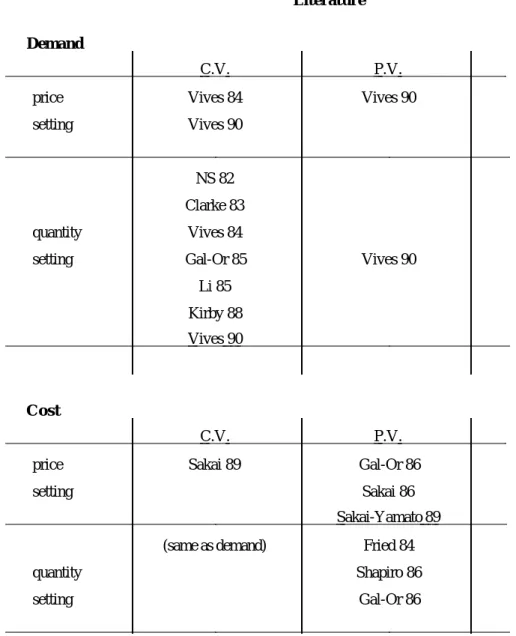
In the pages above we have provided a unifying explanation of the incentives to share information and its welfare consequences in different environments. We have seen how the intuition from the monopoly case could be extended to monopolistic competition and oligopoly situations. We provide here a summary of the results of the literature (the references can be found in Table 3).
5.1 Incentives to share information
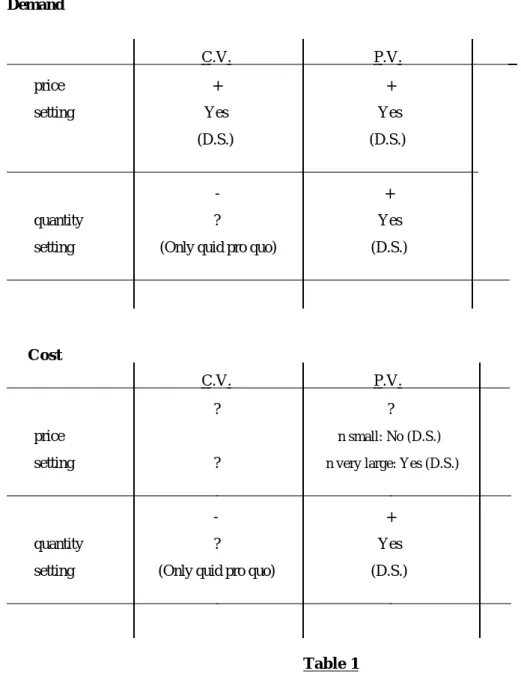
Results on the incentives to share information are contained in Table 1. The Table gives information about the sign of the information externality generated by information sharing on firms' expected profits. A positive information externality will yield incentives for a firm to share information in dominant strategies (that is, no matter what the rivals do about the pooling of data). A negative externality will not destroy necessarily the incentives to share information with a quid pro quo type arrangement provided expected profits increase (due to the increased information that firms have). As is clear from the Table, the sign of the externality depends on the particular specifications of the model. A change of strategic variables (prices instead of quantities) or of the type of uncertainty (common value versus private value), may yield different incentives to share information. Furthermore, under price competition with cost uncertainty a direct externality from information acquisition by others complicates the picture.
Incentives to share information
Demand
C.V. P.V.
price + +
setting Yes Yes
(D.S.) (D.S.)
- +
quantity ? Yes
setting (Only quid pro quo) (D.S.)
Cost
C.V. P.V.
? ?
price n small: No (D.S.)
setting ? n very large: Yes (D.S.)
- +
quantity ? Yes
setting (Only quid pro quo) (D.S.)
Table 1 C.V.: Common value, P.V.: Private values
How to read the Table:
Information Externality (+/-) Incentives to share (Yes/?/No)
We have seen that information sharing may emerge (be it in quid pro quo arrangements or with unilateral commitments) in a wide array of circumstances in which firms compete. Exceptions are Cournot competition with common value uncertainty when goods are close substitutes (or with slowly increasing marginal costs) and Bertrand duopolistic competition with private value cost uncertainty.
5.2 Welfare impact of information sharing
Table 2 summarizes the welfare effects of information sharing on consumer and total surplus. These results depend on two main features of the market. First, the type of decision variable (price or quantity) matters. If firms are quantity setters increasing information decreases the degree of output adjustment. It is important to note that this is an effect that is independent of the degree of competitiveness of the market. Secondly, the type of uncertainty (common value versus private value) matters. This is true because of a preference for variety effect. Consumers prefer, in these models, consumption patterns that are uniform across varieties. With common value demand uncertainty production patterns will become more uniform with information sharing and benefit consumers. With private value uncertainty production patterns tend to become less uniform with information sharing, which leads to a reduction in welfare and consumer surplus. These two effects may be reinforcing or countervailing depending on the combination of uncertainty and decision variable (as well as whether there is demand or cost uncertainty). Furthermore, the relative size of the two effects may vary depending on the size of the industry.
Welfare Demand
C.V. P.V.
price ECS: - ECS:
-setting ETS: − poor sub.
+ good sub.
ETS:
− Monop. Comp + n =2
(n large: -)
quantity ECS: + ECS: − n small(n<9)
? otherwise
setting ETS: + ETS: +
Cost
C.V. P.V.
price ECS: ? ECS: − n small (n<9)
? n large
setting ETS: + ETS:
quantity ECS: + ECS − n small (n<9)
? otherwise
setting ETS: + ETS: +
Table 2
These underlying effects generate a relatively complex picture of the impact of information sharing on welfare and consumer surplus. Fine tuning of competition policy to take into account the welfare impact found in this literature appears to be a formidable task. Note, for example, that welfare results of information sharing literally depend on whether prices or quantities are set. While we know that generally Bertrand competition is more competitive than Cournot competition (see Vives 1985), it is not the case that the competitiveness of the market determines the welfare results. For example, a market may not be very competitive, but firms may still be setting prices, not quantities. This makes it very difficult to use econometric evidence to determine the welfare results of information exchange. Econometrics has helped in trying to determine the degree of competition in markets by
estimating mark ups over marginal costs.10 This literature does not, however, identify whether the decision variable is price or quantity. The static theory of information exchange therefore appears to be insufficiently related to observables to base policy conclusions on it.
Literature Demand
C.V. P.V.
price Vives 84 Vives 90
setting Vives 90
NS 82
Clarke 83
quantity Vives 84
setting Gal-Or 85 Vives 90
Li 85 Kirby 88
Vives 90
Cost
C.V. P.V.
price Sakai 89 Gal-Or 86
setting Sakai 86
Sakai-Yamato 89
(same as demand) Fried 84
quantity Shapiro 86
setting Gal-Or 86
Table 3 Surveys: Sakai (1989), Raith (1993)
10 See, for example, Bresnahan (1989) for a survey of the econometric literature that tests for market power in industries.
6 Ex-Post Incentives to Exchange Information
In all the static models of information sharing discussed above there is a conceptual problem. It is usually assumed that firms can commit to share information through a trade association before they have actually received the information. However, what guarantees that firms stick to the agreement and truthfully report this information? Indeed, if the statements about the information received cannot be verified no credible information exchange can take place. In oligopoly, firms have in general an incentive to lie about the true information received to induce more favorable behaviour by their competitors (see Ziv 1993 for a recent demonstration of the result). However, when information can be verified, for example if actual bills of sales can be sent to the trade association, these incentives change as has first been noted by Grossman (1981). In a systematic analysis of ex-post exchange of verifiable information Okuno-Fujiwara, Postlewaite, and Suzumura (1990) have shown that firms will always completely reveal their private, verifiable information for the types of settings that have been analyzed by the information sharing literature. This means information will even be exchanged if ex ante, i.e. before the private information arrives, firms would prefer a commitment not to exchange information. It is important to note that the welfare analysis of information exchange remains identical to the one above. Welfare results only depend on whether information is exchanged or not.
Similar results to Okuno-Fujiwara et al. can be obtained when information is not verifiable but there are costly signals, like advertising, which can be used to credibly transmit this information. This method of information exchange is, however, more costly since it involves the expenditure of resources in order to make the information exchange credible (Ziv 1993, Kühn 1993). As a result, disallowing information exchange via verifiable documentation like sending invoices to a trade association may be equivalent to forbidding information exchange or may lead to information exchange at higher social cost.
7 Trade Association Rules
Information sharing agreements usually take the institutional form of a Trade Association. Trade Association rules will therefore be important in determining the incentives for information exchange.
Trade associations conduct statistical programs in which individual data of firms are collected, aggregated and disseminated either to the members of the T.A. (exclusionary disclosure) or to all the firms in the industry and other interested parties (non-exclusionary disclosure). Vives (1990) has pointed out a free rider problem when non-exclusionary disclosure rules are applied. Consider the case of a monopolistically competitive market. A firm that does not participate in the information sharing agreement does not affect the market outcome (because the firm is negligible). However, it will receive the aggregate market information saving the fee for the T.A. Services with an exclusionary disclosure rule such a free rider problem does not arise. If all firms share information the defection of a single firm from the agreement will not affect the market aggregates but it will prevent the firm's access to the signals reported by the T.A.. Consequently, it will have lower expected profits provided the T.A. fee is not very high. (Vives (1990)).
Exclusionary disclosure rules are only exclusionary in the sense that trade associations exclude firms from participation that do not contribute to information sharing. However, in practice we often also find exclusionary agreements that restrict membership of information sharing agreements. In trade associations this sometimes occurs in the form of privileges for specific members of the trade association.11 Unfortunately, there is no theory of such discriminatory information sharing agreements to date.
8 Dynamic Aspects of Information Exchange
8.1 Exchanging Data on Past Prices or Quantities
Up to now we have been considering exclusively information exchange on signals about demand and costs. In most practical cases, however, the issue is one of information exchange about past prices or production. The nature of such information exchange is that it involves data from one period being used for decisions in another. To analyze this type of information exchange we have to abandon the analytical framework of static one period models. To fix ideas consider a model in which there are two periods of production and firms are imperfectly informed about demand and costs. Prices or quantities produced of period one will convey information about past costs or demand. This will be information that is useful for the future, because generally demands and costs in one period will be correlated with demand and cost in the next period. Price or quantity observations from the first period are then (possibly imperfect) signals about future market conditions. For example, if firms set prices then quantities sold reveal information about the state of demand to the seller. Passing on this information before decisions are made in period 2 can then be regarded as passing on signals in the sense of our earlier discussion.
There is, however, a difference with the static model discussed before. In the previous model firms could commit ex-ante to information sharing of the signal, but could not take unobservable actions that would influence the signal. Indeed, being able to manipulate the precision of the signal unobservably would be equivalent to the problem of ex-post information exchange with non-verifiable information. In two period models firms can set prices or quantities which are not observed by the other firm. If only one of these variables are reported to other firms, competitors have an incentive to change prices or quantities from the static oligopoly price in order to manipulate the information content of the information exchanged ex-post. The work of learning and experimentation in duopoly has formally demonstrated this "signal jamming" effect when there is interrelated learning about demand or costs over time (see Riordan 1985; Aghion, Espinosa, and Jullien 1993;
Mirman, Samuelson, and Urbano 1993; Mirman, Samuelson, and Schlee 1994). Jin 1994 shows in a duopoly model with demand uncertainty that sales reports increase (decrease) firms' profits and decrease (increase) consumer surplus and social welfare in a Cournot (Bertrand) industry. Indeed, with no sales reports firms in a Cournot industry have an incentive to overproduce to try to convince rivals that demand is low; in a Bertrand industry firms have an incentive to charge high prices to try to convince rivals that demand is high. In both cases the attempt is to induce softer behaviour of the rival (lower quantity or higher price). Sales reports eliminate the incentives to misrepresent and lead to lower outputs in the Cournot case and lower prices in the Bertrand case. The welfare implications of sharing sales reports are thus very different from the ones derived from sharing signals about demand (see Tables 1 and 2). Indeed, results tend to be reversed, with sales reports improving welfare with price but not with quantity competition. Furthermore, with sales reports information sharing is never an equilibrium, it is a dominant strategy not to report. As expected including the signal jamming incentive makes the results obtained in the information pooling models about demand or costs less robust.
8.2 Information Exchange and the Scope for Dynamic Collusion
Our task in this section is to explain what kind of conclusions about the role of information exchange can be drawn from dynamic models of tacit collusion. With tacit collusion we mean any type of cooperation between firms which is not sustained by legally enforceable contracts. The theories do not distinguish between explicit "agreements" between firms and implicit anticipation of reactions by rivals in dynamic interactions (as for example in what is termed "conscious parallelism" in the competition policy literature). This is because in theory there is no significant difference between these two types of behaviour.12
12 Explicit agreements may help in solving coordination problems in selecting an equilibrium. However, this coordination can be achieved by unilateral communication by just one firm, which has been
It is a fairly old idea in industrial economics and the theory of competition that collusion between firms is achieved because firms interact repeatedly in the same market. The basic insight is that deviations from some collusive price in one period may be "punished" by competitors by price cuts in following periods. The problem for early theorists of industrial organization in rigorously formulating a theory of collusion over time, was that they were lacking the analytical techniques for formulating dynamic models of oligopolistic interaction. Instead, Hall and Hitch (1939) and Sweezy (1939) developed a static model of a "kinked demand curve" to capture the dynamic intuition given above. In this theory, firms agree (possibly implicitly) to charge some focal price. Price increases will not be followed by competitors, while price cuts would be responded to by matching price cuts of the competitors. However, such a short cut to modeling dynamic phenomena generates severe conceptual problems. As Stigler (1947) pointed out the focal price was completely indeterminate. As a result the model had no predictive power on how collusive outcomes would change as a response to changes in demand or the technological environment. In particular, in the theory of the kinked demand function rigorous reasoning about cartel behaviour under incomplete information (for example of market conditions or the behaviour of rivals) was not possible. Consequently, the traditional literature on implicit collusion could not really address the question of how information sharing affected the opportunities of collusion in a market.
The development of game theoretic tools in the 1980ies has made it possible to fully model dynamic interaction between oligopolists and address the questions raised in the early literature in a rigorous way. This extensive modeling effort has much improved our understanding about collusive mechanisms. In addition, especially for environments with
branded as insufficient evidence for a concerted practice in the legal literature (see Van Gerven and Navarro Varona 1994, p. 600). Furthermore, there is no satisfactory economic theory that would