
Why Are Drugs So Expensive?
Learning About the Drug Development Process
written by:
Ann Newman
Seventh Street Development Group
This product is for your Personal Use Only and cannot be transferred, reproduced or resold in whole or in part. No other rights are transferred with the purchase of this product.
This product is a guide only and is not meant to take the place of regulatory, legal, or scientific counsel on the various aspects of drug discovery and development.
Seventh Street Development Group PO Box 526, Lafayette, IN 47902-0311
Table of Contents
Chapter 1 Introduction
3
Chapter 2 Overview of the Process
4
Chapter 3 Drug Discovery
7
Chapter 4 Preclinical Studies
16
Chapter 5 IND Submission
29
Chapter 6 Clinical Trials
33
Chapter 7 NDA Submission
38
Chapter 8 Phase IV Clinical Trials
46
Chapter 9 Generic Drugs
48
Chapter 10 Patents
54
Chapter 11 What's Next
61
Appendices
68
Glossary
83
Chapter
1
Introduction
Why are drugs so expensive? Millions of Americans are having problems affording essential and life-saving medicines. Healthcare prescription programs will only cover certain medications, making life even harder. Why is this all so costly and difficult?
There are a variety of reasons for the current state of affairs, such as: -the drug development process
-regulatory aspects of drug manufacture -the cost of getting a drug on the market -patent lifetimes covering the drugs -sales and marketing costs
-etc
In this book, we will go through the drug development process in the United States to give you an idea of what is involved in getting a new drug to the market. We will not cover every detail, but will try to give an overview of what is involved in getting a new drug on the market and will concentrate on pills and capsules, although other products will be mentioned. We think it will surprise you to learn how complex the process actually is, and it will give you a perspective on all the work that has gone into that pill or capsule that you are taking.
We will also cover additional topics, such as generic drugs and patents, so you can understand that once a drug is on the market, there are still many changes that can occur which will affect the pricing of the drug.
Chapter
2
Overview of the Process
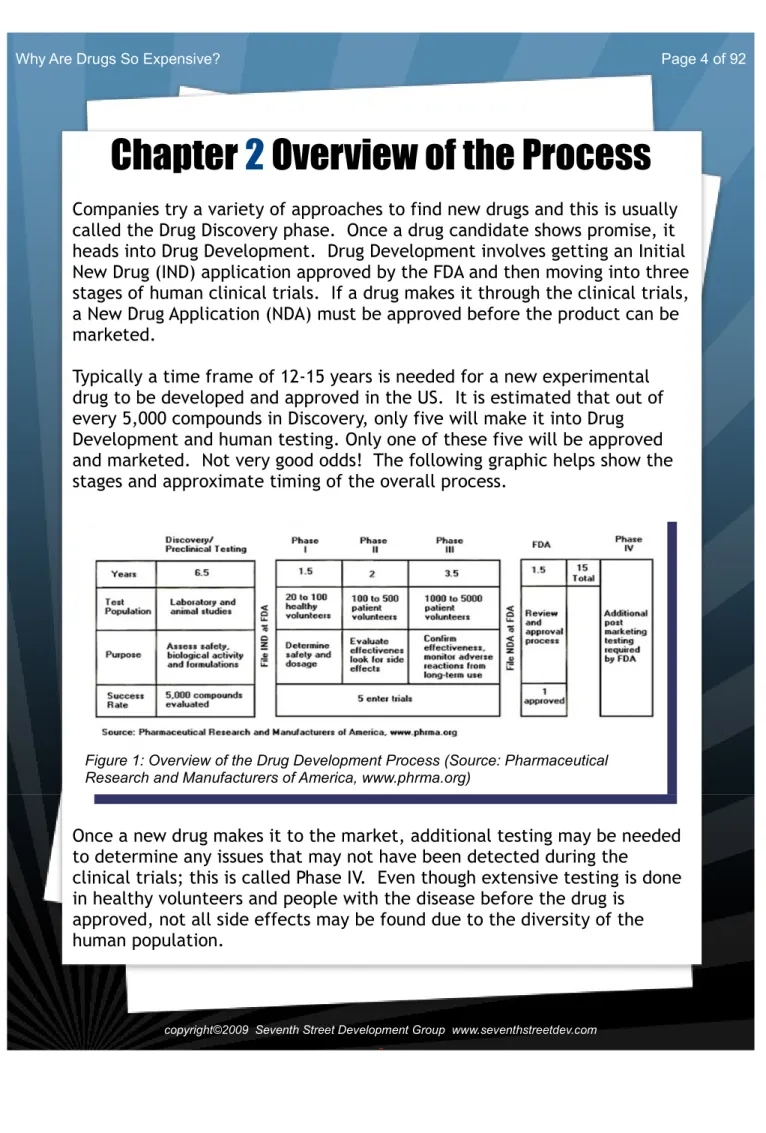
Companies try a variety of approaches to find new drugs and this is usually called the Drug Discovery phase. Once a drug candidate shows promise, it heads into Drug Development. Drug Development involves getting an Initial New Drug (IND) application approved by the FDA and then moving into three stages of human clinical trials. If a drug makes it through the clinical trials, a New Drug Application (NDA) must be approved before the product can be marketed.
Typically a time frame of 12-15 years is needed for a new experimental drug to be developed and approved in the US. It is estimated that out of every 5,000 compounds in Discovery, only five will make it into Drug Development and human testing. Only one of these five will be approved and marketed. Not very good odds! The following graphic helps show the stages and approximate timing of the overall process.
Once a new drug makes it to the market, additional testing may be needed to determine any issues that may not have been detected during the
clinical trials; this is called Phase IV. Even though extensive testing is done in healthy volunteers and people with the disease before the drug is
approved, not all side effects may be found due to the diversity of the
Figure 1: Overview of the Drug Development Process (Source: Pharmaceutical Research and Manufacturers of America, www.phrma.org)
It is estimated that $800 million dollars [1] was spent for each new drug that made it to market in 2000. This cost has increased dramatically over the years as shown in Figure 2.
To put the drug development process in perspective, many of the new drugs that came on the market in 2007 were in discovery or early development around 1992. Many of the drugs currently in discovery today will not be available to patients for another dozen years. Talk about a long lead time! There are three requirements for approval of a new drug:
1. the drug is safe
2. it is effective in treating the disease
3. it can be manufactured correctly and reproducibly each time This sounds straightforward, but actually involves years of testing and research on compounds that no one has any prior experience with. Knowing what is involved in getting a new drug to the marketplace will help you understand why it takes so long and why so many drugs don't make it. It is a complex process that involves many scientific disciplines and many parts of a company or many companies working together to get that one success story on the market to help patients.
Figure 2: Increasing cost of drug development. [1] (Graphic from
www.innovation.org) $138 $318 $802 $0 $100 $200 $300 $400 $500 $600 $700 $800 $900
1975 1987 2000
E xp en d it u re s p er R x D ru g (M ill io n s o f 2 00 0 D ol la rs )
Fun Facts about the Drug Development Process
We will end this chapter with some facts from www.innovation.org:
1 = Number of new medicines that result from every 5,000-10,000 compounds screened [2]
10-15 = Number of years required to make a medicine [3]
80,000 = Number of scientists researching new medicines in America's
pharmaceutical companies [4]
$58,800,000,000 = Spending on research and development of new medicines
by pharmaceutical companies in 2007 [5]
$1,300,000,000 = Average cost to develop one medicine. This amount is up
from $138 million in 1975, $318 million in 1987, and $802 million in 2000 (2005 dollars) [6]
2 out of 10 = Number of new medicines that produce revenues that match or
exceed average research and development costs [7]
over 2,700 = Number of medicines in development [8]
nearly 350 = Number of new medicines approved between 1997 and 2006 [9]
nearly 250 = Number of medicines to treat rare diseases (affecting fewer than
200,000 in the U.S.) approved by the FDA in the last two decades [10]
$4.44 = Amount saved in hospital costs for every $1 spent on medicines[11]
50-60% = Portion of cancer survival increases attributable to new medicines
[12]
70% = Decrease in AIDS death rate since advent of new medicines in 1995 [13]
10¢ = Portion of every dollar spent on health care that goes to prescription medicines [14]
11-12 = Years of effective patent life for medicines - about 6-7 years shorter
![Figure 2: Increasing cost of drug development. [1] (Graphic from www.innovation.org) $138 $318 $802$0$100$200$300$400$500$600$700$800$90019751987 2000](https://thumb-us.123doks.com/thumbv2/123dok_us/8444051.2247358/5.918.95.838.53.1124/figure-increasing-cost-drug-development-graphic-www-innovation.webp)
