Work the Net
A Management Guide for Formal Networks
Deutsche Gesellschaft für
Technische Zusammenarbeit (GTZ) GmbH German Technical Cooperation GTZ Office New Delhi 21 Jor Bagh
Work the Net
A Management Guide for
Formal Networks
Michael Glueck Programme Co-ordinator
Natural Resource Management Programme D-108 Anand Niketan
New Delhi -110021, India
Email [email protected]
Phone +91-11-2411 6223/6224
Imprint
Editor Michael Glueck
Author Dr. Urs Karl Egger, Skat, St. Gallen, Switzerland
in collaboration with Michael Glueck, Georg Buchholz, Greta Rana, and Sagita Arhidani
Preface I
1 Introduction 5
1.1 About this guide 5
1.2 How to use it 6
2 Network Definitions 11
2.1 Different types of network 11
2.2 Examples of formal networks 14
2.3 Networks, organisations, and institutions 16
2.4 Benefits of networks 17
3 Setting up Networks 19
3.1 Developing the network concept 20
3.2 Preparation of a proposal 23
3.2.1 Basic elements 24
3.2.2 Elaboration 29
3.3 Setting up the network 31
4 Involving Decision-Makers 35
4.1 Networks and decision-makers 36
4.1.1 Definition of decision-makers 36
4.1.2 Understanding decision-makers 36
4.1.3 Importance of support staff 37
4.2 Preconditions and incentives 38
4.2.1 Preconditions 38
4.2.2 Incentives 39
4.2.3 Resources for participation 44
4.3 Approaching and involving decision-makers 44
4.3.1 Approaching decision-makers 44
4.3.2 Maintaining relationships 46
5 Network Governance 51
5.1 Strategic framework 52
5.2 Governance structure 55
5.2.1 Regionalisation 55
5.2.2 Organisation chart 57
5.2.3 Secretariat 58
5.2.4 Legal status 59
5.2.5 Network guidelines 60
5.2.6 Membership 63
6 Managing the Network 69
6.1 Operational plan 70
6.2 Meetings 70
6.3 Promotion 74
6.4 Funding 77
6.4.1 Financial needs 77
6.4.2 Types of funding 77
6.4.3 Fundraising 80
6.5 Balancing the network 81
6.5.1 Caring for internal relationships 81
6.5.2 Caring for external relationships 84
6.6 Monitoring and evaluation 87
6.6.1 Results-based monitoring 87
6.6.2 Regular evaluation 90
7 Network Services and Projects 95
7.1 Start with quick wins 96
7.2 Core services 96
7.3 Projects and programmes 98
7.4 Quality assurance 99
8 Communication 103
8.1 Communication strategy 104
8.2 Principles of communication 105
8.3 Need for facilitation 108
8.4 Cultural aspects 110
8.4.1 Language 110
8.4.2 Other challenging aspects 111
8.5 Capacity building for communication 113 9 Tools for Sharing Information and Knowledge 117
9.1 Electronic tools 118
9.2 Face-to-face or combined ways and tools 123
9.3 How to choose the right tools 128
10 Resources for Networking 133
10.1 Publications and websites 134
1 Review your network concept 22
2 Basic elements of a network proposal 28
3 Elaboration of network proposal 31
4 Setting up the network 33
5 Information decision-makers are interested in 40 6 Benefits decision-makers are looking for 43 7 Establishing relationships with decision-makers 46 8 Maintaining relationships with decision-makers 50 9 Basic elements of operational guidelines 61 10 Building up and maintaining membership 67
11 Organisation of meetings 71
12 Techniques for meetings and workshops 72
13 Promotion of the network 76
14 Fundraising essentials 81
15 Balancing relationships 87
16 Evolution and innovation 93
17 Principles of communication 107
18 Essentials of facilitation 109
19 Do’s and don’ts for establishing CoPs 126 20 Selection criteria for communication tools 130
ASEAN Association of South East Asian Nations CHM Clearing house mechanism
CoP Community of practice
DAC Development Co-operation Directorate of the OECD GTZ German Agency for Technical Cooperation
GWP Global Water Partnership
ICTs Information and communication technologies IT Information technology
IWRM Integrated water resources management
KM4Dev Community of international development practitioners interested in knowledge management and knowledge sharing issues and approaches
MOU Memorandum of understanding
NeRO Networking and Information/Knowledge Management by Regional Organisations in the Field of Natural Resources Management
NGO Non-governmental organisation NRM Natural resources management
OECD Organization for Economic Co-operation and Development
SDC Swiss Agency for Development and Cooperation SMS Short message service
SWOT Strengths, weaknesses, opportunities, and threats TOR Terms of reference
UNEP United Nations Environment Programme VOIP Voice-over-Internet Protocol
Preface
Networks – powerful mechanisms for sustainable development Networks are powerful mechanisms for sharing information and knowledge. They also promote communication and coordination to achieve sustainable development. Networks act as effective catalysts for building up relationships and commitment among public and private stakeholders at local, national, regional, and international levels. They help build trustful relationships as a basis for sharing information and knowledge, and serve as mutual learning and capacity-building mechanisms.
Networks are dynamic and bear witness to the fact that the whole is worth more than the sum of all its parts. They serve not only to bring multiple stakeholders together but also to activate the interface between knowledge and action.
The NeRO project
The parties who conceived of the project ‘Networking, Information and Knowledge Management by Regional Organizations in the Field of Natural Resources Management’ (NeRO) did so out of interest in the multifarious possibilities networks presented. Funded by the German Agency for Technical Cooperation (GTZ), work commenced by exchanging information about how regional development organisations use knowledge management approaches and instruments to share information: this sharing focused on the management of natural resources in the Asian context.
The project proved to be a learning process for all parties involved. A network approach was used to explore how information and knowledge are shared successfully among regional development organisations. A careful attempt to share selected information on the what, i.e. natural resources management, was part of the process.
As work progressed, a strongly felt need emerged that led the project team to explore the how of networking in greater depth. To explore the
how, three studies were carried out, and the results of these provided the basis for this networking guide. The studies were on
■ planning, development and management of clearing house mechanisms;
■ involvement of decision-makers in networks; and
■ communication, leadership and culture in networks.
This networking guide is only one of several products from the NeRO project. It is the result of an intensive process of enquiry and has been written by networking practitioners for networking practitioners. Background
This guide is based on the firm belief that the challenges the NeRO project participants and other practitioners face in the management of natural resources in Asia can be addressed by sharing experiences and best practices via networks.
Sustainable management of natural resources requires innovation: innovation in thought and strategy. A sine qua non for such innovation is pluralistic and dynamic systems that catalyse appropriate actions. In these new ways of collaboration we must consider not only the cross-border dimensions of natural resources but also the role of multiple stakeholders at all levels, as one actor alone cannot address such challenges. Opinion is gaining ground that networks offer an opportunity to bring together governments, private sector, civil society, NGOs, and international and multilateral organisations. Networks can help coordinate the actions of various stakeholders and can promote informed decision-making by enabling different actors to contribute to solving problems based on their mandates, roles, and strengths.
But can networks really meet such high expectations? Obviously, this depends on the context in which they are working, as well as a number of other factors. However, we are convinced that generally, there is
many a decision to set up networks was made randomly, that little designing or planning was involved and both time and resources were lost.
This is what prompted us to write this guide. We would like to share our insights with practitioners who are considering establishing new networks. Perhaps they can learn from our experiences, both positive and negative, and avoid reinventing the same old wheel!
Acknowledgements
This guide is the result of three years of intensive work involving many people and organisations. First of all we would like to express our thanks to all those who have contributed to the project ‘Networking, Information and Knowledge Management by Regional Organizations in the Field of Natural Resources Management’ (NeRO). In sharing their insights and practical experience, they laid the basis for this guide on networking. We are particularly grateful to Lucie Lamoureux from Bellanet, who was involved in the first phase of the project and acted as a workshop facilitator, and Layton Montgomery who conducted the study on Communication, Leadership and Culture. Thanks also go to Zbigniew Mikolajuk (ICIMOD), Ujol Sherchan and Prashant Sharma (Mountain Forum), who made valuable contributions to the studies on which this guide is based. We also thank the various organisations and programmes that were involved in the NeRO project and contributed to this successful process in various ways: the ASEAN Secretariat on behalf of ASEAN, the ASEAN-German Regional Forestry Programme, the International Centre for Integrated Mountain Development (ICIMOD) and the Mekong River Commission.
Special thanks go to the German Agency for Technical Cooperation (GTZ) for funding the project. Without its support, this guide would not have been possible.
1
Introduction
1.1
About this guide
T
his is a hands-on guide for setting up, managing and using formal networks efficiently and effectively. It focuses on the structural and operational issues of networks and explains the most important aspects in making them work.The guide addresses networking practitioners, as well as other professionals wishing to establish a network. Hopefully, those involved in established networks will find some useful tips, too.
1.2
How to use it
Every network is unique, and this guide certainly is not meant to be a blueprint for networking. It covers aspects of networking that we think are important, suggests hands-on methods of proceeding, and gives ideas about how to network. We have tried to use a simple and non-technical language in order to reach a wider audience.
The guide has several aids to help you to access the information.
■ Flowchart: On page 8 and 9 you will find a flowchart showing a typical process for establishing and managing a network. The figures link you to different sections providing specific information.
■ Checklists: The most important aspects of some sections are summarised in checklists.
■ Cross-references: Many aspects of networking relate to each other. The guide has cross-references leading to related information.
■ Further resources: Bearing in mind that the guide is not exhaustive, we have included a section (10) on resources such as books, publications, and websites.
For the sake of illustration and emphasis, we have sometimes cited text directly from other sources. All of them are listed in section 10.1, but we have omitted footnotes and quotation marks in the text to avoid a lengthy, academic style. We sincerely thank all authors whose work has contributed to this guide. Without their work, we could not have gone the distance.
We hope you will find useful tips to help you meet the challenge of networking. Establishing and managing networks requires much more know-how and experience than this guide contains. The advice provided here will require your judgement and skills in project management and communication, and, above all, patience and persistence.
❛❛
A fool can learn from his own
experience; the wise learn from
experience of others
❜❜
CONCEPT DEVELOPMENT
(☞section 3.1) Develop network concept (☞3.1)
Find a niche for the network
(☞5.1)
Formulate vision, mission, goals (☞5.1)
Define core activities and first projects (☞7) Form a
core team
(☞3.1)
Ensure sufficient resources (☞3.1)
Decide on network organisation (☞5.2)
Establish relationships with members (☞5.2.6) Obtain backing
for network
(☞4/6.5)
Conduct a risk assessment
(☞3.2.1)
Establish relationships with stake-holders(☞4) Check potential
availability of funding (☞6.4)
Develop and strengthen core team (☞3.2.2)
Prepare a schedule
(☞6.1) Learn from
other networks
(☞3.2.2)
Prepare a financial plan
(☞6.4) Ensure
sufficient funding (☞6.4)
Flowchart for Establishing and Managing Networks
PHASESACTIVITIES
DOCUMENTS Concept paper Network proposal
DECISIONS
PROPOSAL PREPARATION
(☞section 3.2)
Conduct needs assessment
(☞3.1)
Go, no go
decision Funding ?
NO YES
SETTING UP THE NETWORK
(☞section 3.3)
MANAGING THE NETWORK
(☞4/5/6/7/8/9) (☞6.7)
EVALUATING THE NETWORK
Organise a kick-off event or workshop (☞6.2)
Establish backup services (☞5.2.3/9)
Coordinate activities, control operat. plan (☞6.1) Agree on
governance structure (☞5.2)
Develop body of rules and regulations (☞5.2)
Facilitate actively communication (☞8.3)
Develop and deliver services and activities (☞7) Launch first activities and develop mid-term plan Start with promotion and awareness creation(☞6.3)
Nurture internal and external relationships (☞6.5)
Promote network
(☞6.3) Build up a
membership base (☞5.2.6)
Be innovative and evolve continuously (☞6.7)
Monitor network activities and services (☞6.6) Maintain information and communication tools(☞9)
Evaluate network every three years (☞6.6.2)
Mid-term action plan Network guidelines Operational plan Network budget(s)
promotion materials, flyers, website
Project reports and annual reports
Go again through proposal phase
Close down the network Reinvent network &
make adjustments
Evaluation positive ?
YES NO
2
Network Definitions
Not exactly
what we
wanted....
...but it
works!
THE NET
WORKS!
N
etworks can be defined in different ways. This guide focuses on formal networks. This section gives a definition and presents three examples. The differences between networks, institutions, and organisations are also briefly explained.2.1
Different types of network
The notion of a ‘network’ has become omnipresent both in develop-ment cooperation and in our daily lives. Meanwhile, countless definitions and categories of networks exist and there is no definition that fits all of them. In this guide, three basic categories have been distinguished: social networks, communities of practice, and formal networks. While these definitions do not constitute the ultimate truth, they are useful to work with and often applied in practice. This guide focuses mainly on formal networks.
Social networks
Social networks form the basis on which formal networks are built. Social networks are maps of personal, amicable or business relationships consisting of informal individual relations between businessmen or friends, or among members of a larger family. Social networks generally have no deliberately defined purpose. They grow organically and, in most cases, are not actively planned and managed. Social networks play an important part in managing daily private and working lives: they are recreational, and can yield information, rendering assistance in times of need by providing access to other people or resources.
Communities of practice
In this guide, communities of practice are considered to be part of the activities of formal networks.
A community of practice (CoP) is a group of people trusting each other and sharing a common interest in a specific area of knowledge or competence. The members of such groups come together voluntarily to share and develop their knowledge, solve common problems and support each other in finding answers.
An example of a community of practice is a group of network managers who meet twice a year and communicate regularly by email to post and answer questions about network management. In this way, the members of the CoP help each other do a better job.
Another example is when some members of a formal network (as defined in the next section) meet regularly and participate actively in an electronic discussion forum to share their experiences on a specific topic related to the overall goals of the network.
These examples show that CoPs are defined by knowledge and experience and not by a specific task that has to be completed in a certain period of time. Such a task-focused group would be called a
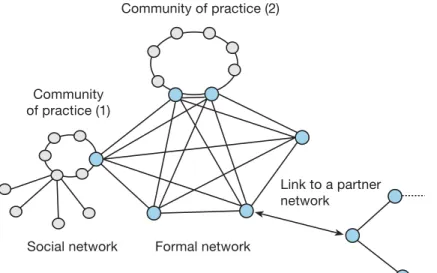
Figure 1: Social networks, CoPs and formal networks
More information about communities of practice and how they are established is provided in section 9.2.
Formal networks
In this guide, formal networks are defined as interrelated groups of several independent institutions or organisations that are established according to a specific design or need. The members of the network share a common vision, objectives and rules, and they carry out a set of common activities, like regular events. A formal network may even have a legal form.
In contrast to communities of practice, formal networks are not only based on the needs of members. Rather, they also have the goal of achieving changes in their own contexts, e.g. the political agenda of countries or regions.
In terms of development cooperation, formal networks consist of non-governmental organisations (NGOs), non-governmental organisations, and development agencies, as well as other national, regional, or international organisations. Staff members who in turn are linked to their social networks represent these organisations in the network. Formal networks may also produce communities of practice about a certain topic or issue that is of interest to the members of the network or others.
Community of practice (2)
Community of practice (1)
Social network Formal network
Link to a partner network
2.2
Examples of formal networks
The following three examples illustrate what a formal network is and what it looks like: the Mountain Forum, the River Network, and Cap-Net.
Example 1: Mountain Forum
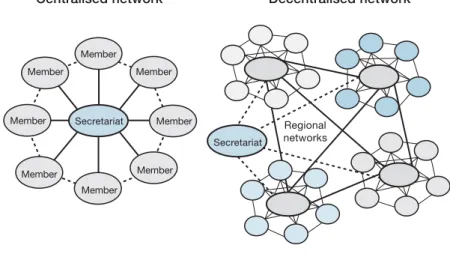
The Mountain Forum (http://www.mtnforum.org) is a global network connecting and empowering people, professionals in mountain development, and those interested in mountains throughout the world. The Mountain Forum is a network of five regional networks in Africa, Asia, Latin America, Europe, and North America.
The Mountain Forum was established in 1995 through a joint international effort by non-governmental organisations, universities, governments, multilateral agencies, and the private sector. Its secretariat is based in Kathmandu (Nepal).
The Mountain Forum promotes global action towards equitable and ecologically sustainable mountain development. This is achieved through the following: sharing information, giving mutual support, and providing advocacy. In order to attain these objectives, the Mountain Forum uses modern and traditional communications, supports networking and capacity building, and encourages members to be proactive in advocating the sustainable development of mountain areas.
The Mountain Forum’s electronic information services include global, regional, and thematic e-mail discussion lists, focused electronic conferencing, a calendar of events, and a rapidly growing on-line library of mountain resources.
The Mountain Forum consists of thousands of people, professionals, and organisations from over 100 countries. Membership of the Mountain Forum is open to individuals and organisations involved in
Example 2: The River Network
The River Network (http://www.rivernetwork.org) is a North American network supporting grassroots river and watershed conservation groups. Its mission is to help people understand, protect and restore rivers and their watersheds.
The network was founded in 1988 with the conviction that the solutions to river degradation are primarily local and must be created by citizens’ action, watershed by watershed. Having started with just a few hundred groups a decade ago, the movement brings together over 4000 organisations today. Nineteen staff members working in three offices across the United States run the network.
The River Network works closely with local watershed protection groups, state river conservation organisations, Native American tribes, schools, organisations and agencies. The network runs a river source information centre, provides publications, training and consultation, offers a grant programme, and provides referrals to other service organisations and networking opportunities.
The partners of the River Network have to pay an annual fee of 100 dollars. For this small contribution they receive a number of services, like a quarterly journal, fundraising alerts, and a 20% discount on the River Network publications. Partners can also attend workshops or receive direct consultation, apply for grants, and contact the River Source Center with a special toll-free number or by email to receive assistance. Last but not least, partners have the possibility to join the national and regional email discussion lists and gain access to the partners section on the website.
Example 3: Cap-Net
Cap-Net (http://www.cap-net.org) is an international network for capacity building in integrated water resources management (IWRM). The network’s mission is to enhance human resources development for IWRM by means of establishing or strengthening regional capacity building networks.
Cap-Net was established in 2002 and is a UNDP project, funded by the Dutch Ministery of Foreign Affairs. The Global Water Partnership
(GWP) has adopted the Cap-Net project as an Associated Programme and considers it one of its flagship projects. Cap-Net is hosted by the UNESCO-IHE Institute for Water Education in Delft (The Netherlands). Cap-Net has three major interlinked axes of activities: 1) Networks: support the establishment, facilitate access to information and exchange of experience between regions; 2) Capacity building: analyse capacity building needs, improve capacity building materials, and assist in the development of capacity building strategies; 3) website to disseminate information on training programmes and courses, make training materials available, provide information on national, regional, and global networks.
The Cap-Net network has grown rapidly and now reaches out to organisations and networks involved in IWRM in most countries in the developing world.
2.3
Networks, organisations, and institutions
Formal networks differ from public institutions or companies in several ways. In this guide, they are considered as systems linking different people and organisations, thus contributing to coordination and joint action.
In comparison to companies or bureaucracies, the relationships among members of formal networks are significantly less hierarchical. Some advocates of networks even claim that networks are characterised by non-hierarchical relationships. In our view, however, this is too optimistic and not consistent with pertaining reality.
Membership is a unique feature of networks. The members of networks participate in them but remain autonomous. They are providers of services to other network members and stakeholders of the network. At the same time they are also users of services offered by the network. This culture of giving and receiving is at the core of every network.
Last but not least, networks are very similar to living organisms. Every network is unique to some extent. The history of a network and its members influences its establishment and management. Networks are dynamic and complex systems, and their outcomes are often not what one would have expected. So they are less controllable than an organisation or public institution. There is reciprocal influence between a network and its contextual environment. In other words, the network influences its environment and is also influenced by it.
2.4
Benefits of networks
Networks create a number of benefits for their members and their stakeholders, contributing to the overall vision of more sustainable development. A few benefits often associated with networks are mentioned below.
Benefits for members and stakeholders
■ Having access to information and know-how
■ Learning from others
■ Better understanding of needs and (political) agendas
■ Strengthening of capabilities
■ Pooling of resources and developing synergies
■ Enlarging personal networks
■ Catalyst for establishing partnerships
■ Testing new ideas and innovative solutions
■ Dividing of work and focusing on specific strengths
■ Benchmarking with other organisations or institutions
Contributions to the vision of sustainable development
■ Improving the information and knowledge base for decision-making through the accumulation of information and knowledge
■ Contributing to learning and shorter learning cycles through
■ Connecting sectors, professions, countries, regions, and cultures and contributing in this way to more coordination, coherence and innovation
■ More widely accepted responses to complex public sector challenges
■ Increased attention for certain topics in the policy agenda ■ More balanced policy decisions
Networks may create a number of benefits, but one ought to keep things in perspective – networks are certainly not the panacea for all information and knowledge sharing problems. And the benefits will only result if the network is managed in an effective and efficient way, which hopefully is where this guide will come in handy.
3
Setting up Networks
S
etting up and later, managing and developing a network is hard work. More often than not, the amount of work and time spent in establishing a network is completely underestimated. Things often go wrong during the very first step, and lots of networks perish in the first months or year. So you are well advised to reflect carefully whether you would like to set up a network or not.Are we
already
connected?
At least,
we’re
ON LINE...
In a
way,
yes...
This section describes the initial steps in establishing a network. First of all, the concept behind the network has to be written down. If you are still convinced at this point that a network is needed, and you have discussed it with possible members, then you should develop a proposal explaining the network in more detail. The next step is to seek funding. Only when sufficient financial resources are available can a network be established.
3.1
Developing the network concept
Every journey starts with an idea. The first step in setting up a network is to formulate the concept and rationale behind it and to examine its plausibility. This step can be called a pre-feasibility study. If you formulate your concept carefully, it will save you time and you will avoid many pitfalls in the long run. Below, we have outlined the most important steps in putting down the initial concept. You do not have to follow the sequence strictly, as many steps overlap with each other.
Consider the demand and work out a rationale
First you need a concrete notion of the needs or demand the network is going to address and what the rationale for it is. The motivation for setting it up may come from any number of directions: to improve collaboration, to avoid duplication of efforts, to improve dissemination of information and knowledge, to learn from existing experiences, to achieve a better impact in a specific thematic area, or simply from the need of professionals to do a better job. Try to work towards a network concept that is shared by your core team, and set distinctive objectives and a number of core services and activities. A good test is to explain your concept to somebody who is not directly involved. If he or she understands what you are driving at, your concept will probably be clear enough.
Carry out a needs assessment
Does your concept respond to the needs of potential members? Often, an individually perceived need does not match actual demand. So
and experts; carry out short interviews or surveys, or contact potential members and decision-makers informally during conferences or workshops.
Find a specific niche
Once you are sure there is a demand for the network you should carry out a short survey to discover whether your concept is really unique. Are other networks already covering the objectives of your planned network? What other organisations are working in similar areas? What are the thematic priorities of the leading national and international organisations and institutions? What do potential members of the network really need? Setting out from the answers to these questions, you may have to adjust your concept. Try to find a specific niche for your network that is not already covered by existing ones. If you cannot find your own niche, you might consider becoming involved in an existing network.
Form a core team
The successful establishment of a new network depends on having a core team committed to building it up, and pulling and pushing the whole process forward. Most formal networks have emerged from social networks that already existed. So you may already know a couple of people who would like to join you in setting up the network. Keep the core team small: three to five people. The larger the group, the more difficult and expensive – if travelling is required – coordination will be.
Obtain backing from relevant stakeholders and decision-makers
However, to actually set up a network, you will need much more than the core team’s support. You will need support not only from your superior if you are working in an organisation, but also from a wider group of potential stakeholders of the network. Important decision-makers and other key persons working in the area of your planned network need to ‘buy-in’. Get in touch with them, discuss your idea, and see what they think of it.
Ensure sufficient resources for start-up
Setting up a network requires not only support but also resources. You have to make sure that you and your core team reserve a part of
your time for the network. In addition, you will also need technical competence in the area in which the network is to be active.
Ensure sufficient funding and check availability
Last but not least you have to make an initial estimate of how much funding you need. Try to do this as realistically and honestly as possible; then assess whether you already have enough funding. Perhaps the organisation you are working for is willing to give you a certain amount of time for the network or has other means available. But you should also be on the lookout for other public and private contributors who might be willing to support the network. Browse through their websites, identify their ongoing or planned programmes, and read their strategy papers, so that you get a feeling of the kind of topics in which they might be interested.
Prepare a concept paper
Once you have collected the necessary information, summarise it in a short paper of about three to five pages written in simple language. Based on the discussions and the work you have carried out so far, it is now time for critical reflection. Take a look at the following 12 questions and see whether you can answer them with a clear YES.
Checklist 1: Review your network concept
❏ Have several people or organisations confirmed that they agree with
the goal of your planned network and that they really need it?
❏ Do you have a distinctive network concept and objectives shared
by others?
❏ Is there a favourable context to set up your specific network?
❏ Have you checked whether other networks are already covering
the thematic area of your network?
❏ Have you identified a number of stakeholders supporting your concept? Are there allies that could be of strategic value for the network?
❏ Have you reserved a reasonable amount of time to set up the
network?
❏ Do you have the technical competence in your core team in the
area in which your network would like to be active?
❏ Did you plan realistically for resources?
❏ Do you have sufficient funding to establish the network?
❏ Do you know whether public or private contributors are willing to
support the network?
How many of these questions can you answer with YES? If you cannot answer the majority with a clear YES, you should honestly consider whether setting up this network would really make sense. It might be better to give up the idea and switch over to something else, like a specific project or an informal community of practice.
3.2
Preparation of a proposal
Have you passed the test in section 3.1, and are you still convinced that setting up your network is an excellent idea? If so, then you have already taken the first important step towards establishing a network. However, there is still a long way to go.
The next step will be to prepare a proposal. This will force you to think through your network concept in a systematic way, identify gaps, make decisions, focus your activities and assess the availability of resources. Elaborating the proposal will be an important process in bringing a committed core team together. Last but not least, the proposal will be helpful in communicating the idea, winning over potential supporters of the network, and securing buy-in from potential members, decision-makers, and other stakeholders.
The following section describes the most important elements of a network proposal. Subsequently, crucial aspects of the kind of composition needed to put together a network proposal are explained.
You will also find more detailed information on all aspects of this process in other sections of this guide.
3.2.1 Basic elements
The network proposal should provide short and concise information about all relevant aspects of the network. A good network proposal should consist of no more than 15 pages and include the elements described below.
Executive summary
Most readers of your proposal will not have much time to study it. You have to attract their attention with an executive summary of about one page that provides a short overview of the network planned and how it will contribute to the goals of decision-makers. Writing a short text is often more difficult than writing a long one. Take enough time to compose the executive summary. Think it over again and clarify what the real added value of the network is and what other core messages could convince potential contributors, decision-makers and other stakeholders to support your network.
Network concept
In this section of the proposal the concept of the network sketched out in the concept paper has to be presented in more detail. It is this section that will determine whether you will win support for your network or not.
Start with a description of the challenges in the areas in which the network will be active. Examples of such challenges are lack of coordination among organisations working in the same thematic area, duplication of work, or repetition of mistakes. Then you should show which potential members and stakeholders the network would target and what their needs or demand are.
Subsequently, this will help you to define the network’s main areas of activity. Examples could be the following: creating more possibilities for interaction such as email discussion groups for peer assistance, organising conferences to inform a wider audience, sensitising decision-makers, carrying out joint research programmes to tackle unresolved issues, increasing access to technical information and news, creating a better overview of experts working in the field, or grouping together the forces for advocacy to influence policy dialogue. Networking alone is not enough. In this section you should also present a few concrete services and projects the network will launch when it gets going. Finally, show why the network is really a new idea and unique in its area, and explain the added value of the new network as well as the expected outcome and impact.
Core team
To establish a network successfully, a core team of three to five people is crucial. A good core team is necessary because setting up a network involves a great deal of work. During the start-up phase, you will have to tackle many unexpected challenges, and a well-functioning core team will find ways to cope with them.
The competencies of the members of the core team should be complementary and cover the following: project managers and organisers, administrators, communicators, promoters and fundraisers, and technical specialists.
The composition of the core team is also crucial because support for the network will depend on how well recognised and relevant the experience of the core team is. In your network proposal, outline the expertise of your core team members with practical examples of their experience. Even if the proposal is excellent, you will only receive support for the network if decision-makers, stakeholders and potential contributors trust the people behind the idea and if they understand their motivation.
Organisation
This section of the network proposal should briefly describe how the organisation, management, and communication in the network will be carried out. The following issues should be covered (☞sections 5 and 6).
■ International structure and regional sub-networks (if necessary)
■ Organisation chart with chairperson, board, executive secretary
■ Location and organisation of secretariat functions
■ Legal status of the network
■ Division of work and decision-making
■ Membership and most important members
■ Most important means of internal communication (e.g. meetings, intranet, email) and external communication (e.g. flyers, website, events)
■ Promotion of network: most important stakeholders
Schedule
Although most schedules are outdated as soon as they are made, it would be wrong to assume that schedules are not necessary. On the contrary, a schedule is an important means of guiding the core team while getting the network going.
A network proposal should include a realistic schedule. First, identify the most important steps in building up your network and summarise them in about seven work packages. Align the work packages to a timeline and consider the critical path. Some activities will have to be carried out before you can start with others. Show the sequence and the dependencies in a diagram and mark the completion of every work package with a milestone so that you can assess the achievements.
up the network, but will also show potential contributors, decision-makers, and other stakeholders that you have planned the establishment of the network in a careful way.
Risk assessment
Setting up a network is a risky endeavour that is all too often unsuccessful. So a network proposal has to reflect its underlying assumptions and consider the risks of setting up a network, such as: the core team disintegrates, funding is insufficient, initial enthusiasm fades away, or a similar network is being established at the same time. A practical way of assessing the risks of setting up a new network is by carrying out a simple sensitivity analysis that includes three scenarios.
■ Best-case scenario: showing what could be achieved if all opportunities are realised and positive expectations met.
■ Normal case scenario: describing the expected development of
the network under normal circumstances.
■ Worst-case scenario: showing what could happen if your worst nightmares were to come true: not even basic expectations are met, no funding is available, people neglect their promises, or your idea is stolen by somebody else who is not willing to work with you. Based on these scenarios, the network proposal should show how you plan to handle the risks.
The magical number ‘Seven’
We suggest the number ‘seven’ several times in this guide. Basically, this is just a practical hint based on experience and a good rule of thumb for structuring project plans, activities, checklists or presentations. For a more in-depth explanation of this suggestion see George Miller’s classic paper ‘The Magical Number Seven, Plus or Minus Two’, published in 1956. Miller found that most people had difficulty handling more than seven, plus or minus two, information units.
Funding
Last but not least, the network proposal has to show how you are going to fund it. This financial plan will also serve as a reality check and clarify what is and what is not possible.
First, you have to calculate the financial resources required for the network. Typically, every network will need core funding for its secretariat, network infrastructure such as websites or databases, and core services and activities such as regular meetings or workshops. In addition, funding will be required for specific projects or programmes initiated by the network and its members.
Second, the network proposal has to show the funding sources and who will contribute how much. The expenses may be covered by in kind contributions of network members, by membership fees, or through support from public contributors or private sponsors. The funding required and the funding sources should be summarised in a financial plan that shows how the network will fund its services and activities over a period of about five years.
Checklist 2: Basic elements of a network proposal
❏ Executive summary
❏ Network concept: goal, objectives, activities, and impact
❏ Core team
❏ Organisation
❏ Schedule
❏ Risk assessment
3.2.2 Elaboration
Typically, writing down the final network proposal will only be the least time-consuming part of the whole process of elaboration! Much more importance and much greater effort should be given to gathering the necessary information and building up relationships with potential members, supporters, decision-makers, and other stakeholders.
Strengthening the core team
A very important step that should not be neglected is developing and strengthening the core team so that you can work in an effective and efficient manner. In the beginning, it is worthwhile to provide enough time and opportunity to socialise and get to know each other. Plan a get-together at a pleasant place over a weekend or arrange for common lunches or dinners. You should also take the time to discuss how you would like to work together and what your expectations and limitations are. The time you take to establish a dynamic core team will be well invested! You will have to rely on the team as a base in the difficult situations you are certainly going to face while setting up the network.
Learn from others
Keep in mind that you are not the first person to set up a new network and try to learn from others. The most effective way to learn is to have the core team visit the secretariat or members of other networks. In most cases, they will be very happy to share with you the challenges they have faced, discuss how they have overcome the problems and give their most important advice and other useful information. Other networks may also serve as models for network organisation and help you to find the right structure for your own one. Most networks provide a lot of information on the Internet about their visions, missions, goals, objectives, governance structures, funding sources, and much more. Do not hesitate to use this wealth of information.
Establish relationships with potential members
During the period when the details of the network proposal are being worked out, the core team should begin to establish relationships with potential members of the network. These contacts are important as they help you learn more about the needs of potential network members and also about their interest in joining a network. Moreover,
potential members are a valuable source of ideas, support for the network and establishing relationships with decision-makers. With these contacts you are laying the foundation for the future membership.
Get in touch with stakeholders and decision-makers
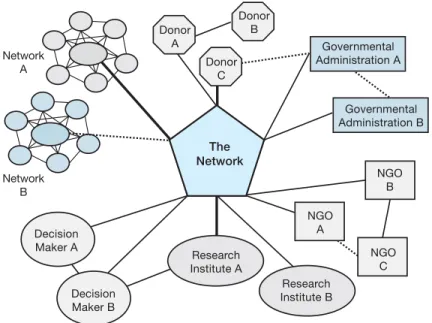
While you are preparing the proposal you should get in touch with stakeholders and decision-makers who can support your network, open doors to other people or organisations, or even provide funding for the network. Potentially useful decision-makers and other stake-holders may be found in government administrations, bilateral and multilateral development organisations, NGOs, research institutions, or even in private companies that have an interest in the thematic area of your network. These contacts will help you to sharpen your arguments in the proposal itself and will be door openers for later contacts. Draw a stakeholder map to provide an overview of the different stakeholders and their relationships (☞section 6.5.2).
Understand potential public and private contributors
Perhaps you are fortunate enough to be able to fund the activities of your network by in-kind contributions of the members or by membership fees. Otherwise you will need additional financial support from public and private contributors, for example, from local or regional governments, other governmental organisations, grant making foundations, or private companies.
Try to understand what the priorities of potential supporters are and what would be added value for them. Keep in mind that they receive numerous requests every day. Therefore, you will have to convince them of the network’s benefits. You should try to be flexible, while keeping your concept and principles. Public and private contributors have their own funding system, funding periods, and other requirements. Therefore the funding proposal has to be tailored to the different specifications without losing the objectives of the network.
Checklist 3: Elaboration of the network proposal
❏ Establish and develop a strong core team.
❏ Learn from others.
❏ Establish relationships with potential members, decision-makers and
other stakeholders.
❏ Tailor the proposal to potential public and private contributors as
long as it fits the goals of the network.
3.3
Setting up the network
Have you secured sufficient resources to fund the activities of your planned network? Congratulations! That’s something worth celebrating with the core team. Now you can begin to implement the ideas you have developed in the network proposal.
Build on the initial enthusiasm
The promise of sufficient resources for establishing the network will give you and your core team a real boost. Do not wait too long with activities and use this initial enthusiasm and motivation to start setting up the network right away. Bear in mind that not only you but also potential members, supporters, partners, and other stakeholder will also have high expectations in the beginning. So inform them regularly about progress.
Organise a start-up workshop
A good idea in the setting up of the network is to have a start-up workshop (☞section 6.2)bringing together not only the core team, but also potential members, stakeholders, and supporters. The objectives of this event should be to present your network concept and to establish a network spirit. At the same time, this is a good opportunity to learn more about the expectations of the members, to collect feedback, to get to know what the possible contributions of network members and their roles will be, and to explore ideas. The workshop should also serve to develop a commonly shared vision, mission, and goals.
Communicate, communicate, communicate
An important cornerstone for a successful start-up phase is proactive communication, communication and again communication! Contact all the relevant people individually on a regular basis. In particular, in the start-up phase, people are keen to know how it is progressing. Many questions have to be answered, misunderstandings clarified, and expectations moderated. Try to answer emails as soon as you can – if possible in one or two days time. If you do not have the answer immediately, let the enquirer know and inform him or her how soon you can send an answer. As long as you practise reliable and consistent communication, you will soon establish a trusting relationship among network members. Prepare short information products such as flyers or fact sheets.
Start with a few concrete activities
The energy level and the expectations are high during the start-up phase. You should make use of this by starting early with one or more concrete activities or small projects to show that the network is actually doing something that meets the needs of its members (☞section 7.1). Even if they are minor ones, these initial activities will also help you to refine the focus and clarify the network concept. And finally, they will help weld together the network community. Here, nothing works better than jointly planned and implemented projects.
In the start-up phase you should also develop a mid-term plan defining the most important areas of action and the programmes the network is going to launch in the next three to five years. Assign clear responsibilities and deadlines to each activity planned.
Becoming operational
Finally you should try to become operational as quickly as possible. The important activities are as follows.
■ Establish back-up services
– agree on the location of the secretariat – organise the secretariat
■ Develop a body of necessary rules and regulations (☞section 5.2) – register the network legally if required
– agree on and write down network guidelines – settle the copyrights
■ Start promoting the network and creating awareness (☞section 6.3) – agree on a logo and develop promotion material such as flyers – set up a website
– develop the membership base
Checklist 4: Setting up the network
❏ Make use of the initial enthusiasm.
❏ Organise a start-up event or workshop.
❏ CCC: Communicate, communicate, and communicate.
❏ Start with a few concrete activities.
❏ Develop a mid-term action plan.
4
Involving Decision-Makers
F
ormal networks strive to effect change or to achieve an impact in a certain area. Decision-makers in public administrations and politics, development agencies and international organisations, business and civil society will therefore play a crucial role for networks, as they have the decision-making power to influence the political agenda and implementation.You said
involved,
not completely
This section describes who the decision-makers are, how they work, what are the incentives and constraints regarding their participation, how they should be approached, and how relationships are maintained.
4.1
Networks and decision-makers
Decision-makers can be found in all kind of organisations and institutions. In order to involve them, you must learn how they work. Sometimes their support staff may be even more important for the network.
4.1.1 Definition of decision-makers
Typically, decision-makers are persons working in organisations at the executive level with the authority to make decisions in their area of competence. Examples of decision-makers are Managing Directors, Executive Secretaries, Executive Directors, Secretary Generals or Senior Officials in large organisations.
Depending on their position and function, managers at the operational level and technical experts may also act as important decision-makers. They prepare political decisions, suggest topics for action, and, in particular, provide quite a lot of room for manoeuvre during execution of decisions.
4.1.2 Understanding decision-makers
To secure the involvement of decision-makers you have to understand their work environment and their day-to-day operations.
Full agendas
The daily work of decision-makers involves frequent meetings, informal networking, giving comments on political issues, making or delaying decisions, getting support for initiatives, or preserving power. Therefore, it may be difficult to gain access to them and obtain an appointment.
and are exposed to power struggles. Their superiors and interest groups try to lever their ideas and influence decision-makers. Decision-makers will be interested in showing the results they have achieved with a view to securing their position.
Filtered information
In general, decision-makers have excellent access to information, an asset that they also use strategically: they will forward or hold back information selectively and according to their interests.
In addition, the sources of information for decision makers, such as opponents, interest groups, superiors, or their staff can filter or withhold strategic information. Thus decision-makers often receive filtered information. Another way of influencing decision makers is the creation of insecurity about the validity and trustworthiness of information by opponents.
In addition, decision-makers often suffer from information overload. As many decision-makers are generalists rather than technical specialists, it is difficult for them to select important information and assess the quality of information. So they have to rely on their technical staff.
4.1.3 Importance of support staff
Support staff, junior staff, and desk officers are important when persuading decision-makers to support networks because they find and filter useful information, give feedback, and prepare speeches and reports. Also, they know the agendas of the decision-makers, their strengths and weaknesses, as well as the best ways to approach them.
Networks should strive to establish good relationships with these valuable entry points to decision-makers and actively include them in their work. Network managers have to be aware that these officers are often overburdened, as they are fully involved in the hectic activities at the decision-maker level.
4.2
Preconditions and incentives
To involve decision-makers in networks, remember it takes two to tango. First, given that they seek to induce policy and strategy changes, networks have to be attractive and interesting for them. Second, the decision-maker needs the network to gain access to information but may have limited resources, such as time and funding, for obtaining the full benefit from participating.
4.2.1 Preconditions
Good management, transparency, and trust are the most important features that make networks attractive for decision-makers.
Good management
Good management is not only important for the network’s success; it is also of high priority for decision-makers and their collaborators. They will only participate in networks that are clearly managed professionally and by a committed team (☞sections 5 and 6).
Transparency
The transparency of networks is an important precondition for convincing decision-makers to be involved. Decision-makers need to be able to quickly grasp the network’s vision, mission, and goals. They also want to know how the network is organised, who is involved, who has what influence, and who funds its activities.
Trust
Trust is the basic lubricant for networking and sharing knowledge. Decision-makers will only become involved in networks if they can trust them. So you should strive to establish relationships of trust with decision-makers. A transparent organisation, effective management, and reliable and consistent communications will support this.
An effective way of building up trust is to involve personalities of widely recognised prestige who share the network’s mission. As Honorary
4.2.2 Incentives
What makes decision-makers participate in networks? First, it is important to understand that there are different degrees of involvement for decision-makers. Second, most decision-makers – or their designated staff – will only get involved in networks if they perceive that they are of personal benefit to them. Third, decision-makers and their staff also need resources, such as time and funding, to participate in networks, for example, by joining email discussion fora or attending conferences.
Different degrees of participation
Decision-makers are involved in networks in various ways. Often, they do not have or take the time for direct involvement in activities. They are also hesitant to expose themselves, as their statements are often interpreted as statements in the name of the organisation they work for, or their comments are associated with a political agenda. Nevertheless, decision-makers might stay indirectly involved in a network by following email discussions passively, participating in workshops or conferences now and then, or being members of the advisory board. Last but not least, decision-makers may participate in networks through their staff by sending them to network meetings and workshops or by assigning them to participate in discussion groups, provide and retrieve information, facilitate discussions, or even run the network’s secretariat.
Benefits from participating in a network
The strongest incentive for decision-makers to devote part of their time to networks or to assign staff to do so is receiving an added value. Some decision-makers may participate in networks for altruistic reasons or just out of personal interest, but in general, decision-makers will only join a network if they receive some benefit.
To involve decision-makers, managers or facilitators of networks should strive to identify common ground among the objectives of the network and the objectives of the decision-makers, and take overlapping goals as a starting point.
Experienced decision-makers know that building up a network and generating a return on their investment takes quite some time. Yet network managers or facilitators should regularly remind decision-makers of this fact and explain why this is so.
The most important benefits networks can provide for decision-makers are obtaining access to information and know-how, increasing one’s personal network, and establishing partnerships. Other benefits are also evident although they are often not mentioned.
Obtaining access to information and know-how
One of the strongest incentives for becoming involved in networks is getting access to information, know-how, and new ideas that might be valuable for the work of decision-makers. In this way networks have an important role in collecting, filtering, validating, creating access to, and disseminating good-quality information for decision-makers.
Decision-makers will not retrieve all information in the same way. Technical information will be retrieved mainly through their support staff. Softer information, like gaining a feeling of what others do and
Checklist 5: Information decision-makers are interested in
❏ Technical data, information, and know-how
❏ Experiences and good practices
❏ News, trends, and information about events, workshops, and
conferences
❏ Information about network members and experts
❏ Services of the network
❏ Ongoing activities and projects
Enlarging one’s personal network
Many decision-makers would like to be involved in networks because this gives them a unique opportunity to meet people and enlarge their personal network. Good relationships among colleagues working within an organisation, as well as with other professionals, friends, and relatives, are among the most valuable resources for effective and efficient work.
In particular, regular meetings or participation in workshops and conferences organised by networks provide excellent opportunities for decision-makers to build up and nurture their personal networks. At the same time, these events provide good occasions for network managers or network members to get in direct touch with decision-makers.
Facilitator for partnerships
Networks are catalysts for building up and maintaining personal networks. They are also a unique and informal way of collaborating or of building up partnerships with other governmental organisations at the local, national, or regional level, with private companies, with NGOs, or with academia. In the network setting decision-makers from government institutions might find a platform for interaction with external parties, such as NGOs, in a more informal way than in structured meetings.
Gaining the power of persuasion
Access to validated information and knowledge through networks empowers decision-makers to work towards achieving their goals. A network can give decision-makers strong arguments for political discussion. If they can say that their opinion is not only their own but also that of all network partners this will give their arguments much more weight and power of persuasion.
A decision-maker is always looking for evidence and arguments to justify his or her decisions and actions vis-à-vis the various stakeholders. By participating in networks, decision-makers learn what others are doing, how they are thinking, and what their perceptions are. This helps decision-makers to construct their communication strategies. By citing investments of partner organisations or pointing to standards
being developed by a network, they can justify their actions. The effect is well known: many people are more willing to accept something if it has already been accepted by many others.
Being involved while remaining independent
In many networks there is no formal membership or the formal duties and implications of membership are limited. This is an advantage for decision-makers as they can participate in a network while maintaining their independence. Such networks do not threaten the traditional, more hierarchical and structured organisations in which decision-makers often work. However, this independence also means that decisions taken jointly by network members are not binding for decision-makers unless they are written down in a formal agreement.
Testing new and innovative solutions
Networks offer decision-makers an informal platform to discuss new ideas or initiatives. Thus, networks also serve as a testing ground and for carrying out reality checks before decision-makers go public with their ideas.
Email discussion groups or bilateral emails are good ways of obtaining informal feedback from peers in a short time. However, it is better to test more sensitive ideas at informal talks during meetings or workshops, or in closed meetings.
Multipliers of resources
Decision-makers are bound to their organisations and their available, and often scarce, financial and personal resources. Networks can serve as multipliers as they are able to pool resources from different network partners to realise common solutions or launch joint projects or initiatives.
Benchmarking
It is often quite difficult for decision-makers to know how well their organisations are doing, and how efficient and effective their work is.
Improving prestige
By participating in networks, decision-makers can improve their prestige. This will particularly be the case if a network has a good public reputation.
Personal benefits
Decision-makers may also receive personal benefits not directly related to their jobs by participating in networks. For instance, they may enjoy the attractive environment in which a conference or workshop is being held. Conferences taking place at appealing venues, in particular, are often fully booked. Network meetings and events are also appreciated as a break from the daily routine.
These personal benefits contribute to the motivation not only of decision-makers, but also of all network members. Creating a positive working atmosphere is an important part of networking, and network managers should pay attention to this.
Checklist 6: Benefits decision-makers are looking for
Most important benefits
❏ Getting access to information and know-how
❏ Enlarging personal networks
❏ Facilitator of partnerships
Other benefits
❏ Gaining the power of persuasion
❏ Being involved while remaining independent
❏ Testing new ideas and innovative solutions
❏ Multipliers of resources
❏ Benchmarking with other organisations or institutions
❏ Improved personal prestige
4.2.3 Resources for participation
Decision-makers not only have to perceive benefits from participating in networks, they also need time and funding to participate in them. Both resources are scarce for decision-makers. They will only participate if this is perceived as a priority over other engagements, which means that they have to be really convinced of the network’s benefits.
Depending on the country and status, the organisation’s funding of participation may also be a factor limiting the involvement of decision-makers in networks. In some countries, it is still difficult to raise the funds needed to use the Internet or attend meetings, workshops, and conferences. Thus networks may have to cover at least a part of the expenses for the participation of decision-makers.
4.3
Approaching and involving decision-makers
Involving decision-makers in networks requires personal relationships that are based on a good understanding of each other’s preferences. Once you have established trusting relationships, they have to be nurtured continuously.
4.3.1 Approaching decision-makers
Involving decision-makers in a network is a strategic choice. Before you approach decision-makers, you have to think about what you want to achieve. Decision-makers may provide funding for your network, act as door openers, give thematic advice, or contribute their name to the network’s prestige.
To establish contact with decision-makers merely by sending an email often does not work. They receive many emails every day and have to be very selective in reading and answering them. They will also be reluctant to answer an email sent by somebody they do not know. The best approach is to contact a decision-maker with a polite and
can act as a door opener. Finally, support staff can provide an entry point to decision-makers.
First meeting
Once contact is established and the decision-maker is willing to receive the network, a face-to-face meeting should be held, if possible together with the messenger. At this first meeting, high-level network representatives should be present and introduce themselves. They should explain the network’s mission, objectives, activities, and services in a concise way.
The first meeting should be used to carefully explore the interests and needs of the decision-maker, put forward convincing arguments for involvement, and demonstrate the network’s added value. Finally, you should look at practical types of possible involvement, for example as a member of the board, a committee of patrons or an advisory committee. However, the decision-maker may prefer only his/her desk officers or support staff to participate actively in the network.
Plan a careful follow-up
After the meeting, the follow-up has to be planned carefully. Decide how you would like to involve the decision-maker. Summarise the discussions held briefly, note what has been agreed upon, and suggest the next steps, such as a second meeting or participation in a workshop. Send these brief minutes to the decision-maker together with a polite accompanying letter.
As is so often the case, the first step will be the most difficult one: to involve the first decision-maker in the network will be quite a challenge, but, as soon as several decision-makers are on board, the snowball principle will work, making it easier to involve more decision-makers.