Vol. 21, No. 3 (2012) 165–197 c
World Scientific Publishing Company DOI:10.1142/S0218843012410018
SECURE COLLABORATIVE INTEGRITY VERIFICATION
FOR HYBRID CLOUD ENVIRONMENTS∗
YAN ZHU†and SHANBIAO WANG‡
Beijing Key Laboratory of Internet Security Technology, Peking University Institute of Computer Science and Technology, Peking University
Beijing 100871, China †[email protected]
‡[email protected] HONGXIN HU
Department of Computer and Information Sciences Delaware State University, Dover, DE 19901, USA
GAIL-JOON AHN
School of Computing, Informatics, and Decision Systems Engineering Arizona State University, Tempe, AZ 85281, USA
DI MA
Department of Computer and Information Science University of Michigan-Dearborn, Dearborn, MI 48168, USA
Received 22 February 2012 Accepted 4 September 2012 Published 29 November 2012
A hybrid cloud is a cloud computing environment in which an organization provides and manages some internal resources and has others provided externally. However, this new environment could bring irretrievable losses to the clients due to a lack of integrity verification mechanism for distributed data outsourcing. To support scalable service and data migration, in this paper we address the construction of a collaborative integrity verification mechanism in hybrid clouds where we consider the existence of multiple cloud service providers to collaboratively store and maintain the clients’ data. We propose a collaborative provable data possession scheme adopting the techniques of homomorphic verifiable responses and hash index hierarchy. In addition, we articulate the performance optimization mechanisms for our scheme and prove the security of our scheme based on multi-prover zero-knowledge proof system, which can satisfy the properties of complete-ness, knowledge soundcomplete-ness, and zero-knowledge. Our experiments also show that our proposed solution only incurs a small constant amount of communications overhead. Keywords: Integrity verification; multi-prover; collaborative; hybrid clouds.
∗This article is an extended version of the article originally published in CollaborateCom2011.1
1. Introduction
Cloud computing has become a faster profit growth point in recent years by pro-viding a comparably low-cost, scalable, location-independent platform for clients’ data. Although commercial cloud services have revolved around public clouds, the growing interest of building private cloud on open-source cloud computing tools allows local users to have a flexible and agile private infrastructure to run service workloads within their administrative domains. Private clouds are not exclusive for being public clouds, and they can also support a hybrid cloud model by sup-plementing a local infrastructure with computing capacity from an external public cloud. By using virtual infrastructure management (VIM),2 a hybrid cloud can
allow remote access to its resources over the Internet via remote interfaces, such as the Web services interfaces that Amazon EC2 uses.
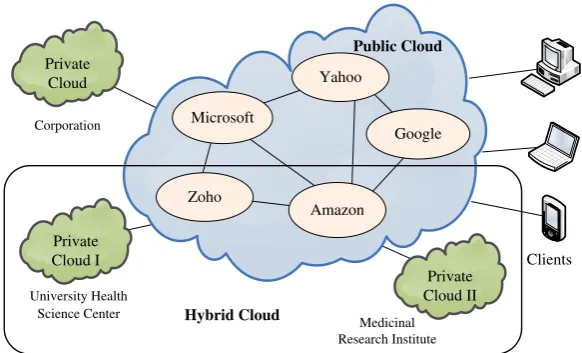
Usually, a hybrid cloud is a cloud computing environment in which an organi-zation provides and manages some internal resources as well as external resources. From the viewpoint of internal resource management, a hybrid cloud is different from a multiple cloud environment, which usually refers to an open cloud archi-tecture consisting of multiple public clouds. Therefore, a hybrid cloud puts more emphasis on a cloud aggregation platform including private clouds and public clouds, combining the features of availability, scalability, and low cost from pub-lic clouds, and security from private clouds. For example, as shown in Fig. 1, an organization, considered as a hybrid cloud, uses public cloud services, such as Zoho and Amazon’s EC2, for general computing purposes while storing customers’ data within its own data centers, such as university health science center (Private Cloud I) and medicinal research institute (Private Cloud II).3Obviously, it is more
secure to store customers’ data in private clouds.
Private Cloud
Microsoft
Zoho
Yahoo
Amazon Private
Cloud I
Hybrid Cloud
Public Cloud
Private Cloud II
Clients
University Health Science Center
Medicinal Research Institute Corporation
As cloud computing has been rapidly adopted, the hybrid model will be more prevalent for a number of reasons2: to provide clients with the same features found
in commercial public clouds; to provide a uniform and homogeneous view of virtual-ized resources; to support configurable resource allocation policies to meet an orga-nization’s specific goals (high availability, server consolidation to minimize power usage, and so on); and to meet an organization’s changing resource needs. In par-ticular, hybrid cloud also fulfills an organization’s security requirements, that is, sensitive data is entirely controlled and retained by the enterprise.
With the growing popularity of clouds, the tools and technologies for hybrid clouds are emerging recently, such as Platform VM Orchestrator,a VMware
vSphere,b and Ovirt.c They help users construct a comparably low-cost, scal-able, location-independent platform for managing clients’ data. However, if such an important platform is vulnerable to security attacks, it would bring irretrievable losses to the clients. For example, confidential data in an enterprise’s private cloud may be illegally accessed by using remote interfaces in hybrid cloud, or relevant data and archives are lost or tampered with when they are transferred into an uncertain storage pool outside the enterprise by an application in a hybrid cloud. Therefore, it is indispensable for cloud service providers (CSPs) to provide secure management techniques to ensure their storage services.
Provable data possession (PDP)4is a probabilistic proof technique for a storage provider to prove that clients’ data remains intact. In other words, clients can fully recover their data and have confidence to use the recovered data. This creates strong demand for seeking an effective solution to check if their data has been tampered with or deleted without downloading the latest version of data. Various PDP schemes have been recently proposed, such as Scalable PDP5 and Dynamic PDP,6to work in a publicly verifiable way so that users can employ their verification
protocol to prove the availability of the stored data. However, these schemes focus on the PDP issues at untrusted servers (public clouds), and are not applicable for a hybrid cloud environment due to the lack of support for heterogeneous multi-cloud storages, as well as a privacy protection mechanism (see Sec.2.3for details).
In this paper, we address the problem of provable data possession in hybrid clouds. By discussing the characteristics of hybrid clouds and analyzing security drawbacks of some existing schemes, we indicate our main research objectives in three aspects: high security, verification transparency and high performance. On this basis, we first propose a verification framework for hybrid clouds along with the description of three techniques adopted in our approach: (i) fragment structure, (ii) hash index hierarchy (HIH), and (iii) homomorphic verifiable response (HVR). We argue that it is possible to construct a collaborative PDP (CPDP) scheme
awww.platform.com/Products/platform-vm-orchestrator bwww.vmware.com/products/vsphere
without compromising data privacy based on modern cryptographic techniques, such as multi-prover zero-knowledge proof system (MP-ZKP).7
We then provide an effective construction of CPDP using homomorphic verifi-able responses and hash index hierarchy. This construction realizes security against data leakage attacks and tag forging attacks, considering transparent property for clients to store and manage resources in hybrid clouds. This construction uses homo-morphic property, on which the responses of clients’ challenges computed from mul-tiple CSPs can be combined into a single response as the final result of hybrid clouds. By using such a mechanism, clients can be convinced of data possession without knowing geographical locations where their files reside. In addition, a new hash index hierarchy is proposed to realize the client-oriented transparency measures to store and manage clients’ resources in hybrid clouds.
We also evaluate the performance of our CPDP scheme. First, we provide a brief security analysis of our scheme. We also analyze the performance of proba-bilistic queries for detecting abnormal situations in a timely manner. This prob-abilistic method also has the inherent benefit in reducing the computation and communication overheads. In addition, we prove the security of our scheme based on multi-prover zero-knowledge proof system, which can satisfy the properties of completeness, knowledge soundness and zero-knowledge. In practical applications, our optimization algorithm also provides an adaptive parameter selection for differ-ent sizes of files (or clusters), which could ensure that the extra storage is optimal for the verification process.
The rest of the paper is organized as follows. In Sec.2, we address our research motivation and research objectives. Section3discusses our framework and model of integrity verification in hybrid clouds. We describe background techniques adopted in our practical construction in Sec. 4. Section 5 describes the security and per-formance analysis of our solution. We address the related work in Secs. 6 and 7 concludes this paper and discusses the future work.
2. Motivation and Objectives
In this section, we give an overview of our motivation and research objectives in constructing collaborative PDP. Our motivation is based on following challenging questions that need to be addressed in secure cloud storage, which also help us define our objectives in this paper.
2.1. Why need integrity checking of data in clouds?
Cloud storage service has become a new profit growth point by providing a compa-rably low-cost, scalable, location-independent platform for managing clients’ data. However, data security is critical to such convenient storage services due to the following reasons: cloud infrastructures are much more powerful and reliable than personal computing devices but they are still facing all kinds of internal and exter-nal threats; for the benefits of their own business, there exist various motivations
for cloud service providers to behave unfaithfully toward cloud users; furthermore, the behaviors of CSPs may not be known by cloud users, thus a dispute may be raised even if this dispute may result from users’ own improper operations. There-fore, it is necessary to explore various mechanisms for integrity, availability, and confidentiality of data stored in clouds.
Data integrity verification is one of the most basic and critical techniques in outsourced cloud storage. In cryptography, message authentication code (MAC) and digital signature can be applied to verify data integrity and ownership. For example, to sign data D, a data owner first produces a fix length string H = Hash(D) through a hash function, and then signs it to compute a data tagS =Signsk(H) by his/her private key. To verify, both the data and the tag (D, S) will be sent to the verifier, and then the verifier checks thatVerifypk(D, S) =True/Falseby using a verification algorithm, where (pk,sk) is a key pair of the data owner. But this process is not suitable for outsourced cloud storage due to the following reasons: • The verification process requires to send back original data to the verifier. It is
only fit for short data, but it is obviously not possible for large amounts of data due to higher transmission overheads; and
• The verification process cannot achieve integrity verification for a part of data, but it is not fit for distributed cloud storage in which outsourced data may be distributed to different physical storage devices or CSPs.8
Therefore, it is crucial for CSPs to offer an efficient verification mechanism for solving the above-mentioned problems. This will bring the following advantages: verification without download and verification for partial data.
2.2. Why need a new mechanism for ensuring data security
in hybrid clouds?
As mentioned previously, a hybrid cloud is an environment consisting of multiple public clouds and private clouds. A hybrid cloud typically needs at least one private cloud. The reason for the existence of private cloud is that it offers the greatest level of security and control for enterprises’ sensitive data, hence security risks are less as compared to those stored in public clouds. Ideally, a hybrid approach allows a business to take advantage of the scalability and cost-effectiveness of a public cloud environment, without exposing mission-critical applications and data to third-party vulnerabilities.
In hybrid clouds, one of the core design principles is dynamic scalability, which guarantees cloud storage services to handle growing amounts of application data in a flexible manner. By employing the virtualization technique, such as VIM, hybrid clouds can effectively provide dynamic scalability of service and data migration. This kind of scalability is also particularly important for large enterprises taking into account their existing substantial investments of infrastructure. Furthermore, many organizations would prefer to keep sensitive data under their own control,
Public Cloud
Private Cloud Position
Script Zoho
Domain
Public
Doc1 Facebook Public
Doc2 Finance Co. Private
Integrated Data Amazon
Zoho Facebook
Script Document1
Document2
Application
Firewall Cloud Client
Cloud Service
Data Stream
Items
xxxxx
xxxxx
xxxxx
Fig. 2. The cloud application for integrated data in hybrid clouds.
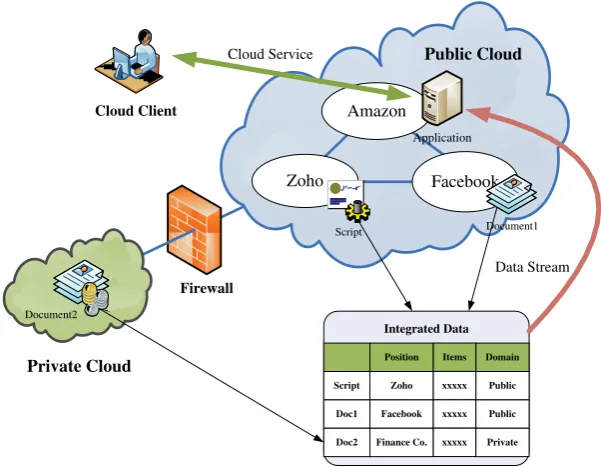
ensuring security requirements. For example, a client might integrate data and scripts from multiple private or public providers into a large-size archive or a com-plete application setting; or a cloud service might capture data from other services in private clouds, but application scripts, intermediate data and results are executed and stored in public clouds.9,10
We show such an example of collaborative computing in Fig.2. Assume that a cloud service, like a Web-based application on service-oriented architecture (SOA), is constructed on Amazon’s EC2. The running of this service depends on the scripts from Zoho, the documents from Facebook and Finance Co. In this example, all of these integrated data, like documents and scripts, is called an application setting. From a practical standpoint, this kind of application setting can be either a large file, a database, or a set of files in an application system including softwares, Web pages, snapshots, and so on. Obviously, this collaborative paradigm is more vulnerable to various security attacks. For instance, an attacker can modify application softwares or scripts, tamper with application data, or load a trojan into a snapshot of virtual machine (VM) to compromise cloud applications. In order to mitigate these security risks, the safest way is to verify the data integrity of application setting before the application service is executed or the outsourced data is downloaded. In addition, an easily overlooked problem is to avoid disclosure of sensitive data in the verification process itself when this process is considered as public Daemons (like httpd, inetd, and fmd).
2.3. Are existing PDP schemes efficient for hybrid clouds?
As mentioned above, traditional cryptographic technologies based on Hash func-tions and signature schemes11,12 cannot support the verification of data integrity
and availability of outsourced data without a local copy of data. It is evidently impractical to download the whole data to verify data validation due to the expen-siveness of communication, especially, for large-size files. Recently, several PDP schemes are proposed to address this issue. Essentially, the PDP is an interactive proof system between a CSP and a client because the client makes a false/true decision for data possession without downloading data.
Existing PDP schemes mainly focus on integrity verification issues at untrusted stores in single clouds, but they are not suitable for a hybrid cloud environment since they were originally constructed based on a two-party interactive proof system (IPS). In cryptography, there exist some quite subtle differences between TP-IPS and multi-party interactive proof system (MP-TP-IPS). These differences restrict the application of existing PDP scheme in hybrid clouds. For example, existing PDP schemes usually employ three-move interactive mode:Commitment,Challenge, and Response. In the first step, the CSPs need to select some random variables and sent their commitments into the client. However, such random selections of variables are independent, thus we cannot simply combine them into PDP scheme for a hybrid cloud. Although it is an alternative way for multiple CSPs to generate random variables by using Multi-Party Random Coin Tosses and Byzantine Agreement, this requests a complex protocol to ensure the randomness and consistency of results (among multiple parties). Likewise, some similar problems must be solved in other steps.
On the other hand. If we do not consider the relationship among data stored in deferent CSPs, existing PDP schemes can be used in a trivial way to realize data integrity verification in a hybrid cloud. That is, a verifier (a client) must invoke them repeatedly to check the integrity of data stored in each single cloud. This means that the verifier must know the exact position of each data block in hybrid clouds. Moreover, this process will consume higher communication bandwidth and computation overheads at both the verifier side and the cloud sides.
In response to actual characteristics of storage services in a hybrid cloud, the concerns to improve the existing PDP schemes are mainly from three aspects: • How to design a more efficient PDP model for hybrid clouds to reduce storage
and network overheads;
• How to deal with heterogeneous storage in a hybrid cloud and enhance the trans-parency of verification activities for the verifier; and
• How to provide an efficient sampling policy to help provide a more cost-effective verification service.
Solving these problems will help improve the quality of PDP services, which can not only timely detect abnormality, but also take up less resources, or rationally
allocate resources. Hence, a new PDP scheme is desirable to accommodate these application requirements from hybrid clouds.
2.4. Are existing PDP schemes secure enough for hybrid cloud environments?
In hybrid clouds, a collaborative work model provides some mutual channels among individual clouds. This kind of channels will no doubt increase the possibility of malicious attacks. In particular, they also provide a possibility of unauthorized access to data in a private cloud. This should be a deadly threat for hybrid cloud environments because most of existing PDP schemes ignore the leakage problem of verified data via the interactive process of the verification protocol in a PDP scheme. Thus, when a public verification service does not have a strong security mechanism to data protection, a malicious attacker could easily exploit such a service to obtain private data. Such an attack is extremely dangerous to the confidential data of an enterprise.
Even though existing PDP schemes have addressed various aspects such as pub-lic verifiability,4dynamics,6 scalability,5and privacy preservation,13we still need a
careful consideration to the following attacks.
• Data leakage attack: Through the interfaces of public clouds, various applications in hybrid clouds are allowed to access data in private clouds, so a PDP service (considered as a Daemon) undoubtedly provides a covert channel to access the secret data in private clouds. Therefore, if a PDP scheme cannot resist against the data leakage attacks, an adversary can easily obtain the entire data through an interactive proof process. For instance, Attacks 1 and 3 described in Appendixes A and B demonstrate that a verifier can get the stored data after running or wire-tapping sufficient verification communications. It is obvious that such attacks could significantly impact the privacy of outsourced data in clouds.
• Tag forgery attack: In hybrid clouds, an untrusted CSP has more opportunities to induce a forgery attack, in which the CSP can cheat a verifier by generating a valid tag for the tampered data. For example, Attacks 2 and 4 given in Appendixes A and B show that a successful forgery attack can occur only if one of the following cases is happened:
(a) Clients modify data blocks in a file;
(b) Clients insert and delete blocks repeatedly in a file;
(c) Clients reuse the same file name to store multiple different files.
2.5. Our objectives
To summarize the above discussions, we believe that it is very essential to develop an efficient collaborative method for data integrity verification in hybrid cloud envi-ronments. Furthermore, from the above-mentioned challenges, our objectives for
checking integrity of outsourced data in hybrid clouds are as follows:
• Usability aspect: In the way of collaboration, a client should utilize the integrity check in a distributed cloud storage system. Our scheme should conceal the details of the storage to reduce the burden on clients;
• Security aspect: Our scheme should provide adequate security features to resist some existing attacks, especially data leakage attack and tag forgery attack; and • Performance aspect: Our scheme should have the lower communication and
com-putation overheads than non-cooperative solutions.
3. Framework and Model
In this section, we present our verification framework for hybrid clouds and a formal definition of collaborative PDP. In order to guarantee security, we also define a security model based on zero-knowledge interactive proof system.
3.1. Verification framework for hybrid clouds
Although PDP schemes evolved around public clouds offer a publicly accessible remote interface to check and manage the tremendous amount of data, the majority of today’s PDP schemes is incapable of satisfying such an inherent requirement of hybrid clouds in the aspects of security, bandwidth and usability. To solve this problem, we consider a hybrid cloud storage service as illustrated in Fig.3.
Public Cloud
Private Cloud
Position Script Zoho
Domain Public Doc1 Facebook Public Doc2 Finance Co. Private
Index Hash Table for Integrated Data
Amazon
Zoho Facebook
Script Document1
Document2
Application
Firewall Cloud Client
Trusted Third Parties(TTP)
Hash xxxxx xxxxx xxxxx Items
xxxxx xxxxx xxxxx
This hash value is used to verify the data integrity.
Integrity Verification Information Integrity Verification
Protocol
Cloud Service
Data Stream
In this architecture, we consider a data storage service in a hybrid cloud involv-ing three different entities:
• Granted clients, who have large amount of data stored in a hybrid cloud and have the right to access and manipulate these stored data;
• Cloud service providers (CSPs), who work together to provide data storage ser-vice and have enough storage spaces and computation resources;
• Trusted third party (TTP), who is trusted to store verification parameters, including index-hash table for integrated data (see Fig. 3), and offers the query services for these parameters.
In Fig.3, we present an index hash table to manage the application data aggre-gated from multiple CSPs in a hybrid cloud. Moreover, some basic data items, such as data block position, access domain, and hash value, should be added to this table. In our scheme, one of the most important items is a cryptographic hash value, which is used to compress the record itself and supports the data integrity verification in collaborative PDP services. More importantly, this table is also used to solve the heterogeneous storage problem (see Sec.4.1).
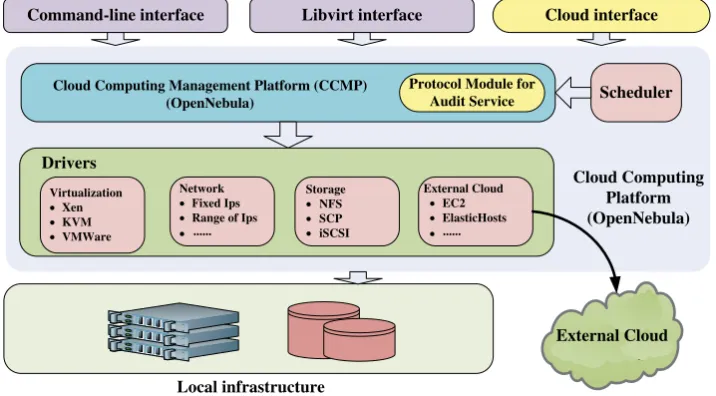
To support this architecture, a cloud storage provider also needs to add corresponding modules to implement collaborative PDP services. For example, OpenNebula is an open source, virtual infrastructure manager that is integrated with multiple virtual machine managers, transfer managers, and external cloud providers. In Fig.4, we describe such a cloud computing platform based on Open-Nebula architecture,2in which a service module of collaborative PDP is added into
cloud computing management platform (CCMP). This module is able to respond
External Cloud
Virtualization Xen KVM VMWare
Network Fixed Ips Range of Ip ...
s
Storage NFS SCP iSCSI
External Cloud EC2 ElasticHosts
Scheduler
Protocol Module for Audit Service
Cloud Computing Platform (OpenNebula)
Cloud Computing Management Platform (CCMP) (OpenNebula)
Command-line interface
Local infrastructure
Libvirt interface Cloud interface
Drivers
...
to the PDP requests of TTP through cloud interfaces. In addition, a hash index hierarchy (HIH), which is described in detail in Sec.4.1, is used to provide a uni-form and homogeneous view of virtualized resources in virtualization components. For the sake of clarity, we use yellow color to indicate the changes from the original OpenNebula architecture.
In this architecture, we consider the existence of multiple CSPs to collabora-tively store and maintain clients’ data. Moreover, a collaborative PDP is used to verify the integrity and availability of their stored data in CSPs. The verification flowchart is described as follows: First, the client (data owner) uses the secret key to pre-process a file, which consists of a collection ofn blocks, generates a set of public verification information that is stored in TTP, transmits the file and some verification tags to CSPs, and may delete its local copy; then, by using a verifica-tion protocol for collaborative PDP, the clients can issue a challenge for one CSP to check the integrity and availability of outsourced data in terms of public verification information stored in TTP.
3.2. Definition of collaborative PDP
In order to prove the integrity of data stored in hybrid clouds, we define a framework for collaborative provable data possession (CPDP) based on multi-prover interactive proof system (MP-IPS)14,15:
Definition 3.1 (Collaborative-PDP). A collaborative provable data possession scheme S is a collection of two algorithms and a multi-prover interactive proof system,S= (K,T,P):
(i) KeyGen(1κ): takes a security parameterκas input, and returns a secret key sk or a public-secret keypair (pk, sk);
(ii) TagGen(sk, F,P): takes as inputs a secret keysk, a file F, and a set of cloud storage providers P ={Pk}, and returns the triples (ζ, ψ, σ), where ζ is the secret of tags, ψ = (u,H) is a set of verification parametersu and an index hierarchyHforF,σ={σ(k)}Pk∈P denotes a set of all tags,σ(k) is the tags of the fractionF(k) ofF in P
k;
(iii) Proof(P, V): is a protocol of proof of data possession between the CSPs (P = {Pk}) and a verifier (V), that is,P
k∈PPk(F
(k), σ(k)), V(pk, ψ), where each Pk takes as input a fileF(k)and a set of tagsσ(k), and a public key pkand a
set of public parametersψis the common input betweenP andV. At the end of the protocol running,V returns a bit{0|1}denoting false and true. where,P
k∈P denotes the collaborative computing inPk ∈ P.
To realize the CPDP, a trivial way is to check the data stored in each cloud one by one. However, it would cause significant cost growth in terms of communication and computation overheads. It is obviously unreasonable to adopt such a primitive
Table 1. The signal and its explanation.
Sig. Repression
n the number of blocks in a file; s the number of sectors in each block;
t the number of index coefficient pairs in a query; c the number of clouds to store a file;
F the file withn×ssectors, i.e.F={mi,j}ij∈∈[1[1,n,s]]; σ the set of tags, i.e.σ={σi}i∈[1,n];
Q the set of index-coefficient pairs, i.e.Q={(i, vi)}; θ the response for the challengeQ.
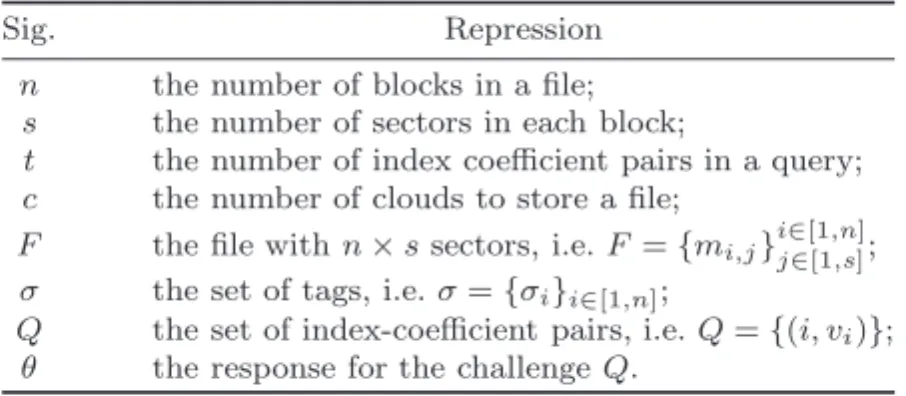
approach that diminishes the advantages of cloud storage: scaling arbitrarily up and down on-demand.16 For the sake of clarity, we list some used signals in Table1.
3.3. Security model for collaborative PDP
In cryptography, the CPDP scheme is a multi-prover interactive proof system (MP-IPS) in nature. According to the security definition of MP-IPS, we require that the CPDP scheme satisfies the following security requirements:
Definition 3.2. A pair of interactive machines (P
k∈PPk, V) is called an available
provable data possession for a file F if P = {Pk} is a collection of (unbounded) probabilistic algorithms, V is a deterministic polynomial-time algorithm, and the following conditions hold for some polynomialp1(·), p2(·), and alls∈N:
(i) Completeness: For everyσ∈TagGen(sk, F), Pr
Pk∈P
Pk(F(k), σ(k)), V
(pk, ψ) = 1
≥1−1/p1(κ); (1)
(ii) Soundness: For everyσ∗∈TagGen(sk, F), every interactive machinePk∗∈ P, Pr
Pk∗∈P
Pk∗(F(k), σ(k)∗), V
(pk, ψ) = 1
≤1/p2(κ); (2)
where,p1(·) andp2(·) denote two polynomials,dandκis a security parameter used
in KeyGen(1κ).
The standard definition of proofs of knowledge was proposed by Bellare and Goldreich.14 Here, the knowledge soundness could be regarded as the stricter
def-inition of security of tag information, e.g. the forging tag attack. This means that the prover can forge file tags by means of a knowledge extractor M if soundness property does not hold.
dThe function 1/p
1(κ) is called the completeness error, and the function 1/p2(κ) is called the soundness error. For non-triviality, we require 1/p1(κ) + 1/p2(κ)≤1−1/poly(κ).
For a private cloud, we concerned more about the disclosure of private informa-tion in the verificainforma-tion process. It is easy to find that data blocks and their tags could be obtained by the verifier in some existing schemes. In order to solve this problem, we introduce Zero-Knowledge notion into the CPDP scheme, as follows: Definition 3.3 (Zero-knowledge). An interactive proof system for provable data possession problem is computational zero knowledge if there exists a probabilistic polynomial-time algorithmS∗ (call a simulator) such that for every probabilistic polynomial-time algorithmD, for every polynomialp(·), and for all sufficiently large
s, it holds that
Pr[D(pk, ψ, S∗(pk, ψ)) = 1] −Pr
D
pk, ψ,
Pk∈P
Pk(F(k), σ(k)), V∗
(pk, ψ)
= 1
≤1/p(s), where, S∗(pk, ψ) denotes the output of simulator S. That is, for allσ ∈ TagGen (sk, F), the ensembles SO(F)(pk, ψ) and
Pk∈PPk(F
(k), σ(k)), V∗(pk, ψ)e are
computationally indistinguishable.
Actually, zero-knowledge is a property that captures P’s robustness against attempts to gain knowledge by interacting with it. For the PDP scheme, we use the zero-knowledge property to the security of data blocks and signature tags.
4. Main Techniques
In this section, we propose a new cooperative provable data possession scheme for hybrid clouds. Concretely speaking, this scheme can meet the following require-ments: conceal the details of the storage, which is not necessary to be known by users in the verification process; and ensure that the verification does not reveal any information, which is of particular importance for sensitive data. We set up our system using bilinear pairings proposed by Boneh and Franklin.17 We define this
kind of bilinear pairings in the following bilinear map group system:
Definition 4.1 (Bilinear Map Group System). A bilinear map group system is a tuple S=p,G,GT, ecomposed of the following objects:G andGT are two multiplicative groups using elliptic curve conventions with a large prime orderp. The function eis a computable bilinear map e: G×G →GT with the following properties: for anyG, H ∈Gand alla, b∈Zp, we have
• Bilinearity:e([a]G,[b]H) =e(G, H)ab;
• Non-degeneracy:e(G, H)= 1 unlessGorH = 1; and • Computability:e(G, H) is efficiently computable. eThe output of the interactive machineV∗after interacting withP
Pk∈PPk(F(k), σ(k)),on com-mon input (pk, ψ).
In the remainder of this section, we first introduce the execution environment of our scheme, including hash index hierarchy and outsourced data storage structure. Then, we give our CPDP scheme in details, and discuss the validity of the scheme.
4.1. Hash index hierarchy for collaborative PDP
As a virtualization approach, we introduce a simple index-hash table to record the status and change of file blocks, as well as generate the Hash value of block in the verification process (see an example in Fig. 3). The structure of our index-hash table is similar to that of file block allocation table in file systems. The index-hash table consists of serial number, block number, version number, random integer, and so on. Different from the common index table, we must assure that all records in this kind of table differ from one another to prevent the forgery of data blocks and tags. In practical applications, it should been constructed into the virtualization infrastructure of cloud-based storage service.2 In addition, the index-hash table
can be used to solve heterogeneous storage problem because it is irrelevant to the type of storage systems in a hybrid cloud.
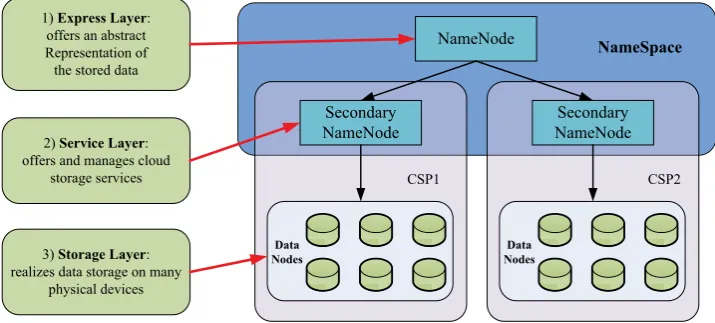
As an extension of name space in data clustering,18a representative architecture for data storage in hybrid clouds is illustrated as follows: this architecture is a hierarchical structure H on three layers to represent the relationship among all blocks for stored resources. Three layers can be described as follows:
• First-Layer (Express Layer): offer an abstract representation of the stored resources;
• Second-Layer (Service Layer):immediately offer and manage cloud storage services; and
• Third-Layer (Storage Layer):practicably realize data storage on many phys-ical devices.
This kind of architecture is a nature representation of file storage. We utilize this simple hierarchy to organize multiple CSP services, including private clouds or public clouds. In practical applications, this architecture can be constructed into a virtualization infrastructure of cloud-based storage service. In Fig. 5, we show an example of mapping three-layer structure into Hadoop distributed file system (HDFS),19 which is a distributed, scalable, and portable file system. HDFS’
architecture is composed of NameNode and DataNode, where NameNode maps a file name to a set of indexes of blocks and DataNode indeed stores data blocks. Obviously, the Express layer corresponds to the NameNode and the Service layer corresponds to secondary NameNode in each CSP. Finally, the Storage layer can be used to represent the structure of DataNode. Hence, based on this architecture, it becomes possible for the CPDP scheme to support actual storage systems. Also, it lays a foundation for replacing the common checksum algorithm with the CPDP scheme to implement the data integrity verification. It is worth pointing out that
Fig. 5. The three-layer hierarchical structure over name space and data nodes.
our architecture is adaptable for the other cloud storage systems, such as Google File System (GFS),20 Amazon S3 File System, and CloudStore.
Based on this hierarchical structure, we define a new index-hash table which is a data structure that uses a hash function to map data identifying values, known as indexes (e.g. file name, CSP server name, block number, and version number), to some fix-size (unique) feature values. These feature values, used in our CPDP construction, are generated by a collision-resistant hash function (also fixed-length compression function). LetH={Hk}be a family of hash functionsHk :{0,1}n→
{0,1}∗indexed byk∈ K, whereKis the key space. We have the following definition: Definition 4.2 (Collision-Resistant Hash). A hash family His (t, )-collision-resistant if no t-time adversary has advantage at least in breaking collision-resistance ofH, that is, for every probabilistic polynomial-time algorithmA,
Pr[A(k) = (m0, m1) :m0=m1, Hk(m0) =Hk(m1)]≥.
where the probability is over the random choices of k ∈ K and the random bits chosen inA.
Given a hash function Hk(·), we make use of this architecture to construct a Hash Index Hierarchy H, which is used to replace the common hash function in PDP scheme, as follows:
• Express layer: given s random {τi}s
i=1 and the file name F N, sets ξ(1) = HPs
i=1τi(“F N”) and makes it public for verification but makes{τi}si=1 secret;
• Service layer: given theξ(1)and the cloud nameCNk, setsξk(2)=Hξ(1)(“CNk”); • Storage layer: given the ξ(2), a block number i, and its index record χ
i =
“BiViRi”, setsξ(3)i,k =H
ξk(2)(χi),
f whereB
iis the sequence number of block,Ri
is the version number of updates for this block, and Ri is a random integer to avoid collision.
To meet this change, the index table χ in the CPDP scheme needs to increase a new column Ci to record the serial number of CSP, that stores the ith block. By using this structure, it is obvious that our CPDP scheme can also support dynamic data operations.
The above structure can be readily adopted into MAC-based, ECC or RSA schemes.4,21 These schemes, built from collision-resistance signatures and the ran-dom oracle model, have the shortest query and response with public verifiability. They have some common characters to implement the CPDP framework in hybrid clouds: (i) the file is split inton×ssectors and each block (ssectors) corresponds to a tag, so that the storage of signature tags can be reduced with increase of s; (ii) the verifier can verify the integrity of file in random sampling approach, which is of utmost importance for large or huge files; (iii) these schemes rely on homo-morphic properties to aggregate the data and tags into a constant size response, which minimizes network communication; and (iv) the hierarchy structure provides a virtualization manner to conceal the storage details of multiple CSPs.
4.2. Outsourced data storage structure
In the storage layer, we define a common fragment structure that provides proba-bilistic verification of data integrity for outsourced storage. The fragment structure is a data structure that maintains a set of block-tag pairs, allowing searches, checks and updates in O(1) time. An instance for this structure which is used in this scheme is showed in the storage layer: an outsourced file F is split into n blocks {m1, m2, . . . , mn}, and each block mi is split intos sectors {mi,1, mi,2, . . . , mi,s}.
The fragment structure consists ofnblock-tag pair (mi, σi), whereσiis a signature tag of block mi generated by some owner’s secrets τ = (τ1, τ2, . . . , τs). The
multi-sector strategy is to improve the storage and verification efficiency. For example, for block length |mi| and signature length |σi|, the rate of signature-message is
|σi|
|mi|=
|σi|
s|mi,j| if each blockmiis split intossectors. It is obvious that assbecomes
larger, higher encoding efficiency (rate) is achieved for the storage, communication, and verification. In addition, the data owner can choose different secretsτ for each file from the security point of view, but we expect that our CPDP scheme is secure enough even if the data owner only relies on such a secretτ to sign all his/her files. Based on this fragment structure and hash index hierarchy, we propose a con-struction of CPDP scheme withKeyGen andT agGenalgorithms, as follows: • KeyGen(1κ): LetS = (p,G,GT, e) be a bilinear map group system with
ran-domly selected generators g, h ∈ G, where G,GT are two bilinear groups of a large prime orderp,|p|=O(κ). Makes a hash functionHk(·) public.
(a) For a CSP Pk ∈ P, chooses a random number δk ∈R Zp and computes
S=gδk∈G. Thus,sk
(b) For a cloud client (data owner), chooses two random numbers α, β ∈R Zp
and sets sku= (α, β) andpku= (g, h, H1=hα, H2=hβ).
• TagGen(sk, F,P):SplitsFinton×ssectors{mi,j}i∈[1,n],j∈[1,s]∈Znp×s. Chooses srandomτ1, . . . , τs∈Zp as the secret of this file and computesui=gτi∈Gfor i∈[1, s]. Constructs the index table χ={χi}n
i=1 and fills out the recordχig in χfori∈[1, n], then calculates the tag for each blockmi as
ξ(1) ←HPs
i=1τi(“F N”), ξ (2)
k ←Hξ(1)(“CNk”), ξi,k(3) ←H
ξ(2)k (χi), σi,k ←(ξ (3) i,k)α·
s
j=1 umj i,j
β ,
whereFn is the file name andCk is the CSP name ofPk ∈ P. And then stores
ψ = (u, ξ(1), χ) into TTP, and σk = {(mi, σi,j)}∀j=k to Pk ∈ P, where u =
(u1, . . . , us). Finally, the data owner saves the secretζ= (τ1, . . . , τs).
Note that, each cloud service provider Pk in hybrid cloud is assigned a public– private key pair (pkk, skk) for anyPk∈ Pin order to achieve identity authentication and secure communication.
In order to check data integrity, the fragment structure implements proba-bilistic verification, as follows: given a random chosen challenge (or query) Q = {(i, vi)}i∈RI, where I is a subset of the block indices and vi is a random coef-ficient. There exists an efficient algorithm to produce a constant-size response (µ1, µ2, . . . , µs, σ), where µi comes from all {mk,i, vk}k∈I and σ is from all
{σk, vk}k∈I. This kind of probabilistic verification property will bring convenience to the development of our CPDP verification protocol.
4.3. Collaborative provable data possession
According to the above-mentioned architecture, four different network entities can be identified as follows: the verifier (V), the trusted third party (TTP), the organizer (O), and some cloud service providers (CSPs) in a hybrid cloud P ={Pi}i∈[1,c].
The organizer is an entity that directly contacts with the verifier. Moreover, it can initiate and organize the verification process.Often, the organizer is an independent server or a certain CSP in P. In our scheme, the verification is performed by a five-move interactive proof protocol showed in Fig.6: (i) the organizer initiates the protocol and sends a commitment to the verifier; (ii) the verifier returns a challenge set of random index-coefficient pairs Qto the organizer; (iii) the organizer relays them into eachPi inPaccording to the exact position of each data block; (iv) each gForχ
i= “Bi, Vi, Ri” in Sec.4.1, we can setχi= (Bi=i, Vi= 1, Ri∈R{0,1}∗) at initial stage of CPDP scheme.
Fig. 6. The flowchart of verification process in our CPDP scheme.
Pireturns its response of challenge to the organizer; (v) the organizer synthesizes a final response from these responses and sends it to the verifier. The above process would guarantee that the verifier accesses files without knowing on which CSPs or in what geographical locations their files reside.
We describe the details of verification protocol as follows:
• Proof(P, V): Let O be an organizer in hybrid cloud P ={Pi}i∈[1,c]. This is a
five-move protocol between Provers (P) and Verifier (V) with the common input (pk, ψ), which is stored in TTP. The protocol can be described as:
(a) Commitment(O → V):O chooses a random γ ∈ Zp and generatesH1 = H1γ,H2 =H2γ, sendsc= (H1, H2) toV;
(b) Challenge1(O ← V): V chooses a set of challenge index coefficient pairs
Q={(i, vi)}i∈I and sendsQtoO;
(c) Challenge2(P ←O):O forwardsQk={(i, vi)}mi∈Pk∈Qalong to eachPk
inP;
(d) Response1(P →O):Pk chooses a randomrk ∈Zpandsrandomλj,k∈Zp
forj∈[1, s], and calculates the response
σk ←Srk k ·
(i,vi)∈Qk σvi
i,k ∈G,
µj,k←λj,k+
(i,vi)∈Qk
vi·mi,j∈Z, πj,k←uλjj,k ∈G,
whereµk ={µj,k}j∈[1,s] and πk ={πj,k}j∈[1,s]. Let Rk ←grk ∈G, eachPk
(e) Response2(O→V): After receiving all responses from{Pi}i∈[1,c],O
aggre-gates {θk}Pk∈P into a commonθas
σ ←
Pk∈P
σk ·R−δk k
γ
, µj ←
Pk∈P
µj,k, πj←
Pk∈P πj,k.
Letµ ={µj}j∈[1,s] andπ={πi}i∈[1,s].O sendsθ= (π, σ, µ) to V.
Verification:Finally, the verifierV can check that the response was correctly formed by checking that
e(σ, h) =e
(i,vi)∈Q H
ξ(2)k (χi) vi, H
1
·e
s
j=1 uµ
j j ·πj
−1 , H2
.
Remark. Regardless of the length of verified files, the verifier executes the ver-ification protocol with fix-length communication overheads (c, Q, θ) and constant computational overheads (just the last equation). Therefore, almost all computa-tional tasks are completed by the organizer and the CSPs.
4.4. Homomorphic verifiable response for collaborative PDP
In this subsection, we describe the correctness of our proposed scheme based on mathematic homomorphism. A homomorphism is a map f : P→ Qbetween two groups such thatf(g1⊕g2) =f(g1)⊗f(g2) for allg1, g2∈P, where⊕denotes the
operation inPand⊗denotes the operation inQ.
This notation has been used to define Homomorphic Verifiable Tags (HVTs)4:
Definition 4.3 (Homomorphic Verifiable Tags). Given two valuesσi andσj
for two messagemiandmj, anyone can combine them into a valueσcorresponding to the sum of the messagemi+mj.
In our construction, this kind of homomorphism property is converted into more complex form because each blockmi is split intossectors. That is, the sum of the messagemi+mjis replaced intose=1τe(mi,e+mj,e), wheremk={mk,1, . . . , mk,s}
andτ1, . . . , τsare some unknown secrets. Therefore, given the definition of signature σi,k = (ξi,k(3))α·(s
j=1u mi,j j )β = (ξ
(3) i,k)α·(g
Ps
j=1τjmi,j)β, the block’s signature has
the homomorphism property, that is,
σi,k·σj,k = (ξi,k(3)·ξj,k(3))α· s
e=1
umi,e+mj,e e
β
Similarly, for a certain CSPPk, all block’s signatures{σi,k} can be aggregated into a signature by using the equation
σk=Srk k ·
(i,vi)∈Qk σvi
i,k =S rk k ·
(i,vi)∈Qk ξi,k(3)vi
α
·(g
Ps
e=1τe·P(i,vi)∈Qkmi,evi)β.
When provable data possession is considered as a challenge–response proto-col, we extend this notation to the concept of a homomorphic verifiable responses (HVRs), which is used to integrate multiple responses from the different CSPs in collaborative PDP scheme as follows:
Definition 4.4 (Homomorphic Verifiable Responses). A response is called HVRs in PDP protocol, if given two responses θi and θj for two challenges Qi
andQj from two CSPs, there exists an efficient algorithm to combine them into a responseθcorresponding to the sum of the challengesQiQj.
Homomorphic verifiable response is the key technique of collaborative PDP because it not only reduces the communication bandwidth, but also conceals the location of outsourced data in hybrid clouds. As we follow a similar method in the previous analysis, the responses (also considered as signatures), obtained from different CSPs, can be further aggregated into a response in terms of
σ =
Pk∈P σk Rδk
k
γ
=
Pk∈P Srk
k ·
(i,vi)∈Qkσ vi i,k Rδk
k
γ
=
Pk∈P
(i,vi)∈Qk σvi
i,k
γ
=
(i,vi)∈Q σvi·γ
i ,
where,Srk
k =gδk·rk=Rδkk. Similarly, forj∈[1, s], the file blocks are also aggregated
into svalues{µ1, . . . , µs}, in which each valueµj can be defined as
µj =
Pk∈P
µj,k=
Pk∈P
λj,k+
(i,vi)∈Qk
vi·mi,j
=
Pk∈P
λj,k+
Pk∈P
(i,vi)∈Qk
vi·mi,j
=λj+
(i,vi)∈Q
vi·mi,j,
whereλjis an unknown secret value for the verifier, and all values{λ1, . . . , λs}are
aggregated into a commitment by using the equation
πj =
Pk∈P
πj,k=
Pk∈P
uλjj,k =u
P
Pk∈Pλj,k
j =u
λj j .
Finally, according to the above-mentioned responses, the final verification equa-tion can be elaborated as follows:
e(σ, h) =e
(i,vi)∈Q
(ξi(3))vi, h
γ·α
·e(g, h)γ·β P
(i,vi)∈QPsj=1τj·vi·mi,j
=e
(i,vi)∈Q
(ξi(3))vi, hα·γ
·e
s
j=1 uγ·
P
(i,vi)∈Qvi·mi,j
j , hβ
=e
(i,vi)∈Q
(ξi(3))vi, hα·γ
·s
j=1 e(uµ
j−λj
j , hβ)
=e
(i,vi)∈Q H
ξ(2)k (χi) vi, H
1
·e
s
j=1 uµ
j j ·πj
−1 , H2
.
This equation means that our CPDP scheme is an efficient interactive proof system.
5. Security and Performance Analysis
In this section, we first give a brief security analysis of our CPDP construction. This analysis is directly derived from security requirements of multi-prover zero-knowledge proof system (MP-ZKPS). Next, we analyze the performance of CPDP scheme from the efficiency point of view of probabilistic verification. Finally, to validate the effectiveness of our scheme, we introduce a prototype of CPDP-based audit system and present experimental results.
5.1. Security analysis for CPDP scheme
The collaborate integrity verification for distrusted outsourced data, in essence, is a multi-prover interactive proof system (IPS), so that the correspondence con-struction should satisfy the security requirements of IPS. Moreover, in order to ensure the security of verified data, this kind of construction is also a multi-prover zero-knowledge proof (MP-ZKP) system,7,15 which can be considered as an exten-sion of the notion of an IPS. Roughly speaking, the scenario of MPZKP is that a polynomial-time bounded verifier interacts with several provers whose computa-tional power is unlimited. Given an assertionL, such a system satisfies following three properties: (i) Completeness: wheneverx ∈L, there exists a strategy for provers that convinces the verifier that this is the case; (ii)Soundness:whenever
x∈L, whatever strategy the provers employ, they will not convince the verifier that
x∈L; (iii)Zero-knowledge:no cheating verifier can learn anything other than the veracity of the statement. Since this construction is directly derived from MPZKP model, the soundness and zero-knowledge properties can protect our construction
from various attacks as follows:
• Security for tag forging attack:The soundness means that it is infeasible to fool the verifier into accepting false statements. It is also regarded as a stricter notion of unforgeability for the file tags. To be exact, soundness is defined as fol-lows: for every “invalid” tagσ∗∈T agGen(sk, F), there does exist an interactive machineP∗which can pass verification with any verifierV∗with noticeable prob-ability. In order to prove the non-existence of P∗, to the contrary, we can make use of P∗ to construct a knowledge extractorM, which gets the common input (pk, ψ) and rewindable black-box access toP∗and attempts to break the compu-tation Diffie–Hellman (CDH) assumption inG: givenG, G1=Ga, G2=Gb ∈RG,
outputGab∈G. This means that the prover cannot forge the file tags or tamper with the data if soundness property holds.
• Security for data leakage attack:In order to protect the confidentiality of the checked data, we are more concerned about the leakage of private information in the verification process. In Sec.2.4, we have shown that data blocks and their tags could be obtained by the verifier in some existing schemes. To solve this problem, we introduce zero-knowledge property into our construction. First, randomness is adopted into the CSP’s response in order to resist Attack 2 and 4 in Appendixes A and B, i.e. the random integerλj,k is adopted into the responseµj,k, i.e.µj,k =
λj,k+(i,v
i)∈Qkvi·mi,j. This means that the cheating verifier cannot obtain mi,j from µj,k because he does not know the random integerλj,k. At the same time, a random integerγ is also introduced to randomize the verification tagσ, i.e.σ ←(P
k∈Pσk·R−ks)γ. Thus, the tagσcannot reveal to the cheating verifier
in terms of randomness.
Based on this idea, we need to prove the following theorem according to the formal definition of zero-knowledge, in which every cheating verifier has some sim-ulator that, given only the statement to be proven (and no access to the prover), can produce a transcript that “looks like” an interaction between the honest prover and the cheating verifier. Actually, zero-knowledge is a property that cap-tures (private or public) CSP’s robustness against attempts to gain knowledge by interacting with it. For our construction, we make use of the zero-knowledge property to guarantee the security of data blocks and signature tags.
5.2. Performance analysis of probabilistic verification
In our construction, the integrity verification achieves the detection of CSP servers misbehavior in a random sampling mode (called probabilistic verification) in order to reduce the workload on the server. In the probabilistic verification of common PDP scheme (which involves one CSP), the detection probability P of disrupted blocks is an important parameter to guarantee that these blocks can be detected in time. Assume the CSP modifieseblocks out of then-block file. The probability of disrupted blocks isρb= ne. Lettbe the number of queried blocks for a challenge
in the verification protocol. We have detection probability
P(ρb, t) = 1−
n−e n
t
= 1−(1−ρb)t.
Hence, the number of queried blocks ist= log(1log(1−−ρP)
b) ≈ Pe·n for a sufficiently large n.hThis means that the number of queried blockstis directly proportional to the
total number of file blocksnfor the constantP ande.
For a PDP scheme withfragment structure, given a file withsz=n·s sectors and the probabilityρof sector corruption, the detection probability of verification protocol hasP ≥1−(1−ρ)sz·ω, where ω denotes the sampling probability in the verification protocol. We can obtain this result as follows: becauseρb≥1−(1−ρ)s
is the probability of block corruption withssectors in common PDP scheme, the verifier can detect block errors with probabilityP ≥1−(1−ρb)t≥1−((1−ρ)s)n·ω=
1−(1−ρ)sz·ω for a challenge witht=n·ω index-coefficient pairs.
Next, we extend the one-CSP PDP scheme into multi-CSPs CPDP scheme as follows: given a file withsz=n·ssectors andωdenotes the sampling probability in the verification protocol. For a hybrid cloudP, the detection probability of CPDP scheme has
P(sz,{ρk, rk}Pk∈P, ω)≥1−
Pk∈P
((1−ρk)s)n·rk·ω
= 1−
Pk∈P
(1−ρk)sz·rk·ω,
where rk denotes the proportion of data blocks in the kth CSP, ρk denotes the probability of file corruption in thekth CSP, andrk·ωdenotes the possible number of blocks queried by the verifier in thekth CSP. Furthermore, we observe the ratio of queried blocks in the total file blocksw under different detection probabilities. Based on above analysis, it is easy to find that this ratio holds the equation
w= log(1−P)
sz·P
k∈Prk·log(1−ρk) .
However, the estimation ofwis not an accurate measurement.
In most cases, we adopt the probability of disrupted blocks to describe the possibility of data loss, damage, forgery or unauthorized changes. When this prob-abilityρb is a constant probability, the verifier can detect severe misbehavior with a certain probabilityP by asking proof for a constant amount of blocks for PDP or
t= log(1−P)
s·PPk∈Prk·log(1−ρk)for CPDP, independently of the total number of file blocks. 4
5.3. CPDP for integrity audit services
We apply our collaborative PDP scheme to construct an audit system architecture for outsourced data in hybrid clouds by replacing TTP with a third party auditor hIn terms of (1− e
(TPA) as shown in Fig. 3. In this architecture, data owners and granted clients need to dynamically interact with CSP to access or update their data for various application purposes. However, we neither assume that CSP is trusted to guarantee the security of stored data, nor assume that data owners have the ability to collect the evidence of the CSP’s fault after errors have been found. Hence TPA, as a trust third party (TTP), is used to ensure the storage security of outsourced data. We assume the TPA is reliable and independent, and thus has no incentive to collude with either CSPs or users during the auditing process.
• TPA should be able to make regular checks on the integrity and availability of these delegated data at appropriate intervals;
• TPA should be able to organize, manage, and maintain the outsourced data instead of data owners, and support dynamic data operations for the granted user;
• TPA should be able to take the evidences for the disputes about the inconsistency of data in terms of authentic records for all data operations.
To enable privacy-preserving public auditing for cloud data storage under this architecture, our protocol design should achieve following security and performance guarantee:
• Public auditability: to allow TPA (or the other clients with help of TPA) to verify the correctness of the cloud data on demand without retrieving a copy of the whole data or introducing additional online burden to cloud users;
• Verification correctness:to ensure there exists no cheating CSP that can pass the audit from TPA without indeed storing users’ data intact;
• Verification transparency: to enable TPA with secure and efficient auditing capability to cope with auditing delegations from possibly large number of dif-ferent CSPs simultaneously;
• Privacy-preserving:to ensure that there exists no way for TPA to derive users’ data from the information collected during the auditing process; and
• Lightweight:to allow TPA to perform auditing with minimum storage, commu-nication and computation overhead, and to support batch auditing with a long enough period.
To validate the effectiveness and efficiency of our proposed approach, we have implemented a prototype of an audit system based on our proposed solution. We simulate the audit service and the storage service by using two local IBM servers with two Intel Core 2 processors at 2.16 GHz and 500M RAM running Windows Server 2003. These servers were connected via 250 MB/s of network bandwidth. Our audit scheme was also deployed in these servers. Using GMP and PBC libraries, we have implemented a cryptographic library upon which our scheme can be con-structed. This C library contains approximately 5200 lines of codes and has been
Fig. 7. An example of hash index hierarchy in Hadoop distributed file system (HDFS).
tested on Windows and Linux platforms. The elliptic curve utilized in the experi-ment is a MNT curve, with base field size of 160 bits and the embedding degree 6. The security level is chosen to be 80 bit, which means|p|= 160.
More importantly, we incorporated this prototype on CPDP scheme into a virtu-alization infrastructure of cloud-based storage service.2In Fig.7, we show an exam-ple of Hadoop distributed file system (HDFS),i which a distributed, scalable, and
portable file system.19 HDFS’ architecture is composed of NameNode and DataN-ode, where NameNode maps a file name to a set of indexes of blocks and DataNode indeed stores data blocks. To support the CPDP, the index-hash table and the metadata of NameNode should be integrated together to provide an enquiry ser-vice for the hash valueξ(3)i,k or index-hash recordχi. Based on the hash value, the clients can implement the verification protocol via CPDP services. Hence, it is easy to replace the checksum methods with the CPDP scheme for anomaly detection in current HDFS.
In our experiments, we maintained a simple global Index-Hash table to man-age the whole file in a hybrid cloud. The Index-Hash table is defined as follows:
χi= (BlkID: 16-bit, Pst: 20-bit, Property: 4-bit, Hash: 40-bit), where BlkID is used to store the order number of block, Pst is to store (CloudNo:4-bit, BlkNo:16-bit), Property is to store some property values each of which is denoted by one bit, and Hash is to store ξ(3)i,k which is computed from a collision-resistant hash function. When the length of each block is 5K Bytes, the radio of storage is 10/5K = 0.2%. For a 10 MB file, the storage of table is 20K Bytes. In our experiments we do not
iHadoop can enable applications to work with thousands of nodes and petabytes of data, and it has been adopted by currently mainstream cloud platforms from Apache, Google, Yahoo, Amazon, IBM and Sun.