ISSN: 2231-2307, Volume-4 Issue-4, September 2014
Model Reference Adaptive Controller using
MOPSO for a Non-Linear Boiler-Turbine
G. Suganya, L. Jenifer Amla, S. P. Dwarakesh
Abstract - Biologically inspired algorithms are attracting lot of researchers in recent decades. Particle swarm optimization is a recent algorithm based on the movement and intelligence of swarms. This paper proposes an application of Multi Objective Particle Swarm Optimization (MOPSO) for tuning the Model Reference Adaptive Controller (MRAC) for a non-linear Boiler-Turbine system. The Boiler-turbine system is a Multi Input Multi Output (MIMO) system which is non-linear in nature and hence MOPSO is used to obtain the solution. This paper proposes a new approach combining a priority based lexicography method and the overall error for tuning the parameters of swarm in order to get the best optimal solution. The model was developed using MATLAB simulink tool and the results were compared.
Keywords: Boiler-Turbine system, MOPSO, MRAC ,Overall error.
I. INTRODUCTION
The generator in thermal electric power plant generates power by rotation using high pressure steam produced by the Boiler-Turbine system. To maintain the balance in the electrical power, the pressure and water level in the drum of the Boiler-Turbine system needs to be controlled. The Boiler-Turbine system is modeled as a MIMO nonlinear system to design a controller [1]. To handle the severe non-linearity of the boiler-turbine system, several approaches were handled in the literature. Dynamic matrix control was applied to fossil power plant [2]. Hybrid controller uses conventional PID along with neural network to control the boiler[3]. Online self organizing fuzzy controllers are used for MIMO boiler-turbine system [4]. Robust control method was applied for a power plant [5]. Output tracking control was implemented to guarantee the robustness against the non-linear system [6]. LQR genetic algorithm is used to enhance the wide range performance of PI controller [7]. Extended version of dynamic matrix control was also applied to the boiler-turbine system [8][9]. The parameter of the boiler turbine system is tuned using MRAC [10]. Extended state observer is used to design the controller [11]. Handling the multi objective functions by use of MOPSO is illustrated [12]. In this paper, MOPSO-lexicography is applied with overall error for tuning the parameters of MRAC. The mathematical modeling of a non-linear boiler turbine system is used from ready reference [1] and the MOPSO is implemented. The remaining section of the paper is organized as follows. Section 2 depicts the model of the boiler turbine system.
Manuscript Received on September 2014.
Ms. G. Suganya, Asst. Prof., in the Department of EEE at Sri Ramakrishana Institute of Technology, Coimbatore, India.
Ms. L. Jenifer Amla, Asst. Prof., in the Department of EEE at Sri Ramakrishana Institute of Technology, Coimbatore, India.
Mr. S. P. Dwarakesh, Asst. Prof., in the Department of EEE at Erode Sengunthar Engineering College, Tamil Nadu, India.
Section 3 and section 4 discusses about the methodology and its related algorithms to optimize the multi-objective functions. Section 5 depicts the MRAC design for the boiler turbine system and section 6 consolidates the simulation and the synthesis results. The conclusions are drawn in section 7.
II. BOILER-TURBINE SYSTEM
The boiler-turbine unit is highly nonlinear, multivariable and strongly coupled complex system. The mathematical model of this work is one of the standard non-linear boiler-turbine models proposed by Bell and Astrom [1]. This is typical oil fired, drum type boiler. The specifications of the parameters of the standard model are listed in Table 1.
Table 1: Parameter Specifications of the Boiler-Turbine System
Parameter Specification
Rated Power 160MW
Drum steam Pressure 140 kg/cm2
Super heater steam
Temperature 535
₀ C
Volume of drum 40m3
Feed water Temperature 300₀C
The dynamics of the system introduced by Bell and Astrom is given as follows: ′
= −0.0018
/+ 0.9 − 0.15
′
= 0.73 − 0.16
−
/10
(1) ′= 141 − 1.1 − 0.19
/85
=
=
(2)= 0.05 0.13073 + 100
!"+
#$−
67.975
where the variables x1, x2, x3 denotes drum pressure (kg/cm2, electric output (MW) and fluid density (kg/m3) respectively [1]. The inputs
, and are the valve positions for fuel flow, steam control and feed water flow respectively. The output is the drum water level (m).
!" and qe are steam quality and evaporation rate (kg/s) respectively and are given by:
!"
1 − 0.001538x 0.8x − 25.6 /
x 1.03940.0012304x
(3)'
(= 0.85 − 0.147
+ 45.59 − 2.514
− 2.096
The model was based on the basic conservation laws and the parameters are estimated from the data measured from the Synvendska Kraft AB plant in Malmo, Sweden. Due to
the following constraints:
−0.007 ≥
*
*+ ≤ 0.007
−2 ≥
-./ -0≤ 0.02
(4)−0.05 ≥
-.1 -0≤ 0.05
III. MULTI OBJECTIVE PARTICLE SWARM
OPTIMIZATION
Particle Swarm Optimization (PSO) is a robust stochastic optimization technique based on the movement and intelligence of swarms. It applies the concept of social interaction to the problem solving. PSO is used for continuous nonlinear and discrete binary single-objective optimization functions. In single-objective optimization, the speed of convergence is higher for PSO compared to other algorithms. Due to this, PSO is particularly selected for solving multiple-objective functions [13]. The proposed technique uses PSO for optimizing MRAC. Multi objective functions are solved by PSO using different approaches.
A. Weighted Sum Approach
In weighted sum approach, multi objective functions are converted into a single objective function and PSO is applied. This approach mainly focuses on diversity maintenance by assigning the larger weight to particles which are relatively best [13]. The weighted sum for the particles pbest is calculated as follows:
∑
3454∑ 36 657
8
9
8:
; (5) where9
8 ; is jth fitness value of particle i. The smallest weighted sum personal best is updated in every iteration. Weighted sum approach was proposed for pbest selection and now it is used for gbest selection also.B. Lexicography Approach
In lexicography approach, different priorities are assigned for every objective function. Based on the priority, the objectives are optimized. The algorithm for solving MOPSO using lexicography approach for the proposed technique is as follows:
Step 1: Initialize swarm
Step 2: Evaluate the fitness of each particle of the swarm. Step 3: Select the minimum fitness value as the best global
fitness value. Step 4: Start the iteration
Step 5: For each particle, select the current global best solution
Step 6: Update the velocity and position Step 7: Mutation
Step 8: Find the global best fitness from the current global best and previous global best fitness values.
Step 9: Update the global best position.
Step10: Continue from step 5 until iteration count exceeds Step 11: Optimum solution = global best position
In this algorithm, the best local fitness values are selected randomly. Taking this as reference, remaining values are compared and the best solution is found. Mutation is done to avoid searching beyond the boundary values.
Pareto approaches are the best suited for finding non-dominated solution to optimization problems if the dimension is more than one. Non-dominated solution is the one which cannot be improved further with respect to one objective function, without decreasing its performance for other objective functions [13].
IV. PROPOSED TECHNIQUE
In the priority based Lexicography approach, the objective function with a highest priority is optimized first and the solution is substituted in the next priority objective function. This process continues till all the objective functions are optimized. This approach has a drawback of introducing more error for the lowest priority objective function. This leads to decay in system performance. So the proposed work combines the priority based lexicography approach with the overall error value for tuning the controller parameters. The algorithm for calculating the overall error value of the proposed work is as follows:
Step1: Find the fitness value for individual objective function. Let the fitness values are fitness1, fitness2 and fitness3 etc..
Step 2: Error value = fitness1*fitness2*fitness3…
Step 3: Overall error value = absolute of error value Considering the advantage of combining priority based lexicography method with overall error value the modified MOPSO algorithm was presented as follows:
Step 1: Initialize the swarm
Step 2: Evaluate the fitness of each particle of the swarm. Step 3: Select the minimum fitness value as the best global
fitness value. Step 4: Start the iteration
Step 5: For each particle, find the individual fitness value for every objective function and calculate the overall fitness which is error value.
Step 6: Select the current local best solution based on the priority and also the overall error value for each particle
Step 7: Select the current global best solution and the local best solution using same method
Step 8: Update the velocity and position Step 9: Mutation
Step 10: Find the global best fitness from the current global best and previous global best fitness values. Step 11: Update the global best position.
Step12: Continue from step 5 until iteration count exceeds Step 13: Optimum solution = global best position
V. MRAC DESIGN
In this modern world, most of the systems are non-linear. Several methods are available to control the non-linear systems among which the adaptive control method plays a vital role. In general control system, stability and characteristics of a system can be examined by the mathematical model. Mathematical modeling of nonlinear boiler turbine system is necessary because it uses the model reference adaptive controller. In the proposed technique, the reference model is designed and compared with the plant model. The convergence is reached when the error is minimum.
ISSN: 2231-2307, Volume-4 Issue-4, September 2014
A. Reference Model
The reference model gives the desired output for a set of specified input. In a boiler-turbine system, it is necessary to maintain the drum pressure at a constant value. The pressure increases linearly upto the threshold and then remains constant. So the system parameters remain at the same value upto the threshold (1). After saturation, parameters are defined by the user. At this condition:
<′
= 0
(5) Because of this, electrical output also reaches the constant value which is mathematically represented as:<′
= 0
(6) Same as above the steam fluid density after saturation is:<′
= 0
(7)Thus the mathematical model for reference model is designed using equations (1)-(3) and (5)-(7).
B. MRAC using MOPSO
The proposed block diagram of MRAC for Boiler-Turbine system is shown in Fig 1. The reference model gives the desired output which is the set point for the boiler turbine system and the plant model gives the actual output of the plant. The MRAC controls the plant output which needs continuous updation of controller parameters at every time instant. Two different approaches are conventionally used to update the controller parameters ie; gradient descent approach and Lyapunov’s direct approach. The existing approaches do not fully consider the presence of non-linearity in the system. So MOPSO is used to optimize the parameters of MRAC. Depending on the output and the error of the system, the specific parameters for the MRAC can be updated in the controller block. So the error minimizes and the plant reaches the desired set point.
Fig. 1: Proposed Block Diagram of MRAC
VI. SIMULATION RESULTS
Two different approaches are handled in the proposed technique to optimize the MRAC viz., lexicography based approach and the priority based lexicography approach combined with overall error. From the simulation results, it is observed that the proposed technique is the best suited to
this kind of non-linear problem compared to lexicography approach. The control system and process model are developed using MATLAB Simulink tool in a personal-computer environment. Sampling time for simulation is 0.5 s. The system is in steady state with initial conditions X = (87, 31,485), Y = (87, 31, 0), U = (0.5, 0.5, 0.5). Fig 2 shows the plot of Pressure vs. time for reference model and plant model with MRAC tuned using lexicographic approach and proposed approach. The result shows that, the proposed technique responds at a faster rate and the change in plant output error decreases even with an existence of nonlinearity. Fig 3 shows the plot of Electrical Output vs. time for reference model and plant model with proposed MRAC tuned using the two approaches. This algorithm decreases the error of electrical output compared to lexicographic method. The electrical output depends on the steam pressure so that the lower error in pressure results in the decrease of electrical output error. Fig 4 shows the plot of steam flow density vs. time for reference model and plant model with MRAC tuned using lexicographic approach and proposed approach.
Fig. 2: Boiler Pressure for Reference Model and Plant Model with MRAC Tuned by Lexicography and
Proposed Method
Fig. 3: Electrical Output for Reference Model and Plant Model with MRAC Tuned by Lexicography and
Proposed Method 350 400 450 500 550 600 650 68 70 72 74 76 78 80 82 84 86 88 90 time(seconds) P r e ss u r e (k g /c m 2 ) data1 proposed model lexicography 350 400 450 500 550 600 650 700 27 28 29 30 31 32 33 34 35 Time(seconds) E le c tr ic a l o u tp u t( M W ) lexicography approach proposed method reference model Error Reference Model Plant model Input U Controller
∑
Output Y Desired output Ym MOPSO Updating controller parameter+
- Controller input UcFig. 4: Steam Flow Density in Reference Model and Plant Model with MRAC Tuned by Lexicography and
Proposed Method
Fig. 5: Drum Water Level in Reference Model and Plant Model with MRAC
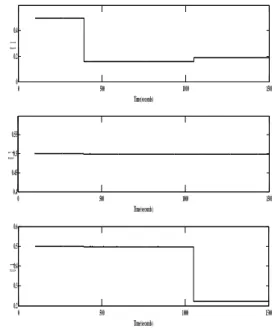
The drum water level of the boiler-turbine system reaches set point when the steam flow density reaches the set point. The inputs which are given to the plant for two approaches get desired outputs are shown in Fig 6 and Fig 7 respectively.
Fig. 6: Inputs given to the Plant to get Desired Set Point in Lexicographic Method
Fig. 7: Inputs given to the Plant to get Desired Set Point in Proposed Algorithm
VII. CONCLUSION
This paper proposed a design of MRAC using evolutionary computation technique PSO and its application in Boiler-Turbine system. In this proposed method, four objective functions are taken to obtain the controller parameters of the MRAC. They are updated based on the output conditions at present instance. The simulation results show that the proposed controller is suitable for the control of Boiler-Turbine system than the lexicographic algorithm based tuning. Results are validated using standard input output condition.
REFERENCES
[1] Bell R. D. and Astrom K. J. (1987), ‘Dynamic Models for Boiler-Turbine-Alternator Units: Data Logs and Parameter Estimation for a 160MW Unit’, Lund Institute of Technology, Sweden, Rep. TRFT-3192.
[2] Rovank J. A and Corlis R (1991), ‘Dynamic matrix based control of
fossile power plant’, IEEE transactions on Energy Conversion, Vol.6, pp.320-326.
[3] Behesti, M.T.H., Rezaee ,M.M. and Tarbiat Modarres (2002), ‘A New
Hybrid Boiler Master Controller’, IEEE proceedings on American control conference, Vol.3, pp. 2070 – 2075.
[4] Un-Chul Moon and Y.Lee (2003), ‘Boiler-Turbine System Control
Using a Fuzzy Auto-Regressive Moving Average (FARMA) Model’, IEEE transactions on Energy Conversion, Vol.18, Issue-1, pp.142-148.
[5] Ben-Abdennour A. and Lee K. Y (1996), ‘A decentralized controller
design for a power plant using robust local controllers and functional mapping’, IEEE transactions on Energy conversion, Vol. 11, pp. 394-400.
[6] Fang Fang, Jizhen Liu, Wen Tan (2004), ‘Output Tracking control of
a Nonlinear Boiler-Turbine Unit’, 43rd IEEE conference on Decision
and control, Vol.3, pp. 2615 – 2620.
[7] Dimeo R., Lee K Y. (1995), ‘Boiler-Turbine Control system Design Using a Genetic Algorithm’, IEEE transaction on Energy Conservation, 10, pp. 752-759
[8] Un-Chul Moon, Woo-Goon Kim,Seung-Chul Lee and Kwang Y.Lee
(2005), ‘Application of Dynamic Matrix Control to a Boiler-Turbine System’, IEEE transactions on Power Engineering Society General Meeting, Vol.2, pp. 1595 - 1600.
[9] Un-Chul Moon, seung-Chul Lee and Kwang Y.Lee (2007), ‘An
Adaptive Dynamic Matrix Control of a Boiler-Turbine System Using Fuzzy Inference’, 14th International conference on Intelligent system applications to Power systems(ISAP), pp.1-6.
960 980 1000 1020 1040 1060 1080 1100 1120 440 450 460 470 480 490 500 Time(seconds) st ea m d en si ty (k g /c m 3 ) lexicographic method propose method reference mode l 200 400 600 800 1000 1200 1400 -12 -10 -8 -6 -4 -2 0 Reference output Plant putput 0 500 1000 1500 0 0.2 0.4 U 1 0 500 1000 1500 0.2 0.4U2 0 500 1000 1500 0.2 0.4 0.6 Time(seconds) U 3 0 500 1000 1500 0 0.2 0.4 Time(seconds) U 1 0 500 1000 1500 0.4 0.45 0.5 0.55 Time(seconds) U 2 0 500 1000 1500 0.2 0.3 0.4 0.5 0.6 Time(seconds) U 3 Time(s) Y3 (m)
ISSN: 2231-2307, Volume-4 Issue-4, September 2014
[10] Toodeskhi.M.H,Askari.J (2008), ‘Model reference Adaptive Control
for a Nonlinear Boiler-Turbine System’, IEEE conference on
Industrial Technology(ICIT), pp.1 – 6.
[11] Khani.F, Yazdizadeh.A (2009), ‘Boiler –Turbine Unit Controller
Design Based on the Extended State Observer’, IEEE international conference on Control and Automation, pp.2066-2071.
[12] Nor Azlina Ab. Aziz, Ammar W. Mohemmed, Mohamad Yusoff
Alias and Kamarulzaman Ab. Aziz (2011), ‘Particle Swarm Optimization for Constrained and Multiobjective Problems:A Brief Review’, International Conference on Management and Artificial Intelligence, IPEDR vol.6.
[13] Carlos A. Coello Coello, Gregorio Toscano Pulido, and Maximino
Salazar Lechuga (2004), ‘Handling Multiple Objectives with Particle
Swarm Optimization’, IEEE transactions on Evolutionary
Computations, Vol. 8, No. 3.
[14] Pavan K. Vempaty, Ka C.Cheok, Robert N.K.Loh and Safa Hasan
(2007), ‘Model Reference Adaptive control of Biped Robot Actuators for Mimicking Human Gait’, Engineering Letters transaction, Vol.18, Issue-2.
[15] Cai Z., De Queiroz M S., Dawson D M. (2006), ‘Robust Adaptive Asymptotic Tracking of Nonlinear Systems with Additive Disturbace’, IEEE transactions On Automatic Control, Vol. 51, No. 3, pp.524-529.
[16] Chen W K. and Asok R. (2002), ‘Robust Wide-Range Control of
Steam-electric Power Plants’, IEEE transactions on Control Systems Technology, Vol. 10, pp. 735-742.
[17] Hsu L., Costa R R. and Lizarralde F., ‘Lyapunov/Passivity-based
adaptive Control of Relative degree Two MIMO Systems with an application to Visual Servoing’, in proceedings American Control Conference, PP. 2682-2687.,
[18] Karl J Astrom and Bjorn wittenmark(1995), ‘Adaptive Control’
published by Pearson Education, Inc and Dorling Kindersley publishing, Inc (Second Edition).
[19] Nagrath.I.J and Gopal.M ‘Control systems Engineering’ published by
New Age International Publishers (Fifth Edition).
[20] Thanomsat C.,Taft C W. and Annaswamy A M. (1998), ‘Level
Controlling Feed Water Heater Systems Using Nonlinear Strategies’, ISA transactions, 37, pp. 299-312.
Ms. G. Suganya, graduated in the year 2009 from Velalar College of Engineering and Technology, Erode and post graduated in the year 2012 from Kongu Engineering College, Perundurai. She is currently working as an Assistant Professor in the department of EEE at Sri Ramakrishana Institute of Technology, Coimbatore. Her interest includes in Control Systems, Instrumentation and Soft Computing Techniques.
Ms. L. Jenifer Amla, graduated in the year 2010 from Maharaja Institute of Technology, Coimbatore and post graduated in the year 2012 from Kumaraguru College of Technology, Coimbatore. She is currently working as an Assistant Professor in the department of EEE at Sri Ramakrishana Institute of Technology, Coimbatore. Her interest includes Power Electronics and Electrical Machines.
Mr. S. P. Dwarakesh, graduated in the year 2009 from Velalar College of Engineering and Technology, Erode and post graduated in the year 2011 from Sona College of Technology, Salem. He is currently working as an Assistant Professor in the department of EEE at Erode Sengunthar Engineering College from June 2013. His interest includes Power Systems and High Voltage Engineering.